

I've just done another piece about car park design for Samizdata, featuring a picture of this one.
I said in passing that, although old fashioned looking wrapping for a technologically modern object, railway terminus style, seemed in this case to have worked quite well, it would be nice if the outsides of some car parks were a bit more modern looking too.
Part of the problem is that we were all, I think, so very badly burned in the sixties and seventies, a time when "multi-story car park" was just another way of saying "the ultimate in hideousness". Brutalist concrete was pretty ghastly when used to make things like London's National Theatre, but when applied to car parks, it sank to a nadir of ghastliness. Anything, certainly including faked up classicism, is better than that.
Michael Jennings commented with an intriguing comparison between car parks and airport buildings:
Until about 15 years ago, airports were considered an architectural and design disaster area that nobody ever said a kind word about, but since then the very best architects have started designing terminals and they seem to be considered almost prestige projects. (The three that come immediately to mind are Norman Foster's terminal at Stansted here in London and his much bigger one at Chek Lap Kok airport in Hong Kong, and also Renzo Piano's Kansai airport terminal in Osaka. There has definitely been a transformation there, as a class of building seen as functional and inherently ugly is no longer necessarily seen that way.Car parks could go the same way. However, the advantage of airport terminals are that they are very big, and lots of people see them. Car parks are inherently much smaller, and as a consequence it is going to be hard to get decent architects interested in them, except as part of a larger project.
I also mentioned that in earlier times, designers were in the habit of dressing high tech buildings, such as water pumping stations, in old-fashioned garb. In that connetion, Gawain, of this fame (don't ask me what it is but it looks pretty), also offered Samizdata readers this link.
KILLJOY UPDATE from Patrick Crozier:
But wouldn't it be better if you couldn't see them at all? One of the things that struck me about many central Tokyo stations is that you can't see them from outside - they are encased in modern, multi-storey buildings. The station is there somewhere in the middle. Why not the same for car parks?Come to think of it, isn't that the whole point of underground car parks?
Ultimately, cars are a mess. Far better (for the sake of aesthetics) to hide them away somewhere.
This is surrender, a counsel of despair. I still say it, car parks could look fantastic. Individual cars look great, often. Why can't clutches of them be made to look great as well?
I've been busy today here already, and don't have much more time for culture blogging, so I will merely note the existence of a Stephen Pollard rant against arts festivals.
Stephen Pollard is too grand a personage to sort out his linking system to the point where it is not an incomprehensible piece of shit. I suspect the blog-ignorant designer of this other piece of shit that is to say pseudo-bloggery which the blogosphere pays even less attention to than it does to Pollard despite it being on an interesting subject to be the progenitor of the Pollard mess. I have had what passes for Pollard's linking system explained to me once before to the point where I made it work properly, but decent linking systems don't have to be explained – they work automatically. There's a a date, or maybe the word "permalink", and that's where the link is. Left click. Copy. Easy. This must be costing Pollard a Niagara of blog traffic. Damn this. I had written most of this piece before I remembered that linking to Pollard is a hideous recipe for grief. Memo to self: Ignore Pollard.
This piece about Festivals was first published in the Times, which is also deeply link unfriendly, so that's no good. So I suggest you either follow the primitive link above to the top of the Pollard blog and then scroll down until you get to the July 30th piece with "Festivals" at the beginning of the title, or else save yourself the bother and just take my word for it from the following quite long quotes:
Kevin Costner might have become a hero to a generation for believing in Field of Dreams that “if you build it, they will come”, but he was using his own money. The lesson of lottery funding is “if the arts establishment decides to build it, they won’t come”. The Life Force Centre, built beside Bradford Cathedral at a cost £5 million, closed in 2001 after seven months. It was projected to attract 40,000 people a year; in its first week it had 62 paying visitors. The Centre for Visual Arts in Cardiff was forecast to have 220,000 visitors in its first year. It managed 47,500 and closed in November 2001, after costing £9 million to build. The £15-million National Centre for Popular Music in Sheffield closed after 16 months in 2000. It was supposed to attract 400,000 people a year. Fewer than 90,000 went through its doors.The annual summer festival season highlights the perversion of the original idea of festivals. The first recorded “festival” was the Workington Festival in Cumberland in 1869, which comprised a band and a choir. During the First World War, evacuees who were at school for only half a day were offered lessons in dance, poetry, painting and music in their spare time, and festivals were created for them to show off their new skills. Today, almost all trace of that genuine community purpose has disappeared and they are merely a further example of the arts establishment spending other people’s money on its own minority tastes.
The trouble with the Pollard approach is that, being so concentrated on all the various enterprises he opposes and wishes the ground to swallow up, it is too easily dismissable as being anti-art.
I note in particular that many of the enterprises Pollard complains about seem to have Asian names, so critics will probably insinuate, and possibly say outright, that the man is a racist.
So let me try to make that same point somewhat differently, that lots of Asian artistic activity, and "diverse" artsism generally, is state funded: I'm in favour of diversity in art, including and especially ethnic and cultural diversity, and that's why I want the state to stop funding it. Arts subsidies are bad for art.
On the other hand, and to make the point that he personally does like art, Pollard cunningly ends his piece – you can tell about the order in which the relevant reading and writing was done here, can't you? – thus:
I’m one of that guilty minority who has his pleasure paid for by other people. So yes, I benefit from all this largesse. But every time I set foot inside one of these institutions, with their self-perpetuating bureaucracies, their now mandatory “outreach” programmes (obfuscatory attempts to show how “relevant” they are), and their oh-so-desperate attempts to be “accessible” (a bizarre aim, since the only people who want access to a minority pursuit are the minority who want access to it), I know that I am taking part in a giant scam, in which a cultural elite extorts money from the rest of society so it can better indulge itself.It’s time the rest of you pulled the rug from underneath my feet.
That would be a diversely designed rug of hideously pseudo-Asian design cunning enough to fool the bureaucrats involved but not at all cunning from an artistic point of view, made possible by a grant from the Rug Diversity Council, and a source of loathing to all the best Asian rug designers, who make a perfectly decent living by being funded by their customers.
That's enough for today. Calm down Brian. Take a few deep breaths and pick up the threads of what passes for your life.
Inspired by Jim of Jim's Journal's comment (on the subject of the movie Pushing Tin) on the posting immediately below, I have just done a piece for Transport Blog about transport based movies generally.
Jim, any chance you could be persuaded to go over there and elaborate on what your brother-in-law said about air traffic control?
Also, as another consequence of this to-ing and fro-ing, I read Jim's latest journal entry, and posted and commented upon a relevant bit of it here.
The other night I watching a rather silly movie called Pushing Tin, which is about insanely neurotic air traffic controllers – in other words the exact sort you do not ever want to be controlled by. As I say, rather silly, even if the background facts it all sprang from so insanely may have been accurate, for all I know. Anyway, my point here is that the very first shots of the movie, and the very last shot of all, right where it said The End, all had New York's now famously absent Twin Towers in them.
Like – I'm guessing – literally millions of others, every time I have watched a movie since 9/11, I have kept a special eye out for those towers, and it is astonishing – truly astonishing – how often they appear in movies. In Woody Allen's Manhattan, they even appeared in the title graphics, as the two ts of Manhattan.
American movies being American movies, any "symbolism" involved in such shots as these is kept at arms length. It's there for the movie buffs, but no character ever steps forward to explain it. That sort of self-consciously artistic art is not allowed in the American art of popular movie making. Nevertheless, those Twin Towers definitely meant a lot, to a lot of people.
If there had only been one Tower, as I seem to recall there once was before the second one got built, I seriously doubt if it would have been missed that much. It was the way there were two of them that really got to people, and made everyone miss them so. (Question: what would have been the reaction if only one of the towers had got knocked down?)
Often the Twin Towers appear for the simple reason that when they existed, they were the most striking feature of the New York skyline. They didn't symbolise anything. They were just there, along with the rest of the city.
But on other occasions, it seems to me, the Twin Towers were used in movies to evoke and to symbolise and echo that most elemental of human experiences, the partnership. As I say, I can't quote you chapter and verse where someone actually says this, but that's how it looks to me.
Usually, that partnership is the one that dominates movies (and especially the kind of soppy chick flick movies I generally like best), the partnership between a man and a woman. But I don't think that what makes the Twin Towers such an appealing representation of human partnership is to do with sex, or romance, or not in the superficial sense of those notions. The Twin Towers were not about sex, or about romantic dinners for two. I think what was appealing about the Twin Towers was their absolute and uncompromising equality.
Underneath all truly effective partnerships, sexual, romantic or any other kind, there lurks absolute equality. Sexually you may be different. What you each do during the day may be different. But a true partnership is a partnership of equals. And those two towers were absolutely equal.
This was emphasised by the extreme blandness of the shape of each tower. The Twin Towers spoken to the inner essence of the human experience, rather than to its outside idiosyncrasies. This is what souls look like on Judgement Day. Faceless.
Take those other Twin Towers, the Petronas Towers in Kuala Lumpur. They are equal as well, but they is so much else going on with them, and above all so much in the way of surface decoration, that they don't have anything like the same universality or innerness – not to me. Also, they are holding hands in a somewhat co-dependent way, which for me slightly spoils the universality of the partnership symbolism. The Twin Towers stood entirely separate, structurally. Each was utterly self-supporting. Yet there were both were together, manifestly sharing life together. Perfect Partners.
Stay with me.
There is also something rather faceless about the most successful film stars. Often their faces are nothing remarkable, and the most characteristic thing that the most successful film stars often do with their faces is: nothing. They simply present them, blankly, "facelessly", and onto that blank the audience projects its own concerns and interpretations.
Modern architecture. Faceless. Modern movie acting. Also "faceless".
Old time acting (British theatrical acting): full of frills and gestures, to get its message across to the folks in the top row at the theatre.
New style movie acting (American): no frills. The face is so huge that it doesn't have to do anything. It can just be there. It communicates effortlessly, by erecting a blank slate upon which the audience scribbles its emotions.
Old time architecture: … New style architecture: …
The idea that the facelessness of big modern architecture might actually be a major part of its appeal is not one that I have ever spelt out to myself in so many words, yet I do believe that it is so.
I'd never thought of this stuff quite like this before, and I'm sure I'm not the first. But interesting, I think.
Gramophone is cleverer at finding stuff in The Times than I am, because they found (their report - in their September (I know: ?!?!) 2003 issue - is paper only, so far as I know, so the link is just to the general Gramophone website) this:
Renowned French pianist François-René Duchable reportedly plans to end his concert career this summer by destroying two grand pianos and his recital clothes. According to The Times newspaper, he will then set off around France on a bicycle with a keyboard on his back giving impromptu performances.Duchable revealed his plans in an interview with the French Catholic newspaper La Croix, in which he attacked the piano as a symbol of bourgeois society, said the recital format was too restrictive and criticised the musical system for its 6litist approach. 'I have had enough of sacrificing my life for one per cent of the population,' he said. In the first of three farewell concerts he plans to send a grand piano crashing into Lake Mercantour, in the second he will set his suit on fire and in the third he plans to make his piano explode in mid-air.
Duchable said he wants to be 'more honest with my own artistic requirements. 1 could give concerts with a commentary and perhaps participate in off-beat festivals, for example, 1 could play on water. 1 could play for children, the ill and for prisoners, without ostentation.'
"Without ostentation." Ah, but that's cruel.
On a more serious note, I actually sympathise with this guy. I mean, you sign up for what you are told all through your childhood is a pinnacle profession, the purest of the pure and the best of the best, and it slowly dawns on you that you are just this peripatetic museum curator, and the people in the audience are just sitting there thinking that their CDs of the piece are better. I can see how that might unhinge you. I can see how that might make you want to blow up pianos and set fire to your clothes.
I have a CD of Duchable, playing Beethoven piano sonatas. It's pretty good. He wasn't such a bad museum curator. But (and this is all part of what he's saying) he won't really be missed.
Duchable is dead wrong about bourgeois society, though. Bourgeois society is good. And he is as typical a bourgeois as you could hope to meet, trying to make something interesting of his life, instead of just plodding along doing whatever boring thing he was brought up to do.
If he plays his cards right, he could end up with a greatly enhanced career, and a really big house. A chateau, as they call it over there.
Today there was a totally irrelevant comment, attached by some woman whose husband done her wrong, to this samizdata piece of mine, which was about the last US superbowl football match, which was won by the underdog Tampa Bay Buccaneers. (Samizdata writers get get email notification of all comments on their stuff, however daft the comments may be.) This caused me to re-read what I'd said about the Superbowl, and I also read the comments.
And, I came across a comment of my own on the subject of the singing of Celine Dion. Most of the comments were about sport, so this comment is never going to get rescued and shown to posterity if I don't do the disinterring myself. Here it is:
Yes, the Celine Dion thing is interesting. Normally I can't stand the way this woman sings. I think what I hate is that she performs every damn song she ever sings, invariably about her troubled relationships with her boy friends, as if she was singing God Bless America in a huge and packed football stadium, and what sane woman would do a thing like that? But this time she was singing God Bless America in a huge and packed football stadium.
I really like that, though I say so myself, which I did.
James Lileks has a lovely description today in his Bleat, about watching the movie Devil in a Blue Dress, which is particular good about the particular joy of watching the thing on a computer, and being able to freeze frame, and internet search for the details of a movie that was shown being shown, in the original movie. Lileks describes all that better, so read him.
What all this also points up, it now occurs to me, is that watching a movie on your own is also a different experience again. If you are watching on your own, you can decide two minutes in that you don't want to watch it after all. You can freeze frame to take incoming phone calls, you can freeze frame if the ball game playing silently on your TV (the DVD being on your computer screen) suddenly springs to life with a big home run, or in my case a wicket or a burst of dramatic slogging. You can just freeze it, and make yourself a cup of coffee.
Now that DVD players and TVs are so very cheap, more and more people are presumably watching movies on their own.
Which leads on to another point, which is that if you watch a movie on your own you don’t have to justify your choice to anyone. You can watch porn, or old Scharzeneggers. I can watch soppy High School Romances or Fred-and-Gingers or tapes of recent England rugby triumphs – while also doing something like blogging – and if other people think that's daft or tasteless or ridiculous, fine, they can watch something else and simultaneously do something else. Unlike me, Lileks is a family man, but he also likes his time alone to watch his preferred stuff.
Personally I value this aspect of home viewing far more than I value a million dollars worth of high techery to do the sound and fury of Terminator 5 at the cinema, or for that matter the equivalent kit for five hundred quid for all the family to watch at home, when that also arrives, which it may already have done for all I know or care. My "home cinema" is plenty big enough for short-sighted little me, given than it is only twenty inches away from my eyes.
Narrowcasting, I think they call this.
Michael Blowhard links to this New York Times piece about the inexorable rise of what it will eventually make sense to call home cinema.
Movies routinely make more money (sometimes twice as much) on video than in theaters: "8 Mile," starring the rapper Eminem, earned $117 million at the box office and $130 million on DVD and cassette; "Drumline" $56.4 million and $84.7 million, respectively; "Barbershop" $76 million and $102 million; "One Hour Photo" $31.6 million and $72.6 million.
(Given how bad I am at numbers, god bless copy and paste to enable me to serve up these without pain.)
I'm a bit surprised that there hasn't been more said about the influence of the home video market on the content of movies.
The big change for me is that you can now watch movies again and again, and that changes the experience, especially if, like me, you often have trouble getting all the subtleties of a plot the first time around. My enjoyment of A Few Good Men, a classic old-fashioned but quite complicated courtroom, would have been be nothing compared to what it has been, if I'd only been able to watch it just the once.
Maybe video tapes have masked the effect. They are so clunky that they were only ever going to be a stopgap until something adequate and silvery and shiny came along, but their effect has perhaps been to disguise any major impact that the punters actually owning movies might have on the movie-making business. It happened too gradually to be obvious. I'm sure the movie-makers themselves have noticed all kinds of differences, obvious and not so obvious.
But what have been the consequences of home video?
Well, I don't know. That's why I'm asking.
But here's a speculation about what might be in the pipeline, which is movies that make virtually no sense until you've pretty much memorised them, and are massively denser and more information packed than your average movie is now. I personally have to struggle to stay awake through the movies of Peter Greenaway. Only the music amuses me. But I've an idea that his movies – I'm thinking especially of one called Prospero's Books (which is an adaptation of The Tempest, I believe – yes) – fill this particular bill.
Because surely one of the big impacts of owning a really nice version of a movie as opposed to merely being able to watch it once in a cinema or bash your way through a hard-to-access VHS tape, is that we can now contemplate movies in the way we only used to be able to contemplate a big and detailed still painting, or a photo.
Or a novel. Imagine what a different art form the novel would be if you were only allowed to access it by listening to it being read allowed at a public performance, once.
Go to rush. Going drinking with all the other London bloggers. Sorry for any typos. Tell you what. Don't scrutinise this. Just read it once.
Shirt update. (I.e update of this.) A Samizdata commenter (Emmanuel Goldstein no less) says go here to read what Steve Sailer said about it. This is what he said (you have to scroll down very patiently):
Lots of fascinating suggestions from you all about why guys on the prowl for girls these days don't tuck in their shirts:- To cover up their pot bellies. This is probably especially true for blacks, many of whom have gotten pretty fat in the decade of so since it became uncool among blacks (thank God) to look like some human skeleton on the pipe.
- To not look like some neat freak homosexual
- To look like a bad boy -- "Think of Brad Pitt -- a handsome guy who uglifies himself with greasy, stick-out hair, two-day beard stubble, shirttails out and collar flapping up. This look defuses the deregatory charges of "pretty boy," "Pat Boone," "clean-cut," and promotes a raffish devil-may-care effect."
- Because they're packing concealed weapons. (I don't think this is literally true very often, but certainly the long-term fashion for loose clothes among youths traces back in part to the desire of crack dealers to carry guns without cops noticing. Rappers took this style and diffused it to the suburbs.) Or maybe just a flask for underage drinking.
But you see I didn't have any of this in mind. I just thought I had noticed that smart was being redefined to include having your shirt out. What Sailer and his commenters/emailers/lowlifer correspondents are saying is that the street yobbo style has taken a new twist.
This tells me that in six months it will be gone, and replaced by some other horror. Sorry I mentioned it.
Stop whatever you are doing. Put down that paint brush. Forget your digital camera. Cease working on your novel. Abandon your erotically aroused beloved. That plan to be a millionaire before you are thirty? - Make it thirty one. Instead, pay attention to this.
Tenor Placido Domingo has been awarded the European Culture Foundation's culture prize for his life's work.Domingo, 62, was awarded the honour for being "an outstanding singer, actor, conductor, director and promoter" of music, said foundation deputy chairman Walter P von Wartburg.
The Spanish opera star was also congratulated in a letter from UN Secretary General Kofi Annan, who wrote: "Your talent, your sincerity and warmth build bridges between all borders, languages and cultures."
On Saturday the singer hosts a concert held on Lake Constance's Mainau Island, as part of an opera festival in the region shared by Germany, Austria and Switzerland.
I have a very good friend who has a standardised reaction for this kind of thing. It goes:
Be still my heart.
Be still my heart.
Clothing fashions are strange things. I don't mean fashion as in the randomly bizarre things they wear on catwalks. I mean fashions as in general trends, like big ties, big hair, flared trousers, totally bald heads, male hair dyed red, metal attachments to the face, women wearing trousers, women baring their navels, that kind of thing.
The one I've been noticing lately is the male habit of wearing the shirt outside the trousers. It really hit me last night, watching Spiderman film actor Tobey Maguire being interviewed by David Letterman.
For well over a hundred years, and despite severe challenges during the nineteen sixties and seventies, the classic shirt tucked in, tie, and suit, consisting of jacket and trousers, probably matching, has ruled the roost, when it has come to formal male attire. But now suddenly things seem to be changing.
I think it may be something to do with the influence of the East. Those short half-shirt-half-jacket things worn by people like Pandit Nehru and the Chinese leaders seem to me to be the fashion influence here that is finally asserting itself in the West.
But what do I know? Maybe in ten years time masculine shirts will all be tucked back in again, and civilisation as we've always known it will be back chugging along as if nothing had happened.
Today I had fun. In among various socialisings, I found myself writing a posting over at Samizdata. Blair equals Nixon, that was the thesis. Never mind if that's true, that's not what Brian's Culture Blog is here to argue about. My point is that when I had basically finished the piece, I needed a nice little witticism to end with, a small, self-mocking raspberry to sign off with. Nixon. Thinks: Nixon in China.
I ended up imagining another opera called Blair in China, which is about the Kelly Affair, with Scarpia Campbell (baritone) and Queen of the Night Cherie (soprano) and Someone Lyrical but Weak Tony (tenor). The things is, Blair has just been in China, and while Cherie and Tony were there they actually were singing, so the opera thing really fitted the situation beautifully.
Apparently they were all siinging the Beatles' old ditty When I'm 64 so I guess it would have to be an extremely comic opera.
None of the Samizdata commenters so far have given Blair In China a second thought. What do such people as these know of opera? But the idea gave me a prolonged chuckle. It's seldom that things slot together so nicely, and a lot of fun when they do.
A quota posting. Didn't have time to think of anything profound, so here's a fun photo from the Brian Collection.

What I like is that it isn't obvious straight away what's going on here. Suggested short answer: a lot.
St Pauls looks a bit dim, I know. It was either that or a very bright pink sky, and actually it wasn't pink at all. But my camera is a Grease 2 fan, especially when it is looking at a bright sky.
Luckily photography is not about accuracy; it is about the effect of light - as received by a camera - on a surface. You retina only gets involved after all that has happened.
I'm serious. What you see and what a camera registers are two entirely different things. Try it. See if I'm not right.
Last night's Prom (that's Promenade Concert for all you massed ranks of non-Brits) featured one of my favourite pieces, the Brahms First Piano Concerto. I'm hoping for great things from Digital Radio, but meanwhile I had to make do with my rather poor analogue radio with its CD player that no longer works, and more to the point with its diabolical London SW1 analogue radio reception. Given these sonic limitations, I concentrated on the piano playing of Stephen Hough.
I have to say I wasn't impressed, or not enough, and if you aren't sufficiently impressed by the pianist in this profoundly impressive concerto, that's not good. I'm pleased and a bit relieved to see that this Telegraph critic shared my doubts about Hough as the pianist for this piece.
I'm spoilt by the recording industry. I first got addicted to this piece with the magnificent Barenboim/Barbirolli/EMI recording, and since then I've heard all the others I could get my hands on, including (most impressively) Gilels, Serkin, Arrau, and Leon Fleischer. The resplendent Barenboim performance still heads the list for me, despite the various imperfections which helpful critics have later pointed out to me.
But how could you possibly perform the Brahms D Minor perfectly? What matters that you create a mighty wall of sound, mighty enough for this mighty mountain of a piece. Barenboim does this. He seems to draw forth the power of the piano in a way that doesn't really seem possible, and of course the massive sonorities that Barbirolli draws from the New (i.e. the old) Philharmonia help enormously. But whereas Barenboim makes a mountain, Hough last night merely seemed to be smacking away at the rock face with a mountaineering axe. Something to do with peddling perhaps? I don't know. But it sounded all wrong to me. Choppy, percussive, petulant and small.
Apparently (again see the critic linked to above), the thing to have been listening to last night was the orchestra (Ivan Fischer's Budapest Festival Orchestra), who later in the evening did wonderful things with Rachmaninov's Second Symphony. I skipped that, but Radio 3 will be broadcasting the entire concert again tomorrow afternoon, and I hope I'll be able to fit in listening to the whole thing, and especially the symphony. It depends what else crops up. And maybe radio reception, which comes and goes here, will be better then.
In a way, radio reception of variable quality is rather exciting. When it's good, you get a real sense of occasion.
This is only a press release about a TV programme, a documentary about US cultural penetration of the Islamic world. But it's interesting:
Muslim countries are increasingly saturated with American-produced films and television programs. These countries are struggling to cope with a cultural phenomenon that continues to seep into even the most protected markets via American movies and television. In a riveting and revealing documentary, AMC probes a variety of Muslim viewpoints on this issue to share them with American audiences.As satellite television and movies invade the homes of Muslims in the Middle East, many perceive it as an insidious cultural invasion by the U.S. -- overt propaganda created to undermine their religious and cultural identity. From the overt homosexuality of Will & Grace, to the exaggerated violence of American action films, these powerful images project a value system that can inspire, as one Egyptian television executive states, "a kind of shock and rejection and hatred."
Yet many Muslims can't take their eyes off these images, as they've become virtually impossible to ignore. In Kurdistan, students say that American films reflect a people with greater freedom of expression and choice. "Our youth are being affected by these media products. They are enjoying it, they are consuming it, and they are imitating what they see," says Angy Ghannam, a news editor for Islam Online in Cairo, Egypt.
Which of course will only make the disapprovers all the more disapproving.
But all will eventually be well. They'll make their own shows, that satisfy their young, but deflect the complaints of the complainers.
And then we'll watch their shows too.
My thanks to David Farrer – whom I'm also finding very linkable to at the moment – for an email flagging this up.
This is only a press release about a TV programme, a documentary about US cultural penetration of the Islamic world. But it's interesting:
Muslim countries are increasingly saturated with American-produced films and television programs. These countries are struggling to cope with a cultural phenomenon that continues to seep into even the most protected markets via American movies and television. In a riveting and revealing documentary, AMC probes a variety of Muslim viewpoints on this issue to share them with American audiences.As satellite television and movies invade the homes of Muslims in the Middle East, many perceive it as an insidious cultural invasion by the U.S. -- overt propaganda created to undermine their religious and cultural identity. From the overt homosexuality of Will & Grace, to the exaggerated violence of American action films, these powerful images project a value system that can inspire, as one Egyptian television executive states, "a kind of shock and rejection and hatred."
Yet many Muslims can't take their eyes off these images, as they've become virtually impossible to ignore. In Kurdistan, students say that American films reflect a people with greater freedom of expression and choice. "Our youth are being affected by these media products. They are enjoying it, they are consuming it, and they are imitating what they see," says Angy Ghannam, a news editor for Islam Online in Cairo, Egypt.
Which of course will only make the disapprovers all the more disapproving.
But all will eventually be well. They'll make their own shows, that satisfy their young, but deflect the complaints of the complainers.
And then we'll watch their shows too.
This is potentially great news, and is a typical consequence of the fact that in the USA they know how to build skyscrapers. Twin Towers replacement competition winner Daniel Libeskind is to be made to work alongside David Childs of Skidmore, Owings & Merrill.
In the bad old days, Modern Movement architects put themselves in unchallenged charge of their buildings, and took in upon themselves to redesign everything, with relentlessly disastrous results.
Architecture is difficult. Architecture is big. Architecture is complicated. Architecture is like ship design. Would you want to travel in a ship designed by a Modern Movement architect, who told you that he had radically rethought what we mean by ship and that this was an experimental not to say revolutionary design? Only if you wanted to drown. To make big buildings work properly, you need people around who are the equivalent of the old master ship designers.
And Skidmore, Owings & Merrill are the master builders of skyscrapers. When they build a skyscraper, it scrapes the sky in regulation style, and it works. Letting some inspired amateur like Libeskind do his unvetoed best and worst for the replacement of the Twin Towers is about as sensible as getting him to redesign the Space Shuttle. But putting an adult in charge of the playpen might just work really well.
Libeskind in partnership with an SOM heavyweight just might be the best of both worlds. SOM towers work, but they tend to be rather dull. Libeskind buidings are not dull, but a Libeskind New York skyscraper is inviting technical cock-ups beyond counting, to the point where they might well have had to knock the damn thing down after a decade of failing to make it work. But if the SOM guy is allowed to veto Libeskind's "inspirational" designs until the thousands of things in a skyscraper design that have to be got right are got right, New York could end up with a fabulous new landmark, and one that will actually be usable as a building, to live in and to work in.
I haven't studied the Libeskind winning design. It looks like a mess to me, but as I always say with big architecture type buildings, you never really know until it's built. I never do, anyway.
All those car adverts which feature snazzy modern buildings with snazzy modern cars parked in front of them, or, on TV, driving past them, are saying something very interesting about modern buildings, which is that the people designing them have finally worked out how to make them look as snazzy and consumer-appealing as cars have looked ever since about 1940.
Take this advert I'm looking at for the Porsche 911 Carrera, in the latest edition of the April 2003 edition of Wired. (I looked for a link to it, but no luck.) The point is that the Porsche at the front and the snazzy building at the back – it looks like some kind of sports stadium, although of course as with all architecture it could be anything (form in architecture follows fashion, not function) - are both identical in colour, and seemingly encased in the exact same metal. They're both singing from the same song sheet. Each partakes of the other.
Or how about those adverts a few years back for Rovers, driving in front of a cool new German art gallery, designed by a "Britischer architect"? The text was hurrah, the British are coming. For me, the willingness of car people to treat architects as equals instead of embarrassing scum was at least as interesting as the patriotism angle. Finally, modern architecture was cool!
Yes, the architects have cracked it. Modern Movement orthodoxy said that structure and appearance should be inseparable. This was a principle that the car designers were at that same time consciously abandoning, and they were right. Compared those clunky old twenties form-follows-function junkheeps with the high-style big-fins fifties creations. The logic of technology is specialisation. To make a car, or a building, you have a structure to hold it together, and you have a skin outside it to make it look cool, and to be aerodynamic, and to keep out the rain. Cars and buildings now both sport the same curvy sheet metal, and the same curvy, tinted glass.
Since the fifties, car design and building design have been converging. The cars have been getting tighter and boxier and more utilitarian, while the buildings have been getting shinier and curvier and sparklier. Culminating in adverts like that Porsche one where it is acknowledged that, spiritually speaking, they are identical.
As another example, take a look at this building, even now groping its way out of the mud in a big site on Victoria Street, a walk away from where I live. Look at this architect's publicity fake-up. And tell me that this has nothing to do with car design.

Not that you can tell how good it will look. Making cars look cool is a doddle compared to making buildings look cool. With cars, you just make it and re-make it and re-re-make it until it is cool. With buildings, you make it, and it has to be cool first time. Difficult. I was an architecture student for a brief happy year and then for another long miserable second year when they made us do actual architecture and I realised that it wasn't for me, and that was the basic thing I learned. Architecture is difficult. But whereas in the sixties, Britischer architects knew almost nothing about how to do architecture, now, there's been a ruthless Darwinian weaning out, and the Lords of Britischer Architecture (basically we're talking Foster and Rogers, but there are plenty of others) are hitting the bullseye almost as a matter of routine. Then, they aspired to a brand new style of which they knew almost nothing, and most of what they did know wasn't so. Now, they know their business and they earn their money.
This from an article in the latest Spectator, by Mark Glazebrook:
Few people in any country have seen Damien Hirst’s drawings. It may even have been thought that he didn’t do any. After all, the telephone is sometimes more useful than the pencil to the conceptual artist. It may have been thought that Damien Hirst just has to ring some farm in Devon where he now lives, or the abattoir, or the butcher, plus the formaldehyde suppliers, the electrician and the factory where vitrines come from and, hey presto!, a lamb or a sliced pig becomes an expensive work of art. Surely it would take no more than a couple of extra calls, to Jay Jopling and Charles Saatchi, perhaps, and an invoice from Hirst’s firm Science Ltd., before a deal would be concluded?
Yes, that is pretty much how I imagine it.
But it turns out that the man can draw. Or at any rate that he does draw. Earlier paragraphs:
To the question ‘Can Hirst draw?’ the answer is ‘Of course’. It would seem that you cannot stop him. It emerges that Hirst has been a compulsive draughtsman from childhood on. Legend has it that his mother helped by never running out of bits of paper with which to feed his hungry hand. This show contains many quite different subjects, types and sizes of drawing. Hirst may investigate an actual skull or a woman’s head in a painting by Delacroix. (There are many elements of the Romantic artist in Hirst.) Some drawings, at least one of them explicitly, show Hirst’s fascination with the preoccupations of Francis Bacon. Hirst’s spot paintings, which are interestingly different from each other in their shapes and in other ways, are worked out in ink on graph paper. These are studies. His spin drawings are in very soft lead pencil and stand on their own, like his spin paintings.To the question ‘How good are Hirst’s drawings?’, the answer is that even the simplest ones are good enough for his own purposes. They are rather good in their own way. …
In their own way. That could mean good, or rubbish, or anything in between. But the fact that Damien Hirst can draw and does draw doesn't mean that his conceptual art is other than foolishness. Maybe the rule is that in order to put weird junk in art galleries you have to be able to do old fashioned drawing to an adequate standard. So what? Lots of absurdly overpaid professions are defended with irrelevant but tough-to-negotiate entrance requirements.
That Hirst can do hands-on drawing says nothing about the merit of his various hands-off installations. You aren't a good artist merely because it has been decided that you are entitled to be.
I use google as a spellchecker, and all I did, while doing the posting below, was type in "Kitsch" to see if I'd spelt it write.
But what I found was this, an essay about kitsch by Roger Scruton from 1999. I'm a third of the way into it, and finding it most helpful and illuminating.
The guts of it (so far) is that avant-guarde art critic Clement Greenberg decreed that you had to be abstract, because representational meant you'd descend into kitsch. He had a point, but made rather too much of it. Not all recent representational art is kitsch, but a lot of the abstract avant-guarde stuff has been:
The problem is, however, that you land yourself in kitsch in any case. Take a stroll around MoMA, and you will encounter it in almost every room: avant-garde, certainly—novel in its presumption, if not in its effect—but also kitsch, abstract kitsch, of the kind that makes modernist wallpaper or is botched together for the tourist trade on the Boulevard Montparnasse. The effusions of Georgia O'Keeffe, with their gushing suggestions of feminine and floral things, are telling instances. Study them, if you can bear it, and you will see that the disease that rotted the heart of figurative painting has struck at its successor. What makes for kitsch is not the attempt to compete with the photograph but the attempt to have your emotions on the cheap—the attempt to appear sublime without the effort of being so. And this cut-price version of the sublime artistic gesture is there for all to see in Barnett Newman or Frank Stella. When the avant-garde becomes a cliché, then it is impossible to defend yourself from kitsch by being avant-garde.
One of the many things I also like about this piece of Scruton's is that it explains something of what was so wrong with pre-modern representational art, and what was so right about, say, the Impressionists. By stripping out the obvious classical allusions, the Impressionists at least ensured that the feelings they did capture were genuine, rather than just, so to speak, linked to.
I'm just going, from time to time, to go on picking out the nicest photos from this collection until someone tells me to stop.
And given that I have wired.com to thank for this picture, in this batch, these are, appropriately enough, wired sculptures.

But, we're getting awfully close to garage sale kitsch here. Not, as Dave Barry (currently on vacation – and supporting the art of poetry in his absence) would say, that there's anything wrong with that.
This, on the other hand, is a regular news photo. But the tiny version of it that I first found here makes it look like a Monet waterscape or something. It works both as real world reportage and abstract art artage, as representation and as misrepresentation.

A refugee walks amongst washed clothes laid out to dry on the pitch at the Samuel K. Doe stadium in the Liberian capital Monrovia, Wednesday, July 16, 2003. The stadium is now home to over 30,000 refugees who have fled fighting in the war-torn West-African nation. (AP Photo/Ben Curtis)
If it's a Monet, then the refugee is walking on water.
I got this picture of a mobile phone which also shows TV from this wired.com collection of photos. Am I breaking any rules showing it here?

Speculation. The last fifty years or so (together with about the next ten) will go down in history as the Indoors Years, when you had to choose between doing things in the Real World and watching TV, and when most people chose TV, leaving the streets free to be terrorised by those wretched untermenchen who didn't have homes and who didn't watch TV all evening, thus causing crime temporailty to rocket and civilisation temporarily to collapse.
Predicted 21st century sport. Driving and watching TV at the same time. A complicated obstacle course to drive through without knocking into things - then questions about what was on TV.
As all those multitudes who read everything I ever post already know, I've been reading Terence Kealey's The Economic Laws of Scientific Research. While I was reading what follows, I thought, I love this. I also thought, hm, maybe the place for this is the Culture Blog. Because that's what it's about. And then, as if to clinch it for me, along came Kealey's delightful final paragraph.
I wrote a short Libertarian Alliance piece in a similar vein, but about arts funding, at the end of which I say (approximately): for art read life. What Kealey says is: and in particular, for art read science. I've added a couple of links about two of the recent (and Nobel Prize winning) hobby scientists he mentions.
The hobby scientists flourished under laissez faire, but laissez-faire Britain came to an end in 1914. Before 1914 the Government sequestered less than 10 per cent of the nation's wealth in taxes, but between 1918 and 1939 the Government increased this to about 25 per cent of GNP, and since 1945 the Government has spent between 40-50 per cent GNP. Because of the attrition of inherited wealth and of private means, the hobby scientist is now practically extinct. By the 1930s, for example, half of the lecturers in the Department of Biochemistry at Cambridge University still had private incomes, but today's tax structure has dramatically cut the numbers of people who inherit sufficient private means to do science for fun. One rare survivor is Peter Mitchell who won the Nobel Prize in 1978 for discovering the chemiosmotic hypothesis in his private laboratories in Bodmin, Cornwall. The occasional hobby scientist can still be found in a theoretical subject; Albert Einstein, for example, was working as a clerk in the patents office in Zurich when, during his spare time, he conceived of his theories of relativity.
Even dirigiste France could produce hobby scientists, but its harsh taxes so restricted opportunities that, inevitably, its most distinguished hobbyist was a taxman. Lavoisier was indeed a Farmer-General, which ultimately led him to the guillotine (the judge who condemned him to death remarked that 'the revolution has no need for scientists'; Karl Marx would have disagreed).
The loss of the hobby scientists has been unfortunate because the hobby scientists tended to be spectacularly good. They were good because they tended to do original science. Professional scientists tend to play it safe; they need to succeed, which tempts them into doing experiments that are certain to produce results. Similarly, grant-giving bodies which are accountable to government try only to give money for experiments that are likely to work. But experiments that are likely to work are probably boring - indeed, if they are that predictable, they are barely experiments at all; rather, they represent the development of established science rather than the creation of the new (though science is so unpredictable that even so-called predictable experiments will yield unpredictable results on occasion). But the hobby scientist is unaccountable. He can follow the will-o'-the-wisp and he is more likely to do original than unoriginal research, because it is original research that is fun.
Most professional scientists spend much of their time doing repetitive work. Science has become a treadmill, and scientists must be seen to be publishing papers, speaking at conferences, getting grants, teaching undergraduates and training PhD students. These activities will not succeed unless they are predictable, and therefore even boring. The hobby scientist need never be bored. He need only do an experiment if it looks fun, The hobby scientist, therefore, will be attracted to challenging science to the same degree that the professional scientist is attracted to safe science.
The hobby scientist, moreover, will be a different sort of human being from the professional scientist. A professional scientist needs to be tough. It is a harsh, competitive world in a modern university, and if a scientist does not drive himself and his students to write the requisite number of papers and to win enough grants, then that scientist does not survive. But a hobby scientist does not have to be any particular sort of human being. Indeed, many of the great hobby scientists would transparently never have survived a modern university. Peter Mitchell, whose is chemiosmotic hypothesis changed the very nature of modern biochemistry, took seven years to complete his PhD. In Britain, PhD grants are only for three years, so Mitchell would never have completed his PhD had he depended on public funds (particularly as he was not a good PhD student, and no one would have fought for him). After his PhD, he obtained a lectureship in the Department of Zoology at Edinburgh University, but he found the job intolerable and left after a few years. He bought a dilapidated country house in Bodmin, in Cornwall, spent two years rebuilding it as a form of psychotherapy, and then started on his researches again, in his own way, on family money - to win a Nobel Prize.
Many of the hobby scientists were decidedly peculiar. Cavendish, a bachelor, only spoke to other human beings on Thursday nights when he dined with a coterie of FRSs. Otherwise he lived in solitude, communicating with his servants by notes and letters. Dinner was served to him through a contraption that shielded the butler from gaze, and if Cavendish ever saw a servant, he dismissed that person instantly. Darwin was also odd. He spent his whole life as a semi-invalid, and although it is claimed he suffered from Chagas' disease, Pickering showed in his Creative Malady that Darwin probably pretended to be ill to shield himself from the strains of everyday life. Neither Cavendish not Darwin would have survived in a modern university any better than did Mitchell, yet they were scientific giants (Darwin could not even survive undergraduate life, and he left before obtaining a degree). Another academic failure was Albert Einstein, one of the greatest of hobby scientists. Einstein did not do well as an undergraduate at university, and he failed to obtain a PhD position, so he had to get a job; he chose to clerk in a patents office because it left him with spare energy in the evenings.
When science was a vocation, personal poverty did not frustrate potential researchers. Michael Faraday, for example, was the son of a blacksmith, and he was apprenticed to a bookbinder, but science was his hobby and despite his lack of conventional qualifications Sir Humphry Davy was happy to employ him as a technician at the Royal Institution. It did not take long for his genius and passion to be recognised. (Even a chronic grumbler like Thomas Huxley prospered as a gifted career scientist despite his lack of private means.) Occasionally, a contemporary private scientific body will be as enlightened as those earlier institutions. Barbara McClintock, who won the Nobel Prize in 1983 for her discovery of transposable genetic elements, was employed from 1942 by the Carnegie Institution in Washington, DC. All they asked of her was that she wrote an annual report, which is all that she wrote. She could not be bothered with all the fuss and nonsense that it takes to publish papers in peer-reviewed journals, and anyone who wanted to know what she had done only had to read the Carnegie Institution's annual report. Only a private body could behave so unconventionally. A modern university would have found McClintock wanting, because she would not have been conventional enough to spend her days writing grants, sitting on committees, and driving PhD students, technicians and post-doctoral fellows to write their quota of papers.
The hobby scientists were the most romantic of scientists, approaching the poets in their intellectual purity and richly individualistic personalities. Rich or poor, the hobby scientists were driven by a vocation and a love of research. We are lessened by their extinction. Those who argue for more government funding of science, or of anything else, should never forget the cost of government money, namely the taxes that impoverish society to enable government to impose its particular, narrow, harsh vision of a modern university.
Terence Kealey
More great pop music commentary from Alice Bachini yesterday, mostly about the pro-capitalist pro-anarchist Sex Pistols. I commented a couple of times, and then I realised that I should send all you gigantic hoards of readers of this over there as well. C'mon everybody.
In my recent posting about the possibility of Michael Jennings joining me at this blog with occasional cultural postings (and I don't just mean about movies by the way, although he is very good on them), I overdid the point about how he might want to close down his personal blog altogether. And as if to emphasise the point he has a posting at his personal blog today that could not really have been written for any blog but his. It rambles over too much territory, and I don't just mean Australia. I mean subject matter. He goes from water resources to … well, his title is: Water resources, Australia's north, cricket, and what precisely is the point of Adelaide, anyway? I don't read all that Michael writes by any means, but this posting I found most entertaining, partly because I just did, and partly because as a libertarian I'm interested in any politicised, important resource (which cries out to be owned, I'd say), and I'm interested in cricket.
The point about the cricket is where it is about to be played. Two test matches (i.e. internationals) are coming up in Darwin and Cairns, Darwin being a first-time test venue. (Cairns I'm not sure about.) Here's hoping Bangladesh surprise everyone and make a fight of it.
I love the idea of specialist blogs, but it is essential that pieces like this are not made unwritable. And if personal blogs are what willensure such writing whenever it springs to the minds of writers, then on with personal blogs.
There's even a charming final twist, into yet more territory:
And just as an almost unrelated point, does anyone know of any city in the world other than Darwin that is named after a great scientist? The fact that we have one in Australia strikes me as extremely cool.
What and where would blogging be without such almost unrelated points?
Maybe what I'll end up doing is gradually converting this blog and my Education Blog into group blogs, and then have Brian's Bonkers Blog or whatever, where I put whatever I like about whatever I like whenever I like, connecting anything whatever that I feel like connecting to anything else whatever that I feel like connecting it to, and screw the universe if the universe doesn't take to it.
But later, eh? For now, this version of Brian's Culture Blog is quite bonkers enough to keep me satisfied.
I've had a busy blogging day today, and there's going to have to be more to come, but I'd be very surprised indeed in anything I do is remotely as good as me merely having provoked this comment, in response to a Samizdata posting on the subject of immigration. I said something along the lines of "multi-culti isn't nearly as strong as the cultural DNA of the USA". And Jim (of Jim's Journal fame) immediately came back with this personal description of what that very USA-DNA consists of, which is so good you can hear the Aaron Copland trumpetting away in the background of it. Seriously, we've all read this kind of thing before, but have you ever read it better? Once the comments have died down over at Samizdata, I'll probably stick it back up there as a separate posting, assuming no one else does. (By the way, I've removed one paragraph, which was in parentheses in the original, and which consists of a question about Britain rather than of any addition to Jim's main theme.)
Brian, I think you are right about "multi-culti diversity crackpottery." That is something for fuzzy liberal college administrators, Democratic politicians, and professional do-gooder types.
I grew up in a very Italian neighborhood in a small city in upstate New York -- my friends' grandparents spoke heavily-accented broken English, some spoke only Italian; my friends' parents spoke English, some with accents, some without, seasoned with a few Italian words or phrases; my friends all spoke standard unaccented English (well, yes, the accent of an upstate New York blue collar neighborhood, but no Italian accent), and only used Italian for cursing.
That is the exact pattern followed by every immigrant group in the U.S. Sometimes it takes a bit longer, sometimes a bit shorter.
America has been called a "melting pot" for the way a multitude of foreign cultures merged together. Oh, we keep our unique cultural heritages, but we share them with everyone. When they paint a green stripe down the middle of the street for a St. Patrick's Day parade in a U.S. town, it's not just the Irish who are celebrating -- the saying is that everyone is Irish on St. Patrick's Day. And a Greek Orthodox church may have a huge Greek festival weekend, attended by thousands of non-Greeks to enjoy the music and the dancing and the food (and the church may be able to cover its mortgage payments for the year with the income from that weekend festival).
I now live in Rhode Island where it seems as if every week there is some ethnic group having a festival -- last week I think there was a big festival celebrating the Cape Verde Islands independence day -- but we're all Americans.
And we all inter-marry and end up as members of many ethnic groups. I'm part English, part Irish, part Scot, part French, part Dutch, and maybe a couple of other things... my wife is half Irish and half German. One of the current debates is over census statistics -- people had always been asked to select a racial category, which upset many people of mixed racial background -- but allowing people to identify themselves as "mixed" upset the professional politicians who wanted to be able to proclaim themselves as leaders of large communities of whatever racial minority. What is Tiger Woods' ethnicity? More and more Americans are of mixed racial backgrounds and don't want to have to pick one kind of "diversity" label.
We're all Americans.
Sometimes we've had strife to end injustices. We fought a bloody civil war to end slavery. In my youth we went through civil unrest to end segregation and then to secure civil rights for all Americans. I knew that battle would be won the day I walked into our living room and saw my father cursing at the television news program that was showing the voting rights march in Selma, Alabama. My father (a man nobody would ever call a left-winger) was saying "They're Americans demanding their right to vote and that's their goddamned right to do that!"
I mentioned that I live in Rhode Island. Providence is by far the largest city in the state and it has a population from an amazing variety of ethnic and national backgrounds. The current mayor of Providence is half Italian, half-Jewish, fluent in Spanish, and openly gay. He was elected by a landslide vote.
I once met an Iranian who lived in Oslo. He was an educated computer professional who spoke excellent English (I couldn't say if his Norwegian was accented or not) and had a good job with a good company -- but he didn't feel at home in Norway and said his wife was really unhappy living there. Go back to Iran? No, that was out of the question; what he wanted to do was to emigrate to America.
Jim
I may or may not be going to a gathering of bloggers at the House of Commons this evening, so, if only not to have to worry about getting back in time to do something here before midnight, here's a quick link to another Michael Jennings movie piece, this time a dissection of the latest Hollywood mishandling of a comic-book theme.
One day soon, Jennings will get himself a paid job that is worthy of his considerable abilities. But, at this point, will he be able to sustain himself as a personal blogger?
I, meanwhile, may likewise become entwined with the real world in the months and years to come, and what may then become of my ability to blog daily? It is with this in mind that I am pondering trying to turn Brian's Culture Blog into a group effort (and ditto my Education Blog). Jennings might be worth asking.
The requirement's for fellow Brian's Culture Bloggers are: (1) You can in my opinion write well, (2) you are ideologically sympatico – I am doing this for political propaganda reasons, not just as a culture fan, (3) it would help if you didn't have identical cultural tastes to me, but that's not asking much. Jennings quite likes what he calls the "best" modern art, define pretty much in the way the official Modern Art art critics define best. This is not quite my attitude. So that's a plus. The advantage to Michael is that he could post here at will, but would not be burdened with the burden of having to post here everyday. Me ditto.
I know what you're thinking. Why couldn't he swallow me, instead of vice versa? Answer (one of many), because I use MovableType, and he uses that other thing. This way, he can become a completely MovableTypist, and can leave his blog as a Blogger archive. (Well, it's worth a try.)
And before anyone else says it, having a group blog named after someone called Brian is no problem, I've decided. After all Old Moore's Almanac is not entirely written by Old Moore. Alice's Restaurant, of the old hippy song fame, had other people eating in it besides Alice. ("You can get anything you want – at Alice's restaurant" as I recall.)
It's typical of me that I should send an email to Jennings in the form of a blog posting. I have not yet mentioned any of this to him face-to-face. But then again, I believe that blogging is all part of the breaking down of the private/public distinction. What's the worst he can say? No, get lost you fascist imperialist bastard. Big deal.
No doubt one day I will make something public that I really, really wish I hadn't. But it hasn't happened so far, and I'm over 50. My problem has never been getting people to stop prying, it has been getting people to pay attention.
In his 1996 book, The Economic Laws of Scientific Research (which is my current book in progress), Terence Kealey supplies an excellent short description of the Gothic style.
The Anglo-Saxon churches that survive in England . . . example, show crude workmanship and a copying of Roman forms such as round-headed windows and arches. The Normans introduced higher standards of workmanship, but Norman romanesque was still a primitive architecture, requiring vast pillars and hugely thick walls. Around 1135, however, Abbot Suger, building S Denis, near Paris, inaugurated a superior architecture known as gothic. Gothic has at least three advantages over romanesque. First, its arches and windows are pointed, not round (the weakest point in a round-headed arch is the centre, but a pointed arch transmits the vertical weight to the supporting wall, so it is stronger). Second, gothic roofs are light because they are vaulted around individual ribs, so allowing the supporting walls to be thin and generously windowed (the romanesque barrel vaulting was immensely heavy). Third, the walls in a gothic building can be made thinner still by using flying buttresses. The consequence of these developments, coupled to improved standards of workmanship, was that gothic walls became so strong that they could consist almost entirely of windows if luminosity was desired (see, for example, the chapel of King's College in Cambridge) or that gothic cathedrals could be built immensely tall if that was the aim (see the cathedrals of Amiens, Beauvais or Cologne). The contrast between a Norman building (dark and heavy) and a late gothic one (luminous and sublime) speaks of the considerable medieval advance in technology.
This is another of those Big Technological Things (another one is airplanes) that the Modern Movement Architects felt envious about. Wouldn't it be great if the beauty of your buildings was the inexorable consequence of the way they had to be built? Gothic cathedrals (like airplanes) are structures of inexorable logic. They cannot be built any other way, and they cannot look any other way. Truth and beauty are combined perfectly. (Provided you set aside what is the Gothic Cathedral equivalent of flying.)
But modern building technology is such that a modern building can look any way you want it to. The Modern Movement Style, despite the protestations of its protagonists, is indeed a style, and it is a style that they tried to make look as they did because that was how they thought it should look. Inexorable logic had very little to do with it.
Sadly, they often did not succeed in making the Modern Style look as they wanted it to, as part of a general pattern of technological failure, resulting from the inherent faultiness of several central Modern Movement ideas.
Which just goes to show that when you are making decisions, it's best to admit that this is what you are doing. You are not giving in to the inevitable. You are making choices, and potentially, therefore, bad choices.
Such is the frequency of postings over at Samizdata that culture vultures (of the sort who care about such lowbrow things as Harry Potter) may have completely missed this piece, from as long ago as Thursday, by Andy Duncan about that amazing publishing phenomenon, and this time it's a less than reverent treatment. I'm guessing Andy has no kids whom HP has rescued from illiteracy.
Andy has just taken a brutal hammering at the hands of Politics, in the form of a long coment by him on this posting, in praise of the leader of Britain's Conservative Party saying that he'll lead Britain out of the EU, followed by this emphatic pronouncement from that same leader. So he needs some cheering up.
I'm off to what promises to be a most agreeable dinner. Two entire French speakers will be present, namely host and expert cook Antoine Clarke, and the Dissident Frogman, who is in London just now and whom I hope to entice into cleaning up the aesthetic mess that is this blog.
(I came across this picture, at this site, while googling for the DF.)
Although there'll be nothing else here today, I do touch loosely on matters cultural in this posting earlier today, again for Samizdata. It's about how the Internet changes the way people write and think and politick, by encouraging different, less localised coalitions of interest. Not original at all, but sometimes the stuff that seems most obvious to you (i.e. me) can be illuminating to others, so I stuck it up anyway.
UPDATE: And how about this for cultural impact?
When the question that Michael Jennings is answering is one you want answered, he's an outstanding writer. So, if the question you want answered is: Michael, can you please tell me something about the movie 12 Monkeys?, go to Michael's blog now to read your answer.
Okay what's this? A three-dimensional piece of Abstract Impressionism? (That's the one where you just chuck it about at random.) The latest Brit Art imperialising of an entire room in some government-funded art palace?
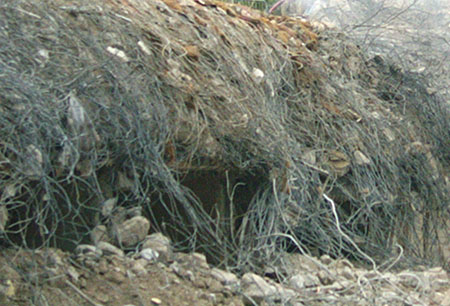
It's a photo I took on my wanderings around London earlier this week. And I know it hasn't come out very well, but you get the idea. You get the picture. Is it some kind of vegetation? The roots of a huge tree that's fallen over, perhaps?
Well, you probably know already, but for those of you who don't, I'll tell you that it's the reinforced concrete bottom end of a tower block in the middle of being destroyed to make way for some boring flats. The "vegetation" is bent out of shape steel reinforcing rods after a grubbing machine has been at them.
The ex-towers were the Department of the Environment towers which used to wreck the view of the Houses of Parliament from the Wheel by looming up behind them. That piece of visual bad manners aside, I used to rather like those towers. I liked the view of them from the big square near me. But now that they're gone I can see the Wheel and Big Ben from the same square. How about that?
If you suspect that this photo is all part of my campaign to piss on Modern Art so often and so completely that it is reduced to a sodden slurry of gunge in the sewer of history, you'd be right. But actually, in its more lucid moments, I'm doing what Modern Art says I should, which is just keep my eyes open for interesting things that crop up in the real world, which look as if they could be Modern Art too.
As so often with Modern Art, this is a message that makes more sense as a piece of verbal advice. There's no need to go to the bother of making Art out of it, other than by taking a photo or two. After all, if Art is all around us, who needs it in museums?
Photography is the way to capture these sorts of things. It's one of the nicest things about photography that it can do this. Thanks to photography, we can see and record these strangenesses and spare the world the bother of lugging whatever it is into a museum.
In the olden days, I suppose someone could have done a painting, but I think that would have been a waste of scarce skilled picture making time. When there are people in the world who haven't been pictured, you shoudn't be painting demolitional serendipity, however amusing. Cameras have changed all that, glory be to them. Now all who want pictures of themselves can have them, and there is abundant camera power left over for us to note the amusingness of disintegrating tower foundations.
But it was capitalism (in the form of the cameras) that did all this. The Artists are merely tagging along behind, trying to stay relevant and to find things to do that still make some sense. Not succeeding mind, just trying.
There's a good piece of culture blogging over at Alice's, about how her generation sat around listening to that Punk Rock music and baaaad-mouthin' their country. (And who am I echoing there? Answers please in the comments section.) Also, there's good stuff about hippies, as exemplified by Neil of the Young Ones. Alice has all the links you'll need.
Did I ever tell you that when I lived in Newcastle during my Youth, I wore thick NHS glasses, and when I took my regular trousers to the cleaners I wore my thin ones, and the youths of Newcastle would yell "Ha way Elvis" at me, which was odd because I do not look at all like Elvis Presley. Question mark. Maybe, maybe not. Anyway, one day I had the shock of my young life when I saw a giant cardboard cut-out of myself, wearing thin trousers, in the window of a record shop. Elvis Costello.
I have once again been listening to a symphony by Bohuslav Martinu, this time his Symphony Number 6, known as "Symphonic Fantasies" or some such thing, in a wonderful old mono Supraphon recording by the Czech Philharmonic and Karel Ancerl.
(Sorry, but I don't know how to do things like put the little circle above the "u" at the end of Martinu, or the spike on top of the "c" in the middle of Ancerl. If anyone can direct me to a page on the Internet where such things are explained, I'd be most grateful.)
Martinu's symphonies are totally wonderful. One of the very first clutch of CDs I ever bought was the set of all six Martinu symphonies by Neeme Jarvi (two dots over the "a" there, which again is beyond my contriving). These were made in the late 1980s, but remain very admired. Every time anyone else records one of these pieces, the reviewers say: yes well it's quite good, but it's not as good as Jarvi. I agree. These are wonderful performances and wonderful recordings, which capture the unique sound world of Martinu's symphonies wondrously.
The cliché about Martinu, referred to whenever yet another of his pieces has been recorded and is being reviewed, is that he wrote too much stuff and that most of it is junk. I agree with this. To my ear, the symphonies are an order of magnitude more splendid than almost anything else he wrote. I love the symphonies so much that for close on twenty years I have bought recordings of anything of Martinu's that I could, and yet in his entire output there is only one other piece of Martinu's that impressed me as much as all the symphonies have. It's called "Bergerettes", and I used to have a delightful recording of it by the Suk Trio, on vinyl. As for the rest, it is all of it dreary, repetitious, rhythmically relentless, utterly forgettable, utterly third rate tedium. Chunk chunk, clug clug, bonk bonk, scrape scrape. The symphonies are to the rest of his output (especially the chamber music) what flying is to staggering about on crutches.
I recall writing here about a similar contrast applying to another Czech composer, Antonin Dvorak (more impossible squiggles), whose symphonies are likewise all of them wondrous, and whose string quartets are likewise very dull and monochromatic by comparison. With Martinu, all that applies also, only more so.
It is often said that particularly famous and prestigious art forms can be off-putting, and that the wise artist might do better to steer clear of them and find his own more modestly appropriate forms. But what if the prestige of the art form puts the artist on his metal and makes him do better than usual? Brahms was said to be terrified of trying to follow in Beethoven's footsteps, but he rose to the challenge in the end, I would say. With Martinu, you get the feeling that when he was banging out one of his tedious little trios or quartets or sextets, taking not a lot longer to write the damn thing than it takes to play it, he was working privately, as it were. He didn't fear public opinion. He didn't mind if he made a fool of himself. Which meant that from where I sit, that's exactly what he did, again and again. But when he wrote symphonies, he slaved away at it until he really had something. This, he knew, was Martinu putting himself next to Beethoven and Brahms, and he didn't want any sniggering and tut-tutting. And, for me, it was mission accomplished.
Moral: some people should avoid writing too much, too often. They should work away at it, polish it, and bash away at it and redo it, until it is truly ready and truly good, and until it will stand comparison with the best.
Hm.
As so often with a blog posting, you find yourself writing the title, and then find that you've pretty much said everything that is on your mind. But just in case I am being a little cryptic, I will expand.
I'm now playing a recently acquired CD, the Hyperion recording of the Edward MacDowell piano concertos as it happens. Very nice. I love piano concertos, and I love the sound they make. MacDowell PC1 has a particular pleasing slow movement.
However, just before that movement ended, nature summoned me urgently to make a different sort of movement, and I pressed the pause button, and went you know where.
While seated you know where, I read, at the conscious level of my mind, the first few pages of an enticing little book about Einstein called Einstein and the Birth of Big Science. However, underneath, above and beyond my reading of that, so to speak, the tune of the MacDowell PC1 slow movement was held in my mind, as it were in suspension. So, nature having been placated and the Einstein book set aside, there remained this tune in my head.
Now here's the thing. I didn't any longer know what this tune was. Was it the tune I had just been listening to? I wasn't sure. I pressed the pause button again (which reverses the interruption and resumes the playing) and of course, the tune I had rattling about in my head was the exact tune that then resumed. So what happens when the flow of music is interrupted is, thanks to the way the brain handles the situation, not so much of an interruption as you might think. (The parallel with doing two or more things at once with a modern personal computer springs to mind at once.)
But, interesting further observation. I'm now into the third movement, and have quite forgotten that slow movement tune. I no longer need to remember it, I suppose. Whereas that tune was where I was standing, my journey interrupted, now it is gone, and I need to be concentrating on the next part of the musical journey. Seriously, if you told me to hum that slow movement tune, on pain of death I could not now do it.
Nevertheless, we all know enough about the brain to know that the tune is there in my brain somewhere. A hypnotist could probably excavate it and make me hum it perfectly, in a minute.
Which leads me to speculate that an interruption of this sort might actually cause me to get to know this tune even better than I would have done normally, without interruption. The interruption process obliged my brain to go to work to deal with the interruption, and as a result my brain paid more attention to that tune than it normally would have done, without interruption.
One thing the definitely happens just before you pause is that you do definitely listen to that which you are about to pause. You can't help yourself, and why would you want to?
What on earth does all that prove? You tell me, if so inclined.
In connection with the Total Surveillance Society thing, Adrian Ramsey commented on the White Rose version of this piece here with a link to this. It's the first four chapters of a book called The Transparent Society. Subtitle: "Will Technology Force Us to Choose Between Privacy and Freedom?" Quite so.
I've only skim-read chapter one, and mostly what it does is ram home the message that this stuff is here to stay. My friend Patrick Crozier (he repeated this at the blogger bash we both attended on Saturday night) often says that governments and computers don't ever work properly together, but I think that this is strictly temporary. When the government can buy stuff at Dixons along with the rest of us, the stuff works okay. Soon, surveillance kit will be in Dixons.
Dave Barry links to this photo, but I recommend that those interested in striking photographic imagery should take a browse through the others.
This one reminded me of this guy's stuff.
Michael Jennings emails me thus:
There are few things as tantalising as Bulgarian manifestos that you can't understand.
Indeed. I mention it because this "Groove Manifesto" appears to be about how to do woodwork, which is a subject of interest here. Bulgarians, please elucidate.
Meanwhile, this Groove Manifesto is totally incomprehensible and full of long words, so until we learn what it really is, think of it as Modern Art criticism. Freed of the distraction of any clear message, we are able to contemplate the manner in which this (to us) non-message is presented. Again, very Modern Artistic.
Also, there is a blogger bash tonight, and I want to be sure that there is something profound here well before I depart, so there's no last minute rush. You don't want to be having to say something cultural under time pressure, trust me. I mean, it can work, but it's not fun.
My two favourite operas written by people who are still alive are Akhnaten by Philip Glass and Nixon in China by John Adams. I understand that my tastes are shared by … I nearly said the "general public", but of course the general public despises opera of any sort. My tastes are shared by opera goers.
The effectiveness of Nixon in China is revealing, and what it reveals is very bad news indeed for opera. Why does Nixon in China not seem to be as ridiculous and absurd as most "opera" written in the last fifty years? How come a stage full of overweight weirdos, singing away in that pre-microphonic smash-the-windows style that opera is sung in, which usually looks and sounds idiotic, in Nixon in China, does not look and sound idiotic, but on the contrary seems amazingly appropriate? What gives?
The answer is that the subject matter of Nixon in China is also totally ridiculous. Nixon in China is about one of those gigantically vacuous photo-opportunity yawn-ins that was the Nixon trip to China. Nothing was said of the remotest significance or interest. If saying things had been the object of the exercise, then a few dozen phone-calls could have seen to everything. But of course, the importance of Nixon's trip to China was "symbolic". It was, that is to say, play acting, with political speeches instead of real ones. And what are political speeches, during events such as this one? They are public performances, scripted in advance to the point where actually delivering them seems pointless, consisting of insincere and totally artificial complements and invocations, from which any trace of actual on-the-spot communication has been studiously removed.
Maybe Nixon, when in China, actually did some serious things and communicated some serious ideas. But who among us thinks this, or feels this?
In short, the events depicted in Nixon in China are of precisely the same kind as the events performed on an operatic stage.
This is why it works so very, very well. It seems totally appropriate. The characters are bonkers - bashing or waffling or self-deceiving their way through a totally obsolete and absurd form of communication, so they work perfectly as characters in an opera.
But the "popular" (these things are relative) success of Nixon in China is not good news for opera. It doesn't signify that opera has any sort of future. As soon as undead classical composers try to portray events that are not ridiculous, the form collapses right back into excruciating, toe-curling embarrassment.
Akhnaten I like also, and that's about an ancient Egyptian boy king who presides over an incomprehensible civilisation of infinite weirdness. To be exact, I don't really like Akhnaten as such. But I do like the sound that it makes.
I do watch other operas by the Undead from time to time, on the TV. Always they are ridiculous. Always.
The most recent such absurdity I saw some of was something called The Silver Tassie, which was about soldiers who fought in the First World War. Please. That's a serious, real subject, something we all care about, deeply. If you're going to present something like that on a stage, you can either do it seriously, or do it as an opera. Both is impossible.
God how I loathe the Jerry Springer Show. A lot of people say that the Jerry Springer Show means that Western Civilisation is collapsing. When I find myself watching it, no matter how briefly, I become one of them.
The disgusting JS starts it off, reeking of such obvious insincerity that it amounts to honesty.
Hey, we're going to talk about this really Deep Problem, which we don't care about at all, and we've rounded up these morons who are so desperate to be on television that they will talk about their problem and pretend that JS is going to take it all seriously and try to help, for God's sakes, and then they'll attack each other.
The studio audience, cheering and clapping and chanting in unison, knows exactly what's going on. This is not therapy. This is emotional gladiatorial combat. And bye and bye, the real thing.
This is why the lower classes are called "lower". Because they watch this stuff week after week all the way through. Although, a simple "low" would make more sense. Everyone involved in this show is totally disgusting, including me for watching it and writing about it and thus Playing Into Their Hands.
There are probably a thousand stupid websites I could go looking for to scatter over this posting. Do it yourself. And when you're there, stay there, and don't come back here. I despise you.
Deep breaths. Pause for twenty four hours.
The trouble is that the Jerry Springer Show is a classic example of the lower classes getting ready for the age of Total Surveillance, a topic already dealt with here, and the whole thing posted across to another place because they thought it was so brilliant, as did Alice.
The Jerry Springer Show prepares all concerned for when what we now think of as our private life is instead the business of the entire world, and for when we get phone calls and emails from people in other continents taking sides in the row we had last night with our wife, which a million people tuned into because it was mentioned ten minutes after it started by a radio station in Sydney Australia, and then picked up and linked to by Instapundit, who thought that our wife made some good points about Homeland Security and about American politicians who want to destroy your computer for copying music with it without paying, in among having plates and chairs thrown at her.
But I still hate the show, and if this is the future, I hate that too.
Those White House Italians have been hard at work again.

The New York Times story to which I previously linked has become emaciated, and the pictures are gone. So here is the latest picture here.
The secret is in the focussing, I think you will agree.
A few days ago I took about twenty pictures of a poster in the tube, for Samizdata, and almost every photo came out really well. I could have used any one of a dozen for the piece. Hey! I'm a photographer! So now I'm back in the groove of taking my camera with me whenever I go out.
Today I was humping an electrical item home when the still (to me) amazing BT Tower suddenly presented itself out of a clear grey sky. So I took a lot of photos of that, and then I came across this delightful chair in a shop, just near the front door. I took about a hundred more photos after seeing this chair and taking a dozen pictures of that, and about half a dozen times I nearly left the electrical thing in the street. But this photo of it is of it is probably the best one I took all afternoon.

The chair was near the front of a shop, and I went right inside with my camera. The bloke at the back, behind his desk, on the phone, didn't seem to mind. In fact he waved. Alright mate? Copying our designs? Any time.
Frankly, most of the stuff in there was pretty forgettable, although the place was beautifully layed out and everything there looked good because of that. But this chair stood out.
It's the contrast between the straight-up classical, normal shape of it, and the outrageous home-made-ness of how it is actually put together (or maybe decorated). I have no idea who made/designed it. I can find no reference to it at the website of the shop, the address of which was, as always these days, prominently displayed on the front window.
I am, of course, not a real phtographer. Not in the slightest. Absolutely not at all. Real photographers know what they want the picture to look like, and they set it up, and they take it. And that's what it looks like. The only surprise is if it comes out even better than they imagined, as what they wanted only more so.
Me, as with all the other digitised amateurs now turned loose upon the world by the Japanese electronics industry, I just get out there and take a hundred pictures, and then pick out the three or six best ones, and try to pass them off as decisions instead of happy flukes.
The only clever thing I did was realise that the digital camera was the first camera ever made that suited me. With a digital camera, I spent all the money at the outset. The marginal cost of taking another stupid failed photo is: zero. And that goes for bother as well as the expense. There's no faffing about with film or taking things to Boots the Chemist so that they can tell on you to the Government. You just take out the little chocolate-biscuit-like object where the pictures are stored, stuff it into the PC, and copy it all across. All the hardware can be used over and over again, including the chocolate biscuit.
So I'm in a hurry, facing a busy evening, and I type "Culture" into google, and this from the International Herald Tribune comes up:
PARIS It is a time-honored summer ritual in France: a marathon of culture in cities and towns throughout the country.But this year's performing arts festivals are in jeopardy because of strikes by workers in the arts over tougher regulations for unemployment benefits.
Already the Montpellier Dance Festival, which was scheduled to run through this week in that southern French city, has been canceled. So have performances at the Comédie-Française and several other Paris theaters.
At dawn on Monday, the police stormed a theater in Caen in Normandy and evacuated 100 strikers who had staged a sit-in since Friday. In Marseille, organizers of the city's eighth annual arts festival called it off rather than risk the unpredictability of wildcat strikes by unhappy workers. The 18-day festival involved the production of 14 plays and expected 17,000 visitors.
"I don't want to take risks," Apolline Quintrand, the Marseille festival's director, said at a news conference. "It is out of the question for me to enter into a fratricidal war with the crews."
Whatever happened to the idea that culture is supposed to be about taking risks?
Summer festivals in France and throughout Europe have become big business. Last year about 900,000 spectators attended a staggering 650 music, dance and theater festivals across France. French tourism has already suffered this year from the sharp drop in the value of the dollar, the political fallout from the war with Iraq and fears of the SARS virus. In cities like Avignon and Aix-en-Provence, festival organizers and local businesses rely on income from the summer festivals, and the cancellations could be financially disastrous.Singers, dancers, actors, choreographers, technicians, circus performers - all sorts of people with seasonal employment in the arts - have united in protest. The object of their wrath is a deal signed last week by three unions with the French employers' association that would reduce unemployment benefits to eight months from 12 months a year for workers who do not have full-time work.
The agreement also requires workers in the arts to work 507 hours in 10 months rather than over the course of a year before they are eligible for the benefits. A hundred arts workers, including prominent performers and directors, sent an open letter last week to the center-right government supporting the protests and objecting to the new rules.
"We are witnessing today a swift degradation of French political cultures, of which the change of compensation for seasonal workers is only one facet," the letter said. Calling the labor agreement an "unacceptable policy of the right," the letter demanded that the government reject it and called for a national and Europe-wide debate on the subject. Jean Voirin, an official with the hard-line union CGT (Confédération Générale du Travail), one of the two main unions that did not sign the agreement, was quoted on Monday in Le Parisien as saying, "This is a catastrophic agreement that will not resolve the true problems." ...
This is like a British coal miners sttrike.
But Daniele Rived, an official with the union CFDT (Confédération Française Démocratique du Travail), which was one of those that signed the accord, told Le Parisien, "By signing, we feel like we have saved a system that was in jeopardy." The unemployment system for these workers has suffered enormous losses in recent years.
Other commentaries predicted that the disruption of the festivals would damage France's cultural standing in the world. "One of the best images of France's trademark - the liveliness of its culture, its creativity, its diversity - is seriously threatened," said an editorial in the Tuesday issue of Le Monde. "The craft of the artist has always been precarious because it's haphazard and uncertain."
The culture minister, Jean-Jacques Aillagon, met with festival directors and has urged arts workers to go back to work. He said the agreement offered "considerable advances." He called the strikes irresponsible.
But the director of the Montpellier festival for the last 20 years, Jean-Paul Montanari, said: "I support the workers. Otherwise why would I have canceled my festival?"
In Britain, a strike by "arts workers" would be greeted with guffaws of laughter. "Britain's theaters closed. British economy brought to its knees. Government acts to avert crisis." I don't think so. And as if to prove my point, I just told my friend Chris Tame that there was a strike by French arts workers, and what did he do? Correct. He guffawed with laughter.
But I told him: no. Over there, this is serious. The French economy depends on this stuff. The fact that French arts workers can stop working and thereby stab the French economy in the heart, shows you how seriously they take their culture over there.


