

This is beginning to take shape.

Expect many more photos, as it nears completion and when it is completed.
Meanwhile, here is another view of what they think it will look like.
The Dissident Frogman (who designed this blog for me) has been in London, and taking photographs.
They're good. Lots of bridges.
Also houses:

I think he may have played some Photoshop tricks with that one, focussing the middle and blurring the house at the back. It ends up looking rather like a model. In a good way. He's giving me another Movable Type lesson soon, and he will throw in some more Photoshop, and that trick with the focussing in particular.
I also picked this house because of the bright colours. DF generally seems to prefer dark ones. His favourite colour seems to be dark sepia. But I like the bright yellow car, and the bus with Waterloo on it.
There is a fascinating "cultural" titbit buried in this article (linked to by Transport Blog In Brief section - April 28th) about the battle between Boeing and Airbus for the aircraft market. I'm sure others have spotted this months ago, but I've only just realised what is going on here.
Styling has finally hit aircraft design:
… The Dreamliner will be the first airliner with a fuselage made entirely of lightweight carbon fibre and plastic instead of aluminium, allowing the aircraft to burn 20 per cent less fuel than similar aircraft.
Its windows are 30 per cent bigger and "electrically dimmable", meaning the view does not have to be blocked by lowering the blinds. It will also look different from other aircraft, with a pointed nose and a swept tailfin.
So far so logical. But now hear this:
Mike Bair, Boeing’s senior vice-president, admitted that the aircraft’s appearance had more to do with marketing than aerodynamics.

"The airlines wanted something that people would recognise. So that influenced the design, much to the chagrin of our engineers who normally decide what the aircraft is going to look like."
The "chagrin of our engineers"!
Mr Bair said Boeing would even be willing to sacrifice a small amount of efficiency in order to preserve the Dreamliner's unique appearance. Andrew Doyle, of Flight International magazine, said Boeing was desperate to have an aircraft as distinctive as the double-deck A380 but added that the key factor in the battle between the two aircraft would be people's willingness to fly with 800 other people.
The significance of this little moment in aircraft history would, from the aesthetic point of view, be hard to overestimate. For a century, the airplane has been held up by designers (and in particular by envious architects) as the perfect expression of how form follows function. When Le Corbusier wanted to rethink architecture, he said it should be done like a modern airplane, not like the decorated Victoriana he so hated.
But now, the aesthetics of airplanes has gone beyond painting them in wild and wacky colours. The very shape of the airplane itself is now being considered as a distinct matter from the mere engineering considerations which give rise to such shapes. Form has stopped entirely following function. Now, function is starting to accommodate itself to form. And form comes not (only) from the engineers, but from the comics and the movies and sculpting department where they attend to such things. (Virginia Postrel must surely have spotted this, and loved it, although searching for Boeing at her blog didn't yield any treasure.)

Airplanes are now becoming like cars, in other words.
As threatened here already, John Richardson's The Annals of London is going to be a rich source of postings here. 1576, for example, starts very enticingly:
1576LONDON'S FIRST THEATRES OPENED
On 13 April James Burbage, who lived in Holywell Street, Shoreditch, leased a piece of ground on which he built London's first playhouse. It was called simply the Theatre, and its site was that of today's 86-90 Curtain Road. Made of timber, it was probably circular or polygonal in shape. At the end of the theatre's 21-year lease, the building was dismantled and moved to Bankside, where it was resurrected as the Globe.
Because of the prevailing puritanical view of theatrical performances, companies of players sought the protection of noble patrons. Burbage was adopted by the powerful earl of Leicester and was granted a royal patent to perform. It is likely that works by Marlowe and many of Shakespeare's plays were performed here during the Theatre's brief life.
Burbage's theatre opened in the autumn. A few months later, probably early in 1577, the Curtain Theatre began in the same road, south of today's Holywell Lane; it is thought to have been built by one Henry Lanman. Superficially it would seem that Curtain Road derives its name from its theatrical past, but in fact there were no curtains in Elizabethan theatres. The theatre and road instead were named from a cluster of buildings which probably supplanted a fortification wall (curtain wall) here.
The Curtain managed to survive until 1627, but was gradually eclipsed by the fame of the theatres in Southwark.
 The 1602 entry concerns James Burbage's son Richard, the celebrated actor, for it was in that year that Hamlet was premiered, at the Globe, with Richard Burbage in the title role.
But by then Burbage had become rather fat. Which is why …
… It is suggested that the lines:King: Our son shall win.
Queen: He's fat and scant of breath.
were written by Shakespeare to take account of his friend's unfit state.
It can't have been the first time that a script got rewritten to accommodate an actor who looked different to the originally envisaged character, and it certainly wasn't the last.
Yes, another prodigy has been unearthed by the BBC Young Musician of the Year competition, in the form of an eleven year old pianist called Benjamin Grosvenor. No less a personage than Noriko Ogawa (yes, she does look nice doesn't she?), who is one of the judges, described the occasion as "historic".
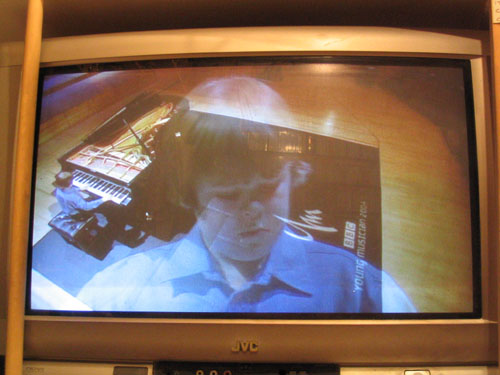
Yes and no. To say it again, there have never been so many wonderfully capable classical musicians as there are now, but what will they actually spend their lives playing, or failing that, doing? What will it be like for the also-rans? As I asked yesterday of Jennifer Pike, what will it be like for Benjamin when the years go by and the amazement at him being able to do this when only eleven has faded?
They haven't announced the winner of tonight's keyboard semi-final, but I would be amazed if Benjamin Grosvenor doesn't win it. The others, compared to him, all sound also-rans to me.
Once again, it seems that this competition was all recorded, way back in February this time, judging by that blog posting I linked to above. So is the final, where concertos are played, to be shown by the BBC on May 2nd, live as well, or also recorded?
The last semi-finalist, a slim, dark haired chap called Otis Beasley is playing Chopin, very well. But I'd bet on Ben Grosvenor.
The decision has just been anounced. "Quick and unanimous": Benjamin Grosvenor.
Jennifer Pike looked like a grown-up, even at the age of twelve. Benjamin is very visibly only a boy. She was remarkable. This kid is downright spooky. I will definitely be watching the final.
 On the right, we have what is known as a thumbnail. But you probably knew that. And you probably also know that if you click on this "thumbnail" you get the whole thumb, in the form of another, much bigger picture, of which this little picture is but a small glimpse. The picture was chosen in some haste from the enormous picture pile on my hard disc. No doubt I could have chosen better, but the priority here was getting the procedure working properly, not aesthetics. It is of a crowd of tourists on the south side of the Thames, just downstream from Westminster Bridge. A little further downstream the London Wheel towers.
I have been taking Movable Type (and also Photoshop) lessons from the Dissident Frogman, who has been honouring my bit of the London blogosphere with his enlightening presence in recent weeks. Sometimes there is no substitute for face to face teaching and learning. My thanks to him, both for his wisdom, and for being willing to share it with me in my kitchen. It's one thing to see things working on someone else's computer. It is something else again to have it demonstrated, and then for you to learn it, on your own computer. So, merci beaucoup.
Last night I watched a lot of classical musical TV, all of it on BBC4 TV, in the form of two shows that I had marked in the Radio Times to watch, and one that I just stumbled upon, of which the one I stumbled upon was the most interesting.
The first show I had already decided to watch was Chiao-Ying Chang playing Beethoven's Piano Concerto No. 4 at the Leeds Piano Competition of 2003. But I tuned into BBC4 a bit before that, and so it was that I stumbled upon a group called Red Priest playing Vivaldi.
Red Priest consist of just four musicians. The boss is a guy called Piers Adams, who has something of the look of Neal Hannon of Divine Comedy. He plays - and I know this doesn't suit with bossing anything, but there it is, this is what he plays – the recorder. There's a violin lady who looks somewhat like Christine McVie of Fleetwood Mac. (That's how she does her hair anyway.) There was a somewhat older cello lady with short hair and somewhat older, but good at the cello. And there was a somewhat geeky guy who played mostly harpsichord, but who also did some some support violin playing. But although this guy didn't look so exciting, he sure behaved strangely when he was doing a barking dog with his violin.
 They were playing one of the Vivaldi Four Seasons concertos, in a programme of "Early Music". They played it with lots of special effects, which is fair enough, because the original is full of special effects – although you wouldn't know it from the average Brand-X performance of these pieces on CD.
Early Music usually means Classical Music so Classical that you iust know that although maybe you like it, no one else does in any numbers, and that as far as the ongoing history of music, this is a backwater, going nowhere. And the rest of this Early Music programme consisted of exactly this kind of thing. Oxbridge graduates in a line singing motets, or whatever they were, in a manner which shrieked of Arts Council grants. Solemn and safe gatherings of viol players, violing away in a manner that you've heard a hundred times, in the unlikely event that you care for such stuff.
But Red Priest are entirely different. They weren't doing yet another "historically authentic" exercise in museum curatorship. They were doing a cover version. Seriously, that was the phrase that Piers Adams used when he was interviewed. He was using Vivaldi's music as the basis for a hyper-theatrical hyper-exciting entertainment, with lots of Hammer Horror costumes and Hammer Horror harpsichord playing, and general leaping about and ripping into the music, in a manner more like that manic pseudo-folk-singer who used to play the flute in among singing on Top of the Pops about a thousand years ago, than like your usual Early Musicians. (Commenters please offer some names, so I can say, yes that's it.) It was great.
And the irony is that I reckon is was probably far more authentic than your average authentic performance, because Vivaldi was nothing if not an entertainer. But if that's wrong, who cares? Entertainment and genuinely musical music is what matters, not mere accuracy of recreation.
Then I heard Chiao-Ying Chang do (as it turned out) her (for she was a she) Beethoven. And then later I listened to the final of the Young Musician of the Year 2002 tournament, basically to hear Jennifer Pike play the Mendelssohn Violin Concerto. The Beethoven was okay, and the Mendelssohn was better than okay. But is the music profession going to make a serious living rehashing these same old concertos in the same old style? And if if a tiny few such people can make a living, what will it prove artistically?
Which is where Red Priest come in. There was an air of busking-in-the-tube desperation to entertain about their act which lifted it a level above the usual dreary, heard-it-all-before classical event. I know it must sound strange to say this, but I really feel that they have a tighter grip on what the problem is with classical music nowadays and what it makes sense to do about it, than does either of these two tremendously nice young ladies with their Beethoven and their Mendelssohn. Pike, as I say, is exceptionally good at the violin. But, unless she is given new stuff to play besides the stuff that she now plays - and I include in that condemnation the dreary stuff (if the same I heard at the semi-final was anything to go by) written by her doting father, who is a Professor of Composition and who looks like it – her life will be downhill from now on. She may have a fine old time playing the same old stuff, but fewer and fewer other people will care, once the novelty of her being that good when aged twelve has worn off.
But Red Priest? Vivaldi?!?!?!
Yes. I believe that part of the "future of Classical Music" is to be found in this huge mismatch between the huge number of and extraordinary technical excellence of the latest generation of classical musicians, and the lack of demand for the number of symphony orchestras that the world would have to contain to employ them all, what with being able to listen to recordings of all the classics. They should be playing Red Priest videos in all the music schools, because the atmosphere they give off is what Successful Future of Classical Music events are going to be like.
And not a drum kit to be seen.
I bought this book, crammed with London occurrences throughout the ages, at a bargain price, today, and a rich source of quota postings it is sure to prove. Although, my first two postings from it have been at my Education Blog.
No time for anything profound today, just an amazing little event from the summer of 1707. This is the second of four entries for that year:
A FLY EPIDEMICAbout the middle of August there was an epidemic of flies in London so prodigous that, as Henry Chamberlain related in 1770, 'many of the streets were so covered with them, that the people's feet made as full an impression on them as upon thick snow'.
Remarkable.
Busy day, so only time for a quota posting. This time not a photo, but a snatch of dialogue from Office Space, remembered well enough to get the essentials of the joke, but probably not.
Google: "Office Space" and "He's really good", and I have the exact quote for you! All hail the Internet!
PETER: Maybe I should go see that doctor. He did help Nancy lose weight.MICHAEL: Nancy's anorexic.
PETER: I know. He's really good.
Ha!
Here it is. Proof that I don't only take pictures of classy looking bird monkeys. This is a really nice looking picture of a bloke monkey ...

… taken in Brussels, the day before I took this picture.
I have been watching the BBC Young Musician of the Year show, on BBC4 TV, and having my sleep patterns deranged dreadfully, because I can't videotape digital TV properly and have to listen to it when it goes out or not at all.
Tonight I watched the string semi-final. There were two very good older-teenage girls playing the violin, and a very good older-teenage girl playing the cello. There was a older-teenage guy playing the cello, also very good.
And there was Jennifer Pike, aged twelve, playing the violin.

Usually I can't pick winners in circumstances like these. For example, the other night I watched a lady called Yuma Osaki play the Tchaikovsky First Piano Concerto for the Leeds Piano Competition of 2003 (also on BBC4), and it sounded fine to me. But Artur Pizarro was unimpressed by it, and said she should have fifth instead of third.
But I picked Jennifer Pike to win tonight in about three seconds. She was an order of magnitude more confident than the rest of them. With the others, you hoped they'd play it well, and on the whole they did. With her, you knew she'd play it well, and you just listened. Truly, truly amazing.
It was only when I went a-googling that I discovered what I should have noticed in the Radio Times, which is that this was a recording of the 2002 Young Musician of the Year competition. And to my complete non-amazement I learned that she had won the whole thing that year.
In short, I was not the only one who was impressed.
I got an email a while back inviting me to contribute to this. But I have enough places to write at as it is. So, pass on that, I'm afraid.
But by going to the site, I did find something of interest, in the form of this list (which started out here), of Britain's most popular living artists, as measured by print sales:
1 Jack Vettriano
2 Gillian McDonald
3 Mackenzie Thorpe
4 Kay Boyce
5 Sue Macartney-Snape
6 Steven Townsend
7 Mary Ann Rogers
8 Jonathan Shaw
9 David Dipnall
10 Charlotte Atkinson
Vettriano I've here. I looked at what the Internet could offer concerning the next five, and frankly, I was extremely disappointed.
This second list, of the dead artists which Britain likes most, again rated by print sales, I found much more interesting:
1 L S Lowry
2 Monet
3 Alan Ingham
4 Russell Flint
5 John Miller
6 Mark Rothko
7 Vincent Van Gogh
8 Pablo Picasso
9 Gustave Klimt
10 Henri Matisse
Ingham I had never heard of, and Flint only just. John Miller I still haven't heard of, because John Miller is too common a name. (There seems to be another artist called John Miller who is very much alive.) But the others are all big names, of course.
And what interests me about this list is its modernity. Where are the earlier big names, like Turner, Constable, Gainsborough, Rubens, Rembrandt? Where is the Italian Renaissance?
Could it be that print buying is a niche market, which doesn't really measure popularity? Or is this what is really happening to British public taste in paintings nowadays?
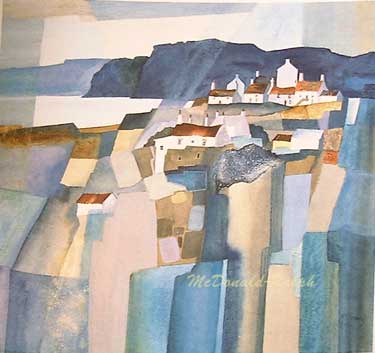
Anyway, I'll illustrate my little foray into the (what is for me rather) foreign country of painting with this picture, done by number two on the still-alive list, Gillian McDonald:
… and with this painting, by L. S. Lowry, of L. S. Lowry, from this intriguing collection of self-portraits.

The point I make with this is that Lowry was not all matchstick men and matchstick cats and dogs. I was going to feature the two portraits here but they "cannot be downloaded for any purpose", although I think they actually mean "may" not be.
If you do download either of them, the man with the red eyes will come and get you.
 Comments that go "very beautiful picture" exclamation mark usually mean stupid attempts to interest me in penis enlargement and the like, but when I followed that exact comment (on this) I found my way via this interesting looking blog to this posting and thereby to this.
I love landmarks.
They have to be tall and distinctive, and to have somewhat unusual tops, which by the way means that the proposed new Shanghai tower featured in this posting here, which I there dismissed as a giant bottle opener, might prove to be a huge popular success. You are sweeping trash out of the streets of one of Shanghai's slummier slums, and you look up and there it is: Hey! The Bottle Opener! Although I suppose if that's your job, it might be: Oh God not again. The Bottle Opener. Someone take it down. But, on the whole, I think not. Also, if a 9/11 type terrorist tried to drive an airplane at it, he might go straight through it by mistake!
Speaking, as I was in the previous posting, of DVDs, I'm two thirds of the way through the Godfather triology (no links – you know the one I mean), on DVD.
The second one had a really strong "deleted scenes from the real movie" feeling about it. I don't share the widespread opinion that Godfather 2 is the greatest movie in general and sequel in particular ever made. I thought half of it was those deleted scenes, and the other half was a rather slight anti-capitalist Americans Being Evil in Central America movie, that every star seemed to want to do one of in those days, usually starring a journalist or a photojournalist. The Godfather is, in short, one movie, not three. There is The Movie. There are the extra bits. There is the Al Pacino versus the Jewish Guy bit, which is as small and mundane and stitched on as the Real Movie is big and remarkable and of itself. And there is 3, which everyone says is nonsense, and which I'll let you know about when I've sat through it.
What is remarkable about Godfather, I think, is that it is a European Art Movie and an American Gangster Movie, all in one. There is no dramatic tension. You know from the very start what is going to happen, even if you've never been told (which is most unlikely). What there is is superb cinematography and production design. It's just one amazing oil painting after another. And the cars …
I mean it about the dramatic tension, and the oil paintings. The remarkable thing about this movie is that time and again, you are not shown how whatever just happened was actually arranged. The horse's head just shows up in the guy's bed. Rival mafiosi just get shot. Only the bit where Michael gets the gun from the toilet is gone into in any detail, and even then, we learn nothing of how exactly the gun got there in the first place.
In the normal mafia movie, the James Caan character would be the central figure. But the whole point of Godfather is that the James Caan figure is not the central figure. Too impulsive. Too eager to do something. Not willing enough simply to let nature take its course. So the James Caan guy does not get the top job when Marlon Brando retires. The passive Al Pacino character, the one who just sits in the corner quietly, and later at his desk quietly, and allows most things to just happen, gets the job. And the active, impulsive, James Caan guy gets killed, because of his desire to act. He gets lured into the open and gunned down. The one action that Michael takes being the decision to kill the cop. "Where does it say you can't kill a cop?" Like the perfect poker player, Micheal Corleone sits and waits, and then plays his ace, himself.
The eldest brother, on the other hand, is so inactive that he never does anything. He lets things happen to him and nothing else. Which eventually does for him as well.
Great movie.
Some time ago, I seem to recall them showing on British TV a re-edit of the first two parts of Godfather with everything in chronological order, with those deleted scenes reinserted in their correct place in other words. That I would like to have. Failing that, a bit of paper with all the scenes itemised, starting with a de-Hyman-Rothised G2, then the Real Movie, but with Michael's first marriage from G2 interpolated, then (if you want it) Hyman Roth. Next time, that may be how I do it.
There's an interesting article by Sharon Waxman in the New York Times about the importance of the DVD market to Hollywood, which includes speculations that DVDs may be changing the content of movies.
LOS ANGELES, April 19 — The other day the chairman of 20th Century Fox, Jim Gianopulos, said he got a call from a lawyer friend. The friend said it was an anniversary of the firm and asked where he could get 100 DVD copies of the cult Fox movie "Office Space". The film made only $10 million at the box office but has become a hit on DVD. No one at Fox pretends to know why, but the film's success is another big drop in the river of DVD cash now flowing into Hollywood's coffers.
I'll tell you why. They thought it was crap. But the word of mouth disagreed.
No one in charge at Fox would have spotted Office Space. They are bosses. They were the ones being sent up. They should have asked their nephews and nieces in their twenties with crap jobs like the jobs of the people who work for them. (No use asking the people who work for them, because a truthful conversation in such circumstances would have been impossible. "Uuuuuuurrrrrrrrgggggghhhhh I'm gonna need you to come in Sunday to tell us what you think of this uuuurrrrrggghhhh movie … so if you could be here at 7am that would be uuuurrrrrgggghhhhhh great", or whatever is the equivalent in Hollywoodese.)
Not since the advent of the videocassette in the mid-1980's has the movie industry enjoyed such a windfall from a new product. And just as video caused a seismic shift two decades ago, the success of the DVD is altering priorities and the balance of power in the making of popular culture. And industry players, starting with the Writers Guild, are lining up to claim their share.There's good cause. Between January and mid-March this year, Americans spent $1.78 billion at the box office. But in the same period they spent $4.8 billion – more than $3 billion more – to buy and rent DVD's and videocassettes.
Little wonder then that studio executives now calibrate the release dates of DVD's with the same care used for opening weekends, as seen by Miramax's strategic release of "Kill Bill: Vol. 1" a few days before the theatrical release of "Kill Bill: Vol. 2." (The DVD made $40 million its first day out.)
Studios now spend comparable amounts of money on DVD and theatrical marketing campaigns. Disney spent an estimated $50 million marketing the "Finding Nemo" DVD last year, said officials at Pixar, which made the film. It was money well spent. The DVD took in $431 million domestically, about $100 million more than the domestic box office. DVD has resuscitated canceled or nearly canceled television series like "The Family Guy" and "24," and has helped small art movies like "Donnie Darko" win rerelease in theaters. It is also beginning to affect the kinds of movies being made, as DVD revenues figure heavily in green-light decisions and are used as a perk to woo craft-conscious movie directors.
I think DVD is one of the reasons I'm starting to feel this way about movies.
The piece ends thus:
What no one knows is how long the windfall will last, whether DVD is a consumer bubble that will burst once the studios finish releasing the films and TV shows in their libraries, or whether it will remain a strong current in the entertainment industry profit stream."Right now the studios are making money hand over fist," said Mr. Lesher. "But in five years when you can download a movie as fast as a song, that will go away."
Mr. Gianopulos disagreed. DVD's will last "because of the uniqueness of that experience," he said. "It's no longer 'I saw that movie.' It's 'I saw that movie, now I'm going to see multiple dimensions of that movie.' That's why you want to own it."
I'm with Mr Gianopulos, provided they make them cheap enough. (I bought Office Space for £5.99.) For a fiver a go, I'll keep on buying these things. For more than a tenner, forget it, except if they are Whit Stillman movies.
For more erudite commentary on the above, await the comment(s) here of Michael Jennings, or read these Samizdata pieces.
 I love this. It's a really great slant on the ancient art of Sticking Photos Up On The Internet. The gimmick here is that the Photographer has a baby called Jeremy, and he gets celebs to hold/sit with Jeremy, while he photos the two of them.
On the right is my favourite of the pictures, Jeremy being held by Cynthia Nixon, who plays the ginger one called I forget what in Sex and the City.
There are quite a few politicians involved, mostly of the Democrat persuasion, although G. Gordon Liddy also gets a look in. But I suppose Democrats like him because he keeps the memory of Republican Watergate Wickedness alive by continuing to be a celeb.
Thanks to b3ta.com for linking to this. They swear a lot, but they have hearts of mush and regularly feature ultrasentimentality such as this, or kittens. Or sheep.
A commenter has insinuated that my ongoing Brian's Culture Blog Billion Monkeys project is just an excuse to photograph nice looking women.
Absolutely not. Only the other day I photoed an ugly fat bloke taking pictures. It's just that pictures like this look nicer:


But mayble I will change it into the Half a Billion Lady Monkeys project, for the time being.
I won't be seeing the movie because it's not (any longer) my kind of thing, but I do (still) love these huge movie posters. How much would they be paying per week for a spread like this?
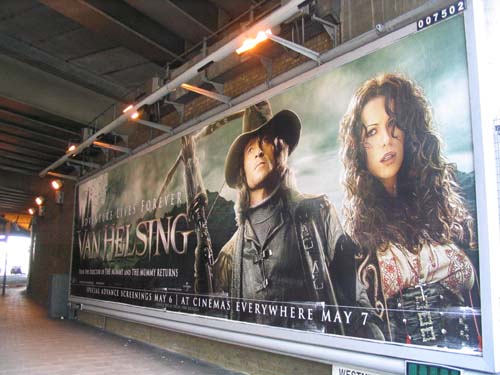
This one was photoed last week, right under where the Eurostars come and go in and out of Waterloo.
Looks like tosh to me. But I'm glad to see Kate Beckinsale keeping busy. That must be her in the poster.
The boss of Universal explains how Africa and Universal are on the same side in the CD music copying argument:
"What is now happening, which is very scary, is a deterioration of morals in how the consumer views piracy. They see it as a victimless crime. They don’t feel sorry for the music industry. There has been a change in perception caused by the popularity of blank CDs. People say that if a blank costs 10p, why do recorded discs cost £12? Their answer is that we must be ripping them off. They forget the cost in recording it."We cannot see these misguided people simply as thieving bastards – we have to try to educate them and show them how much it’s damaging the cultural environment."
Larsen cites Africa as showing the worst that can happen if piracy is allowed to run rife. "There was a time when we and other music majors had an office in six or seven African nations," he says. "Now, there is nothing between the Mediterranean and Johannesburg. We used to record a lot of local music. Now the only way you can hear it is if you go to a bar in Nairobi. There's nothing wrong with live music, but you can't share it with the world. So you destroy that cultural diversity in music."
You can read the whole thing here.
This afternoon I came across this vehicle.

Now I remember Solidarnosc as the Gallant Trade Union that did away with the USSR by making Poland impervious to Soviet Imperialism. Solidarnosc.co.uk? What could that be? Something heroic, I hoped. Something terrible I feared. I feared right. It's a porn site. Either that or it is a branch of Solidarnosc Poland that you have to be over 18 to learn about. How depressing.
No link from here. This is a family blog. Well no it's not, but anyway, no link.
So let me cheer you - myself anyway - up with another picture I took from almost the exact same place, which is a street called Lower Marsh, a regular haunt of mine because there is a guy there who sells second hand classical CDs from a market stall, and a regular indoors second hand classical CD shop called Grammex.
One of the things about London's big new landmarks is that, because London is not yet choc-a-block with big tall buildings or big things generally, when there is a great big thing in the vicinity, it towers over the surrounding muddle and confers distinction upon the otherwise undistinguished, thus:

I like this. I'm not saying this is a great picture, although please feel free to think so. I am saying that if you are actually there, it's a nice effect.
Yes, I did a Samizdata posting today called Could someone do with 9/11 what Mel Gibson did with the crucifixion?
My answer is: probably not. Reason: we've already seen it.
Commenter number one agreed, and rammed it home by supplying the link to this.
Yesterday evening I watched two television plays of a very similar sort, which often seems to happen on TV. One channel puts on a Clint Eastwood movie, and to cut into that audience another channel puts on another Clint movie, often at the exact same time. Most aggravating, if you're a Clint fan, which I often am.
BBC2 TV last night showed Hawking, and then later BBC4 TV showed Life Story. But this time the BBC was cooperating with itself, because after Hawking on BBC2 they had another little show about Hawking's work on BBC4, just before they then showed
Hawking was about Stephen Hawking, and Life Story was about the cracking of DNA by Watson and Crick. I saw Life Story when it was first shown ages ago (1986?), but like everyone else watching it, I was watching Hawking for the first time.
The trouble with plays about science of this exalted sort is that someone like me has only a very dim idea of what is being talked about by all those brainy people, and I was agreeably surprised by how much incidental information I did manage to gather up, not just about the personalities involved, but about some of the actual key concepts.
Both types of information were very welcome. For example, I have never until now known just where Roger Penrose fits into the larger scientific scheme of things. Penrose: brainbox. That was about the limit of my knowledge of this man and his works. Now I learn that he was the first bloke to propose the existence of Black Holes. And as for Hawking …
Until now I have always been deeply suspicious of the cult of Hawking, suspecting that, had he not been so photogenically crippled and obliged to talk with a machine jammed against his emaciated throat, we would pay him no attention at all. But now I learn that Hawking actually has contributed something of scientific substance to the ongoing debate about what The Universe consists of. By applying Penrose's Black Hole notion to The Entire Universe, while reversing the direction of its occurrence, he has turned a relatively small planets-disappearing-down-a-local-plughole act into The Entire Universe starting out from a single point in a huge explosion. A Big Bang, that is to say. Okay, I am hazy about the proof of all that. I could not cover a blackboard with mathematical equations which meaningfully allude to all this. But, very roughly, I get it. Since I expected to get exactly nothing when I started watching Hawking, that was a real plus.
I now actually want to read this.
To put it another way, I stopped feeling sorry for Hawking and started feeling appropriately envious. He is not the physically ruined object of an idiot modern celeb-cult, or not only that. He actually did get his trembling hands onto a major piece of The Truth, the jammy bastard. His grin of self-satisfaction and self-congratulation as he staggered off into his own version of the sunset – his unthreatened mind trapped inside his ever more unreliable body – was really something to see, and a triumph for all concerned.
And nor did I know that Fred Hoyle was famous for disagreeing with all this Big Bang stuff.
Oh, I sort of knew, in the sense of having read it somewhere, and having then forgotten it. And no doubt I will forget all this stuff again very soon. After all, knowing what Penrose and Hawking and Hoyle all said is of no direct importance to me. I won't have to remember any of this, so presumably I won't. Nevertheless, acquainting oneself with the mysteries of cosmology, which have (and here I complete agree with Hoyle's ferocious atheism and despise the deluded religiosity of Mrs Hawking) now entirely replaced the mysteries of the Christian version of cosmology, is something that all educated people should do from time to time.
Personally, I now think that cosmology is an excuse for more total rubbish than any other ology around these days., my favourite "you have got to be kidding" piece of "science" these days being all that malarkey that says that there are lots of different multidimensional universes fanning out in all directions from every single moment in time and space, or whatever the hell it says. Now to me that is just these people ing, in high faluting language: "Well actually we don't know." When multiple universes shows up on telescopes and give us better flat screen TV sets then I'll believe them. Until then, I'm a multi-universe agnostic.
But insofar as the Big Bang has apparently shown up on the telescopes as otherwise inexplicable hissing (as a scientist played by Dempsey from Dempsey and Makepiece explained), then fine: I believe in the Big Bang, and I await the resulting improved TV sets eagerly. I'm a member of the congregation of science, in other words, even if I choose to regard some of the sermons as drivel. Me watching these TV shows approvingly is me nodding towards the altar of my religion.
Life Story caused quite a stir when it was first shown, because it showed scientists not as ego-less priests of The Truth, but as fiercely competitive racers after it. Well, it showed Rosie Franklin as an ego-less priest of The Truth, but the point was, as she herself admitted, she did not crack DNA, while the boy racers Crick and Watson did. When Crick and Watson began their version of the quest, the theory was that cracking DNA would swallow up the lifetimes of all who embarked on it. Crick and Watson had it all up and modelled within a few months, or whatever it was.
This lesson – that, even though the truth is The Truth, scientists are human – now having been thoroughly learned by the sort of people who like me watch TV shows about scientific breakthroughs, I was not at all shocked to learn that cosmology is also a field in which those racing each other for The Truth cover each other in great jets of mud and generally fight like hell to win their various races. Quite right, and good for them.
And good for the BBC. Nobody has much good to say of the BBC in my part of the political landscape, and I often join in with such complaining myself. But this kind of thing justifies the license fee if anything can, I think.
I took this photograph this afternoon in the general vicinity of Tate Modern, and it is definitely of some Art, because I saw a bit on TV about it arriving, presumably at Tate Modern. The person I was with told me who did it, but I didn't catch the name, and can't find any trace of it at the Tate Modern website.

Can anyone clarify?
You don't often get the chance to photograph Art, because galleries (understandably) don't take kindly to it. But this was just standing there, right next to a big floor to ceiling window, and just begging to be photoed. So I photoed. But what is it called and who is it by?
They look like underwater tentacles to me. And what they are (as opposed to what they're called and who they're by) is rather beautiful, to my eye.
UPDATE: My companion of yesterday tells me that it is by Ioan Nemtoi. I can't find this particular piece, but that is presumably because it is new work.
I googled "Easter", and because of this, I found my way to this lady's work.
Of which this one …

… is my favourite.
Where this picture figures in the official art pecking order, or indeed if it figures at all, I have no idea.
I've been saying here that I like the symphonies of Malcolm Arnold, but I don't actually know them all that well, in the sense that if you played me a bit of one of them, I couldn't number it, whereas with most of the Shostakovich symphonies, which I know really well, I could. What I can tell you about the Arnold symphonies is that I like them in the sense of knowing that I am going to know them better, and and to like them even better, than I do already.
Anyway, encouraged by what Lynn Syslo says here about it, I put on one of the CDs I have of Arnold's Ninth Symphony. I chose the one by Vernon Handley, and was especially struck by the second movement, the Allegretto. The whole thing is great, but this movement especially is particularly beautiful.
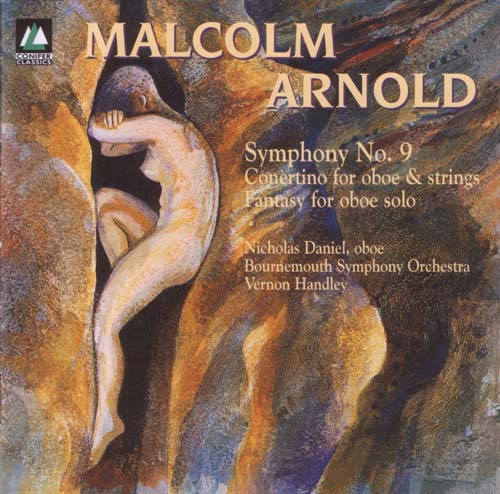
The bad news is that I am now listening to the Naxos version of this piece, conducted by Andrew Penny. I'm at that same second movement. And the impact is nothing by comparison. Handley finds a stillness which I found extraordinary. Penny goes for a more "swirling" effect, but for me the result is very earthbound and mundane by comparison.
Shostokovich definitely looms large as an influence, or at any rate as a definite comparison. What Arnold here demonstrates, like Shostakovich, is a willingness to be very simple. Two instruments, such as a flute playing up high and a bassoon playing down low, carry the tune (and a very love tune it is), without any of those frantic complications that modern "modern" music seems to demand, in order to be modern. Shostakovich's Ninth Symphony is a deliberately frisky little thing compared to Arnold, and more to the point compared to Beethoven and Mahler, but in this respect it is very like Arnold's Ninth.
I remember being very struck by something Daniel Barenboim once said, about Shostakovich, along the lines of: "Look at the score, there's nothing there." He meant this as an insult. But to me, this is a compliment.
Barenboim does lots of "modern" music, all of it that I have heard being, to my ear, utter dross. While he has fun threading his way through the complexities of the "scores" he likes, the audience sits with its arms folded waiting for the damn things to end. Shostakovich, and Arnold, communicate a lot, and often with extremely little. But this is good.
Digressing even more, I've often wondered if Barenboim is responsible for his wife Jacqueline du Pré not having anything to do with Shostakovich, and in particular the two cello concertos. No 1 especially was already a big hit when Du Pré was playing, thanks to Rostropovich. I'd love to have heard what she might have done with this.
All of which began simply as: Try Arnold's Ninth, you might like it!
 This made me laugh out loud, perhaps because I am drunk. If sober, I would fill up the rest of this space with sober verbiage. But alas ...
Got this at b3ta.com. Do your own link. (I'm drunk, etc. ...)
Is this art? Who cares?
I've looked at the final version, and it needs just another line or two, otherwise the coloured rectangles at the bottom get all piled up together, and I don't like that.
In his comment about this photograph, Scott Wickstein makes sense of something that had been puzzling me. Why do I so definitely prefer photographing new nice London buildings to old nice London buildings and even to old great London buildings? What's that about? Do I really think that some snazzy new block of flats is actually superior as architecture to St Paul's Cathedral? Hardly. So, why the photos?
Here is what Scott says:
What it also says to me personally is that there are places in the world that still have a bit of self-belief and are ready to take risks. This is important to me as I live in a city which lost its self-belief long ago, and its doubts are starting to corrode onto myself.
And there you have it. I can't say anything to cheer him up about his home city (Melbourne?), having never been anywhere near it, ever. But he is right on the money about London. The old buildings are great, but the new ones are "important to me", and to me also, for the exact same reason that they are important to him.
St Paul's is great and all that. But the thing that really cheers me up about new buildings which are only half as great, but nevertheless great, is that they say something about the direction that London is going in, now. Unlike St Paul's, decent London buildings now are the promise of greater things to come. Even dreary London buildings can sometimes be the promise of greater things to come, if only because they are the promise of bigger things to come, and because the general standard of the big stuff is improving all the time.
Were it not for the new stuff, I would probably find the great old stuff actively depressing. The contrast between the grandeur of the past and the dreariness of now, between the splendour of my generation's inheritance and the boringness of what it had done with it, would be very hard to stomach, as it actually was in the seventies, when this pretty much was the story. I can really understand why crazy Chinese people in the seventies used to smash all their old stuff. They were stupid, ignorant and philistine, but I can truly understand why they did it. Thank God that this phase of their history stopped, and they are now back on track and matching the achievements of their past rather than just wrecking them.
I'm not the only one who feels this way about the new London. Last night I watched Murder City, again. It was everything I said it was, again. The plot was barking bonkers. But the locations … They were all what Scott called "Micklethwaitvision" places. Basically, they were newly minted little spots in between shiny new buildings, dotted with intriguingly retro and representational statues. (Last night's statues were two oarsman in among, I think, the new Broad Street development, near Liverpool Street Station.) The very first shots last night, for example, were on one of the new Hungerford Footbridges. Later, they wandered all along the river, and wandering along the river in London gets better every year, what with the new bridges, and the new buildings and the new footpaths and coffee bars and art galleries and statues and general tourist trappery. When public places and new buildings get featured (approvingly) in TV and the movies, they have arrived.

In short, thank you Scott, and the photos will keep coming.
I picked up the latest BBC Music Magazine today, and it has this report:

It seems that the days of the musician may be numbered. Toyota has unveiled a Robot that walks, talks and plays the trumpet … The 120-centimtre-tall humanoid has a lung function, dextrous fingers and mechanical lips, and made its debut at a Tokyo hotel with an accurate, if uninspired, rendition of 'When You Wish Upon A Star'.In a more ambitious display of android musicianship, the Tokyo Philharmonic recently chose a robot to conduct Beethoven's Symphony No. 5. The 58-centimetre-tall robot, made by Sony Corporation, appeared before 70 orchestra members and admitted, 'I'm feeling nervous.'
I'm sure that the Tokyo Philharmonic speaks for many orchestras in preferring a robot to yet another conductor, with yet another interpretation that they have to get with.
This is fun:
In one of the most intriguing sections of The Literary Mind, Turner discusses "the concept of a concept." Bringing together elements of his argument, he says that parable involves “dynamic construction” which links and blends the spaces in which stories occur, with the resulting projections and analogies creating meaning, often quite new meaning. In this kind of process, meaning and inference "are not bounded by a single conceptual locus. Meaning is a complex operation of projecting, blending, and integrating over multiple spaces. Meaning never settles down into a single residence. Meaning is parabolic and literary." To many of us this seems counterintuitive. We like to think of meanings as discrete packets with circumscribed boundaries, abstractions which refer to appropriate entities, while we regard parabolic extension and blending of meaning, with all its potential for both warping and enriching sense, as something "poetic" and exceptional.But we do not "have" concepts in this way, he says. In the spirit of Turner’s book, let's parabolically imagine concepts as countries. These countries are often distinguished from each other by borders that appear as clear, natural divisions, like rivers or mountain ranges. Sometimes they are divided by unmapped wastelands, or by swampy and disputed marshes. Some are islands, with the sea such an obvious natural boundary that no one even thinks to question it. Over on the continent of mathematics, borders are laid out in straight, stipulated grids, which at least makes foreign relations tidy. Concept-countries have centers of life, major cities and capitals. The country of Art, which interests me especially, has many, some inhabited by the likes of Homer, Lady Murasaki, and Shakespeare, while in others are to be found Praxiteles, Bernini, and Rodin. There are less powerful towns as well, and on the frontier you can find dusty settlements of refugees from the nearby country of Craft. Some cynics claim these illegals are nothing more than economic refugees who ought to be sent home. At a border post, Marcel Duchamp argues with the guards. They are confused whether to let him in, while he laughs, telling them their post is not at the border at all, but a hundred miles inside it.
If you want to, read all of it. I didn't. I just read the beginning, then that bit, and laughed.
I'm guessing that not all of my regular readers are regular readers of Alice Bachini. (And vice versa of course.) If so, had I not linked to them, they might have missed these Quentin Crisp quotes, of which this one is my favourite:
I simply haven't the nerve to imagine a being, a force, a cause which keeps the planets revolving in their orbits and then suddenly stops in order to give me a bicycle with three speeds.
And my personal favourite Crisp quote of all, if I remember it right, goes something like this. He was accosted in a bus or some such public place by a group of belligerent young men, or it may have been a belligerent middle aged lady, who asked, belligerently, "Who are you???" His reply, clearly much used and like his appearance something he prepared earlier:
Who indeed?
A few more Crisp quotes here.
You get the feeling that, provided he was all kitted up, Crisp liked being photographed. In fact I believe he regarded being photographed as a kind of public service. (Crisp was also a quite good graphic artist, which I didn't know until now.)
Which reminds me that, in Britain (and elsewhere?), many of us fondly remember the TV play called The Naked Civil Servant, not least because it kick-re-started the acting career of John Hurt. This was shown in the days when starring as a very obviously homosexual homosexual would be "career suicide" for a leading man of the Hurt sort. Said Hurt at the time: "What career?" He has been interestingly busy ever since (most recently as the star of the TV Alan Clarke Diaries.)
Not long after doing Crisp, Hurt got the on-the-face-of-it completely non-Crispian part of the bloke from whose stomach the Alien first emerged. I wonder, did he get that part because he had played Crisp? Did the John Hurt persona, from The Naked Civil Servant onwards, suggest a normal looking guy who harboured a monster within?
Now they're all at it. The last time I observed Michael Douglas at work, he was doing a turn on Will and Grace as a gay police detective. The publicity profile of a leading man cannot now be said to be complete until some suggestions of gayness have been sprinkled into the mix.
This obviously means that Western Civilisation now teaters on the brink of collapse. But doesn't it always? Isn't that part of its charm?
The dullest buildings come alive, for me, when the sun lights them up lighter than the sky behind them, and these buildings are not that dull. The big tower was not long ago given a makeover, and behind it, you can see the triple winged rooves of St George's Wharf.
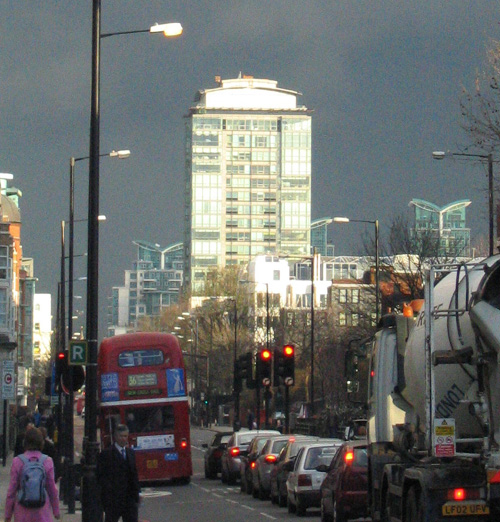
On any day, this, the view as you look down Vauxhall Bridge Road and across the river, is one of my more favourite ones. When the Weather Gods join in with their special effects, the effects can be special indeed. Or so I think.
Although, if you're thinking that the actual photography could have been better, and that maybe one of those old fashioned non-digital ones might have done better, well, this time I agree.
Not that I would have got the picture with it, because I wouldn't have had it with me in the first place. The benefits of digicams are so much more than the mere techical satisfactoriness (or unsatisfactoriness) of the mere pictures. They are small. I can take five pictures of a view like this and pick the least worst. I don't have to faff about in a special room filled with evil smelling chemicals or pay fortunes to a chemist every time I want to actually look at my pictures. So if you like my pictures, and I really hope you do, it's digital or nothing.
The reactions of the analogue photographers to digital cameras remind me uncannily of the reactions of the black vinyl crowd when CDs first got into their magic stride, and this time the room for improvement in the digital product is so huge that soon it will all be over.
My next digicam will be the size of a credit card, cost £50, and be able to photograph the breasts of sunbathers in perfect focus from earth orbit.
The record industry believes – to hell with that, it knows – that file sharing is hurting its sales of CDs. Yet here come two economists (see today's New York Times) who say the opposite:
But what if the industry is wrong, and file sharing is not hurting record sales?It might seem counterintuitive, but that is the conclusion reached by two economists who released a draft last week of the first study that makes a rigorous economic comparison of directly observed activity on file-sharing networks and music buying.
"Downloads have an effect on sales which is statistically indistinguishable from zero, despite rather precise estimates," write its authors, Felix Oberholzer-Gee of the Harvard Business School and Koleman S. Strumpf of the University of North Carolina at Chapel Hill.
The industry has reacted with the kind of flustered consternation that the White House might display if Richard A. Clarke showed up at a Rose Garden tea party. Last week, the Recording Industry Association of America sent out three versions of a six-page response to the study.
The problem with the industry view, Professors Oberholzer-Gee and Strumpf say, is that it is not supported by solid evidence. Previous studies have failed because they tend to depend on surveys, and the authors contend that surveys of illegal activity are not trustworthy. "Those who agree to have their Internet behavior discussed or monitored are unlikely to be representative of all Internet users," the authors wrote.
Instead, they analyzed the direct data of music downloaders over a 17-week period in the fall of 2002, and compared that activity with actual music purchases during that time. Using complex mathematical formulas, they determined that spikes in downloading had almost no discernible effect on sales. Even under their worst-case example, "it would take 5,000 downloads to reduce the sales of an album by one copy," they wrote. "After annualizing, this would imply a yearly sales loss of two million albums, which is virtually rounding error" given that 803 million records were sold in 2002. Sales dropped by 139 million albums from 2000 to 2002.
"While downloads occur on a vast scale, most users are likely individuals who would not have bought the album even in the absence of file sharing," the professors wrote.
In an interview, Professor Oberholzer-Gee said that previous research assumed that every download could be thought of as a lost sale. In fact, he said, most downloaders were drawn to free music and were unlikely to spend $18 on a CD.
"Say I offer you a free flight to Florida," he asks. "How likely is it that you will go to Florida? It is very likely, because the price is free." If there were no free ticket, that trip to Florida would be much less likely, he said. Similarly, free music might draw all kinds of people, but "it doesn't mean that these people would buy CD's at $18," he said.
This is Mad Professor talk. Counter-intuitive? Make that bonkers. Crazy. These guys call themselves economists but they clearly don't have any understanding of economic behaviour, otherwise known as shopping. None at all. Not the faintest notion. Who is paying these fools? Why?
They have analysed the behaviour of people who are musical downloaders and who are not CD buyers, and have discovered – surprise surprise – that they download stuff from time to time, but don't ever buy CDs. Cock-a-doodle-do.
The point is not just to observe that "these people wouldn't have bought CDs anyway", but to understand why they wouldn't. And why they wouldn't is that these non CD buyers have stopped being or never in the first place became CD buyers. All the Professors are saying is that downloaders are not CD buyers, ergo, downloading doesn't in the short run "affect" CD buying. This is like saying that, because I won't buy a black plastic record or a cassette of some particular recording if denied the opportunity to buy it on CD (which I definitely won't), CDs therefore have had no impact on black plastic sales or cassettes, when in truth, and as everyone with two brain cells to rub together knows, CDs pretty much destroyed the black plastic and cassette trade.
What these guys are saying is that because, if your car breaks down, you don't immediately hire a horse, therefore cars haven't hurt the horse trade.
I am an unashamed member of the CD buying generation, as all regulars here will know. Having struggled for a quarter of a century first with black plastic records and then with cassettes, I and my contemporaries hit the CD shops when they finally arrived and became reasonably cheap to shop in like Visigoths hitting Rome, and so it has continued. I love the things, and not just the music they make but the things themselves.
But the next generation, when working out how to supply itself with entertainment in general and musical entertainment in particular, looked at CDs and said: pass. And why? Well, lots of reasons, to do with price and portability and computers, but mainly because there was now another way to get hold of music. They turned their backs on CDs because they could. They may possess CD players, on the same sort of basis that I possess a cassette player, to play back tapes of radio broadcasts and whatnot, but they don't buy pre-recorded CDs. Ergo the CD business is collapsing, and the music companies know this, and know why, just as everyone else does, apart from these two Mad Professors.
For a restatement of the above truisms, see also this, which makes sense. The Mad Professors do not.
I was in Brussels the week before last, and took a ton of pictures. Many were private, so to speak. Others were public, that is to say they were pictures either of inanimate objects or of strangers. Of the public ones, this is one of my favourites.
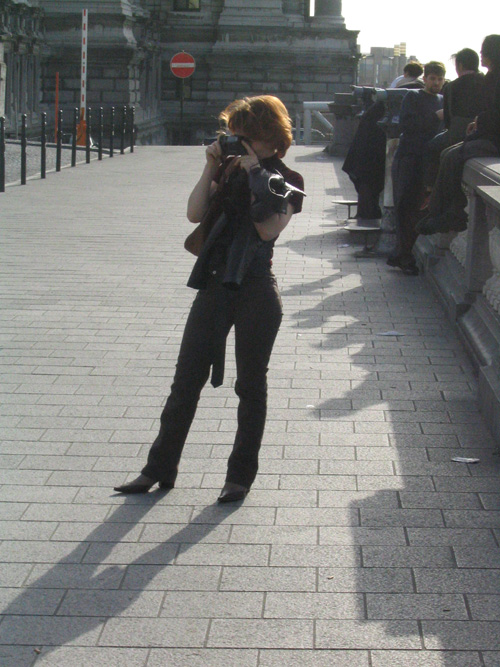
This picture is part of my ongoing Billion Monkeys Project, the billion monkeys being all the people who now have digital cameras and who are snapping away at random. One of these monkeys of course being me.
However, I suspect that this classy bird may have been equipped with something better than a cheapo digicam. Something about the way she is standing, and about the obvious fact that she chooses to observe Life, even though Life would obviously be perfectly willing to offer her a starring role should she ever want one, and very possibly already has.
Photographing photographers works, and I am going to keep on with it. The great thing about them is that they are usually too busy with their photography to care about me snapping away at them, but that if they do decide they don't like it, what can they say? Yes, it's complicated, isn't it? By the time they have worked out the distinction between the wrongness of the photos I'm taking but nevertheless the okayness of the ones they are taking, the deed is done.
And mostly, if they do realise what I'm doing, they don't mind at all.
By the way, if you turn right you are looking at a spectacular view of the centre of Brussels. On that particular day there was not a cloud in the sky. Not one. This is very rare apparently.
Charles Hazlewood's attempts to interest us in the life and works of Mozart have certainly been getting my attention. Last night I watched the final part of the drama documentary The Genius of Mozart, in and a bunch of actors in ancient outfits both acted out and were "interviewed" about Mozart, while Hazlewood in a modern outfit commented, like one of those modern TV military historians striding about on a battlefield.
Opinions differ about the legitimacy of mixing the rules up like this, but I liked it, a lot. After all, a play is, when it comes down to it, the opinion of our contemporaries about what happened, not the thing itself. And why shouldn't historical characters be interviewed the way real people are interviewed about Dunkirk for the History Channel. I thought that Emma Cunniffe as Mozart's wife Constanze was especially affecting, convincing and memorable.
Talk about mixed feelings. Constanze adored Mozart and was adored back, and she shared her husband's adoration of music. And she knew right away that he was a great composer, what with Haydn telling everyone who would listen. Yet she lost baby after baby. And although Mozart may have been a musical capitalist, he was a sadly incompetent one when it came to making or keeping money, and being married to him was a bit like having another baby to look after.
 But then there was the music. Hazlewood rightly, both in this drama-documentary and in subsequent shows on BBC4 TV and on BBC Radio 3, made much of Symphony No 40 in G Minor, K550. But then I am hopelessly biased, as this would be the one piece of music, if I were forced at gunpoint to pick just one, which I would choose as my absolute all time desert island favourite.
I recall writing a decade ago or more (towards the end of this) that Mozart's G Minor Symphony seems perfectly poised between the classical and the romantic, the world of outward stateliness of form and the expression of inner feeling. Hazlewood made rather more of the inner feeling aspect, and he made it clear that as far as contemporaries were concerned, this music was all over the damn place, like some kind of natural disaster, like an earthquake or an erupting volcano. That makes sense. Those of us who now love it now hear the similarities between this music and the much more mundane stuff that Mozart's contemporaries were then turning out. Salieri and Mozart, in the age of electro-pop, do sound very alike, and to an ear unused in classical music completely alike, I dare say. But in Mozart's time there was no electro-cacophany to force them to hear the classicism of Mozart's late symphonies, their controlled-ness, their formality, their eighteenth-century-ness.
What applies to Mozart's contemporaries also applies to an expert like Hazlewood, who thinks himself so completely into the shoes and ears of Mozart's contemporaries that he too is liable to, not miss, but maybe under-react to the continuing classicism of Mozart's late works, to the extraordinary way that he managed to pour his musical lava into the regular shaped musical containers of his time, albeit somewhat expanded ones. But this is only a matter of nuance, and I don't want to turn this into some kind of fight. I loved all these shows, and I learned a lot from them.
Things like the movie Amadeus are all very well, but they contain too many made-up non-facts for my liking. The big talking point about this TV series has been how solemn and sensible this Mozart was compared to the Mozart of Amadeus, but the thing I didn't like about Amadeus was the way it convinced everyone that poor old Salieri had murdered him. Nonsense, of course. Mozart died too soon for the same reason his babies did, which was that in those days, people did.
I share the widespread admiration among classical music fans for the Naxos label, and must endure none of the discomfort it inflicts on musicians by paying them only what they have to be paid, or any of the grief he has made for the other classical music labels by doing the job so much better than them.
Yes, other labels put out stuff for a fiver, but only with their teeth gritted, as it were, after they have tried it on at £16.99 and all prices in between. By the time they do deign to cut the price down to super-bargain, I generally either have it (mostly second hand) or don't want it.
Like thousands of others, I often buy Naxos discs speculatively, of music unknown or almost unknown to me. A year or two ago, having once upon a time long ago owned a gramophone record of a symphony by someone called Kraus (Joseph Martin Kraus, 1756-1792), and having liked it a lot in a Sturm und Drang sort of way, I was delighted to have the opportunity to acquire more Kraus symphonies, courtesy of Naxos, and these discs have not disappointed either in quality of music or of performance.
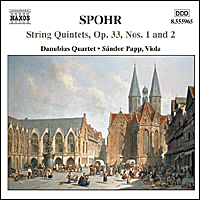 And now I have had a similar experience with the music of Louis Spohr (1784-1859), having recently acquired volumes 1 and 2 of the three Naxos discs of Spohr String Quintets. If you enjoy, say, the Mozart string quartets and quintets, and also the later quartets, quintets and sextets of Brahms for strings, then this music might also hit the spot for you. The music is continuously interesting, and it helps that the playing is excellent, and the recording very pleasing.
Actually, these discs don't conform to the pristine Naxos pattern of starting out as bargains. These performances were done a decade ago and put out at full price on the Marco Polo label (linking to this directly doesn't seem to work, so go to the Naxos site and click where it says "Marco Polo" at the bottom), Naxos' expensive brother label which specialised in music otherwise unrecorded. But "otherwise unrecorded" has not been a formula with the legs of the basic bargain label. The music may indeed have been otherwise unrecorded when it was first recorded, but time and again, that hasn't lasted, and Marco Polo seems to be winding down. That Marco Polo discs have been on sale in HMV Oxford Street at £2.99 a throw would certainly suggest this.
 So, as I say, these Spohr quintets started out as a full-price non-bargain in the early nineties from Marco Polo. But somehow I don't resent this procedure when Naxos does this, probably because Marco Polo was off my radar at the price they were asking.
Meanwhile, although the basic white Naxos label does now put out a steady trickle of ex-Marco Polo stuff, and it has also acquired some discs from the now defunct Collins label, nevertheless, the heart of the Naxos operation is new recordings for a fiver. As far as I was concerned, the Spohr String Quintets felt like a new release, and I only later discovered that they were re-issues.
I'm looking forward very much to volume 3.
 I put up a brand-X posting about private enterprise in space on Samizdata, but this picture, included in a comment by paul d s was what got most of the rest of the comments.
The parallels between the next wave of space travel and the second wave of ship-borne exploration of the rest of the world by Europeans are there, but they are not exact. When Captain Cooke landed in what became Australia there was no live TV coverage of the event, or instant communication of the news back to earth. The first settlements in America were not built in order to accommodate European tourists. But European flags were planted on alien shores, to the greater glory of the sponsors back home.
Robert Heinlein wrote a short story a long time ago, entitled The Man Who Sold The Moon, about a guy who managed to get Coke and Pepsi to shell out two fortunes, merely to keep the other's logo off the moon. Just as well. A logo on the moon would have really taken some doing. Logos on space rockets are a far better bet, like the picture says.


