

I just watched a nice little TV programme ("Map Man" BBC2 TV 7.30pm) about the London Tube Map, during which a brief reference was made to this:
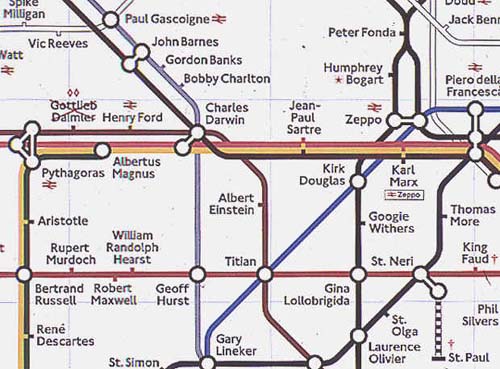
I found my way to it via here. (Scroll down to "The Tube Map as Art".) Art? Well, if an "artist" says so, so be it, but all the art in this is surely down to the original designer, Harry Beck. Simon Patterson's rehash is not very profound, being little more than a joke. But it does show what a very strong design the original is.
Change all the stations, yet still it remains instantly recognisable.
The philosophers go round and round in a circle, going nowhere. Ho ho.
I also found myself being intrigued by the sight of this. Strange how isolating the middle of the original muddle makes it seem so much less muddled.
More Tube mapology here.
Nice things were also said on the programme about the design of the Moscow Underground map.
My assumption has for long been that the Next Big Thing in music, movie, etc., storage is going to be accessing it from the Internet, rather than keeping in the form of Things, at home. In fact, this already is the Big Thing.
But there may be life in smaller Things for a few decades yet. I refuse to buy CDs for twice as much, even if they are in "SACD" super-surround orgasmasound with quadropheniac nobs on. But, if the price is right, I might consider getting the entire output of Beethoven, in SACD etc., on one disc.
Well, I probably wouldn't. But future generations might.
First it was potato crisps (see five below), now it's chocolate bars:

Obviously this stuff works. And it can't all be people buying them because they're stupid and photo-ing them and putting the photos up on their blogs and having a laugh.
Yesterday I blogged about the extreme usefulness of having a digital camera small enough to take everywhere, all the time. Here are some photos which illustrate this.
From the left.
One. A picture of England's ace rugby fly half Jonny Wilkinson, advertising cholesterol, or something to do with cholesterol, in a local chemist. I thought this might come in handy at this blog, and in fact I have already used it, although not very relevantly.
Two. Every so often, the evening sun shines in from the West, straight back down Oxford Street, and if there are clouds above, the effects can be very striking, as they were when I took this photo. Clearly, a better camera, or me being cleverer with my existing camera, would have been better. But a better camera would not have been in my pocket and ready to go.
Three. Taken moments before or after the previous one, after I think - "Borders" featuring in both. The first of three pictures where the point is not photographic excellence but the facts being photographed, in this case the fact that Bill Bryson's book on science, which I like and admire so much is being piled high and sold cheap in London's bookshops. Either they think they can massively increase their sales by discounting, or they printed far too many copies and are desperate to get rid of them. Don't know which.
Four. The point here, once again, is the price tag. And this is in Blockbuster. That's right. Blockbuster is now in the second hand DVD market and its cheapest DVDs are going for £3. That's less than Oxfam charges. A sure sign of a price plunge is when the people who know the business are discounting their product more severely than the charity shops. And we're talking about reasonably good DVDs too. Not total rubbish by any means. The Grinch was quite a hit, I believe.
I think these cheapo DVDs are the result of a scheme where they buy DVDs off customers in exchange for further business, at about £1 or £2 a go presumably,.
And finally five. Here is a case of a photo which doesn't need an expensive camera, and where again, the info is the point. My particular point being that I think there is something slightly out of line with the universe when potato crisps are sold in "limited editions". What are they? Engravings? David Hockneys? Read of a customer sighting here (scroll down to Friday May 21 2004), by this guy.
They are very tasty, though. And I thought I'd best be sure and buy two bags, what with it being only a limited edition ...


Not a Billion Monkey to be seen.
I think I have zeroed in on what digital camera I want:
The best digital camera in the world, money no object, that I can fit into my jacket pocket, and preferably which uses Compact Flash cards so I don't have to stop using the ones I have.
So, what might that be?
This posting is being done to test out the spacing of thumbnail photos, to see if they will fit. Don't bother yourself about what this involves or why. Just click on the small photos to get the bigger versions.
All these photos were taken on the same expedition as yielded these two snaps.
All are good in some way or another, but not necessarily as good in all ways as I would like. In particular, some are of nice things, but didn't come out so nicely. My twin obsessions – London towers (in this case the Docklands towers, again) and digital photographers – are on show, sometimes in the same picture. The lady with her bottom facing us was chasing a squirrel.








Those who are somewhat distressed by the technical inadequacy of these snaps will not be surprised to learn that I have signed up for a course in Beginner Digital Photography. I did the first day of this last week. I said that the things that bothered me most were controlling light, and focussing. With luck, I will learn how to do these things better. Next week it's "controlling image outcomes", which sounds like what I want.
While at the class, I asked whether it made sense for me to get a more expensive camera, or make do with the cheap (Canon A70) camera that I already have. The teacher brought along a bunch of Canon EOS 300D cameras, which he said were good, costing around £700, he reckoned. Would that be great improvement, or just an opportunity for me to take bad pictures more expensively?
One thing I do know is that this Canon EOS whatever is a whole lot less convenient. The thing I love about the tiny ones like mine is that I can catch opportunist snaps which I didn't go looking for but merely chanced upon, as a result of having it with me all the time. And using two different cameras seems like a really bad idea, never mind the extra expense.
The teacher favoured more teaching. But then he would, wouldn't he?
So I google for "news" about "art", and I find my way to immediately to this:

Fans of artist James Tyler's "Brickhead 3" sculpture, which sits in Davlan Park at 430 Massachusetts Ave., will be happy to hear that it's going to become a permanent fixture in the neighborhood.In fact, Mayor Bart Peterson will use "Brickhead 3" as a backdrop today when he joins community arts leaders to announce that a quarter of a million dollars in new funding will be devoted to adding more public art to Indianapolis' landscape during the next two years.
Here is some more about Brickhead 3.
The mayor will make the announcement at 9:15 a.m. in the park.In addition to the purchase of Tyler's sculpture, which is constructed of 550 handmade ceramic bricks and was installed earlier this year on a temporary basis, the money will pay for projects ranging from a series a billboards to other large-scale sculptures.
The Indianapolis Cultural Development Commission and the Arts Council of Indianapolis, which operate the city's public sculpture program, will oversee the disbursement of the new money.
Well I don't like the way all this is being paid for, but I do like the look of this particular sculpture. And what is more I agree with the artist that it represents an advance on Brickhead 2, which looks like this:

What I like about Brickhead 3 is that the head is totally realistic, not to say mundane, while the medium is obviously nonrealistic. "This is a head" collides with "Actually these are bricks". (See also this: "This is a mountain with a tree in front of it" – "Actually it's a painting".)
However, with Brickhead 2, those bobbles on its head mean that the head itself is rather sculpted. The head that the artist is representing is itself rather arty. At the very least it is somewhat exotic. And I think this works less well.
I also like that Brickhead 3 has been placed in front of a brick building. That definitely adds to the fun.
I'd like to see further and bigger Brickheads, but of celebrities. Perhaps that Mayor fancies being one.
My very good virtual friend, Scott Wickstein, writes on Samizdata today about the painter and GULAG victim Nikolai Getman. Here's where you can see some of his paintings.
Samizdata is not that strong on pictures, because it's a group blog and group bloggers are often nervous about infringing picture rules which they only think about occasionally. So, here (where I do know the rules because they're mine) is a Getman painting. Any of dogs? - I wondered. I've read about those dogs. Yes.

I also nearly picked instead one of this, this, and/or this. That last one may actually be my favourite one of all, as of now.
I really do not know if connoisseurs of painting rate Getman's work highly or not, as paintings, assuming any of them are capable of being unbiased about it. They certainly look very striking to me. And the subject was definitely worth all the effort.
I'd never heard of Getman before, so particular thanks to Scott.
(By the time I got around to checking all these links, they had stopped working. Has Getman perchance been "Samizlaunched"? It would be nice to think so. I'll check them later, but that may be some time later as tonight I have a Brian's Friday. IMMEDIATE UPDATE: They all now work.))
James Lileks writes about the music for Where Eagles Dare as if he's the only person on earth who loves it. But, Lileks, you are not alone.
He offers two snatches of it on mp3: here and here. Click and be patient.
And hullo. It seems that Lileks has been on about WED before, and that I have linked to him before about it.
RAT. Ta-ta-ta-ta TAT.
With luck, and as already reported at my Education Blog, the Comments Gremlin has been slain. I will add a few comments to this posting, as I did there, but basically, everything now seems to be working. It may rudely demand that you type in a new number, despite you already having typed in one very carefully, but the signs are that it has been cured of its very disagreeable habit of eating comments without leaving so much as a verbal crumb.
My apologies for the extreme delay in sorting this out.
If anyone does get any more comments eaten, please try to add another, complaining about this. If it misbehaves again, I am anxious (if not eager) to know about it.
 Tonight I am listening to: A London Symphony by Ralph Vaughan Williams. And I have chosen the mono version done by Sir Adrian Boult with the LPO, from this boxed set of all but the last of the nine RVW symphonies.
I do not offer a general review of this lovely piece, with an exhaustive explication of exactly what makes it so lovely. I just wanted to make what I hope is one interesting observation.
I refer to the second movement, "Lento", and in particular to the lovely tune in this second movement, which we first begin to hear (on this particular recording anyway) at about 6 minutes and 40 seconds.
To me, this tune could have come straight out of the sound track of a Hollywood biblical epic. It would have sounded completely in place had it occurred, not in a piece celebrating London, but in a story celebrating the life of, e.g., Jesus Christ. I'm thinking in particular of the scenes in Ben Hur where Jesus is seen, but only, by us cinema viewers, from behind. We see that archetypal hair-do, evocative of all that is magnificent and history-changing, yet at the same time consoling and loving, but only Charlton Heston gets to see Jesus' face. It's been a long while since I've seen this movie, and heard the actual music that Miklos Rozsa wrote for the Jesus scenes, but I do definitely seem to remember them sounding very similar in atmosphere to this London Symphony tune.
There is, by the way, a distinct whiff of similarly Israelite harmonies in Vaughan Williams' glorious Fantasia on a Theme by Thomas Tallis, and, for that matter, also in the original Tallis anthem which that piece was inspired by.
And now, that tune has come and gone. The third movement is back to the hustle and bustle (and also the Georgian stateliness) of London, as if Israel had never been thought of.
All of which leads me on to wonder about this whole musical nationalism thing. We are constantly told that particular harmonies evoke particular national moods or national landscapes. I wonder. I suspect it may be pure association caused by the constant placing together of certain sorts of music with certain sorts of imagery and certain sorts of national myths and stories, the actual connection being accidental. Had the music chips landed only somewhat differently, Dvorak could have sounded unmistakably Italian and Tchaikovsky unmistakably Finnish.
That the music of Vaughan Williams of all people made me think of ancient Israel rather than of ancient or not so ancient England is a particular irony, because RVW of all people is credited with creating an "unmistakably" English sort of sound, the one dismissed unkindly by Elizabeth Lutyens as cowpat music. (Scroll down to the start of para 2 of the review linked to.)
So: Vaughan Williams. Unmistakably English, except when he sounds unmistakably something completely different.
Busy this evening, and up early tomorrow, assuming all goes to plan, to do an all-day-long Billion Monkeys beginners' digital camera course.

Taken at Perry de Havilland's a few weeks ago.
Instapundit caught this, but maybe you missed it.
Here's another (real but inaccurate) snap (from the DVD on my TV) of that scene:
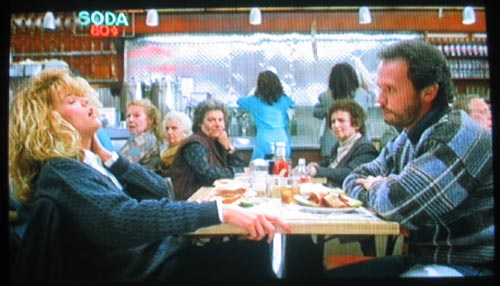
And the people who made this delightful movie? Democrats and Kerry-persons the lot of them, I'll bet.
I wonder if this meme will catch on. It deserves to.
 I hadn't visited b3ta.com since my Summer Recess, so as soon as I remembered this, i.e. today, I visited it again. This was the most cultural thing I could find via them, in B3ta Issue 151. It's about using flat screen TVs to do more than watch flat screen TV shows. You can stick flat screen TVs with fake views on them behind fake windows. Scoff if you like, but this has a big future.
And how about combining one of these windows with something like this picture.
I have just watched the first half of the televised Measure For Measure from the Globe directed and starred in by Mark Rylance, the same team, in other words, who did that magnificent Richard II, also on BBC4 TV.
This Measure for Measure has been, for me, somewhat of a disappointment. The funny bits weren't funny enough, and worse, the serious bits werent' serious enough.
David Starkey, commenting at half time, said it all. The basis of the play is that it is set in a world which takes sex seriously, and somehow that has to come across. There are rules for sex, and God help you if you get caught disobeying them. This did not come across here. I thought momentarily that maybe that could be accomplished by setting it in some decaying Muslim Fundamentalist state, which is falling apart but still lashing out with the remnants of its dogmatic certainties. But that wouldn't work because fundamentalist Islam blames women for everything, and in Measure for Measure, Claudio is to be punished for his adultery.
No, all I want to see is a better production. The other commenter, the actress Juliet Stephenson, herself a notable Isabella apparently, said that it was good to see all the arguments so clearly laid out. But they didn't sound clear enough to me.
But now the second half is underway, and Shakespeare's sheer genius as a script writer is now sweeping everyone and everything along, and everything, despite all the confusions of the first half, is being made clear. The underlying situation – so serious for those in it, so weird in the way the Duke set it all up – simply cannot be denied, for all the tittering.
There was much talk at half time of The Duke being James I, but to me he comes across as more like a self-send-up of the God Almighty Playwright himself. Shifting the characters hither and thither. Slinking away to let them do their worst, yet still spying on them. In charge, yet not in charge. Enraged when some of the characters (Lucio in particular) subvert his plottings and make nonsense of his delusions of omnipotence. Hah! What a strange play.
And a production of two halves.
We over here in the UK have not had much to say about the CBS forged document proving that President Bush stole an airplane while on drugs and flew to Mexico for a holiday instead of doing his basic training being shouted at by Louis Gossett Jnr., or whatever it was he was supposed to have been doing. Well, apart from this.
 My problem is doing superscript. Let me see if I can do it. Ra
Also: you say pajamas, we say pyjamas.
Natalie Solent reckoned the "forgery" could have been a draft which got out of control and got passed off as the real thing before the forger could finish his work. Her original surmise included that he was going to put in the proper address later, but that his obvious nonsense PO Box ("34567") became the final version. But apparently, as an emailer to her later reported, that address is genuine.
My favourite cock-up along these lines, and apologies if I've mentioned this here before, is to be found on my version of a CD of Mahler's 7th Symphony by Rattle and the CBSO for EMI. In among all the stuff about who did the technical work (Producer/Produzent/Directeur artistique: whoever, Balance engineer/Tonmeister/Ingénieur du son: whoever, etc.) it says "Technical Engineer/?????????/Ingénieur technique: Andy Beer". In other words "I don't know the German for Technical Engineer I'll find out and stick it in later", but instead that became the final version.
Be it duly noted that I composed this entire post while wearing pyjamas.
And thank you Instapundit for this.
UPDATE: This is fun.
Profuse thanks to Adriana, for the link, to this report:
A Hungarian architect has combined the world’s most popular building material with optical fiber to create LiTraCon a new type of concrete that transmits light. The results are stunning.
Indeed.


Where does she find these things?
Well, I can tell you where that picture at the top with the trees came from. It came from this guy. Go there. Worth a scroll. I like this. More games with light. A bit too seventiesish to live with though.
A further thought about how music consoles the grieving (see the previous post).
Think of how grieving people often move rhythmically, like musicians, obsessively and repetitively following the rhythm of the kind of rather rapid breathing you do why you cry inconsolably. Think also of how Shakespeare, in one of most famous lines of all, uses repetition to communicate Lear's grief at the death of his favourite daughter: "Thou'lt come no more, Never, never, never, never, never."
Maybe that says something about how music chimes in with the needs of the very miserable.
On second thoughts, what that probably tells you is how to describe grief with music. And music like that isn't necessarily going to make you feel any better. Worse, if anything, would be my guess. And I would further guess that you need music with long smooth lines to it, that contradicts and changes such grief stricken rhythms, to console the otherwise inconsolable.
It is diabolically hard to write about music. You grab overwrought and inexact metaphors taken from religion or from nature. (Heaven, hell, mountains, waterfalls, etc.) I don't like that, unless God is explicitly mentioned or unless it's something like Beethoven's Pastoral Symphony. Or, you can resort to musical jargon about descending sevenths and transition sections and key changes, and so forth. Which can work if you can do it, but on the whole I can't. Or, which is what I prefer, you focus on banalities, about which you can at least be more precise, like what the CD cost or how nice the lady playing it looked in her pretty dress.
In the latest (October 2004) issue of the BBC Music Magazine, however, there is to be found a paragraph which manages to be exact about the nature of music, and about its power to move, and quite profound at the same time, or so I think. Religion is alluded to, but not in any way that compromises on precision. On the contrary, the religion thing is cleaned up and clarified, I think.
It is from an article by Jessica Duchen. The article itself is not, I believe, on line and linkable to, although Duchen now has a classical music blog. Duchen's article, entitled "Musician, heal thyself", is about why music – classical music especially – consoles and comforts the people whom it consoles and comforts. Duchen herself says that she was much consoled by listening to Bach when her mother was dying, and by playing Janacek on the piano when her father died. But she also spoke to many others whom music had also comforted.
Why does music have such power to support during the most demanding times of our lives? Why does it carry us through when nothing else can? …
Among those Duchen spoke with was a certain Richard Bittleston, "an organist and special minister for music in the Unitarian Church who has also worked in music therapy".
'… I once played a Schubert impromptu at the funeral of a musician,' he says. 'It had been his favourite piece and its impact was highly charged, both negatively and positively. The positive charge was the fact that here was something that was still alive. The music communicated an idea about eternity that we would never be able to put into words. It made a particular impact on the musician's wife, who wept profusely. …'
Yes, but why does it do this? Now we get to the bit that I really like.
'The ultimate power of music,' continues Bittleston, 'is that it temporarily demands you to exist in the present. There are no problems in the present! The performing arts are unlike other art forms, which are tied up with anything but the present. In music you can literally leave your problems behind, because they're not there. That would be a very Zen Buddhist way of looking at what music is. In Christianity it was once argued that music transports one through the gates of heaven. But what they were really saying is the same thing - it transports one not through the gates of heaven, but slap-bang into the place where you actually are, which is the now. That process dissolves all problems, at least for a time. I think this might be defined as heaven in some circles.'
Now. That doesn't say everything about music for me, because in addition to its now-ness, there is also the way it progresses (especially Western classical music), the way it brings the immediate past into now and sets up an immediate expected future now. So now is not all that is going on. But to get all this past and future stuff you do have to concentrate on that nowness, or you lose it.
At the home where I was brought up, in the dining room, was this painting. Well, a copy. But quite a nice one. In a frame and everything.
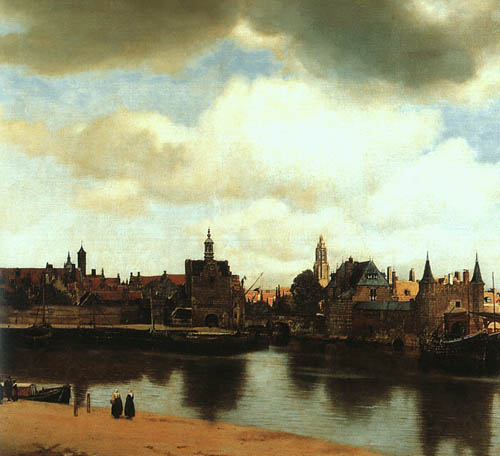
It's called View of Delft, and it was painted by Vermeer, in 1660-61.
I am amazed how much it resembles a lot of the photos I now try to take, across the Thames, with light striking some buildings but not others.
I was reminded of this painting by reading, as I have been, a book called Maritime Supremacy and the Opening of the Western Mind. Chapter 4 is about "The Dutch Golden Age", and here's how it starts:
The prosperity of the United Provinces in the mid seventeenth century was evident to all visitors. They marvelled as much at the freedoms its citizens took as their birthright. Descartes, acknowledged as the first modern philosopher, since he admitted the new principles of science into his system, wrote his seminal works in Holland, because of the unique intellectual and religious freedoms he found there; there was no other country in which one could enjoy such complete liberty, he declared.' The English ambassador at The Hague, Sir William Temple, who travelled incognito through Holland, afterwards expressed his admiration for the liberty 'the Dutch valued so much' - in particular, 'the strange freedom that all men took in boats and inns and all other common places, of talking openly whatever they thought upon all public affairs, both of their own state, and their neighbours'.Temple was equally struck by the religious freedoms. Calvinism was the official Protestant denomination, and no one could hold office in the republic without affirming membership of the Calvinist Reformed Church, yet a large Catholic minority and innumerable dissenting sects practised their own rites in their own places of worship and published their own sacred texts. Even Jews lived freely among the populace without being confined to ghettos; later they were permitted a synagogue in Amsterdam, which was opened in 1675. Such essentially pragmatic indulgence in an age of extreme religious intolerance so impressed the fourth Earl of Shaftesbury he recommended that England follow suit, in order likewise to attract and retain skilled workers.
I never really learned about the Dutch when I did history at school. They were merely a vague interlude between the French (bad) and the British Empire (good, mostly). Yet for a while, they were the leading mercantile power of Europe and a beacon of life, liberty and property for all, secure against the depradations of the old aristocracy, who struck fear into the autocracies of the rest of mainland Europe.
And they celebrated all this by producing lots and lots of great oil paintings.
This, from Beyond Brilliance, looks like a fine idea. The idea being: a giant map on the floor of a public space, of the surrounding places. The one they illustrate is quite large scale, it would appear, and is in Washington DC.
My guess would be that, what with all these new materials (spin-off from Space Shuttles blah blah blah) everyone talks about these days, this kind of thing has got a whole lot easier to do than it would have been, say, twenty years ago.
I'm guessing ceramics would be how to do it. If you had a London map in, say Trafalgar Square, there would be nothing to prevent other almost identical maps, done with the same kit of ceramic tiles, in other open spaces, if the idea caught on and was liked.
And I know that ceramic tiles have improved dramatically in recent years, because I collect promotional mugs. The old ones get scratched when regularly washed, and the colours of whatever promotional junk is on them often fades quite badly. Coffee/tea gets stuck in scratches. Not good. But more recent mugs with lots of colourful messages on them remain pristine no matter what vicious scourers are applied to them.
Are there any maps like this in London already, for me to go and photo?
That, at any rate, has been my experience.
Take just recently. My latest clutch of second hand classical acquisitions included a double CD of assorted chamber music by Louis Spohr (at a mere fiver from Neil's barrow in Lower Marsh) and this SACD/CD hybrid disc of the Brahms Violin Concerto, played by Joseph Swenson (scroll down – it is there), on Telarc (for £:3.50 ditto). Excellent bargains both, and notice that, in my part of the market, SACD seems to command little in the way of a premium. (I bought it as much to scrutinise the new and – presumably – they think – improved CD case that SACD/CD hybrid discs come in.
The Brahms is a lovely piece which I can't hear too often, and of the Spohr discs, follow the link above, scroll down, and they end by saying this:
MDG Gold are releasing some wonderful recordings and should be given the appropriate accolades. This is an exceptional double CD set of previously released material that will give Spohr’s chamber music a significant boost and gain him many new supporters. Superbly performed and recorded this is a release worthy of inclusion in any serious collection.
So thank you Neil of Lower Marsh, very much. But I only feel this now, after the difficulties I am about to recount were surmounted.
Because, both these fine recordings misbehaved in my hitherto very satisfactory Marantz CD-48 player. The Spohr went haywire on side 1 track 3. The Brahms played for a while but then went completely crazy, jumping hither and thither like a mad thing, and eventually deciding that there was "no DISC" inside, regardless of the fact that there plainly was. With the Spohr disc, I blamed the Spohr disc. After all, most stuff is playing fine, so it has to be the disc, right? But then, when the Brahms disc was playing its evil tricks, I thought, hang on, maybe I've been here before.
A few years ago, a great many of my CDs started misbehaving, and I thought that (a) CDs don't last and had finally starting melting into oblivion, and that accordingly (b) Western Civilisation was now at an end. But then I thought, for no reason that I can recall, but I did, that maybe it was my CD player. So I bought another. My tastes in fi are relatively low – medium at best - so this was not an especially painful procedure. (What matters to me is adequate sound with no clicks and jumps.) And sure enough, from then on, almost all CDs except those which had quite clearly been stampeded upon by hippopotami worked fine. Western Civilisation could proceed with undimmed excellence.
So, when these Brahms and Spohr discs started misbehaving, I tried them on a different CD player, which this time I already possess. My Goodmans GPS 280 digital radio cum CD player. And guess what: no problems. None at all. The entire Goodmans GPS 280 cost only £100 or thereabouts, so it isn't the technical splendour of its CD player that is making the difference, simply the fact that the Goodmans GPS CD players is working properly, while the Marantz CD-48 is not now working so well. Nearly, because most things still play fine on it. Just not quite properly.
Come to think of it, I do seem to recall some mugs falling out of the mug cupboard on the Marantz CD-48. So maybe the descending mugs jerked the CD player out of alignment, or made some connection dodgy, or something.
Could this not be mended, for less than the price of a new CD player? Maybe, but who needs the grief of finding out. Have you ever tried to get a piece of electronic equipment mended? – after it's out of warranty, I mean? I have. Never again. They charge an arm just to tell you what needs doing and whether it's worth it, and actually doing it costs the other arm, and a leg. Forget it.
Our world is not now organised to mend things. It organised to make things. So, if your thing is not working, throw it away, and get another. Okay this doesn't work with cars yet (although give it time), but this is definitely the rule to apply to something like CD players. So that is what I will do.
The reason I mention all this is that, commenting on a piece I did on Samizdata about books, which also mentioned CDs in passing, Andrew Duffin had this to say about whether the CD format will last:
Well if it does you had better make sure you buy good ones; none of them seems to last more than about ten years before the information becomes unreadable.Stick to books I say. And vinyl for your music.
But I have many thousands of CDs which are the best part of twenty years old (including many second hand ones which were at least a decade old when I bought them), and the only time I've suffered a plague of jumpings and clickings is just before I replace a CD player, i.e. now, and that previous time. Apart from that, no worries.
So maybe, probably I would say, Andrew Duffin just needs a new CD player.
Further thoughts. CD copies tend to cause problems, in my experience, more so than factory done originals. Plus: could there be any significance in the fact that, like many of those copies, both the Spohr and the Brahms discs mentioned above are gold in colour rather than silver, on their playing surface? Does that make things harder for a very slightly wonky CD player to deal with?
Interesting comment at Cronaca about the documents re GWB's military record, forged or what? (Can't make copying and pasting from the original post work - deliberate on his part or just me being techno-dumb? - so here is the plain link.) His point is: the defenders of the documents sound to him just like people stuck with forged art, and trying to prove (if only to themselves) that they're genuine.
If there are seven reasons to think these things were probably typed in the nineteen nineties, even if they just about could have been typed in the seventies, then they almost certainly were typed in the nineties.
The forger's problem is suppressing the "impress of his own time".
ADDENDUM: RC Dean has an interesting Samizdata posting about how the blogosphere went to work on these forgeries-or-not-as-the-case-may-be-but-probably-they-are. One blogger does not a New York Times make, but the blogosphere does, more than.
Can't stay long. So just a recent favourite photo, looking up river from Westminster Bridge:
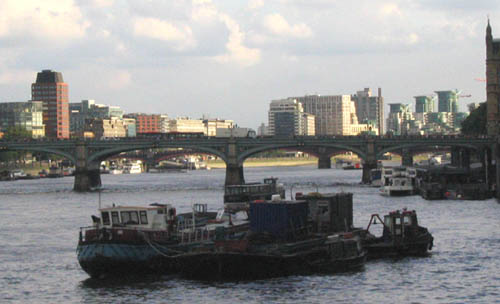
Click to get it bigger, with a bit more context. No cropping of the bigger one. Just a bit of lightening and contrasting.
I like the light on the buildings. Like one of those Dutch oil paintings.
Tomorrow, I hope, wedding photos.
I spent most of my blogging time this evening concocting this, so only time for a quicky here, in the form of a snap taken in the Underground of a movie poster:

I like this poster a lot, if only because of the cricket bat. How often do you see cricket bats in movie posters? And wielded by the leading man?
But there is another reason to pay attention to this poster, which is that it illustrates an interesting trend. Look carefully. This is not an advert for the cinema release of this movie. It is an advert for the DVD and the video. I remember being very struck when I first noticed this trend, which has surely only happened since the arrival of DVD.
Here, by way of contrast, is the poster for the original cinema release. No sign of that splodge of yellowness. What's that about?

That was to be seen a lot on phone boxes. Which makes sense, I think you will agree.
Interesting that the DVD poster makes great play of quotes from the critics, the way the cinema poster doesn't. Presumably this reflects the fact that the adult stay-at-home audience is the one that buys the DVDs and adults pay more attention to critics. I certainly find that I do, now, as I get more … mature.
Prediction In a few years time, DVDs and DVD players will have got so good that cinemas will in many cases simply be big DVD playing rooms, with both domestic machines and cinemas using the same software. Why not? Under the influence of the copying menace, movies will get more numerous, but on average "smaller", with the big hits being surprise successes rather than big blockbuster pre-crafted smash hits of the sort that will immediately attract piratical attention.
Michael Jennings will be giving my next Last Friday of the Month talk, on the 24th, about the impact of new technology on the workings of Hollywood, and although he may not talk about this particular matter (what with the impact of new technology on Hollywood being such a huge subject), I will try to remember to ask him about this. He has already told me that in his opinion the copying of big movies is done by treacherous Hollywood insiders (in a manner that Hollywood doesn't like to talk about) rather than by people sneaking into cinemas with cameras (the story Hollywood prefers).
The Proms. They're televising them all of this week. They take place in the Royal Festival Hall. The accoustics are controversial, but the place looks wonderful. Here's how the inside looked on the telly:
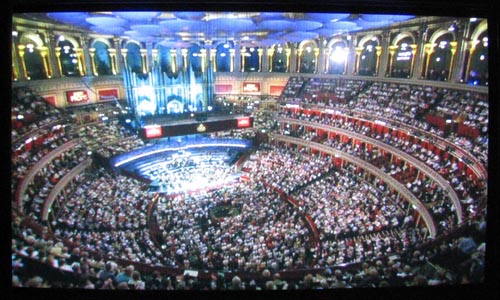
It was an all Dvorak programme, with the Czech Philharmonic conducted by Sir Charles Mackerras. For me the highlight was a fabulous performance of the Violin Concerto, given by Sarah Chang. She's an American, with parent originally from Korea.
Her technique is ironclad, and you knew that if this was how it sounded, this was how she meant it to sound.
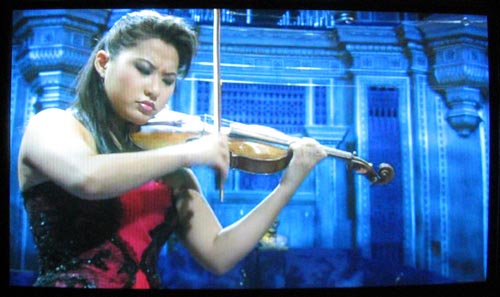
Which might have been why she was no obviously enjoying herself so much. I would too, if I could play beautiful music like this, as beautifully as she did.
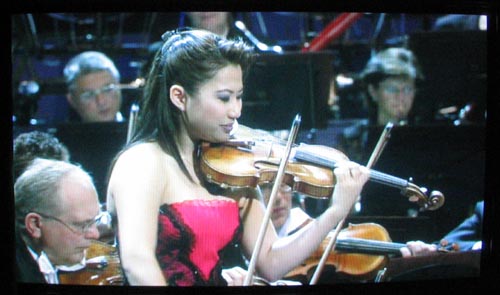
The rapport between her and Mackerras and his orchestra was excellent throughout.
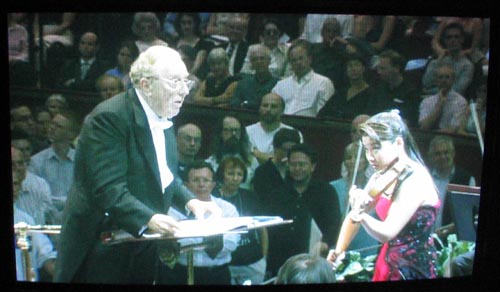
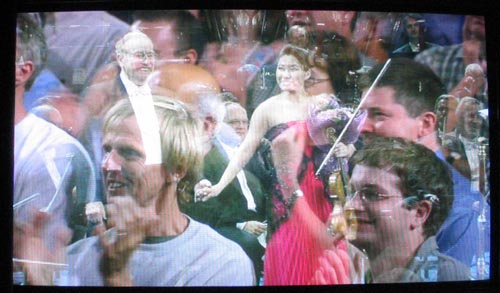
And the audience went predictably mad at the end. Here's one of those fading-from-one-to-other TV snaps I like so much, which saves me the bother of showing the audience clapping, and the performers lapping it all up, in two separate pictures.
Mackerras and the orchestra did the New World Symphony in the second half. I've nothing against this piece. It's beautiful. It's not its fault that it gets played so often. It's a fine piece, and they played it very finely. It was just that, for me, this evening, Chang playing the concerto was the thing.
This Concerto is not quite as well known as the Beethoven, the Mendelssohn, the Brahms, or even the Bruch. Maybe it's the glorious Dvorak Cello Concerto that makes it seem less wonderful than it really is. Ditto the Dvorak Piano Concerto, which is held in even lower esteem, for equally mysterious and bad reasons.
Chang has recorded this concerto, for EMI.
In case I don't manage anything else today, let me at least manage a link to this piece by Anthony Daniels about what a bad idea self expression is.
I first encountered the idea that self expression might be a bad rather than good thing when reading one of Karl Popper's works, about thirty years ago or more, and the thought has stuck with me ever since. I have always thought the "self" to be a somewhat vacuous notion, meaning only, roughly, the personal experience we all have at the heart of … ourselves, but not itself any different from the identical experience of selfhood that everyone else has. It is the things that assemble around the self, like memories, experienecs, and so on, which are the stuff of artistic communication, rather than the self itself, if you'll pardon the expression.
Daniels is right. If "self expression", in fact, on close examination, turns out to mean very little indeed, which is exactly what it does mean, then the expression becomes a license to express any damned old rubbish you care to settle on. It becomes an excuse for nonsense and tastelessness (and evil) of every imaginable kind.
Popper's point, if I recall it correctly, is that it is precisely the self that is not expressed in artistic, but more especially scientific activity. There is you, and there is your theory, and they are not the same thing. That being so, it is possible for someone to take a felling axe to your theory without you taking it personally. Such conjecture and refutation is the essence of science, and of scientific progress.
Self-expression is to art what modern individualism is to individuality: a pale and much distorted simulacrum, based upon a romantic rumour. According to this rumour, each person carries within him, by mere virtue of drawing breath as a human being, something not only unique, but of imperishable value, of which the world stands urgently in need. It must be expressed in public, or it is lost forever.
Daniels then goes on to defend convention against the menace of self-expression.
In practice, the need to express oneself, irrespective of whether one has anything worthwhile to express, leads to a rejection of convention and mass antinomianism. Of course, the rejection of convention is itself a convention, but this is not a thought that frequently crosses the mind of those desperate to express themselves. Nor is the fact that conventions may often be, without being always, of social and ethical value. When a writer in the Times Literary Supplement listed the late A J Ayer's virtues, he included among them that he was unconventional. This might indeed have been a virtue, but it might also have been a vice, indeed it might have included the very worst vices possible. Ian Brady and Myra Hindley, after all, were unconventional.
Quite so.
Last night I did a posting on Samizdata, about books, and about what fine things they are and what a great future they have. They certainly do in my flat. I asked about the history of book binding, because that is what makes books so convenient, and a commenter (Tatyana – thank you Tatyana) supplied this link. Bending-outwards books spines with titles would appear to have been sorted out earlier than I thought, in Italy – but presumably only at crippling expense.
 But the comments also turned towards E-books, and another commenter supplied a link to this gizmo, the Sony Librie.
The important thing about it is that its screen is a lot more like paper than the traditional computer screen. It is not back lit, any more than paper is when you read that.
Here's what Dalmaster said:
Reading from a traditional laptop doesn't allow the same kind of comfort as reading a book, even when small and light, they're often noisy and more difficult to read. Even take out all the things you don't need, make it book-sized, you have the problem of the screen.Several organisations have developed their own paper-like displays to solve this problem. They are pleasant to look at, require only a small amount of power (it takes power to change the picture, but it stays, rather than requiring frequent refreshing like a traditional tube, tft or lcd). Only drawback is that they're currently only black and white, and only available in Japan.
Which is surely a drawback that won't last.
Google google.
More Librie comment (and more Librie links) here:
First, the good news. Initial reports of the screen quality left me quite unprepared for the actual thing. The screen is unbelievable. Not quite paper, more like a dull plastic like look. My first impression of the device was that it was not an actual working unit, but a plastic mock up made for stores. With high contrast black text on a reflective background, the screen has a readability rivaling actual paper. The weight of the book is also quite a shock. About the weight of a long paperback, the book will be both easy on the eyes as well as very easy to hold and carry around.Running on 4 AAA batteries, the book is supposed to last 10,000 page turns, more than enough for extended trips, and the use of standard batteries ensures you'll never be stuck in a lurch.
Additional features include a memory stick slot for adding additional space for your library or BBeB formatted dictionary cards, a keyboard for using said dictionaries, and a well designed removable integrated screen cover. You can select text from a document and run it through a built in dictionary for a definition or even an English translation. A huge thing is the ability to play embedded audio files through a small built in speaker or earphone plug.
Overall this is a sharp, stylish, package with cutting edge technology. The perfect new gadget if it weren't for.
Then follows the bad news, which is bad, I do agree. But with technology like this, the good news stays good and gets even better, and the bad news just slides away into a puddle and is forgotten.
My TV system doesn't record digitally, and the analogue reception is garbage. Eventually I'll have some kind of Tivo/hard disc gismo. Meanwhile, life's too short to lash up an answer that will be obsolete soon anyway. So I generally now either watch stuff when it's on, or not at all
This evening I watched the first of four shows on BBC3 about guerrilla homes, which means little boxes craned onto the top of bigger buildings, or just lashed up without planning permission buit prettily enough then to be tolerated, from a kit of parts. Said presenter Charlie Luxton: "Planning permission sucks." Go Charlie. Now tell us what you think of property rights. Maybe you think they suck too? But without them, it's anarchy, and not in a good way.
Then I watched a Channel 4 documentary about the design of the new tower they're building in New York to replace the Twin Towers. I seem to recall hailing the idea of teaming Libeskind with SOM's David Childs as a good one. This show made it look like a complete mess. The Childs design would have been pretty good. The Libeskind design would have been pretty good. The Childs/Libeskind/Governor of New York design looks like it's going to be pretty bad, with a stupid, pointless point stuck on the top, in a way that has damn all to do with what is underneath it. Scroll down here for more about this show.
And then I switched to hearing the last bit of Messiaen's Éclairs sur l'Au-delà…, on BBC4. Very fine, by the sound of it, as supplied in their customary fine sound by the Berlin Philharmonic, conducted by Rattle.
Here is a link to the CD they've recently done of this piece. I think this will sell very well, and that in three months it will be havable in HMV Oxford Street for way less than full price.
I have been trying to like Messiaen's piano music recently, but have yet to succeed. The Turangulila Symphony sounds just that tiny bit too slushy and Mantovani-ish for my taste. This sounded rather better. On the strength of what I heard, I want the CD of all of it. When it's come down a bit.
I am still ploughing through more tons of mostly pointless paper, chucking most of it out, combining a mid life crisis with spring cleaning (in the autumn). And while doing some more of this today, I came across this bit of paper.
I made it in the mid-eighties. I had done some pieces for the IEA's journal, Economic Affairs, and had been on the receiving end of the editorial attentions of the IEA's Editorial Director Arthur Seldon. I hugely admire Seldon, and for as long as I was the Editorial Director of the Libertarian Alliance he was a role model.
But I was pissed off. So I typed out To Be Or Not To Be, and then said, right I'm Arthur Seldon. What happens? About five minutes later, there it was.

The IEA didn't use this in the form you see, as I had originally done it. They re-scribbled it. Amazing. Even when being sent up, they couldn't resist behaving in the manner being lampooned.
Whatever. This probably says more about me than it does about Seldon, and it will not amaze you to learn that I have never made much money writing for … well, money. But I think this bit of paper speaks for every hack writer who ever had his stuff yanked around by an interventionist editor, regardless of the mere merits of the matter. Anyway, enjoy. I tried to get it so you could click to get it bigger, but I couldn't get this to work. Hope you can read it as is.
By the way, the title I have given to this posting is a combination of two things. First, "To be or what" is a send up version of Sylvester Stallone doing Hamlet wittily invented by the actress Betty Thomas, who was once upon a time one of the cops in Hill Street Blues. I love that she actually had Stallone shortening the original, which you would have thought wasn't possible. And I have changed "what" to "wot" in deference to Seldon, who really did use this word. It expressed his overwhelming desire that matters be made clear, and the IEA was all the better for it under his editorial leadership.
Well, it's business as usual now, with me having no time to expand profoundly and fobbing you off with my favourite recent picture:

It's of the Towers of Docklands, as seen from the north end of Blackheath Common, with Greenwich Palace in the relative foreground.
And here's another version of the same view. There were lots of Billion Monkeys there, of course, but this great looking girl had a definitely non-Monkey camera.

My friends Alastair and Katy took me to this spot the weekend before last. I never knew it existed.
Have nice weekend.
I like photographing tourists, and I like it when some of the tourists are my friends. Because of them being in London and me wanting to help show them round, I get to visit some classic tourist traps of the sort I often neglect, because, what with me living here anyway, they can wait.
Thus it was that when some foreign friends were in town last week I found myself inside London's National Gallery. I should go to this place more often.
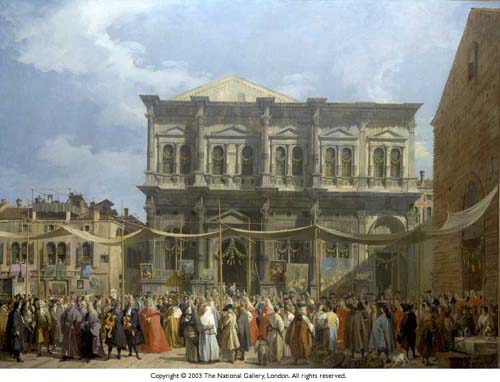
You can't look at everything in a place like this. The trick is to focus in on a few works, either predetermined, or which force themselves on your attention on the day. With me, it was some of the Caneletto paintings I found myself scrutinising, in particular, .
This is what the whole thing looks like (and I hope the stuff at the bottom doesn't mean I'm going to have scary lawyer enemies):
But what fascinated me was the detail. I was struck, in some of the other Canalettos, by how badly he did water, which he often made look like a shiny floor covered in white squiggles. But, I was also struck by how well he did people, and buildings, and by how much detail he was able to cram in, which only the very best reproductions show. I like his people especially. His figures seem to have been done quite quickly and rather schematically, but they really live.
This is a situation where the Internet really does not (yet) do it. Here is the kind of thing I mean:
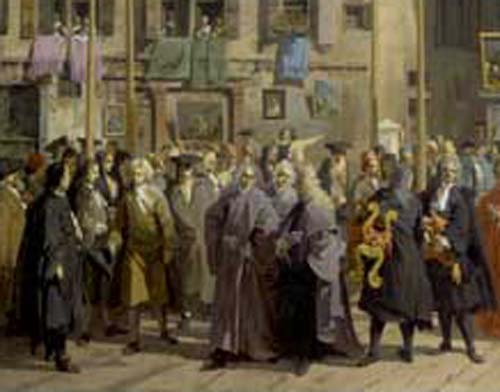
The original was much better, as I am sure you can imagine.
I had my camera with me while I was looking at this picture, but I don't think me using it would have gone down very well. Maybe there were postcards with detail like this. And I bet there are books with such details reproduced well. But no worries, because I can just go back to the original.
The other thing I found myself thinking, about the pictures in the National Gallery generally, was that there were lots of "famous" paintings on view. Suddenly, I started to wonder if their fame is a local thing, an English thing, a function of which paintings England possesses, as opposed to which ones by all these painters really are the best. Nationalism takes many forms, including the one that goes: our paintings by this foreign guy are better than yours.
I'm back, but only just. A week ago I was having dreadful Internet Connection problems (see below), and just half an hour ago I thought they were back, rather than me. But as of now, things seem to be working. So, further posts should soon follow. But maybe not as regularly as I would like.


