

Last night I watched Office Space. I remember having loved this movie when it was first hirable on video and I hired it. Now I own it on DVD. It was only £5.99.
And it's great. The running gag is that the heroes and heroin of the story are all being bossed by people who refuse to admit that bossing is what they do. "If you could do that, that would be really great" – instead of "Do that." Also, our hero, instead of having just the one boss, has eight of them (which is an easy mistake to make if you think that you don't have any bosses in your organisation at all) all of them asking our hero in the space of half an hour about the same trivial little mistake.
This is a highly stressful sort of regime to be subjected to. The superficialities of niceness are all being dumped on top of you, but in a deeply nasty and dishonest way, and your natural reflexes are thus screwed around with something chronic, the way they aren't by a boss who is honest about being that.
This movie is a throwback (in a more modest and Good First Movie way) to those fifties black and white Jack Lemmon movies, most notably The Apartment, in which a vast floor full of slaves slave away at desks, only now instead of desks it's cubicles. The moronically insincere language ( "Buddy boy!!") has changed, but is just as moronically insincere. Instead of pushing pens, the slaves push buttons on computers. But it's the same universe all over again.
The McGuffin, as I believe Alfred Hitchcock used to describe it, of this movie is the moment when a hypnotherapist (a) tells our hero to stop worrying about anything and just do whatever he feels like doing and to generally enjoy life, and then immediately (b) drops dead of a heart attack, which (c) leaves our hero in the (a) state permanently. That sets everything in motion, and creates a further string of great comic effects, as when he tells the complete truth about his job and how hard he does it and how he feels about it, to some visiting consultants.
Lumbergh, the Ghastly Boss, played by Gary Cole, is a truly wondrous creation.
Plus Jennifer Aniston is in it. She plays a character who is likewise neck deep in bullshit as the price of having her stupid waitress job. Her torment is that her boss wants her to wear lots of stupid badges, but won't just tell her to. Instead of simply obeying orders, she has to "express herself". Eventually, of course, that's what she does.
If you could watch Office Space, that would be really great.
Via b3ta.com, who never cease to amuse, a link to a video of a cute three-year-old Korean girl playing the xylophone, really very well, and with a look of profound satisfaction on her face which is what makes it so ultra-cute.
UPDATE! NORTH Korean three-year-old girl! That puts the entire operation into a completely different and much more interesting/sinister light. This website deserves serious investigation.
North Korea, for those who have been immersed in Brahms piano concertos and oil paintings etc. for the last twenty years, is one of the nastiest countries on earth, currently suffering from mass starvation.
Alice Bachini has been scratching about in her archives, and as a result I found myself reading this, again, about Modernist Architecture. It's terrific. Sample paragraph from near the end:
"However, the one thing that really did it for The Great Modernist Paradise Revolution was, bits of the buildings started falling down. This killed people. And when the wisdom of constructing blocks of flats out of plaster-of-Paris and old egg cartons began to be questioned by the normal folk at large, sadly and unjustly, even those architects who had used proper materials such as concrete were tarnished with the same brush by those idiotic general public morons without any understanding of Design Awards who don't know a Clean Line if its carrying its own mop and brush."
The inverted commas are there because this is an Alice send-up rewrite of a TV programme she'd just been watching.
One of the things anti-bloggists tell me is that blogs are here today and gone tomorrow. Electronic wrapping for virtual fish and chips. I don't agree. I think the archiving side of blogs makes it possible to pick out the diamonds from all the muck and shite, and put them in greatest hits lists, and generally treasure them for ever.
Most people wouldn't see it. But the readers of Brian's Culture Blog are an aesthetically sophisticated lot, and some at least of this elite will be asking themselves now: "Has there or has there not been some sort of a change in the way this blog now looks? I can't quite put my finger on it, but something about this place is different." Etc. etc. Quite right. Well spotted, those of you who did. Things have indeed changed here, visually.
But the content is unaltered. The only immediate practical consequence is that comments on ancient posts can now be accessed whereas before they couldn't, for some reason that I still don't understand. It is therefore more worth commenting on recent posts than it used to be, because others will be able to access your comments for ever and be amazed by them, instead of just while the post lasted on the front page.
My deepest thanks to the genius who did all this for me (and this as well don't forget). I hope some time soon to gather my thoughts on the subject of the aesthetics of blogs and to present some of them here. This is a subject concerning which I felt it improper for me to comment until now.
One opinion about aesthetics I am already sure of is that whereas I hope you like the new design, I am confident that if you don't like it but have tended to enjoy reading this stuff, you will be back, and will put up with the look. On the other hand, newcomers who love the look but don't like the content will probably not return very often, if at all.
Blatant quota posting, in the form of a fun photo I took a few weeks ago.
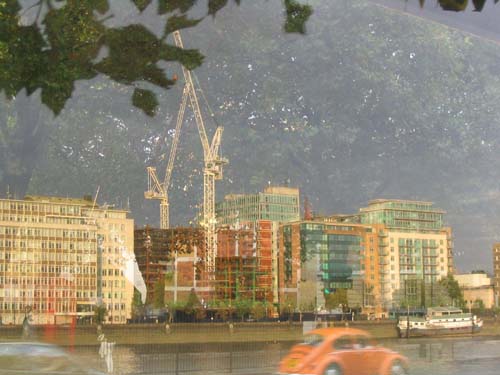
I know what you're thinking. Why is the sky above the buildings made of big leaves? The thing is: this is the photo I took. No photoshopping was involved. This is exactly how it came out of the camera. But if Photoshop wasn't involved, what was?
Answers in comments please. If anyone feels like it.
 Last week there was a little buzz in my part of the blogosphere about "defensible space", and about suburban cul-de-sacs as a better defence against plunderers than more easily accessible public spaces designed by collectivists who want to make community easier to do, but who forget what else is also made easier. You can plug into this debate by going to this Natalie Solent posting.
Meanwhile, here is proof that when the public sector really wants defensible space, it can contrive it with great definiteness. This is the new Government Communications Headquarters (known in Britain as GCHQ) building in Cheltenham. No chance of would-be intruders busting in on the not-so-public open space at the centre of this neighbourhood.
This is a book I'm going to have to get my hands on. Charles Murray, it would appear, is up to his usual tricks.
To judge by this New York Times review he is, as now seems to be his habit, drawing attention to his central and somewhat mundane thesis by decorating it with a few contemporary debate bombshells, calculated to (or just happening to) poke some burning sticks into a few vocal interest groups. The thesis is that the West has been more creative than the Rest, and one contemporary debate bombshell is that Europe in particular is in headlong creative decline because of the headlong decline within it of Christianity. So, many anti-Christians will queue up to denounce it. Murray also makes a stab at measuring creativity. With numbers. The cultural critics, who generally prefer to judge creativity by deciding how good they personally think this or that cultural object or enterprise is, rather than to measure it by bean counting other people's opinions and reactions, will be incensed at that.
Which means that I won't be the only person reading the book.
Some Q&A here, with Steve Sailer Q-ing and Murray A-ing.
Today Concorde flies for the last time, in England, I think. I really can't tell exactly what's happening today, which is being called a "celebration". Will the French be flying theirs some more? Will there be further celebrations? Will Richard Branson buy one and use it for holiday outings and to annoy British Airways, which he likes to do? Don't know, don't care. All that matters to me is that the serious flying career is ending, some time around now, of one of the most beautiful objects ever to take to the skies. I will almost certainly neither hear it or see it ever again.
Really good photos of the big bird are surprisingly hard to come by on the internet, although there are dull ones in abundance, mostly of one of them on the ground, or taking off which is impressive I do agree.
I like this photo because it shows Concorde as I saw it, from below, and dwarfed by the sky which it still dominates aesthetically. It captures the shape of the whole thing, whereas many of the pictures seem to focus in on close-up detail, like that extraordinary dipping beak, or the strangely thick neck, or those downward sloping wings as seen from head on.
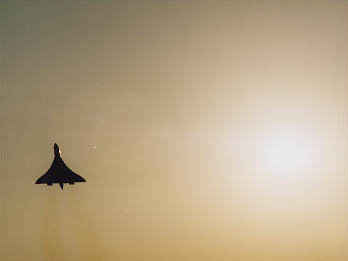
The ideal Concorde photo, for me, would have a vast and mundane London roofscape, with Concorde itself only a tiny fragment of faraway beauty in the sky. I might have taken such a photo myself, but I never got around to it.
A whole herd of hobby horses being ridden with this picture, which I took yesterday.

First, the glory of the Gherkin, this time seen from a distance. All else is mediocrity, in this, one of the many less grand parts of London, but the Gherkin shines out from afar as a pinnacle of excellence.
Second, the contrast between how the eye sees things and how the camera sees them, which as a camera-wielder I am starting to understand and make use of. My eye saw the Gherkin. My camera said: but the Gherkin isn't as big as this sign here, now is it? I did no cropping of this picture. That's exactly how it emerged from the Flashcard. I did not edit it to make my …
Third point, which is, as deliberately photographed, all the clutter in the foreground. On a recent TV show called Grumpy Old Men, shown last weekend on BBC2 TV, they had their GOMs complaining about the appalling number and incomprehensibility of the street signs and street barriers that now threaten to overwhelm every street and road in Britain. Matthew Parris was especially eloquent, as I recall. Well said.
Googling "Twin Towers in the movies" got me next to nothing, but I've just tried "Twin Towers" "Movies", and up came this, listing no less than eighty six movies in which the Twin Towers appear.
 All the ones I've been able to think of appear in this list, which gives me some confidence. If I'd not found, say, Family Man in the list, I'd have known at once that it was woefully incomplete, but there it is. Yesterday in my googlings I came across a picture of Melanie Griffith in Working Girl, with the Twin Towers in the background, but what I didn't realise until now was that the Twin Towers featured in the publicity poster. (The picture I found was simply a cropping of Melanie Griffith, with the Towers but without all the propaganda.) And there's Working Girl that is in the list also. Michael Jennings mentioned in a comment on yesterdays post that AI features the towers. And that's there too. So this list may well be pretty much complete.
Hollywood seems to have been rather baffled by the events of September 11th 2001. What is the appropriate response? Ignore? Do one of those multi-star epics about it all? Do stories "set" in the disaster, so to speak, with the disaster central to the story, but the story not being any explanation of the disaster? Do movies about people warning against terrorism and being ignored? So far there's been little response, other than a hasty shifting of the scenery for the first Spiderman movie, and such like.
But as this list of sightings of the Twin Towers in the movies shows, Hollywood was fascinated by these giant buildings while they stood. Hollywood was (and is) fascinated by New York, and New York was dominated by the Towers.
Speaking for myself, and I suspect for many others too, I loved those towers, but until those maniacs knocked them over, I didn't realise how much.
I still think that a coffee table book along these lines would be an excellent idea. But until today I didn't realise if anyone had even got to work on the subject, so maybe the book already exists too, and I just haven't heard about that either.
If it does exist, or if someone's working on it and it's due out soon, I'd buy it.
I've started to read a book by Bernard Levin called Conducted Tour, about his travels around Europe's music festivals during 1980.
In the introduction Levin writes of his particular musical tastes and early musical experiences. He has this to say about Wagner audiences:
It was only many years later, when I began to notice that there were more clergymen in the Royal Opera House on Wagner nights than at performances of any other composer's works, and that most of them were alone, that I also began to wonder what it was in Wagner that appealed to me so much, and what it was that I had in common with the clergymen and Shaw, and for that matter Hitler. We may fear the great emotions, but we need them, and if we cannot allow them into our lives directly, we are under the necessity of bringing them in vicariously, and therefore, we like to think, safely. Whence the clergymen, Hitler, and me. And whence, at last now, the weakening hold.
I like that. "We may fear the great emotions, but we need them, and if we cannot allow them into our lives directly, we are under the necessity of bringing them in vicariously, and therefore, we like to think, safely." That, it seems to me, captures a lot about the appeal not just of Wagner in particular, but of classical music, indeed music itself, generally. Music is emotion without any kind of involvement other than emotional involvement. It is involvement without a price, other than the price of being addicted to the music itself, the drug/disease metaphor being one which Levin makes much of, especially to describe Wagner of course.
And nowadays we know all about the relationship between emotional involvement and disease, more than Levin did when he wrote this. Music, you might say, is the safest sex there is. It is sex without sex.
Thinking of music this way also explains, I think, why people like me are so keen on owning music, by owning the physical objects that make it available. By owning a CD of some music, I diminish its power over me, because I can then play it whenever I want. I no longer depend on some dealer to give me my fix.
A thought process I notice in myself goes a stage further, in the form of precautionary CD purchasing. I buy a CD before I've ever heard the music, just in case I become addicted to it, and hence would find myself hopeless deranged by having heard it once, on the radio or at a concert, but not then being able to hear it again and again. Classical music – I need its power to stir in me the great emotions, yet I fear it.
Sub-hypothesis: hurling yourself head-first into contemporary pop music is an entirely different – indeed emotionally opposite – thing to becoming enthralled by classical music. Classical music supplies another world, and hence an emotional distance. Loving classical music doesn't involve having messy love affairs with people who wear powdered wigs and have servants and who travel about in bumpy and inconvenient horse-drawn carriages. (As various other genres of twentieth century popular music sink into the history books, the same applies to being a fan of them.) Time lends emotional distance. The actual people who did it are all dead – or old, which amounts to the same thing for these purposes.
Hurling yourself head first into the pop music of your own time, and in particular of your own adolescence, on the other hand, means getting all messed up by it and involved in it, and involved with all the other people who love it, and having messy love affairs and sexual flings with them. A pop music concert is a true community. A classical audience, by contrast, is a mere assemblage of the separate.
(Thought: The Proms defy this general categorisation, which might be why Proms and the Prommers inspire such love, and such loathing. Prommers treat classical music as if it was contemporary pop music.)
I realise that I am confirming a widespread popular stereotype here, of the classical music nerd who fears real life, in the form of real emotional entanglements. But I can't help that, because I believe that this stereotype, like so many stereotypes, is rooted in the truth.
Those Twin Towers. They were everywhere in the movies, I tell you. I'm watching X-Men, the original one, made in the year 2000, on TV. There's been an historical flashback bit, and seconds into the "and here we are back in the near future and in colour" bit … another sighting of the Twin Towers, in a big picture pinned up in a teenage bedroom.
Has anyone done a book about the Twin Towers in the Movies, itemising every shot of them in every movie that got general distribution, between the time when they were built and the time they were knocked own? Someone should.
My favourite book in this XXX-in-the-Movies genre was called "Cluck!" and was subtitled: "Chickens in the Movies". I can only remember one chicken of significance, which was the one chased by Rocky to improve his footwork, in the original and best Rocky movie.
I've just googled "Twin Towers in the movies". I got this feeble apology for a list. And I got this.
Every time I mention anything here about the Gramophone, the magazine that puffs and (if only to make its puffs count for something) complains about the latest classical CDs, I have to deal with its weird dating habits. I don't mean its attempts at romance, I mean its weird way of selling an issue in the middle of May with the word "July" on the front. I don't know the full explanation for this odd practice, but I do know part of it.
Part of the reason for this weirdness is that in Gramophone-world the year has thirteen months. There are the regular months that you and I are familiar with, and then there is that strange month which occurs around now (i.e. between November and December in Gramophone-world time), known to the classical music recording industry as the month of the Gramophone Awards. A separate and otherwise undated issue of Gramophone is issued containing the news of who has won all these awards this year (which is 2003 by the way, not 2004 as you might now be fearing – that much of the regular calendar still remains as we know it).
The strange thing is that in this Gramophone Awards issue, not only is there news of all the Gramophone Awards winners (for 2003). There is also a great gob of regular reviews just as if this was a normal month of the sort that the rest of us are familiar with. Not only do we learn that this year the Gramophone Awards record of this year is the Zehetmair Quartett's recording of Schumann string quartets on ECM, that the conductor Marin Alsop is the Gramophone Awards artist of the year, and so on and so forth. We also learn that the Editor's Choice for Record of the Month, for the month of Gramophone Awards, is Magdalena Kozena's CD of French Arias by Auber, Berlioz, Bizet, etc., on DGG, together with the Editors choice of all his other favourite CDs of for the month of Gramophone Awards.
Odd.
This site was out of business all of yesterday afternoon and evening, because Hosting Matters was kaput.
It's now the smallest hour of Wednesday, and I'm watching one of those delightfully pointless French films with one guy and three girls he has to choose between. He is somewhat weak and somewhat selfish and more than somewhat indecisive, and consequently, without particularly meaning to be, somewhat cruel. I know a young man almost exactly like him, in appearance, in behaviour, and in the fact that the girls just queue up to be tormented by him. The actresses all have bigger bums than you expect of actresses, which makes them look like real people, which I like. All they've done is walk about, and talk. No expense has been incurred, all expense has been spared, which I also like, although everything looks great because the setting is the coast of Brittany, which I like a lot. Because it's not Hollywood, you can't tell what's going to happen next. I'm enjoying it, even though it has subtitles, which I hate. Oh bugger, it's just finished, and nothing was decided.
Am I now allowed to say I didn't enjoy it as much as I did, until it stopped? I fear not.
I've just done an extremely and I fear excessively long posting at my Education Blog about the idea of education as a social display mechanism. Education as peacock feathers, I called it, and it was inspired by a piece at 2 Blowhards. So if a daily fix of culture from Brian is necessary to you, you will almost certainly have to make do with that.
I warned you all about this kind of thing a long time ago, before any of you were actually reading this, so maybe I should say it again. There is usually (although not always) something here each day. But that something is not always a real post. Sometimes, as today, it's a bullshit post.
I am having some thoughts about photography, but then again, I have a DVD out from Blockbuster which stars Julia Stiles. My thoughts about photography. Julia Stiles. Good night and see you some time tomorrow.<
Busy weekend, obsessing and writing about rugby, and also spending a great gob of time watching Whit Stillman's movie Metropolitan, one of my all time favourites. So, not a lot here, in other words.
Various websites I've looked at have described Metropolitan as containing lots of sitting about and talking about nothing. There is indeed lots of sitting about and talking, but it is not about nothing. It is merely about things that most people can't be bothering with, but which some people can, like writing, downward social mobility, and so forth. Also, in extreme contrast to your average Hollywood non-left-wing movie, people say interesting things about once every two minutes instead of about twice in the entire thing. I hereby nominate Metropolitan as a key blogosphere work of art, because in it the heroine falls in love with the hero entirely on the strength of what he has written.
I also did a bit yesterday about plastic surgery, another of those pieces which began as something for here (or for here) but which ended up on Samizdata. This painful picture is of the British actress Leslie Ash, who used to look like this but who now looks like this:
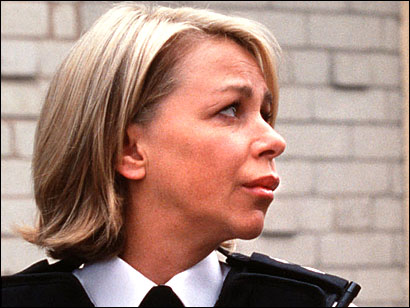
The horror, the horror.
In the rest of my blogging time today, I'm going to try to write something More Serious for Samizdata.
You never know when it's going to hit you, and it just hit me again. I'm referring to Classical Music, which a few hours ago now, before Friends and Will and Grace and Scrubs and Have I Got News For You and all the other Friday night amusement on British TV now, just reached his vast fist out of the musical wallpaper and gripped me by the throat.
I put on the Brahms First Piano Concerto and it duly thundered away for its allotted forty five minutes, in a way that impinged upon me hardly at all. Very nice. So then put I put on the Brahms Second Piano Concerto, and half way through the first movement I went for a piss, and it occurred to me when I was on my way there that it was on rather loud, and that it might be disturbing the neighbours. The fact that it hadn't been disturbing me at all until I noticed how loud it was when I was in the next room isn't logical. But there it is, that's how it was. So anyway, I paused it, switched off the loudspeakers, put on my headphones, connected up my headphone, and resumed it. Bloody hell, it was fabulous. It was one of, I now realise, my favourite recordings of this much recorded work, the one done in 1964 by Geza Anda with Karajan and the Berlin Philharmonic at the height of their combined powers.
It may have helped that the sound was switched up to something a bit louder than my headphones could really handle. This served as a satisfactory substitute for the now obsolete idea that the musicians ought to be struggling with music which is beyond their power to perform, which I am sure used to be an intrinsic part of the appeal of pieces like this. Will the soloist hit all the notes? Will he remember it all? Will the horns fluff their big moment? Will they all manage to stay together? Of course you know the answer to all such questions with a CD, which means that this sense of possible catastrophe just round every corner has to be recreated by other means, and my headphones (£9.99 in the market about ten years ago) do that job splendidly.
Geza Anda was Hungarian, I believe, and made another favourite recording of mine from the days of LPs, in the form of the Bartok piano concertos with fellow Hungarian Ferenc Fricsay, and his Hungarianness surely helps for this Brahms piece also, which is likewise full of gypsy cross-rhythms and such like. And the Karajan accompaniment is absolutely fabulous, wonderfully lush and vigorous and forceful and sonorous. This Brahms recording, unlike the Bartok of which much has been made ever since they first did it, is one of those lesser recorded beings deemed not worthy of having photographs of any of the musicians on the front of it, or even of the composer. No, it merely has some old houses on it, which puts it only one up from a box of chocolates or a puzzle. But second rate it absolutely is not. It's terrific.
Karajan is terribly unfashionable these days, the basic complaint being that he was just too good. The music he made was too beautiful. He was, you might say, the opposite of my headphones. But in this Brahms he uses his extreme musical excellence to take the music to its outer limits, rather than to make it sound merely comfortable. And anyway, what's wrong with perfection I'd like to know. Not all music makes its impact by sounding impossible to play. Lots of it is just beautiful.
Or then again, maybe it was just me, and maybe I had just been storing up inside myself the readiness to pay some serious attention to some music, and this just happened to be it.
I've been googling to try to find a link to this recording, but all I got was huge lists which it was buried in the middle of. But I was reminded in my googlings that Anda made another recording of this same piece, also with the Berlin Phil, but this time with Fricsay conducting. Yes, the very same accompanist as in the famous Bartok. This is considered better than the Karajan one, because Fricsay (having made far fewer recordings) is considered as brilliant and "musical" as Karajan was bland and power hungry. And guess what, I have that one also. I'd forgotten about it. I shall try that soon as well, also with the headphones, and hear how it compares.
There's an absolutely brilliant piece over at Alice Bachini's about how talking in a foreign accent makes you into a different person. Commenter number one is me saying do please finish this because it's terrific, and introducing a few changes of subject by way of encouragement (I hope). And commenter two is saying how right it all is, with examples, this time of people who are switching entire languages. Even if this piece ends now it will still be wonderful.
UPDATE: She finished it, with a description of the specific vibes given off by an American accent, welcoming, optimistic, confident, etc. Another commenter agrees.
More on the theme of good enough sound being good enough, if there are other important benefits along with it, in this case ultra-portability:
LIKE the herds of ever-smaller personal cassette players that roamed the earth in the 1980's, droves of tiny devices that play music in digital form are peeking out from pockets, purses, briefcases and backpacks everywhere you turn these days.Although some will argue that their audio fidelity is not as high, digital music players do have one distinct advantage over the portable cassette, disc and minidisc players competing for the public's ear: you can leave the tapes, CD's or minidiscs at home and still listen to lots of different albums or mixes. With a digital player, you can carry anywhere from two hours to four weeks of continuous music with you, ready to pour through your headphones.
Even since I read an Instapundit piece from way back when saying that the science and technology coverage in the New York Times is outstandingly good, I've been going there almost every day to check out what miracles and wonders they've got this time. (This was a recent find there.) These little music boxes aren't especially miraculous or wondrous. Most of us probably know by now that they exist. But how do they work? Which one to get? The next paragraph ends thus:
Here is an outline of what you need to know and acquire to get your music moving.
I don't care for portable music myself. But if it's your bag, and you want that bag to be extremely light …
Alan Little went to an art exhibition today. Well, actually it was on the twelfth. He emailed me about this, and if only to encourage others to email me about matters cultural that they've written about, I duly link. Apologies for the delay.
I found this paragraph to be the one that really intrigued:
Also striking was how much better and more interesting the "modern art" (for want of a better term for the art of the first half of the last century – there was very little on display that was less than about forty years old) was than the older stuff. People who dismiss modern art can’t, I conclude, have spent much time looking at eighteenth and early nineteenth century European art, most of which is hideous. I doubt if even Damien Hirst or Tracy Emin has ever produced anything as ugly and ridiculous as a sparkly porcelain bundle of asparagus.
I had a similar albeit not identical reaction when I went round the non-modern English stuff in the Tate, being struck by how bad I thought the worst of it was, how feeble, how small, and how much more exciting and shiny and "sparkly" (to echo Alan's phrase) the very same things looked in some of the book and magazine reproductions of them I'd seen. In particular, many of the William Blake pictures looked like they'd been dashed off on the backs of envelopes, which for all I know they may well have been. And he's supposed to be really good.
It's a change of subject, away from the badness of Ancient Art, because actually I don't think that Blake was an "artist" at all, in the orthodox sense that his pictures are at their best when you view the original artwork itself. Those originals are just that, artwork. They are instructions to a printer, and once the printer has got to work, they can actually look better than those originals. I'm not saying that they actually were instructions to a printer when he did them. I do not know, and would welcome education by comment, as often happens to me here. But I do say that this is how I think they work best. For me.
William Blake's pictures also work very well on a half-decent computer screen, I think. Maybe that's because a computer screen supplies an internal light source, which many of Blake's pictures cry out for, but which in the original they just do not have. Also, the originals are absurdly small, compared to, say, the big shiny posters that are made from them.
Talking of inner light sources takes me back to the Italian Renaissance, where, although they didn't literally have electric lights behind their paintings, they were masters at making it look as if they did.
I did a posting a while ago on Samizdata about a really interesting invention, which was basically a computer screen which did not have a light source behind it or otherwise built into it, and which only reflected light off its surface. It behaves exactly like a regular printed photograph or a painting, in other words. That'll be an interesting development, assuming it develops.
In general, when I go around a really big and famous art gallery, with lots of pictures from all the different art eras, I'm struck by how fabulous the very first oil paintings often were, compared to a lot of the later ones. Those first great renaissance set piece religious paintings were like Hollywood epics, and it can't be an accident that when movies first arrived at their technical peak, a lot of movies looked like renaissance paintings, and I don't just mean the Biblical epics. It's as if those first few generations of painters just exulted at what was suddenly possible, and maybe also suddenly allowed, the way only movie makers do now. And it occurs to me that the Bright Shining Dawn of movie making has maybe now, on the whole, drawn to a close. Or maybe it's me, and I'm getting old and am not myself dazzled by the sheer look of movies any more. And my impression of the Renaissance upstaging the later stuff may merely reflect either that this particular art gallery had better Renaissance stuff than later stuff, or that there was just as much good stuff done later, but a lot more bad stuff. Which I would suppose is the truth.
As for the general run of bad Ancient Art, I agree with Alan that there's tons and tons of rubbish out there, not involving the twentieth century at all.
A bit of a ramble, I fear, and no doubt hideously misinformed. Oh well. I'll learn.
Never have I more enjoyed a close-up picture of an elephant's bottom ejecting elephant crap. I'm referring to the joyous moment when, having switched on my TV last night just after 7pm, I switched over to BBC4, where an elephantine David Attenborough show was just getting going. And BBC4 worked. BBC 4 had previously come, and then gone, and for months now, it's been gone. But Michael Jennings dropped by yesterday.
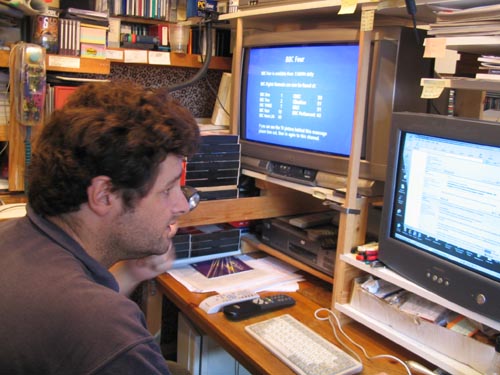
Although he was unable to do anything to the TV aerial on account of the door (to the communal roof to which the TV aerial is attached) being locked, Michael did do some downloading magic which, it is now clear, did the trick. For the few hours before that happy, crappy moment, I had to make do with Michael's claim that it "should" work, and we've all heard "should" from techies haven't we? – to be followed quickly by doesn't. Only this time it was did. Long may it last. BBC 4 is the most cultural of the free digital channels, so this is a most happy development.
Michael also contrived for my TV to spout forth all the digital radio programmes. So there we go. I wait years for a digital radio, and then suddenly two arrive.
To be less frivolous, this story illustrates the value of (a) Other People, and (b) Cities, which contain such a great choice of Other People to choose from and to cultivate, so that when you want your TV set to work better, you can pick an Other Person to do it for you.
You can't do things like this nearly so easily in the countryside.
Okay let's try what Natalie said.
At first, nothing. Then I tried one of the Samizdata ones, and that worked:

And the sanscrit in that one was what Natalie said. So I went looking again for the violinist, and found one. Not as good as the first one I found (but have now lost) but ...:
AND ALTHOUGH AT THIS POINT I GOT A SMILEY VIOLINIST, I HAVE - SEE COMMENTS, AND UPON FURTHER REFLECTION - TAKEN IT DOWN UNTIL I KNOW HOW TO GET A SMILEY VIOLINIST WITHOUT ANGERING ITS ORIGINATOR BY LINKING TO THEIR WEBSITE ALL THE TIME.
So, progress. If you think miniature animated violinsts is progress.
Now I have to work out fitting it to the text, but one thing at a time, eh?
In the latest issue of the BBC Music Magazine (November 2003), there's an article by the now 75-year-old Gary Graffman, who was a star concert pianist until injury cut his performing career short. For the last eighteen years he's been the head of the Curtis Institute in Philadelphia, which trains performers and composers. I'm not aware of this piece being available on the net, and I accordingly quote from it at some length.
When I started out as a pianist, in the late Forties, there was no such thing as an American orchestra that played – and therefore, was paid – for 52 weeks a year, and the salary of an orchestra player was not a living wage. And since there were far fewer concerts than there are now, opportunities for soloists were a fraction of what they are today. At that time there were only two major American concert management organisations with a total of about 40 pianists between them. This year's Musical America Directory lists over 600 pianists. And I can't even begin to compare the number of existing orchestra and arts organisations with those of 50 years ago. So perhaps we should be worrying more about glut than decline.The audience for serious music has grown apace, too. Fifty years ago, New York had only one large concert hall and, aside from Horowitz, Heifetz and Rubinstein, very few performers filled it. I remember often sitting in a half-empty Carnegie Hall to hear New York Philharmonic concerts conducted by Bruno Walter, Artur Rodzinski and Dimitri Mitropoulos. In those years, though, nobody expected the world to beat a path to Carnegie Hall.
I wonder whether a good part of today's distress about 'declining' audiences has been caused by the unrealistic expectations of arts administrators. Do any of them actually remember what the music business was like in those longed-for Good Old Days? I think if they had been around then, they'd be a lot more realistic now. Meanwhile, greed rears its head: many administrators, carried away by uncharacteristic success in recent years, have come to believe that their potential audience is unlimited. As a result of this insatiable hunger for expansion – ever more performances in ever larger auditoriums – musical activities have gradually been stretched far beyond demand. And so the music marketers, chasing their tails in the endless search for the larger audiences needed to pay for the costs of the endless search for larger audiences, have begun to tamper with artistic matters. Pops music and potboilers, video enhancement, light shows and 'crossover' artists have begun to invade the symphony concert hall with results, I fear, that will succeed only in alienating true music lovers.
I think its crucial to understand that the demand for serious music is – and, in my opinion, always will be – quite finite. In any culture, at any time in history, interest in the arts has been shown by only a small minority of the population. It is neither a necessity for survival nor an instinctive human response. In most cultures this instinct has been an acquired taste. But I think we must also bear in mind that not every person, no matter how well educated, will necessarily become interested in what is known as 'classical music.' So what? Nobody is trying to get me to attend a wrestling match; why should I try to make someone who prefers wrestling to Beethoven attend a symphony concert?
I call that a breath of fresh air, don't you? You don't usually get perspective and sanity and sheer common sense like that from a performing artist.
The thing is, the classical music recording industry may be in all kinds of mess, but the appreciation of classical music is jogging along fine. And all those recordings, done by Horowitz, Heifetz and Rubinstein (and Gary Graffman) are out there working their magic.
I don't normally like those twee little smiley faces laughing, being sad, waving sticks, etc. But here's one I found by accident that plays the violin. The instructions for it say this:
http://media.fastclick.net/w/click.here?cid=10584&mid=24091&sid=11905&m=4&c=2058
But what do I attach to that to turn sanscrit into the picture?
Last time I posted a technical query I got the answer very quickly, so I'm optimistic about this one too.
If the comments are as helpful as I hope - and actually rather expect - this posting will have the answer added to the question. Thanking you in advance.
And if this works, how and where can I get other culture-related smileys?
I don't know how Natalie Solent came across this piece by Perseus, but I'm glad she did because I've been wanting to read a piece like this for some time, doing some crude number crunching for the entire blogosphere, but haven't come across one on my travels lately. I know it's navel gazing, but I happen to like the look of my navel now that I'm a blogger but still relatively new to it. I didn't realise, for instance, how much more of an impact Movable Type makes in the multi-reader blogosphere (where I hope I live) than in the nano-readership blogosphere (where it apparently hardly registers).
So, will blogging march forward to cultural prominence, or will it be forgotten?
It's surely the top of the blogosphere, or, to switch to the metaphor used by Perseus, the most visible bit of the iceberg, which will make the difference. If something replaces blogs and blogging for the likes of you, me and Instapundit, then blogging is doomed. I can't see that happening. I see blogging evolving a lot, and in due course changing out of all recognition, but I believe the tradition we've all now started won't be broken. But I would say that wouldn't I?
Blogging is surely already being replaced for all those teenagers with one entry per month until last June when it stopped altogether, and with no readership beyond (a diminishing number of) their friends and family. They'll want something more like mobile teleconferencing. Souped-up mobile phones, in other words. The kids will mostly jump straight to that, even as we bloggers find our own more evolutionary path towards something very similar.
A technology – or perhaps I should say something more like a "software pattern" – doesn't die out merely because a teenage fashion wave overestimates its possibilities and doesn't grasp its costs properly. Blogging doesn't immediately give you the readership of the New York Times, just because, theoretically (technologically), it could. To blog well enough to want to keep at it, you have to be able to write reasonably well and to want to keep at that, and be willing to build your readership from tiny to not so tiny to non-tiny enough to make a difference. Maybe most people could do that, but they don't want to.
Or, you have to be content with a readership scoring between tiny and not so tiny, which for this blog I'm happy with because my most important reader here is me. I'm the reader (I'll be rootling through my archives in five years time ever if no one else wants to) whom I most want to entertain with my stuff here, with the rest of you being welcome to read my culture-or-whatever diary over my shoulder. And again, most people aren't content with that kind of arrangement either. Ergo, the blogging kit, for most of the people who've bought it, ends up gathering dust in the virtual cupboard under the stairs. But I don't think that signifies.
Well there goes the opening game of the Rugby World Cup. Australia 24 Argentina 8. Not a classic. But it will not surprise Brian's Culture Blog readers that Wendell Sailor scored the opening try of the tournament. Not that any of you care, you Pommy-loving Pansy Poofders.
Is it just me or are sports tournament opening ceremonies getting more and more of a pain? It probably is just me, but I found this one especially dire. Working on my computer to take some of the pain out of it, I thought for a brief moment that I saw a burning swastika out of the corner of my eye, but it was just some Aboriginal figure, burning symbolically, or something. The Australians are apparently still at the Bogus Dancing Natives Stage of their relationship with their original locals.
In general, the thing reminded me of the rubbish that briefly went on inside our Dome on millenium night. Remember The Dome? The show was indeed dazzling, i.e. it had lots of colours and costumes and arsing about by huge gangs of people marching this way and that, and overweight women singing, but so what? It was a huge relief when ageing blokes in normal suits appeared, to make short and forgettable speeches about the forthcoming tournament that actually had something to do with the forthcoming tournament. I ought to watch Grumpy Old Men tonight (BBC2 – no link that makes sense and you don't have to search through for ten minutes – bloody internet), which is not the Matthau/Lemon movie, but a "documentary" of grumpy old Moaning Heads moaning grumpily about speed bumps, designer labels the internet, etc., but I'll be out.
My new digital radio continues to delight, so I switched the TV sound down (off if any music was involved) and listened instead to Arthur Schnabel playing Beethoven's Third Piano Concerto (I now realise I already possess this on CD but no matter), one of Rob Cowan's morning picks for Radio 3. It was followed by William Schuman's Third Symphony (not to be confused with Robert Schumann's Third Symphony). Cowan chose the early Bernstein New York Phil CBS (now Sony) recording, which sounded beefier and more effective than the later DGG remake by the same team that I have. It's a splendid piece and it quite cheered me up.
Have a nice weekend.
Category: Classical music • Radio • Sport • TV • This and that
You can always spot an arrogant ruling power by the way it hates old buildings. From eighteenth century earls forcibly ejecting whole villages so as not to spoil their classical gardens to twentieth century slum clearances that cleared social cohesion along with the slum, there is nothing a power-freak likes better than replacing a muddle with a slab. China is busily smashing the Uighur quarter of the city of Kashgar. The ghost of Nicolae Ceausescu is cheering them on. Unlike his, this is one "modernisation plan" that is unlikely to be cut short by an uprising against the moderniser.
And I think that "There is nothing a power-freak likes better than replacing a muddle with a slab" should forthwith be posted at Samizdata as a slogan of the day. Done.
I like this piece by Friedrich Blowhard about Macbeth.
Friedrich's Macbeth reminds me of Shaka Zulu, whom I've just been reading about. He too was one weird guy, whose motivations don't seem to have been purely "political". He too seemed to be spoiling for a fight all the time, rather than merely a man who had to fight to achieve mere worldy ends. On one occasion, he banned sex for an entire year throughout his realm. Couples where the wife got pregnant were executed. How weird is that? Also, in Africa in those days and I daresay in these days too, the political atmosphere is altered somewhat by the tendency of sons to murder their fathers to get the top job, and the consequent tendency of fathers to murder their sons in order to prevent their sons from getting the top job.
Another possible Macbeth reference caught my ear recently. Apparently the recently deceased Alec Guinness wasn't much of a dad. No touching or hugging or affection, etc. One day, however, he did try to give his son a cuddle, and he called him his "chicken". "I'm not your chicken!" said the son indignantly, running away. Was that a reference, I wonder, to that appalling moment in Macbeth when Macduff learns that "all my pretty chickens and their dam" have been murdered by Macbeth's people "at one fell swoop"? I bet it was. And I bet Guinness identified with Macbeth like crazy. He must certainly have played him a few times. And how about this? (see paragraph one) – a small part in Macbeth seems to have played a big part in getting Guinness started as a pro actor.
Now I have to go looking for where I read that bit about his son the chicken (not).
Can't find it. I think it may have been in the paper Sunday Times, in one of the cultural appandages, a week or two ago. The episode is in a new biography of Guinness, I think, and I read a review of that.
The Philosophical Cowboy (link not working properly - scroll down to Sept 30 7.16pm), gearing up for the Rugby World Cup, likes this stuff.
With respect, as people say when they are about to say something completely lacking in respect hence the need to shake some verbal respect on with a verbal bottle of pseudo-respect, I … don't like it as much as The PhC does.
The real art of rugby is the game itself, and all the great photos of it that there are, and before that I daresay the odd painting. The idea that in order to make rugby artistic you have to subject it to abstract expressionism is insulting to rugby, and misses a basic point about art which is that it should be all of a piece. Art should be tight, and consistent, and the connections within it should make sense. The art should grow out of the thing itself, not be slopped on afterwards. This Adidas site makes "art" out of rugby in the manner of a Photoshop dork who thinks he can make his holiday snaps more "artistic" by pressing the Cézanne button. Okay, I'm taking it too seriously, it's only a bit of fun, blah blah, but this does suggest to me a wholly unjustified and unnecessary sense of artistic inferiority on the part of the rugby people.
That famous photo of Fran Cotton with mud all over him on a Lions Tour (that's the only www version of it I could find) is worth this entire Adidas site put together, artistically speaking (never mind rugbily speaking), and then some. No metaphorical violence was done to rugby with that photo. It arose completely naturally out of the game itself.
If those New York idiots who chucked paint about want to enjoy this photo too, and pretend that what they do, or used to do thirty years ago (isn't that nonsense rather passé now?), is being backhandedly referred to by it, fine. It isn't, but they can pretend if they want to. But the real art of rugby and of rugby photography is quite different.
Consider these two photos.
This photo doesn't capture the defining moment of this particular moment, which came a fraction of a moment later. What we see here is Jonah Lomu of New Zealand about to run over the top of Mike Catt of England. But we do not see Lomu actually doing it, although I've seen the exact photo somewhere that does show this.

This next photo, on the other hand, from the same site, does capture the exact moment of this moment, during the same game (NZ v England – World Cup 1995). That was exactly when Lomu got past the wretched Rob Andrew.

There's no need to splash paint about to make stuff like this artistic. Both photos have those blurry and "artistic" backgrounds that you often get in sports photos, if you like that sort of thing. Since it arises naturally out of the regular processes involved in photography (focussing, following the action by swinging the camera around to follow it, etc.), I do like this sort of effect a lot. It's quite unlike how the eye sees things, but that's half the fun.
To be fair to The PhC, he does have one terrific rugby photo up at his new World Cup Rugby site, namely the one of Wendell Sailor (who by the way is my tip for Man of the Tournament). He's the beautifully lit black guy, second row down on the right. Although, it does occur to me that there may also be something artistically contrived about this picture too. But if it is contrived, it's contrived in a good way, in a genuine hero-worshipping way, rather than in a pseudo-art way. It doesn't look as if it was taken during a game, but you never know, what with the floodlights they have for games these days … Maybe it was. Either way, it's dead artistic, I think. (Another argument for sporting floodlights!)
It really helps that the rugby players (like the soccer players) don't wear stupid costumes that drain the pictures of individuality, the way that cricketers and American footballers do. Complicated headgear is particularly damaging in this respect.
Okay these people are very post-modern and lefty and all that. I mean, here's what they think of the Pentagon.
But you do get a sense from their site of just how expressive the Internet can be when it's in inventive (don't miss this and this) and exuberant hands like these.
Well worth a look. Link via b3ta.com.
Continuing the technology theme, I liked these reflections a lot, from Michael Jennings, on the difference that communications technology makes to the texture of everyday life.
Michael's parents have email, and now read his blog to stay in touch. My surviving parent does not have email, and never reads this, or this, or for that matter this. Huge difference, to echo and adapt Julia Roberts when shopping in Pretty Woman. Huge.
I've just had an interesting blogging experience which I think throws an intriguing light on the subtleties of how specialist and generalist blogs interact with, compete with, and yet also help and feed into each other.
There's no doubt that my doubled-up specialist blogging obligations, here and here, have caused my other only semi- (blogging) obligations to suffer. I have written less for Samizdata of late than I would like to have. And have written hardly at all recently for Transport Blog or for Ubersportingpundit (even though I have automatic posting rights at those blogs also – I really must get back into the swing of posting at those, especially Ubersportingpundit, what with the Rugby World Cup, for which England are much fancied, fast approaching). So blogging here can definitely cause blogging elsewhere to suffer.
Sometimes, however, having a specialist blog outlet for something causes a piece to get written which might never have got done at all had there only been a big generalist group blog as an available outlet for it.
Over the last couple of days, I've written a big piece sparked off by me purchasing of a new digital radio. On the face of it, this piece was going to be pure self-indulgence: the boring details of Brian's domestic listerning habits, blah blah. Only the existence of Brian's Culture Blog, the entire purpose of which is for Brian to self-indulge, enabled this piece even to get started. Yet by the end of it, earlier today, I found that I had a really quite Good Essay under my fingers, and I thought, this could go on Samizdata. It's technological as well as musical. It throws a little light on all manner of commercial as well as artistic matters. There's a pop music angle, and there was even, at the end, an Internet angle, in the form of a sting in the tail of the tale about Downloading Music For Free Off The Internet, a subject of perpetual Samizdata fascination, because of the intellectual property debates we constantly have over there. So, to Samizdata the piece duly went.
Not only will the piece obviously get more readers there than here; I even reckon that there are people who will read it there, but who would not have read it here even if they'd come across it here. Why? Because a good reason to read anything is that others are reading it besides you. A piece about classical music etc. at Samizdata is a whole lot more significant than the identical piece about classical music etc. here.
So here was a case where my specialist blogging preoccupations actually helped me to write a piece for Samizdata.
I am now listening to BBC Radio Three on my digital radio, plugged into, as I explain at Samizdata, my regular CD playing kit. Fantastic.
And I'm listening to a wondrous performance of the Dvorak Piano Quintet, which is making more sense and more fun out of this piece than I've ever heard before. Fantastic, fantastic, fantastic. Sarah Chang and Ilya Gringolts (violins), Nobuko Imai (viola), Frans Helmerson (cello), Emanuel Ax (piano) – how's that for a line-up? Five players and five different record companies, according to my calculations. so good luck to anyone who tries to issue that as a CD in the next ten years.
Just to say, I like this picture, "A Portrait of a Woman" by Robert Campin (1375/80-1444):

I got it here.
There was a vivid illustration of the curative power of theatrical performance last night on the Jonathan Ross Show.
Quentin Tarantino was being interviewed (most entertainingly by the way) about his latest movie, Kill Bill. He and Kill Bill star Uma Thurman were in the middle of a huge and hugely strenuous Euro-tour to boost the movie. You know the stuff, thirty interviews in one day, giving the same answers to the same questions (as sent up in Notting Hill where Hugh Grant asks on behalf of Horse and Hound if there are any horses or hounds in the movie he's asking about, which turns out to be set in space).
Anyway, Tarantino's throat had gone. It was all he could do to make much of a noise at all, although he managed, and even seemed to enjoy things. At least Ross' questions were not the usual ones, and added some excellent analysis of the yellow tracksuit with black vertical stripes at the side that Uma Thurman wears in Kill Bill. Apparently it was what Bruce Lee was seen in during the very last piece of movie-making he ever did, and Ross even owned a costume just like it, which his wife had given him. He shown some photos of himself thus adorned, to the apparently genuine amusement of Tarantino and Thurman . So Tarantino seemed to be having a good time, but he was still struggle to say things.

ANYway. At one point in Tarantino's performance, he did an imitation. I wasn't paying much attention so I missed who it was or why who it was was saying what who it was was saying. But get this. Tarantino's voice was suddenly working full blast! It was quite amazing. And then when the imitation had finished, he went back immediately to croaking and choking, as if nothing had happened.
Usually when you see a performer thus afflicted, you either get him in "real life" (or what passes for real life with such people) and he can hardly say a word. Or you get him on the stage, and hear everything, and never realise that there's much of or even any problem. So for us theatrical civilians to witness this contrast on nationwide TV was really something. We've all heard about this thing, those of us with any interesting at all in theatrical performance. But it's not something we usually get to see and hear for ourselves.
Having TV on in the background, as wallpaper, is an underestimated form of entertainmnent, in my opinion. The chat show is a format which can be particularly effective as entertainment when taken or left in this way. At its worst the chat show is abysmal, wall to wall clichés and lies and insincerities and tedia. At it's best it can be truly sublime.
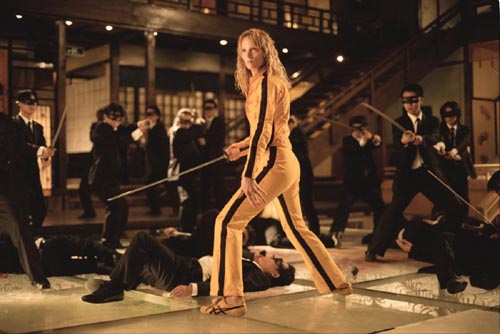
As for the movie itself, it scares me. Blood everywhere, apparently. But the stills they're hawking around are wonderful, especially this one above, which you can see full size here. I also like this one of Thurman and Lucy Liu having a fight. Liu looks like your granny, doing her limited best but doomed. Very comical. It's the costume, but also the gawky way she just happens to be looking at her (presumably) soon-to-be executioner.
Here's an interesting Blowhard insight:
Many people don't realize that the nothing-but-text, read-it-straight-through book that's still seen by many overly-serious people as the only kind of "real book" was a bizarre and anomalous publishing development; it was (in large part) a historical accident attributable to the difficulties of getting industrial-era publishing technology to manage images and text well.
A related myopia is that a lot of people don't seem to get that "books" and therefore also "literature" are not just one of the old arts – they were and are the first of the new. The first mass produced art, the first "modern" art. And I'll bet you anything that when those trashy "novels" (listen to the word for God's sakes!!), read by … everyone!!, there was all hell from the existing literati.
Now they fake up printed books to be like works of, you know, Real Art, and give them prizes for being profound and selling only twenty copies. It's as if they're trying to disguise their true roots.
Even more crazy, to me, perhaps because more recent and hence even more obviously ridiculous, is the attempt to dress up photography and colour printing as a fine, one-off, but-you-just-have-to-see-it-in-the-original-my-dear Art, instead of as machine arts. The whole point of photography, and of the printing press, is that you can have an infinite number of copies, each of which is just as good as the original.
How soon before the Art-snobbos demand to see the original digital electronic files of things, and to claim that no copy is really as good, and try to charge extra for the damn things? I wouldn't put it past them.
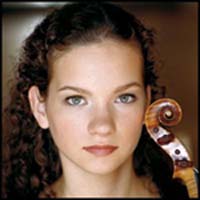 This is a picture of the outstanding young violinist Hilary Hahn, partly because I think she is outstanding, but mainly because I'm trying to get text alongside a picture and not just above it or below it, and Hilary Hahn's picture seemed like a nice idea, what with her looking so good in it.
The hiatus in Hahn's website activity is presumably because she has recently switched from Sony Classical to Deutsche Grammophon, for whom she has recently recorded a CD of the two Bach violin concertos, the double violin concerto, and the violin and oboe concerto. I've not heard this, but have heard all her earlier Sony records, and all are excellent.
Michael Jennings suggested something, which eventually, after I had tried several different places to put it, worked. Definite progress. So far so good. But now I want to be able to insert a wider margin between the picture and the text at the side. Can that be done with simple html commands? Or do I have to modify the original picture and put a blank bit to the right of it? That seems rather clumsy, and surely there's a better way. And unless I am mistaken, and that's been known to happen with me and matters computational, there already a little tiny margin around the picture now. On the preview I've been looking at, the picture is a bit in from being entirely properly aligned. That's not good. That's not how pictures in blogs are supposed to be. They are supposed to be LINED UP.
Don't be surprised if this posting does strange things, like change a lot, and/or disappear. Comment if you like, but take nothing for granted.
UPDATE: Actually saying what you did, exactly, means that it is liable to happen again instead of say what you did, so I will just say that I tried what Alan said for the margin right thing, after a hiatus working out what the hell he'd said exactly, and it worked, just as I wanted it to.
For the benefit of Alice I put something along the lines of %&_)$+)marginrightoverabit^&*)andlinethepictureupontheleftyoumoronicmachine$^%&*)&*^. So try doing that.
Micklethwait's law of how hard computing is say: everything hard until you know - then everything easy.
Today is supermarket day, in my little corner of the blogosphere. Both Jonathan Pearce and Michael Jennings, and coincidentally it would seem, chose today to write about supermarkets for Samizdata. David Sucher has already commented on these two pieces.
Jonathan, who lives a walk away from me, even wrote about the very same newly opened supermarket of which I am about to show you a picture. Believe it or not, this same new Sainsbury's that Jonathan wrote about is what I actually sallied forth to photograph with my new Canon PowerShot A70, last Saturday, when I got sidetracked by one of the other snaps I took into writing about this.
Anyway, here it is:

Notice anything odd about it? Correct. Well spotted. It isn't finished. The Sainsbury's supermarket on the ground floor is finished and open for business, but the stuff above is yet to be unveiled.
This must have happened before many times, but I've never before really noticed a building that is wide open on the ground floor, but still shut on all the floors above, because not even finished. I'll keep you posted. The longer the wait, of course, the more remarkable the contrast between how finished things already are at ground level, and how unfinished they are above.
As to what I think of the look of it, well, try as I will, I can find no mention of the intended look of this place on the Internet.
So far it seems very dull – corporate at its worst. That bland and unchanging first floor horizontal thick white slab, with those ghastly signs hanging off it, is presumably intended to make the place fit in with the other quite low buildings in the vicinity, but at the moment this looks more like an insult to these buildings.
But I have to say: at the moment. Because aesthetically, there's still everything to play for. When finally revealed, the final result could be anything from wonderful, with the first floor slab being the ideal foundation for what rests upon it, to boring boring boring, with the slab being but a foretaste of and resting place for further tedium. I really hope I'm going to like it, because as Jonathan explains so well, this place is already having quite an impact on the surrounding area. If it not only tastes good but looks good as well, that will be doubly good news for us Pimlicans.
Like Alice Bachini, with whom I saw them last Sunday, I liked the sculptures by Lynn Chadwick at the Tate. I preferred the semi-representational ones that were definitely people to the more famous ones, i.e. the ones I've seen a couple of before, that look a bit like birds but basically lilke weird things with messy horizontal heads.


This one on the left is the best Chadwick picture I could find on the Internet, which I got from here.
After Alice had gone I paid £8.50 to see the Bridget Riley exhibition, i.e. all the stuff done by the woman who did the one on the right, above. Seeing the originals adds nothing to seeing decent copies, except the knowledge that seeing the originals adds nothing to seeing decent copies, which is, I suppose, something. The paintings of Bridget Riley are artwork for the printer, presented as if they were regular paintings, and although I like them a lot, I'd already seen them all, in perfectly satisfactory printouts thank you.
Some of the pictures are like those bits of artwork they have in magazines to show you how the eye can sometimes be deceived, into seeing colours that aren't there, and into seeing diagonals which are really upright, and so on. Some of them look like that new flag someone has designed for the EU, like a multicoloured barcode. They aren't unpleasant. Many are very pretty. And if you do the same artistic thing for about four decades, it will have its own kind of single-minded impressiveness. But … the Chadwicks were much better to actually see in the flesh, I thought. The Chadwicks are still there, unlike the Rileys which finished on Sunday, and viewing the Chadwicks costs nothing.
My favourite Chadwicks, and I couldn't find a photo of these, were three ladies with shiny golden triangular flat faces, and with shiny golden rectangles of accurately done bosoms and bellies on the front of otherwise very sculptural and black and abstract figures. It was as if they had a window on their fronts instead of clothes.
If Chadwick's reputation had taken a slightly different turn, things like these, only smaller (as some of the Chadwicks themselves are - as Alice explains) could easily be the stuff of car boot sales, with the art critics all sneering away at their crass popular appeal and shameless playing-to-the-gallery quality, what with the nicest of them so clearly being of something.
If they were at a car boot sale, would I have liked them so much? Probably not. At the Tate the Chadwicks are keeping out stuff that would almost certainly have been far worse, whereas there's usually fun stuff at car boot sales, if you look. At a car boot sale I would have said: these are okay. At the Tate I said: Hey! These are okay! With modern art, you are grateful for small mercies.


