

Today I was in Oxford Street and spotted – and hastily snapped – one of my favourite things, this back of bus advert:

It's one of my favourite things because it combines three of my favourite things: Johnny Vaughan, London double decker buses, and the Erotic Gherkin. This is an advert for Johnny Vaughan's Capital Radio breakfast show, as you can see if you look carefully.
I'm trying to think of a new building in London which has been such an instant hit. The only other one I can think of which has been comparably successful is what began life as the Post Office Tower, and is now, presumably, called the BT Tower, although by now it could be something else again.
I can't help comparing these two popular hits with that lump out in Docklands, the Canary Wharf Tower, which impresses mostly because it is so big, but otherwise hardly at all. I've recently taken a couple of trips to Docklands. More about that when I've the time, and have mulled over the wording some more.
For another fine use of a bus, see the last of these pictures.

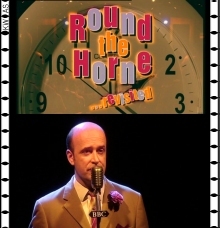 I've been watching Round the Horne Revisited on BBC4 TV, the bloke on the right being the revisited version of Kenneth Horne rather than the original.
Good line:
"His men would follow him anywhere, if only out of morbid curiosity."
Presumably this line was recycled from the original. I used to listen to Round the Horne on the radio when I was a kid, and also to a show which was I think its predecessor, Beyond Our Ken. I knew then that it was all chock full, if you'll pardon the expression, of innuendo, but didn't understand the majority of them. But half the time the fact of innuendo was the joke rather than the actual innuendo itself. Even the fiction of innuendo served perfectly well, i.e. when it only sounded like innuendo.
Kenneth Williams was the master of suggestive gibberish, but they were all pretty good at it.
My life just now is going through an odd phase. It will not last because it is absurd, but while it lasts it is strange, and I at least will enjoy reading about it in, I don't know, five years time, when the problem I am now mired in has been solved, and I've forgotten about it. (Never forget that my number one reader here is me. That explains a lot.)
But back to this odd phase. I'm talking about the fact that before I went digital, I could record TV programmes, and radio programmes, semi-satisfactorily, but now I can't. Now I'm sure that there are simple procedures for solving these problems, but the trouble is that just for now it they are too complicated. I'm sure that if I could get a routine going, I could record radio programmes on my hard disc and then play them back through the speakers attached to my computer. I'm pretty sure that I can't record digital TV now, until I get a "TiVo", or whatever those things are called. Recording digital TV on videotape is worse than analogue TV on videotape, because the sound is utter crap.
Please spare me the helpful advice about all this. There are more important things going on in my life right now than being able to record every digital signal that enters my kitchen. When everyone else is kitted out with the relevant stuff I'll get it too, and that will be that.
But meanwhile, my life has reverted to the pre-video-recorder age. My weekly clock is now governed by the Radio Times and its contents. I find myself inventing non-existent alternative dinner engagements, so that I can watch certain movies or listen to certain classical concerts, or watch a cherished re-run of Ab Fab.
Take last night. Basically, the job in hand was to write this about how Michael Jennings wants a job. I had promised it for Monday, and did actually finish it in the early hours of today. But alas, BBC TV 4, on channel 10, was simultaneously broadcasting, live from the new-olde Globe Theatre, London, the Mark Rylance Richard II. Which was fantastic.
Basically, I have nothing much more to say about this production than that. It was fantastic. It was outstanding. Rylance's characterisation of Richard was the most convincing I've ever seen. Bolingbroke was very fine. The John of Gaunt speech was very fine. Blah blah blah. Fine fine fine. Anyway, I had to watch it. It was last night or never (although actually of course they'll rerun it several more times and it will be available soon on DVD).
And in among it, I did the piece about Michael wanting a job. So, with digital TV, I write a bad article and Michael has to settle for a dead-end job. No digital TV, the article is brilliant, Michael becomes a billionaire uber-geek and lavish sponsor of Brian's Culture Blog which proceeds to take over the world. Such is history. Anyway, as I say, it's an odd time in my life.
And then this morning I had to get up at the crack of … well never mind, to listen to a promising Dvorak chamber music recording on Radio 3. Radio 3 is now a near continuous delight. Thank god it isn't all as good as some of it is, or I'd never do anything except listen to it.
Never have I more enjoyed a close-up picture of an elephant's bottom ejecting elephant crap. I'm referring to the joyous moment when, having switched on my TV last night just after 7pm, I switched over to BBC4, where an elephantine David Attenborough show was just getting going. And BBC4 worked. BBC 4 had previously come, and then gone, and for months now, it's been gone. But Michael Jennings dropped by yesterday.
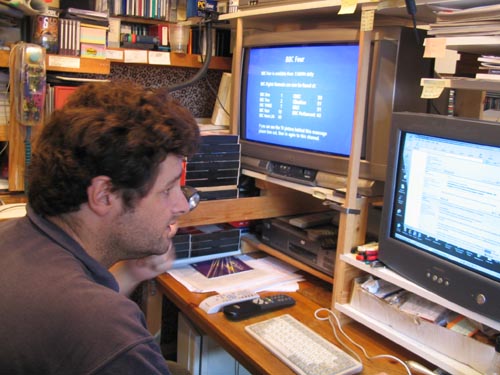
Although he was unable to do anything to the TV aerial on account of the door (to the communal roof to which the TV aerial is attached) being locked, Michael did do some downloading magic which, it is now clear, did the trick. For the few hours before that happy, crappy moment, I had to make do with Michael's claim that it "should" work, and we've all heard "should" from techies haven't we? – to be followed quickly by doesn't. Only this time it was did. Long may it last. BBC 4 is the most cultural of the free digital channels, so this is a most happy development.
Michael also contrived for my TV to spout forth all the digital radio programmes. So there we go. I wait years for a digital radio, and then suddenly two arrive.
To be less frivolous, this story illustrates the value of (a) Other People, and (b) Cities, which contain such a great choice of Other People to choose from and to cultivate, so that when you want your TV set to work better, you can pick an Other Person to do it for you.
You can't do things like this nearly so easily in the countryside.
Well there goes the opening game of the Rugby World Cup. Australia 24 Argentina 8. Not a classic. But it will not surprise Brian's Culture Blog readers that Wendell Sailor scored the opening try of the tournament. Not that any of you care, you Pommy-loving Pansy Poofders.
Is it just me or are sports tournament opening ceremonies getting more and more of a pain? It probably is just me, but I found this one especially dire. Working on my computer to take some of the pain out of it, I thought for a brief moment that I saw a burning swastika out of the corner of my eye, but it was just some Aboriginal figure, burning symbolically, or something. The Australians are apparently still at the Bogus Dancing Natives Stage of their relationship with their original locals.
In general, the thing reminded me of the rubbish that briefly went on inside our Dome on millenium night. Remember The Dome? The show was indeed dazzling, i.e. it had lots of colours and costumes and arsing about by huge gangs of people marching this way and that, and overweight women singing, but so what? It was a huge relief when ageing blokes in normal suits appeared, to make short and forgettable speeches about the forthcoming tournament that actually had something to do with the forthcoming tournament. I ought to watch Grumpy Old Men tonight (BBC2 – no link that makes sense and you don't have to search through for ten minutes – bloody internet), which is not the Matthau/Lemon movie, but a "documentary" of grumpy old Moaning Heads moaning grumpily about speed bumps, designer labels the internet, etc., but I'll be out.
My new digital radio continues to delight, so I switched the TV sound down (off if any music was involved) and listened instead to Arthur Schnabel playing Beethoven's Third Piano Concerto (I now realise I already possess this on CD but no matter), one of Rob Cowan's morning picks for Radio 3. It was followed by William Schuman's Third Symphony (not to be confused with Robert Schumann's Third Symphony). Cowan chose the early Bernstein New York Phil CBS (now Sony) recording, which sounded beefier and more effective than the later DGG remake by the same team that I have. It's a splendid piece and it quite cheered me up.
Have a nice weekend.
No time for profundity (i.e. excessive length). Just time for a quick rumination on the strange places that human instinct takes the solitary but connected human in these electrical times.
Do you often watch movies on television or listen to music from the radio, at times of their choosing, not your own, which you already own in a form that you could play to yourself at a time of your own choosing?
I first noticed this odd syndrome when I caught myself listening on Radio Three to a recording of Elgar's First Symphony which I already owned on CD. And not only was I doing this, but a fact to add is that my CD player makes far better sound than does my radio.
Last night, which was what reminded me of this, I watched large chunks of one of my favourite movies, The Right Stuff, which I already own on DVD, on television.
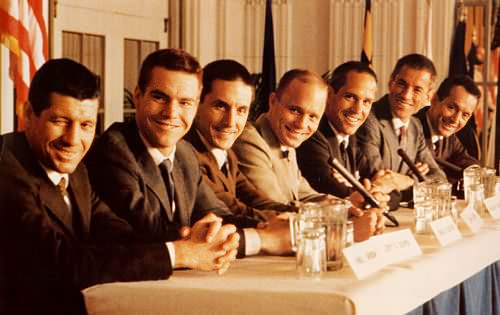
It occurs to me that these two works, Elgar One and The Right Stuff, are rather similar. Both embody the confidence of a Great Power at the height of its power, and with an undercurrent of nervous laughter caused by the uneasy feeling that maybe it won't last. Both are very public pieces, especially the Elgar. And I've chosen a picture from The Right Stuff to illustrate this post which also captures the public importance of those First Seven astronauts. The Right Stuff is at least as much about the supreme social niche that those men briefly occupied in American society, down there on the ground, and about the earthly society they inhabited, as it is about their astronautical achievement. As Dennis Quaid's grinning Gordo Cooper says, he's got all manner of deals going, and a "free lunch from one end of America to the other", and all this before he ever ventured into space. And who could forget the scene where John Glenn, played so beautifully by Ed Harris, proves that, at least for that brief shining moment, he and the other astronauts between them outranked the Vice-President of the United States?
And of course those rocket expeditions were immense public events.
So both the Elgar and The Right Stuff, being public pieces, are the sort of things you want to witness at a public event. So is that why I wanted to witness them on the radio and the TV? At least I join a virtual "event", instead of it being a private event of my own, as the next best thing to a real public occasion.
Or is it that if there is a major terrorist incident in some big western city with huge loss of life, I want an emergency news bulletin to interrupt the proceedings and tell me about this straight away? This can't happen when you listen to a CD or watch a DVD, and in this respect the public media are an improvement. Do I want the potential connection with History, should a slice of it erupt while I'm watching or listening? Closer, maybe.
Is it simply that I'm human, and as such, am a social animal? I simply like to huddle together with my fellow humans. But actually huddling together with fellow humans brings me slap up against their imperfections, and mine in their eyes. In the sort of audiences I am usually a member of, they aren't the people I'd really like them to be. And I'm very rarely the person I'd like myself to be. But if I listen to the radio or watch it on the telly, I can imagine my ideal audience, and be an ideal member of it. I think it's more like that. Sociability without all the bother and sweat and annoyance of actual socialising. The idea of other people, as opposed to the actual fact of them. Mankind, rather than other people.
Forgive me. I profounded on rather more than I intended to.
I'm listening to an ancient 1950 recording of The Mikado. Naxos have been reissuing them, and I got it (2 CDs of it) for £3 in the market.
I'm enjoying it very much, for many reasons, including that it enshrines the upper middle class English voice in its definitely previous manifestation to the present one.
Some time during or just after the nineteen sixties, the money earning classes of my country did a voice makeover. They squirted a more or less huge dose of Michael Caine into their previous John Mills not to say Donald Sinden vowels. This new voice has since spread throughout the new suburbs, to create a new, truly middle class English accent. You do it and you aren't a toff, because toffs are so weird and isolated from normal life that they still talk like John Mills used to in 1950 and sometimes even the way Donald Sinden still did in 1990. But you aren't a criminal stroke tramp either. You have GCSEs. Your parents understand what a mortgage is, and so do you.
But where does that leave the John Mills Donald Sinden accent? Well, nowhere, now that even the old toffs are dying out. Donald Sinden has run out of steam and is probably officially dead himself by now, and John Mills, although still alive despite being 110 years old, is enough of an actor to have introduced slight but definite modifications over the years, to have kept him in touch and make him an acceptable chat-show guest. But for us made-over upper-middles it's nice to hear The Voice in all its 1950 embarrassingness given an outing from time to time.
However, and here's my point, we made-over upper-middles do quite agree that The Voice was indeed embarrassing. If we didn't think this we wouldn't have abandoned The Voice (either with a Michael Caine Switch or with a John Mills Modified Makeover - my preferred route) in the sixties. Young pin-striped ginks trying to become Conservative MPs who haven't dumped The Voice, or who even deliberately taught themselves to sound like 1950 John Mills (or even Donald Sinden) are indeed truly embarrassing. You can't talk like that and mean it. I recall listening to an ancient BBC radio production of Hamlet, and the security guards at the beginning sounded like they were driving around in ancient sports cars in the 1950 London to Brighton ancient sports car race. Good god man!, as they would say, or, as their grandchildren would say: Give me a break! They sounded like Boat Race commentators, and may well have been exactly that in later years. What ho, Marcellus! Did you see the jolly old ghost last night? Gosh what an absolutely ripping show! Cringe.
But I do want to be able to listen to The Voice from time to time, for old time's sake, in all its unashamed embarrassingness. But I want to hear it in a setting where self-mockery is built in. Hence the pleasure of listening to The Voice doing The Mikado, rather than Hamlet.
"If you want to know who we are!!!! … We are gentlemen of Japan!!!! …" That generation saying serious stuff with The Voice is too much to bear. Noel Coward explaining in all seriousness why he is fighting the Second World War, dressed as a sea captain. Please. Donald Sinden trying to be even more serious, in The Cruel Sea. That is just too over the top, dear boy, and one simply can't, dear boy, take it seriously. But, dear boy, when one is sending oneself up, conceding with one's every inflection that the British Empire is folding its tents even as we speak in this peculiar way, dear boy, and that this whole way of talking will soon be a thing of the past, dear boy, well, that doesn't date. Or rather, it does date but in a completely satisfactory way, that I at any rate can still now enjoy.
One of the huge changes that has come over History, no less, is that we now have genuine recordings of how people really spoke, from about 1900 onwards. In my recent piece about Hamlet on Samizdata I included the guess that Shakespeare as originally spoken probably sounded more like modern American than modern posh English. Wow, said someone, is that what people really now think? I think they think this, but both halves of that are just guesses, I'm afraid, and I hope to muster the guts to admit it over there some time soon. But what wouldn't we give for a scratchy old gramophone record, like my Mikado CDs, of Shakespeare himself reading one of his bits? A photo would be fantastic. But a sound recording, now I think about it, and if I had to choose, would be even better. The pictures of Shakespeare that we do now have give us a pretty good idea of how he looked, but a recording of the man would cause an earthquake in Shakespeare scholarship and Shakespeare interpretation, and probably in History itself.
"Three little girls from school are we, come from the ladies' seminary …"
Gels, that is, with a elongated short "e": "Ge-e-e-e-e-ls". You know. The Voice. The ladies did it too of course.
"We're very wide ar-wake thar moon end ay."
The moon yes, but not you granny dearest, not any more. You're dead. As is the Queen Mother. But you live on in electro-vinyl, I'm very happy to report.


