

Jerry Maguire is a key movie. I admire it, but I hate it. It's well made. Tom Cruise doesn't do badly made movies. I hate it because the central message, embodied in the change of emotional style demanded of Rod Tidwell (played by Cuba Gooding Jnr.) by the universe in general, and by Jerry Maguire (Tom Cruise) in particular, is one I abhor.
This movie preaches the same message, of what to me seems like emotional incontinence, that Princess Diana – or perhaps I mean the Princess Diana industry – preached and still preaches here in Britain. Old fashioned (stuck up) stoicism is out. Emotional display is in. Self control is out. "Honesty" and "authenticity" are here. Although just how authentic the acting out that goes on nowadays actually is, I choose to be skeptical about. I prefer people who do brilliant things on a sports field to exchange solemn handshakes, not to go crazy and kiss each other and dance about like mad things.
I also believe that the good god of evolutionary biology gave us brains to judge, repress, distance ourselves and generally keep control over our emotions. This is because our emotions conflict with each other. Indulged in without thought or judgement, they lead us to catastrophe. If they control us, instead of us controlling them, situations that would merely be situations become instead emotional battlefields, and can do incalculable damage and cause incalculable pain. I associate emotional incontinence with poor, unhappy people, and I believe that their emotional incontinence is, above all else, what makes them poor and unhappy. They don't live their lives. Their lives live them.
It is all this that sportsmen like Tidwell are paid to encourage. Every time a Rod Tidwell throws an emotional tantrum of joy after scoring a touchdown, the message goes out to the people: let your emotions flood through you. Don't repress. Don't think. Feel.
Do you feel like throwing plates at your wife. Go ahead. Throw them. Be honest. Show her your true "self", located in your rage rather than in your thinking brain.
If Tidwell is to get the money on the scale he wants for himself and for his family, he must learn to celebrate like a fool when he scores a touchdown, waggle his hips, and generally go mad. He really, really doesn't want to, and I really, really don't want him to. I'm watching it all again, on Channel 4 TV, because I like Renée Zellweger, and none of this has yet happened, but it is going to. And the arguments from JM about how as a player he is all head and no heart, etc., are persuasive stuff.
The above paragraphs are not just my thoughts, they're more like my feelings. Think of this as a plate flying through the air.
While googling for a link to the Kempff/Leitner/Beethoven recordings discussed in the posting immediately before and below this one, I came across a site called the Enemies of Classical Music, which ought to be fun.
However, if entry number one, John Ashcroft, is anything to go by, it is not so much fun as dishonest, politically motivated nonsense.
Ashcroft is quoted saying these two things – this:
"The average guy [who] wants to go down and see Garth Brooks at the country concert, he doesn't get a federal subsidy, but the silk-stocking crowd wants to go to watch the ballet or the symphony orchestra, they get a subsidy."
… and this:
"I tend not to be an individual who has invested a great deal of my life in opera. Now the opera gets a subsidy from the National Endowment for the Arts, but, by and large, Willie Nelson and Garth Brooks don't. Those of us who drive our pickups to those concerts don't get a subsidy, but the people who drive their Mercedes to the opera get a subsidy."
Ashcroft may or may not be an "enemy of classical music". From this evidence it is impossible to tell. What he definitely is is an enemy of the unfairness, as he sees it, of subsidising classical music but not other more popular kinds of music.
Personally I go further than Ashcroft does in either of these quotes. (After all, you could interpret his words as a plea for subsidies to the likes of Willie Nelson and Garth Brooks.) I oppose subsidies to any sort of music, Nelson, Brooks, opera, the lot. And I defy Matthew B. Tepper to call me an enemy of classical music just because I don't agree with him about the government subsidising it.
I genuinely believe that subsidies for classical music have harmed classical music, especially what passes for "new" classical music. Subsidies have helped to separate new classical music from new regular music, and thereby helped to drain the life out of it. It's a point of view. And certainly not one based on hating classical music as such.
I won't expand on this point of view now, as I have a busy day in front of me. I need to get my blogging duties done and my living room dusted.
I'm listening to the Kempff/Leitner/Berlin Philharmonic/DGG recordings of the Beethoven Piano Concertos, and now to number three in C minor, one of my all time favourite pieces. First movement. Slow movement.
And it is out of tune.
It is amazing how many recordings, especially for some reason piano concerto recordings, are thus disfigured. This one, I think, has the piano badly tuned so that the upper registers are flat compared to the rest, and the woodwind is sharper than the strings. I can't be sure precisely what is wrong, or all that is wrong, but something very definitely is, let me tell you.
Not everywhere in the performance, it seems. We've now reached the last movement, and the orchestra sounds okay, and now so does the piano. But the first two movements were horrible.
I don't have perfect pitch. I can't, that is to say, sing exact notes out of nowhere or tell you if someone else's notes are sharp or flat if I have nothing to compare them with. But if two notes are supposed to be the same and are actually very slightly different, I can tell, and so, I should guess, can most music lovers. So what were DGG thinking when they arranged for "Prof. Elsa Schiller" to do the Production of these recordings? It was basically her fault, yes? I've never heard that name in any other connection whatsoever, and I'm not surprised.
Is it intrinsically hard to achieve proper tuning when you are making a recording? Are are some recording venues treacherous from the tuning point of view? Do performances that sound fine to the naked ear on the day emerge from the machines all mis-tuned and hideous? Is that what's happening? If so, it is not surprising if some major recordings go haywire in this respect.
What is not pardonable, however, is that reviewers so seldom pick up on these things. I've never read of this particular performance being disfigured tuning-wise. But trust me, it is. And I seem to recall very similar and if anything even worse tuning problems afflicting some of the Barenboim/Klemperer/EMI recordings of the same pieces, and I've never read anyone complaining about that either. Extraordinary. Occasionally magazines like Gramophone get grumpy letters to the editor complaining in the manner of this posting, but the reviewers seldom rock the boat by dissing the products of the major labels for being thus deranged. Only obscure and powerless labels get slated, or individual string players for not playing properly in tune (for which the producer can't be blamed except insofar as he should perhaps have made them do it again).
Maybe I have better ears than I thought. Perhaps some people don't like classical music for the simplest of all reasons. They don't hear it.
I'm listening now to number four, which sounds much better. The problem was only with the first two movements of three.
Have minutes of modern art fun with this Art or Crap? quiz.
With thanks to b3ta.com.
UPDATE (via Dave Barry): This is definitely art.
That's it really. Further to this posting, when I next walked along Pimlico Road, I kept an eye out for Viscount Linley's furniture shop, and bingo, there it was: "LINLEY".
I took a look through the various huge windows, and frankly, I was not impressed. There was no Brunel desk to be seen, but the desk that was on show looked like £30,000 worth of garish, tacky nonsense to me. Everything either was or looked veneered. I hate veneered. There were bits of gold and silver painted on all over the place, and frankly it looked like something I would not buy at a garage sale. I'd sooner have an old door balanced on a couple of dead loudspeakers, which, quite often, I do.
Viscount Linley has a website.
Welcome to our website. It has been designed to give an idea of the breadth of furniture, accessories and upholstery that you can discover in our London shop at 60 Pimlico Road. It also allows you to purchase gifts and accessories online should you so wish.Every item you find on our website has been exclusively designed by us and made in Britain using the highest standards of traditional craftsmanship to ensure each product is of a superlative quality.
We hope you find our website both inspiring and useful and we look forward to seeing you at 60 Pimlico Road.
But I couldn't get the damn thing to load beyond that bit. Warning: Failed opening 'ecommerceInclude.inc.php' for inclusion (include_path='') in /home/.sites/106/site3/web/cust-bin/home4.php on line 11. I hate it when that happens.
So if my experience is anything to go by, the website aspect of the operation is not using the highest standards of craftsmanship and is not of superlative quality. And don't try putting a desk in that carrier bag.
But don't let me stop you buying one of his desks. Me, I'd go with a new house.
I know less than nothing about computer games, but I am acutely aware that for a cultural commentator this is a serious defect. Computer games are now (you have only to look in the racks at Blockbuster) a huge, huge deal, now making up blah per cent of the GNP, etc.
For a symptom of how huge they are, take a read of this:
As perhaps the clearest evidence yet of the computing power of sophisticated but inexpensive video-game consoles, the National Center for Supercomputing Applications at the University of Illinois at Urbana-Champaign has assembled a supercomputer from an army of Sony PlayStation 2's.The resulting system, with components purchased at retail prices, cost a little more than $50,000. The center's researchers believe the system may be capable of a half trillion operations a second, well within the definition of supercomputer, although it may not rank among the world's 500 fastest supercomputers.
Read, as they say, the whole thing. Thanks to Daryl Cobranchi for the link.
Here are two extraordinarily interesting chunks of writing, which both converge, from wildly different starting conversations, on the same end-point. The first version of this end-point is the throwaway sting in the tale of this.
If you only read The New York Times, you might think the only truly important recent event in Iraq was the looting of the Iraqi National Museum. For art lovers, this branded the U.S. occupation with the worst of all possible labels, worse than "imperialist," worse than "illegal" -- "Philistine."Robert Deutsch, an archeologist at Haifa University and a licensed antiquities dealer, shakes his head at all the coverage of the museum sacking. The Times originally reported that 170,000 pieces had been stolen. "Nonsense," says Deutsch. He points out that there would have to be "miles and miles" of display area for such a massive amount of material to be readily available for the snatching. …
"They just had to have something to complain about," Deutsch says of the museum hype from skeptics of the war. "The war was fast. It was clean. They found a small place where they can complain." ...
"I don't see any big or significant damage from this looting," says Deutsch. "It was very small-scale. And the historical value of an antiquity is in its publication. Once it's published, it's part of our knowledge." Thereafter, its value is mostly as an object of art.
Those paragraphs were reproduced in full by the indispensable Instapundit, to whom deep and reverent thanks as always, who got it from Bill Quick, who got it from Rich Lowry of townhall.com.
And here is a letter from the latest (paper so no dedicated link) issue of Prospect magazine, from Martin Mayer, of Westoning, Bedfordshire:
In support of Patrick Lyndon, I recall my own experience as a student in Rome in 1964. In that year there was an exhibition to mark the 400th anniversary of Michelangelo's death. It did not include a single original work. Instead it showed reproductions of every major work of his, from alabaster copies of his sculptures to, sometimes, just black and white photographs of his paintings. I went every day for a week. And I would still say, 39 years later, that I was more inspired by seeing his complete body of work in this way than I have been by any exhibition of originals I have seen since.
It seems to me – and I'm sure I've said this here before and that I will say it again here many, many times – that you just cannot understand the place of "art" in the modern world if you glide past the profound effects – on painting itself, and on the publicising and disseminating of the achievements of painters, and sculptors, and architects, and the whole lot of them – of the means of artistic reproduction.
Think what it will do to the culture when three dimensional reproduction is perfected – when we can all just set up our 3DRepro boards on our coffee tables and click our way through all of sculpture and architecture. This surely isn't far away.
More fuel to the debate about who the greatest Brit was, in the form of a desk built by Viscount Linley in honour of Brunel:
The Queen's nephew, Viscount Linley, believes that Isambard Kingdom Brunel was the greatest Briton and has backed his view by producing a unique desk commemorating the achievements of the 19th-century engineer.The Brunel Desk, an intricate piece of workmanship which has taken designers and craftsmen more than eight months to create, went on sale for £95,000 at Lord Linley's shop in London last week.
Among Brunel's projects which have been incorporated into the design are the Thames Tunnel, SS Great Britain and the Clifton Suspension Bridge.
The desk was conceived after Lord Linley, son of the Earl of Snowdon and the late Princess Margaret, nominated Brunel as his choice in last year's BBC poll to find the greatest Briton.
"I have always been interested in the amalgamation of engineering and craftsmanship which I think he showed," said Lord Linley, who trained as a cabinet maker and now has a shop in Pimlico Road.
"Workmanship", "designers", "craftsmanship" – good to see these words being given a bit of exercise. It would seem that someone still knows how to make furniture in these islands.
Linley's shop is only a walk away from where I live, but this thing is still way out of my range.
Ever wondered how a blogosphere story works? Like this:
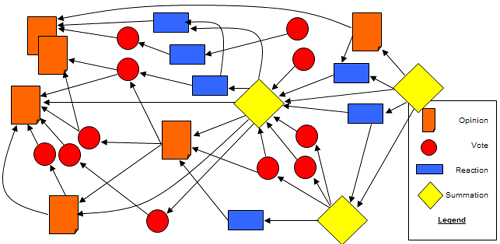
Explanation here. Link from Instapundit.
I include this not because I like the explanation. I just like the picture. Nice colours. And if he's done it right, it shouldn't take people with primitive computers too long to load.
I'm not sure if I'm going to like this, but it looks like a really good effort.
In general, I have a personal architectural category called something along the lines of "They tried but, for me, it didn't work." Example: the Channel 4 Headquarters building in Horseferry Road, just near where I live. And I fear that this Beijing Olympic Stadium could end up in that category.
But the funny thing about architecture is: until it's built you can't tell. You just can't. It's like the movies. Until it opens, you don't know.
But, at least you can try, and with this stadium, someone is really trying.
My fear is that it is going to look like one of those lampshades which you make by wrapping string round a balloon and then popping the balloon.
Breaking news. Britain's song apparently got NO VOTES AT ALL in the Eurovision Song Contest.
That could be wrong. But when I checked half an hour ago the UK definitely had no votes, and other countries had over a hundred, and on Liquid Eurovision they were making "no points" jokes.
Yes, by gum, it's true.
I don't watch the tunes, but this year I ignored the voting as well, which I usually like to have on. I was watching the DiCaprio/Danes Romeo/Juliet, and only checked Eurovision during one of the commercial breaks.
UPDATE: Samizdata links to this.
Deadline looms. So here's what I think is a fun photo, which I found here.

Very artistic. The work of someone called Jesse Marlow.
I've just done a posting on my education blog that could equally well have been put here, about the decline of Britain's art schools, kicking off with quotes from a Spectator article on that subject. Just so you know.
Maybe one day my two specialist blogs will merge, into plain old Brian's Blog. Feel entirely free to comment favourably about that. In the short run such comments will make no difference. In the long run, they just might.
It has, in particular, been a surprise to me how much sense, now that I am thinking about it and reading about it, the idea of "cultural education" is starting to make, as an essential component of the good life. I even found myself confronting this idea head on when I visited some home schoolers. By this I do not mean that I am suddenly converted to the notion of compelling children to sit through classical music broadcasts or gawp at paintings which disgust them; I merely mean that those children who do acquire such artistic interests are more likely to lead not only more enjoyable, but also more more productive lives.
People who have "culture" are better at entertaining themselves – they enjoy their own company more – than those without "culture". That means that, in a pinch, they need less money and energy to keep themselves amused and diverted, and in general have more money and energy to devote to other things. They are freer. Freer people do better economically.
If you are the sort of eonomic thinker who believes that what matters is turnover, this may not impress you, but if the purpose of economic activity is to increase human happiness, then "culture" will, if what I say about it is true, impress you very much.
I am enriching the world with this blog. Trying to, anyway.
There an intriguing piece, complete with a picture, in today's New York Times about the influence of the domestic DVD machine on furniture. First three paragraphs:
The $23-billion-a-year furniture industry is in a state of high excitement over an item of furniture that, in the average living room, looks like a huge Danish. Your local bakery would call it a bear claw. The furniture industry calls it home theater seating.With the ascent of DVD players, flat-screen and high-definition television and surround-sound home "theaters in a box" as standard equipment in American households, the furnishings of media rooms and movie theaters are descending into the mass-marketplace.
The new home theater seating is typically a free-standing unit of three or four reclinerlike modules attached at the hip by cup holders and eating trays, features more typically found in multiplexes or screening rooms. It is now generally available and affordable — a question of hundreds or thousands of dollars and not tens of thousands. Since its introduction by Berkline, a furniture company in Morristown, Tenn., in 1999, home theater seating has proved popular enough to encourage most other major players in the business of "motion" furniture (a k a recliners) to jump into the fray.
Ah, but what happens when the kids start having home cinemas in their bedrooms?
I've never listened to all of Dvorak's string quartets at one go, so I was looking forward to doing this with my newly purchased super-bargain box of the lot of them (for £12 for 10 CDs), played by the Stamitz Quartet.
I was disappointed. All but the late, famous ones, notably the "American", Op. 96, seemed to me to be like musical wallpaper, but in a bad way. I don't know if this was the playing of the Stamitz Quartet, or the composer's fault, or my fault, but something was wrong.
I had hoped for better. All the Dvorak symphonies, including the very earliest, are charming works and I recommend all of them, for example in the Phillips recordings made of them all by Witold Rowicki and the London Symphony Orchestra in the 1960s. Symphonies One and Two probably outstay their welcome a bit, but at least you start by giving them a welcome. Most of the quartets just seemed dull.
The other bargain box of string quartets I got on the same expedition was of the complete Beethovens, made in the 1960s by the Julliard Quartet, and the contrast was immediate. These are great from the word go, of course, and there is no question of the excellence of the playing either. A genuine bargain, this time at £15 for a mere 8 CDs.
Could it be that writing string quartets is more difficult than writing symphonies? With an entire orchestra, you can take refuge in musical colour. When writing for the string quartet, there is no special effects hiding place. Maybe a musical expert can explain.
Meanwhile, how about those prices. There is, as I said in a Samizdata comment yesterday, a real atmosphere of fire sale about the big London CD stores these days. CDs released only months ago have already done the price plunge. And these box sets are being virtually given away. I hate the packaging. I far prefer jewel cases to these horrid little cardboard mini-LP-sleeves. But at £2 per CD, how can I resist? (Sorry, can find no links for these CDs.)
One of the giveaway signs of a genuinely collapsing market is when the second hand shops don't know how cheap the stuff is in the brand new shops, and where half the punters don't either. The default price for the cheapest stuff in the second hand shops is now about £3. In the "new" shops, you can find things for about £1.50. This is new. The new recordings are not selling nearly well enough, and the big labels are eking out a living recycling older and older stuff, at cheaper and cheaper prices.
The big labels, in other words, aren't waiting to be destroyed by the likes of Brilliant Classics. They are becoming Brilliant Classics themselves. The classical music business is spinning ever deeper into its long predicted black hole.
The actual making of new and interesting recordings of classical music is fast becoming a economically irrational hobby, rather than a business. It is moving, in other words, in the opposite direction to that recently travelled by Britain's national newspapers.
Earlier this evening there was a TV show about a French aerial photographer by the name of Yann Arthus Bertrand. This is a new name to me, but it turns out his work is not, because there was an exhibition of his photos outside the London Science Museum about a year ago or so, and I saw it. And guess what, I really liked it.
I even liked it despite Bertrand's extremely obvious political ambitions for his activities. He votes a straight environmental left ticket, and peppers his shows with big, simple-minded slogans about how X per cent of people are starving or suffering from Y or whatever, and the implied but not actually stated punch line is that we should all be socialists and thereby save the desperately threatened world and the desperately miserable people who live on it.
The trouble is that his pictures tell an entirely different story. They are gorgeous, and they tell of a gorgeous world, of a world so big and splendid that it will effortlessly shrug off any nasty thing that mere people may manage to disfigure it with, and in any case most of the things that men do are, if viewed from the air, really rather nice to look at. Even things like rubbish dumps.
This is an "irregular river" in the desert of southern Morocco. Jackson Pollock eat your heart out.

And here are some olive groves viewed from above Tunisia. Not quite so gorgeous, maybe, but very interesting. Turn it sideways and it's a lovely start-up screen.

The captions are all fashionable misery, but the pictures themselves are sheer delight. And I bet I'm not the only one gazing and smiling, and reading only to find out what they are, rather than to find out what terrible news it all is.
The link to the man (above) takes you to the collection of pictures from which these two come. I recommend a leisurely browse. Since this is a "culture" blog, I'll allow myself one more, chosen because it looks even more like nice looking abstract art than the previous two.

This man also knows a lot about spontaneous architectural orders, but I'll save that for another time.
There have been a couple of interesting posts over at Samizdata about the whole vexed question of intellectual property rights, copyright, etc, one about a (revived apparently) scheme by the Disney corporation to try selling auto-destructive DVDs, basically so that you don't have to return your DVD to the rental store anymore. It lasts for two days and then you just chuck it away.
And the other was a more substantial piece about the whole attitude of libertarians (a category which includes me) towards the whole business of music file-copying, CD copying, etc.
The comments to these postings, especially to the second one, are a pretty good summary of the arguments that rage around this issue.
Is it worth this blog, with its miniscule trickle of writings and readers, flagging up two of the postings of a mighty gusher like Samizdata? Well, I like to think that there are some who come here but don't go there, and since stuff accumulates here more slowly, it may also be said to "last longer", so a connection from here to these two postings, soon to be under a pile of new Samizdata stuff, might be helpful. I hope so.
… there is this:
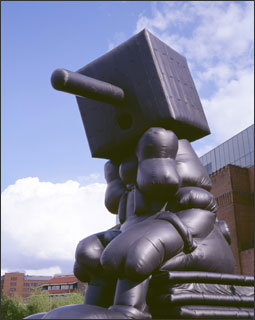
I love it. The boundary between art and fairground entertainment can't be too blurred, I say.
Last week I posted a piece about how films about famous battles might be better done. I've now just watched a very good documentary, which was first shown last October but which I was seeing tonight for the first time, about the Battle of El Alamein. It was written and fronted by Peter Snow and by his son Daniel. Peter Snow told of the big decisions and the big strategic and battlefield agonisings, as befitted his age, while son Daniel related what it was like for the poor bloody infantry, tankers, gunners, minefield clearers, etc., ditto. It could have been ghastly, but Dan is obviously going to be just as much of a broardcasting pro as his Dad is and I thought it worked fine.
Concerning what I said in my previous post about how the drama genre and the documentary genre need to merge, and how documentaries need to make more serious use of actors, they used (young) actors in this documentary to tell the story from the point of view of the average soldier, as if telling the story just after the battle had ended. Maps, commentary, practical demonstrations of the difficulties of clearing mines, shots of the same landscape filmed now, all merged very well to tell the story with great clarity. As one who has read a lot about this battle over the years, I still managed to learn a lot, in the sense that it was all pulled together into a single story for me better than ever before. At first I thought that the computer graphics were going to be needlessly fussy and trixy, but once the battle got seriously underway, that mostly stopped.
Nevertheless, when they finally do make a decent drama-documentary about Alamein, they'll have to have an actor doing Monty (what a part!). And others doing Auchinleck, Lumsden, Rommel, and the rest of them.
Just as interesting as what this documentary did contain was what it did not. There was no attempt to downgrade the importance or the bravery of what the soldiers had done. There was no "revisionism". No campaigning for peace, other than noting how terrible it must be to get burnt to death in a tank. There was just an important story, clearly and vividly told.
It was interesting also, in this age of multi-national production deals and global audiences, that full credit was given to the contributions of the non-English (such as the Scots) and the non-British (Australians, New Zealanders, Indians, etc.). Special mention was, in particular, made of the contribution made to the winning of Alamein by the Australians, who made the vital attack in the extreme north after the first attack in the north had been stalled.
About ten minutes to deadline, so nothing long or profound tonight, just a link via 2 Blowhards, to this. Be sure to scroll down when you go there, to see others besides the relatively dull cube. The seeing-black in colour one and the spiralling one are the best, I think. Michael found this for one of his websurfing ("linkorama") pieces. These are always good for an hour's fun and profundity.
I'm off to read the piece on evolutionary biology.
Whereas "art" is now all frivolity and ironic distance and "Why do you take it so seriously?" wide eyed pseudo-innocence (see my previous posting), after the crap is in the can and has got the desired response, this is the real thing. And don't whatever you do miss the extra pictures. Click were it says "MULTIMEDIA" to the right of the second paragraph of the story. I especially like the first one, with its oh-so-artful ethnic mixing, of The Man embracing his fellow fliers, at "magic hour".
In fifty year's time, this is the stuff that should be in the museums.
The New York Times can't help itself. It is impressed. As am I.
"They understand the visual as well as anybody ever has," said Michael K. Deaver, Ronald Reagan's chief image maker. "They watched what we did, they watched the mistakes of Bush I, they watched how Clinton kind of stumbled into it, and they've taken it to an art form."
In case the links collapse, what all this is about is the extraordinary pictorial propaganda effort being run from the Geroge W. Bush White House to glorify George W. Bush.
"I don't know who does it," Mr. Deaver said, "but somebody's got a good eye over there."That somebody, White House officials and television executives say, is in fact three or four people. First among equals is Scott Sforza, a former ABC producer who was hired by the Bush campaign in Austin, Tex., and who now works for Dan Bartlett, the White House communications director. Mr. Sforza created the White House "message of the day" backdrops and helped design the $250,000 set at the United States Central Command forward headquarters in Doha, Qatar, during the Iraq war.
Mr. Sforza works closely with Bob DeServi, a former NBC cameraman whom the Bush White House hired after seeing his work in the 2000 campaign. Mr. DeServi, whose title is associate director of communications for production, is considered a master at lighting. "You want it, I'll heat it up and make a picture," he said early this week. Mr. DeServi helped produce one of Mr. Bush's largest events, a speech to a crowd in Revolution Square in Bucharest last November.
To stage the event, Mr. DeServi went so far as to rent Musco lights in Britain, which were then shipped across the English Channel and driven across Europe to Romania, where they lighted Mr. Bush and the giant stage across from the country's former Communist headquarters.
Interesting how Italian names like Sforza and DeServi crop up as two of the leading brains behind this stuff. Some things never change. Think of those amazing Italian renaissance portraits with their extraordinary and extraordinarily detailed and carefully crafted backgrounds. Well, here come those Italians again.
I recommend this piece by Aaron Haspel. Anyone who supposes that as found art was some kind of eighties Brit art revelation will learn a lot.
Final two paragraphs:
Warhol famously made movies, indescribably dull movies, like the 12-hour shot of the Empire State Building whose only action is a bird flying by every half hour or so. He was often asked why he gave up painting for movies. "Because it's easier," he would say. He once advertised in The Village Voice that he would endorse anything for money. The beauty of these jokes is that they were literally true.No jokes, however, are funny after the first couple times you've heard them, and these days it is hard to raise more than a yawn when you hear that the Tate Gallery has bought tin cans of some poor lunatic's excrement. Nonetheless, we should remember that it was funny once. Duchamp and Warhol have an indelible place in history, though it may not be in art history — possibly the history of humor, or public relations.
Quite right. When we speak of modern art we are definitely speaking about art, but not of the usual kind. Being a successful con artists is, after all, not easy.
There was recently a BBC4 TV documentary about those here's-my-unmade-bed here's-a-dead-cow-sliced-down-the-middle school of Brit art, and I was struck by that same air of delighted amazement, this time expressed by cockney wide boys, that the scheme was working so well and has such legs.
You can't understand modern art without including the modern media in the story. No newspapers and magazines to puff, discuss, denounce, and there's very little left of it. Ancient art was the media. Modern art is a mere succession of media events, whose media frisson is caused by their very outrageousness and vacuity.
Above all, there must be photography. Even as you curse this nonsense, you want to know what the damn stuff looks like. Would the telegraph have bothered with those tins of crap if there'd be no photograph of them? Have you seen what those Tate bricks look like? I have. I've got a little postcard of them. They're nothing special, but my curiosity was aroused and has been satisfied.
Someone, loot Tate Modern, this time for real.
(As usual, the blogcrap archiving seems to be shot to hell, so go to MJ's main page and then back to May 15th, if you can. Good news: although this link doesn't take you to MJ's May 15th piece about Baghdad (non) looting, it does instead take you to a great May 11th posting about Salam Pax.)
But no one will. The economic value of this stuff would collapse completely if the society which sustains their "importance" were ever to crumble to the point where such looting was doable. Put it this way, if western civilisation in London and its surrounding areas were to collapse next Thursday afternoon, just after lunch, and you were prowling the ruins looking for a pension fund to replace the one you had, would you give the Emin bed a second glance? Well, I suppose you might, on the off chance that Americans might want it, to help them ponder what on earth had gone wrong with these benighted islands.
Does Windows versus Unix count as "culture"? It's probably stretching things a bit, but this is my ego trip blog. My other place is for disciplined sticking to the point. And in any case, software is culture. Where is the serious aesthetic effort of a non-decadent sort now being made in our society? In the museums of modern art? Hardly. In the software dens is where. Why, I'm even working away myself at making this blog look nicer, and any month now …
Anyway, Peeve Farm has a nice bit about the software and automotive industries colliding, the point of which is that software folks (if they are Windows software folks) are free-wheelers who take chances to stay ahead of their competitors, while the carmakers don't like to take chances because when they do people die. Ditto the airplane and spaceship makers, only more so.
Contractors who write software for jetliners or the Air Force get to work under banners that say "When our software crashes, so does the plane"; you won't find those kinds of banners in Redmond. (One hopes there's a banner somewhere on the campus that says "Remember the Yorktown", but I'm not holding my breath.)
Yorktown. That was the one that got mended really, really quickly during the Battle of Midway, right? "Yorktown" was in link-lettering, so I went there. No, this Yorktown is Midway Yorktown's great grand-daughter, or some such, and a quite different ship.
Here's the story, from Wired:
Microsoft continues to trumpet the success of its NT operating system over Unix-based systems, the US Navy is having second thoughts about putting NT at the helm. A system failure on the USS Yorktown last September temporarily paralyzed the cruiser, leaving it stalled in port for the remainder of a weekend."For about two-and-a-half hours, the ship was what we call 'dead in the water,'" said Commander John Singley of the Atlantic Fleet Surface Force.
The warship was testing its new Snart Ship system, which uses off-the-shelf PCs to automate tasks that sailors have traditionally done themselves. "The Navy started the Smart Ship program with three essential goals in mind: improve combat readiness, reduce crew workload and operating costs, and to do it safely," said Singley.
The Smart Ship program is still in development, and officials said glitches are to be expected, but in this case the problem appeared to be more political than technical. Using Microsoft's Windows NT operating system in such a critical environment, some engineers said, was a bad move.
"The simple root of the problem on Yorktown was that politics were played in the assigning of the contract -- there was not a discussion of engineers, it was just a very small group of people pitching for it," said an engineer close to the project, who spoke on the condition of anonymity.
In a statement issued this week on why NT was chosen over Unix, the Navy said that while Windows NT was specified in the Statement of Work as the operating system for the workstations in question, other components of a coming upgrade will primarily utilize Unix-based systems.
"They rushed this stuff on the ship, there was no real prototype, and then they tried to make things work as they went along," the source said. "I don't think that Unix or NT were ever really evaluated -- it was just somebody thinking this was good, with no knowledge."
The statement said that Unix is still being considered for future Smart Ship technologies, acknowledging that many systems already utilize Unix-based systems and that a "government team is currently researching the best technical and financial solution[s] ... of which the decision to use Windows NT or Unix will play a major role."
My understanding, which is kindergarten level but which does exist, is that Unix is pretty good for running something like a warship, while Windows is seriously bad. Windows is cheap and messy, for allowing cheap and messy people like me to have something almost as pretty looking as a Mac which will be able to do most of what I want cheaply and messily, without always having to dive down into the code and be a geek.
They still haven't got Unix working as a non-geek civilian alternative to Windows. But if you are running, or trying to run, a "tight ship" of some kind – such as, e.g., a ship – which has a predictable and listable list of functions that the system has to do anddo right, then Unix is definitely preferable to Windows. You have the money to bring in the expertise to set everything up shipshape, and you should.
I did a piece a week or two back about the educational edge that having a big military may be providing to the USA in the form of a society that is permeated with military procedures and military habits of organisation and training. Europe has had this for centuries, but has now lost it, and it could make for a deeply ignorant Europe. That was the speculation.
And I further speculate that the military superiority of Unix could be a more particular thing that spreads outwards from the US military to the wider society. This Yorktown story is a story of the temporary pollution of naval discipline by civilian sloppiness. I surmise that, the US military being the US military, the permanent influences are more likely to flow in the opposite direction. The USA will in due course make the big Windows-to-Linux switch under the influence of a generation of ex-military types who learnt, the hard way, that Linux is in lots of ways (crucially in being more "solid" and less crash-prone, but also being less virus-threatened) better than Windows, and who have learned how to make it work, or failing that who know of someone they bunked with during Gulf War 3 who can make it work. Surely one of the guys now wrestling with applying Unix to missile systems or satellites or submarines or inventory will demob, and finally crack the problem of that Linux front-end-good-enough-for-civilians which keeps being promised but which never seems to materialise. The US military may not have that many people in it at any one time, but the total number of people who pass through it is huge, and more and more of those will be using and learning about computers.
The blogosphere is full of people who combine geekness with humanity to a degree that surpasses me on both fronts, and some of them may be able to comment usefully. I'm sure that to lots of folks what I've just put has been obviously true, or obviously false, or obviously oversimplified for years now. But other culture blog readers, the artsy types, might be worth reaching on all this. If you do comment though, remember who you're writing at.
Watching TV back in France the night before last, I saw a lot of flagwaving for an any-night-now showing of Pearl Harbour, the movie starring Ben Affleck and (as I recall) Kate Beckinsale. I didn't see this movie and I don't plan to. I don't like battle movies which mash fact and fiction together the way this one does, and as do others such as The Battle of the Bulge and Midway. Midway featured a particularly annoying character played by Charlton Heston, called "Matt Garth", who dragged in a sub-plot involving a Japanese daughter-in-law. The real Midway had quite enough all-American heroes involved without them having to fake up another. And The Battle of the Bulge was likewise populated with "composite characters". Either the battle is background, in which case fine, the real story is something else and you can fake it all you like. Or it is the foreground, in which case spare me the fictional sub-plots.
The other thing that upsets me about these high-concept high-tech super-special effects low-accuracy battle movies is the shocking waste of all those special effects. All that military expertise about which guns they used and what kind of noise they made and what sort of uniforms everyone was wearing. Why waste it on a soap opera movie? It must be heartbreaking to do all that technical stuff and then watch the movie people piss on it by changing the uniforms to make them more filmic and more appealing to the teen market, and change the noise made by the guns because it isn't noisy enough or is too noisy, or make all the action occupy less physical space than it really did so that it can be more conveniently photographed. Above all what is the point of a movie which gets some Nazi general's uniform spot on, but which gets him, the general, completely wrong so that some bankable actor can be accommodated into the project?
Meanwhile, another art form is sneaking up on the rails, in the form of the historical documentary, fronted by a story teller, and fleshed out with scenes acted out by actors, in a very rudimentary fashion and in a way which is now careful not to treat on the toes of any of the big actors with names you've heard of. Here there is at least an all round attempt to get the story exactly right. Of couse different story tellers will have a different take on the story, but there's none of that "only the facts have been changed in order to tell the story better" nonsense that you get in the "real" movies. Nothing is deliberate made up. There are no Matt Garths fighting at Midway or tiny tank battles pretending to be the Battle of the Bulge.
What I wish I could see would be one of those TV story tellers fronting high-tech super-special-effects tellings of the stories of these battles. That way I'd get to see not just all those totally accurate weapons doing whatever they did, but I'd get someone at the front telling me what the hell was actually going on, and why this set of guys won and that set of guys lost. Let's see the action, and the maps with the moving arrows, explaining why that particular bit of action was so important. If you watch The Battle of Midway you get the general idea that the USA won against Japan by sinking a bunch of aircraft carriers, and by a guy in a dressing gown breaking some codes, but you don't get what an almighty god-damned fluke it all was, how absolutely and totally amazing the story of that battle really was. That you can only learn now from reading a book. That you can only learn from a narrator.
Why were there no maps for us to look at during A Bridge Too Far (which was about the Arnhem campaign)? And why couldn't it have been a real historian doing a detailed and accurate voice-over, instead of some Swedish actress doing a totally bogus bit of voice-overing only at the beginning and the end. Well, maybe the map for the Arnhem campaign is so simple that they could do without it, and just have people talk us through it. But Midway? The Bulge? Most other battles ever fought? If all they show you is bangs and shouting and killing, then that's all you'll get. You may say: oh, maps will make it all too clear. Real warfare is confused. In real battles you don't know what is happening, or what happened.
But a good narrator is perfectly capable of making that point. And I already know that if you die in mid-battle, you don't get to hear the result. I know that. I just think it would make a whole lot more sense to have a military historian fleshing out the details of what it all means and meant than having Ben Affleck and Kate Beckinsale playing two made-up people having a love interest.
Economically, it could work. Special effects are getting better all the time, and so potentially a lot cheaper without embarrassment. Good documentaries, both military and historical generally, are getting ever more popular, partly because there are so many more old people around than there used to be. Documentaries are getting easier to finance in the age of the DVD (a particular important product for oldies who don't get out so much), just as lots of other kinds of video material are.
All that's missing right now is the open-hearted acceptance that this way of telling stories is a reasonable one.
I can't be sure, but suspect that while I have managed to maintain volume here during the last week, I have not managed to maintain quality. There are several reasons for this. First, I have had only limited access to a computer, and to an unfamiliar one at that. Second, I have not had access to my normal diet of cultural stuff. Usually, what I attend to is the output of the cultural media: DVDs, TV programmes of various kinds, and books, including books with art-type illustrations. Here in France, I have the two or three books which I took with me, none of them very cultural, and very occasional bouts of TV that are of my hosts' choosing rather than mine, together with a determination in any case not to spend much of my time here watching TV.
My third excuse is the one that caught me by surprise, and which I have only now starting to think about. At home, internet time is fixed cost and unlimited. This means that surfing time is plentiful and ideally bloggable thoughts (i.e. thoughts provoked by reading other blogs) occur to me constantly. When they do, and if they strike me as good enough, then I am already where I need to be, at my screen. Here, blogging time is scarce, and I have either to arrive with something beforehand or else to think of something quickly when at the screen. It's not that my hosts are hovering behind me, waiting to do their scarce little burst of surfing, although there is much work that my hostess in particular is now busily ploughing through, and I must wait until that is finished for the day before I even think of taking my turn. It is simply that I no more want to spend lots of time blogging than I want to spend lots of time watching TV.
Blogging, I am finding, is an anti-social habit, at least the way I've been doing it. Michael of the 2 Blowhards (I'll do the link later) has been kind enough to say of me that I do a great deal of blogging. Well, I've failed utterly to contribute anything to Samizdata. My one posting to that had to take the form of an email, and that either didn't get through or was considered unworthy. And my stuff here and at my other place (link, see above) has been very average in quality, I fear.
I've also (see my other place) been watching motherhood at close quarters, and have been witnessing for myself that combining motherhood with getting anything much else done is a herculean task. Tomorrow I return home with a much enhanced feeling of respect for Natalie Solent and for Alice Bachini. I understand that Natalie has recently earned plaudits from no less a personage than Mark Steyn, and Alice's stuff I've always loved.
They do motherhood and blogging. All I've been doing is taking a holiday and blogging. They make their blogging work. All I could manage was to wait until I get home.
Still, I do have some pretty pictures from my travels, and maybe I'll show you some of them when I get home. Maybe, more to the point, I'll get back home and resume doing this stuff, approximately speaking, properly.
Today my host and I visited a delightful French seaside town, called Collioure. All that I've been saying here about the pleasures of vernacular architecture applied to this place. Cute or what.
There were, of course, many shops aimed at tourists, selling trinkets, food and drink of all kinds. In particular, there were a number of "art" shops.
Coullioure is one of a number of towns in these parts which are famous for their association with artists, rather in the way that the town of St Ives in Cornwall is, although that's not somewhere I've been so I don't know how exact the comparison is. But whereas St Ives is merely a quaint oddity in terms of its place in the life of the British nation, it is no exaggeration to say that France itself actually defines itself as an aesthetic enterprise.
Remember that film called The Train, the one with Burt Lancaster playing a French railway worker in the French Resistance, who gets embroiled into supervising a daring scheme to divert a bunch of French paintings which evil Nazi Paul Scofield is trying to steal and take back to Germany. True, this film was made by an American, John Frankenheimer, who also directed another favourite film of mine, The Manchurian Candidate. Nevertheless, I think this film captures something very basic about post World War 2 France, which is that France now defines itself as an aesthetic enterprise. Those paintings - the names picked out in big letters, "PICASSO", "MATISSE", "VAN GOGH", and so on - now are France, in a way that nothing else is.
I live in a country, Britain, which defines itself as its history, as its constitution - unwritten but proud, as its institutions, as its procedures. Insofar as Britain is the way it merely looks then that look would be the English countryside and a manner of occupying it both of which are now rapidly fading into history, and being buried under agribusiness and concrete and general modernity.
In France, it's the opposite. The national political history of France is a mixed story at best. They brag about "gloire", but they have precious little of it really to boast about. What they still do really well is this beauty thing. The place just looks so damned nice, almost everywhere you go.
So these art shops are not mere side shows; they are the equivalent of those many, many souvenir shops in Britain which celebrate the continuity of our political institutions (personified by the members of the Royal Family), the decency of our policemen, the honesty of our cab drivers, and the excellence of our Parliamentary system of government.
And I hate these French art shops in much the same way that I hate those ghastly London souvenir shops. Both these institutions are cashing in on something real, by selling trash which is the bastard cousin of these realities. These French art shops are crammed with faked up impressionism by the square yard, with mass produced Cezanne rip-offs, with pictures of pin-up girls done with Van Gogh clouds in the background, with stuff that is just not real. It would be okay if they sold photos and posters of the real stuff, the way lots of real art shops in places like Paris do. But what they sell is not the honest reproduction of art but the illusion of art itself. In fact, thinking about it some more, I think I probably hate these places more than I do those damned souvenir shops.
Everything else about this national aesthetic project seems to me to be working, at any rate aesthetically. But the important thing to get is that this is what is going on. If you want to understand French foreign policy, you have to realise that their anti Anglo Saxonism is not "political", it is aesthetic. The French are anti-American because they are anti-ugly.
There are, of course, lots of French people who wish France could be a bit less beautiful and a bit more, well, interesting - a bit more aimed at the future and aimed at making money and doing stuff not already done. Lots of young French people would love to live in a country where, even if you have crap qualifications, you could get a job with a future without travelling to ugly little Britain or ugly great America.
Will France be able to keep this aesthetic enterprise going? I doubt it. The way they are heading now is that they are well on the way to turning their entire country into a huge retirement home for the rich middle classes of the world. Will they settle for this indefinitely? My guess would be not. But it will be very pretty for as long as it lasts. Apart from those art shops, I mean.
Yesterday evening I finally got to have a listen on DVD to the World War I episodes of Blackadder, known, I believe, as "Blackadder Goes Forth", the first four of the six anyway.
They were funny, but not quite as funny as I remember them, and at first they were not nearly as funny as I remembered them, and for a curious reason. The laughter track on the DVDs is far, far too loud, compared to the loudness of the dialogue. As a result these particular laughter tracks affected me in the way I've often heard people complain that laughter tracks of any kind affect them. I felt as if I was being forced to find lines hilariously amusing which were only rather funny. Thus my comedy resistance was aroused and I found myself analysing various lines and saying to myself: that wasn't at all funny, I've heard better in a school play, and such like. However, in due course I adjusted, and found myself being as amused as ever.
The phrase "alternative comedy" is very common these days, and I have even heard this expression applied to Blackadder. But Blackadder is utterly and completely conventional, and Blackadder Goes Forth expresses the utterly and completely orthodox view that World War I was a gigantic waste of human blood and achieved nothing. I have a friend, who once gave one of my friday evening talks to this effect, who believes that actually World War I was well worth fighting, and that if it had not been fought Europe in general and Britain in particular would now be in a far worse state, and he further believes that there was not really any other way to fight it. Add some jokes to all that, and that really would be alternative comedy.
If I ever become a stand-up comic, I will describe myself as reverent and conventional, and giving voice to the establishment point of view. I shall treat captains of industry, front rank politicians, major military commanders, and such grand personages, with deep respect at all times. Only alternative comedians will be sneered at.
Today more journeying by car, and I can now report further on the matter of architectural vernacular continuity. I hope that last phrase makes some sense. I'm referring to the feeling I get in these parts (the extreme and nearly Spanish parts of France in Perpignan and places south) that the way they build houses now is an evolved version of how they have always built them, rather than a modernistical discontinuity imposed from above by big housing entrepreneurs, and of course by big government and big government's regulations.
Start with that matter of big government. Government around here is not all big. It is also small. Local government in France is a lot stronger than it is in Britain, and this has, I'm sure, been good for local vernacular building traditions and bad for any attempts to impose a national building style based on nationally available - but not necessarily locally familiar - materials.
Seond, as I have already reported here, the typical house is built not by a big firm for a clutch of later customers buying a house off the shelf, but by a small builder building a bespoke dwelling for an individual house buyer, who has already purchased his own plot of land. Today, we were driving along a valley further inland, towards the higher parts of the Pyrenees, and when you do that you can look across to the other side of the valley and see one of European life's greatest visual glories, namely a town all built in a similar style on the side of the hill, but with each building being slightly different, at a slightly different angle, and with slightly different design decisions embodied in it. Together these buildings form, not a unified architectural design, but something far more life enhancing (because life-resembling): an architectural cluster.
Hill towns are classic examples of clusters. Another classic cluster is the skyscraper cluster. There again you see a cluster of buildings, each built in response to a distinct set of problems by a separate centre of decision-making, but using sufficiently similar materials and to solve sufficiently similar problems for the result to be a cluster of not (A) not identical but (B) very similar buildings.
The difference between the average hill town cluster and the average skyscraper cluster is that skyscraper clusters are still alive and being added to, with new smaller towers being added in the outskirts and brand new huge towers being added in the middle, while the average cute hill town cluster in Europe is now finished. If it is changed, the changes will be in a different style, so if you want the original cluster to be preserved, you'd better preserve it in aspic, so to speak, and refuse planning permission. In practice, the way you preserve a hill town cluster is to switch off economic development and turn the whole plave over to the tourist trade. Cute, as I say, but also depressing.
Well, in the valleys of southern France, if the valley in southern France that I saw today is anything to go by, there are clusters of town houses perched cutely on the side of hills which are still growing. These clusters do not depend on economic stagnation to preserve them from the new, because the new is sufficiently like the old to be a satisfactory addition to it. Because the venacular has suffered not technological discontinuities that are discontinuous enough to be aesthetically disruptive, you can see newly minted cuteness springing up right in front of your eyes.
The other item of information which I can now report concerns what I said in a previous posting about how modernism itself seems to be part of the vernacular in these parts. Concrete and stucco do not seem to be an alien imposition, but are rather a local habit.
I was right, and I have now discovered part of why I was right. It concerns roofs. In Britain, roofs are made of timber. But in these parts, roofs are made of, guess what? - reinforced concrete. Why? because timber gets eaten by termites.
Now. Think about it. You can build a wall with bricks or blocks or stones, and cement. So far so orthodox. That's how walls have been done in Britain for thousands of years also. But you can't do a sloping roof with bricks or blocks, unless you want to go to the bother of building a gothic cathedral every time all you actually want is a house. Thus it is that reinforced concrete is used in these parts not just in modernistical monstrosity office buildings and gigantic blocks of flats, but in regular old fashioned houses. The regular old fashioned house that I'm staying in now has a reinforced concrete roof. Brit tourist that I am, I couldn't tell this at a glance from the street, because this concrete roof is protected on its top by old fashioned terra cotta tiles. I only found out about the concrete when I was being shown round the house, including the attic.
What this means is that the average small builder in this part of France, and I'd guess in the entire southern, sunny part of Europe, knows about reinforced concrete as part of his daily routine. So when such a person moves up the building food chain to making small office blocks or blocks of flats, reinforced concrete is his obvious method. It's a smooth technological path. Again, there's no discontinuity. Reinforced concrete is not a technlogy that has to be imposed by the big building firms; it bubbles up spontaneously from the small building undergrowth.
I visited Athens in the late 1960s, when Athens was in the midst of a frenzy of building development. But although concrete was being used almost universally, it was being used in a vernacular way rather than in an "imposed" way, if you get my drift. The symptom of this is that buildings tended to line up with the old streets rather than with each other as part of some new masster plan. I loved it, but it is only now that I have worked out why. Yes it was modern, in the sense of technologically not eighteenth century, or ye olde, or hill town cute, but it still had that timeless old world charm, that came from the combined effect being a cluster rather than a grid, an aggregate of many separate decisions rather than than the imposition of the one dictatorial plan. That's the feeling you still get here in the towns too, mostly.
I am being asked to stop, and in any case I want to. Please pardon all errors, repetitions and plain blunders in the above. I have no time even to check this through, only the time to save it and scuttle away. Maybe when I get home I will be able to clearn it up at my leisure, and add some links. Meanwhile, I hope what went up first time around makes enough sense to make sense. See you tomorrow I hope.
UPDATE (Sunday): I went on about rooves in the above, but I should have included floors as well, for the same reason. Termites. It only reinforces the point about how small builders here are familiar with reinforced concrete technology. Although today I did see some timber work being done on a house under construction, so maybe an antidote to the termites has been discovered recently.
Today we took a trip into Spain, and the contrast was not that great, but nevertheless definite. The part of France where my hosts live has the air of a place where old people outnumber most others, and of being a place where things are accordingly done for the convenience and entertainmet of old people. So for example, yesterday, when we visited a French seaside resort, the most striking sight was a bandstand next to which elderly couples were dancing old fashioned type dances to old fashioned type tunes. Most tellingly of all, there were even some young people doing olden type dancing. All the virtues that old people value, like peace and quiet, architectural cuteness, politeness when greeting strangers in the street ("Bonsoir, monsieur!" even from the most scarily dressed and forbidding looking people), and so forth. Is France all of it like this? Is its current foreign policy the diplomatic equivalent of a batty old great grandmother shouting illogicalities from the far corner of the room in response to half heard snatches of conversation among the still definitely functioning? Probably France is not all like this, but a lot of it seems to be. If you want to do anything economically dynamic or different, your best bet is to move to England or America. French society seems to be going nowhere, but very prettily. On the other hand, maybe that will be France's economic future. Maybe it will be a pretty place for old people to live in, just before they die. Well, it's a living. Sort of.
But in northern Spain things are different. Spain is on the up and up. Spain in thirty years time will be very different, and a lot richer. The town of Figueras, which we drove to today, is full of young women pushing prams, and has an altogether livelier feel to it than southern France.
Figueras is the world headquarters of the Salvador Dali industry, but I'm afraid Dali is not an artist whom I much care for. All those bendy clocks, and broken feet, and suggestively meaningless landscapes. Well, correction, I'm sure if I dropped everything and studied Dali for a decade I'd find that it all means a tremendous amount, but my heart sinks at the thought. The museum which is the centre of the Dali cult is an entertaining building, though, even if it is decorated in little repetitive gobs of what appear to be little deposits of dog crap. I kid you not. There is a tower with giant eggs on the top, which looks amusing, and a big geodesic dome on top of everything. I didn't go inside. I didn't fancy the price, it wasn't convenient, and I didn't want to give the ghost of the old fraud the tiniest speck of further satisfaction. But the outside is fun, and far more good humoured and less self-important than the object of its devotion.
I am fighting with an alien computer just now, and I have put a posting up here which I intended only for my education blog, and it still seems to be here despite all my frenzied efforts to delete it. So if the entry below this one is about my goddaughter's school, please ignore it. If, on the other hand it is about architectural modernism, that's correct, and in that case, ignore this entry.
The basic problem is these damned little pads which laptops have, instead of mice as nature intended.
I am now in the south of France, just outside Perpignan, and it is idyllic. Sunshine. Fluffy clouds. A gentle breeze. A house with a tiled roof and lots of rooms.
For all the Anglo-Saxon complaints about France, there is something very good about the way they do houses. Maybe it’s just in this part of France, but I suspect the principle applies everywhere.
In Britain, houses are built in great clutches, by entrepreneurs. In France, houses are built by householders.
In France, being a medium-sized house building entrepreneur is very, very difficult. Most building enterprises, like most shops, are mom and pop outfits, and the way you buy a house, if no one will sell you an old one of the sort you want, is to buy a new one, from one of these mom and pop outfits. First you buy your plot of land, and then you, and mom and pop, work out what sort of house you’ll have and they build it for you. There are rules about zoning and sight lines and so on, but each house tends to be different and distinct. And my hostess says that it also tends to be very nice. You don’t build a bad house if you yourself are about to live in it. There doesn’t appear to have been this radical discontinuity in building technology and architectural fashion that so afflicted Britain in the years after World War 2. Here, the local traditions of building and house design seem to have just carried on evolving. Even modernism itself seems here like an evolved way of building rather than an alien imposition. All those blank walls of stucco, all the balconies, and all the façade games played with balconies, here make sense, in the bright south of France light.
Come to think of it, Le Corbusier did quite a lot of his work in these parts, did he not? I seem to recall lots of plans for Algiers that he did. Hereabouts, he doesn't seem quite such a lunatic as he does if you are stuck in the pouring rain in some hell of a London housing estate perpetrated by some idiot English accolyte of his.
I have to get to Stansted airport tomorrow morning, and thence to Southern France for a week. It is midnight, and I have yet to pack, so what am I doing? Why, I'm watching television of course. I've been ambushed by a film version of Titus Andronnicus, a Shakespeare character whom I do not even know with any confidence how to spell, let alone tell you the fate of. And it's terrific. Especially the music which is as sinful and jazzy and fascistic as you could ever hope for - with a touch of Lloyd Webber about it if I'm not mistaken, and none the worse for it.
Talk about sex and violence. It has it all. Should Shakespeare be banned?
I'm in France for a week, but it is not impossible that I will still be able to manage daily posts on cultural matters. The south of France is bursting with culture, and my hosts are computerised.
So, come here in hope, but not in certain expectation. (Listen to Shakespeare and soon you're talking it.)
Let me go back to that question again, that I referred to a couple of days ago: "Why Are We Scared of New Music?" It reveals that Radio 3 has a very odd idea of what "music" actually is. Because of course by "music", they actually mean only the "serious" sort of music, the music that is offered as the successor music to the music of Bach, Beethoven, Brahms, etc. Nobody is very scared of the latest offering from the Sugarbabes. Is that not "music" also? Of course it is. Radio 3 people, as opposed to regular people people, live in a split musical universe, divided into proper music, and Sugarbabe rubbish music that is music of a sort, if you like that sort of thing, but isn't real music, proper music, musical music.
What's going on here? And why, to repeat the original observation, is "new music" so much more disliked and ignored than new art (i.e. visual art) and new literature.
Or to put it another way, why has this bizarre distinction between "new music" and pop music persisted, when literature and the visual arts have seen the boundaries between the High and the Popular become blurred to the point where High is just as much popular as high, and Popular ditto? What has been different about music?
Here's another of my suggested-but-not-sure see-what-you-think answers.
Briefly, the problem has been (A) that "classical music" is so damned good; (B) that "classical music" had to be performed, and (C) that "classical music" has had to be recorded.
Start with (A). Western classical music is not just ordinarily successful art. It has been overwhelmingly successful. It is wonderful, wonderful, wonderful. And although most of it was written before electronic recording and microphones and CDs and even radio broadcasting were ever thought of, the way it is produced, with what the pop people call "accoustic" instruments has persisted.
This is (B) because of the very nature of music. Once a painting or a sculpture is done, it's done. You need careful owners and museum curators, but no further creative effort is needed from anybody. To realise how different this is from music, imagine a world in which Leonardos had constantly to be, so to speak repainted by contemporary artists, before we could enjoy them. You can see how this activity would cut into the creative time of these same artists. The whole balance of the painting profession would shift towards to dead past and away from the living present, and leaving "modern" art to either a coterie of insignificant self-styled successors to Leonardo who frankly didn't register much, and to an equally insigniticant, in terms of cultural grandeur and prestige, pop art "industry", which would of course nowadays be rooted in photography, the visual equivalent of twentieth century electronic sound technology.
Recording has (C) further intensified this difference.
What the recording of classical music did was further to yank the balance of power within the music-making profession away from the here and now and back to the dead and gone. If you were a composer living and working in about 1960, you had to be a mighty important composer (Stravinsky? Britten? Shostakovitch?) to be regarded as a more significant musical personality than Herbert von Karajan, the top dog conductor of that time. And this despite the fact that Karajan composed hardly a single note of music himself and spent his entire life performing pieces by other composers, most of them dead.
It was recording that made Karajan such a significant figure. It was his huge catalogue of recordings that made him the enormous musical force that he was.
But now the job of recording all the classics is done, and this bizarre interlude of musical history, when the most important "high art" musical activity was not composing music but recording that which had already been composed, is now over, and something like normality is now able to re-assert itself.
But the form in which this re-assertion is occurring is that this split, between the high and the low, the posh and the pop, has been pretty much resolved and negotiated almost out of existence, still lingers in music, and is only now being seriously tackled. Sir Simon Rattle, Karajan's successor at the Berlin Philharmonic, cannot have the cultural centrality of Karajan, because all those recordings of Beethoven symphonies and concertos and Mahler symphonies and song cycles have now all been made. Rattle goes through the same motions eagerly enough, but it can't possibly pack the same cultural punch, which means that discussions like this one, about "why people are scared of new music", take on a sudden new intensity. When Karajan was in his pomp, it didn't matter. It was enough that people flocked to buy recordings of the old music. Now, it does matter. I already have many sets of the Beethoven symphonies. I refuse to pay full price for yet another set, even if it is by Sir Simon Rattle. I might pay £20 for this set. £50? Forget it.
In my earlier posting, I pointed out that people who go to classical concerts are expected to sit still and listen, and this pisses them off. But where did this rule come from in the first place? It is not carved in stone that to listen to an orchestra play Mozart you have to be sitting still and not saying anything. How come this archaic rule still persists? It's because only now have classical concerts lost their cultural pre-eminence. In the days of Karajan and his Berliners, the audience was glad to sit in silence, as if in a cathedral. Now, it's the Okay Philharmonic conducted by Sir George Not-Half-Bad (but not a patch on Karajan), so now the rules start to feel wrong. The audience starts to grumble and shuffle and yawn and say: why are we bothering with this? The musicians retaliate with "new music", which this time has to do well, and this time, since it's no longer Karajan or some such grand figure fixing the audience with his beady eye and telling them to sit still and listen, the audience doesn't want to sit still for and listen to any longer. To hell with it. Suddenly, we're back in the world of Mozart, where the servants made music and the audience weren't even willing to stop chattering. Pop music, from the time of the Strauss family onwards, has never not been like this. Yet the institutions of "serious" music-making are only now beginning to adapt to this extreme mismatch between form and content.
And that, ladies and gentlemen of the culture-sphere, is my story for today. It's a story of delayed action. Problems which other arts have solved decades ago, are being seriously confronted by musicians for the first time only now. No wonder the musicians are baffled by and envious of the other arts. No wonder they say: Why us? What's wrong with music? My answer is that they are the victims of the past successes of those decomposing composers. Only now are the Living Dead of classical music settling back in their graves, to leave "new music" to the living.
That's part of the story anyway. As always with Art, the full truth is always far more complicated and elusive than any one short essay can possibly make it seem. But as what the mathematicians call a "first approximation", my story is better, I submit, than most.
They showed The Hunt for Red October on BBC1 last night, which is based on the book of the same name by Tom Clancy. I love this movie. I don't believe that Sean Connery has ever looked or will ever again look so good in a movie. Something about that grey wig just seemed to suit him perfectly. The world's first Scottish Lithuanian. And I don't ever remember enjoying Alec Baldwin so much as this either, before or since.
I'm in a rush to hit my daily deadline so I'll keep this brief.
It is sometimes said that movies like Red October are an anachronism, now that the Cold War is over. This was said of this movie as long ago as 1990, by the Washingon Post. Here's the first paragraph of that review:
"The Hunt for Red October," the new Sean Connery movie based on the Tom Clancy novel, is a leviathan relic of an age that no longer exists. It's also a leviathan bore, big, clunky and ponderously overplotted. And that it lurches into view as a Cold War anachronism is, in fact, the picture's most fascinating feature. It makes it irrelevant in an astoundingly up-to-date way.
And briefly, what I want to say is: bollocks. This really is a thoroughly despicable pro-Bolshevik meme, which deserves to be trampled on a lot more than it is.
Was The Dambusters an anachronism merely because it was made in 1954 yet still portrayed the people who flew in the dams raid as having done a brave job? Are all historical novels, for goodness sakes, anachronisms, merely because the events they portray and maybe celebrate are now dead and gone? You have only to ask questions like these for the answers to be obvious.
So why do people say this about films like Red October? Because (a) they didn't approve of the battle being portrayed and celebrated, but (b) they haven't the pure stamp-on-your-face brass to say so straight out. So, instead, they say that it is out of date, in the same way that an Osborne computer would now be out of date for doing your company accounts.
But a good story is a good story, no matter when it is set.
Soviet Russia was an abominable horror story, and all the brave men and true who together saw it off (people like most of the characters in Red October) deserve the eternal gratitude and admiration of civilised people now and for ever. As my friend David Carr says:
Never forget. Never forgive. Remain vigilant and, above all, never ever, ever apologise for fighting back.
There should never not be Cold War movies.
As this Washington Post review illustrates, one of the ways that the pro-Soviet and anti-anti-Soviet tendency tried to snatch a draw from the jaws of defeat was by saying that this particular war was over before it actually was. The Cold War only ended in 1991, when communism was officially ended as the basis of the government of Russia. The USSR's Cold Warriors and their useful idiots had been declaring the Cold War over, and any movies that told the truth about it to be anachronisms, ever since they devised the policy of Detente, the purpose of Detente being to win the thing for their side by persuading the good guys to declare themselves the winners before they'd won and to give up.
On BBC Radio 3 Norman Lebrecht is about to host a discussion under the heading of : "Why Are We Scared of New Music?" (The above link takes you to the topic of the June show, but this is May. I can't find any direct mention of the May show other than the mere title.)
I wonder what they'll say. If the purpose of such programmes is to stimulate thought, then the mere presence in the Radio Times of the title of this programme has done the trick with me. I will be taping this show (while listening to Quote Unquote on another radio set), so maybe I'll have more to say about this after listening to that tape, but meanwhile here are some thoughts on the matter.
I'm going to be mundane rather than profound, because it seems to me that there are some very simple things to be said about the difference, say, between looking at a piece of sculpture and listening to a piece of music that the radio people may miss in among all the profundity they will no doubt (and quite properly for this is Radio 3) plunge into.
When I enter an art gallery and confront a piece of sculpture two things are very different from the experience of going to a concert and starting to listen to a piece of music.
First, I can leave an art gallery at any moment without in any way straying from the etiquette of the event. Walking out of an art gallery is not rudeness. It is simply what you must eventually do anyway, and you can do it whenever you want, without anyone looking askance. With music at a concert, walking out before it has finished is not the idea. You can do it, legally speaking, but it is a deviation from the basic routine.
Second, walking out of a concert before the music finishes is deeply unsatisfactory in another way. Simply, you do not know what you were missing. Music in a concert hall is a profoundly linear experience. You get the experience in a pre-arranged line of moments, and you cannot browse about along that line, and make up your mind whether you want to dig deeper, the way you can with a sculpture or a painting.
On the other hand, when you first confront an item of visual art, you immediately learn a huge amount about it, and about whether you want to view it and reflect upon it more, or to walk on or walk away. In this sense viewing visual art is a hierarchical experience, not in the sense that your father or your boss tells you to view it, but in the sense that you get supplied, in the nature of the thing and in the nature of the way you see it, with a rough outline of what you are being offered, into which you can dig deeper, wherever you like, and in whatever degree of detail you like. You get the big map, and you can zoom in at your leisure at any point on the map. And you are not at any stage in this experience in any way trapped in it.
So, what I'm saying is that – unless you are being dragged around a gallery by somebody else who has no concern for your response, which can happen of course – concert music traps you, while visual art doesn't.
Recordings of music are a somewhat different matter. You can browse through a CD when you are on your own at home, at least in the sense of dipping in at different moments and fast forwarding. But even that is difficult. You don't really get much of an idea about it without subjecting yourself to at least some of the music's linearity, by surrendering at least a little of your attention to it for a while. Nevertheless, it is a common fact of the CD industry that people (I'm most definitely one of them) who will risk a few quid on perhaps unwelcome music in a way that they absolutely refuse to risk time in a concert hall. CD buyers are much more "adventurous" than concert goers. But of course they are the same people! What is really going on is that a concert is much more of an "adventure", that is to say more of a risk of serious unhappiness, in a way that wasting a few pounds on a horrible CD is not.
Incidentally, the written word, and most especially the printed word, is often touted as the ultimate in "linear" artistic experience. (Think Marshall McLuhan.) Not in the sense I mean. When you pick up a book you can work out an amazing amount about it in a couple of minutes, by glancing at the contents page, if any, and by dipping in it at random, which is an inherently easier thing to do with a book than with a sound recording, I submit. And when you read a book, that's an inherently individual experience, and if you stop you don't have to barge past anyone else's legs to get away. It's between you and the book.
Poetry readings, now, they're a different thing altogether. I have the suspicion that if it was considered routine for all novels to be "first performed" by being read aloud at public, shared events, we'd all be pretty scared about that also. And how popular would art galleries be if you had to sit in a particular chair and stare at the stuff, for a prearranged time?
None of this has anything to do with either the intrinsic or the it-just-so-happens-now niceness or nastiness of the visual (or literary) arts as opposed to the musical arts. I have (and have had) thoughts along those lines too ("new" music? etc.), of course, but for here, for now, they can wait.
By the way, I have taped lebrecht.live and listened to it intermittently, in among interruptions, and it seems they also covered the "trapped" issue, in among, as I said, more profound things. I'm looking forward to settling down to the whole thing.
I've used my blogging time today to comment on this at 2Blowhards, here, here, and here. In particular, I have been recommending this article.
Meanwhile I have been listening to another favourite piece of music. Dvorak's Piano Concerto is liked by me a whole lot more than it seems to be admired by the classical music world generally. My favourite recording of this is the first one by Rudolf Firkusny on the Westminster label, almost certainly because this was the version I got to know it with. There's a greatly admired recording also on EMI by Richter. (He's accompanied by that famous under-achiever Carlos Kleiber, who can do no wrong in the opinion of most reviewers. So why doesn't he make more recordings then? Wanker. And something equivalent also goes for Martha Argerich, who is fast becoming one of classical music's most over-rated phenomena. She refuses to make solo piano recordings because she reckons music making is about teamwork not egoism. She has no problem with doing piano concertos, though, which are not egotistical at all. Or something. Maybe she just gets lonely. Silly woman. Or maybe one of her husbands has dosed her with a version of socialism that forbids solo piano recordings. Whatever. But I digress.)
Other pieces by great composers which deserve to be better known than they seem to be:
J. S. Bach: Cantata BWV 30. I especially recommend the recording of this on an Erato two-for-one set by Fritz Werner, where the opening and closing chorus (same thing) is a wonder to hear.
W. A. Mozart: Divertimento No. 11 in D Major, K 251. I have yet to hear a recording of this I didn't enjoy. I especially love the Menuetto (Tema con Variazioni).
That'll have to do for today.
One very good way to listen to a great recording of a great piece is to listen to a not-great recording of the same piece first.
I don't know why – curiosity I think, I hadn't listened to it lately – but, whyever, I put on the Arte Nova recording of one of my favourites, the Brahms Violin Concerto. Arte Nova is a me-too version of Naxos which puts out one decent performance of all the best classical music for a fiver a go, and their in-house violinist is a chap called Benjamin Schmid. He does the Brahms.
So I start listening, and I say to myself, this doesn't sound quite right. He's good, but is he great? Nothing sounds quite right. Each note seems to be about 0.000001% out of tune. The beginnings of the notes don't sound quite the way they could. He is good. He can play. If I heard this in a concert, I'd not be growling and wanting my money back. But I don't know, it just sounds like a "could do better" performance to me, he's clinging to the cliff rather than standing
I wonder. I just wonder, I say to myself. Am I imagining all this, or is there someone on the shelf here who really could do better? I switch off Mr Schmid and put on one of my absolute favourite recordings of this piece, the first EMI Perlman recording, the one with Giulini conducting. Long introduction, which is better because it has more base in it, which I like, and because Giulini of all conductors can do those long legato paragraphs that I so like and which they all so liked in the late nineteenth century when this piece was composed. Also, everything is absolutely perfectly in tune.
Enter Perlman, and the miracle unfolds. It's true. Everything is just right. Everything is perfectly in tune. Every note begins in its own distinct way, the exact way it should. Every note, every phrase, every paragraph, means something. In fact it means everything.
Perlman plays the piece a bit slower than is usual, perhaps because of Giulini, perhaps because he wants to, never mind Giulini. This is asking for trouble. Play a piece like this slow, and if every note is not a miracle, you draw the most cruel sort of attention to its unmiraculousness. Could do better and several minutes longer. But of course Perlman makes it work. You savour every instant and bless the tiny extra moment you have to enjoy each moment.
When I think how many decisions a violin soloist has to make per second in a piece like this Brahms concerto, I am astounded at Perlman's achievement.
Take tuning. All music buffs know this, but any non-music buffs who have followed me this far may not know that playing western-scale music in tune is an art, not a science. Our great clutch of notes and key signatures embodies a universe of tiny compromises, which pianists don't have to bother with while they're playing because the tuning is all done, for better or worse, but which violinists have to bother with all the time. As do singers of course.
There are some pieces – the Brahms violin concerto sounds to me like one of them – where every bar seems to be a tuning trap. Another way of putting that might be to say that the tunes wouldn't sound right on a piano, because each one has to be "compromised" in a slightly different way, depending on the notes before and after each note that you are actually being played. Listening to someone like Mr Schmid play this piece, and you wonder (a) what's wrong, and (b) how the hell anyone could ever play this piece perfectly if this guy can't. And then you listen to Perlman, where everything just sounds perfect.
And that's just the tuning. Tempo, legato, vibrato, everything-else-in-Italian-you-can-think-of-o. It all has to be decided about and got right.
Perlman isn't deciding about all this by being a supercomputer who just decides things very fast, any more than I decide what's in front of me by knowing all about electromagnetic waves. Well, not as much more as you might suppose. Instead of (or as well as) that, he brings to bear a tradition of violin-playing and violin-tuning and violin-phrasing on everything he does which spits out the right answers like one of those WYSIWYG programmes where you don't have to think about the machine code, just about how you want it to look. Perlman is one of those people who can look at the score of the Brahms, hear it, and then WPHIWPP (What Perlman Hears Is What Perlman Plays) it, without any further fuss. Oh, he thinks about all manner of bits in the piece when he's preparing it and practising it. He gives immense thought to how he wants us to hear it, and his taste is beyond reproach. But once he's fixed that, out it comes. And what's more he is so totally in command of what he's doing that he can introduce those tiny modifications in response to what the conductor is doing (in this case also a super-great musician) and thus make everything sound even more exactly right.
Genius.
I've spent the last hour worrying about the fact that I haven't the time to do anything profound here today, which wasn't very logical, but there you go.
I thought about just shoving up some picture or other, but pictures usually take time to load if they're to make any sort of impact, and I've already got some pictures on the go as it is. And a mere link to a picture seems very short change.
So instead of a picture or a link to a picture, here's a thought instead, in the form of a competition if you're the competitive sort. A prize – what it will be yet I know not, but it will be the envy of the world, King Lear, mucked about – for the item of artwork or link to an item of artwork which combines maximum artistic punch with minimum loading time. (And by the way I do know about "pop-up" pictures – I just don't like them very much, and besides they take me a bit of time to put up and check out, and time I don't now have.)
The kind of thing I have in mind is one of those miraculous little matadors that Picasso used to do in one squiggle, or maybe something wonderful that is achieved just by being typed out in courier. I remember a magical picture of a magically young Queen Elizabeth II done like this. It was typed, on a ye olde typewriter, yet how it shone and sparkled. Any thoughts?
If not don't worry, I'm really just playing for time. I may be back before midnight with something more substantial to say, but don't count on it.
Meanwhile, by way of more stalling here's a link to this piece of foolery, courtesy of Dave Barry.


