

Blatant quota posting. Busy day, preparing for and then presiding over one of my Friday evenings. (Thanks Patrick, excellent.)
More snapping today, after doing some shopping. On the left, the original as it emerged from the camera. On the right, how I cropped it. Originally I was only going to show you the cropped one, and write lots of stuff in the space to the side of it, but then I would have had to write lots of stuff to fill up all the space to the side of it which defeats the point of a quota posting. Quota posts take no time at all to do.


The point of it is she looks like a film star, I would say. I love the way the yellow makes such a good background for her, and the way his face fits so nicely just in front of her hair.
Norman Lebrecht is a desperate doom-spreading protagonist for the future of Classical Music, and in this piece from earlier this month he tries to persuade himself that it is doing okay. I, on the other hand, note Classical Music's travails, confident that nothing this huge could possibly disappear without trace or subsequent influence.
And classical music does remain enormous in its cultural presence. Says Lebrecht:
… According to three Classic FM surveys, 15m people in Britain have a liking for orchestral music. About half of them listen to classical radio ...
Lebrecht is desperate to entice some of these millions into concert halls to sit through concert performances. Why? Don't know. He just is. Doesn't want his orchestral pals to have to switch to tele-marketing, presumably. And, live music is good for you, presumably. Drums and guitars bad, like carbohydrates in the Atkins diet.
Me, I'm coming to regard the future of Classical Music not as a desperate struggle, but as an obvious fact. It may not be a fact which keeps five London Symphony orchestras is permanent business, in fact if it did I'd be amazed. And rather disgusted, because that would be bound to involve a hell of a lot of subsidies from unconsulted taxpayers and shareholders. But survive it will, in some form, and since it will survive, it is bound to have creative consequences.
Perhaps the most interesting immediate after-echo of classic Classical Music is to be found in film music. While the official classical composers disappear into their various never never lands of atonalism, and then minimalism, and now … I can't remember, but I had it written down on a scrap of paper and I'll let you know … While the official classicals are off, you know, doing their feeble feeble things, and giving their first and last performances of each other's feeble feeble pieces, the ancient voice of the symphony orchestra continues to blare forth in the background of epics like the Lord of the Rings and Matrix movies. Those moments when classical music is at its most rock and roll, so to speak, such as the Dies Irae in Verdi's Requiem (or for that matter the Dies Irae in Britten's War Requiem), or the rhythmic string patterns of the more aggressive tank warfare music in Shostakovitch's symphonies, have resulted in a whole new epic style of film music making. I hear it every time I browse through the DVDs in EMI Oxford Street. Guitars do not jangle. Drums are often quiet. No, that's an orchestra doing that. Strange creatures with funny ears say portentously platitudinous things, and fifty violinists and violists and cellists are fending off the dole in the background.
I prefer listening to Verdi's actual Requiem, Britten's actual War Requiem, and Shostakovitch's actual symphonies, to listening to all the various film scores that have been influenced by such music, so I'm probably not the best person to be discussing the nuances of the work of John Williams or … all the other guys who write rather like John Williams. I can only offer small snatches of musical recollection from among my years of movie watching.
Consider 2001: A Space Odyssey. You really don't have to be very musically well informed to know that the music Kubrick chose for that was classical. Who could forget the rocket slowly inching its way towards the huge space wheel to the sound of the Blue Danube? But by the time I heard that, I had already been transfixed by the music Kubrick had already used at the beginning, that amazing thing with the drums and organ and brass. Wow, I thought, that was really something. It turned out, of course, to be Also Sprach Zarathustra, by not-Johann Strauss, that is to say by Richard Strauss. The music for 2001, or more precisely the feeling about music that 2001 tapped into, was crucial to the future of Classical Music because what it said was: Classical Music has a future. It will go to the stars in our space ships, alongside drinks machines, video-telephones and the boredom of interplanetary travel. (In the Alien movies, they hibernate. Me, I'd stay awake for longer, and listen to the complete Haydn string quartets or the complete Bach Cantatas.)
Or consider another movie from long ago, called The Lion in Winter, the one in which Peter O'Toole and Katherine Hepburn played Henry II and his wife Eleanor of Aquitaine. The music for that was done, I just happen to remember, by John Barry, who cut his cinematic musical fangs on early James Bond movies. Twang twang bang bang doo-wop doo-wop. But faced with the job of evoking the dynastic rivalries of twelfth century Anglo-France, Barry resorted to a more classical idiom. It had the rhythmic insistence of pop, but he got a chorus and an orchestra to actually play it. I am not claiming that this was any sort of musical landmark, with ripples spreading onwards and outwards I'm just saying that this is typical of what happens when cinema composers want to step beyond the pop they got started in, or the contemporary action adventures they then move to when they get too old to do pop. When they want to evoke a bigger, older, more universal, more future-proof world, they reach for the classics.
Although, I just did some Lion in Winter googling, and the film is now held in higher regard by others besides me than I realised. So maybe it was a musical influence, and not just a musical symptom. Not much is said about John Barry's music in the stuff I've seen, but I remember it as having a huge effect on the atmosphere of the film, and accordingly a huge influence on the success of the film as a whole. And if that's so, then the other musicians will definitely have noted this.
And hello (googling "John Barry" as well as just "Lion in Winter" this time), what's this? Apparently John Barry got an Oscar for it. That would definitely have been noticed by the other musicians.
Whatever. What I'm saying is that thanks to Lions in Winter, Star Wars, Matrices and the rest of them, the basic musical grammar of classical music will go on being pounded into new generations. It won't go away. Universality equals Beethoven, is the subtext of all this. And since when did people ever turn their backs on universality.
There's a lot more going on with the non-death of Classical Music than mere film music, but that will do for today.
Expect comment from Michael Jennings, who really does like his film music, but oddly, has no fondness for traditional Classical Music itself.
It snowed in London today, and we were all plunged into chaos. Quarter inch snow drifts brought our capital city to a halt. Road chaos. Rail chaos. Well not quite, but to watch the TV news you'd think so. We're just not used to snow, so when it happens, panic stations.
I was out shopping when the blizzard struck, and I took some snaps, with my Tesco shopping dumped next to me. What is he doing? – they must have thought. In fact I know they did, because several of them asked me. I was photo-ing because it was my surmise that the snow covering would make normally dull streets look a little less dull.

That was taken with the flash operating.
And this one …

… was with the flash switched off.
Flash equals less light. That's because the camera chose to take in less light when the flash was operating, but when it wasn't it hung around, so to speak. I don't know which is nicer, so, in the words of a Welshman who once gave me directions about which steep Welsh hill I should bicycle up to get to wherever it was I was going: "You can try both and then you'll be shoo-er won't you?" That is actually what he said. And there are bicycles in the pictures too.
While I was looking through these snaps, my friend Bruce the Real Photographer rang me, and we chatted about the Digital Revolution in Photography, and he told me what has to be true, that the more pictures you take (and I can now take as many shots as I feel like at no extra cost beyond a bit of battery power), the more you learn. What I am now mostly learning is: make sure you are focussing on what you want to focus on but that you at least focus on something; and: hold the camera still, e.g. by jamming it up against something still. Just holding it, in light that is other than perfect as was the case with these shots, tends not to be nearly good enough.
UPDATE: Meanwhile Michael has been doing a different kind of photography.
I've been concentrating a bit on my Education Blog during the last day or so, so I am now going to palm you off with someone else's writing. It's Allen Buchler, the music critic of the Conservative electro-organ of cultural commentary, Electric Review, writing about the performance of John Cage's 4'33", which was performed by the BBC Symphony Orchestra under the baton of Laurence Foster at the Barbican on January 16th, and televised live by BBC4 TV.
I've been fretting for some time now over the relative ease with which I find I can write about the visual arts, and the relative ease with which I can fling up illustrations of what I'm writing about, compared to music, which I find a lot harder to describe or illustrate, by comparison, for the kind of people I imagine to be the readers of this blog. So this chunk of writing fills a definite gap here.
The score of this piece (which was available for purchase in the foyer at the price of £4.33) is simplicity itself. Silence is to be maintained for the stated period, divided into three sections, the lengths of which can be arbitrarily determined. Although the piece was originally conceived for piano solo, the orchestra rose to the challenge and gave a technically faultless performance. I do however have serious reservations about the interpretation.
And the convenient thing about that is that you all know, approximately speaking, what silence sounds like. No need to link to that, or have a box at the side full of it.
The enigma of 4'33", which Cage himself was careful to maintain, is whether it is serious or is a joke. The joke aspect is apparent to us – it is music catching up, 25 years late, with Duchamps. That there may be a serious – or at least non-trivial – point to consider in this jape (as with Duchamps), I have tried to adumbrate above. The only way in which you can try to catch both these (and any other) aspects is to play the piece absolutely po-faced.The performance interestingly demonstrated this. Foster mounted the podium and lowered his baton as the indication that the work had commenced. Nobody stirred – not in the orchestra, or even in the audience. The absence of coughing or spluttering was in fact astonishing. No-one wanted to break the spell, to giggle, to boo – we were genuinely held in suspense, the more so as we had no idea at what point the first section would end, or indeed what we might do at this release. As it happened, when the baton was raised to mark this event, we did, remarkably, what we always do — cough, mutter to our companions, stretch a little. This was also in its way interesting, but then I am afraid Foster broke the spell – he drew out his handkerchief and, in the time-honoured affectation of the orchestral maestro, mopped his brow. So now we were all safe – it was clearly just for laughs. The last two sections were marked by a notable lack of concentration compared to the first section, particularly after a further lapse at the end of the second section, when the orchestra-members turned the page of their parts.
Well, it is certainly a valid interpretation of 4'33", but not, I fear, one that reaches its full potential. But perhaps the perfect 4'33" is as elusive as the perfect 'Ring'.
Buchler is a conscientious reviewer, and if you are at all interested in the more serious American composers (Antheil, Copland, Cowell, Ives, Schuman (nothing to do with Robert Schumann)) of recent times, I recommend that you read the whole thing, and for that matter track down Buchler's other writings for Electric Review.
(By the way, Alice Bachini also comments on 4'33", here. And she supplies some sort of link to it.)
I was reminded of Electric Review's continuing existence by my friend Bunny Smedley, who also writes for it. Bunny herself writes about the visual arts, her line being that Modern Art is something that libertarians in particular, but non-lefties generally, ought to relax about and enjoy rather than fulminate at, as I sometimes do here and expect to go on doing. I suspect that I take Modern Art more seriously than she does. Guess: she thinks that at worst Modern Art is stupid; I think that at worst Modern Art is evil.
Bunny's latest piece deals at length with the same Philip Guston whom I wrote about here the other day but only very briefly.
My thanks to Bunny for the email, and my congratulations to all at Electric Review for their most interesting publication.
I have long known about Electric Review. (As I say, Bunny is a friend.) But I have refrained from linking to it because until now I couldn't get the links to work properly, and feared that others might have the same experience. Worse, I didn't want even to read it, in case – as I am sure would have happened constantly – I wanted to comment about something in it here. Very annoying. I'm glad to say that all such nonsense is now a thing of my past. Electric Review has now had a retread of some complicated sort and all now seems to be working fine.
Steven Malanga of City Journal pours cold water on the idea that public arts and culture spending can revitalise the economy of a city. Boring things like anti-crime measures and lower taxes do this. Arts and culture spending does not, says Malanga. And if arts and culture spending spawns tax increases, then it does harm. And even if it were economically advantageous for a city to be hip, that doesn't mean that governments can contrive this, any more than they can run other industries successfully.
I'd add that although Malanga doesn't say it, his article reads like a prolonged spanking of the notion that because the wives of millionaires often sport diamond necklaces, the way to get rich is to buy your wife a diamond necklace. The man in Malanga's crosshairs, Richard Florida, developed his theories about creative cities just before the internet boom turned into the internet bust. Florida was describing, in other words, a culture not of wealth creation, but of wealth dissipation, not of getting but of spending.
Alice Bachini went, over the weekend, to see the Thomas Jones in Italy exhibition now on at the National Gallery. The plug for the exhibition offers this one tantalising image, A Wall in Naples, painted in about 1782.
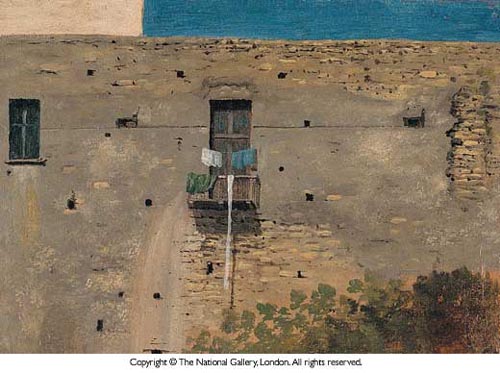
Fascinating. Totally ancient in its style of painting, totally modern in its choice of subject. It's the pink and the blue at the top that is so weird and twentieth century looking.
With a name like "Thomas Jones", this is a hard man to learn about.
By the way if you are a lawyer for the National Gallery and you object to me publicising your exhibition like this and want me to remove the picture from this site, you have only to say. "All rights reserved" sounds like you'd be entitled and I'd owe you an apology which you would get at once. Plus maybe some ruminations on your salesmanship skills. Anyway, I hope that causes no problem.
UPDATE: By googling "Thomas Jones" "Wall in Naples" instead of just "Thomas Jones" (which got me all manner of irrelevant persons such as an NFL footballer) I found my way to this, which has much more on this man, and several more good pictures.
Interesting that the one the National Gallery chose to plug the exhibition was the most modern looking. The others are much more like regular oil painting type paintings.
If you like photos, and if you hate them you will have been avoiding this blog, then take a look at these, in colour, taken in 1940s and 50s Chicago. Thanks to David Sucher for the link.
Even more incredible, the Skyscraper.com man only shows a tiny few of them. The motherlode is, if I understand all this correctly, here.
There are pictures from all over the world, including 278 from London alone.
Looking at all the London photos, what they say to me is, don't just record the most magnificent buildings and great sights, photograph the god-awful waste land bombsite, total dump places, and the most hideously nothing buildings you can find, because they are the ones that will change.

 This Telegraph article is interesting, about a big legal ruckus in the USA concerning the definition of art. Marcel Duchamp wanted to import some Brancusis, but wanted it acknowledged that his Brancusis were definitely art, otherwise importing them would cost more.
The definition of art is not something that anyone would lightly undertake. Nor would it normally be left to a US customs official to decide. But that is exactly what happened in October 1926 when Marcel Duchamp arrived on the New York dockside accompanying 20 modernist masterpieces from Brancusi's studio that were destined for selling exhibitions in New York and Chicago. Duchamp at that time had given up art in favour of chess, and was trying to eke out a living by art-dealing with his friend Henri-Pierre Roché, mainly in Brancusi.The point was that ordinary merchandise was subject to duty at 40 per cent, while art was not. And the customs official on duty at the time happened to be an amateur sculptor – just the sort of person to have bumptiously confident views about matters aesthetic. He took one look at the Brancusis, concluded that they weren't art, and levied $4,000 duty.
The respectable majority comment here would probably now be that those ghastly customs officials ought not to be such philistines. Mine is that if the government is nagged by aesthetes into placing "art" into a special and more economically advantageous category, then the government is bound to be asked, sooner or later, just what is or is not art.
A similar thing happens with "education" subsidies, or for that matter education vouchers. If arrangements like that are put in place, then the government has to decide what education is.
And if you put your government in the position of making decisions like this, do not be surprised if you don't like the answer it gives you.
FJH Kracke, federal customs appraiser, was in no doubt. "After long enquiry and a written report from the inspector in charge of the case," he told the New York Evening Post, "it has been decided that Brancusi's work is not art. Several men, high in the art world, were asked to express their opinions for the government. They are unanimous in their decision. One of them told us, 'If that's art, I'm a bricklayer.'"Brancusi in turn received pugnacious support from the poet Ezra Pound: "I was sick to hear a bastard in New York made you pay duty on your sculpture. I could spit in the eye of the skinflint in charge of these matters." …
What a pity that Ezra Pound couldn't find it in him to get angrier about people besides his friends having to pay duty on the things they want to import. No discriminatory duty, better yet no duty at all on anything, and there would be no legal argument.
In the event, the judgment was surprisingly sensible. "There has been developing a so-called new school of art, whose exponents attempt to portray abstract ideas rather than to imitate natural objects. Whether or not we are in sympathy with these newer ideas, we think that the facts of their existence and their influence on the art world must be considered." In other words, there is this stuff called modern art, the judges concluded, and, whether you happen to like it or not, people admire it and collect it, so it is ridiculous to classify it as hardware.
If enough of the right people say it's art, it is art. But what if building materials suppliers start importing bricks and calling them art? If Duchamp can do this, why not they? Wrong people. Tradesmen.
It's all a matter of power.
Although, I do like Brancusi's birds. The one I show here is called Bird in Space.
There's an exhibition of paintings by Philip Guston at the Royal Academy. So says Andrew Lambirth in the Spectator.
I don't know how they decide who gets to have a exhibition at the RA and have themselves written up in the Spectator for their Apocalyptic Vision, and who gets flogged off in car boot sales for less than the cost of the paint, but I went a-googling anyway, and quickly found this site and these pictures, and I clicked pictures until I found one I really liked. And the winner was: The Studio.

I think this is really funny. I particularly like the big hand.
Guston strongly disapproves of the Ku Klux Klan, naturally. Judging by this picture he made them seem like Daleks, evil but comic.
Good story from the BBC laying out the reasons why people like me love digital cameras. The pros also did the old snap-snap-snap and then select the lucky ones routine, and now amateurs can be like that too. You can see it beforehand on a screen. You can fiddle about with it afterwards on your computer. All the basic arguments in other words. But this is news?
Thanks to the esteemed lady reader who emailed the link. She knows who she is.
UPDATE: I also found this at economist.com:
Last September, Daniel Carp, Kodak’s chief executive, unveiled a new strategy: the firm would no longer focus on the film and paper that have generated the bulk of its revenue and profit till now, but which are in sharp decline. Instead, Kodak would beef up its investment in digital photography, which has already helped it claim the number two slot in digital-camera sales in America (see chart). The dividend paid out on Kodak shares was slashed by 72% in order to help release some $3 billion to be spent on digital investment and acquisitions. The latest in a string of recent deals, announced on Thursday, is the $35m acquisition of the shares in Chinon Industries, a Japanese digital-camera firm, which Kodak did not already own.
That says it all. If Kodak, the archetypical photography-on-paper business, is going digital, that means the whole world is.
In a comment on this Samizdata posting about the (I hope and trust – according to this guy's comment planning permission may not be the end of the arguing) forthcoming London Bridge Tower, the otherwise estimable Kim du Toit really pushes one of my buttons:
Ugh. One of London's charms is that it doesn't have (many) skyscrapers. Now it runs the risk of looking like any other modern metropolis, if this trend continues.
Let me rephrase that:
Ugh. One of Britain's charms is that it doesn't have (many) legally owned guns. Now it runs the risk of being as safe as the American mid-West, if this trend continues.
The trend in question being if Britain were to reverse its current mania for only letting its criminals be armed. We wish. How would du Toit, who quite rightly never misses a chance to urge us to follow the American way in guns, feel about that?
The skyscraper was discovered and perfected in the USA yes, in Chicago and then in New York. But the idea that the rest of us should refrain, just so that Americans can be charmed by our silly little old cities, disgusts me. Why shouldn't we build them too? What are we, Hawaiian dancers in grass skirts who only survive by demeaning themselves with faked-up derangements of their past? If tourists don't like London when it finally gets kitted out with a proper skyline, say by about 2030, stuff them. Actually, they're going to love it.
Skyscrapers solve a universal problem, not a specifically American problem, which is how to fit lots and lots of people into one working place, of that special sort now called a World City. Skyscrapers are the way that cities Keep It Real. Paris, denied the twin stimulants of the Luftwaffe and the Modern Movement in architecture, now has nowhere to put any skyscrapers. London has been luckier. Result? London is a real place with a great, great future, and Paris is an increasingly tatty nineteenth century stage set.
And the way to make London not look like "any other modern metropolis" is for it to have nice skyscrapers, special looking skyscrapers. And things like the Wheel.
London Bridge Tower may look a bit too much like that one in San Francisco, but at least it's big. Better yet, it takes the skyscraper across the Thames to the south, and believe me there are some mighty charmless bits in that part of London, once you get past the newly restored river bank.
Michael Jennings emailed me about one non-American skyscraper, and has blogged about another. The other night a gang of us went to see Lost in Translation and obviously we were most excited about the brief glimpse we had of a High Speed Train, but we also found time to discuss the architecture of Tokyo, which looked rather dull to me, although there is certainly a great deal of it. Lights good. Towers boring. Jennings responded by emailing me about this Japanese tower, which is in Yokohama. There are some other not too bad pictures of it here, of which this is one of the better ones:

Not bad, but still maybe a little lumpish in the Tokyo manner, to my eye. But definitely a nice try, and maybe if saw it in the flesh, so to speak, I'd say: great. At that time of the evening, and with that mountain behind it, it can hardly be a complete failure.
And the tower that Jennings blogs about is the alleged Gherkin now nearing completion in Barcelona.

But of course it isn’t a Gherkin at all, it's a non-vibrating vibrator. The Barcelona Vibrator. Anyone can see that. Are you a three thousand foot tall woman? You'll love it. Let's hope it doesn't live up to that name and start wobbling in a high wind.
The Digital Camera Monkey visited Tate Modern a few days ago, and once again the best results were from pointing the camera almost directly at the sun, although in this case it was an artificial sun. Michael Jenning' pictures here had made me want to see this, and photo it. Remember, the more light there is pouring into the camera, the less long the camera wants to look, and the sharper the picture.
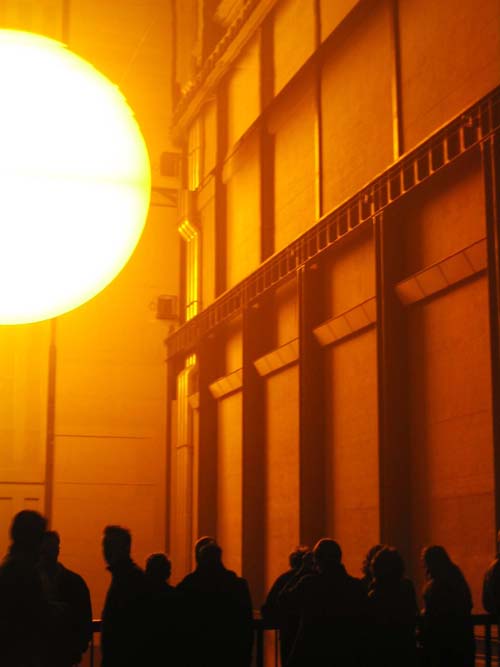
As you can see, the horizontals of which the sun is constructed have slid a bit sideways.
I like that rather Wagnerian wall to the right, don't you? We're not in London, we're in post-Nazi Bayreuth and everything is being re-evaluated, confusingly but impressively.
It took me a while to get that the people lit by it were more interesting, photographically, than the sun itself.

And I tried doing all sorts of things to this next one, cropping and photoshop fiddling, but in the end I left it as it emerged from the camera, the best of a blurry lot of attempted portraits, because it gets how much she's enjoying it. Other viewers were better photographed, but less fun to look at.
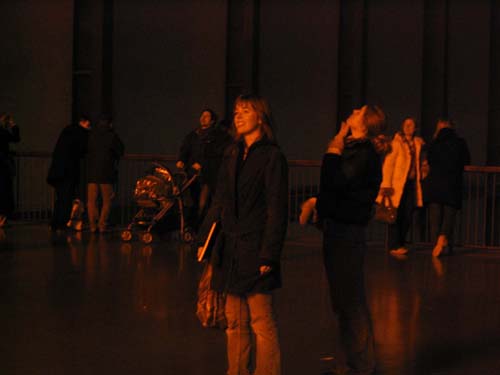
And here are all the true worshippers.

However, they are not worshipping the sun. They are worshipping themselves, as reflected in the ceiling, as you can see at the top of this.

Right, that's enough Tate Modern sun photos. For more about the sun go here.
I recall once visiting the Acropolis and hearing an American, who had been taking lots of photos, say to his children (who wanted to stay and look at it): "Come on, come on, we'll look at it when we get home." This is now how I feel about my photography expeditions. The things themselves are okay, but the point is the photos. Make or break time comes when I get home.
Last night I was obliged, temporarily, to switch off the comments system here. This blog, and my other blog too, came under severe automated comment attack. (This posting is an adapted version of one that has just gone up there as well.)
There were several hundred comments in the space of a couple of hours. I was out late and only got home an hour into the process. All the comments have been cleared out, and a random number system has now been installed, like the one already in use for the comments at Samizdata. New comments are trickling in as per usual, so there doesn't seem to be any great problem with this.
My deepest thanks to Perry de Havilland of Samizdata, and especially to the Dissident Frogman, for their prompt and excellent assistance. First, the crisis was stemmed. Then the solution was put in place which ensures that this particular crisis can't happen again.
Quite what the cultural lesson of that is, I don't know. That my bit of the culture seems to work? And maybe some random thoughts about the immense utility of random numbers, despite seeming only to be an artistic fancy when first thought about?
I'll leave it to commenters.
Alan Little says they don't make movies like they did thirty years ago, and asks: do art forms have a life cycle, and are movies at the end of theirs?
Is it just that any art form quickly mines out the worthwhile ideas that are within its reach and then has nothing left to say or do? There’s certainly a strong case for arguing that with, say, western classical music – a couple of hundred years of sheer exuberant wonder from circa 1700 to 1900, then picking over the remains? Or the "literary" novel. And mass communications may make the process faster – jazz lasted, creatively, from the 1920s to at the latest the 1960s. Maybe cinema just managed a decade or so more than that at both ends and is now a zombie art form too. I hope not.
I found myself itemising all the great symphonies written since 1900, in a comment on this at Samizdata a few weeks back, and I amazed myself. The big surprise for me was discovering how many Mahler symphonies date from after 1900, which I had not appreciated until now. Number 4 onwards, I discovered. Until now, all I'd done was listen to these monsters, not read the sleeve notes. So the "picking over the remains" phase can still be amazingly impressive. Gustav Mahler is a fine example to think about, because many contemporaries thought his stuff derivative and decadent and self-consciously knowing and just generally rubbish, in lots of the ways that art is rubbish when it's done by people who know everything that has been said for the last two hundred years and are scraping the barrel for new things to say. What those contemporaries missed, I'd say, was the depth of feeling under all that kitsch and cleverness and which demanded all the kitsch and cleverness in order to express itself.
Also, despite things now seeming so lively to us until 1900 at least, I bet you there were people just as clever as Alan Little saying in 1850 or thenabouts that whatever they called classical music in those days (music?) was already zombified. Come to think of it, didn't Wagner say pretty much exactly this about "Jewish music" of the Meyerbeer, Mendlessohn variety? Mastery of surface forms and formulae. A big nothing where the real depth ought to be. Wasn't that what he said?
Wagner appallingly overdid his protestations that Jewish artists were/are uniquely incapable of depth, but I do think that he had a point. Could it be that as an art "matures", it gets easier to do basically second-rate, formulaic stuff that nevertheless is sufficiently satisfying and well-produced to keep the manufacturers of it in business. Indeed, maybe that's what "maturing" means. People learn what a core audience will tolerate, and how to fake greatness for them, and they then serve it up year after year. Meanwhile there is at least as much truly great stuff still being done, but it is harder to find and takes longer for posterity to dig out and celebrate.
I don't think that this model explains the decline (and I think it was decline) of "classical music" in the late twentieth century. What happened there was more like a recoiling in disgust from the established forms and a conscious refusal to churn out formula stuff and pay the rent. What wouldn't they now give for a Meyerbeer! I'm not sure if Alan is right about art forms getting mined out, but the late twentieth century classical bosses certainly believed this themselves. Sadly, they were unable to find any other forms that were remotely as popular as their old ones. The Pop industrialists (Jazz, then R&R, now … whatever the young people call it these days) were way ahead of them on that, and they still are. (I think "classical" might catch up, but that's a whole different post.)
Getting back to movies, maybe posterity will decide that Steven Spielberg was a basically formulaic hack, a movie Meyebeer, whose work served to create an impression of general movie zombietude in the minds of people like Alan Little (and me also, I rather think, although I was much impressed by Schindler's List), but that other less mechanically done stuff (Wagner before he got noticed, Schumann) was still being produced, under the radar so to speak. In general, I have the feeling that your average Hollywood movie maker now knows, one way (Quentin Tarantino) or another (Mr Average Movie Exec), too much about too many past movies, and spends too much time either "homage"-ing (Tarantino) or churning the formulae (Mr AME).
There's now an interesting little flurry of appreciation in my corner of the blogosphere being stirred up around Whit Stillman 's movie Metropolitan, a flurry provoked by this piece, and to which I have been contributing. This is obviously a movie which thousands now adore, yet it still can't be bought in London on DVD. (Stephen Pollard said in a Samizdata comment: expect it any month now.) Is this perhaps the kind of movie that posterity will dig out and celebrate more?
This posting started off as just a little something to deal with the fact that I'm busy this evening, and need to get my daily duties here out of the way. So I did my little nod to Alan, and the idea was to leave it at that. Nice one Alan. Then it got out of hand, basically when I found myself disagreeing, and in general, you know, thinking about it. Which is just what Alan himself said later in his posting.
Hmm. This started out as something throwaway to write on the train after a weekend of being ill, and is heading towards altogether more mentally strenuous territory of "is the phase space of possible art forms getting mined out too?", and "what is art for anyway?", which I don't propose to even attempt in the remaining ten minutes of my journey to work.
This second little Little quote above makes we want to ramble on some more here about how I also often sit down, as in this case, to do a short post and end up doing a long and profound one instead, and to ruminate upon the goodness and badness of setting yourself the task of doing something every day, and what sort of writers benefit from such rules, and what sort do not, blah blah. But like him, I will cut it short and leave that stuff for another time.
Reading Virginia Postrel's The Substance of Style didn't tell me much that I didn't know, but it encouraged me to think more about how technically advanced and advancing electronics-based products do and do not benefit from the input of aestheticians. And I was also caused to think some more about such things by this link from Alex Singleton's personal techy-blog to this rather stylish computer. It is small, cute, and made out of just one piece of aluminium, and with a flat and empty top. And see also this picture of Perry de Havilland's new computer.
Perry's new computer has a curvy top. I prefer flat and empty tops for this kind of beast (also for music boxes), such as the thing Alex linked to has, because then you can put other gadgets on top, and pens, and paper clips and biros and Disprin and plates of food and cups of coffee. My new digital radio is wondrous, but I can't put stuff on top of it, and my new digital TV add-on is shaped not like a book but like a bug and is most inconvenient. Here is a case where being "aesthetic" is a downright negative.
The trouble with getting all aesthetic about computers, aside from the trouble caused by doing it badly, is that the technology is not stable. Imagine how car design would be if every two years or so they invented a whole new subsystem you had to bolt onto the thing. But actually, car design is stable. That is why the aesthetics department of car companies is so large and so important and so commercially vital. Aesthetics can regularly make the difference between car famine and car feast, and once you've perfected your new design, it can, with a bit of ducking and weaving, last quite a few years.
Not so with computers. By the nature of computer technology, extra bits of junk accumulate all the time. Techies may reply: ah but you can stuff it all inside, and thus ensure the aesthetic integrity of that cool box. Yes, but non-techies are the ones most influenced by aesthetics, and non-techies prefer to just add things on by adding them on, on the outside. (This is why the USB standard for adding on add-ons is so important to us non-techies.)
That said, computer technology is now more stable than it was ten years ago, and for that reason, computers of all kinds are becoming more aesthetic. Think Apple. The trend now is more towards buying a very similar machine every few years to the one you had before for far less money, or towards buying a massively more powerful machine than the one you had for the same money, but with the basic architecture and functioning of the machine changing less now than it was changing ten years ago. Computers are becoming more carlike, in other words. Hence, as with cars, the boxes are getting rather prettier.
The other things that influence whether gizmo aesthetics are worth bothering with are expense, and portability, which are closely related of course. Portability equals small. And with luck, small may mean cheap, and hence replaceable in entirely every year or two.
My new digital camera is very aesthetic, and yours too no doubt, if you have one. Why? Because digital cameras don't have add-ons. When digital camera technology does its customary leap forward every eighteen months the only ways to respond are either by getting a new camera, or by making do with the old one. Add-ons get added on in the design stage. Users aren't going to cart them around in their pockets.
(Although, I do sometimes carry with me my little widget for stuffing the photos on my Flash Card into other people's computers. Aesthetically, this gadget bears no relation to my camera. By the way, being able to take this little thing on holiday with me is part of why I didn't want to bolt it irrevocably into my big box computer.)
It is noticeable that aesthetics has a far greater impact on the shaping of portable computers than it does on the shaping of the big bastard non-portable computers of the sort that I have. This is because, for the kind of people who buy them, portable computers are actually very cheap (corporate petty cash) and are hence replaced every year or two in their entirety, and because portable computer people can't be doing with carting extra bits of clobber around. Thus it makes sense for someone to pull everything in a portable computer together into a sexy looking package. As with cars, all the components are the same as they are for all the other portable makers (not completely true but it will do as a generalisation). Aesthetics can make all the difference.
Portability also says aesthetics because portability means that you are more likely to be showing the thing off to second parties, to corporate rivals, to admiring audiences. Portable gizmos are more likely to be aesthetic status goods. See also: portable phones. Very similar tendencies there to digital cameras, only more so. Think of all those fancy new cases you can buy for them. And note how when portable phones do a leap forward technologically, aesthetics steps back a little. (That's happening now, isn't it? – and those fancy covers are a little less common now. They'll be back.)
But that big computer box that stays under my desk? The only aesthetic I want there is how such things look when they work well. The functional look is all I want there. The aesthetic "honesty" of the engineering brick or the out-of-town warehouse circa 1960. My computer is a boring metal box which is there to do a job, not to look cute. And it looks like a boring metal box, which is just fine by me. We need to be "smart and pretty" now, says Postrel. All I want from my big box computer is smart, thank you.
We all know that thing about a million monkeys banging away at a million typewriters, and the general opinion is that there wouldn't be much to show from such an exercise of any great literary value.
But the current global social experiment now well in hand of placing about a billion digital cameras in the hands of about a billion monkeys, of whom I am one, promises to yield much better results.
This monkey went a-snapping earlier in the week. I was after a footbridge that had been recommended to me, but the light was fading, and with fading light the camera seems to want to expose itself for longer and that blurs things. So results were mixed, that is to say useable, but I believe I can do better.
However the monkey got luckier, or so I think, with this ballerina statue. I even thought to get that window behind her in a sensible place.

I don't know what all those phone boxes are doing there. London now seems to sport such clutches, after what I recall as a decision to banish these things from our lives entirely, and replace with something more modern and bland and dull. That's how I remember it, but this could be all wrong. Anyway, I like how they look.
Statues are good. They stay still. And they don't suffer from red eye. On the other hand they are weird colours, and look best in sillouette, as this ballerina is, pretty much.
Cars are an obvious focus of aesthetic fascination, so I'm sure (as I said here) that I'll be linking to this guy in the weeks and months to come, especially if he has lots of pictures. However, the bit I read today at CarBlog that really hooked me was about the art, if art it be, of signing autographs:
… The way it worked out this year, I spoke with not one but three pretty famous car guys at the NAIAS this year.First, I was coming or going to somewhere and stopped by the Bentley stand to get another look at the Continental GT. The hood was up and three men were discussing the engine compartment. It didn't take me long to realize that the guy with the Ford pin was Sir Jackie Stewart, three-time Formula One driving champion and inspiration for a million bad vocal impressionists ... "this is Jack ... ie Stewart". At a break in their conversation, I asked him if I could trouble him for his autograph on a Bentley press cd.
Now some guys have class. …
Digression about somebody else with class. Then back to Jackie Stewart.
When I asked Stewart for his autograph, he whipped out a Sharpie and graciously signed not one but two Bentley press cds in a beautiful, distinguished autograph. The Sharpie and legible autograph are not a coincidence. Eoin Young described how Stewart refined his autograph and why: "He felt that if someone granted him the honour of asking for his autograph, it should be worthwhile, and he practised his copperplate autograph. No disinterested squiggle, looking away, talking to someone else, here." …
Interesting. Sharpie, presumably, is some kind of fountain pen, yes? I'm a total keyboardhead myself. I used to be able to hand-write but it's almost gone now, for all but scrawled notes to myself.
I've just got back from a night out, and on my way home I spied this striking illuminated picture, inside the (very transparent) Channel 4 TV Headquarters Building in Horseferry Road, just opposite the (highly visible) lift. Out came the digicam, snap snap snap, and here it is.

I like it, even though I'm not sure what it means. Perhaps that's the idea. I must be grabbed hold of, stopped short, and made to think. (Which normally I don't do, is the insulting implication of art works like this.) But I like this image too much to be annoyed by its cryptic nature. It is a combination of a clearly legible (if not understandable) message and lots of decorative skill to back it.
I think what it means is "we don't take orders and we don't give orders". That doesn't rule out being influenced by or influencing others, so if that is the message, I disagree with it, in the sense of disagreeing with the assumptions behind it. Can anyone tell me more about this thing?
As I say, it is illuminated. Hence the clarity of my picture. Maybe it's just a light box with a tacky poster in it, and if I got close to it in daylight I wouldn't be nearly so diverted.
UPDATE: What was I thinking? Here is a picture that can be googled after. So I did and here it is.
Mark TitchnerPhrases borrowed from miscellaneous sources and found text feature prominently in Mark's work. These seemingly random texts and slogans have resonances that can be found in once radical, but now outdated, philosophies, the territory of the avant-garde. Divorced from their original context, the meanings of such catchphrases and cliches become ambiguous and the appropriate response is perhaps bewildering – should we interpret these works with humour, sincerity or cynicism? Mark presents these 'cod-philosophies' in the forms of light boxes and banners, which in themselves possess a slick advertising aesthetic - the radical consumed by popular culture. Mark appropriates styles that originate from diverse sources such as the high street, interior decor and abstract art. For example the work 'WE WILL NOT FOLLOW. WE WILL NOT LEAD.' uses images taken from Andy Warhol and William Morris, whilst the text paraphrases an aphorism by Nietzsche. In his practice Mark tries to deal with the difficulty or contingent nature of assuming a position in relation to 'large themes'.
So now I know.
Adam Tinworth links to this photo-essay about fashion photography. Fashion is foreign territory to me, but some of this I definitely got.
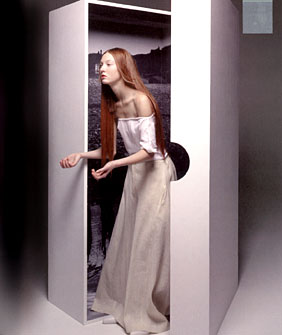 For example. the caption to this picture (Number 22 of 28) reads as follows:
Today, 30 years into feminism, we have models who look not just weak and unsophisticated, but also dumb and victimized. Academic feminists haven't complained because the models are supposedly playing a subversive role and subversion is inherently politically correct. Moreover, many of the young photographers are female. But now we've moved into "fashion vérité" and the models still look stupid. Is this how women in fashion see themselves?
The gist of Ms. Lehrman's complaint is that fashion models used to look like Lauren Bacall in her pomp, and now they look like under-age wimpettes.
Well that was as long as this post was going to be, but then I remembered someone else saying all this. One of my favourite middlebrow writers is Susan Isaacs. And that's where I got that word "wimpette" from.
Here is an excerpt from Ms. Isaacs' quite recent (2000) non-fiction book Brave Dames and Wimpettes:
What brave dames have in common is that they're passionate about something besides passion. Yes, Jane Eyre loved Edward Rochester, but her lifelong quest was not for love but for justice. Brave dames, then, are self-sufficient, active, dynamic, three-dimensional heroes who see past that picket fence. They may love their children, but they also love the work that takes them away from them. They may be interested in men--and often are successful in their relationships with them--but they rarely spend their time mooning over a man. Nor are they full-time victims, either of circumstance or of villains. The message of the movies, books, and television shows they inhabit is that you can care about home and hearth and also the world beyond them. You can do well, do good, or simply do. Brave dames can be strong and active, but they are not only about kicking butt. Like Marge on The Simpsons, who is often the lone voice of decency speaking out against her town's and husband's flaming stupidity, they are moral.
And here, because it says all this so very clearly, is what the plug for the book above that excerpt says:
In this thoroughly witty, incisive look at the role of women on screen and page, Susan Isaacs argues that assertive, ethical women characters are losing ground to wounded, shallow sisters who are driven by what she calls the articles of wimpette philosophy. (Article Eight: A wimpette looks to a man to give her an identity.) Although female roles today include lawyers like Ally McBeal and CEOs like Ronnie of Veronica's Closet, they are wimpettes nonetheless. A brave dame, on the other hand, is a dignified, three-dimensional hero who may care about men, home, and hearth, but also cares--and acts--passionately about something in the world beyond. Brave dames' stories range from mundane (Mary Richards in The Mary Tyler Moore Show) to romantic (Francesca in The Horse Whisperer) to fantastic (Xena: Warrior Princess), but whatever they do, they care about justice and carry themselves with self-respect and decency. For a Really Brave Dame, think Frances McDormand as the tenacious, pregnant police chief in Fargo.
Well, yes, I see that. But try this for an explanation of Modern Woman and her dreams. If it's wrong, you can tell me. My ego isn't on the line here. I'm new at this kind of thing. But here's how this all might make sense, in a way that no women need feel especially ashamed about. (We men are another matter.)
Fifty years ago, women were all stuck in the role of Wimpette, and many secretly dreamed of being Brave Women. Now, women can all be as brave as they want to be. Their problem now is that they have to be Brave Women all the time. Many can manage this. But many can't, and secretly yearn to be Wimpettes, which is the thing you now aren't allowed to say. Oh you can say you want to be a housewife, but woe betide your Modern Woman if she dares to say that she'd like to be a weak and dependent housewife, or a weak and dependent commodities trader for that matter. The women now all have these exhausting, macho jobs their grannies fought so hard for, and now they have to disguise their inner Wimpette under a façade of Brave Woman.
The men don't help, because while the women have been becoming Brave Women, huge numbers of the men have gone wimp on them. And the last thing a wimp man wants is a wimp woman to worry about.
Ergo, womanly dreams, as performed in the fashion photos and the most cutting edge TV shows, are now Wimpette dreams. Ergo, Ally McBeal – Ms. High Powered Lawyer but a Wimpette – because the Wimpette thing is what you are now not allowed to be for real. Only in your dreams. Only on the telly. Only in the fashion mags. Reality has done a switch and so have the dreams.
Remember that great scene in Ally McBeal where a Feminist Battleaxe, having selected Ally McBeal as Woman of the Year, or some such thing, then tells her she'll have to damn well shape up (get rid of that "thin thing") and put some backbone into herself, and generally live up to her responsibilities as a FemaleRole Model. You are going to have to be strong, Little Missy, whether you like it or not, you hear me girl!! That's what Modern Woman is now up against.
Well, perhaps you didn't see that, because when I – wimp that I am – was watching that, you were watching The Dirty Dozen with your Superheroic Rich Husband.
Here's an ice sculpture, which I found here that is to say a picture of an ice sculpture, and it vividly illustrates the difference between how a camera sees and how the human eye sees.

During the run-up to the recently and very satisfactorily concluded Rugby World Cup, I posted some great photos of the great rugby player Jonah Lomu, and I made this same point. Chris disagreed:
And Brian ... I beg to differ about your take on how the eye actually sees things. All that blurry stuff, caused by depth of field focus is exactly what I see when I focus on something HERE and not BACK THERE. Try it.
Ever since then I've been meaning to respond to Chris, and have meanwhile been watching myself watch foreground objects and background backgrounds, to see how I do it. So I have tried it. And Chris is, unless he and I are members of different species which I suppose is always a possibility, completely wrong. When we see an object and a background, what we see is a volume. We see the space between the object and things behind it. We size up the situation, by moving, both our bodies and our eyes. We theorise – sometimes wrongly, which is when this difference really hits you – about what is going on, and from then on that theory informs and shapes every incoming signal.
But what the camera sees is a static, two dimensional surface, in or out of focus but never both at different moments right next to each other, still less any different angle on the scene. The two experiences could hardly be more different.
Getting back to the picture of the ice sculpture, there is no way that the human eye would allow itself to be so comprehensively confused about what the hell this object consists of, the way this camera was. This picture is about as clear a description of what is going on as the special effects in the latest James Bond for that invisible car.
The eye would duck and weave, to establish volume and shape and surface. It wouldn't just gawp – camera style – at whatever incoming light signals came in, and just tabulate them in a baffling, static rectangle. I'm not saying it's a bad photo. In a way, its very bafflingness makes it rather a good one, if you like that sort of thing. But it is a very different experience from actually seeing the thing.
Photography is one of the great under-discussed influences on Modern Art. It is discussed quite a lot, but not enough.
Consider. Photography pretty much drove the painters out of the likeness-making industry. They had to do other things. Photography publicised what the painters subsequently did, which gave huge impetus to the whole shock-art style of self-advancement. In general, the experience of Art nowadays is utterly saturated with the experiencing of Art via photos. And maybe (I'm a lot less sure of this part of the story but it makes sense to me that it should be so) the very first thing that photography did to Art was to make painters unprecedentedly aware of and self-conscious about the various processes involved in seeing things. After all, many of the first photographers were themselves painters, applying this new technology to their existing trade.
Impressionism looks very post-photographic to me. You can just here them saying: hey, we could do that, but in colour. But, we'd better get a move on.
Michael Jennings has spotted a Gherkin in Barcelona. You know my views on Gherkins. I'm for Gherkins. If you are too, or for that matter if you regard Gherkins as a menace to civilisation and all that is decent, keep yourself posted.
On December 5th of last year I did a posting here about the sublime Vicky Pollard, the genius comic creation of genius comic Matt Lucas, the fat bald guy who plays a baby with the drum kit on that show with those two surreal comedians called I can't remember what at the moment, with all the celebrities, including that one from Iceland with the blond hair who had a fling with Sven G… with the England football manager.
Anyway, there's been a trickle of comments on that Vicky Pollard posting, at irregular intervals. Here they are.
On December 16th, Paul commented thus:
vicky rocks but yeah no yeah shut up!
Then silence over the Christmas period, followed on January 7th, by this, from rainbow:
yeah but no but yeah but no but theres this whole other thing wot you don't even no about so SHURRUP! u SHURRUP! and tasha ses ur gay but dont listen to er cos she smokes weed and she's pregnant with darren's baby so SHAP u!
A mere three days later, on January 10th, christine chimed in thus:
me and my friend are always sayin yer but no but deres dis ova thing u dont no bout yea and i wasnt even wid amber so i dont what ur talkin about yea but no but and we r always crakin up and i also like da man hu sez "im a ladyy me and u r alike becuz we r both ladys" and da man "yeeeees" ahahhahahahah little britian is sooooooooooooooooooooooooooooooooo funny!!!!
Followed just one day later on the 11th by this, from Dave:
Vicky has to be the best character on there. It must be so hard for Matt Lucas to play her, having to do all those takes in a scene, one after the other...the amount of breaks for a breather he must need!
Vicki though, I do luv her, shes so gr8!!!
"Doesn't matter ne way coz we got one of dese (sniffs pritt stick) Come on girls, lets gwo, dis place is RABBASH!" hehehe.
Well, well, well. Brian's Culture Blog does certainly seem to have struck a chord with Today's Youth. And thank you, all of you good young ladies and young gentlemen, if young you be, sincerely, for reproducing the patois of the sublime Vicky for the benefit of my less pop-culture-savvy readers, with their noses stuck in Shakespeare plays and their ears buzzing with Bruckner Symphonies.
Really, this is great. Sorry: gr8!! When people imitate the jokes of comedians in conversation it can be rather tedious, can't it? But when they do it in writing, I find my reaction to be quite different. The pleasure these young commenters feel along with me about Vicky and her extraordinary sayings and doings shines through, as does their joy in just what you can do with our alphabet and numerals when your teachers aren't looking.
But how did Youth keep learning about this posting? I found the answer to this puzzle when, googling for a better picture of Ms. Pollard, I discovered that my Pollard posting is NUMBER ONE on google, if you type in "Vicky Pollard". How about that!
Anyway, I will now try to find a better picture than I had up on the first posting. Is there now a Vicky Pollard Fan Club? There should be. … Bear with me.
I don't know how this works, but you could try it.
But no, couldn't find any good pics, or any fan club. ("Vicky Pollard Fan Club" did not match any documents.) But I did discover that two other Vicky Pollards exist, a gymnast, and somebody who works for the European Wind Energy Association. Bad luck, eh?
The Observer, to its credit, today gives another nod of mainstream media recognition to Jack Vettriano:
Anyone wishing to see an original Vettriano must travel to Scotland's Kirkcaldy Art Gallery, which has two. Last night the artist, a former mining engineer from Fife, launched a withering attack on the cultural elite that leaves him out in the cold.In a rare interview, Vettriano said: 'The art world is not a lot to do with art; it's to do with money and power and position. Annually the national galleries are given a budget of taxpayers' money and they should spend it on behalf of the people of Great Britain, but I feel they don't.
"If they've decided you fit what they like, you'll be in; if they've made up their minds otherwise, you never will be. I appear to be in the latter category. If they were truly buying for the people of Great Britain then they would buy my work, that is as clear as day. But they don't.
'I have days when I couldn't care less, and other days when I wonder why the gulf exists. There's a snob association: when something's too popular it's regarded as a bit trashy. But I would rather my paintings sold to ordinary people, rather than being stacked in a store house at the National Gallery.'
Vettriano, 52, has sold more than three million poster reproductions around the world and earns an estimated £500,000 a year from the royalties. The works themselves disappear from public view into the hands of private collectors, with buyers including Hollywood star Jack Nicholson, composer Sir Tim Rice and British actor Robbie Coltrane.
You can see how the Official Galleries would hate such a person. Vettriano doesn't need them. He'd like their recognition, but is damned if he'll beg for it. After all, he thinks he's better than they are. And they think they're better than him. A classic dog fight in other words.
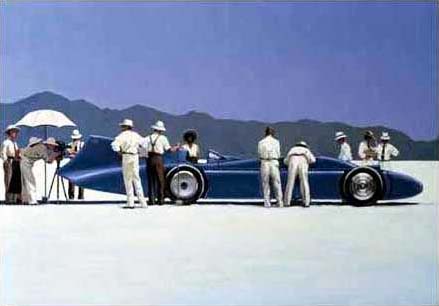
I believe that the internet can only add to the problems of the Official Art scene, by breaking their definition of "art" into a thousand pieces. In this spirit, I pick a nice looking Vettriano to reproduce here. This one is my favourite today:
But hello. What's this?
The next Vettriano exhibition will be at Portland Gallery in 2004. Further details and exact dates are yet to be confirmed but as soon as we have this information, our website will be updated accordingly.
And just whereabouts in the wilds of Scotland might the Portland Gallery be?
Just south of Picadilly, in a little Scottish village called London. So that would be the other galleries that are ignoring him, then. And could all this launching of withering attacks perchance be all mixed up with his forthcoming show at the Portland?
Half a million a year minimum, and a nice friendly London gallery. He's getting by.
So much for the up-to-the-minute tittle tattle. The real story here is that Vettriano is celebrating a way of life, and an attitude to life, that twentieth century Modern Art quite deliberately set out to destroy. Modern Art says that dreaming of your own personal, individual future, by envisaging it, picturing it, by representing it, is Old Hat man. A picture is just a thing. It ain't of anything. All representation is suspect, and if you do it, you must draw attention to the fact that you are doing it, and how suspect it is. God forbid you should ever perpetrate, in the bullseye words of one of Barry Humphries' alter egos, cartoon Aussie innocent Barry McKenzie, "hand done photos", which are about something completely other than the process of and the suspectness of picture making.
So along comes Vettriano. He hand does photos of achingly romantic beautiful people, doing achingly romantic things like have dinner parties on the beach. They have servants who aren't complaining. They yearn. They put on make-up. They race racing cars. They are the beautiful people, or they were, or they would like to be, or they would have liked to have been, and they want to become more beautiful or to remain beautiful, or just to imagine themselves beautiful. They're looking forward to, or wanting to remember, all their I-had-my-moments moments.
Vettriano obliges. He gives his public what they want. How vulgar. How ghastly. And as if Picasso didn't.
I'm watching Evgeni Kissin and Martha Argerich play a Mozart piano duet on the television. It certainly adds something to one's appreciation of the music to see them playing it. I think part of the reason it is so revealing is that they need to communcate with each other to make the performance work, and thus they communicate also with the rest of us.
Listening to the same performance on the radio would be to listen to what they actually played. Watching them play as well as hearing it means being told how they wanted to play it also. And we all know how profoundly the human nervous system is influenced by what it expects to see, or in this case what it expects to hear.
When you google: "Kissin" and "Argerich", you get a mass of references to solo piano pieces which they have both recorded. You get them as rivals. But now Argerich refuses to play on her own, which I won't complain about again. (Argerich is overrated, basically because a lot of people think she's God, but she is still very good. Except in Mozart piano concertos.)
Now there's a bunch of famous string virtuosi – Sarah Chang, Gidon Kremer, Nobuko Imai, Vadim Repin, Christian Tetzlaff, Yuri Bashmet, Mischa Maisky – playing a joke piece by a German guy, which is a pastiche set of variations on Happy Birthday to You. I don't know whose or what's birthday it is. They all seem to be enjoying themselves greatly. Why can't real compositions be more like this? It seems that this is not allowed. Sooner or later these people – not these particularly people, but their massed pupils – are going to have to play entertaining music not all that unlike this joke piece, but for real. Or starve or get jobs as computer operatives. It won't be long before these are their real choices. Maybe this joke piece, which is only one up from something by Gerard Hoffnung, is these people sensing what their future is going to be about.
Now they're playing the Bach concerto for four pianos and orchestra. Fatty conductor James Levine has joined them, to play piano. And there's Michael Pletnev as well. This must be one of the most expensive performances of this piece ever. But it's also very good. Plenty of bounce and dance about it. I love Bach keyboard concertos played on the piano, as well as on the harpsichord. Now the slow movement. Delicious. They're all sitting absolutely still while they play, and that's also how they're playing it of course. Now the finale. I'm just going to listen.
Finished. Wonderful. And it's the Verbier Birthday Festival Orchestra, so I guess it's the Verbier Festival that is having its birthday.
Now they're going to play Rossini's overture to Semiramide, arranged for eight pianos. They started with a joke tuning session. No much they can do about that, with pianos, so ha ha.
Sarah Chang is a real looker, and she's on the cover the latest BBC Music Magazine. Meanwhile, Gramophone has the equally gorgeous Helene Grimaud. I wonder if that also is a sign of things to come. Answer: it's probably a sign of things that have already arrived. Chang is a terrific musician, no doubt about it. Grimaud, recently signed by DGG bothers me, after what I thought was a decidedly average Bartok Third Piano Concerto at last summer's Proms.
Now the eight pianists are doing the Ride of the Valkyries. It sounds great.
I have never witnessed anything at all like this before. I am musing about how many of them have recorded Rachmaninoff's Third Piano Concerto. I have CDs of Argerich, Kissin, Lang Lang, Pletnev, and Andsnes. Now they're doing mad Americana on all those pianos, like arrangements of Stars and Stripes For Ever. The hour and a half went by in a flash.
My thanks to Alan Little for commenting (on this posting almost immediately below) with a link to this response from Eric Raymond to Instapundit about giving stuff away. (And boy, did I have to scroll down to find that Insta-piece again? Boy: "Yes, you certainly did. So why didn't you just copy Raymond's link to it? Fool.")
Says Raymond:
I'm one of a handful of technical-book writers who publishers treat like rock stars, because I have a large fan base and my name on a cover will sell a book in volumes that are exceptional for its category (for comparison my editor at AW mentions Bruce Eckel as another). I'm not certain my experience generalizes to authors who aren't rock stars. On the other hand, it's more than possible that I'm a rock star largely because I have been throwing my stuff on the Web since 1991. It's even likely — after all, I was next to an unknown when I edited The New Hacker's Dictionary.So I don't find the InstaWife's experience very surprising. Webbing one's books seems to be really effective way to build a fan base. My impression is that people start by browsing the the on-line versions of my books, then buy the paper copy partly for convenience and partly as what marketers call an identity good.
An identity good is something people buy to express their tie to a group or category they belong to or would like to belong to. People buy The New Hacker's Dictionary because they are, or want to be, the kind of person they think should own a copy of it.
Here's the causal connection: A Web version can't be an identity good, because it doesn't sit on your bookshelf or your coffee table telling everybody (and reminding you!) who you are. But Web exposure can, I think, help turn a book with the right kind of potential into an identity good. I suspect there is now a population of psychologists and social workers who perceive the InstaWife's book as an identity good, and that (as with my stuff) that perception was either created or strongly reinforced by web exposure.
If so, this would explain why webbing her book made the auction price for the out-of-print paper version go up. The price of the paper version reflects buyers' desires to be identifiable as members of the community of readers of the book. By making softcopy available for download, the InstaWife enhanced the power of the paper version as an identity token, by making it easy for a larger population to learn the meaning of the token.
I would go so far as to predict that any book (or movie, or CD) that functions as an identity good will tend to sell more rather than less after Web exposure. All three of my in-print books happen to be identity goods rather strongly, for slightly different but overlapping populations. I suspect the InstaWife's book has this quality too. About those things which aren't identity goods, I can't say. Not enough experience.
And I severely doubt if slicing great gobs of his bloggings to put on a lesser blog does the guy any harm either.
I've found another amazing skyscraper. Do you know what this is?

If you want to find out, read about it in – and follow all the links from – a piece I've just done about it at Samizdata.
Here's an interesting proclamation, concerning an SF author who is making all his writings available as pdf files, free of charge or condition, on the Internet. He explains why, and his explanation can be summarised in one word: profit.
Thanks to Instapundit for the link. (Mrs Instapundit also has a book available free online, a cheery little number about juvenile murderers. Summary: too much self esteem.)
And a reminder that my only two works of fiction, and one a very short short story (pdf and html), and a short story about three times as long as that one (pdf and html, are both available to be read on a similar basis. Or, you can buy them on paper (which is just a photocopy of the pdf stuff) for 20p and 40p respectively. Don't all write in at once, in fact my preference would be for nobody to write in at all.
And hey, look at this. Funny how, when you start to write about something, the same thing suddenly pops up elsewhere. (Or maybe it was always there and you suddenly notice it.) Here's Jackie D linking to this clutch of 700 free online e-books.
Clearly this is not a trend which will go away. But where is the best site for getting free stuff of this kind? It seems to me that there will sooner or later be a market leader for old writings out of copyright, based on number of hits, quality of text, excellence of edition choice, and so forth.
This stuff is a natural next step for publicly funded libraries and universities. They have the skills. They have the money. So let them just use it. Personally I want the public sector to drop dead, but if I was in favour of it, this is what I would be begging it to do, to justify its existence.
The reason that the public sector is especially well placed to do such things is that, what with them already being paid by the government, they don't have to chase every last little micro-penny and micro-cent from their users, which is in any case a losing strategy as this guy explains (in a piece I've already linked to from here.
Come to think of it, I did a posting on Samizdata not so long ago which made the point, which I still think is a good one, that the big distinction on the Internet is not between the "blogosphere" and other things, but between what's free to start reading right away with no bullshit about paying or registering or telling them your email or your granny's maiden name, and what is not.
Not feeling well today, so a quota picture from the archives is all I can manage, of the Millenium Footbridge (the one that wobbled) which joins St Pauls to Tate Modern, looking downstream. Tower Bridge beyond.

Taken with the old camera, so a hint of strawberry icecream in the sky, I'm afraid.
I rather think I may have put up something like this here before. The way I see it is: never mind. It's pretty.
Not feeling well today, so a quota picture from the archives is all I can manage, of the Millenium Footbridge (the one that wobbled) which joins St Pauls to Tate Modern, looking downstream. Tower Bridge beyond.
Taken with the old camera, so a hint of strawberry icecream in the sky, I'm afraid.
I rather think I may have put up something like this here before. The way I see it is: never mind. It's pretty.
My life just now is going through an odd phase. It will not last because it is absurd, but while it lasts it is strange, and I at least will enjoy reading about it in, I don't know, five years time, when the problem I am now mired in has been solved, and I've forgotten about it. (Never forget that my number one reader here is me. That explains a lot.)
But back to this odd phase. I'm talking about the fact that before I went digital, I could record TV programmes, and radio programmes, semi-satisfactorily, but now I can't. Now I'm sure that there are simple procedures for solving these problems, but the trouble is that just for now it they are too complicated. I'm sure that if I could get a routine going, I could record radio programmes on my hard disc and then play them back through the speakers attached to my computer. I'm pretty sure that I can't record digital TV now, until I get a "TiVo", or whatever those things are called. Recording digital TV on videotape is worse than analogue TV on videotape, because the sound is utter crap.
Please spare me the helpful advice about all this. There are more important things going on in my life right now than being able to record every digital signal that enters my kitchen. When everyone else is kitted out with the relevant stuff I'll get it too, and that will be that.
But meanwhile, my life has reverted to the pre-video-recorder age. My weekly clock is now governed by the Radio Times and its contents. I find myself inventing non-existent alternative dinner engagements, so that I can watch certain movies or listen to certain classical concerts, or watch a cherished re-run of Ab Fab.
Take last night. Basically, the job in hand was to write this about how Michael Jennings wants a job. I had promised it for Monday, and did actually finish it in the early hours of today. But alas, BBC TV 4, on channel 10, was simultaneously broadcasting, live from the new-olde Globe Theatre, London, the Mark Rylance Richard II. Which was fantastic.
Basically, I have nothing much more to say about this production than that. It was fantastic. It was outstanding. Rylance's characterisation of Richard was the most convincing I've ever seen. Bolingbroke was very fine. The John of Gaunt speech was very fine. Blah blah blah. Fine fine fine. Anyway, I had to watch it. It was last night or never (although actually of course they'll rerun it several more times and it will be available soon on DVD).
And in among it, I did the piece about Michael wanting a job. So, with digital TV, I write a bad article and Michael has to settle for a dead-end job. No digital TV, the article is brilliant, Michael becomes a billionaire uber-geek and lavish sponsor of Brian's Culture Blog which proceeds to take over the world. Such is history. Anyway, as I say, it's an odd time in my life.
And then this morning I had to get up at the crack of … well never mind, to listen to a promising Dvorak chamber music recording on Radio 3. Radio 3 is now a near continuous delight. Thank god it isn't all as good as some of it is, or I'd never do anything except listen to it.
I have one of those started for here but ended up there bits, about Norman Lebrecht, up at Samizdata.
I tried various googlings in search of photographs, and the best one by far proved to be photographs. With that I got to these snowflake photos and in particular to Wilson A. Bentley, who seems to have been something of a snowflake photography pioneer.
Here's one of Bentley's pictures that I like:

What I find intriguing about this image is that it doesn't really look like a snowflake, perhaps because it is melting. Instead, it looks more like a manufactured structure, maybe some kind of plastic moulded object. Or even a biological object. If Mother Nature ever evolved wheels, maybe that's what they'd look like.
The same applies to many of the pictures in colour at the top, like this one for instance:

Again, it seems to be melting, Do snowflake photos always look like that? Surely not.
Here are some tips from these guys for if you want to photo snowflakes yourself.
That's if it ever snows in your part of the world.
I love a good skyscraper, and I'll happily settle for a big skyscraper. However, I completely missed this one, until this evening I watched a recording of a Channel 5 documentary about skyscrapers. (Salisbury Cathedral came in for some serious praise. Way ahead of its time in a number of ways, apparently.)
 Here's how this October 18 2003 report starts:
The Taipei 101 office building laid claim to the title of the world's tallest skyscraper following a ceremony yesterday to position a 60m spire on top of the structure.With the addition of the spire, the building boasts of a full height of 508m, eclipsing Malaysia's Petronas Twin Towers, a company executive said yesterday.
But why Taipei 101? Answer here:
TAIPEI is an acronym for Techonology, Art, Innovation, People, Environment, and Identity. 101 represents the concept of striving for beyond perfection.
Bullshit is alive and well and living in Taiwan. For a more jaundiced view of this new edifice, go to this guy:
You can only imagine the horror when my friend and I decided to pop by Taipei 101 after a Christmas-day buffet lunch at the Hyatt next door. We took a pit stop at the restrooms in the Taipei 101 mall (the only part of the building open to the public, unless they close it because crap is dropping off the building and injuring people) and just couldn't believe how horrible they smelled. Those restrooms stank to high hell. How long has that mall been opened? Like two months? All that wonderful technology that produced the world's tallest building in an earthquake zone and they can't figure out how to deodorize a bathroom?
Architecture is very cruel. Unless you get everything right, you can get it badly wrong.


