

I'm watching a really rather good TV programme about Tamara de Lempicka, the woman who painted these pictures. The one on the left is apparently one of her most popular:

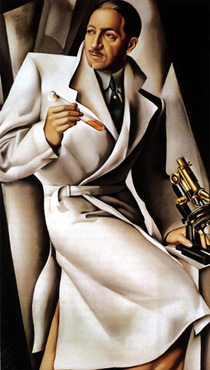
Lempicka's determined exclusion from the official Modern Art canon began as soon as she got into her stride as a painter. She simply did not do the right things, or embody the correct ideas.
Her clientele was "bourgeois and conservative" (I'm listening to the BBC man, Andrew Graham-Dixon doing his patter), but instead of epater-ing them, she made no secret of her desire to be one of them, or rather remain one of them (what with her having been a rich Russian aristocrat who had fallen foul of the revolution).
The picture of hers I really like is the one glorifying a research chemist patron of hers, a handsomely heroic chap brandishing a test tube and standing in front of a microscope (see above). Dear oh dear. Can't glorify people like that. There is a distinct whiff of Ayn Rand about her, and I bet a lot of Randians love her.
She bombed in America, but Hollywood now loves her. A Royal Academy show of her stuff has just got under way.
Her best stuff is very distinctive. "Art Deco gems", Graham-Dixon is calling them. But she wore her marketing on her sleeve, and when her best and most natural style didn't cut it in the USA, she very visibly attempted to follow art fashion, and that is a deeply unfashionable thing to do. She even had an "abstract" phase, G-D is now saying.
Most of the art historians still hate her, but Graham-Dixon recognises the truth of it, which is that these are powerful and distinctive images. I've been meaning to blog about this woman ever since I saw a poster about the RA exhibition of her in the Underground.
Deepest thanks to Scott Wickstein for telling me about these pictures, taken by an unmanned spaceship called Cassini, now in the vicinity of …

Art or what?
By the way, the tiny white dot to the top left is not a mistake, it's a moon.
 This morning I listened to CD Review, as is my custom of a Saturday morning, and their record of the week was a performance of Mozart's Marriage of Figaro which sounded way above average. Mid price, they said. I might just be buying it right off the shelf at HMV.
The thing is, I've never really taken to opera, and if you do take to Mozart (as I do, big time, the symphonies and piano concertos, the wind serenades, the string quintets, ) then you are missing the thing that is, so everyone says, at the very core of Mozart's output. The piano concertos, for example, especially the last movements, abound with operatic references, and I heard someone say the other day (in what context I have totally forgotten) that for Beethoven music was blah, and for Brahms (or someone) it was blah blah, and for Mozart it was … singing. So to get Mozart, the more you know about his operas the better.
I love the Magic Flute, but that is because (at any rate in large chunks – although excluding the Birdcatcher bits) it is Mozart's least "operatic" opera, nearer to an oratorio, or even one of those symphonies where there just happen to be singers at the front. The Mozart operas where people do things like hide in cupboards and sing lots of recitative have never appealed to me - i.e. The Marriage of Figaro. So this just might be my foot in the door.
What I liked about it was that the women singers sounded like sexy young women, rather than singing battleships. There was a touch of the Broadway Musical about it all, not least in the fact that, if you knew Italian, you would actually have been able to make out the words that they were singing, and how they felt about it all. The Joan Sutherland/Cecilia Bartoli style, where the sound disappears into the back of the throat into a homogonised sound whose purpose is to get itself to the back of a too-big opera house rather than the meaning to an audience in a smaller and nicer opera house, has never appealed to me. The microphone was invented to do away with this nonsense, is my opinion. And in a recording studio, they have microphones, don't they? So, let's for god's sake hear the words properly, and let them for god's sake sound like the young humans they are supposed to be, and not just middle aged opera singers. (I went to an English National Opera performance of Madame Butterfly a few years ago, and although it was sung "in English", I could not make out one damn work that MB sang. Everything was just woor woor woor, with only the consonants changing. Ridiculous.)
So, like I say, what I'm saying is, I might just buy this.
And it's not even a DVD.
Michael Jennings has another of his fascinating blow-by-blow accounts of business in Hollywood lately, this time about this year's "Summer Movie Season". (He explains what that means.)
He makes many interesting points, as he always does in these pieces (which could well end up as a quite successful book, it occurs to me). I've not yet read all of this posting, but have already been especially diverted by the trend Michael notes, towards Hollywood movies being released at the same time all around the world:
One other thing that has been happening this year is what is often called "day and date" international programming. Traditionally, films were released in the US first, and would be rolled out throughout the rest of the world over a period of months. This is now happening less and less for big movies. Films are being released on the same weekend in most major markets. There are two reasons for this. The first is that Hollywood as always is afraid of piracy. Certainly they are losing some money to pirates. Once upon a time I was frequently offered illicit CD and VCDs and VHS tapes when walking down the streets of Asian cities, but if I wanted them in developed countries they would be harder to find. These days I cannot walk down Oxford Street in London without encountering someone selling illicit DVDs of movies current in the US that have probably not been released in the UK yet. Releasing movies in large swathes of Europe and Asia on the same weekend as in the US certainly reduces the window in which this activity is profitable, and this is the main reason given for the fact that there are now simultaneous worldwide releases.But in reality this is more of a symptom than the cause.
The fact is, the world is rapidly becoming one global media market. …
Michael then digresses to the anachronistically chaotic problems faced by TV signals when trying to gain acceptance for themselves in countries which, technically, they can reach with ease, but which are political defended against them. But that is, as I say, a digression. The big picture story here is globalisation.
… Traditionally movie producers have managed to segment advertising campaigns and everything else into these national markets, but it is working less and less. Publicity campaigns now cross borders at high speed. Teenagers in Australia know by Friday afternoon whether a movie just released in the US is any good. People read reviews from foreign newspapers' websites. If there is a delay between release in the US and release elsewhere, the media buzz may have died by the time the fim gets there. People on British websites such as this one might be writing for largely American audiences, and it is counterproductive if the movies they are talking about are two months old in American terms. All this means that segmented national releases no longer work. And Hollywood is learning to deal with that. (If simultaneous worldwide releases are going to happen, one of the chief problems is expense and logistics. It costs a lot to strike that many prints of celluloid, and getting them around the world is expensive and time consuming. Thus this trend is also an impetus for digital distribution and projection systems to come into being to facilitate this that is not really there for the domestic market. This is particularly so in rapidly developing countries where there are no large networks of existing conventional cinemas already. And indeed we are seeing this, particularly in China, where quite a large network of digital cinemas has been built in the last couple of years).In any event, this makes writing about the summer movie season much easier for me, since I can now see most of the movies at the same times the Americans do. Of the first five big summer releases this year, four of them have or will be released in the UK within two days of the release in the US. …
I like living in this kind of world, and resented the previous one, where Hollywood stars would turn up on our chat shows and have to wrench their tired minds back to their previous movie but three. And I bet the stars prefer the new world order too. This way, they only have to do their marathons of chit-chatting for the media just the once for each movie.
More importantly, I like the idea of a world in which I have that bit more in common than I used to have with a random guy I meet who lives in China or Turkistan. We already have some things in common of course, most notably major historical events, like 9/11, or, from an earlier time, the assassination of President Kennedy. We have the big sporting events, of course, like the Olympics and the soccer World Cup. The Millenium happened at more or less the same time everywhere, which was also fun. But "history", and also sport, tends to get editorialised locally. I like the idea of an entire movie, with its particular point of view, being shown everywhere, un-"explained" by local middle men.
Of course, so far, these Global Movies have all been made in America. But interestingly (and I can't recall where I've been reading this because I've been reading it in all kinds of places – maybe Michael Jennings has talked about it too) these Global Movies are almost as much of an attack on indigenous US culture as they are on everyone else's culture. All slam bang action, and "universal" themes, with no excessively local references to confuse the Turkistanians.
Nevertheless, for all its dangers of lowest-common-denominator vapidity, I like the idea of a global fuss being made about a movie, even a bad movie, at the same time everywhere. That way I can have a nice little chat with a Turkistanian tourist in London about why, no, I won't be bothering with the latest Tom Cruise either.
Of course "Globalisation" has been gradual, and has been going on for a long, long time, at least since the electric telegraph was first got going in 1842, and this is just another little step in that long, slow, faltering trend, with its numerous local and localist interruptions and counter-reactions (stimulated into existence by the very fact of Globalisation). Nevertheless, as the Jazz Man on the Fast Show says: nice. (What's the Fast Show? Never mind, it's a local thing we have here.)
All the effort in this posting went into the interminable process of organising all these pretty little pictures. So don't expect literature. Don't expect all that much in the way of coherence.
Anyway, what they are is the new EUroParliament building in Brussels. I was there however many weeks ago it was, and took a stack of photos of it.
It is very impressive I think, and if you disapprove of what goes on inside the thing as much as I do, very scary.
But photographing it is hard, if you don't have a very wide angle lens (as I don't), like trying to photograph an elephant in a crowd. All the other buildings near it are too close for you to be able to get the big picture. Behind the thing, there is a big park, but it slopes away downwards, and again, you can't see everything, just the bit at the back.
So before I tell you about my snaps, here is an aerial view of the thing, which gives you an idea of its entire scope.

There's the Parliament thing in middle at the back, the oval shape. And then on each side, in front and taller, are two huge slabs of Office, two Walls of Bureaucracy. No good can come of this place, it seems to me.
My first lot of pictures were taken at the front, some in the square on the Central Brussels side of the thing, and some nearer to the beast itself.
Click on these little squares to get the big picture of which the square is a detail.


They are still building it, and the last one is of the railway station entrance for what I think will be another railway.
The next few are of the central Oval, the Parliament building itself, which is particularly well designed, I think, at any rate in terms of how it looks from outside. Everything about this building says: Money No Object. We Are The Bosses. You Cannot Defy Us. Which is entirely deliberate, and goodness knows what this thing did in fact cost. But as I say, I'm sure that they wanted an expensive building, that looked expensive, and was expensive. This is not a building to save money. It is a building to rule. That is Micklethwait's Alternative Theory of why public sector building always costs far more than was originally "planned". It's deliberate.



Now some looks at the back of the huge offices. The bridge in the third of these next pictures joins the offices and the main building, I think.


These next ones are near the heart of the beast. The sign is as near as I actually went to venturing inside. I should have. At the time I just really, really didn't want to, and didn't. The green picture was taken pearing into the inside through a green window.


And now I am round the back, in the big park, part of which got swallowed up by this vast new erection. From behind, it feels more like Glyndebourne, or some such place, rather than the fuck-you fuck-Brussels fuck-the-World object it looks like from the front.


I just hope that one of the not-so-well-known Parkinson's Laws applies, and that the EUropean Parliament, having constructed itself a magnificent new purpose built headquarters, will never again be such a force in the affairs of men as it has been, and that the EU itself will now disintegrate. I wish. It is actually quite possible that the relative importance of this Parliament is actually about to decline, within the EU as a whole, the real business of which will continue to be run from anonymous office blocks that do not flaunt themselves nearly as much as this place does.
And I wish doing postings like this was not such a labour. Hope you like the photos. But the point is not actually the photos; it's what they're of.
From today's Independent:
More details emerged of the losses yesterday. It was confirmed that more than 50 works by the late British abstract painter Patrick Heron, including his final two paintings, were destroyed. The works belonged to Mr Heron's two daughters.
I rather think that one of those last two paintings, which I found here, is this one:

Each to his own of course, but to me it looks decidedly ordinary.
But I can't help noting that it still, to me, looks ordinary, on account of having been copied, and despite having been destroyed. And I bet I'm not the only one taking a look at this thing for the first time.
I wonder how detailed and accurate the copies and reproductions of this and all the other lost items will prove to be.
And so (see previous posting) … it begins:
The fallout from a huge warehouse fire that has destroyed millions of pounds-worth of modern art is spreading a lethal plume of post modern conceptualism over London, it has emerged.The fire, at the Momart art warehouse facility at Leyton to the north-east of the capital has destroyed work owned by art collector Charles Saatchi, which includes pieces by Tracey Emin, the Chapman Brothers and other artists in the Britart movement.
Now, fears are growing that a cloud of wind-borne conceptualism released in the blaze could be carried over Central London, affecting institutions and Government. A number of spontaneous incidents are said to have already occurred, including an alleged meeting of the cabinet in nude and the installation of a mannequin as Foreign Secretary. Observers are closely following today's Prime Minister's Question Time in the House of Commons, where Tony Blair is expected to query his right, in existential terms, to be Prime Minister at all.
Fire fighters at the blaze brought the inferno under control last night and then relit it, to "see what would happen".
Heh.
Last night, because trade there was so thin, I flung up in haste a Samizdata posting about the Brit Art fire, confining my commentary to having a rather unkind laugh at the expense of all the embarrassed Brit Artists whose work has been destroyed. You guys need to look at reality in a different way. Stop thinking of them as disparate works of art. Blah blah hah hah. Quite a few further comments have accumulated in a similar vein, and if you want to have a cultural read with a Samizdatistan sneering-at-Modern-Art twist to it, you can go there.
But as Michael Jennings said in one of the kinder comments:
Saatchi has spent a lot of time putting the collection together, I am sure he valued the art greatly, and when he says that he "feels sick" about the fire, I am sure that this is completely true. If you have put effort into accumulating a big collection of anything, losing it feels painful. So he quite genuinely has my sympathy here. …
I concur. However, as Michael also went on to say:
… On the other hand, if the fire had destroyed ten Turners belonging to the Tate Gallery I would be extremely upset about it, whereas I will confess that finding out about the loss of this art doesn't appear to have affected my morning unduly.
I concur again. Mine neither.
I think this may turn into a rather big story, with an "end of an era" feel to it. Journalists will use it to illustrate the end of the Blair Moment, the final official death of Cool Britannia, etc. Together with The Dome, it all adds to the atmosphere of an New Elite which is not as competent as it ought to be and would like to be. After all, if it can't even stop its own art going up in flames …
My other reaction this evening is that this, from the story linked to above, has got to be one of the newspaper paragraphs of the year so far:
Dinos Chapman last night confirmed that Hell had been destroyed. "It has burnt," he said. "We have had it confirmed by two or three sources."
Shrieks of demonic laughter, and my envious congratulations to Nic Fleming and Will Bennett of the Telegraph.
Further reaction: Something tells me that I and the Samizdata commentariat will not be alone in letting out a whoop of ignoble pleasure at this Brit Art Bonfire. And this time it's going to hurt, which is why it may go on for a while. After all, the catcalls and howls of contempt aimed at Modern Art usually only serve to add to the fuss, to the price, and to the irresistible success of Modern Art. Bourgeois Opinion has learned that Modern Art must not be criticised, because that will only encourage it. Confonted with the latest variant of Duchamp's Urinal, Bourgeois Opinion has learned to bite its tongue.
This, however, is going to be a media frenzy with a difference, one which the Modern Artists will find it much harder to profit from. It is accordingly a chance for Bourgeois Opinion to really put the boot in, at a rare time of Modern Art vulnerability. This time, the Modern Artists will be the ones whose "point of view" will be held up to public ridicule, and whose public squirmings and howls of outrage (at not being accorded sufficient sympathy for their various losses by all the people whom they have spent the last century despising) will only add to the fun. Dinos Chapman's masterpiece of unconscious humour, siezed upon and exhibited for us by those Telegraph guys, may only be the first of many such mirth opportunities.
What can they do? Bundle up the ashes and turn them into yet another aesthetically empty but pseudo-religiously fraught exhibit? This will just be a cue for further derision.
Well, we'll see. Maybe it will be forgotten in a fortnight, by all but the bereaved.
Yes, over the last few nights I've watched my way through Lawrence of Arabia on DVD.
This was one of three DVDs I hired from Blockbuster - £5 for three, for a week. On the whole, this arrangement is not quite the bargain it may seem. The idea is that, as ancient DVDs accumulate on their shelves, and as most of the people who really, really want to see them have seen them, they hire out their back catalogue for longer, and for less. The competition from the Mom and Pop Everything Including Videos And DVDs shops has also stirred Blockhuster into action.
Trouble is, for the time being anyway, they've overdone the price cut.
Basically, this is such a "good deal" that there aren't any rentable copies of the majority of the DVDs the pretty covers of which are on display. This means that it takes a long time to find three that appeal. And when you do, what with there only being one copy of each movie they are liable to be in a seriously scratched state, such that they not infrequently won't play properly all the way through, which is extremely irritating. My advice to Blockbuster would be: get this system working properly by having a decent number of copies of each title, and in decent condition, and don't waste your money on national TV advertising until the product is worth bragging about. Hard selling a duff product is a textbook way to build bad word of mouth. The idea is excellent. The execution, at any rate its manifestation in my branch (the Warwick Way branch) of Blockbuster, is not good.
This deal has, though, caused me to rent weird little foreign movies (to make up the three) which I wouldn't otherwise have given a second thought to, which hasn't been all bad news. There are usually a few of those available.
And it also caused me to take another look at Lawrence. What a movie! I had no idea. I thought I had seen it, but I never take in what is happening in a movie the first two goes. Plus I was obviously far too young to grasp even approximately what was happening the first time around. It is humiliating how much I learned about Lawrence – who he was, what he was, what he did, when he did it, where he did it, etc. etc.
I realise that liberties were taken with the mere facts. Real Lawrence was a midget, O'Toole Lawrence was a giant. The American journalist was called something quite different. Only the facts were changed. But the rough outlines of the story are presumably approximately as told in the movie, and I didn't really know these at all, I now realise. I spent quite a bit of time poring over an Atlas, and was very grateful for the extra information on DVD number 2 which explained the routes of Lawrence's various journeyings.

One particular thing I didn't know about this movie until now was that Robert Bolt (he of A Man For All Seasons) did the script for it. It showed. That man had a real knack of summarising great gobs of history in one line of dialogue. I think Bolt's contribution helps to account for what was, for me, the most interesting aspect of all of this movie, which was the way it so continuously held my interest. More and more these days, I find my mind wandering during movies. Lawrence held my interest throughout, and I clockwatched during it only to register how long it had been going on without me clockwatching, if you get my meaning. I always knew that it looked great, with all those mountains and mirages and Arabs cavalry charging with big flags. What I hadn't realised was how engagingly the actual story was told. All the feuding between different brands of Arabs had been pretty much lost on me the first time round, as had the scenes in Damascus towards the end, when Lawrence's Arabs storm into Damascus but then get bored with politics, city life, etc. and bugger off back to the desert.
But the pictures obviously helped, a lot, in fact I've since read that David Lean had to be sure that the pictures would work before he started seriously to make the movie. Freddie Young, I think they said, was the Director of Photography, and he was a Big Cheese, yes? I remembered some of the great visual effects (blowing out the match and cutting to the desert, Omar Sharif riding out of the mirage) probably because these get rehashed endlessly on the television whenever Lawrence is talked about. But there were many more visual glories that I had quite forgotten about. That every frame was concocted with the care of an oil painter is obviously a huge part of why I constantly wanted to see what happened next.
All that, plus another couple of really pretty good movies, called Slap Her She's French and Dirty Pretty Things which, the latter especially, were also above average in my opinion, for a fiver. And not a scratch on any of them, enough to matter. This time, I got my Blockbuster special offer money's worth. And they don't have to be back until tomorrow.
This email has arrived at Samizdata HQ and been sent around to all the Samizdatistas. In case it falls between the cracks, with each of us assuming that someone else will flag it up, I take the liberty of reproducing this eamil here in its entirety, which is about a matter where the interests of Samizdata and Brian's Culture Blog overlap. If there is no response to this email at Samizdata I will perhaps (I know from bitter experience that I am bad at keeping promises so I do not promise this) do a shorter posting there myself.
I have not myself read the book about which Scott Hillis writes so enthusiastically.
 Greetings Samizdatistas!
This to call your attention to a science fiction novel that I believe is one of the most important pieces of libertarian fiction in recent memory.
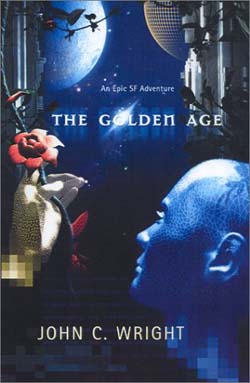
The book is The Golden Age by John C. Wright. It was published in 2002 and won critical praise for his flowery revival of the romantic space opera. It is one of the finest works of science fiction I have read in at least a decade.
I am writing you because I found no reference to it while searching the Samizdata site (of which I am a regular reader). Please accept my apologies if this perception is mistaken.
Mr. Wright was schooled in classics from Homer to The Federalist Papers, and his erudition shines through on every page. Characters are named after personages from ancient myth. He appears equally passionate about scientific realism. While the book paints incredible advances in computing and nano-scale technology, there are no warp drives or blatant breaking of the known laws of physics.
Yet his scenarios and inventions are so fantastic, so wonderfully fresh and well-crafted, as to send the mind reeling.
All this would be enough to recommend the book on its own, but I believe the book's philosophical merits will make of particular interest to Samizdata's contributors and readers. In interviews, Mr. Wright states outright that he created his future society to be a libertarian utopia. In fact, he wrote it partly as an explicit rebuttal to certain portrayals of communist utopias.
Of course, there is not much drama in an actual utopia, and the central conflict in the novel arises out of the desire of one man to upset the conventions of his prosperous society in pursuit of a magnificent vision. In one interview, Mr. Wright named his target audience when he says, "I am certainly writing for those who believe in the American dream."
The book is not long, but it took me more than a week to finish it simply because it is so dense. Every page is packed with meaning, and I found myself rereading passages over and over to extract their full meaning. No words are wasted, and readers are rewarded for paying attention to details like names, titles and descriptions of the various factions and elements in Mr. Wrights fabulous future society.
Here are two amazing and revealing interviews with Mr. Wright. I challenge any Samizdata sci-fi fan to read these exchanges and NOT immediately rush to read "The Golden Age" (and its sequel, "The Phoenix Ascendant").
For the record, I have no association with Mr. Wright, his publisher or any of that. I am simply a long-time Samizdata reader who has been deeply affected by a remarkable work of science fiction, and hope the word can be spread.
Thank you for your attention.
Scott Hillis - Beijing - China
So yesterday afternoon I was out and about in London town, taking salad and coffee with a friend, and, inevitably, taking the odd snap, including this very odd snap. Sometimes I misunderstand when the photo is actually being taken, and by the time it gets taken, the camera is pointing in the wrong direction entirely.

But, of all my photography mistakes, this is the one I have so far liked the best.
I think, but am not sure, that the shadow was thrown by one of the Billion Monkeys, and that the big thing sticking out at the front is a great big lens. It would figure. I am often in a confused rush when I spot particularly fine specimens, and you never know when you are going to meet one.
I'm watching Police Academy on the TV. This is one of the all time great movies, destined to grow and grow in esteem as the decades role by. It abounds with superb comic creations, none finer than Commandant Lassard, the magnificently un-policemanlike figurehead of the Academy, played by the sublime George Gaynes. "I'm trapped here?" – "Well yes, we all are."
And who could forget the black man (Michael Winslow) who imitates police cars and games machines and electric razors and horse noises? Then there is the amazing Tackleberry (David Graf) who draws his gun when confronted with a cat stuck up a tree, and who is distraught when "there was gunplay, and he missed it". Or how about the guy who whimpers wordlessly when his car is wrecked.? I never get tired of that bit. And as for the blond instructress, Sergeant Callaghan, played by the glorious Leslie Easterbrook. "Come at me with an imaginary knife." "Do I have to?" "Yes you do." Whatever happened to her? Still working away, it would appear.
The Crumpet Interest in Police Academy is played by none other than Kim Cattrall, she of Sex and the City fame.
Police Academy is the pinnacle of Steve Guttenberg's career. (If there are other pinnacles in this career, I am not aware of them.) His contribution to this movie is easy to underrate. He adds a welcome touch of charm in general and Gay Innuendo in particular (as when he inserts himself into the end of the Blow Job scene), without overdoing it.
The movie reviewing classes don't like this movie, because beneath and beyond all the mayhem and comic foolery and Chaucerian bawdy and the extraction of piss out of excessively militaristic young men with hair that is too short, it ends up endorsing the Rightness of Law and Order. Scum are Scum, and Good Upstanding Policemen are needed to control them. The movie ends with a grand parade, in which the entire caste graduates triumphantly.
The subsequent manifestations of Police Academy (Police Academies 2 to 6) tend to rehash the best jokes in the original one, and are not quite as great, although still good fun I think. But these have somewhat delayed the inevitable critical consensus to the effect that the original Police Academy is right up there with Citizen Kane, Some Like It Hot, Lawrence of Arabia, The Battle of Algiers, The Godfather and Carry On Up The Khyber.
And now, the Blow Job Scene …
I'm taking the day off, and am fobbing you off with an old photo from my Minolta archives.
This is one of my most favourite photos that I've ever taken. He's a boy I once taught maths to. He looked very bright, and he was.

What this picture illustrates is why I so miss my old Minolta Dimage XYZPQR Whateveritwas camera. (There's a picture of it in this posting from way back.)
This photo illustrates why, despite its defects (like absurdly short battery life), I regret the Minolta's passing. It separated the photo-ing from the flash-ing, by putting them at opposite ends of a bit of wire. This meant I could throw fascinating shadows, avoid stupid direct flash shadows, avoided red eye, and I could side light faces instead of flooding them with in the face direct light. I could also direct the victim's attention away from the bit doing the photo-ing. Too bad it stopped working, and when I got them to mend it they sent me another which also didn't work.
To photo indoors, I now set the Canon at "P", and something else to "200" or even "400". What does that mean? I'll tell you what it means. It means I can take photos indoors that come out, without using flash. They don't come out all that well. But they come out.
Recently I acquired a second hand copy of a book about and called Skyscrapers. It includes the illustration on the left, of my favourite, the Foster's London Gherkin, familiar to regulars here (which is why I chose this picture to illustrate my point). The picture is a bit blurry, which is my scanner not functioning properly rather than the original. And I fear that it may have taken rather a long time to load, so sorry if that was the case. (At present it's a .tif file. If anyone knows how to slim that down into something like a .jpg, comment accordingly please.)


Anyway, my point is: the picture on the left is a faked up guess as to what the building was going to look like, which is what appeared in the book because when the book went to press the real thing hadn't been built yet. On the right is the real thing.
The difference in the shape is probably down to the weirdness of the lens on my camera. No, the difference that interests me is the way the inner structure dominates in the fake, while in the real thing, the glass surface dominates. And it's not just me. All the pictures I've seen of the finished article resemble my photo, in this particular respect.
It isn't as if this picture was just dashed off. A lot of work and thought obviously went into it. Yet, it is seriously misleading. It looks like a real building, in other words it is "realistic" enough to be misleading, in the absence of the real thing. In the book, there are lots of fake pictures of this kind, to the point where it is extremely difficult to determine which skyscrapers have actually been built and which ones remain on the drawing board. They should definitely state this item of information, and clearly. Not stating it at all means that I cannot recommend this book nearly as much as I would like to.
But that is a mere criticism of a book. The serious point here is how relentlessly difficult it is to know what a building is really going to look like, until it is built. Which is just one of many reasons why ... architecture is difficult.
This comment from Peter Reavy, which was actually just the final bit of a comment (on this), got me thinking:
That said, I was thrown by Brian's argument, which is to insist that the film be judged by the reality of the world we live in.
And this is how it got me thinking. It got me thinking that there are really two kinds of artistic reaction, namely the presentation of an argument, and the attempt to analyse a feeling. And the trouble is that the second is liable to be confused with the first.
I was trying to explain what I, Brian Micklethwait, found unsatisfactory about a film I'd seen, which I found unsatisfactory but which Peter Reavy liked much more. And I was trying to explain, to myself, as much as to anyone else, why I found it unsatisfactory. And, although Peter may have understood very well what I said, he actually did not get what kind of thing I was trying to say. I certainly didn't think of myself as "arguing" that he ought to think of the film in the way that I was thinking of it, instead of in the way he did think of it. In this sense, I wasn't presenting an argument at all. I'm very happy that others enjoy this movie. I certainly don't think they should stop enjoying it on my account.
I want to emphasise that I intend no criticism of Peter Reavy here. I am sure that I am at least as much to blame for any confusion along these lines as he is. Peter, please do not take this posting as a criticism of you. It was merely sparked off in my mind by what you said, which means that I am grateful to you rather than in way resentful. (I might have got resentful if I had not understood what had happened, but ... well, see below.)
So anyway, does this distinction – between self-analysis and argument – matter? I think it does, because if people make an honest effort to respond to a work of art, and are then in their turn responded to as if they had presented an argument about how others should think (in the manner of a political manifesto), they may then be deterred from being honest about their feelings next time around. They may just clam up.
This may be especially so if the distinction that I have just offered is something they were not aware of. Our "critic" listens to what he just said (when he was trying to explain why he didn't enjoy himself), and it does indeed sound like an argument about what others besides him should think. So, he either pursues the argument, in territory which he did not originally intend to invade (the responses of others), or, he retreats in confusion, saying: "Well, that's what I think, so there. Take it or leave it."
The situation is complicated by the fact that describing your own feelings is – especially if you are a man? – often quite complicated. To be jumped on conversationally at the exact moment when you are trying to do this as best you can is to be caught at a rather vulnerable moment, which is why it feels like being jumped on even when the jumper didn't think they were jumping at all. Another reason to respond by clamming up.
You are especially vulnerable (because even more confused) if, when you are describing your feelings (rather than presenting an argument), you do not yourself quite grasp this distinction, and accept that, even as you grapple with all your other confusions (your feelings), you have to defend your non-argument as if it were a real argument.
Thinking about it some more, I do believe that I have heard this kind of argument a lot, and been involved in it myself, quite often, and on both sides. It can cause a lot of grief. We're not just talking about rows in newspapers or on blogs. We're talking failed relationships, unhappy marriages.
It will not amaze you to learn that I intend to go on trying here to describe my reactions to cultural objects, as honestly and entertainingly as I can, despite the danger I daily risk that I will be misunderstood as saying that everyone else ought to feel and think in the same way about all the stuff I write about as I do.
But, I will try to write more accurately in the future, so that you know better what kind of writing it is. ("It seems to me", etc.)
And, I will also try to avoid making the same mistake about the critical responses of others that I believe Peter Reavy made about my little piece the other day (with my help and encouragement - see above - blah blah). I will try not to jump down other people's throats and stomp all over their "arguments", when they weren't actually "arguing" at all.
This from today's Guardian:
A valuable Stradivarius cello narrowly escaped conversion into a handsome CD rack after being found in a Los Angeles skip, it was reported yesterday. The cello, which belongs to the Los Angeles Philharmonic, is said to be worth nearly $2m.The cello is one of only 60 by the 17th century luthier Antonio Stradivari still in existence. The LA Times says it was found by a nurse, Melanie Stevens, three days after a musician from the Philarmonic left it on his front step after coming home tired one Saturday night. She gave it to her boyfriend, a carpenter, who offered to turn it into a CD rack.
Almost as priceless as the cello is the home video security footage which shows it being stolen. Police said the grainy video showed a young man on a bicycle struggling to make off with the instrument, crashing into some dustbins on his way.
Peter Stumpf, the cellist from whose porch the Stradivarius was taken, spoke to the press yesterday to express his relief that it had been found. "It's been an enormous weight on me for the last three weeks," he said. "It's difficult to express how that has felt."
How about some unaccompanied Bach?
 Today I bought a second hand copy of a CD conducted by a man whose CDs are only just now coming into the second hand market at prices I will pay, namely Osmo Vanska. Please sprinkle dots over both the 'a's in Vanska.
The music was Carl Nielsen's Symphonies Number 3 and Number 4, with 3 being a particular favourite of mine. I particularly like this comment here, to the effect that …
His brass choruses make this "Bruckner meets Charles Ives."
This is especially true for the first movement of Number 3, the so-called 'Espansiva'. When I first acquired a CD of this piece, the DECCA one by Herbert Blomstedt (again, weird modifications are required for the 'o' there) with the San Francisco Symphony (the recording that gave rise to the above comment about Bruckner and Ives), I went crazy for this particular movement. When that happens with a piece of music, you are seldom subsequently ever quite satisfied with any later performance, no matter how much it is admired by others. I just sounds wrong, to the exact degree that it differs from your First Love.
So it was with Vanska's performance of this movement. It just didn't sound right, given that my idea of what does sound right has already been fixed irrevocably for me by Blomstedt. But the subsequent three movements of Vanska's Number 3 made a big impression, especially the second, slow movement, which I think I actually prefer to Blomstedt. It certainly sounded great to me, especially the doleful yet assertive string harmonies, immediately recognisable as Nielsen. This guy didn't think this Nielsen 3 of Vanska's was all that good, but (my earlier love affair with Blomstedt in the first movement aside) it sounded wonderful to me, and certainly well worth the way less than half price I paid for it.
I let the CD run to the end, i.e. to the end of Number 4, but frankly I had only so much attention to give to this music, and it snapped at the end of Number 3.
It was actually worse than that, because I found myself taking an early evening nap during Number 4, even though I was wearing headphones, turned up quite high, and even though this is extremely passionate, not to say violently loud music. I often slumber during performances, including quite loud ones, as do many others I'm told. And then later you lie in bed, in complete silence, wide awake. What's that about?
Last night I went to see The Eternal … … the one with Jim Carrey and Kate Winslet How amusing to give a movie about memory loss a title that is impossible to remember.
Anyway, as I say, for all those of you with short term memory loss, it's about memory loss, and there is lots of pot and whiskey swirling and swilling about in it, and I haven't done any of the first or nearly enough of the second to really empathise with the main characters. The way I see it, this is one of those movies that romanticises and makes "real" the mental malfunctions of a particular bit of the lowlife subculture, in this case the one where people with enough brains and education to know far better nevertheless inflict brain damage upon themselves with drugs and booze. The romantic pretence embodied in this movie is that instead of just forgetting stuff, the characters decide to forget particular stuff, and there are Mad Scientists with Computers who do Frankensteiny things in reverse to their brains to make them forget stuff. Now I'm no computer expert, but it is my clear understanding that they have not yet reached this state of advanced mental destructiveness, where you can put a helmet on someone and then just chase their conscious mind around in their brain with scanners and zap whatever they then think about. The techies have a bit of a way to go before they can do that. I further surmise that when they do get to be able to do this, the people doing it will be quite well paid and inhabit buildings where people have security passes and advanced degrees, to say nothing of anti-drugs and anti-booze employment policies. Nerds in bedrooms don't pioneer things like this while remaining in their bedrooms.
So, I didn't believe in the various premises of the movie for one moment. Or perhaps it was that, on account of not liking the movie enough, I spent a lot of time analysing it, instead of just enjoying it.
I normally don't like Jim Carrey. Too manic and selfish and self-referential. For similar reasons, I didn't like Jerry Lewis or Jack Lemmon, although I did love Jack Lemmon's taste in movie scripts and two of my all time favourites have him starring in them – The Appartment and Some Like It Hot. Jerry Lewis, on the other hand, had crap taste in scripts and was himself crap, which made everything very easy.
But I liked Carrey in this. He cooled it down and behaved like a normal person (the way Jerry Lewis eventually did in a few less crap late movies), which under the circumstances was a rather peculiar decision but there you go, that's actors for you. Maybe, like John Hurt in Alien, Carrey reckoned that there was no point in him trying to upstage the real star of the movie, which was the Special Effects department. But I don't like Special Effects as much as I used to. As one of my cinema companions said, there was a nice movie in there in among all the craziness, starring Jim Carrey and Kate Winslet, having a romance, which she would have liked to see. Me too.
The Two Nerds I just found annoying. The movie itself was apparently created by two real nerds named Kaufman and Gondry. I suspect these two real nerds of having done far too much dope and booze themselves, and that the Two Nerds were a fantasised self portrait, with the socially dyslexic and mentally damaged selves of the two real nerds kitted up to look like movie stars, in this case a fattened up Mark Ruffalo and the little one in Lord of the Rings. Both were ludicrously miscast in my opinion, especially the little one.
The boss of the Two Nerds, played by Tom Wilkinson, was likewise unbelievable. He seemed entirely sane, other than the small matter of what he did for a living and who he did it with, when the part surely called for a Mad Professor type.
And there was the basic problem with this movie, for me. A completely unbelievable scenario was created, and then you were asked to Take It Seriously, the way the Tom Wilkinson character did. I just couldn't do this.
Some of the memory loss effects were quite good. Things disappearing in front of your eyes, etc. But on the whole, I was underwhelmed. In a world of drug addled movie makers and drug addled movie goers, I felt left out. I didn't hate it, definitely not. A lot of it was quite fun. Kate Winslet is nice, after all. So, I might give it another look when it comes around on telly.
So, by way of a substitute for a sensible posting, I googled for news about "art" (and I know that you all love it when I do that), and this was undoubtedly the most enticing item:
On May 13th, Moscow's "Crokin gallery" presented a new art collection of one famous Russian artist Andrey Bilzho entitled "History of the country from Kutuzov to Putin on bras." Andrey Bilzho proudly announced the opening date live on the "Echo of Moscow" radio station.According to the artist, his previous exhibition of three bras which depicted Kazbek and Elbrus mountains was a great success among spectators and journalists. That is why he decided to continue with the collection.
The new art collection includes 25 bras, stated Bilzho. "There is one bra that is dedicated to Kutuzov, another one depicts Putin's eyes, Brezhnev's eyebrows, Khruschev's wart, Yeltsin's reign, Lenin-Stalin."
Bilzho also noted he decided to paint on bras was due to the following reason: "the object appeals to me; it is erotic; it attracts men and is used by women; it is also philosophical, because it portrays the everlasting battle of opposing powers, of Ying and Yang."
He had my respect right up until the bit about Ying and Yang. But that bit makes me think he's a crip artist.
Off to my Mum's Ninetieth so expect no more today. But I've been quite busy at Samizdata lately doing cultural type things.
I've done a couple of recent photo postings. Natalie Solent was kind enough to say of the first lot that they made a nice change from other photos that have been much on people's minds lately, and in general they seemed to be well received. So I've just done another little set.



I'd be interested to know what people think about the size I've used to display these photos. In deference to Samizdata stylistic requirements, these pics are nearer 300 across than the 500 I tend to use here. Is that bad because detail is lost? - or good because loading time is shortened?
I've also done a couple of pieces at Samizdata about a interesting TV series.
Quota picture for today, and I have a busy weekend, so maybe no more here until Monday.
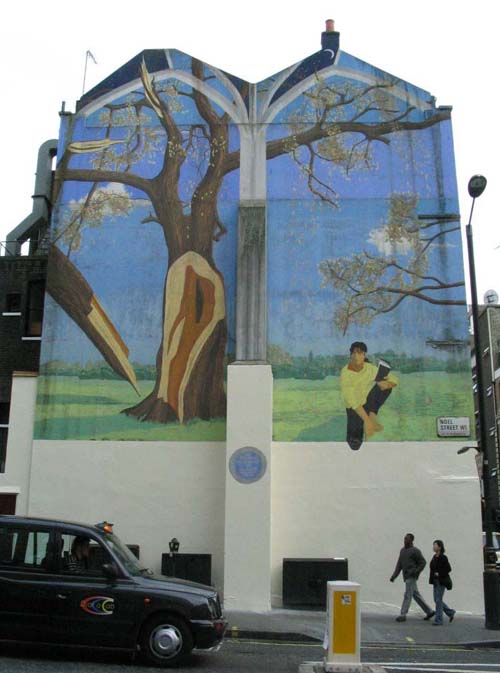
Sadly, this mural is starting to show its age. But it brightens up its little bit of Soho nevertheless. It's the "Soho Mural", and it is subtitled "Ode to the West Wind". It was the work of Louise Vines.
I can find no direct reference to this mural on the Internet, perhaps because, according to the blue circular sign, it was done in 1980. But I'm guessing that it is an illustration of or a reference to this.
And this ends, rather famously I think, thus:
The trumpet of a prophecy! O, Wind,
If Winter comes, can Spring be far behind?
Indeed.
One of the things that the blogosphere is particularly good at is telling you about big arguments. This is partly because you seldom have to take the word of the actual writer you are reading. You can, if you doubt him, follow his links and see if the views he is denouncing or endorsing make sense to you.
There is also, given that I am especially keen on blogging about music, the fact that it is easier to write about an argument, if it just happens to be an argument about music, than it is to write about music itself. (This was something I always sort of knew, but now, having tried to blog regularly about music, I really know it. Time and again, I find my limits reached with phrases like: "very nice", "excellent", "not very good", etc. Shall I bone up on all those techical terms I've been neglecting for most of my life? Probably not. Real musicians are never going to bother with my writing, so if I suddenly started talking in continuous Italian, where would my actual readers, assuming I have any besides Alan Little, be?)
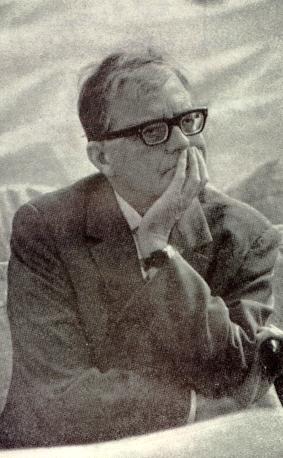 Anyway, what with arguments being easy(er) to write about, one of the more interesting things I have learned about classical music since I began blogging about it has been the argument about Shostakovich's attitude towards Stalin and towards Soviet Communism generally. Alan Little seems to know not a lot more about this argument than I do, but he knows of and has linked to people who do know a lot more, or who think they do, and I have found this very interesting. I have long loved Shostakovich's music, but (for reasons which I will here elaborate on) have tended not to bother with the Great Testimony row, until recently.
All my judgements are tentative and will probably never be more than that (for reasons which … reprise), but what I now think about this is that basically Shostakovich's heart was probably in pretty much the right place all along, but that exactly where your heart is when Stalin is breathing down your neck is a hard thing to be honest about, and hence for others to judge accurately, or even to make a judgement about that means anything.
Take one of the items on this list of classical music's dirty little secrets (Mozart all sounds alike, Liszt is trash, Schoenberg never sounds any better, etc.), to the effect that the triumphantly upbeat finale of Shostakovich's Fifth Symphony is "perfectly sincere".
Perfectly? Just how "sincere" is it if someone points a gun at you and says: Sing a happy tune! – and you do, convincingly? Maybe that is being sincere, after a fashion. After all, you did mean it to sound happy, and it did. Your life depended on it. But, did you, at a deeper level, "mean" it? That, it seems to me, is the kind of argument we are dealing with here, and to discuss Shostakovich's intentions when composing his Fifth as if we are arguing about just what John Lennon had in mind when he composed Imagine, with all the artistic freedom that John Lennon had when he composed Imagine, is, well, a failure to imagine what really goes on when a man like Stalin gets to rule a very large country.
It's not that I am uninterested in the duckings and weavings that Shostakovich chose to/was forced to execute – the signing of this condemnatory proclamation, the penning of that impeccably Bolshevik symphony with its impeccably Bolshevik words, the silence when others were protesting, etc. etc.. It's just that, well, what would you have done, if you were your country's most prominent composer, and your country was the demanding kind of place that the USSR was for all of Shostakovich's working life? That Stalin and his numerous slaves forced Shostakovich into this or that Bolshevik obeisance, or even that Stalin created an atmosphere within which Shostakovich "chose" to do this or that and refrain from this or that (I believe that this is the real meaning of totalitarianism – the victims end up choosing to do what is at first only demanded of them) doesn't really prove much one way or the other about what Shostakovich "really" believed.
*
A further point. Whereas Bolshevik obediences on the part of Shostakovich mean little, his disobediences mean, it seems to me, rather more. There is a logical imbalance in the evidence, rather like the imbalance that Popper describes in scientific evidence when most of it proves something, but little bits of it disprove something. The bit that disproves is the bit that matters! After all, if Stalin is ordering you to say one thing, and you mostly do, but sometimes don't, those don'ts count for rather more than the obedient stuff … don't they?
This was, after all, the attitude of Stalin and the Stalinists when such dastardly infringements were committed in the first place. You were as bad as your worst outburst of complaint. If you called Stalin a murderous bastard, and they caught you having done it, then no amount of listing of the number of times in which you had proclaimed him to be the Father of All The Virtues would save you from the camps or maybe even from death.
Suppose that Shostakovich was a "fundamentally" loyal Stalinist who only blew off the occasional bit of anti-Stalinist steam. If the anomalous outbursts are interpreted by posterity as meaning that "basically" Shostakovich was an anti-Stalinist whose public mask of faked obedience (such as the finale of the Fifth) occasionally slipped, that is no more than Stalin himself deserves. This will mean that posterity has treated Stalin in the exact way that he and his henchmen treated everyone else.
Not that I think for a second that Shostakovich's complaints about the world he found himself in were mere anomalous outbursts. If they were, then those fifteen string quartets were one hell of an anomaly. As was the first of the Cello Concertos (which I am listening to right now), and as were many, many others of his pieces. You just cannot listen to the entire body of this man's music – film music, grovelling symphonies (try Number Two (scroll down) – just read the words!) and all – and conclude that this was a "sincere" supporter of the rulers of the world he lived in.
*
Final point. Stalin did admire Shostakovich, I think, more than the other more obviously "Stalinist" hack composers, which is how Shostakovich got to stay alive for so long. He was not killed on the basis of his most anti-Stalinist moment! And I think that requires a bit of explaining. Why Stalin killed people who were blameless needs no explaining. That is what he did. But why did he keep Shostakovich – who was not "blameless" – alive? The answer to that question, I believe, also helps to explain how this Shostakovich argument got started. But I'll keep that for another time.
*
Final final point here. Notice how this ruckus about the secret, "real" attitude of Shostakovich throws light on the idea that great music and great musicians are inherently, morally good.
After all, why does it matter what Shostakovich thought of Stalin and Stalinism? Stalin was a monster and Stalinism an abomination, and if Shostakovich disagreed that was surely his problem, right?
Not quite. Shostakovich is now acknowledged as a Great Composer, his works as part of the "Canon" of Classical Music – as the inclusion of his name in that list of "dirty secrets" illustrates. And the reason why it matters what this Great Composer of Classical Music felt about Stalin is that Great Composers of Classical Music are … automatically people of moral wisdom and profound insight! This is why it actually matters what Shostakovich "really" thought. If he liked Stalin, then this proves that the rest of us ought to as well, more than most of us actually do.
It proves no such thing of course. Which is why, ultimately, this argument doesn't engage me as much as it seems to engage some others. I don't need to believe that Shostakovich was a Great Man in order to believe, as I have always believed ever since I first heard his music, that he was a Great Musician. (I happen to think that he was a Great Man too, but if I became convinced that he wasn't, it wouldn't spoil my appreciation of his music.) But I do believe that the inherent moral excellence of classical music, and classical musicians (an even more questionable assumption) hovers over this debate.
It seems that this is an idea that not even the Nazis could destroy. And insofar as they did damage it, Shostakovich has done a lot to reinstate it.
Which sort of proves that Shostakovich was himself Good as well as Great. He may not have been wholly good, in that he failed at all times and in all ways possible to do what he could to topple Stalin (an accusation that also applies to pretty much all of Stalin's contemporaries), but he was good in that he composed a lot of music that sounded good, that is to say morally good.
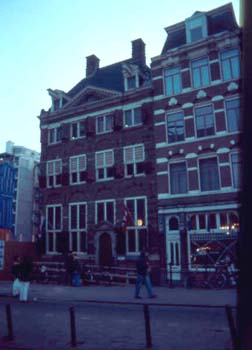
Regarding the quiz, everyone seems to have given up, which officially proves that I am cleverer (and in particular more cultural, because the answer is cultural) than everybody else in the world, because I know and they didn't. No not really. But ho ho anyway.
Here's a clue. Look carefully at its name.
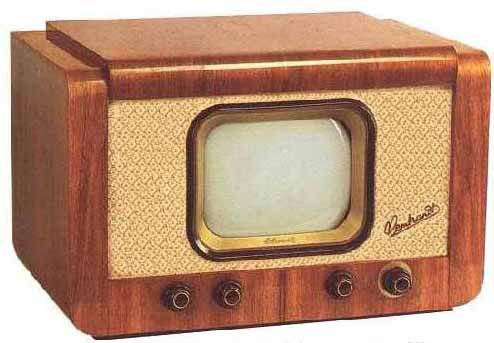
And if that isn't enough, I will simply tell you all. If you get it now, don't be afraid to say.
As regulars here will know, doing my own photo photos excites me far more than the photos hand done by others. But lots of the kind of people who read this, will also be very glad to read this:
They are all noted, prize-winning artists at the peak of their early maturity. Yet in their more wretched moments they feel like a forgotten, exiled species, "afflicted" by their skills and fated by their sense of vocation to work in "a bankrupt currency".
Their currency is an artistic medium running from Lucian Freud, David Hockney and Francis Bacon back to Michelangelo, and further still to the earliest human to discover pigment in a cave. And generally the public still chooses wall prints and quality greetings cards depicting works in this medium.
But, in the dominant and highest priced areas of contemporary art, the medium has been treated almost as a dirty five-letter word - paint. For the artists are painters whose vocation is to represent the human figure and human landscapes or cityscapes.
Later this month eight of the painters are putting on an unusually ambitious show at a fashionable London gallery. One of the aims is to test a conviction, which some others share, that the pendulum of critical, art market and media interest has begun to swing away from conceptual art, including installations and videos, and back to painting.
In a foreword to the exhibition catalogue, one of their admirers, the director of the National Gallery, Charles Saumarez Smith, writes that they are typical of "a whole generation of artists who are working outside the mainstream of contemporary art, as represented by the more fashionable avant garde".
And what's more, Charles Saumarez Smith is my cousin's wife's brother.
The rather striking portrait of the noted actor John Hurt (whom I wrote about recently here) is by Stuart Pearson Wright, another of whose works is used to illustrate the Guardian piece quoted from above.
Yes. Today: a quiz!
What do all these pictures have in common?
It will still make a quite interesting posting even when you know it.








I very much enjoy the radio manner of regular BBC Radio 3 classical music presenter Rob Cowan.
Radio 3 presenters have recently taken to swooping up and down with their voices, in a manner which suggests that they have been on a course and that one of the headings was "communicating enthusiasm". I find this somewhat annoying. But Cowan needs no such voice making-over, because he has always talked enthusiastically without having to be told. (I even met the guy once, in Gramex, one of my second hand CD haunts, and he was just as nice in person as he is on the radio.) I therefore find Cowan a pleasing rest from the rather forced excitement of the other presenters.
 I now have another reason to be grateful to Rob Cowan, which is that on Sunday morning he introduced me to an entirely new piece of music which I had never heard before, and which I liked a lot. (Usually with music on the radio, I either don't want to own it on CD or I own it on CD already.) The piece is by the nineteenth century composer Robert Volkmann, his Serenade No 2 for strings. It sounded really good. Happily I recognised the name of the conducter he mentioned, and was able to find the CD on the Internet. I insert the cover of this CD into this posting mostly for my own convenience, to remind me to keep an eye open for it in the second hand shelves, and to see if it might even be cheap enough to buy brand new.
I see that Volkmann also wrote thought good enough to be worth recording, including some piano trios. I have loved piano trios ever since I first started buying gramophone records. I recall with particular pleasure the Supraphon records of piano trios, most notably by the Suk Trio of the Dvorak op 65 and the great Tchaikovsky trio. These performances I now have on CD now, of course. But Volkmann is an entirely new name.
Suitable musical game to go hunting for inevitably gets harder to find as you get older and more knowledgeable. Also, priority inevitably shifts from getting new stuff to listening properly to what you already have. So this is a nice reminder of how music was when I was first finding out about it in my teens.
More ghreat Gherkin pictures courtesy Ghuardian Unlimited.
Apparently, these guys were just cleaning the windows.
This building has become an instant classic, like the Wheel, Big Ben, Tower Bridge, etc. See Jonny Vaughan fondling it in his Capital Radio adverts on buses. Picture of that follows, I hope, but adverts come and go, and I may not be able to supply that.
Meanwhile, here from me is another photo, featuring another bus advert, which I took in London the other day.
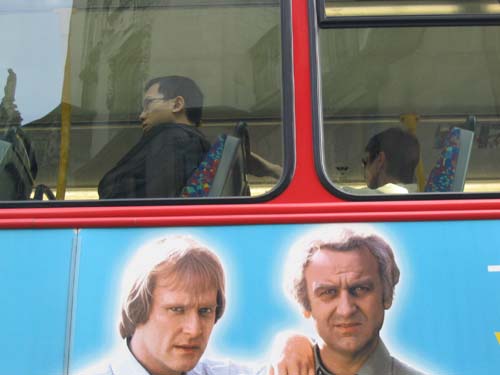
That's exactly as it emerged from the Canon A70. No cropping, no Photoshopping. Very London I think.
 One of my more favourite books about artistic matters is Bryan Magee's little volume entitled, in a sneekily modest yet accurate way, Aspects of Wagner. I was provoked into thinking about this short but stimulating volume by reading the article about Shostakovitch that Alan Little recently linked to, in which both the Jewishness (musically) and the non-Jewishness (by descent) of Shostakovitch is gone into. Shostakovitch not Jewish? I had always – I don't know – assumed that he was.
And the Jewishness (by descent of course) of such an extraodinary proportion of the creative artists and intellectuals of the last hundred years or so is something that Magee both describes, and – with the (very surprising for such a vicious anti-semite) help of Wagner – explains.
Having nothing to say today for myself, I dipped into this little book to see if I could find a quote about the Jews to put up here. The trouble is, however, that the argument is such that you never want to end the quote (a constant problem with good writing which you are trying to quote – I often find this with good pieces of journalism also). I did, however, find this striking passage about musical interpretation which can just about survive being amputated from its context and savoured separately:
"Great music" said Schnabel, "is music that's better than it can be played." A simple but eloquent demonstration of this can be got by comparing the Brahms symphonies as conducted by Toscanini and Bruno Walter. Under Toscanini they are played with an almost demonic ferocity and drive, and are deeply disturbing. Under Walter they have a glowing, autumnal relaxation and warmth, and are deeply consoling. Neither conductor transgresses the letter of the scores, nor their spirit. Yet the sum of what they bring out in them could not possibly be combined in a single performance. The acidity and cutting edge of the one entirely precludes the loving embrace of the other. High tension and heartsease are mutually exclusive. Everything each gives us is unquestionably there in the music, but for every element that is realized in performance some other has had to be sacrificed.
I like that.
And now I am reminded that Magee has written another book, which the first of the reviewers here is better about Wagner (and about Wagner's anti-semitism) called The Tristan Chord. I must get hold of that.
I think you know what I am doing here.
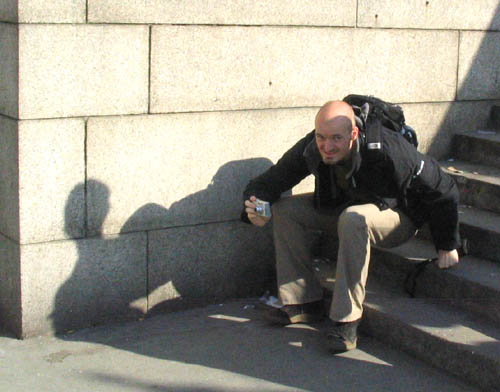
First, trivially, the Billion Monkeys Project doesn't just mean female monkeys. Second, more seriously, Billion Monkeys could sound like some sort of racist complaint about all the non-white people wandering around London taking pictures. Actually the monkeys thing is a reference to those million monkeys who wouldn't type the works of Shakespeare no matter how long they went at it. The Billion Monkeys have a billion little digital cameras, and are doing, I assert, rather better than those literary monkeys. So it isn't a racist thing.
So here to prove all that: some White Bloke Monkeys. I'm one myself, but I've concentrated here on some of the others, one in particular, who had the decency to stand in front of a better background that is usual, and to cast some amusing shadows.
I hope soon to manage a little essay on why I am enjoying this project so much, and on why I believe it to be such a huge public service. But I've no time for that now.


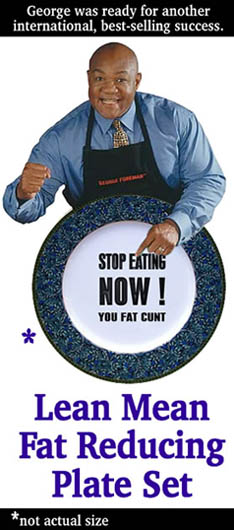
Whenever I see a really good piece of computerised art at b3ta.com, I copy it. Who knows what happens to old b3ta.com computerised art, once it disappears from view? So here's a great picture of George Foreman advertising some new plates which he should have thought of but hasn't yet, and then to fill in the gap this picture would have left, I picked another, which highlights the horrendous problem – one of Western Civilisation's most burdensome in my view – of gum scum, who put chewing gum on tube posters in what they think of as clever places. (Bear with me, I'll sort this out, if they're still in a vertical pile. But it'll take a bit of time.)
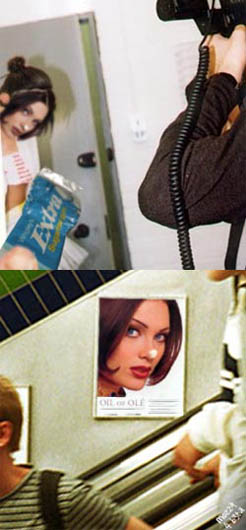
I also think that this, which for some bizarre reason I got to by clicking on the George Foreman picture in a different way to the way you click on it to copy it, is rather hilarious.
I agree with Dave Barry's co-worker judi that this is fairly pathetic. On the other hand, Dave himself links to this, which I think is really something.
Punky Brewster agreed. He left twelve identical comments on the DB posting, linking to this twelve times, and then a thirteenth comment saying sorry for the previous eleven comments.
Two interesting letters from the latest issue of BBC Music magazine. The first is from Crispin Harden of Bath:
I seize my pen in response to the BBC's latest adulatory Mozart season. Mozart is not the 'Shakespeare of Music'. He's merely the pundits' current favourite, wearing the yellow jersey like many before him. Only a fool would deny Mozart his place in the front rank, but it's a long front rank and different composers stand there for different reasons. The sad truth is that Mozart is the least demanding of the great composers, which makes him the natural choice for a shallow, passive, ignorant age.
Personally I don't find any of the great composers "demanding", except in the sense that they demand my attention and get it, and I love to listen to their music for hour after hour after hour. I don't find listening to any of them in the slightest bit of a struggle, in the sense that I have to force myself to concentrate, or have to work to enjoy it. Sometimes I don't pay attention, but that's different. And sometimes the music (as with Beethoven, say) communicates struggle and demandingness, and that is also different. I find it no strain to listen to the Egmont overture, merely because Egmont himself struggled (to liberate the low countries from Spain, wasn't it?) and Beethoven communicates this struggle. I find it just as easy to listen and just as hard to ignore Bach, Beethoven, Brahms, Bruckner, Mahler, Sibelius, Nielsen or Shostakovitch as I find it easy to listen to and hard to ignore Mozart. I think I detect a whiff of the "no pain no gain" theory of artistic response. This can sometimes be true, but isn't always and that's putting it mildly.
Opera on CD (as opposed to on DVD and with subtitles), I do find demanding, in what I take to he the sense Harden means. When I do endure the pain of attending to the libretto, I generally gain. But on the whole I decide that life is too short to be forcing myself to do something no one is paying me to do. Learn the words and the story with DVD and then wallow in the CDs is my usual strategy now.
Nevertheless, it makes a change to see someone swimming against the Mozart tide, of which I am a tiny ripple. And I think I know what he is getting at. Mozart is relentlessly sweet, as well as constantly more than that.
But that sweetness can be the very thing that others find "demanding", in the sense that they have to force themselves not to be put off by it, as if forcing themselves to drink coffee with three times too much sugar in it. We don't live in a shallow age, or no shallower than previous ones. What we do live in is an age where there is so much stuff worth attending to that we generally, and quite rationally, want what we do attend to to speak to us at all levels, rather than merely at some deep level that has to be preceded by lots of uncomfortable pot-holing.
And the other interesting letter that caught my eye is from Michael Bordeaux (I think – they spell him Michael Bourdeaux), who I seem to recall (if it is indeed Bordeaux) as an energetic fighter against the ills of the sort his letter complains about, at the time when they were first happening. Bordeaux recalls how Galina Vishnevskaya was forbidden by the rulers of the USSR to take part in the premier of Britten's War Requiem in 1962, because they suddenly reaslised that it was an event about religion as well as "peace". There should have been a Russian, a German and an English singer. As it was, Britten (and Britain) had to make do with a German and two Brits: Dietrich Fischer-Dieskau , Peter Pears, and Heather Harper. (Personally I always preferred Harper to Vishnevskaya, but that is not the point.) Bastards.
Unlike Bordeaux, I'm an atheist. But I do love the War Requiem, and especially the Dies Irae, which is a Dies Irae in the Verdi Requiem class, I think. That's another piece all about struggle and demandingness, but which I have no trouble paying attention to.
Galina Vishnevskaya did sing in the classic Britten recording of the work. Harper only got around to recording her part in this mighty work with Richard Hickox thirty years later, which for her was somewhat later than would have been ideal.
Yesterday I photographed hail. Here is another in the same series.
 I took the advice of Rich Coencas - commenter number one among several, (almost) all greatly appreciated, here – and beefed up the colour and contrast with Photoshop. It made a terrific difference.
UPDATE: RAB, commenting on my Samizdata pix, says:
Fine photos! Isn't digital wonderful. I take my Nikon with me everywhere now and try all sorts of shots that in the old print processing days you'd say to yourself "nahh that'll never come out, and why pay good money for a blurry blob of a photo 15 times out of 24". They don't all come out now , but digital is increasing my interest and imagination and it's costing very little. Add to that the photoshop type editing progs and we're in a new world.
Indeed. It's all down to the marginal cost of the next photo being ... zero!
But 15 out of 24? That's way above my hit rate now. Although I suppose "come out" could cover a multitude of sins.
Today I found myself in Waterloo Road, and the walk back home took me past the Old Vic theatre. They have a production of Trevor Nunn's Hamlet running there, and it's being much talked about. So I went in to see about how much it might cost for me, or maybe me and a friend, to see Trevor Nunn's Hamlet.
The crappiest seats to watch Trevor Nunn's Hamlet, where you don't actually get to sit down at all, to watch Trevor Nunn's Hamlet, are £10. The crappiest seats where you do get to sit down and watch Trevor Nunn's Hamlet are, if I remember it right, £12.50.
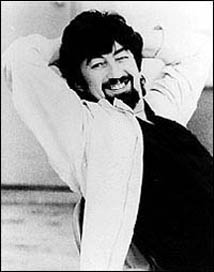 The genuinely decent seats for Trevor Nunn's Hamlet are £37.50. This is way out of my league. No offence to Trevor Nunn's Hamlet (keep reading, we'll get to offending Trevor Nunn's Hamlet quite soon now) but this is more than I can afford. What if I really like it and want to go again, to Trevor Nunn's Hamlet? What if I want to take another friend to Trevor Nunn's Hamlet. That's a whole trip to the South of France.
One of the more annoying affectations of the British subsidised theatre is that even when a production clearly has a Big Star Performer, as here, they nevertheless list the actors in alphabetical order. So who the hell is playing Hamlet? Impossible to tell.
No problem about telling us all about how important Trevor Nunn is though. He gets start billing on the posters. You'd think he was playing Hamlet. "Trevor Nunn's Hamlet." As they say in America: please. You do eventually learn, if you follow that link and read past the big picture of Trevor Nunn, that Trevor Nunn's Hamlet is actually being acted (as opposed to directed/produced) not by Trevor Nunn as you might have expected, but by a certain Ben Whishaw, 23.
Guess who's playing Gertrude. Correct. Mrs Trevor Nunn.
In case you are confused, and given that Trevor Nunn doesn't actually act Hamlet in Trevor Nunn's Hamlet, did Trevor Nunn perhaps write Trevor Nunn's Hamlet. No again. Trevor Nunn's Hamlet wasn't actually written by Trevor Nunn at all, but by William Shakespeare (1564-1616). True. Not Trevor Nunn at all. Trevor Nunn just told the actors where to stand and organised the rehearsals. Just for that, Trevor Nunn gets to have Trevor Nunn up on the poster in big letters. TREVOR NUNN.
Pass.
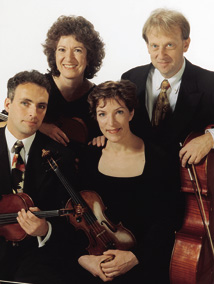 I made my way to Neil's barrow of second hand classical CDs in Lower Marsh, prior to visiting Gramex, where second hand classical CDs are sold indoors. Gramex had few pickings, but at Neil's barrow I got a CD of Beethoven's String Quartet in A minor opus 132, which is by Ludwig van Beethoven (1770-1827) and which is one of the peaks (one of a set of peaks in the form of all the late Beethoven String Quartets) of Western Civilisation, played by the Franciscus Quartet, or by Franciscus Kwartet as it says on the front. It's a Dutch production, recorded in Delft in 2003.
Price: £1.
I've just listened to it. It's excellent.
If I could watch a second hand DVD of Trevor Nunn's William Shakespeare's Hamlet for, say, a fiver, as many times as I wanted, and with as many friends as I wanted, then I might be interested.
I share the high opinion that people seem to have of these photographs.
Thanks to Adam Tinworth for the link.
I particularly like this one. By this I mean, this is the kind of picture I myself like to take, and wish I could get looking as pin sharp as this, where pin sharpness is wanted, and as artistically blurred as this where that is the objective.
 Let me now try to do one of those thumbnail procedures, in which I link from a small detail of the picture here to the real thing separately, but uploaded to my own … thing.
Back soon.
Well, that seems to be working. My Graphics Guru is coming round later today, and I wanted to be able to show him some homework I'd done.
So, about these Chromasia photos. They are extraordinarily good photos, from the technical point of view. They are, in particular, perfectly focussed. Plus, they look magnificent even on my little Brand-X computer screen.
So Question: how does he/she/they do that? Is the secret a better camera than my Canon A70? Or is it that he/she/etc. know how to take better pictures than I know how to take? Is it a matter of pushing the right buttons on a cheap camera rather than having a more expensive camera? Or to put it another way: Should my next step be a better camera, or some lessons in how to use my existing camera? If the latter, can anyone recommend a good course in London for someone like me, where I could learn a decent amount cheaply and quickly? Any suggestions welcome.
Further question: I notice that the Chromasia guy(s) do the large version of their pictures at 700 times 526 size. Is this a good choice? I am hoping to set up a photo-archive myself, to enable those who like my photos to see more without the rest of your being bored to death. What is the best size for this? Have Chromasia get it right? Or is larger a bonus?
My originals are much bigger than 700 by 500. Would people like to be able to see the mega-huge original? Should there be a three tier arrangement? Thumbnails, then single screen friendly versions, and finally, behind that, the mega-huge original? That might make sense. Bear in my mind that I have no plans ever to try to make any money with my pictures, and don't mind even if someone else makes quite a lot and me nothing. I just enjoy them and hope others do too.
 Here is my latest photo that I like. It's of this extraordinary boy, playing the Ravel piano concerto on the TV last night in the final of the Young Musician of the Year tournament. He didn't win although he did play excellently, and I think many would have tipped him.
This is a classic click-and-pick job. I took about a hundred photos while he was playing, and I think this is the best, because it captures what I think it must be like (a) to be a real musician, and (b) to have a a real orchestra playing along with you. As with the previous picture of this boy, it was of a TV picture in transition from one shot to another. TV in Photoshop mode, you might say.
In future, I will make all little pictures on the right the same width, within each post I mean, but don't have time to do this now. Live and learn.
Yes, I missed this report from last Wednesday.
The Gherkin, more formally know as the Swiss Re Tower or 30 St Mary Axe, has slipped so easily into the London skyline that it comes as a shock to discover that it officially opened only yesterday. That is the trouble with a very, very tall building. It takes so long to go up that, by the time it is finished, you feel you’ve known it for ever.
Built in the heart of the City of London, the Gherkin was Norman Foster's second attempt at a skyscraper on the site. The first was a massive affair that would have dwarfed Tower 42 (formerly the NatWest tower), then the tallest building in the City, and reduced the dome of St Paul’s Cathedral to a pimple. This building, which did have the feel of a rather knobbly gherkin, was rejected by the planners. But Foster, ever the pragmatist, came back with a revised scheme, deliberately marginally lower than Tower 42.
Interesting. I wonder what the original looked like. The implication is that it might have been more dominant, but not as elegant. Anyone have a link to what Plan A looked like?
Quite why "Tower 42" is thought to deserve all this cosseting, I have no idea.
In the latest Gramophone (paper only) comes news that:
A new DVD release of The Battle of Britain will reunite the film with the original soundtrack by Sir William Walton.Walton was initially commissioned to compose the score for Guy Hamilton's 1969 film depicting the decisive serial conflict that took place in the skies over southern England in 1940. Although recorded, it was replaced by a score commissioned from Ron Goodwin, with only Walton's Battle in the Air sequence remaining. One explanation for the decision is that Walton's score was not long enough to fill an accompanying soundtrack LP.
In 1900 Timothy Gee, who as the film's assistant music editor worked closely with Walton, tracked down the original recording to the garage of Eric Tomlinson, the recording engineer. He then persuaded MGM, who are releasing the DVD, to restore Walton's music to the film.
He recalls that many people working on the film opposed the decision to scrap Walton's score. 'I think it is now more in tune with Guy Hamilton's concept of the picture,' he said.
I thought I did some blogging about this, but haven't been able to disinter any. But I do vividly recall instantly noticing the Walton music when it cut into the original version of this movie, and being very impressed. Although, I think Goodwin's music is also very good, especially the triumphant German march at the beginning. (I did find a posting about Goodwin's music for Where Eagles Dare.) Would that this were a straightforward replacement of rubbish by gold. Alas, not. Still, I'm looking forward to this DVD. (here and here are links to more on this topic.)
As for the film itself, it's another of these real events with made-up people jobs, which I really really wish they wouldn't do. (Think Charlton Heston in Midway. Urrgh!) I mean, if you can have the likes of Dowding, Park and Leigh Mallory for real, why not the real pilots, and maybe a real wife or girlfriend or two? I suppose there are all kinds of legal and confidentiality reasons, but all the same, when I see a historical movie, I want it to be as accurate as possible. I don't want to be learning things that ain't so. A lot to ask from the movies, I know. At least with these TV drama-stroke-documentaries which lots complain about but not me, they try to get things accurate, and when they can't because it isn't known, they say so.
Despite all that, I do love The Battle of Britain, made-up pilots, no William Walton, and all. It even has Laurence Olivier in it, and I still like it. That's rare for me.


