

This email has arrived at Samizdata HQ and been sent around to all the Samizdatistas. In case it falls between the cracks, with each of us assuming that someone else will flag it up, I take the liberty of reproducing this eamil here in its entirety, which is about a matter where the interests of Samizdata and Brian's Culture Blog overlap. If there is no response to this email at Samizdata I will perhaps (I know from bitter experience that I am bad at keeping promises so I do not promise this) do a shorter posting there myself.
I have not myself read the book about which Scott Hillis writes so enthusiastically.
 Greetings Samizdatistas!
This to call your attention to a science fiction novel that I believe is one of the most important pieces of libertarian fiction in recent memory.
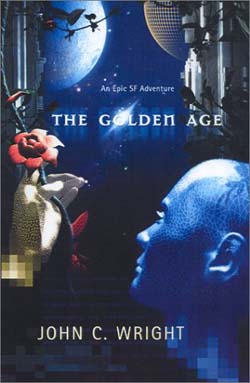
The book is The Golden Age by John C. Wright. It was published in 2002 and won critical praise for his flowery revival of the romantic space opera. It is one of the finest works of science fiction I have read in at least a decade.
I am writing you because I found no reference to it while searching the Samizdata site (of which I am a regular reader). Please accept my apologies if this perception is mistaken.
Mr. Wright was schooled in classics from Homer to The Federalist Papers, and his erudition shines through on every page. Characters are named after personages from ancient myth. He appears equally passionate about scientific realism. While the book paints incredible advances in computing and nano-scale technology, there are no warp drives or blatant breaking of the known laws of physics.
Yet his scenarios and inventions are so fantastic, so wonderfully fresh and well-crafted, as to send the mind reeling.
All this would be enough to recommend the book on its own, but I believe the book's philosophical merits will make of particular interest to Samizdata's contributors and readers. In interviews, Mr. Wright states outright that he created his future society to be a libertarian utopia. In fact, he wrote it partly as an explicit rebuttal to certain portrayals of communist utopias.
Of course, there is not much drama in an actual utopia, and the central conflict in the novel arises out of the desire of one man to upset the conventions of his prosperous society in pursuit of a magnificent vision. In one interview, Mr. Wright named his target audience when he says, "I am certainly writing for those who believe in the American dream."
The book is not long, but it took me more than a week to finish it simply because it is so dense. Every page is packed with meaning, and I found myself rereading passages over and over to extract their full meaning. No words are wasted, and readers are rewarded for paying attention to details like names, titles and descriptions of the various factions and elements in Mr. Wrights fabulous future society.
Here are two amazing and revealing interviews with Mr. Wright. I challenge any Samizdata sci-fi fan to read these exchanges and NOT immediately rush to read "The Golden Age" (and its sequel, "The Phoenix Ascendant").
For the record, I have no association with Mr. Wright, his publisher or any of that. I am simply a long-time Samizdata reader who has been deeply affected by a remarkable work of science fiction, and hope the word can be spread.
Thank you for your attention.
Scott Hillis - Beijing - China


