

The bit of Movable Type that uploads pictures seems to have stopped working. It says that the picture is uploaded, but says it is size: 0 bytes, and asks if I want this file to be a LINK. No, I want it to be a photo, you moron machine.
Anyone know what this could be about?
I was going to post some pictures of Jackie D, photo-ing food, but that will have to wait.
A bad day here at Brian's Culture Blog.
I've just had an idea for a regular series (although I promise nothing) of postings here. I love those Twin Towers, and I want to start writing about movies more often than I have so far here, so here's the plan. Every time I spot the Twin Towers in a DVD, I will pause it, photo it, and shove it up here.
Two things may happen. One, as I say, this may kick start me into writing about movies more than I have. But two, maybe a picture will start to form of how movie makers used to use those towers. What else happens when we see them? What do they seem to mean? And so on.


Click on these two clictures (a word I'm hoping you first read here) to get the full pictures.
On the left, forty seconds into Sidewalks of New York, is the Twin Towers bit of the first sighting of the character played by Edward Burns (who also auteured the entire movie). He is being interviewed by an offscreen voice about his sex life. The Twin Towers are kept in shot, or very nearly, although out of focus, throughout this interview, bits of which, alongside interviews with the other main characters, intersperse the entire movie.
Which I enjoyed. The characters are pretty enough to be pretty, but real enough to be real. Perhaps the most telling plot point concerning Burns' rather gloomy view of life in New York is that only one child features in the entire thing, namely the child that the Rosario Dawson character conceives, by mistake and without telling him, with the Edward Burns character. Rosario Dawson then leaves New York, or at any rate says that she will. New York, Burns seems to be saying, is not a place that makes children. Too expensive. Everyone too fussed about their careers. Two many New Yorkers just don’t want kids.
Stanley Tucci plays a character for whom, in both appearance and behaviour, the phrase "love rat" might have been invented. Dennis Farina plays a man whose advice about cologne proves unsound. Cologne on the balls proves you care, says he. It proves he's weird, says the lady confronted with it. Penis size also gets an airing. In general, this is a movie with a lot to say about male insecurities and confusions, as well as female resentments at what swine men are.
If you love Woody Allen's New York movies, there's a good chance you'll like this, and for the time being Mr Burns seems able to choose his romantic partners in a manner that leaves his dignity in place.
Well-known actors love being in movies of this sort, for they queue up to be in them, half a dozen at a time. They get to talk and act and create character, instead of being upstaged by special effects or having to act opposite mysterious computer animations that only get put in afterwards. They don't have to kill people, or to die, or spend any time hanging from ceilings..
On the other hand, if you find semi-realistic movies about Relationships tedious, what with today's people having it so easy and being so cosseted that they can sit around all night long discussing their Relationships, unlike their grandparents who had depressions to survive and world wars to fight, well, one of the characters says that.
And, on the right is the very first frame of New Jack City, the rest of which I have yet to see, because, having just watched Sidewalks of New York and noted the Twin Towers, this was when I got the idea for this series (although I promise nothing) of postings. I should imagine that the people in this movie get to do lots of killing of one another and have little time to think about Relationships, although I could be quite wrong.
So I went past that puddle again today, on the bus again, and guess what, I photographed two more puddles in the same place - Duke of York Square, right at the Sloane Square end of Kings Road. I spotted the third one on the way back, and thought I'd missed photo-ing it, but when I got home I found that you can just about make out that one way behind the one I photoed properly, on the way.

I'm starting to rather like these damn things. At least they are different. Different because stupid, but different.
I am going to have to take a closer look at them. Maybe there are more that I have yet to observe. Expect lots of reflections in puddles photos, although I promise nothing.
I think that these clutches of photos arranged in lots of little squares to click on work rather well. The basic post seems to load quite quickly, which means that it does not cause too much inconvenience to the non-photographically inclined, and if you are interested, from then on it's one click shopping. I like the format anyway. Even though it is rather laborious.
So, why do the photos have to be mine? They don't. I have friends who take photos, but can't be doing with all the bother of putting them up on the Internet. So, why don't I do it for them? It's a great plan. If you are a friend of mine, and you have a few Billion Monkey snaps to get off your chest and share with whatever bit of the world wants to share them, but (like me) don't want to nag the basically uninterested, get in touch?
What's the worst that could happen? I'd say no they're crap, and we'd never speak to each other again. I suppose that is a consideration to be considered. But I actually don't think this is very likely. Given the nature of Billion Monkey cameras, there's pretty much bound to be a few of your pictures that I like and consider worthy of world-wide mini-fame. Most of mine are crap, after all.
So anyway, this little rectangle of clictures (ha!) is the work of my Samizdatista colleague and fellow Londoner Johnathan Pearce. They were taken when he was on holiday in New York last September. I have quite a few more nice pictures by Johnathan, but this lot makes a convenient set. All were taken from the top of the Empires State Building, with the exception of the very first, which I am guessing was taken in the lobby at the bottom of the Empire State Building. The day was a little cloudy, and I slightly beefed up the brightness and contrast of some of them, but there was no cropping. I really like them, and I particularly like that there are lots of them, and they add up to a real portrait from on high of Manhattan.
The star of these pictures is the Chrysler Building. Note also the far distant Statue of Liberty. But what is that one with the gold, octagonal spike on the top?


Native New Yorkers, as I think I have said here before, like to photo little street scenes and shop fronts, and they forget their skyscrapers because they see them every day. But for the rest of us, the skyscrapers are definitely the thing. And yes, we non New Yorkers all miss those Twin Towers, even though we gave them scant attention until they got knocked down. Well, my kind of non New Yorker, anyway.
So, thank you Johnathan, and my apologies for taking so long to get any of these up. I promise nothing (as I always say when promising anything on a blog), but I hope that another clutch of Johnathan's America pictures will follow soon.
I only got one proper Christmas present this time around, but it was a cracker. My Kiwi friend Tim Sturm gave me a copy of Stephen Jones' book On My Knees, about the Rugby World Cup of 2003 – won by England – hurrah! This was an especially sporting choice by Tim, given what Jones has to say about the relative merits of England rugby and New Zealand rugby.
Jones' book is about the World Cup, yes, of course, but also about the process of covering the World Cup for a major newspaper, and in general of being an aging rugby reporter. (In the midst of the tournament he had to have an elaborate and scary operation on one of his eyes.)
Here is how Jones describes one particularly exhausting day at the coal-face of rugby reportage, fraught with both mental and moral worries, and physical exhaustion.
The late evening kick-offs meant that I would be still hacking away in the media centre well into the early hours, with people bustling around cursing malfunctioning modem connections, barking views on the game, vainly trying to discover from the locals if any restaurants stayed open till 4 a.m. England were beautifully embarked now. They would have to walk into some kind of catastrophe not to go through to the semi-finals, and, as near as dammit, Europe was guaranteed a finalist.
It was a matter of trying to shine up the last few words; check with London that they were captioning the pictures with the names of players who were actually in them; talk to the graphics department about our representation of the Greenwood try; have our Rugby Roundup man talk us through the other events of the day in the tournament; rewrite and retouch; making sure our preview material already filed referring to the next day's games still stood up. Then, dredge for nuggets from all our columnists - Lawrence Dallaglio, Jeremy Guscott, Malcolm O'Kelly and Chris Paterson all 'wrote' ghosted columns in some or all of our editions. Guscott is highly professional in his approach and Bob Dwyer, in my experience, easily the best match analyst in the media anywhere, worked for us throughout the tournament.
Sometimes, it falls into place. Sometimes, it is a long grind. At some time, when all the maelstrom of production of the first edition had subsided back in London, when the media centre bustle gave way to tired faces and a slow sense of relief, there would then be a check with the sports editor. Are we OK, have we covered the bases, have we missed a story that our rivals are running? No, as usual.
Just before I made that call, I took another. It was from a member of the Harlequins who told me that Will Greenwood, the try-scorer, was to leave for home the next day. Carol, his wife, had been admitted to hospital with complications early in her pregnancy. It was only just over a year ago that Will and Carol had lost Freddie, their son, who had been born 18 weeks premature.
It was a story. A profoundly upsetting one for the Greenwoods but in the sense that it was bound to come out soon (due to Greenwood not appearing in the team), still a story. I rang England's media people, who went deathly quiet. They refused to confirm the story.
'I know this is true, why are you denying it?'
Their answer was that Greenwood had already been booked to fly home from Perth the day after, at three in the afternoon, and the media announcement would be made at the same time, with him safely departed. I had a sinking feeling as I apprised the hierarchy back in London. I knew they would be keen to run it. Essentially, I did not want to. I expect to be pushed hard by my sports desk. I push hard back at them. I try to be reasonably sanguine, always, if something that appears in the paper gives offence to the subject, and they are safely back at Wapping, I am in the field along with that subject. It's just tough luck. They also knew that there were many ways that the story could emerge that night and be run in any competing Sunday paper; they knew that Greenwood himself, under contract to the News of the World, may well be announcing it himself in his weekly column and that I, who knew it, would look silly for not filing it.
The exigencies of newspapers were one thing. But this was something else. Will Greenwood was not hiding a pulled hamstring; he was not hiding a positive drugs test. He was hiding, for the moment, the news that his missus was under treatment so that a second youngster was not born prematurely; and even though it was way past midnight and he would be in bed, all packed, the idea that the story might cause him inconvenience, cause him to be waylaid by hacks when his mind was elsewhere, caused me a considerable amount of unease. We ran a story, factual and unadorned.
Less than two weeks later. Greenwood was back in Australia. Carol was in excellent order and sent him back to play his part in a shot on glory. On 3 February 2004, Archie Frederick Lewis Greenwood arrived safely.
The Sunday Times reporting squad, as unimpressive a bunch at that time of day as you could find, arrived back at our hotel around three, shattered, and hoovered up a beer. I was starving. I ordered a steak sandwich from room service. I was almost too tired to eat. As it arrived, the office rang. 'The editor wants a 1,000-word feature on France. He thinks they will be England's next big game.'
France? I hadn't even seen them play. I didn't feel that 3 a.m. Perth time was quite the slot to call their media officer demanding an interview. It was something of a struggle. I put the steak sandwich down. My contact lenses were sticking to my eyes, so I was not inclined to unravel all the leads, the modems and the chargers, and to power up the laptop. I made some notes, rang the copytaker and started dictating off the top of my head. I dozed off completely at one stage and was woken after a few seconds by a tinny 'Hello, hello' on the line.
There had been nothing light about the day.
Now you people all know that I love a good puddle, but really, is there any need, in London, with London's weather, to create a puddle?

In some baking southern Italian town with two hundred days of hot sunshine every year, this would make sense. But here? Stupid, I think.
This photo was taken, as was this one of the school bus (not the yellow one – the other one), from the top of a double decker bus in the Kings Road, looking south.
Prospect Magazine has revamped its website. If I understand the rules correctly, you can read quite a few of their pieces when they first come out, for free, for a few weeks, and then you have to pay for them, either at about a quid a go, or with a £25 annual sub. Please tell me if I've got that wrong.
Prospect is, I think, very good, which is why I bother with a web operation which charges. Normally I wouldn't.
So anyway, that means that you can read this most informative piece about the Philharmonia Orchestra by their regular classical music writer, Stephen Everson.
Everson makes many telling points, of which I have picked these, for the somewhat ignoble reason that they have also mostly been made here:
It is ironic that as the quality and enthusiasm of orchestral musicians has increased, so the interest in orchestral music within the general culture has declined so markedly. "We're in a period now where the broad population of this country is totally unfamiliar with orchestral music and reluctant to enjoy anything that requires some investment of time and thought. Our world is shrinking by the day because of the overwhelming impact of popular culture. When I was a kid, although I didn't grow up in a musical family, you were always aware of orchestral music on the radio because there was the light programme, and the home service. The musical language you grew up with was the basic harmonic tonality that underpins music from the Renaissance until the present day. Now that language is almost entirely foreign because rap music and garage and house have no harmonic references at all. It's purely linear. People's experience of great music is now negligible. If you put on Dvorak's New World Symphony, over half of the audience are hearing it for the first time."
This next bit was particularly interesting to me, because I saw this coming, as I am sure did many others. Not only are public subsidies harder to come by, but corporate money is getting harder to extract, because the generation that now runs these things, both public and private, grew up with the Beatles, rather than with the Proms on the Third Programme.
This has consequences for the orchestra's ability to find commercial sponsors. When Whelton first went to the Philharmonia, he found he could raise about £800,000 a year, and spend only half a day a week doing so. "You'd go to one company and put a proposal, and there'd be a yes or a no; if it was a no there'd be another ten companies you knew were interested. Chairmen of boards and managing directors were from a generation that was passionate about music and opera. But those people have retired. In the main, the people in those positions now have no interest in high culture. First of all they're with each company a very short time, secondly they're driven entirely by adding shareholder value, and thirdly what we do is something alien to most of them … they'd prefer to take clients to a football match."
And then Everson homes in on how film music is surviving as one of the few routes from popular culture to classical music. It's not that much of it is classical music, in the sense of being great and part of the classical canon. It is that it is at least, unlike most music these days, written in the same language as classical music.
More fundamentally, it requires orchestras to rethink how they can build and maintain their audience. "Most people's only relationship with orchestral music these days is in the cinema and occasionally the television. We gave a concert of film music in the Festival Hall recently that was sold out, and in the middle of it we did the Adagietto from Mahler's 5th Symphony and the overture to Figaro. The people listened to those pieces with just the same level of concentration as they did Star Wars. They loved the emotional impact of that music – that's their starting point now. I wrote to a critic the other day who complained that we were putting the Rachmaninov 2nd piano concerto in a concert and I said look at the symphony it's with, which was Prokofiev's 5th. Now, I think that's central repertoire but 3,000 people probably heard it for the first time that night. Familiarisation is the only way to build the audience. If you can get the public from film music to, say, Pictures from an Exhibition and then to the Rachmaninov 2nd piano concerto and then on to Prokofiev's 5th, they've got one more piece in their repertoire. If we don't succeed in doing that, our audience will become narrower and narrower. When I came to the Philharmonia, it was the last season that you could do even very mainstream concerts at the Festival Hall that would be packed to the gunnels."
Prokofiev's 5th has long been a favourite of mine, ever since I was first persuaded by a record reviewer to buy the Karajan DGG version, which is still regarded as one of the best.
Everson also ruminates upon the soon-to-be undertaken revamp of the accoustics of the Royal Festival Hall, which is the performing home of the Philharmonia.
Here's a picture of the RFH, seen from the downstream of the two new Hungerford footbridges.

The Festival Hall is a place I might well go to more often if the accoustics were up to scratch.
Usually when caught short for a posting with midnight approaching, I shove up a picture, either hand done by some dead bloke, or one of mine done with my camera. But tonight, I'll give a plug for a CD, by the Yggdrasil Quartet. Funny name that: Yggdrasil. Still, I shouldn't grumble. I expect there are places in the world where "Micklethwait" raises a bit of a smirk.
 Anyway, the Yggdrasil Quartet's recording of two Schubert quartets is, the bit of it I've listened to, very fine indeed.
I bought this CD because BIS have a reputation for superb recordings and all round technical excellence. I think that there is a special pleasure to be had from a really good recording of string quartet music, even if you can get used to a bad one. I was not disappointed. The CD cost me only £3, which is all part of how happy it made me. (I wouldn't dream of paying the full wack for a CD with pieces that I already have lots of CDs of.) So far I've only listened to the non-famous quartet on it, Number 10 in E flat major opus 125 no. 1.
I don't know this quartet very well. I know Death and the Maiden, the other piece on this CD, but not Number 10. And the less magnificent a piece of music is, the more important is the sound that it makes, and the sound that this piece makes in these hands is real Rolls Royce stuff.
Critics are fond of praising technically less than perfect string quartet playing to the skies and beyond. What matters to them is the music , and not the sound that it makes. With some music, I agree. But with string quartets, I really like it when the harmonies are truly harmonious to the point of heavenliness. So much of string quartetness is harmony that if harmony is done badly, that utterly spoils it.
My most favourite string quartet performance of all is the Quartetto Italiano's recording on Philips of Beethoven's Opus 132, the slow movement being a high point. This music, as composed and heard by the already deaf Beethoven, sounds perfect, absolutely perfect. And the playing of it must be absolutely perfect too. Musical but imperfect is, for me, no use at all. And the Quartetto Italiano make a sound that is as near to the sound of heaven as you will ever hear on this earth, which as far as atheist me is concerned means ever full stop.
I wouldn't put the playing of the Yggdrasil quite in this class, but it is very good. And maybe their Death and the Maiden will be even better.
This is a photograph of my friend Adriana's computer screen. And the whole point of it is that we are looking at it from an angle. And it still works. Apparently flat screens used not to be lookable at from an angle. This made them useless for public display, which is what Adriana needs her computer to be able to do. She needs to be able to share something with a group. Only recently did flat screens learn to do this.

Adriana's computer is quite expensive. But it is noticeable how much cheaper these flat computer screens are getting. All offices kitting themselves up with new computers (it used to be only rather expensive and posh offices), now get flat screens as a matter or routine. Flat screens even seem to be standard with all Dell computers, which are the bog standard ones they advertise with a billion fliers through your letter box.
I have always pretty much assumed that eventually, the price of a consumer item can be measured with a ruler. It eventually costs nothing to make, what with so many people wanting so many of them, so the only question remains is: how much bother is it to store and to cart around the place? Well, flat screens are about as hard to store and distribute as pizza, except that they're even easier because they don't get cold. If you can make and sell an unwieldy thing like a sticking-out TV for fifty quid, then it ought to be possible in due course to make and sell flat screens for a fiver.
What I'm getting at is that the moment when we all decorate our front rooms by having twenty flat screens in them is not far away. Incredibly fancy new software will be needed to make the best of all these screens – lots of separate pictures, one huge picture spread out on all of them, etc. – but software prices follow the same pricing rule. Software also eventually costs whatever it takes to store and distribute it, i.e. even less than pizza.
I wonder what pictures people will want to have. Will they be static or movies, like a wall of TVs all going flat out in Dixons? Will there be a new market for visual stuff to show on such domestic arrays? Presumably. Will old paintings make a come-back in popular taste, given than the same old Old Master doesn't have to bore you to death year after year.
I think I have finally found a reason to regret that I am not a clubber. I am not a clubber because clubs disgust and depress me and always have. But clubs – I guess because all I can do is guess – to do interesting things in the way of pioneering new forms of interior décor. They must have a ton a flat screens in them right now. Yes?
I see that I am repeating myself. This posting here, dating from January 2003, from before the time when I had worked out how to put pictures in my blogs, let alone on flat screens on my living room wall, says most of the same things as this posting today does.
But if it's worth saying, it's worth repeating. Yes, I like that. If something is worth saying once, it is indeed worthy of repetition.
Busy day, so just a quick architecture photo I took today on my travels:
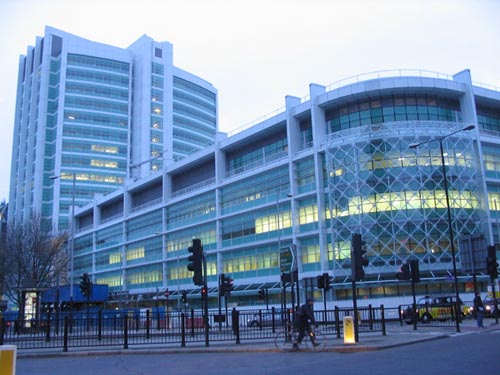
The combination of the fading light and my cheap camera makes these buildings look bluer and weirder than they really are, but I find the effect rather pleasing. I don't know what they are, in particular the tall one at the back, but they on the opposite side of the big interchange at the bottom of it from Euston Tower. Go to the top end of Tottenham Court Road, turn right along the south of Euston Road, and there you are. This is not a place I usually visit, and I knew nothing of this building until I saw it today. I now realise I should have taken the time to find out a little more of what it is and what is inside it. Sorry about that. I was just too tired after a day wandering about doing stuff.
It's the tall bit at the back that I like. There's something about the curve of the wall, and those sticking out right angles at the top, that just manages to raise it above the level of mundane modern vernacular. I think I detect in this design the continuing influence of this man.
Earlier today I did a Samizdata piece about the dodgy methods being used to sell the Airbus A380, and in the course of googling for info about this massive aircraft, I visited this blog. (Go there now, and scroll down, and you eventually get to an A380 picture.)
This blog, written in a language which is entirely unfamiliar to me, is not a very copying friendly blog, and I assume that the delightful picture it now features of a cross between a high speed sporting motor bike, a Reliant Robin, and a tilting high speed train, will soon be gone. Which would be a pity. So here is a photo of the picture on my screen.

This is the kind of contraption that in earlier times I would have written about and posted pictures of here. (I still remember this amazing device with fondness.) But now, I must put all such things here, adding inexorably to the atmosphere of culture-means-anything-Brian-thinks-is-cool that pertains here, and which I have no plans to resist.

And how about that, which I found here?
As regulars here will know, I like to stick up something every day, or more exactly every night before midnight, and that something, because this is quick, is often one of my photos. This often works well, and for a particular reason. Often, I don't know straight away which of my photos I'm going to like. The ones I like best have a way of sneaking up on me. At first they look nothing special, but a month or two later, I still like them. Such a one was this:

I don't know this guy (click to make him even bigger); I just happened to encounter him in this graveyard, but I'm afraid I can't recall exactly which graveyard this was. It is the kind of graveyard where famous people are buried, I do remember that. But it is already too late for me to be able politely to ring the person I shared the walk with and find out. I'll try to do this later and with luck there will be an informative addendum.
I love the Internet. Thanks to it, we Billion Monkeys photomaniacs can exhibit our favourite snaps and have them enjoyed by whoever in the world cares to enjoy them, without forcing intolerable slide shows upon our friends and relatives.
It's always hard to tell of course, but I reckon that this could be a very smart move.
Charles Saatchi, who bought Damien Hirst's infamous 14-foot tiger shark floating in a tank of formaldehyde for £50,000 pounds 14 years ago, has been offered £6.25 million for the work.The deal is likely to be clinched "in the next few weeks," said a spokesman for Mr Saatchi yesterday.
With the sale, Mr Saatchi, who is the country's biggest collector of contemporary art, will relinquish the most iconic work by a British artist in the late 20th century and the single most valuable asset in his collection.
My favourite comment on this is by Sunday Times arts editor Richard Brooks, who solemnly states, in an article about this deal last Sunday:
The departure of the shark, which was placed in formaldehyde in a tank to help its preservation, is a big loss to Britain. …
 To me it seems more like a big profit.
Will there be one of those public appeals, in which The Nation is asked to stump up a vast sum to keep some vital National Treasure in its Rightful Place? I somehow think not, because the laughter would be too humiliating to those who would be humiliated, and too enjoyable to those who would enjoy it.
I found this picture of Hirst's greatest coup here.
My thanks to Gerald Hartup for alerting me to this unfolding national catastrophe. (Well, for some people, it is.)
I've never actually been to the USA, and Alice Bachini clears up something for me about the USA that has always puzzled me.
Here is what Alice says about that rude guy on the telly who denounces aspiring pop singers, and makes them cry. He is now big in the America, apparently, but they think he's an American.
… The difference between the UK and the US is, if you're famous in America people will assume you are American, even if the way you speak says otherwise. They'll just make up an obvious explanation. An English accent is not English, it's just a disdainful and rude version of American. …
Alice goes on to say that this means she is sunk, but that is not what concerns me, what with me not being Alice and what with me being an uncaring swine. No, what concerns me is the way that obviously English people occasionally show up in American movies, apparently playing Americans. They have American parents, and went to American schools. Yet they turned out English. And Americans don't seem to have any objections to this bizarre arrangement, because they are the ones making and watching these movies. Now all is clear. Americans think that these English people are Americans, but disdainful and rude.
Mind you, when I first encountered an American who talked the way Lloyd Grossman talks, I thought he was taking the piss out of my accent. (This was long before Lloyd Grossman himself had occurred.) Since he was doing this in England, this struck me as a very odd thing for him to do. But it turned out he was an American, from somewhere near Boston, i.e. from the exact same place as Lloyd Grossman. Then when Lloyd Grossman started babbling away on the telly, I said: hah! I know that weird voice. I've heard that before.
Last time I went to a concert, I promised myself I would write about it here, but took the task too seriously, procrastinated, and eventually failed to write a word.
Well, earlier this evening I went to another concert, and this time I am damn well going to put something about it here, however feeble or unpersuasive.
The venue was the Conway Hall in Red Lion Square. The musicians were the Chilingirian String Quartet (keep scrolling and clicking until you get something), plus another cellist, Raphael Wallfisch, and the music was: the Beethoven Street Quartet in F opus 18 no 1, the Bach Suite for Solo Cello No. 5 in C minor, and the Schubert String Quintet in C major D956. The Chilingirians did the Beethoven. Wallfisch then did the Bach. Then, after an interval, all five of them together did the Schubert.
The weak link in the proceedings was the leader of the quartet, Levon Chilingirian. I feel like a swine for saying something like this, but it is true. After all, this was music making of the highest order, and nitpicking seems churlish. Nevertheless, I spent the entire time he was playing wishing that I could find it in me to enjoy his playing more than I did. Maybe the accoustics didn't help him, in particular when he played high notes, and maybe he toned down his playing of high notes a bit, and maybe this affected his control. Whatever the reason, whenever he was up there and out on his own, and should have been rhapsodising like an angel in flight, I found myself thinking that it was all rather earthbound and scratchy and lacking in rhythmic certainty. Only when he played low down and was harmonising with the others did the quartet playing, or quintet playing, suddenly have that real, hear-a-pin-drop, magic about it. I've not had time to put on a recording of any of the music I heard this evening, but I intend to, and when I do, I expect to hear just what it was I was missing this evening.
Wallfisch, on the other hand, was a revelation, especially in the solo Bach, which of course involved no playing whatever by Levon Chilingirian. The utterly simple Sarabande, devoid of double stopping or of any complicated skittering about, was especially affecting, as was the way he immediately after it launched into the Gavotte that followed, with infectiously foot-stamping elan. In his hands this music really danced. I now am listening to the highly regarded Fournier DGG recording of this music, just to get the names of the movements right (given that the programme was mute on the subject), and frankly, I remember Wallfisch's playing as far more fun than Fournier's now sounds. Although maybe being able to look at the charming expressions that played on Wallfisch's face made it all sound better than it really did.
In the Schubert, Wallfisch merged with absolute precision into the ensemble around him, and again, I found his facial expressions fascinating, communing this time with his fellow musicians. He looked like Napoleon, but nice.
The other cellist, Chilingirian regular Philip de Groote, a very fat man indeed who moved nothing except his left hand fingers and his right arm when playing (too much effort, presumably), was exactly everything that his leader was not quite. Despite not appearing to notice that they were even there, he harmonised perfectly with Wallfisch and the rest of them, and was in general a beautifully sure foundation to the two ensemble pieces. When the spotlight beckoned he was more than equal to it. Much the same applies to the other two Chilingirians.
It was a fine, fine evening. But had there been a first violinist in the same class as the guest cellist, it would have been a great one.
The Schubert Quintet is one of the great masterpieces of Western chamber music, and despite my complaints about Levon Chilingirian, this performance certainly made that fact very clear. Far better a concert where you know it's great but where you are left feeling that it might have been even greater, than one where you are left wondering what all the fuss is about.
This is a picture I took at the end.
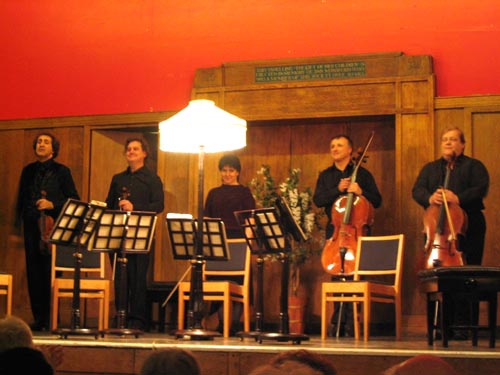
Not one of my best, but good of the chairs and music stands.
The event was organised to commemorate the life of a lady called Miriam Elton, who died this year. Miriam Elton spent her last days at the Hospice of St Francis in Berkhamsted, Herts. They're now raising money to build a new version of this place, and the money raised by this concert will be going towards that.
Slack day at Samizdata, and this evening, I was taking it up, which left no time for here, so here is a recent favourite photo, which will not be to all tastes, on account of it being blurry and dark and insufficiently of anything. But this is my blog and I like it.
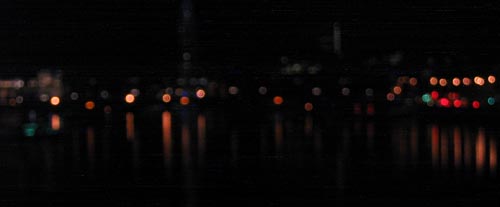
What I like is the way the dots look so painted. Click to get them bigger.
Here are the dots on the right in close-up, nearly full size:
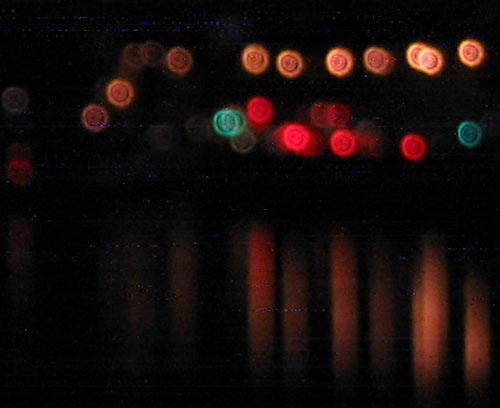
We have entered a world of pure machine reaction here, having almost no connection with how it looks to the human eye. But in a good way, I think.
Why is it that I have so much more respect for my photos when they look almost like abstract paintings, than I do for actual abstract paintings? What's that about?
By the way, what it is is lights seen across the river Thames, at night. And there was you thinking it was lunchtime.
Watching telly this evening I finally heard the word I needed to go a-googling after this bridge:
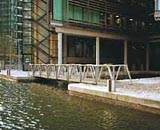


Cute, yes?
Slightly bigger versions of those pictures, and a description of how it works, here.
The word I needed was Heatherwick, the name of the designer. BBC4 TV had a show about him this evening.
More recently, Heatherwick has done this. Which was unveiled this very evening, apparently.
Private life in the public eye seems doomed these days, but life out of the public eye fares little better.
Read the rest of that, about the break-up of Jennifer Anniston and Brad Pitt, here.
To me one of the most interesting things about Being Alive Now has, and for quite a few decades, been the way that the hitherto sacrosanct distinction between the private and the public is getting blurrier every day.
Another of my favourite quotes concerning this odd relationship now concerned what it was like having a private negotiation with Dr Henry Kissinger when he was having one of his bursts of shuttle diplomacy. And yes, that "shuttle" did rather suggest that a mere Boing 747 was too slow for the Flying Doctor and he had to have a spaceship.
Here's the quote:
A conversation with Dr Kissinger at such a time was about as private as the inside of the Eiffel Tower.
Not bad, I reckon. It's one of mine, although I don't believe I ever got around to making it public, no matter how you define that these days.
The point being that once a secret that anyone cares about gets public, it's everyone's, i.e. not a secret any more. If you're Pitt or Anniston, everyone feels entitled to write what they think about you, and entitled or not, they do.
Compare and contrast, as they say, the time – not so long ago – when the fact that the President of the United States, no less. was stuck in a wheel chair was concealed from public view, for year after year after year. Amazing.
Or how about this? - quoted today here:
A Texas computer consultant said he stumbled upon photos of a silver-blue Z06 on the Internet and posted them that afternoon on a Corvette online discussion forum he frequents. Five days later, on Nov. 14, two men from Securitas, GM's contract security firm, knocked on the door of his Houston home demanding to know who gave him the pictures. He said he refused to let them in, and their parting shot was "We’ll see you in court."As soon as the security men left, the 36-year-old computer consultant, who requested his name not be used, posted details of the visit from the "two goons," as he described them, on two Corvette Web sites. He also posted scanned images of their business cards.
… which is where I first encountered it this morning, and more to the point for the purposes of what I am saying here, here.
Monet had his haystack. With me it's 355 Kings Road.
355 Kings Road is a big boring refurbished sixties blockhouse tower, refurbished to look not quite as ugly as it used to look, by being covered in sheeting of some sort. Or maybe it was like this to start with. Who knows? Don't answer that, I don't care.
What I do care about is the amazingly different coloured pictures I have of this edifice.


The one with two different colours is the best, isn't it? It looks like it's painted, and they ran out of orange. And look at where the two colours meet. It's a paintbrush join on the left, but a spray gun join on the right. But it isn't that. It's setting sunlight, coming in from the West, with part of it in shadow. Buildings on the left and trees on the right.
No Photoshopping by the way, not even cropping. Those were the pictures, straight from the camera. And here's Lights that change colour (1).
My thanks to he-knows-who, for this link, to an American Spectator article about Asian skycrapers.
I'm glad to see that this North Korean abomination gets a mention, in among references to the better stuff.
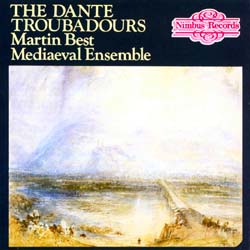 Recently I bought a very cheap, very second-hand copy of this CD. It had a slightly exotic sound about it, even slightly Indian. The singing style in particular was more Indian classical than Western classical. Early music meets world music.
This CD, which was made in 1982, would suggest that for some time now classical musicians of the early sort been learning from traditional musicians of other parts of the world how early western music might have been done. The trouble with the West, from the early music point of view, is that it is so dynamic that past traditions just get steamrollered, in art as in everything else, and if you depend on social continuity and there are no important physical relics involved, then nothing survives. With music, the only physical relics are the instruments, or pictures of them and descriptions of them. The sound of the music itself is lost.
Less dynamic parts of the world may oblige their people to remain stuck in poverty, but they do offer indirect evidence, in the form of surviving musical traditions, of how the Western music of long ago used to sound. Certainly Martin Best, the man in charge of this CD, seems to have made use of such knowledge. That, at any rate, is how it sounds to me.
And then last Saturday, on the BBC Radio 3 Early Music Show, they broadcast some medieval music from Santiago de Compostela, in north western Spain. This time, the "world" connection was made explicit, because in one of the pieces they played, a traditional Arabic orchestra (Fes Abdelkrim Rais Andalusian Orchestra) was brought in to help. I think I have that right.
I'm outside my core musical competence here, but I find this coming together of "early" and "world" musics to be most interesting.
My impression is that early music has not always been like this, despite that Martin Best CD. Early music has mostly been quiet and precious. And world music has been a world away. Yet the connection ought to be obvious.
Even more interesting is the way that early music and world music are both now converging on being less authentic (the authentic thing having now been recorded) and more entertaining. Again, that's just a casual impression.
Incoming email from Billy Beck, who reckons I might like this photo, of my part of London, from an airplane. He reckons right, partly because of the cute little union jack, shining forth in the gloom, but mostly because of what's on the ground.

Not to be used for any reason blah blah, so maybe it will vanish from here, but either way you can find a bigger version here.
I live pretty much in the middle, and can pick out all my local roads and walks. Top(ish) right(ish): the Wheel. Bottom in the middle: Battersea Power Station. Three famous parks (left to right): the right hand end of Hyde Park, Green Park and St James' Park.
Did some more rootling at the same site, and also came across this rather striking picture of an Airbus A320 control panel.
Now I know what you're thinking. Where can you find out about a plastic surgery, diet, dentistry, etcetera, makeover reality TV show? Well, not here. Not today anyway.
But try here.
Via this Samizdata posting, I found my way to these excellent London photos, of which this one, which he posted last October, is now particularly thought-making:

In general, if you like the kind of photos I like to take (minus the self-portraiture that I indulge in), then (as Michael Jennings suggests) you'll love these. Architecture, statues, oddities, and lots of interesting signs and adverts.
What's the German for Billion Monkeys?
Regulars here will know that I collect bridges. So, here's a rather pretty one, this being one of a number of pictures that appear here. That's right: Eton. I found it while concocting this posting.
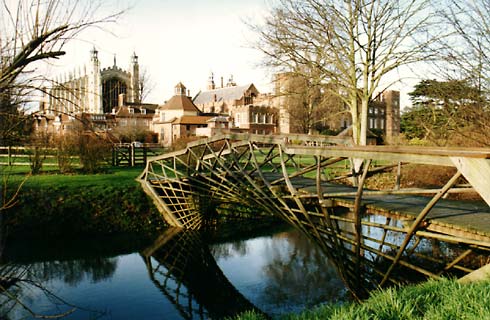
Why I was younger I too had a brief phase playing with objects like this, although on a smaller scale. Hyperbolic paraboloid was what my things were called, although the maths at the end of that link remains utterly foreign to me. My things, like the bridge also looks, were constructed entirely of straight lines, but were pleasingly curved.
Which makes me suspect that this bridge was probably built by Etonians. It looks like a boy thing.
Instapundit links to a bunch of New York Billion Monkeys, these photos being my favourites of the ones I looked at, because I finally got to see some skyscrapers. I suppose locals get blasé about those towers, and want to do things like close-ups of peculiar signs or shops or hair or dogs or whatever. But I love those towers.

Dark grey at the front, lighter grey behind. Never fails.
And here's some excellent graffiti, …

… which always gives me a dose of mixed feelings. One: excellent graffiti. Clearlyl this is one of the defining art forms of our era. But two: graffiti suggests to me that the official owners of the place have lost some of their control of it, to a new and nastier sort of owner, and I don't like to see that. Saw some very witty graffiti-graphics yesterday evening at Vauxhall station last night, and I tried to photo it, but it was too dark and it didn't come out right.
Skyscrapers and graffiti have in common that both can be seen as male pissing contests. Discuss.
And also, discuss this. When I saved those pictures from the MetroPlus blog posting (which I assume he doesn't mind), they at first came up as just two of those annoying little red crosses in a little square, in a big blank square where the picture was supposed to be. But then, because I thought it might work and because I recall something like this having worked before, I looked at the "Format Options" in Photoshop when you save pictures (which are: "Baseline ("Standard")", "Baseline Optimized", and "Progressive") and switched them from Progressive to Baseline ("Standard"). Bingo. First I didn't see them, now you do. What's that all about?
So much of computer use seems to mean doing splig and remembering not to do splog, without knowing what the hell splig and splog really mean. So, what do splig and splog mean in this case?
I am delighted to report that a new remaindered books shop has opened up near me, although the one a bit further away that closed down recently had a much better choice of recent stuff.
Anyway, at the new place I obtained, for a mere £3.99, a copy of Why Can't I Fall In Love? by Rabbi Shmuley Boteach. (And never you mind why.) Rabbi Shmuley Boteach is also the author of Kosher Sex, and, although a new name (and what a name) to me, is apparently quite a big cheese in America, on talk radio and such.
Here is what he says about Sex and the City, the final two episodes of which were recently reshown on Channel 4 TV here in Britain:
Our culture's obsessive emphasis on independence has led too many singles to back-burner their search for love and turn instead to their like-minded, sympathetic friends for solace. Now I don't want to go on record saying we should cut off all our friends if we're going to find romance. But I will take a stand that may prove controversial: For too many of us, our attachment to friends threatens to dull our longing for a long-term romantic relationship. The wildly popular HBO series Sex and the City offers a fascinating window into this problem, though I hardly think its writers intended it this way. The series presents its four central characters as avid manipulators of men; ultimately, they always seem happier complaining to each other about the flawed opposite sex than pursuing the men they bemoan. To be sure, they make brief forays into the world of dating, but it's when Samantha, Charlotte, Carrie, and Miranda return and regale each other with the stories of their encounters that each episode reaches its stride. In fact, I believe the secret of Sex and the City's success isn't just that it's funny and sexy, but that it captures the camaraderie many women today have come to think of as more important and more lasting than the romantic relationships they claim to crave. For these women, men are a means to the end of their own friendships, rather than vice versa; they derive greater stimulation from each other than they could ever derive from a man.
Setting aside the matter of whether you agree with the Rabbi about whether friendship really does interrupt more intimate relationships in real life, I do think that the man has a point about Sex and the City.
I watched those final two episodes before reading the above judgement, and was myself struck by the air of falsity and fairy tale which pervaded all the various happy romantic endings we were offered for the four ladies (most especially for Carrie and Samantha), while noting that the relationship between the four when they got together to talk about these various endings was as convincing as ever.
When classical CDs first hit the shops, I recall anti-capitalist whingers saying that it was all Brahms and Beethoven symphonies, but nothing obscure and interesting, and generally capitalism screwing up. I knew that things would eventually change, and they did, with a vengeance. There is now virtually no limit to the music you can get on CD. Oh, there are some gaps still to be chased down and filled, but the choice of stuff you can now get is fantastic compared to the bad old days of records and cassettes.
With DVDs, I have been eagerly anticipating similar bounty. New big distribution movies of course all now come out on DVD, and I presume that quite a few more go straight to DVD after only the most casual distribution in the cinemas if any. Although I further suppose that you might have to know where to look for such oddities.
Better than that is that the best movies of the pre-DVD era, starting with the most popular ones like Casablanca and It's a Wonderful Life and all the Fred and Gingers and the James Bonds. This part of the job is now well underway. Although, I'm still waiting for DVDs of the classic Ryan O'Neal, Barbara Streisand screwball comedy What's Up, Doc?, and of Metropolitan, to show up in HMV Oxford Street.
And then of course there are all the ancient TV shows that you can now get on DVD. Those are already in HMV in strength.
Nevertheless, most of what I have seen available on DVD has been pretty mainstream, not really all that esoteric or obscure.
But now, however, comes news of something that I would rate as genuinely off the beaten track.
This is from the a latest DVD issues leaflet that fell out of the this week's Radio Times:
Silent ShakespeareCLASSIC SILENT DRAMA These early film adaptations of Shakespeare's plays feature a new score by composer Laura Rossi. As well as the first Shakespeare film - King John (1899) – the collection also includes: The Tempest (1908), A Midsummer Night's Dream (1910), King Lear (1910), Twelfth Night (1910), The Merchant of Venice (1910), Richard III (1911). DVD extras include: filmed introduction and commentary by Judith Buchanan, sleeve notes by Nicci Gerrard, bibliography.
Never heard of those last two.
And that's my point. Silent Shakespeare? What on God's earth is the point of that? Well, I guess they have the words stuck on at the bottom, so maybe not so bad. But even so, weird. Learn more about it here.
In five years time? Or ten? It'll be a new world.
Another year another quota photo. Midnight approaches, I like building reflections bounced off cars, with something on the surface to give it some depth don't you know. Some things never change eh?

I like the tower because it's my home tower, the one outside my front window. And I like the way the car window transforms it from a sixties blockhouse into something more shapely and cutting edge, less brutalist and more Foster.
Despite all the tsunami horrors of 12/26 and onwards - this guy looks like a good man to read, if you can take it - London nevertheless celebrated the arrival of the New Year in style. BBC1 switched back and forth between appropriately doleful reportage from the smitten East, and the rather subdued celebrations that were nevertheless happening in London, in Britain and in general.
There was nothing subdued, however, about the firework display which was staged in London, in and around the Wheel. You can't tone down a firework display, I guess. You either have it as originally planned, or you don't. And London had it.
As soon as I saw how impressive it was going to be, I started snapping away at my telly.





Click and enjoy.
I seem to recall hoping here that as part of the London effort to get the Olympic Games, good things would happen to London. This, I suspect, was one of them. Look! We may have hopeless public transport and no proper stadium, but at least we can do fireworks!
I really envy those who got out to see all this for real, and here are some reaction shots of the envied, to end with. Brian's Culture Blog wouldn't be Brian's Culture Blog without a picture of someone taking pictures, so I end with a regulation Billion Monkey. This was the one shot I had to exhume from darkness with a bit of photoshopping. All the others are as snapped.


The footage of the two ladies and the moustachioed gent was very artfully set up, and recurred several times. I'm sure the BBC liked it for the beauty of the ladies, and for the ethnic mix. And what the hell, so do I. I'm glad I got Lady in the Middle brushing away a tear.
As for the other pics, I probably shouldn't have had so many of the Wheel, but really, has it ever looked better? And it must be the answer to the pyrotechnicians's (?) prayers. About the only thing missing was giant rockets attached to the Wheel to make it spin round madly like a giant catherine wheel. As it was, each pod was crammed with explosives and the entire frame must have been festooned with bangs and wires of every sort. Even on mere TV it looked remarkable, and though I say it myself, I love how it looks in some of these photos.
Brits will have seen all this on their TVs if they cared, even if they were at parties (I myself was hosting one), because at parties the TV gets switched on for the chimes of Big Ben, and to make sure you get the timing of the New Year right. But non Brits may not have seen this particular show. Even those who did see the TV may agree with me that stills of it all do add something, in an oil painting sort of way.
I wonder what Turner would have made of all this.


