

Not every cloud has a silver lining, but this one (which I chanced upon out in the suburbs yesterday) did, which made it look not unlike this:

It actually wasn't as dramatic as that makes it look. But it did have that bright line around the edge of the cloud, definitely brighter than the sky behind. I photoed it on "AUTO" (automatic), but that completely ignored the contrast between the line around the cloud and the sky behind, making both equally bright.
Then I thought back to those digital camera lessons I did, and tried it on "Tv" (timer variation?), and quickened the shutter speed (?). My first stab with that was excessively dark, but lengthening it a little got me what I wanted. Even the crappy little screen on my cheap camera suggested that this had worked.
Back home with the computer, the original AUTO pictures weren't as bad as they looked on the camera. But the Tv ones were definitely better, at least for that silver lining.
Click to get it larger. Although I'm not sure if that really adds much.
I wasn't at the north London Halloween soirée at which this hideous apparition was to be observed.

My thanks to fellow BM Michael Jennings, who was there.
By all the accounts I have read (including one that I swear I read by Alice in Texas but cannot now find), and certainly by this one, Jarmusch's movie Coffee and Cigarettes is mostly very dull.
Although, these bits sound fun:
The only two episodes that generate any comic energy from the premise are the most non-Jarmuschian. In one, Cate Blanchett plays both a star called “Cate Blanchett” and, under a long black wig, her loser cousin Shelby in a strained encounter in the lounge of her hotel. The loser cousin is a laugh, but Cate as “Cate” visibly struggling not to condescend or provoke is a miniature masterpiece. Miss Blanchett pulls off single-handedly what most of the double-acts never quite manage – two people meeting for coffee and never connecting. She’s topped only by Alfred Molina and Steve Coogan’s scene, in which the actor “Alfred Molina” requests a meeting with fellow Brit “Steve Coogan” while he’s visiting Los Angeles. Alfred says he’s a huge fan of Steve and Steve replies that “obviously” he’s “aware” of Alfred’s work. Molina says he asked to meet for a reason and slides a manila folder across the table. “What stage is this at?” Coogan demands. “Is it greenlit? Is it a treatment?” So Molina explains that it’s not a project, it’s just that he was doing some genealogical research and discovered that they’re cousins – they share the same great-great-great-grandfather, and that’s pretty amazing and exciting, isn’t it? Maybe they can hang out, get to know each other. Coogan doesn’t think so.This encounter is the only one that has any narrative resolution – indeed, for Jarmusch, it’s almost an O Henry twist. And Molina’s rueful big-heartedness, which anchors the scene, is almost the antithesis of a Jarmusch performance. One notes also the curious fact that, in a movie about coffee, the most effective episode features a couple of tea drinkers. “Shall I be mother?” offers Molina, sweetly offering the pot. “I’ll be my own mother,” mumbles Coogan dourly. That may be the best exchange in the picture.
Coffee and Cigarettes was filmed over a long period, which makes it a boring film done very interestingly, I think. By the sound of it, the various mostly very boring episodes in it only involve a succession of cameos by different people. But why not have the same people coming back again and again throughout the making of the movie, getting gradually older?
If practised more regularly, this method could solve the problem of movies where a succession of actors who look very unlike each other form a queue to play the same alleged character. Answer: have the same actor play the same character over a period of thirty years.
The trick would be to have a flexible story, with the possibility of dramatically expensive special effects which could be added towards the end, after you have filmed the earlier scenes cheaply and on the basis of which you raise the money for the final expensive climaxes. You could start with your cast aged about ten and doing cheap things, and then they could get older and do gradually more dramatic things. Of course, with growing children involved, the legal situation would have to be sewn up very tight, and the story might have to be about bolshy teenagers rather than biddable ones. Like I say, duck and weave, scriptwise.
How about a bunch of kids lost in space in a small and nasty (and hence cheap) space ship, finally contriving to find their way back to (final scene – very expensive) civilisation! The excitement and with it the cost per frame would build slowly, as and when the money for the later scenes was raised. The Anabasis, in other words, with the sea at the end being expensive and special effecty, but most of the film being claustrophic and cheap.
As cameras get cheaper, and as a steadily increasing proportion of humanity dreams of being film stars and film directors, this will happen more and more often I think.
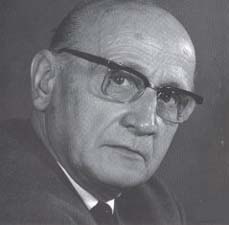 So, Fritz Werner's Bach Cantata recordings are wonderful. But have a read of this, from the sleeve notes:
Fritz Werner was born in Berlin on 15 December 1898. At the end of the First World War he was taken prisoner by the British, and he only began to study music in 1920. In 1936, on the recommendation of Wilhelm Kempff, he was appointed organist and choirmaster of the Nikolaikirche in Potsdam, a Neo-classical church designed by the famous German architect Karl Friedrich Schinkel. Two years later, in 1938, Werner was appointed to Potsdam's Garrison Church, the Prussian "Holy of Holies" where the Prussian Kings were buried. At the outbreak of the Second World War he fought in the Polish campaign and in the battles around the Maginot Line in France. The Nazis then gave him the job of Musikbeauftragter in Occupied France. In this position, part of which put him in charge of music for the radio, he came into close contact with the composer and director of the Paris Conservatoire, Claude Delvincourt (1888-1954), who, like Werner, possessed humanist qualities which were widely recognised. Another part of Werner's job was to send French musicians to Germany for travail obligatoire (forced labour), and his protection of many of them made him a much-loved figure in the musical life of Occupied France, which he upheld with conviction. An illustration of Werner's compassion is contained in a charmingly mischievous anecdote concerning the twenty-year-old oboist Pierre Pierlot, whose playing features prominently in this Edition. Pierlot was told that he had to go to Königsberg in eastern Prussia for forced labour. He replied that his father would not let him go because it was too far. By the time the German official involved had found out who his father was, Pierlot had escaped his clutches. But not for long; a month later the German bumped into him again in the orchestra where he was principal oboe. Pierlot hid as best he could behind his desk until the leader called out "Pierlot, give us an A!". The German pretended he had heard nothing. He was Fritz Werner. After the war, when Erato needed a first-rate oboist to play in the Bach cantata recordings in Germany, Pierlot eagerly offered his services by way of thanking Werner, to whom he owed so much. The story has it that when Werner apologised to Pierlot for not at once recognising him because he looked so well, the oboist replied: "Since you Germans were driven out of France we can eat as much as we want, just as we used to. And, by the way, you look much better in a shirt than in a uniform". In August 1944 Werner again became a prisoner, this time of the Americans. He later returned to Germany, where he was interned in the Heilbronn-Böckingen camp, from which he was released in 1946.
The spine-chilling phrase here, just in case you missed it, was that bit about his protection of "many of them". So, Werner saved Pierlot, and "many of them". Good for him. But who did he not manage to save, or worse, who did he choose not to save? I'm not saying he's evil, but it certainly seems that this man got pretty close to some evil things, an impression that is reinforced by this biography of Werner (which is where I found the photographs of him), which, on the matter of Werner's war, has only this to say:
In 1936 he stated his career as a church musician at Berlin and Potsdam, where he became Kirchenmusikdirektor in 1938. He served as organist at Potsdam until the outbreak of World War II, when he left Germany and became a music director of the German radio in occupied France.After the war he returned to Germany, settling this time at Heilbronn. …
My guess would be that Werner, like many other of his musical compatriot contemporaries, loved and worshipped music above everything, and did as much as he had to, and as little as he had to, to become a good and successful musician in those bad, bad times. Anybody know any different to that? All I really know about this man is his Bach conducting.
I'm busy lashing up a TransportBlog posting, following on from this Samizdata posting about air taxis, and in connection with that, I want this image ….
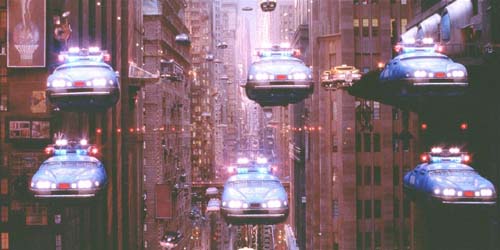
… up here, so I can link to it from there. Click to get it lots bigger.
The Fifth Element (and by the way these storyboards are worth a look if you are the arty type) has always struck me as a hugely under-rated movie, from the urban futurology point of view. It deserves, from that point of view, at least equal billing with Blade Runner, which I believe is only liked as much as it is because it says (with the usual absurdly short and impatient SF timeframe – it's set round about now, as I recall) that the weather is about to become permanently horrible.
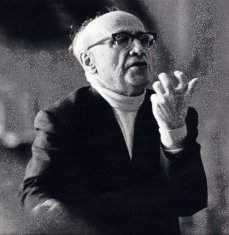 I have long admired the Bach Cantata recordings made by Fritz Werner for Erato in and around the 1960s. His performance of Number 30 – "Freue dich, erlöste Schar" – is my all-time favourite recording of any Bach Cantata, by anyone.
So when Erato recently issued a couple of ten CD sets of all the Bach Cantata recordings that Werner made, for the bargain price of less than £3 per CD, I eagerly snapped up the first ten, and having got stuck into these I intend also to buy the other ten. They are wonderful.
Bach interpretation since the war can be divided into three phases, which have overlapped in time and are inevitably somewhat blurred at the edges.
Phase One. Solemn, deeply meaningful, but too slow. Extreme case: the Karajan DGG Brandenburgs. See also Klemperer. Bach as Bruckner. Fifties to seventies, when this style was shut down by the record companies.
Phase Two. German church cantors who specialised in Bach. Karl Richter, Helmut Rilling, Fritz Werner. Faster, but still grand. At its best: radiant. I like all of these performances. Rilling is still going, as if Phase Three (see below) had never happened. But best of all of these is Fritz Werner. I am a devout atheist, but I cannot help noticing that these men were/are all Christians. Timing: late fifties to seventies and in some cases (Rilling) seventies onwards.
Phase Three. The "authentics". Eighties and nineties onwards. I cannot be objective about this style, because basically I hate it. At its worst: totally un-transcendent, landing like a ton of bricks on the first beat of every bar, recorded by fussy little men with names like Trevor and Ton (although the absolute worst one of all is called "Reinhardt" – see the Samizdata link above), who look (and – more to the point – radiant the spiritual atmosphere of) spare parts managers rather than conductors. God knows what these people actually believe they are saying with this music. (I told you I couldn't be objective.)
Perhaps I ought to add a Phase Four. This is: the Bach Collegium of Japan directed by Masaaki Suzuki.
These are wonderful performances, done by honest-to-God Christians, which somehow make the best of the authentic style (which I do admit has a best – clarity, sparkle, even Phase Two type radiance, which Phase Two itself can often lack – Suzuki was actually taught by Ton, see above).
But unfortunately, whereas the Werners and the now deeply unfashionable Rillings can be got very cheaply, for around a fiver or less, these Suzuki performances (on BIS) are ultra-fashionable, are sold at full price, and have yet to appear on the second hand market or in the bargain boxes at the big new-CD stores like the HMVs of Oxford Street. £17 for three cantatas is too strong for me. I have a few of the early issues of this wonderful series, got second hand before it became widely realised just how wonderful it was, but after about number 10 cheaper copies just haven't been obtainable.
I can find no reference on the Internet to the newly packaged bargain boxes of the Werner recordings, even though these are already available brand new in some of the big London stores, like HMV. The Warner Records Internet operation is, as of now though presumably this will change, beneath contempt.
All of which began as a the briefest of brief intros to a piece about what Fritz Werner did during the war, which I will now do as a separate posting.
 I have a programme called Skype running on my computer, which means that Michael Jennings can send me emails and invite immediate conversation. Here is his latest, on the subject of yesterday's posting about films stars etc.
Hmm. Just reading your culture blog. It has of course been noted by many people that Hollywood casting agents are always casting the same small number of actors because they have themselves seen very few movies and have very little imagination. One thing to be said for Quentin Tarantino is that his movies are always interestingly cast because he has seen more movies than anyone and he remembers good performances in obscure seventies TV series and the like.
Which is probably a better explanation of what I was writing about than I offered.
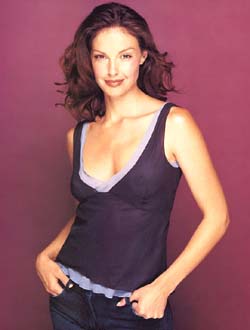
Picture of Ashley Judd there. She appears in lots of films, and in this case I agree with those myopic and ignorant casting agents. No wonder she looks so smug. I even like it when she is miscast in rubbish, as often happens. (New Hollywood job description: Miscasting Agent.)
Alice (back in Texas again?) was not that smitten with Troy, which I haven't myself seen and have no plans to see, until I take a look at it on the telly (if that is convenient). My favourite reason she didn't much like it was this one:
… in history, everything was brown, because colours cost too much, and this is dull on the eyeballs, …
See also The Gladiator. But I don't think it's that colour costs too much. I think it's that colour makes everything look not like XXX BC, but like XXX BC as filmed in 1960. and you wouldn't want that.
Later she says this:
Also I am worried about the small number of people who keep acting in every single movie I watch these days. There don't seem to be enough actors to go round. Half the cast of Troy looked like they were also in Lord of the Rings, and playing the same characters as well. Just dying your hair and removing the elf ears is not enough to make us think you're someone else, Orlando Bloom. We know who you are. And we know Brad Pitt is a crazed egomaniac, Sean Bean is Captain Sharpe, and all those dark wide-eyed feisty girls who look like Natalie Portman and Keira Knightley are actually the same person as each other.I don't think it was always thus: there used to be Stars and Everyone Else. Now there is a whole (albeit small) Acting Class. …
I don't know what I think about that, or even if it is true. Surely the old Stars were just as much the same from film to film as anybody is now.
I wonder if it is anything to do with getting older. When you are young (I realise that Alice is quite young now, but in the past, I surmise, she was even younger), you see a few Great Stars, and lots of old people. As you get older, you see more Stars. When you reach a hundred they all look like Stars, and there is no Everyone Else who are, compared to you, not Stars.
Plus the Stars don't look as great as those old Stars did, when you were a kid. Everyone just just looks like ... Everyone Else. The Stars merge into a great big acting company. But it's you, not them.
Just a thought.
Today I contributed to a panel discussion organised by some LSE students. On my way there, from the Temple tube station, I encountered the statue of Bomber Harris and took a photo of it. It's impressive, I think.
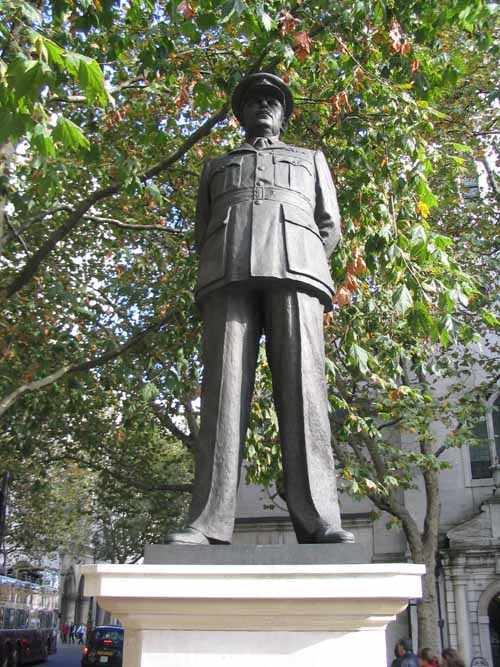
In general I think that all the Second World War military statues tend to be very fine, being full of individual character. Although I guess all those long dead aristocrats on horseback looked more individual to people used to the nuances of horsemanship than they do to someone like me.
While googling for Harris linkage, I found that if you click on this link you can actually hear Harris himself talking.
"There are a lot of people who say that bombing can never win a war. Well, my answer to that is that it has never been tried yet."
A scary man. The human embodiment of the whirlwind reaped by Nazi Germany.
What a difference it makes to our appreciation of the past if we can actually hear dead people talking to us. As I seem to recall writing here before, what would we not give for a similar little snatch of, say, William Shakespeare talking,
Photographing statues is a very hit or miss thing I find. The darkness of the object combined with the arbitrary shadows caste by nearby trees (especially) can obliterate the shape of the thing entirely. But this snap came out quite well, especially when you factor in that a lot of the character of these statues is in the body langauge and the way the uniform is worn rather than just in the face. And this time the trees were on my side, metaphorically speaking, because behind the statue literally.
My one hurried attempt to photograph the writing on the plinth was not such a success.
I'm listening to the new LSO Live Falstaff conducted by Sir Colin Davis, or at any rate to the sound it makes, and this sound makes me want to pay attention to it seriously some time very soon, perhaps by watching the DVD of Falstaff by some other people that I picked up very cheaply a few weeks back.
Meanwhile, here is a picture, of the back cover of the Davis/Falstaff CDs, which perhaps goes some small way towards explaining why English is doing so well these days. It occupies less space. It uses fewer letters to say the same thing. It is shorter.
I have sort of known this for a long time, but this really brings it home:
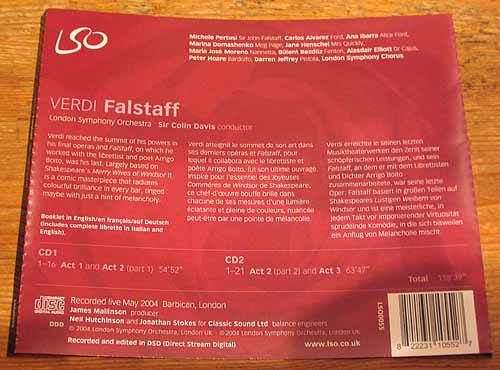
I took it out of the plastic case to reduce reflection. (No self portrait this time, I'm afraid.) As often here (but not always), click to get it bigger, i.e. in this case somewhat easier to read.
The opera itself is sung in Italian. Where would Italian come in this comparison? In the middle, alongside French, I'm guessing.
For reasons of my own I need to display a cinema poster, which I saw in the tube yesterday.
I have been watching L'Appartment (silly me - I completely missed those Hitchcock references - he likes it too) and this has given me a taste for French Romantic comedies with gorgeous and fascinating women and adoring but decidedly ridiculous not to say ugly men (I wonder why), and, well anyway, here is another that looks promising.
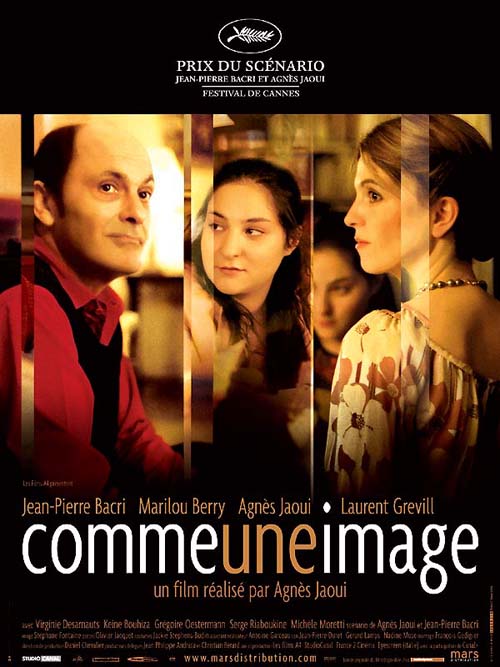
Something about how 'society' (i.e. me and you and everybody) attaches too much importance to looking gorgeous in a picture, a point made (I'm guessing) by making lots of gorgeous pictures (i.e. a movie) about a particularly gorgeous woman …
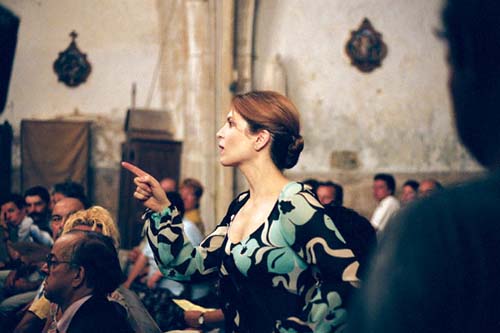
… (and god help anyone who wasn't gorgeous who was up for that part), and others of the kind of gorgeous woman who can be made up to look non-gorgeous, with done-up hair and glasses, which can then be undone and taken off. …
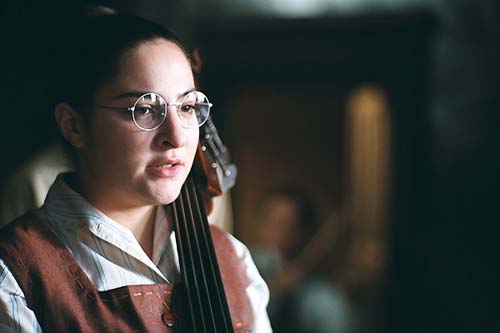
IMPORTANT NOTE: All these french actresses have distracted me from doing an Important Posting about the play I saw last weekend. I now have no time to do the review of this that I promised in the previous posting. The instructions at the top of that posting about what to do if I did not post this posting immediately are now inopperative. I will try to do the review over the weekend. It's my blog and I'll procrastinate if I want to.
Another photo to show you. I went walking in the Hammersmith area earlier in the week, beside the river, the weather being windy but otherwise perfect. Some seagulls were congregating around a man throwing bread to them and my companion said I should I attempt to photo them. So I snapped away, but I wasn't hopeful. I expected tiny smudges. However, when I got home and screened them, it turned out that some of them were decidedly okay, this being the best bit of the best one.

Had I known how well I was doing I'd have done more snaps, and maybe got something even better. The two on the lower right of things are a bit of a muddle. I have been learning Photoshop lately, and in particular have learned how to eliminate such things. But Photoshop is evil. We can now all lie with our cameras, but we shouldn't.
These fun photos was taken by me last night, as I walked from Sloane Square along the Kings Road towards Perry de Havilland's, for a party, which puts time-of-taking at around 7pm. The premises in which all these young chaps and chapesses were gathered was Foxton's, the estate agents. Click to see them bigger.
What were they there for? My guess would be that they were Foxtonians who were about to be dosed with some Foxtonian propaganda about how to sell houses for more than people want to pay and for less than people want to charge, and that after that they would be having a party of their own. They certainly seemed cheerful enough.
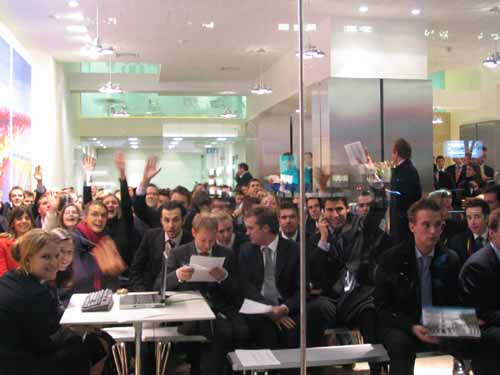
Collectively, they responded much as these ladies of fond memory did. That is, as soon as I decided that there was a photograph to be taken here, they started playing up to my camera, even though it was only my tiny little Canon A70. I myself made no secret whatever of my photographic intentions. I stood proud in front of their window, grinning at them much as they grinned at me. Once again, my tiny camera proved its worth be being in my pocket when I needed it for the simple reason that I now never go out without it. Obviously I had it with me this time for my party later, but the principle still applies. Were I the owner only of a bigger camera, I might not have bothered taking that even to my party.
(Actually that is quite plausible. It does occur to me that silly little digital cameras like mine are party fun cameras, but that big heavy cameras are big and heavy, and not proper party-machines for photo-ing party-animals. Too serious. It's like you've come as A Photographer, rather than as a party-animal yourself, who just happens to have one of these stupid toys on him.)
As often happens on occasions like this, I took quite a few photos, but the first was, I think, the best. Technically it is no great shakes (although that of course is the exact wrong expression to describe what happened), but humanly, I like it a lot.
I took some closer-ups, but then did a final panorama, reproduced below, by which time they seemed to have calmed down a little. No doubt if I had snapped away for another two minutes they would have reverted to a state of nature.

I then proceeded to my party, where I finally remembered to ask David Carr, my friend and fellow Samizdatista, and more to the point my fellow-contributor here, about the law of taking photos without the consent of the photoed and then (b) shoving them up on the Internet.
That's now illegal, apparently. It used not to be in Britain, but now there has been a Euro-Directive and there is now someone called the "Information Commissioner" to whom you can complain about this, and the photoer can then be fined.
But crowd scenes, whatever exactly that means, are okay, Daivd said. which means that I'm hoping that these pix don't break any law. And more to the point, someone has to complain, and I'm guessing none of these people will. Plus, there are no snide captions sneering at any individual, plus I'm not making any money. Plus, if anyone complains to me first, the pictures will come down from here at once, with no further questions asked, on netiquette as well as legal grounds.
Nevertheless, I do want to know more about these photo-ing and Internetting laws, if only to do a posting at that CNE intellectual property blog I write for, that I linked to above and which both I and David write for. Anyone know of any blogs/sites where this stuff is explained?
I am now going to do two postings, about two quite distinct subjects, one after the other, and if I don't feel free to hunt me down and shoot me. With a gun I mean, not a digital camera.
Subject one concerns a troubling syndrome which I have noticed in myself, and expect that others may recognise also.
There are many ways in which I mentally classify my various blogging efforts, but one subdivision is: important postings, and unimportant postings.
The unimportant postings are easy. I just do them. They aren't important, so it's not important for me to do them perfectly. I just bash them out and forget about them. Hey how about this! Interesting, yes? No? Oh well, I liked it. Blah blah blah. Finished.
But the important postings are difficult. These are the ones that make an Important Point. These must be got right. People must be made to agree with me about how important it is, so they must be written well, linked impeccably, and perhaps illustrated exquisitely. Result: again and again, these important postings don't get written at all.
So for example, last weekend, I went to see a play. That's right, I Got Out More, as I always tell myself I ought to, and actually saw a play, in a theatre, on a stage. True, it only involved one actor, and he was seated at a drab desk in a drab room, surrounded by junk and doing work that depended entirely upon electronic equipment, so the culture shock for me was not as total as it might have been.
But imagine if there had been lots of smartly dressed people saying Elegant things while sipping Elegant Drinks in an Elegant Drawing Room with Large and Elegant Windows! I would probably have died of the shock and had to be stretchered out.
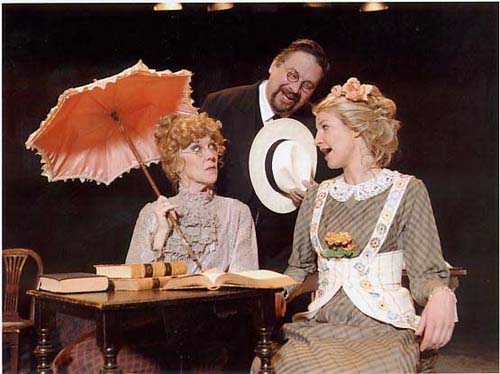
So, anyway, I went to the theatre. So, this was my chance to do a Theatrical Review, immediately afterwards. Like they have here. Wow, I could be a real Culture Blogger!
However, this would have been an important posting. It would have been my debut here as a Theatrical Reviewer. It would have to have been dazzlingly written, to have made all its points (a) properly and (b) in the correct order and (c) other things I have now forgotten but which are just as important.
So, it never got written. Well, it got half written. But it didn't get wholly written and it didn't get posted. Until today, when, I have resolved, I will write it and I will post it. It is important that I write it and post it. However, it order to get it written and posted you and I both will have to resign ourselves to it being written and posted in the Unimportant Style, i.e. the way this posting was written. And posted. Facetiously, and perhaps with Too Many Capital Letterised Words, to name but two defects Among Many of the Unimportant Style.
Another feature of the Unimportant Style is Abrupt Endings.
Time for some more proper painting.
Who did this?
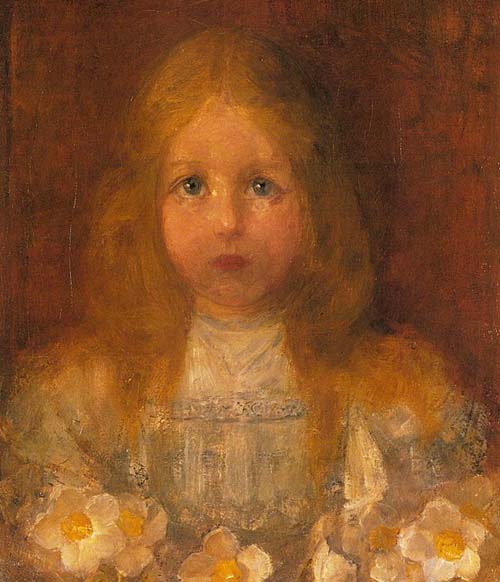
It's a slightly cropped version (to exclude the signature and to fit it better here) of number two of these. (See also this similar posting here.)
And check out number seven, The Wall Of My Grandma's Shower Before The Gunge In Between The Small Multicoloured Ceramic Tiles Had Been Added. Click on each ceramic tile, but it won't do you a bit of good.
Malcolm Hutty emailed me, urging me to take note of this interview with Neal Stephenson, which I certainly will.
And Michael Jennings has already posted this choice quote from it at Samizdata, which deserves to be anthologised for at least the next several hundred years:
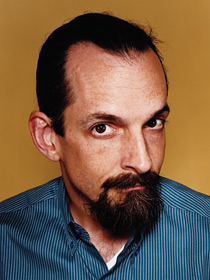
Because she'd never heard of me, she made the quite reasonable assumption that I was a Dante writer – one so new or obscure that she'd never seen me mentioned in a journal of literary criticism, and never bumped into me at a conference. Therefore, I couldn't be making any money at it. Therefore, I was most likely teaching somewhere. All perfectly logical. In order to set her straight, I had to let her know that the reason she'd never heard of me was because I was famous.
This guy is also impressed. (UPDATE: As is she.)
This Stephenson interview is the kind of thing, I think, that people start copying, pasting and blog-posting about before they've got even half way through it.
The Stephenson picture above, plus another interview, are to be found here.
I was out snapping in the late afternoon sunshine yesterday, and frankly I found the light hard to handle.
I think this lady may have been doing better.

Like me, she was photo-ing the skateboarders under the National Theatre. This was the best shot of any of these guys that I got. (And oh look, there's me again, on the left.)

As you can imagine, there was a lot of snapping, and later, a lot of deleting. But that's digital photography for you. You can do that!
Click to get them bigger.
Here's am NYT story that I can link to from here. It's about performance enhancing drugs, but the performances in question were not athletic; they were musical.
RUTH ANN McCLAIN, a flutist from Memphis, used to suffer from debilitating onstage jitters."My hands were so cold and wet, I thought I'd drop my flute," Ms. McClain said recently, remembering a performance at the National Flute Convention in the late 1980's. Her heart thumped loudly in her chest, she added; her mind would not focus, and her head felt as if it were on fire. She tried to hide her nervousness, but her quivering lips kept her from performing with sensitivity and nuance.
However much she tried to relax before a concert, the nerves always stayed with her. But in 1995, her doctor provided a cure, a prescription medication called propranolol. "After the first time I tried it," she said, "I never looked back. It's fabulous to feel normal for a performance."
Ms. McClain, a grandmother who was then teaching flute at Rhodes College in Memphis, started recommending beta-blocking drugs like propranolol to adult students afflicted with performance anxiety. And last year she lost her job for doing so.
College officials, who declined to comment for this article, said at the time that recommending drugs fell outside the student-instructor relationship and charged that Ms. McClain asked a doctor for medication for her students. Ms. McClain, who taught at Rhodes for 11 years, says she merely recommended that they consult a physician about obtaining a prescription.
Ms. McClain is hardly the only musician to rely on beta blockers, which, taken in small dosages, can quell anxiety without apparent side effects. The little secret in the classical music world – dirty or not – is that the drugs have become nearly ubiquitous. …
Fascinating.
In sport, there is widespread agreement that drug-enhanced performances are not "real", although all the word-of-mouth I hear says that drugs are ubiquitous in athletics also, and the difference between the successful athletes and the ones who get banned is merely that the successful ones are more skilful at hiding what they are doing.
In classical music the debate is much more about whether drug-enhanced (or maybe that should be: drug-enabled) performances are actually as good as non-drug-enhanced(abled) ones. Use of such drugs is very widespread, says the NYT article …
But some performers object to beta blockers on musical rather than medical grounds. "If you have to take a drug to do your job, then go get another job," said Sara Sant'Ambrogio, who plays cello in the Eroica Trio. Chemically assisted performances can be soulless and inauthentic, say detractors like Barry Green, the author of "The Inner Game of Music," and Don Greene, a former Olympic diving coach who teaches Juilliard students to overcome their stage fight naturally. The sound may be technically correct, but it's somewhat deadened, both men say. Angella Ahn, a violinist and a member of the Ahn Trio, remembers that fellow students at Juilliard who took beta blockers "lost a little bit of the intensity," she said. Ms. Ahn doesn't use the drugs, she said: "I want to be there 100 percent."Indeed, the high stakes involved in live performance are part of what makes it so thrilling, for both performers and audiences. A little onstage anxiety may be a good thing: one function of adrenaline is to provide extra energy in a threatening or challenging situation, and that energy can be harnessed to produce a particularly exciting musical performance. Performance anxiety tends to push musicians to rehearse more and to confront their anxieties about their work; beta blockers mask these musical and emotional obstacles.
For me, classical music is the drug.
Next: drug enhanced blogging …
My thanks, as so often, to Arts & Letters Daily for the link.
Instapundit, of all people, links to this menacing instrument:
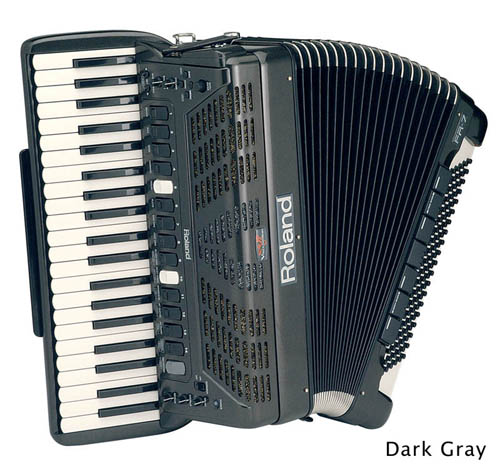
Although, now I come to think of it, I seem to recall him being some kind of musician himself.
Announcing the World's First Complete Digital AccordionRoland is pleased to introduce another milestone in digital musical instrument history – the V-Accordion. Models FR-7 and FR-5 are the first instruments of their type to successfully integrate powerful digital technology such as new Physical Behavior Modeling (PBM) into a traditional accordion design, offering performance features and authentic sounds that appeal to a wide range of musical styles.
People in leather shorts and braces, but with modernistically coloured hairdos, will soon be emitting techno-folk-music.
There have long been electro-pianos capable of reproducing all sounds ever made, able to redo the Ode to Joy in the manner of a chorus of barking dogs or orgasmic actresses or foghorns. Now, this device has gone portable.
Last night I watched American film actor Richard Dreyfuss on the Frank Skinner show, doing the one part above all parts he for which is most completely unsuited and most grievously miscast, himself.
I guess a lot of actors get their start desperately trying, and failing, to play themselves. There they are, aged, I don't what, four? – and they look in a mirror or something one day and say oh god, how am I supposed to do that? They work and work at the role, trying out different versions until the audience likes it.
Many of them get themselves down pat very quickly, and then go on to further triumphs in other roles, doing other people. Almost all of them arrive at a passable version of themselves eventually. But I reckon Dreyfuss has never mastered himself. As soon as he starts in doing himself, you (and by that I mean I) want to curl up in a foetal ball and jam blotting paper in your (my) ears. All those ludicrously over-pronounced syllables, and studied juvenile-isms, which get ever more embarrassing as he gets older.
When he's in movies there are directors around to say, Richard, it's too Dreyfussy, please do it again. Try to act normal. Plus, he does other people in order to find temporary escape from being himself. That's how it looks to me. (Dreyfussy. New word to describe a particular sort of bad acting.)
There are other actors like this, I think. In the past, when faced with such people, I just switched off. Now, I can talk back, by blogging.
Snap. (My point being: snap. But his is better, I think. Better focus. And his camera's way bigger than my camera. With lenses, I am learning, size matters.)

For lots more of his snaps start here. And here looks like an especially good place to go a-browsing.
This made cackle louder than anything else today so far.

It adorns (don't know why and very typographically confusingly on my screen) this Mark Steyn Spectator piece trashing poor old John Nuancy Boy Kerry.
Ah, I've just spotted the Canadian flag. That must be the Steyn connection. So, Canadian subs are not very good, I suppose. I missed that. Kind of took it for granted.
The Social Affairs Unit blog is everything that Brian's Culture Blog is not, culture-wise. They have a theatre and opera critic, who goes to the theatre and to the opera. They have a guy who reads novels, a guy who goes to art galleries, a guy who goes to classical music concerts. No need for links, just go there and scroll down. It's all there. Seriously, if you are angry with me for not being cultural enough and just bombarding you with my stupid photos and my stupid opinions about old classical CDs that have been around for decades, and non-classical movies ditto, that's the place to go.
The latest posting there is by Tyler Cowen and it is really interesting, I think. It's about the lawsuits that Big Music is launching against lots of quite big downloaders. I tried picking out paragraphs that were better than the other paragraphs, but the truth is they're all good, and I recommend you read the lot.
I have already posted on this subject here, here being at the CNE Intellectual Property blog, which I actually get paid to do a weekly piece for. As Monica in Friends would say: I know!
The line that CNE takes on Intellectual Property is that it is Very Good. But the line I tend to take at that blog is that given the state of technology these days, there's at least a decent chance that a different approach to people stealing ideas will emerge, based on the fact that when they do, that might be good. I mean, take today. This guy stole something of mine, from in among this). Just copied it and stuck it up at his blog. The nerve of him. "Quote of the day" or some such palaver. But he didn't fool me. He nicked it. He couldn't be bothered to write his own posting, so he swiped a bit of mine instead. But am I bitter? Moi? No of course I'm not bitter. Why would I be? This is the age of the Internet, and when this kind of thing happens, the stealee gains as well as the stealer, to the point where we don't think of it as stealing at all.
Now you may say, he did a link to my original, and he cited me as the one who originally wrote it, and he even spelt my surname right, which doesn't happen always I can tell you. What if he hadn't done this, and had really stolen it, to the point where he had tried to pass it off as his own? My point is, even if he had tried that, and I had eventually heard about it only by some very roundabout means, I could have pointed to my original post and said, pretty convincingly I believe, that I thought of it first and aren't I wonderful? Or, other people could have done this for me, thus boosting by global grandeur without me even knowing. In the Internet age, the people who first think of something tend to get the credit and the reputation, provided only that they tell the Internet as soon as they think of it. This didn't use to be, but now it is. When you consider how many people there are in the world, and how well connected they are all getting, that has to mean income-income to those with the reputational grandeur as well as just psychic income.
Besides which, don't knock psychic income. If you have lots of that it's amazing what you can get by on, income-income-wise. And, people will swap a lot of their income-income for psychic income. Or happiness, as it used to be called.
Anyway, I'm going to bed now. Tomorrow, more digital photography!
I've stuck up more photos of some of my new Billion Monkey friends, at my Education Blog.
The first picture is probably the best, but, my photographic proclivities being what they are, I also like the one that contains this:

Click to get it even bigger. Follow the link and scroll down to see what the guy looks like.
I have just done a review for Samizdata of a book by Peter Padfield about the history of Maritime Supremacy. What makes this book interesting is that it contains both blow by blow accounts of sea battles and a succession of o sketches of what these battles meant for the lives of those on land. Britain, of course, had its time of maritime supremacy, and its own highly distinctive sort of liberal, capitalist culture. Here is Padfield's account of the beginnings of the English novel. I do not personally enjoy reading the great works of fiction of the past, my fictional tastes being contemporary, and middlebrow if that. But I know that I am missing a great deal, and I do at least like to know about these works, and about the people who wrote them. So bluffers guide paragraphs like these are something that I especially appreciate.
The novel was an important vehicle. Its development had been foreshadowed even before William's revolution by the poet and popular playwright Aphra Behn, the first woman in England to earn her living by the pen. Her Oroonoko, or the History of the Royal Slave (1688) told the story of a Negro of noble descent whom she had known while living in Suriname (now Dutch Guiana). Besides lighting the way for the future novel, Oroonoko, which was adapted for the theatre and played successfully for many years, was an important influence for change in the generally uncomprehending attitudes towards Negroes and the institution of European slavery.
Daniel Defoe took the imaginative embellishment of real persons and events a stage further in The Life and Surprising Adventures of Robinson Crusoe (1719), often regarded as the first English novel. The son of a prosperous small businessman and religious Dissenter of Cripplegate, London, Defoe was also a living example of how trade had bred a clamorous and articulate middle class. His own attempts to set up as a merchant failed spectacularly, ending in the Fleet prison for bankrupts, and obliging him, like Aphra Behn, to earn his living from writing. Nonetheless, he remained a prolific publicist for trade, which he called his 'beloved subject'. He had previously taken part in the rebellion against James in the cause of both trade and religious dissent, and had written a verse eulogy of William of Orange as The True-Born Englishman – an illustration of the depth of the historical tide William had ridden, which must surely have brought about revolutionary change very soon with or without the 'Protestant wind' down-Channel.
Defoe's most famous protagonist, Crusoe, had made two slaving voyages to Africa before setting himself up as a planter in Brazil; there he told his Portuguese neighbours how easy it was on the coast of Guinea to buy Negroes 'for trifles – such as beads, toys, knives, scissors, hatchets, bits of glass and the like', as a result of which they persuaded him to guide an expedition to Africa and bring back slaves for them. On the way, he was shipwrecked and cast ashore on a deserted island; perhaps Defoe intended a moral. Basing Crusoe's subsequent experiences loosely on those of a real castaway, Alexander Selkirk, Defoe entered his mind so powerfully and portrayed his lonely struggle in such straightforward prose the book entered popular mythology and enjoyed immediate and lasting success at home and in continental Europe. Encouraged, he wrote a second novel, taking his readers into the mind of a girl, Moll Flanders, coping with even less promising circumstances in a debtors jail.
The next original genius of the English novel, Samuel Richardson, also came from the middle classes. He was a printer who had married well and established one of the best presses in London. In Pamela, or Virtue Rewarded (1740), he used the device of letters written by his characters to tell the story of a maid resisting extreme attempts at seduction from her former employer's son, until eventually the young man marries her; whereupon she embarks on a second, equally successful, struggle to disarm those who disapprove of the misalliance. This very moral and sentimental story and the novel method of its telling won extraordinary acclamation, and Richardson followed it in similar epistolary style with Clarissa: or the History of a Young Lady. Here the heroine's family attempts to force her into marriage for money; in her refusal and subsequent adventures, Clarissa exhibits more sublime moral virtues even than Pamela.
Meanwhile Richardson had provoked Henry Fielding, most accomplished and witty of the pioneers of the novel, into the genre. Fielding came from the gentry, but while studying at Leiden University his allowance had been stopped and like Defoe he had turned to his pen to earn a living, principally as a satirical playwright. In 1737 he lampooned Walpole so savagely that the Prime Minister retaliated by steering through an Act of Parliament requiring all new plays to be licensed by the Lord Chamberlain before being produced. It was a small dent in British liberties – plays could still be printed and published – but put an end to Fielding's career in the theatre. He studied law to become a barrister. When Richardson published Pamela, however, Fielding was evidently so struck by what he regarded as its sentimentality and prim morality – although, like Robinson Crusoe, the novel was based on a true story - he produced two parodies of the type. The second, Joseph Andrews, in which the protagonist, a footman, resists all attempts of a well-born lady to seduce him, was a masterpiece of observation and irony which took on its own life; together with two later novels by Fielding, Tom Jones (1749) and Amelia (1751), it established a pattern in plotting, characterization and authentic contemporary setting that was to dominate English fiction thereafter, and indeed spread across continental Europe.
These trailblazing books were written by middle-class or professional men, and won a huge middle-class readership which identified with the realistic characters and social settings depicted. The prominence accorded women is striking. Apart from Robinson Crusoe, the extraordinarily popular novels mentioned all had strong, admirable women as the central character or in a major role: a beautiful, high-mettled girl, Sophia Western, inspired Tom Jones's odyssey; like Amelia in Fielding's subsequent book, she was based upon the novelist's own beloved wife. This was an accurate reflection of the strong position women enjoyed in society, despite their unequal legal status, and another echo of the United Provinces of the previous century, where, as noted, women of all classes moved and expressed themselves freely as individuals, enjoying a far greater measure of independence than anywhere else in Europe at that time.
The novels, plays and journals were products of a free, trading society – their success or failure depending upon volume of sales – and also agents of change, undermining, often none too subtly, aristocratic or dogmatic assumptions, replacing them with more bourgeois attitudes. In the same way other branches of art were metamorphosed into new, more popular and subversive forms as they emerged from patronage into the market place.
You know how some pieces of classical music sound wonderful when played on the right instruments and nothing like so impressive on other ones. Think especially of the Bach Double Violin Concerto (deranged for harpsichord and orchestra) or the Beethoven Violin Concerto (ditto piano and orchestra). Played on the right instruments, this music is wonderful, but with the wrong instruments it is extraordinarily diminished. Fun to listen to but … put it this way, "fun" says it all.
 But now, I have discovered another such contrast, and this time in a good way. I have just been listening to some truly excellent CDs by Ronald Brautigam of Mozart piano sonatas played, not on a modern piano, but on a fortepiano, which is what they had just before they had finalised the modern piano, or pianoforte.
I have heard Mozart piano concertos played the usual way, with a modern piano and orchestra, and the "authentic" way with a fortepiano and orchestra, and in my opinion the comparison entirely favours the modern piano. Played on a fortepiano, for example on the CDs done by Melvyn Tan or Malcolm Bilson, these pieces sound small and constricted, strictly eighteenth century, and in a bad way. Played on a modern grand piano, by a modern grand piano virtuoso, they take wing magnificently. Indeed, one of the very first pieces of classical music that ever grabbed me by the throat was the Mozart D minor Concerto, K466, played for me first by Ashkenazy, later by Katchen and Barenboim.
But, unlike the Beethoven piano sonatas, which are every bit as magnificent as the Beethoven piano concertos, the Mozart piano sonatas have always seemed to me to be a bit of a let down. They have several pretty tunes. But that's all they were, pretty. Like those Mozart piano concertos played on a fortepiano, they seemed small, even insignificant. I've got wonderful CDs of these pieces, by the likes of Alfred Brendel and Mitsuko Ushida, and (above all) Sviatoslav Richter, but even when Richter plays them, you feel that it is the player who is magnificent, rather than what he is playing. It's great playing, but not of great music.
But with Brautigam, and his wonderfully strong sounding fortepiano, all that sense of disappointment vanishes. This music sounds truly great.
When a fortepiano plays along with an orchestra, what you hear is a keyboard instrument that isn't strong enough compared to the orchestra, and the music is diminished. But when the fortepiano plays on its own, especially the way Brautigam plays it, and recorded the way Brautigam is recorded, and with music by Woflgang Amadeus Mozart for precisely this instrument, with lots of reverberation, it sounds positively orchestral. It sounds bigger than a piano. It's a piano and a harpsichord, the best of both worlds instead of the worst. And the Mozart sonatas, which sound small and female (in a bad way) on the piano, sound grand and orchestral. Or something. In truth I am not sure why exactly this music sounds so magnificent, but magnificent is how it does indeed sound, on these CDs.
I got them because somebody died, and Gramex, the second hand CD cathedral in Lower Marsh, got the lot. There was a feeding frenzy about two weeks ago, which I completely missed, and which is presumably when volumes 1, 2 and 6 got snapped up. But I still got volumes 3, 4 and 5, for £4 each. Cheap at twice the price, although at twice the price I would have said no. More fool me.
It isn't every day you discover a whole new collection of unreservedly great pieces by … Mozart. But today, I did.
Finally, today, I found – and am able to show you – a picture of the one, the only, the magnificent Vicky Pollard …
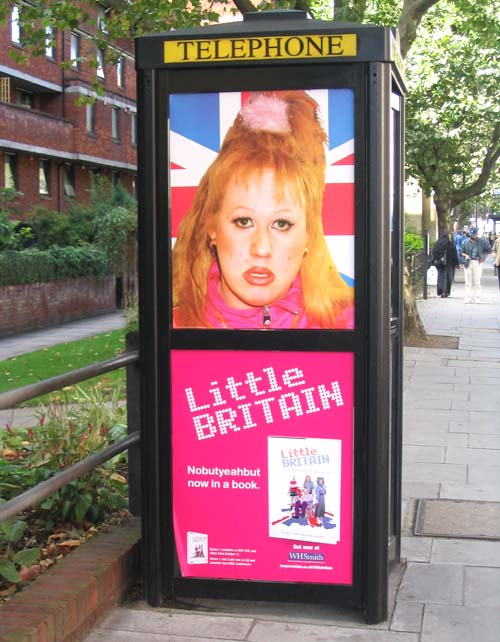
… which does her justice, and puts her in her deserved place in British society, on a phone box.
Vicky is already working her magic on British Pop Culture. One of my favourite TV shows just now – actually it just finished this evening – is called Doc Martin. It's about a grumpy doctor in a Cornwall village played by Martin Clunes. And, Doc Martin has an amazingly strange and insubordinate secretary, played by the excellent Lucy Punch. Now it may all be coincidence, but as far as I'm concerned Lucy Punch in Doc Martin was a thinner, better looking Vicky Pollard, with twiddlier hair.
A lot yesterday. Today, just a quota photo.

It's a car, a Bentley.
I am learning that the things that the human eye hardly registers, to the camera can be fascinating.
And vice versa. Yesterday London enjoyed bright sunshine, followed by rain, in other words, a rainbow! To look at, it was spectacular. I took photos. Boring. We don't need a camera to make us notice a rainbow. So, the camera adds nothing.
Reflections in cars, on the other hand, we are programmed not to notice. We only notice the cars. The camera sees it all.
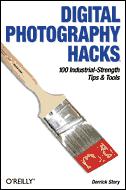 This posting is to remind me to get hold of a copy of this book.
Amazon review:
Your digital camera is more than new incarnation of your old film camera. Yes, it still produces photos, but it also offers new outlets for creativity, including instant gratification of seeing your photos now, the ability to experiment without worrying about expense, the technology to fine-tune your photos with advanced professional techniques, and the means to share your work instantaneously with anyone, anyplace in the world. It's no wonder that digital cameras are outselling traditional cameras for the first time ever. But the question most digital camera users ask is this, "How do I get from taking 'decent' photos to doing the things I'd really like to do? How do I tap into that potential?"Digital Photography Hacks is your passport to taking the kind of digital photos you've always aspired to. Written by Derrick Story, photographer and author of Digital Photography Pocket Guide and other books, it goes beyond the standard fare of most digital photography books – such as camera basics, understanding memory cards, and when to use a flash – to the things that professional photographers have learned through thousands of shots' worth of experience, years of experimentation, and fiddling and hacking. The book includes a foreword by photographer Rick Smolan, author of America 24/7.
With exquisite, full-color photos throughout, the book presents a collection of tips, tricks, and techniques for photographers ready to move beyond the basics. And if you don't have the latest in digital camera photography, this book will show you how to extend the life and functionality of your existing camera. All the hacks in the book are platform-agnostic, designed for use on both Mac on Windows-based computers. You'll find 100 proven techniques in the areas of: Daytime and nighttime photo secrets Flash magic Digital camera attachments The computer connection Photoshop magic Fun photo projects Camera phone tricks This book is for the photographer you are now, and the one you want to be. Digital Photography Hacks is for the creative adventurer who resides in each of us.
My kind of book.
I took another trip up to the top of Peter Jones, in different and sunnier light, but I'm afraid that the nice part of the view that I already photoed was silhouetted, again, i.e. no change except that the sky was duller, and only the drearier part of the view was differently and better lit.
But I did take this remarkable photo of Venice:
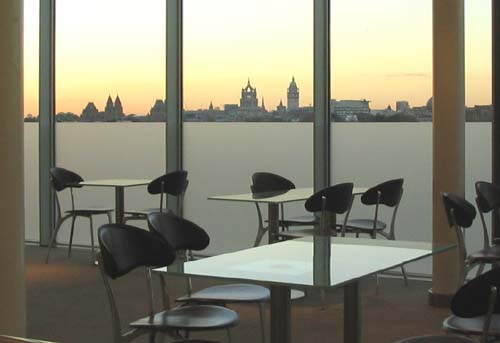
Click on it to get the bigger and real picture. Ha.
Also, you can have a lot of fun pointing cameras upwards. This is the Peter Jones stairwell:

See also this photo. And while you're there, scroll down to this amusing image, also snapped by Adam Tinworth in Budapest.
I know, I know, far too many photos. But this is my blog and I'll stick up far too many photos if I want to. Anyway, a lot of them are pretty good, though I say it myself.
They were all taken last Wednesday, at my Digital Camera class. A dozen or more Billion Monkeys, me among them, have been assembling themselves at one of the Westminster Council Adult Education Centres, the one at the top end of Warwick Way (a mere walk from my home), there to be told, every Wednesday for five weeks, about digital photography, by a German guy called André who teaches at one of the London Universities, in the department of photography (which is reassuring). André is the one in the glasses and the red top. He reminds me vaguely of a slightly nerdier version of Alan Rickman, but he is in all other respects very nice. His assistant, the one with the pony tail, is called Giovanni.
One of my most hobbiastic hobbies these days, as regulars here will be wearily aware of, is taking digital photographs of digital photographers. Well, at this class, last Wednesday, we were all being told to take digital photos of each other. Imagine how that felt for me. No wonder I took thousands of snaps and was only, and with extreme difficulty, able to narrow them down to a mere 72 for here. Plus, I am actually learning things, about apertures and exposure times, and such like. (The night time portrait mode on digital cameras deserves a whole posting all to itself. That was fascinating.)


Some trivial observations:
First, quite a few of these pictures have bits in focus and bits not. This is because the main business of the day was learning about focussing, and learning about focussing by taking photos where bits were in focus and bits were not. So a lot of that was deliberate. Besides which, a bit blurring can be fun.
Second (these points are in no particular order – I'm just clearing the decks of trivia before getting stuck into the main point I want to make here), there are bottles present. Several of these pictures, and one in particular, illustrate one of the most basic laws of digital photography. This is: that digital cameras are, for who knows what reason, fascinated by water bottles and always present them to the world in perfect, pin sharp focus and any people in the vicinity as only a vague blur by comparison, unless severely discouraged. The bottles here are plastic water bottles, but digital cameras get equally excited about wine bottles, especially those in the middle of the table at dinner parties.
Third, one or two of the pictures show various of us pupils doing something I have never before observed. They are reading the manual. To me this is extraordinary. Maybe there is a lesson there for me.
Fourth, I am aware that these photos look like a prolonged commercial for the Canon EOS 300D. This is because André brought about six of these with him for us to use if we didn't have our own cameras. He says, yes, these are pretty good cameras. And I must say I am envious. (I fear that something similar will also happen when we start playing with the cute Macintosh computers that you can also see in some of the pictures.)
There were other digital cameras to be seen, as some of the pictures illustrate, but the Canon EOS 300D dominates.
What appeals to me about the Canon EOS 300D is that it is what is called an SLR. SLR stands for … well, I don't know what it stands for literally. Single Lens something? I don't know. But what this means is that it is a WYSIWYG camera, and I do know what WYSIWYG stands for. It stands for What You See Is What You Get. What you see through the little spy hole at the top is exactly what you get on your photo, because both you and the sensitive surface where the picture is made inside the camera are both receiving exactly the same picture, which is not the way it works with my little Canon A70. There the camera gets one thing, and you look through the bit at the top in the same general direction, but it's guesswork how your actual picture will turn out. And before you ask, the little screen thingy on my A70 is good for telling me the general composition, but hopeless at telling me about focussing, or about whether the light is too bright And because you can twiddle the lenses on the front manually on the EOS 300D rather than just fiddle about with computer type settings, this means you can immediately start to control things far better. I am sorely tempted, I don't mind telling you.
The bad news is that this EOS 300D is a bulky piece of kit, and I wouldn't be able to use it to take those little impulse photos with it that we bloggers so like to capture, of posters, adverts, and surprise events and excitements generally, because it would be too big to take around always, just in case. Maybe I'll take a deep breath and get a EOS 300D, and use it for special occasions when I deliberately go out looking for pictures, and keep the A70 in my jacket for opportunistic shots. Extravagant. But at least they both use the same kind of storage: Compact Flash cards.


But enough technical trivia. The real story here is how amazingly good looking so many of my fellow students are. I was expecting at least one man with a huge paunch and with a face that made him look like some ghastly failed genetic experiment. But at our worst, the men among us are non-repulsive, and at least half a dozen of those present (equally distributed across the genders) look like film actors of the sort that make me say: of course, film actors are always good looking, but real people seldom look as nice as that. Maybe, being so very, very happy, I was seeing everyone as beautiful even when they weren't. Or, maybe, having mixed for most of my life up until now with fringe political people, I expect everyone to look grotesque, and am dazzled if they merely look half-reasonable. But I don't think I was just seeing this. I think it was actually there. What do you reckon?
I wonder if photography attracts a higher proportion than average of good looking people, or whether I just got lucky with my particular Billion Monkey troupe. My tentative theory is that Billion Monkey Ladies are good looking because they and their friends like to take each others' photos, and those who are uncomfortable with this stay away from digital photo-ing. As a general tendency. As to Billion Monkey Men, well, we just creep about on our own, with no friends, seeing everything but never getting involved, and we are Invisible. Ugly, okay, beautiful, it doesn't matter. It's beside the point. But if that's so, how come so many of the men in these pictures are so very good looking?
Another explanation is that there is something special about digital photography just now, and good looking people, good looking young women especially, are instinctively attracted to milieus where something of significance is going on. I wish. But I actually don't think that's it.


I was going to put all the thumbnails together in one great rectangle, but eventually I decided on having the three separate clutches. One day, I will do thumbnail collection in such a way that they come together to make another picture. Each little bit of a picture being chosen not to entice you to the big one behind it, but in order to help make the big picture that the thumbnails combine to make. This kind of thing has been done a million times before in other contexts, and no doubt dozens of times on the Internet, but never by me, and I'd like to have a go at that. Not that I've seen anyone else doing this. Any links, anyone?
Incoming email from Alan Little:
You might find this interesting, from Tyler Cowen et al's excellent libertarian economics blog Marginal Revolution: The DVD format is taking over the classical music world, especially opera.I don't think music DVDs will be all that relevant for me. Even if they're as cheap as CDs and have at-least-as-good sound quality (I know audio-only DVD is supposed to be great, albeit a stillborn format; I haven't really seriously listened to how good movie DVD soundtracks are), they're still not relevant to my music-listening life. I mostly listen to music while doing other things, whereas a DVD expects you to sit down and give it your undivided attention. With a toddler in the house my attention is almost never undivided. I would consider buying DVDs if they were cheap and there was an easy way to get the audio off of them into a usable format (CD or mp3) – I do know how to do this but it's laborious and I really don't think I could be bothered on a regular basis.
The point passed on (from Klaus Heyman of Naxos) by the Marginal Revolutionary Tyler Cowen about DVDs of opera is that opera on DVD is now starting to sell massively better than opera on CD, i.e. opera with only the sound. Thus, although DVD-ing an opera is presumably at least as bothersome as merely recording it, and copying the DVD is no easier, DVDs of opera, because many more are willing to buy them if the price is right, are now roaring down the supply/demand curve, and are thus finding their profitable price to be way below that of opera on CD.
Which is obvious, because opera is a dramatic thing as well as an audio thing. I am so obsessed with classical music that I have lots of CDs of operas, because I love the sound they make. But trawling through the libretto to find out what the hell they are singing about (seldom in English of course) is very irksome, and you miss lots of excitement by not being able to see, e.g. Wagner giants or Queens of the Night or Czars of Russia or Kings of Egypt, plus all their assembled minions. Obviously. So, although I can just about be doing with opera on CD (I bought the new René Jacobs Marriage of Figaro only yesterday), opera on DVD has already been a godsend to me.
I also have a few operas on VHS, but they are terrible. They look terrible, and above all, NO SUBTITLES. DVDs, in addition to be far nicer to look at, DO HAVE SUBTITLES. This is crucial for me.
I like DVD operas even when the production is weird, as they tend to be for Ring Cycle operas, for example, with dams and goldfish bowls instead of the Rhine, 1920s society hostesses instead of Norse Goddesses, and (my favourite Wagnabsurdity so far) scruffy librarians waving enormously long spears in the Boulez/Bayreuth Gotterdammerung. (Is the idea is that they are losing their grip, having inherited power that they no longer know how to use? Maybe that's it.)
(Wagnabsurdity. Did I just think of that word? I mean, I did, but who else has?)
However, what Alan Little says about undivided attention is also very, very true. When I sit down to watch a DVD, any DVD, I have to look at it and listen to it, and I have to look and listen continuously or I lose the plot, literally. This also is very irksome, and DVDs don't answer this problem. They are this problem, as Alan says.
Now I agree that Beethoven's Fifth Symphony packs a hell of a lot more punch if you concentrate on that all the way though also, but the fact is that if you do a blog posting or some work-work or something during the second movement and completely ignore it banging away in the background, but then tune in again to the last movement, you can still get a lot out of that experience. Music, to refer back to this quote (which I notice Alan also liked and quoted) music happens now, and if all you do is tune into it now, having ignored all that went before, you get a great deal of what it is saying. Tuning into an opera now, in the middle of an act, means you miss the point.
To put it another way, DVDs of opera have the potential to break out of the ghetto of being listened to only by people who already love this music, like me. Opera can be, as it used to be before the gramophone was invented, in the vanguard of classical musical publicity, instead of staggering along at the rear the way it has for the last fifty years or so. (Opera arias are a complete other matter!)
I need two things before I go mad with operatic DVDs.
First (originally I put this second – but actually it is first), I need for the DVD opera sellers to stop trying to gouge twenty five quid per opera out of me, and to settle for a tenner. After all, that's all that they now charge me for Lawrence of Arabia, which was a hell of a lot more of a bother to make even than an opera DVD. It may not seem fair to them but sorry, twenty five quid is more than I can get into the habit of spending. (Economics – I am becoming more and more convinced – is all about the cost of habits rather than just of individual items.)
And second, when that negotiation between supply and demand has finally been settled in my favour, for lots of DVD operas if not all of them, I will then be wanting a good fat book called Opera on DVD, which surely must exist, but which I never seem to come across in bookshops, even in the shelves groaning with guides to classical CDs. The Internet is great at giving me the best price on an opera DVD that I have already decided I want, but I need to decide what I want in the first place. Anyone know of a book like that? Or a website? The point is not prices, in the sense of £11.99 instead of £14.99. Once I know what I want, I can keep an eye open for it, and buy it when I see it cheap enough. Or, I can finally get into the buying-stuff-from-the-Internet habit, which so far I have not done because I like to combine shopping with taking some exercise. What I want is comparative reviews, of things like, say, all the four regularly available DVDs out there of Turandot (plus of the new DVD of Turandot which has just come out), which are descriptively helpful as well as (which is fair enough) opinionated, so that even if he hates it I will be able to tell that I might like it, or vice versa, so that I know what I am looking for.
I'd even consider regularly buying a monthly magazine entirely devoted to opera on DVD, with opera on CD only mentioned in a sneering little page near the end laced with yet more DVD propaganda.
Caution one. Forget about video. It has to be DVDs. (See above.)
Caution two. I don't want an "Internet Site" where I can spend thousands of happy hours chatting about why the Levine New York Met Ring is better/worse than the Boulez Bayreuth Ring, and why the latest one from Germany is barking bonkers etc. etc.. I do not have these hours. More fundamentally, such hours would not be happy. I am not that fond of my fellow classical music enthusiasts. Mad, sad bastards the lot of them, as good as, as far as I'm concerned, and I bet that's just how most of them feel about me. If all that Alan Little and I had in common was a liking for classical music then – no offence (as people say when they are about to be offensive) – I wouldn't be interested. Happily he is also a blogger, and a general discusser of all manner of other things that also interest me. An entirely different proposition.
Even if both of those conditions are fulfilled I probably won't go mad. I like opera, every now and again. Real opera lovers love it. Obviously. (As this person would say. Good that she's found her blog voice again.)
This is great:
THE City of Melbourne will today rename a back lane in the city centre after legendary Australian rock band AC/DC.Guitarist Angus Young, a founding member of the band, had a special message for fans and users of the lane: "Welcome to the Highway to Hell".
City of Melbourne councillors on Wednesday agreed to change the name of Corporation Lane, which runs off Flinders Lane near Swanston St in central Melbourne, to ACDC Lane after considering the proposal since June this year.
Council workers will today erect new street signs proclaiming the name change.
The band resided in Melbourne during the 1970s and filmed a video for its 1975 classic It's a Long Way to the Top on the back of a truck rolling down Swanston St.
Two members of the band were also born in Melbourne.
In a brief recorded statement, Angus Young and brother Malcolm thanked the City of Melbourne and fans for the honour.
I love it, although I think I would have preferred it if they'd kept the forward slash. Now that rock and roll is so respectable, there must be lots of other such roads, including some equally bizarre ones.
Next, road names taken from vicious gangsta' rap ditties. You-can-be-my-bitch Avenue, etc.
Peter Jones is a big (by London standards) department store in Sloane Square. Yesterday afternoon I went there with my friend Elena (who I hope may one day become a blogger – she'd be an excellent one, I think). We like to meet for coffee from time to time, and I wanted to see the view from the café at the top of Peter Jones. Peter Jones has recently been closed for refurbishment, but I was seeing the inside of the place for the first time. The view did not disappoint.



Click to see these photos bigger. The first three are mine, but since mine of Elena is a little unflattering, I have added one taken a while ago of Elena by my friend Bruce The Real Photographer, which Elena uses for all her various attempts to become an Award Winning Actress. His is by far the best photo, I think you will agree.
The interior of Peter Jones is also very fine, but I took no photos of that yesterday. I definitely intend to go back there soon on my own and go Billion Monkey mad, both inside and looking outwards.
Does anyone know what all the various pointed towers are? The ones with the horizontal bits at the top are, I think, the Science Museum. Certainly, they are in that part of London. And could the one that looks like a crown, featured in the thumbnail photo above, perhaps be the Victorian and Albert Museum? Yes.
By the way, does anyone know of other high-up places with good views out over London from which members of the public such as I can take photos? Elena says that the Oxo Tower, just downstream from the National Theatre, is another such good vantage point. Anyone know of any more? Anyone work in a skyscraper and like to invite me to lunch? Just asking.
This is a definite laugh, in the form of a map of Florida showing how Hurricanes Ivan, Frances and Charlie between them attacked all the bits of Florida that voted Bush in 2000 and carefully avoided all the bits that voted Gore. I don't know if this ever got as far as the Mainstream Media in the USA. If they did I'm guessing some pompous Republican accused it (the Mainstream Media) of blasphemy and political bias, and pointed out that God is obviously a pompous Republican too. So hurrah for the Internet that we can still get to chuckle over this. Like the previous posting, this is a fine example of what the democratisation of computer graphics plus the Internet has made possible. And unlike the thing in the previous posting, no one is claiming that this is art. It's too good a joke to need that kind of justification.
I got to this via here and to there via here.
My computer refuses to look for more than a few tiny moments at this map in its full size version. It makes it fit the screen, and I can't make it stop that. The problem is that if the map is not full size, the lettering is gobbledegook. Anyone know what I should do about that? I had to save the map and look at it in Photoshop, because when Photoshop is told to keep if full size it does, and I then scrolled.


