

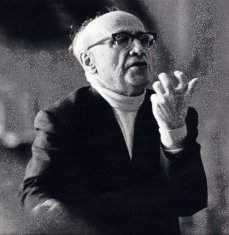
 I have long admired the Bach Cantata recordings made by Fritz Werner for Erato in and around the 1960s. His performance of Number 30 – "Freue dich, erlöste Schar" – is my all-time favourite recording of any Bach Cantata, by anyone.
So when Erato recently issued a couple of ten CD sets of all the Bach Cantata recordings that Werner made, for the bargain price of less than £3 per CD, I eagerly snapped up the first ten, and having got stuck into these I intend also to buy the other ten. They are wonderful.
Bach interpretation since the war can be divided into three phases, which have overlapped in time and are inevitably somewhat blurred at the edges.
Phase One. Solemn, deeply meaningful, but too slow. Extreme case: the Karajan DGG Brandenburgs. See also Klemperer. Bach as Bruckner. Fifties to seventies, when this style was shut down by the record companies.
Phase Two. German church cantors who specialised in Bach. Karl Richter, Helmut Rilling, Fritz Werner. Faster, but still grand. At its best: radiant. I like all of these performances. Rilling is still going, as if Phase Three (see below) had never happened. But best of all of these is Fritz Werner. I am a devout atheist, but I cannot help noticing that these men were/are all Christians. Timing: late fifties to seventies and in some cases (Rilling) seventies onwards.
Phase Three. The "authentics". Eighties and nineties onwards. I cannot be objective about this style, because basically I hate it. At its worst: totally un-transcendent, landing like a ton of bricks on the first beat of every bar, recorded by fussy little men with names like Trevor and Ton (although the absolute worst one of all is called "Reinhardt" – see the Samizdata link above), who look (and – more to the point – radiant the spiritual atmosphere of) spare parts managers rather than conductors. God knows what these people actually believe they are saying with this music. (I told you I couldn't be objective.)
Perhaps I ought to add a Phase Four. This is: the Bach Collegium of Japan directed by Masaaki Suzuki.
These are wonderful performances, done by honest-to-God Christians, which somehow make the best of the authentic style (which I do admit has a best – clarity, sparkle, even Phase Two type radiance, which Phase Two itself can often lack – Suzuki was actually taught by Ton, see above).
But unfortunately, whereas the Werners and the now deeply unfashionable Rillings can be got very cheaply, for around a fiver or less, these Suzuki performances (on BIS) are ultra-fashionable, are sold at full price, and have yet to appear on the second hand market or in the bargain boxes at the big new-CD stores like the HMVs of Oxford Street. £17 for three cantatas is too strong for me. I have a few of the early issues of this wonderful series, got second hand before it became widely realised just how wonderful it was, but after about number 10 cheaper copies just haven't been obtainable.
I can find no reference on the Internet to the newly packaged bargain boxes of the Werner recordings, even though these are already available brand new in some of the big London stores, like HMV. The Warner Records Internet operation is, as of now though presumably this will change, beneath contempt.
All of which began as a the briefest of brief intros to a piece about what Fritz Werner did during the war, which I will now do as a separate posting.


