

One of my favourite radio shows is the BBC Radio 4 evergreen Quote Unquote, and last Monday evening they had a round devoted to performers trashing critics, a favourite theme of quote recyclers. Asking an artist about critics is like asking a lamp-post about dogs, ha, ha. That kind of thing.
I wonder what the film-maker in question would make of this, from the ever droll Mark Steyn, dissing his latest effort, a would-be thriller called Trapped:
Purely by coincidence, the other day I happened to be re-watching Suddenly, Lewis Allen's 1954 thriller with Frank Sinatra, Sterling Hayden, James Gleason, Nancy Gates, etc. Frank hadn't quite fully emerged from his pre-From Here To Eternity slump, which is part of what makes the film such fun: instead of palling around with Crosby or Kelly and romancing Kim Novak or Rita Hayworth, one of the great icons of the 20th century is pulling his weight in an ensemble piece with reliable Fifties B-movie types. He plays, like Bacon does, a somewhat unstable type leading his accomplices through a plan that's perfect on paper. As in Trapped, his victims quickly get the measure of him and start messing with his head. But Suddenly is far more secure in its sense of itself. Unlike Trapped, the one-word title isn't just a lame generality pulled off the shelf: it refers to the setting - the sleepy small town of Suddenly, California. You get the feeling it would never have occurred to the makers of Trapped to set it in Trapped, Oregon. They don't think that way, and their clumsiness is perhaps the film's saving grace. An efficient thriller about child kidnapping would seem disgustingly manipulative and exploitative, but Trapped is so incompetent those are the least of its worries.
Very droll.
And how about poor old George Clooney's outburst at a televised press conference not long ago when some Euro-journo called his recent rather boring remake of Solaris rather boring.
Memo from Brian's Culture Blog to Hollywood: Don't remake good films. Remake bad films, i.e. films that were not done properly the first time around and about which a teacher might say "Not good enough, do again." "That's a classic, do a remake!" makes no sense. Memo from Hollywood to Brian's Culture Blog: By Jove, Brian's Culture Blog, how very right you are, we'll change our entire remake procedure from now on.
Well of course Hollywood would never say such a thing. If it deigned to say anything at all, it would probably say: Stop pissing on our lamp-posts you Euro-prick. And what I'm here to tell you today is: Hollywood has a point. (Besides the point, I mean, that the original Solaris was all in foreign and had subtitles which means that no one normal will have seen it and that a remake for the benefit of normals makes perfect sense.)
No matter how clever a put-down of a film may be, and no matter how lame the original film may be, there is something disproportionate about the time and effort that goes into the film, and then the time and effort that doesn't go into the put-down. I mean, I haven't even seen that Solaris remake. I haven't even given the thing the time it takes to watch it (although I understand that the time it takes to watch it is considered by many critics who have seen it to be one of its bigger problems), and yet here I am, smugly consuming an entire four and a half irreplaceable minutes of my life by dragging my typing fingers up and down almost half an inch per keystroke to complain about it. What I'm saying is, even as I poke my ounce of fun at George Clooney, I sympathise with him. He went on to say to his press conference tormentor something along the lines of: If you thing my film's so bloody bad you bloody well make a film, instead of just standing there like the jerk you are complaining about mine. Fair point.
Making a film must be like conducting a military operation where you deliberately put yourself in mortal danger in order to entertain the viewers at home better and have to fight the final battle a hundred and sixteen times. The film that Mark Steyn was denouncing apparently climaxes in a scene where the leading characters chase each other around, shooting at one another, in a multiple vehicle pile-up type crash on a motorway. That must have involved an awful lot of effort. They must have spent about a month running about in among tomato-ketchup smeared wreckage to get those few minutes of film. And then along comes Mister Smuggo Mark Steyn and, in one of the three world-syndicated articles he wrote that day, he says: Sorry Kevin Bacon, not as good as Frank Sinatra. Go and stand in the corner. Your film, Bacon, is not sure enough in its sense of itself. You can see how Bacon might want to put some real bullets in his gun and turn it on Steyn and cover him in real tomato ketchup if you get my meaning.
Additional memo from Brian's Culture Blog to Hollywood: After a decent interval consider doing a remake of Trapped. Call it Oh Shit, and set it in Oh Shit, Nevada.
In about 1970 the western world endured a fashion for erecting meaningless lumps of metal and stone, known to their perpetrators as "scupture" and to everybody else as: "What the hell is that bloody thing? Take it away at once."
This fad is now mercifully drawing to a close, and public statuary that is actually of somebody is back in business again.
I took the picture below on a recent trip to Bratislava. Similarly entertaining objects are now appearing in London, where I recently observed what looked like a leprechaun leapfrogging over a bollard just outside Bond Street Tube Station. And, in the posh clothes selling bit of London just south of Picadilly, I spotted not long ago a recently erected statute of Beau Brummel, no less, looking very dapper.
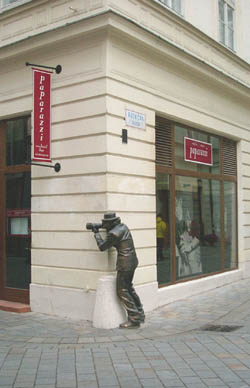
For an anonymous made-up character like the one above, plain bronze is probably sufficient, but why do all outdoor statues have to be drearily monochrome, with the shape right, but the colour merely the colour of bronze, or whatever it is?
I was provoked into asking this here by a fleeting TV glimpse of a statue of the late Leeds United soccer player Billy Bremner which now stands outside the Leeds ground.

From my little TV glimpse I thought that this time some attempt has been made to get the colour looking right. Bremner's upper right thigh certainly looks thigh-coloured rather than merely metal coloured. Sadly, the dark looking face suggests otherwise.
I wonder why more effort is not made to make statues realistic in colour as well as shape. Here, for example, is a recently unveiled statue of four of the England 1966 World Cup winning side, done in the usual solemn and "historic" monochrome. Do things have to be done this way, still?
Beau Brummel in particular would look a lot finer if justice had been done to the real look of the man, and of his famed attire.
Madame Tussaud's does better indoors. Why can't something similar be done outdoors? Is it just too difficult? Or is it assumed that monochromatic bronze is what a statue is just dumb, plain supposed to be made of?
A. C. Douglas calls it a "Superb Essay Apropos Wagner's Art". I agree, although on the basis of far less knowledge of Wagner than Douglas has. The piece in question is by British conservative Roger Scruton, and is entitled Desecrating Wagner. Read all of it, says Douglas. I did, and recommend others to do the same. Douglas also supplied the direct link to the piece, which I wouldn't have been able to get to without such help.
This rang a particular bell:
Wagner tried to create a new musical public, one that would see the point of idealising the human condition. This attempt was already doomed when he first conceived it: kitsch culture was already eclipsing the romantic icon of the artist as priest. Since then, Wagner's enterprise has acquired its own tragic pathos, as modern producers, embarrassed by dramas that make a mockery of their way of life, decide in their turn to make a mockery of the dramas. Of course, even today, musicians and singers, responding as they must to the urgency and sincerity of the music, do their best to produce the sounds that Wagner intended. But the action is invariably caricatured, wrapped in inverted commas, and reduced to the dimensions of a television sitcom. Sarcasm and satire run riot, as in Richard Jones's 1994-6 Covent Garden production of the "Ring", because nobility has become intolerable. The producer strives to distract the audience from Wagner's message and to mock every heroic gesture. As Michael Tanner has argued, in his penetrating defence of the composer, modern productions attempt to "domesticate" Wagner, to bring his dramas down from the exalted sphere in which the music places them, to the world of human trivia, usually in order to make a "political statement" which, being both blatant and banal, succeeds only in cancelling the rich ambiguities of the drama.
As a special treat, a few months ago I bought myself the entire Ring Cycle on DVD, in the only production then available in that format, the 70s Bayreuth one directed by Patrice Chereau and conducted by Pierre Boulez. The singing is, to my un-Wagnerian ear, pretty good, and Boulez, not my favourite musician in all the world, does a fine job of keeping things moving, in both senses. It sounds great, I think. Most of the singing is very fine. Thanks to the magic of subtitles (which makes DVD such a boon for opera) I now know far better what the blazes it is all about. But Chereau's staging is an oddhybrid. You never know if you are going to be faced with something really quite Wagnerian, like the Valkyrie rock, or not very Wagnerian, like the shamelessly mechanical dragon in Siegfried that fills in for a real one, or not Wagnerian at all, like characters dressed as mid-twentieth century librarians instead of Wagnerian baritones. The giants in Rhinegold look just like giants and are excellent, but the Rhine itself is a hydro-electric power station, which can't be what Wagner originally put, surely. Wotan looks like Wotan. But Gunther looks like he works for Sky TV. And so on.
This might explain the fact although at first utterly gripped, I became progressively less involved as the Cycle churned on. It sounds great throughout, but the thing itself progressively eluded me. Rhinegold, despite the industrialised Rhine and despite the fact that this is the one in the tretralogy that contains by far the fewest Wagner best bits (only the wonderful entry of the Gods into Valhalla really qualifies), is splendid. This is, I think, because the action in it is the least "mythical" and accordingly the sort of thing that Chereau is least embarrassed by. Loge (Heinz Zednik) is an especially splendid creation. He looks the way the soul of Sir Humphrey in Yes Minister would look if you ever got a glimpse of it. But as the action of the Cycle gets ever more inescapably "mythical", I found myself more and more put off by the staging oddities. Nor did it help that Siegfried (Manfred Jung) looked like exactly what he was, namely a middle aged man pretending to be twenty years younger.
The trouble with an "authentic" Ring, of the sort someone who agrees with Scruton would presumably attempt, is that it is awfully liable to look even more ridiculous than the dafter bits in the Chereau Ring. Put a contemporary singer in a ye olde Wagner costume, and he or she is liable to look like exactly that and nothing more, making the suspension of disbelief even more impossible. Years ago I caught a few acts on TV of the Metropolitan Opera Ring conducted by James Levine (which is now available on DVD but wasn't when I was picking one for myself), and I now remember quite a lot of it as looking idiotic – with mysteriously singing accountants and district nurses clumping about in am' dram' costumes, and look about as mythical as Xena the Warrior Princess, in fact quite a lot less so. But maybe that was just me, then, resisting the spell of Wagner by deliberately distancing myself from it all.
Our best hope, I think, is that the ever-evolving art of cinema animation may one day give us an embarrassment-free and appropriately mythical Ring Cycle on DVD or its subsequent equivalent which truly presents Wagner's original intentions in their amazing entirety. When I first saw Terminator 2 and was blown away by the still incredible special effects in it, I wrote a review of it which included the words "I wonder if Arnold Schwarzenegger is a Wagner nut."
It's been suggested quite a few times in my hearing that TATU are not really lesbians but are only pretending. Is nothing sacred? Says a commenter here:
TATU are the most retarded act i've ever heard of. they're what is truly wrong with america these days. some stupid no-talent broads (that aren't even that attractive) can pretend they're lesbians and suddenly be played all over MTV. that photo and their video that consists of them making out as the whole concept, prove that they're only trying to make money, and they knew that lesbians sell, especially on MTV which tries as hard as it can to make gays acceptable by showing guys or girls making out all the time. i'm just sad that it keeps working.
Setting aside the matter of this commenter's retarded way with capital letters, and the general absurdity of getting so worked up about pop music, for goodness sakes, this puts me in mind of an idea for a mainstream Hollywood romantic comedy of the boy-bonks-girl, majority-sexual-preference sort. And there can't be enough of those, in my view.
Our story is set in MTV land. One or both of our boy-meets-girl duo is/are pretending to be gay, for the purposes of pop career advancement. The story is how they manage to identify themselves as a potential couple despite all the surrounding gayness. Or something, My earlier version of this story was set in a college, where I understand that some people also pretend to be gay when they aren't in order to achieve political advancement, but I think showbiz is better, if only because politics is hard to do in a way that doesn't alienate half your audience. And if the politics was authentic college politics, it might alienate almost all of them. But showbiz, unlike college politics, is something that the big demographics out there could very happily and identify with. One of the rules of mainstream movie making is that the stars of them must be normal people whom it is possible to admire unconditionally, which rules out campus politicians.
Perhaps there will be comments which tell of this story having already been invented somewhere else. It would certainly be a blot on the homo sapiens copybook if no-one has ever had a similar idea. I mean, it wasn't hard to get to. However, with movies, everything depends on getting the details right, so getting the "plot" right only takes you so far.
Coincidentally, British TV showed the episode of Friends this morning where Phoebe's husband shows up, a person not hitherto known about, and reveals that he is "not gay". He's an ice skater, you see, and he always tried to pass as gay in order to fit in with his friends. "On some level I think I always knew", "Sometimes I would sneak off to bars, get drunk and wake up with a girl beside me", etc. Excellent. And beautifully done, by Lisa Kudrow of coure, and by an actor called Steve Zahn doing the husband.
But I digress. What I really want here to say now is something about the idea of public and collaborative literary effort, done in some place like a blog. The current "business model" for literary activity is based on great secrecy, and great emphasis on who owns which particular bit of the creative product. But suppose that between us, we (i.e. I and my little band of commenters) started swapping movie stories, here and on other blogs, as I imagine they do already in many other internet locations now unknown to me. What's to stop us concocting an entire script, using the economic model of linux programming, i.e. just being satisfied with the credit.? At some point in our creative process, Hollywood swoops in and steals what we've done, and makes its movie, pocketing all the proceeds. Our only reward is that we get to say: "Hey we thought of half of that", probably adding "… and our idea was … and if that had been done, it would have turned out far better!" And we can link back to the original (time specific) discussions where we first thought of it all. And we get our hit rates and our egos boosted.
Not much of a reward, you may say. But we don't now get paid anything to write about movies after they are made? So why would we object to not getting paid for deciding about some of them beforehand? That's a fun hobby, isn't it? Why be greedy? What's the problem? Some folks get paid quite a lot to drive ships. Others pay a lot to drive ships? Both of those things seem to work. So why can't the same principle apply to movie plot development and script-writing?
After all, given how easy it now is to copy movies once they're finished, the actual making of movies may one day quite soon become a largely voluntary and unpaid process.
Good movie ideas have a sort of objective, impersonal rightness, like good car engines or good computer programmes. And objects of this sort lend themselves to collaborative activity. And collaboration between teams of people is a whole lot easier if you aren't bothering about secrecy, and if secrecy means no one gets paid, well, just get lots of people to pitch in. That way no one person has to work too hard.

It's too entertaining to be art. With thanks to b3ta.com.
I've just done a posting for Samizdata which began as a posting for here, about the possible influence of kid's toys on later artistic tastes, Modern Art tastes in particular. But since I ended it by saying comments please, I thought I'd put it there rather than here, and the comments have already begun. If you are not a regular Samizdata reader, please make an exception for this posting, if only to enjoy the comments yourself. Samizdata comments can be very good, in my opinion. It cheers me greatly that the comments both here and at my Education Blog are starting to buzz along very nicely.
At Samizdata there's also a very cool looking picture of a spaceship, which reminds me of my posting here about airplane aesthetics. This creature, especially when it is carrying its baby, looks a whole lot more of a muddle than Concorde or the B2. And while you're there, I also did a couple of postings (here and here) about the aesthetics of the new Rolls Royce Phantom. Not nice was the verdict which I and the Samizdata commenters arrived at, although personally I have yet to set eyes on this vehicle.
Being as I am on the subject of culture on other blogs, I've just been to 2Blowhards to catch up there, and I found that Michael had given this blog a(nother) plug. Thanks Michael. 2Blowhards is the culture blogging mothership as far as I'm concerned, and one of the things that had me paralysed into silence in the only somewhat earlier days of this blog was the silly notion that I had to be as productive and informed and all round brilliant as those guys are. Not possible. I particularly like this piece about New York architecture, which reminds me, I need to write up my piece about the Meaningless Triangle". What's that? It's a Modern Movement Architecture effect, which is stupid, but which happens for big, big (and stupid stupid) reasons. Stay tuned.
In general, I realise that I'm not linking to cultural postings on other blogs as often as I might, and especially to cultural postings on other blogs which are not themselves specialist culture blogs which culturalists may accordingly have missed. But rather than correct that now, I'll finish this up before my deadline, and then see how I feel about doing more. I have a busy day tomorrow and it would make sense to do tomorrow's piece tonight, so to speak.
I'm rushing to finish this, so I've no time to do any thinking now, only the time to jot down something I thought earlier.
Last night I encountered on TV a documentary about film-maker Woody Allen. In it, Allen made a rather startling confession. He's a sports nut, he said, and if of an evening there was a conflict between going to the ball game he had tickets for, or doing that extra shot of the scene that would get it just perfect, instead of merely okay, he'd as likely as not go to the ball game.
Now okay, this was probably Allen trying to sell himself to TV land as an all-round okay guy with his feet on the ground, who definitely does not do weird things to his adopted children. But it might explain something, which is that when I say I like Woody Allen's movies a lot, what I really mean is that I like a lot of the scenes in Woody Allen movies.
There's the scene where Goldie Hawn recommends haute cuisine as the way to improve the atmosphere in prisons, and the scene in the same one where an adolescent boy gets smacked on the head and becomes right wing. There's the scene where he inserts Marshal McLuhan into a cinema queue to help him win an argument with a fellow queue-er. There's the scene where he chats up Diane (Annie Hall) Keaton, with subtitles which say what they're both thinking. There's the scene with the aliens who "like your early funny ones". There are the scenes where the Greek Tragedy chorus in Mighty Aphrodite sings show tunes, and the scene where the same chorus gets answered not by Zeus, but by the answering machine of Zeus. And who could forget the Volkswagen Beetle which starts first time after about three centuries?
Each favourite scene is unique and uniquely memorable. But the movies just merge into each other in memory, and often I can't remember which Woody movie "that great scene where …" was actually in, which can make digging them up and re-enjoying them rather tricky.
What this says to me is that Allen is a hit-or-miss kind of movie-maker. As he himself famously once recommended, he keeps on showing up, in his case showing up with another movie, and another, and another … So every so often he hits the bullseye. But the bullseye seldom takes the form of an entire movie.
Maybe if he wasn't such a sports nut he might have hung around at work and made more movies that were entirely superb, rather than just superb in flashes.
After that Woody documentary, I put John Frankenheimer's The Manchurian Candidate on my DVD machine, and suddenly I was watching the real thing, a movie that is superb and superbly memorable in its entirety. When I first saw it, the nightmare scenes hit me for six, but every time I watch this movie again I'm struck not only by the excellence of the scenes I had already registered as excellent but by new stuff of equal excellence. This time, I found myself noting with particular pleasure the facial close-ups, and the skill with which all the faces are lit and photographed. I don't know the name of the director of photography or the lighting boss, or even if they are two separate people, but whoever he (they) is (are) he is (they are) very, very good at it.
As is so often the case with movies I admire, the political message being put in front of me is one I utterly despise, and the message of The Manchurian Candidate is that both sides fighting the Cold War were as bad as each other, and egging each other on – that Joe McCarthy was as bad a person as Joe Stalin. In MC the two sides are actually conspiring together! Bollocks. If our most serious Cold Warriors had been hand in glove with their psychopath monsters (i.e, them in their damned entirety), how come our guys went to all the bother of actually winning the Cold War instead of merely keeping it going indefinitely?
But to hell with that. Maybe half the people who made this movie spent their lives in well-deserved (because morals trump art in my book) Black Listed obscurity. Maybe they were trying to sell me an ideological piece of nonsense. Maybe, morally and politically (as opposed to artistically), Top Gun is worth ten Manchurian Candidates. And I just don't believe for one second that "brainwashing" could ever be made to work half that terrifyingly well. But again I say, to hell with that. The Manchurian Candidate is a great, great movie.
With a DVD player you can do something you never used to be able to do in a cinema, or even on an old-style video like mine with any great effect. You can freeze on one frame. And if you do this at random during The Manchurian Candidate you always get something beautifully composed and photographed, and just downright memorable. The thing is uninterruptedly superb from start to finish.
Whoever the guys were, aside from Frankenheimer himself, one thing I do know. They were willing to skip ball games to get their scenes absolutely right.
Damn. Did more thinking. Now I'm late.
I'm only now getting around to commenting on this piece in the electric Sun, which Alice Bachini linked to last week. It's about how Saddam Hussein liked paintings of fantasy heroes battling snakes and monsters, and impressing scantily clad blondes.

Alice quotes the Sun approvingly for reporting that "experts" reckon that the pictures Saddam liked show that he knew nothing about art. Says the Sun's Sally Brook:
Experts also reckon they show he knows NOTHING about art.
The basis of Alice's complaint about these pictures is that she didn't like all the people she once knew who did like them. Fair enough. Don't tell my friend Chris Tame, the Director of the Libertarian Alliance. He loves this sort of stuff, as, I would surmise, do quite a few other libertarians.
But what interests me is this notion of "knowing" about art. Who says that in order to enjoy art you have to "know" about it? Liking paintings like this would prove that you "know nothing" about art, only if included in this "knowledge" is the knowledge that art such as this is completely worthless. But how can any such thing be "known"?
As I've said here earlier, somewhere, at some time or another, Tom Wolfe's book The Painted Word is a key Brian's Culture Blog text. This is because this book nails a certain sort of modern art which only has any meaning or value at all because of what those who like it "know" about it. What would otherwise have been regarded as mere items of refuse or of at best trivial decorative value become, because and only because of the theories by which art critics surrounded these objects, "important" objects.
You can see why critics – why "experts" - would love this sort of art, because it puts them right at the centre of the story. No critical "theory", and you have no "art". Just bits of junk.
And at the opposite end of the artistic universe you have paintings like these ones that Saddam Hussein stands accused of liking. Paintings that are "of " something, and what is more, of something exciting and glamorous and stirring to the imagination. These are paintings you can enjoy, if you enjoy this sort of thing, without "knowing" any more about them then you can see by just looking at them.
There is, of course, plenty that one might know about such paintings as these. There might be published stories to know about, of which this painting is an illustration. There might be other paintings to know about, by the artist who painted this one. And so forth. So I'm not saying that art "knowledge" is worthless and pointless. But if you have to know things for a work of "art" to be of any value at all, or to mean anything at all, well, that's something else again. Something else again from art, I would say. If it is art, then it is art of a very silly sort.
Ha, that got your attention. I've just caught a really good line, from that TV show called Curb Your Enthusiasm, which I only heard because I had gone to sleep in front of my TV and then woke up during it. I don't actually like it that much, or I thought I didn't. Maybe I should start liking it. No. I shouldn't. The rest of it is complete rubbish and of no entertainment value whatsoever. It's just an old man being stupid and pointless. The fact that it is a really, really accurate portrayal of an old man being stupid and pointless does not make it any more amusing. This is just my opinion, you understand. To the rest of the universe just now, this show is everything that is wonderful. Don't let me spoil your enjoyment of this abysmal slice of foolishness if you enjoy it.
Anyway the line that was good before everything went back to being bad again was about how a man can have sex with any woman, because women a so beautiful. But women have to be in love with a man before they'll have sex with him, because male genitalia are so appalling. This makes perfect sense to me. I've never really understood why all women aren't lesbians. After all, women are just so much nicer to look at nude than men, and why would women feel any different to the way most men seem to feel? But apparently it doesn't work like that. Do all mothers just force themselves to endure sex with men just to have children? Surely not. So, I'm baffled.
This is another quota fulfiller, so stop now if you think that stupid.
Today I semi-watched one of my favorite silly films on TV, Turner and Hooch. This is the one about a dog that witnesses a murder and has to be chaperoned by Tom Hanks. Hanks is a very tidy policeman, and the dog is a slob who trashes Hanks' house. Hanks is a good actor. Often he plays a slob. Whoever he plays, you believe it.
Later in the evening they played another favourite of mine, The American President, which I have on tape and have watched quite enough already for this decade. In this film Michael Douglas plays a President with Clintonian policies, but without Clintonian domestic morals. He is widowed. He gets himself a sweet girlfield who stays the night, and both his Republican opponent and large tracts of the USA react as if he had got himself a blowjob with an intern in the Oval Office. All the stupid behaviour of Republicans that really happened, plus all the dignity of their man that didn't, in other words. Preposterous. And at the end, President Michael Douglas goes for a huge cut in globe-warming gases and a hugely more repressive anti-gun law, egged on by that little weasel Michael J. Fox, who I thought was a Republican, in public anyway. Dream on guys. The romance is a model of mundane plausibility when set beside the politics of the thing. But Douglas and Annette Bening are both charming and I still enjoy it.
In the later TV version of this movie, The West Wing, done by the same gang of people I strongly suspect (lead by Aaron Sorkin?), the President does Behave Badly, unlike Michael Douglas in The American President. I guess there was too much derision aimed at the movie for their comfort. But this time the President's Bad Behaviour takes the form of covering up, not a sordid sex life, but a Terminal Illness, which is much more profound and dignified. That way, all the same White House manoevrings can be recreated, but in a less depressing cause.
The American President still running, so to remind me of it for this I'm listening to Michael Douglas' big press conference speech at the end, and oh, the Democratic joy of it. He is as morally upright as Clinton wasn't and as verbally fluent and felicitous as Gore wasn't.
"We've got serious problems and we need serious people. ... My name is Andrew Shepherd and I am the President." And now he's got the girl. Aaaaah!!!!
Well, these people are entitled to their dreams. They lost the next Presidential election in a dead heat, and now they are having to live with the nightmare that is George W. Bush jnr. Now he really is serious. And for real.
Another of the perfunctory sort of posting now. It is the Easter weekend, after all.
I'm watching a movie called The Rainmaker, which is based on a John Grisham book, and it's terrific fun. I can't wait to see how it turns out, and in half an hour it'll be finished. It's set in The South. There are lawyers lawyering away, quite a lot of the time in court. One of the them is the lizard faced Jon Voight. Our Hero's slimy dustbin robbing sidekick is Danny de Vito, no less. The plot is enough to make you believe that America needs more lawyers like Our Hero, to do battle with all the bad lawyers. It's a hymn of praise to the Ambulance Chasing profession, and as well put together as any propaganda movie I've ever seen. Punitive damages, of £50,000,000, and as big and bad and just all-round wicked a pack of rich fatcat capitalists as you could hope to meet, only of course these bad guys have skipped town with all the money.
So next time an American criminal sues an American householder for slipping on the American householder's loose tiled roof while he was robbing the place, that's okay, okay? The lawyer was Danny de Vito, and he's Only Doing His Job. Directed by Francis Ford Coppola. How about that?
Okay so how come I don't just video it and watch it later, and give you my considered thoughts on seriously cultural matters? Well, I have this new digital box attachment to my TV, and it's only thanks to that that I'm watching The Rainmaker at all, because it's on BBC 8 or some such thing. But now here's the catch. My video can't handle digital stuff. Why? Ask Jennings. Jennings?!?!?! You just can't get good help these days can you. He's obsessed with cricket I tell you, obsessed. Still, at least he eventually answers the questions.
This changes my culture, which as you are all beginning to learn mostly comes out of electric boxes rather than out of proscenium arches or from concert platforms. My culture has now gone back to being ruled by the clock and the TV listings, and by agonised choices between this and that (given that I can't tape one and watch the other nearly so often as in the old analogue days. Plus the unvideoable digital stuff spoils the very bad reception analogue stuff that I could tape and watch later, which bolts me even more tightly to the original schedule. Combining all that with daily blogging duties is not good. Ah, poor me.
... and I won't get home before midnight, so this is me doing today's post, about I don't yet know what. I have acquired a rich treasure trove of information for my Education Blog (sorry can't manage links because I'm out to supper and don't have blah blah blah) but nothing especially cultural. So, this posting is about nothing at all. Goodnight for now, and I'll get back to you when I have something to say.
Music of the sort that I mostly listen to comes out of a music box rather than out of actual musical instruments played by actual musicians at a concert, or, if you are really grand, by people in your living room or even by your brilliant self in your living room. Treating classical music as musical wallpaper is considered by many classical music lovers to be immoral, but I can't be bothered with that attitude. I do love Great Music, but I also love the sound it makes, so I frequently have it on in the background.
Often whole movements of Great Music will go by without me paying them any attention whatsoever, but about once a month, very approximately, something extraordinary happens. A piece of music leaps out of my music box and compels me to pay attention to it. I stop whatever I'm doing and either switch it off and resume my work, because I can't take the interruption, or else I continue the interruption to whatever I was doing and really pay attention. I never know when this will happen and thus when a decision, listen or don't listen, will have to be made.
The most recent occurrence of this sort was when Alfred Brendel's most recent recording of Beethoven's First Piano Concerto forced itself upon me. (This recording is part of a complete set of all the Beethoven piano concertos.)
This piano concerto is a high spirited piece written by the young Beethoven for him to show off his talents as a pianist. It is full of the joy of life, and I'm sure than one of the reasons it grabbed me was that at the moment when I had thoughtlessly put it on (because of liking the sound that it makes), I myself had just been seriously cheered up (by some nice blog comments, as it happens), so the music matched my mood. And I found everything about the music and the way it was played wholly delightful.
Brendel is nearing retirement and maybe he finds it hard to believe that everyone will stay interested in the music he still plays, perhaps because he himself now knows it so well. Whatever the reason, he now often highlights phrases in a rather schoolmasterish fashion, in a way which I sometimes find tiresome. A recent Mozart piano concerto recording of his with Mackerras is, for me, rather spoilt by this kind of thing. The tempo gets yanked about from bar to bar. Hardly a phrase goes by without Brendel having something fascinating to say about it, so to speak, but all this in music which, if simply played well and in time is a slice of heaven. It's like being fussed over by a waiter in the world's best restaurant.
And he did the same in the Beethoven, egged on by conductor Simon Rattle, who is a similarly didactic sort of musician.
And I loved every single second of it. Every inflection, every nuance, even little dig in the ribs or eager little emphasis or thoughtful slowing up, either from Beethoven or from Brendel or from Rattle, seemed to me to be totally perfect, and perfectly suited to the music.
I never know when this sort of this will happen. The most vivid memory I have of such a musical interruption was when I had Mravinsky and the Leningrad Philharmonic Orchestra's Erato recording of Tchaikovsky's Pathethique Symphony on my headphones. Now you may think that it would be hard to ignore something like that, but my powers of indifference are formidable, and I am capable of actually sleeping with my headphones on and blaring. But not, it so happens, on that occasion. Then, I found myself listening. Soon, tears were streaming pathetically down my face, and I was Tchaikovsky's temporary slave.
The usual attitude towards classical music is that one ought to "make an effort", "put something into it", and so forth. But I treat it the way an eighteenth century aristocrat treated his servants. The burden of grabbing my attention is entirely on the shoulders of the music. If it does not impinge upon me, so much the worse for it.
What the modern electronic music box has done is to reverse the power relationship between classical music and its audience, that was established, I believe, in its modern concert-audience-equals-silent-congregation form by a nineteenth century conductor by the name of Richard Wagner. He it was who established the modern practice of dimming the lights in the opera house. Until then, it was up to the performers to impose themselves upon their audience, like a stand-up comic now.
Now, the gramophone and its successors has turned all that upside down yet again. Yes yes, thank you Mr Mozart! That will be all. Too many notes. So click, off with it. I am the master now.
Except that sometimes the music rises up from its Dead White grave and demands my attention.
I find these experiences deeply satisfying. I don't like the idea of paying attention to great art out of mere duty. How would I ever truly know that I liked it?
On Tuesday night I watched the DVD of the recent movie adaptation of The Importance of Being Earnest. I enjoyed it very much, and I feel I now understand this play far better.
Until now, most of the productions I've seen of this old warhorse have played it in comic irony overdrive, with every line spoken with exaggerated knowingness by an actor who reeks of actoring, with the audience laughing along partly because it is indeed quite witty, but also out of a sense of patriotic duty. So full of quotations dear.
Well, these people played it in dead earnest.
At the end of Earnest there is what passes for a happy ending. In many productions, you think: what idiots, being taken in by this piece of ridiculous theatrical engineering. Are we now expected to clap these idiots? No way are these absurdly stupid and frivolous people, any one of whom would sacrifice a finger for a laugh, all going to stay married. So it's a good thing it's only the Windsor Rep, or maybe a posh film with that maniacal actress woman doing Lady B, and it's only a stupid play and it doesn't matter.
But the characters in this movie were very different. They were their own engineers. They knew that their "society" was an elaborate social construct that required from them their unrelenting willingness to accept the unacceptable and to believe the unbelievable.
The steely determination of Judy Dench's Lady Bracknell suddenly made sense. This is a woman who would no more tolerate an unsatisfactory marriage than a structural engineer would tolerate an unsatisfactory bridge design. She does not indulge her feelings ("a ha-a-a-a-a-a-a-a-ndbag!?!?!?!?!"), she keeps them under iron control. A handbag. Hm. Instead of throwing a tantrum, she seeks clarification. And when it comes, but is unsatisfactory, she doesn't burn any bridges or indulge in any theatrically exaggerated fits. She simply declares the marriage off. But, she does it with the emotional self-control of the top diplomat that she is, a diplomat who knows that even the most final cuttings off of relations can be subject to revision at a later time, as of course later happens.
Her change of what for a want of a better word I'll call "heart" at the end, when those £130,000 in The Funds work their magic on her and make her appreciate what a very suitable wife Cicely Cardew will be for her Algy, and thus that Jack Worthing, who can refuse to allow Cicely to marry until she is thirty five and who uses that as a bargaining counter, is after all an acceptable spouse for her daughter, comes across not as shallow money grubbing, but as the judicious revision of policy in the light of new evidence of the sort which, I don't know, might have prevented World War I. She knows that Algy is a worthless fraud, and that without money to paper over the cracks of his character any marriage he is entangled in is doomed. She also knows that any friend (and in the end brother) of Algy's is probably an enemy of her daughter, but she silently redoes the sums and for Algy's and her family's sake, she accepts Jack marrying her daughter Gwendolen.
She even tolerates Jack pretending at the end that his real name is Earnest. I don't remember this being a lie in the original, but maybe I just wasn't paying attention in any of the previous productions I've seen, on account of them being so stupid.
This production uses the magic of the cinema to spell out the seething cauldron of fallen manhood and the absurd sentimentalities of romantically deluded womanhood that "society" is there to concrete over, something which all those earlier productions skated over, usually by having such unconvincing men in the lead roles. Algy and Jack are shown in their London haunts at the beginning, and there are lots of parts for aspiring actresses, if you get my drift. The pre-Raphaelite reveries of Cicely are shown with fantastic imaginary changes of costume, with Cicely as the Lady of Shallot and Algy as, literally, a knight in shining armour. Lady Bracknell herself is shown in her pre-society days dancing on the London stage, waving her bosoms and being for real one of the people she will later guard her children against. These are conflicting agendas that society must hold in balance, and which the ending of the drama must bolt together. Does this movie, I wonder, signify a dawning respect for Victorian values, and a belated appreciation by the movie-making classes that hypocrisy, aside from being a vice, also has its virtues?
The black joke of an ending where all present agree to tie up the loose ends into one great public lie is not a new device, of course. I once upon a time acted in a university production of John Webster's The Country Wife, a restoration comedy in which an hour and a half of mayhem and debauchery ends the same way. And think of the final scene of Beverley Hills Cop, in which the final shoot-out with the bad guys is solemnly re-scripted into an acceptable scenario for the benefit of the supreme police boss, when he finally arrives, all the dust having settled. "Is that true?" asks the supreme police boss when the lie is presented to him and he t once recognises it for the lie that it is. "It's what will be in my report," says his hitherto immaculately by-the-book underling. Earlier in Beverley Hills Cop, the Eddie Murphy character sets this final scene up by talking about an earlier lie of his which his pals didn't stick with. Remember that bit? "I just want to say that this lie was working. It was a good lie. It would have worked."
I thought this Earnest to be well cast throughout. Dench, as I say, is Dench, a huge force no matter how softly she speaks. Colin Firth and Rupert Everett as Jack and Algy are well contrasted, which you don't always see, Jack being suitably earnest and Algy being Algy. Frances O'Connor and Reese Witherspoon are also a good pair. Witherspoon's English accent is not wholly un-American, but I didn't find myself minding that much. Perhaps Cicely was originally an American herself. I seem to recall other reviews talking of some of this cast being "out of their depth", but I thought it all went swimmingly. My only quibble: I thought Miss Prism looked a bit too old. Her romance with Tom Wilkinson's Chasuble, who, opposite a younger Prism, would have been very convincing, appeared ridiculous and stagey and was accordingly, I felt, the one wrong note. Otherwise, recommended.
If you get some strange experiences today, with this blog doing a succession of strange alterations, do not be amazed. I am trying to achieve some changes, and that means it's working.
As a result of my consultations today, I may get a posting about the aesthetics of blogs. This one is a muddle, especially the archives, and I hope that this will be corrected Real Soon Now.
I have always envied New York its skyscrapers, and regretted the horizontal smudge that is London, neither Georgian and glorious any more, nor new and shiny as it could be. "Why does it have to be so big?" asked Prince Charles of that uninspiring lump in Docklands. Say I: why did it have to be so small?
So this is terrific news.
Slowly, relentlessly, architects and developers are pushing the boundaries, finding chinks through which they can drive immensely tall buildings up above the London skyline. Norman Foster's Gherkin is nearly complete. Attempts last year to stop the Bishopsgate Tower failed. And tomorrow the public inquiry opens on the most dramatic skyscraper so far, Renzo Piano's London Bridge Tower, which, if built, will soar 1,016ft, making it Europe's tallest building.
Individually, with the exception of the Gherkin and this one by Renzo Piano (Piano and Rogers designed the Pompidou Centre in Paris), the newly arising towers of London look like being fairly undistinguished lot, taken one at a time. But that's to miss the point. They won't be "taken" one at a time. They'll form a cluster, and skyscraper clusters are far more than the sum of their parts.
The London Bridge Tower may become the tallest in Europe, but the tallest in the world has got to be built at Ground Zero in New York, to replace the Twin Towers, and that's what the current "winning design" includes. Not two very tall towers. One tallest of them all monster. Spot on. What happens at ground level is very unimportant by comparison with the big picture. So London won't challenge New York. But it's starting to make Berlin, Paris, Frankfurt and the rest of them look very third team by comparison. Eventually the view from the Wheel may get to be as good as the view of the Wheel itself.
Too bad the top of the London Bridge Tower looks like it won't ever look finished.
There's a big spread in today's Sunday Times about a new All In One Take TV advert for the Honda Accord. Apparently they needed over six hundred takes to get the one take that got it right. And because of that, the Sunday Times is giving them more square inches of free advertising, and now so am I.
This advert is an improvement over the ones with babies being born in hospitals, in a televisually appealing way (as if). At least they are fetishising and fantasising about the bits of the car doing odd things, rather than fantasising about the lives of the fantasy couple who represent the lifestyle aspirations of their target demographic, which always pisses me off. That's probably because I feel excluded, and that's probably because I am excluded. I'm not in the market for any sort of car.
British TV advertising is a strange, strange thing. It costs a fortune. US TV advertising, by comparison is cheap and cheerful and straightforward, or so I'm told. We sell cars!!! Buy one!!! They're good, and cheap!!! Come and get one!!! British car adverts, by comparison, are like mini-Hollywood films. I've always assumed this to be something to do with there being a car cartel, which promises itself to charge far too much for each car, and then semi-breaks ranks by spending absurd sums on adverts, on account of the profit per car sold being so huge.
I've also been told that because British TV advert censoring is centralised, you only need one advert for the whole country, while in the USA you have to bash your way past every little local politician from the towers of Manhattan to the Grand Canyon and beyond. There are advantages, I guess, to not having real local government, which in Britain we don't. It's a nationalised industry, only disguised as local.
Advertising has been one of the great cultural influences of Britain on the world in recent decades. They’ve been showing a documentary in recent days on BBC4, which is one of the free digital channels, about that generation of advertising whizzes who masterminded the switch in Britain from dull old black and white adverts which told you the product and the price and where to get it, to groovy colour magazine and colour TV adverts which were like guessing games directed by Frederico Fellini.
It spurred these people into creative action that one of the products they made a particular stir out of selling, Benson and Hedges cigarettes, were something it became illegal to advertise by conventional means, such as saying they were nice to smoke or stylish or sexy. Art was all they were allowed. Surrealism for the posters, and fully fledged mini-movies for the TV adverts.
One of these whizzes, David Puttnam, is now a New Labour Lord. He said he felt bad about how so many of the products that they all sold in their younger days were bad, like cigarettes and cars, instead of virtuous like New Labour. But of course later he did advertise New Labour. This network of movers and shakers, having done regular advertising, then took over political advertising. "Labour Isn't Working" was one of theirs. And now, I dare say, their various minions are producing the equally popular range of "The Conservatives Are Simply, Simply Ghastly! I Mean, Really!!" posters.
Several of these Brits, who started out directing TV commercials, now direct for Hollywood, or try to. One of them is called Parker, and most of the others are called Scott. One of the Scotts directed Top Gun, which is one of my favourite movies, because it fetishises jet airplanes and their pilots, and how these things together helped to win the Cold War by winning secret battles with the Russians over the Indian Ocean. Personally, I was in favour of all that and I still am.
And a Scott also directed Alien, unless I'm mistaken, although Alien wasn't mentioned. Alien, I think, illustrates the virtues of these people most vividly, which is their extreme attention to the minutest details of visual appearance and visual atmosphere. When they apply this approach to cars or cigarettes, you think: oh for heaven's sake, it's only a car, it’s only fags. Even Top Gun is only jet airplanes, which not everyone reckons to be worth all that Scottery. But science fiction in the cinema stands or falls entirely by how real it looks and feels, and benefits hugely from the Scottist attention to detail.
Contrast Alien, with the (I think) ridiculous Star Wars movies, ridiculous (in this particular respect anyway) because, as the Alien posters subsequently explained, Nobody Can Hear You Scream in space, and by implication, nobody can hear a spaceship flying past your spaceship either. I remember the Alien movies as one of the first serious attempts to explain how squalid and grubby and damp, but also how quiet, actual space travel would likely be. When a major part of the point of any movie you are producing is that it should look right and feel right (and provided but if you have a lot of money to spend) then send for one of these Brits. I think Blade Runner also came from the same stable, did it not? Wasn't that a Scott movie too?
Jennings will no doubt clarify all the factual vaguenesses and confusions in the above paragraphs, in your own time please Michael. I thank him in advance.
One of the great ironies of twentieth century aesthetics is that one of the most aesthetics-driven design enterprises, architecture, has been obsessed by its perceived aesthetic inferiority to one of the least aesthetics-driven design enterprises, namely aircraft design. Modernist architects queued up ever since the aircraft was invented to say that buildings should be like airplanes, in that the form of buildings should follow their function, in the way that the forms of aircraft followed their function. And the architects were right. If airplanes are beautiful, it is because they have to be beautiful.
There has been no more perfect illustration of this fact than Concorde, whose withdrawal from commercial service by both British Airways and Air France was recently announced.
The shape of Concorde was determined by the demands of aerodynamics. Since then, the other great legislator of airborne beauty has been stealth technology. Here too, amazingly beautiful shapes are created by the application of the most rigidly non-aesthetic considerations.
Airplanes. They're a bit like life, aren't they?
Just a thought. No time for more. Rushing off to a blogger social.
Here is what may be another of those feeble Brian's Culture Blog postings that I warned you about. A quota fulfiller, as I've long been calling such postings on my Education Blog.
In my film list piece, I touched on the Posterity thing. How does stuff make it into the "canon"? This, after all, is why it matters if something is considered to be Art or not. If it is deemed to be art, more people will be told about it in future decades.
Well, I don't now have anything profound to add, but meanwhile, this, from Aaron Haspel, is good stuff, in answer to Michael Blowhard's original question:
Woody Allen's movie Crimes and Misdemeanors features an incredibly annoying TV writer, played by Alan Alda, who keeps repeating, "Comedy is tragedy plus time." Well, the Canon is the fashion plus time. It's subject to exactly the same vicissitudes. Shakespeare largely owes his reputation as the greatest English writer to two 19th century German critics, the Schlegel brothers. Nobody read John Donne 100 years ago. In 1921 Sir Herbert Grierson published an anthology, featuring Donne, of "metaphysical" poets, borrowing the term from Samuel Johnson, who used it disparagingly. T.S. Eliot picked up on Grierson, emphasizing Donne's "difficulty" when difficulty was all the rage. An entire generation of academics, steeped in Eliot, began to teach Donne, things picked up steam, and now he is a "classic," and the streets are littered with college graduates who know nothing of Donne except that he is "metaphysical." Note that in this process one critic, maybe two, formed an independent opinion of Donne's actual merits.
The problem with art that is addressed by having a canon is how long it can take to get acquainted with it.
Profound thought. It is much, much easier to get a rough idea of a painting, and of how much you like it, from one minute's acquaintance, than it is to make a similar judgement of a novel, or even a longer poem. Not necessarily easy, but easier. So the relative power of the literature canon-arbiters is likely to be bigger than that of their confreres in the visual arts, a state of affairs that will only be reinforced when just about all paintings of any merit are available for view in decent repros on the Internet, which is surely not the case yet, but equally surely soon will be.
That's one of the advantages that Michael Blowhard has over me, besides being cleverer and more knowledgeable and everything about these things than I am. He likes pictures, and he can show them in a form that gives us a very good idea indeed of what he's talking about. I can do the same with architecture, once I get the aesthetics of this blog semi-organised.
But one of my biggest cultural enthusiasms is classical music, and although I can say that the Brahms Violin Concerto is very nice, I can't show it to you for twenty seconds confident that you will immediately get, at a glance, that it has a longish first movement, a delightful shorter slow movement with a famously prominent oboe part, and a nice upbeat gypsy-style finale. I can tell you all that, of course, but what have I really told you? Not much, frankly.
Thus, we can expect the classical music canon to remain more solidly in place, alongside the literary canon, for a while yet and maybe for ever, and at any rate compared to the paintings canon.
Or maybe, the paintings canon is going to get a lot, lot bigger, and a lot more blurry at the edges, to the point where time also becomes a consideration, the time it takes you to glance at that many pictures. And what Michael is doing is throwing a few thousand more pictures into the canon at this technologically opportune moment. He probably says that somewhere.
Gotta rush now. Tonight I'm giving a talk, about "culture" – wouldn't you know? - and I have to, er, get it ready. So apologies if any typos (and worse) take a bit of a while to get cleaned up.
It's a tiny thought, but worth mentioning, maybe.
You know how, mostly in movies and sitcoms, but I dare say in real life too sometimes, people say "Get a room!" to couples who are being too public with their feelings of lust towards one another. Well, I predict that any year now, when movie and sitcom characters who are being too free and opinionated with their opinions, they will be told to "Get a blog!"
Apologies to you if you've already had it. Or worse, read it, or worse than that, written it, and worst of all, written it publicly.
It's a variant of an older insult: "You ought to be on the radio. Then we could switch you off."
And that, if you think about it, is one of the greatest benefits of the electronic media, of all kinds including blogging. All those who like something can go ahead and go on liking it, while nobody else need suffer.
Rootling around in CoblyCosh.com got me to this, which is a piece about those funny (in both senses – peculiar and ha-ha) American shopping centres which were deliberately designed to look broken, crumbly, tilting, or with curling walls. I loved them when I first saw the pictures. Very post-modern, deconstructivist, blah blah. I never learned the art-speak around these things. I just thought they were a laugh, and that, exactly as intended, they inserted a little cultural fizz into a part of modern life (and a very big part) which is normally considered aesthetically beyond bothering with. (See also this Samizdata piece of mine about the aesthetics of car parks, which was animated by the same ambition.)
Sadly, it seems that these peculiar and ha-ha erections are mostly now no more. The company which commissioned them went bankrupt.
But, what a difference it makes that we still have lots of pictures of them from before they were destroyed.
In his From Bauhaus to Our House, Tom Wolfe wrote derisively about "buildings" which only ever existed as drawings and projects. They never "actually existed", yet architecture critics wrote elaborate essays about them exactly as if they really did exist.
Here is another architectural hybrid: the building which did exist, but only for a brief while, but of which there is an elaborate architectural and pictorial record. One can imagine, for example, the curling wall, being faked up again in another setting, such as a big museum, or being rebuilt as an art gallery.
I don't know all of what this means. One of the many possibilities of blogging rather than only essay-ing, is that you can take half-baked thoughts out of the oven and have a nibble. (Incidentally, note how the word "essay" now means the finished article. Taken literally, the word actually means only an "attempt", like this posting.)
But, one of the things this story means is that here as almost everywhere in art, photography – and record-keeping and recording (and distribution e.g. via the internet of said records) technology generally – has had a profound effect on every aspect of the thing, from the making and pre-publicity for the original creation itself, through to the experience of the final physical object, to the point where we can all still gaze at the photos long after the things themselves have disappeared into the rubble that to begin with they were only pretending artfully to resemble.
Carrying on with this pleasure/art thing, I was watching a documentary about James Stewart while finalising the posting below, and they included clips of him being interviewed by Michael Parkinson.
Michael Parkinson is a classic pleasure merchant. Art is art, and chatshows are just chatshows. It's seldom said. It is simply assumed. A James Stewart film, provided it's good enough, is art. But an interview done by James Stewart with Parky is just an interview.
Yet this interview, like a film, is also now a permanent thing. It's some kind of superior BBC variety of video tape, or some such. So this interview passes the physics test.
How about the other test, the "how good was it?" test? Well, it is now very clear that James Stewart presenting "himself" on a chat show was every bit as much Art as any of his other performance creations. The story about Pie the horse doing a scene in one take, after Stewart had talked with him for a while. "This is not going to be easy for you … because you're a horse", etc., all timed to perfection, and surely honed during many private hours with friends and acquaintances, just like any other performance. Art, surely.
Or what about that fabulous interview that Alec Guinness did with Parky, when he performed a brilliant impersonation of a big bird in a zoo, which stood absolutely still whenever you were looking at it, but which, as soon as your back was turned, adopted a quite different pose, so when you looked back again (Grandmother's Footsteps style), there he was, standing motionless again, but differently. Classic. Guiness even gave the cameramen directions, so that they too were looking away when the bird moved.
Or what of Oliver Reed, giving Parky (again) a master class in what being a film actor actually consists of, by actually doing a scene for everyone. "If you think it's so easy, you do it."
And what of Parky himself? Can it be coincidence that these film and theatre giants seem to give of their very best to posterity, when he just happens to be sitting next to them mumbling his way through his non-questions until they interrupt him with their artful self-presentations? He too may be judged by Posterity to have been more of an artist than he's now reckoned to be.
But the bad news for Parky is what these three much loved actors now have in common. They're dead. We treasure their conversational relics the way we never did when they were still around to add to the pile. So, drop dead Parky. As soon as you do, you'll be a True Artist.
Tracey Emin, on the other hand, seems likely to head in the exact opposite direction. As soon as she stops being around to tell us all that she's an artist, she'll stop being thought of as one. Well, not an art artist anyway.
Over at 2Blowhards they have one of those lists of films that various people like.
I too am fond of Police Academy, Turner and Hooch, Top Gun, Every Which Way But Loose, The Truth About Cats and Dogs, to mention five that are on their list.
I also like a lot – let's see now – Under Siege (Seagal, battle ship), The Sure Thing, that one with De Niro and Fonda where De Niro finally learns how to read (which would explain a lot), Notting Hill, Clueless, LA Story, The Battle of Britain, The Manchurian Candidate, It's A Wonderful Life, City of Angels (until Nicholas Cage stops being an angel), Moonstruck, About Last Night, The Dam Busters, A Few Good Men, Dave, Overboard, Groundhog Day, all the Fred and Gingers, The Apartment, Some Like It Hot, Pretty in Pink, 16 Candles, Some Kind of Wonderful, Klute, One Hundred and One Dalmations (original cartoon version), Get Carter (Caine – haven't seen the much despised Stallone one), Patton, When Harry Met Sally, Sense and Sensibility, The Electric Horseman, The Day of The Jackal, Ferris Bueller's Day Off, Bull Durham, Manhattan, Hannah and Her Sisters, Stardust Memories (the only Woody not available on DVD for some damn reason), the one with Sarandon and Spader where she plays a oldish but still sexy waitress, The Owl and The Pussycat, The Glenn Miller Story, Six Days and Seven Nights (not sure about the numbers there – it's the one where that lesbian does a fine turn as a hetero (it's called acting)), What's Up Doc, The Train, Flay Away Home (goose rescuing), Into The Night (Pfeiffer and Goldblum), The Family Man, Legally Blonde, the one with Joe Pesci as a dodgy lawyer with the girl friend (Marisa Tomei?) who turns out to be a car expert, Down To You (the gorgeous Julia Stiles), Ten Things I Hate About You (ditto), and Eyes of Laura Mars, to name but some. Oh, and Godfathers 1 and 2. They're good too. Schindler's List was also impressive. And there are lots more that I've forgotten. Yes, add the Edward Fox playing General Horrocks bits of A Bridge Too Far.
(If you like your film titles italicised or emboldened or inverted comma-ed, then I suggest you download this piece and do the job yourself.)
In my list there is a clear bias towards romance, comic or otherwise, with occasional random deviations into violence.
I'm struck by the general absence of special effects. The point there being that I only seem to watch those films once, however much I admired and enjoyed them that first time. Terminator 2 impressed the hell out of me, but now that I can watch it whenever I want, I don't seem to want to. Two other films that I hugely admired when I saw them but don't much relish seeing again are Witchfinder General and The Last Valley. Too scary. In general, I don't like horror. I find it horrifying.
This is not an invitation to my seven regular readers to bombard me with their seven lists of the films they like. They can if they like. I won't delete such comments. But that's not my real point here.
No, my point is: this distinction which I have tended to knuckle under to, but am starting now seriously to shake off, between my "official" list of "great" or at least "good" or "decent" movies that I want you to know that I like, and the actual list of the movies that I actually do like. You think I'm insane for liking The Owl and the Pussycat, or for omitting that black and white one that everyone includes about the French Resistance (and in general for not having any subtitles in my list, not even Amelie), well … my list is my list. Think what you like. Tend to your list.
You know the kind of lists I'm objecting to. The ones in the Sunday newspaper Culture Sections with Citizen Kane at the top and The Godfather 2 near the bottom (even better than Godfather 1 blah blah) and three foreign ones you've scarcely heard of, apart from them being in lots of lists, and just one frivolous one or maybe two, picked with a pin from a list like the one I've just supplied. After all, I am a human being as well as a film critic!
And then there is the unofficial but true list, of the ones the guy actually likes. Mostly smash and grab, or mostly porn, or mostly Catherine Z-J because he is fixated on her but would never admit it in company.
The 2 Blowhards list both challenges and perpetuates this distinction. On the one hand, it is a list of pleasures. This is not the Official Citizen Kane At The Top List. On the other hand it is a list of shameful pleasures. But why shameful?
Looming underneath and towering beyond all this is the distinction between on the one hand, pleasure, and on the other hand, in the completely opposite corner, pleasure's mortal foe, ART. Love-it-but-shouldn't versus ought-to-love-it-but-don't. In other genres: pleasurable reading versus literature, or fun music versus Proper and Serious Classical Music which I really ought to listen to more blah blah.
My list contains quite a few Officially Very Good films, such as recur on other Official Lists, like Some Like It Hot, The Manchurian Candidate, It's A Wonderful Life, and the Godfathers. But most of them wouldn't be allowed in any but tiny numbers on one of those Official Lists, not if I wanted to keep my job as a film critic.
Some of my favourites are, I know, flawed, and I just like them despite their flaws. But others strike me as a great deal better than that. I love them, and I expect Posterity to pay such opinions more attention than it pays them now, if you get my drift.
To put it another way, I think that, of the many posterities out there waiting to have their various turns as Posterity, there is at least one which thinks that Some Kind of Wonderful and Into The Night are better art than Citizen Kane. I'm not saying it's right, mind. I'm just saying.
I'll feel free to change my list without warning. It's there to help me decide what to watch; it's not the boss of me or of my viewing habits. That's an important pleasure principle: never get stuck with what you've told yourself you like, any more than you should get stuck with what others have told you is art.
The 2 Blowhards, one of them anyway, will agree with almost all of this, despite that "shameful". I know, because, this time in a literary setting, he flat says so, here. And it a lot of other places too, is my distinct recollection. If I get him right, this bogus distinction between pleasure and art is one of the major leitmotifs of his entire blogging mission.
Culture definitely includes language, and language remains one of the biggest barriers to a truly global culture. Anglosphere yes. Francophonia, yes again. Hispanosphere, Hindusphere, and the rest of them, yes, yes, yes. But great big single Everyonesphere, not quite yet, I'm afraid.
Instapundit links this afternoon to a google translation of a Die Zeit piece. I realise that most of you have surely seen such stuff many times before, but to me, as it happens, this is a first, and maybe to a few of you also. If my experience is typical, the translation link actually does the job again, each time you follow it. Odd. Anyway, here is what I got for the first two paragraphs.
In this, the real world the USA are to be defeated at present not. Therefore the Amerikahasser invents itself approximately around the globe simply another world. Everything in front the Iraqi regime, which is under the impacts of the allied troops in the last courses. That US troops penetrated in Bagdad, a "propaganda lie" is, bruestete itself an Iraqi "information Minister" on weekend. In reality the aggressors of the Iraqis are struck into the escape and "crushed"; one the US Besatzer on the Bagdader airport "slaughtered".The offering no prospects the situation of the regime, the more zuegelloser and savages become its propagandistic Fantasien. The boldness, with which the communist manifestos reality is denied and turned in the opposite, certainly probably hardly rises from the almost insanity; it is calculated obvious. The Fantasmen of the Baathisten is purposefully directed toward the broad Arab public, which wants to betaeuben their pain over the own faint by conceited victory messages. We experience a frightening further schraubendrehung in the collective Psychose of the Arab nationalism: Still during the current events material history is replaced by a mythische Gegenwelt. Thus, if disappearing the regime Saddam Husseins will not have sometime to be denied no more, nevertheless the impression clinging to remain, it supplied a heroischen fight connected for the Americans with devastating losses to the USA with.
More research is needed, as they say. But, equally important point, it's definitely a start. I mean, you do get the gist of it. The Everyonesphere can't be all that far away.
Natalie Solent links to this piece, about (a) an artist who has wrapped Rodin's The Kiss in string, and about (b) some other person who has taken a pair of scissors to the string in defence of the original sculpture.
I find the strung version of the Rodin quite appealing and vivid, as a message about how romantic love can enmesh you in a disfunctional relationship. I dare say Alice Bachini would also approve, because this is the kind of thing she also says.
But notice how the tables are turning. The Establishment Artist is the one doing prankish and studenty things to the Great Masterpiece, and the Anti-Establishment Rebel is the one trying to undo them.
I've decided to try an experiment. As of today, I'm going to start posting something on Brian's Culture Blog every day.
All the talk amongst my blogging friends is of how they don't want to get burned out and blogged out and exhausted and depressed, and of how necessary it is for them to take a week or two off from blogging from time to time. But I've been asking myself which depresses me more: Having to put something up every week day (the rule I've set myself and so far stuck to over at my Education Blog)? Or: My infinite powers of procrastination here, which result in nothing going up here at all for days and days? No contest. It's the total absence of any posting rule here that has failed, while the one-per-week-day rule at BEdBlog has worked well. This is where I have temporarily become blogged out, not there. To be sure, there have been days when rather feeble posts have been stuck up on BEdBlog ten minutes before midnight. But often quite good posts have been stuck up there, ten minutes before midnight, and now I'm going to try the same thing here.
Be warned though. I am liable to allow myself seriously feeble postings here, rather than merely the rather perfunctory ones I sometimes commit over at BEdBlog. To put it another way, Brian's Culture Blog is liable, on some days, to resemble the kind of blog that this brilliantly funny blog (count the comments) is extracting the piss from, only for real.
The only other caveat is that this rule is not set in concrete the way the BEdBlog rule is. Or if it is set in concrete, it's in the rather crumbly, cheesy concrete that Russian communism was made out of.
So. Some culture. I am now listening to Brahms' Violin Concerto, played by Gil Shaham, accompanied by the Berlin Philharmonic Orchestra conducted by Claudio Abbado (DGG full price). It is very nice. It is all the nicer for me having got it at half price at my favourite second hand classical CD shop, Gramex in Lower Marsh, just the other side of Waterloo station. Strange how cheap potent music is.
There. You see. Dead profound. It's working already.


