

From the New York Times:
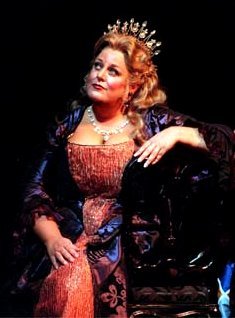
If the name of the American soprano Deborah Voigt is attached to any one thing, it is the title character of Richard Strauss's "Ariadne auf Naxos." It is her signature role, the one that shot her to fame when she first performed it 13 years ago in Boston. Her Ariadne at the Metropolitan Opera last year prompted Anthony Tommasini, a critic for The Times, to praise her "arching lyrical beauty" and to add, "She was at once truly grand and amusingly self-deprecating, striking deadpan poses that any Broadway actor would envy."Little of that seems to have mattered to the Royal Opera House at Covent Garden in London, which is producing the Strauss opera in June. It replaced Ms. Voigt – a large woman even when her weight fluctuates downward – with a slimmer and lesser-known soprano who not only fit the casting director's vision of Ariadne, but also fit into the little black cocktail dress chosen for the character.
Opera fans are used to extending their senses beyond seeing a body on the stage, which is but one piece in a pageant. It's the musicality that matters.But as audiences are graying, opera houses are looking for ways to pack in a younger crowd. Casting directors trying to make opera hip may be turned off by "big hips," like those Ms. Voigt admits to owning. In this case, the decision will deny British audiences an opportunity to hear and see a performer who may be at the peak of her powers. Her voice may be perfect, but at least for Covent Garden, she's too big a star.
It's not my argument. I won't be going to Covent Garden no matter how slim the sopranos. For me, it's just not worth what they charge, and even if they were to try to loss lead me into that place, I'd still be reluctant. Live opera is a habit, and not one I can afford.
I found the Deborah Voigt picture here.
I wonder, is a (small) part of the reason fat ladies are no longer attractive that a strong female voice, in the age of microphones, counts for so much less these days? Probably not. But I am struck by how important, historically, the ability of females to make music influenced the ability of females to get husbands. On the other hand, an industrial strength, opera-house-filling soprano is not quite what pre-hi-fi Husband would have been looking for.
No, the real villainess, from where Ms. Voigt stands, is this spectacular looking lady.

This blog's unwillingness to be very impressed by opera seems, according to the Guardian, to be having consequences:
You can't give tickets away for young people to watch opera, not even Wagner's rarely performed Ring, arguably the greatest event in the operatic canon. That appears to be the devastating conclusion of an embarrassing experiment at the Edinburgh International Festival.Scottish Opera's ambitious complete Ring cycle sold out as long ago as October, but the organisers of the Festival held back one performance of Gotterdammerung for people under 27. Faced with frequent attacks that it was elitist, "out of touch", and aimed only at the "middle-aged upper middle class audience", the heavily subsidised Festival hoped that the free ticket offer would help to reverse its demographic.
But only 237 young people turned up for the performance on Friday, leaving a staggering 1,660 seats empty in the flagship Festival Theatre.
I've just been watching the Chereau Ring Cycle Gotterdamerung on DVD, and Hagen spent the whole of it dressed like a harassed librarian, i.e. in a crumpled suit and a tie, with his top shirt button undone. Yet despite his mundane costume, he spent the last act carrying a long spear, just like a real Hagen, which he used to stab Siegfried in the back. Very peculiar.
Then, by way of enlightenment, I listened to a CD of the English National Opera English language production of the last couple of acts of "The Twilight of the Gods" (i.e. Gotterdamerung in English), but because it was sung by opera singers instead of normal singers I couldn't make out a single word and it might as well have been in German for all the use it was.
Nevertheless, I would have attended that Edinburgh performance if I'd been within range of it. It was presumably in German, but without subtitles anywhere, but despite all that, I'd have got something from it. Nothing can dim the glory of this music. Wagner always wins in the end.
Today I had fun. In among various socialisings, I found myself writing a posting over at Samizdata. Blair equals Nixon, that was the thesis. Never mind if that's true, that's not what Brian's Culture Blog is here to argue about. My point is that when I had basically finished the piece, I needed a nice little witticism to end with, a small, self-mocking raspberry to sign off with. Nixon. Thinks: Nixon in China.
I ended up imagining another opera called Blair in China, which is about the Kelly Affair, with Scarpia Campbell (baritone) and Queen of the Night Cherie (soprano) and Someone Lyrical but Weak Tony (tenor). The things is, Blair has just been in China, and while Cherie and Tony were there they actually were singing, so the opera thing really fitted the situation beautifully.
Apparently they were all siinging the Beatles' old ditty When I'm 64 so I guess it would have to be an extremely comic opera.
None of the Samizdata commenters so far have given Blair In China a second thought. What do such people as these know of opera? But the idea gave me a prolonged chuckle. It's seldom that things slot together so nicely, and a lot of fun when they do.
My two favourite operas written by people who are still alive are Akhnaten by Philip Glass and Nixon in China by John Adams. I understand that my tastes are shared by … I nearly said the "general public", but of course the general public despises opera of any sort. My tastes are shared by opera goers.
The effectiveness of Nixon in China is revealing, and what it reveals is very bad news indeed for opera. Why does Nixon in China not seem to be as ridiculous and absurd as most "opera" written in the last fifty years? How come a stage full of overweight weirdos, singing away in that pre-microphonic smash-the-windows style that opera is sung in, which usually looks and sounds idiotic, in Nixon in China, does not look and sound idiotic, but on the contrary seems amazingly appropriate? What gives?
The answer is that the subject matter of Nixon in China is also totally ridiculous. Nixon in China is about one of those gigantically vacuous photo-opportunity yawn-ins that was the Nixon trip to China. Nothing was said of the remotest significance or interest. If saying things had been the object of the exercise, then a few dozen phone-calls could have seen to everything. But of course, the importance of Nixon's trip to China was "symbolic". It was, that is to say, play acting, with political speeches instead of real ones. And what are political speeches, during events such as this one? They are public performances, scripted in advance to the point where actually delivering them seems pointless, consisting of insincere and totally artificial complements and invocations, from which any trace of actual on-the-spot communication has been studiously removed.
Maybe Nixon, when in China, actually did some serious things and communicated some serious ideas. But who among us thinks this, or feels this?
In short, the events depicted in Nixon in China are of precisely the same kind as the events performed on an operatic stage.
This is why it works so very, very well. It seems totally appropriate. The characters are bonkers - bashing or waffling or self-deceiving their way through a totally obsolete and absurd form of communication, so they work perfectly as characters in an opera.
But the "popular" (these things are relative) success of Nixon in China is not good news for opera. It doesn't signify that opera has any sort of future. As soon as undead classical composers try to portray events that are not ridiculous, the form collapses right back into excruciating, toe-curling embarrassment.
Akhnaten I like also, and that's about an ancient Egyptian boy king who presides over an incomprehensible civilisation of infinite weirdness. To be exact, I don't really like Akhnaten as such. But I do like the sound that it makes.
I do watch other operas by the Undead from time to time, on the TV. Always they are ridiculous. Always.
The most recent such absurdity I saw some of was something called The Silver Tassie, which was about soldiers who fought in the First World War. Please. That's a serious, real subject, something we all care about, deeply. If you're going to present something like that on a stage, you can either do it seriously, or do it as an opera. Both is impossible.
A. C. Douglas calls it a "Superb Essay Apropos Wagner's Art". I agree, although on the basis of far less knowledge of Wagner than Douglas has. The piece in question is by British conservative Roger Scruton, and is entitled Desecrating Wagner. Read all of it, says Douglas. I did, and recommend others to do the same. Douglas also supplied the direct link to the piece, which I wouldn't have been able to get to without such help.
This rang a particular bell:
Wagner tried to create a new musical public, one that would see the point of idealising the human condition. This attempt was already doomed when he first conceived it: kitsch culture was already eclipsing the romantic icon of the artist as priest. Since then, Wagner's enterprise has acquired its own tragic pathos, as modern producers, embarrassed by dramas that make a mockery of their way of life, decide in their turn to make a mockery of the dramas. Of course, even today, musicians and singers, responding as they must to the urgency and sincerity of the music, do their best to produce the sounds that Wagner intended. But the action is invariably caricatured, wrapped in inverted commas, and reduced to the dimensions of a television sitcom. Sarcasm and satire run riot, as in Richard Jones's 1994-6 Covent Garden production of the "Ring", because nobility has become intolerable. The producer strives to distract the audience from Wagner's message and to mock every heroic gesture. As Michael Tanner has argued, in his penetrating defence of the composer, modern productions attempt to "domesticate" Wagner, to bring his dramas down from the exalted sphere in which the music places them, to the world of human trivia, usually in order to make a "political statement" which, being both blatant and banal, succeeds only in cancelling the rich ambiguities of the drama.
As a special treat, a few months ago I bought myself the entire Ring Cycle on DVD, in the only production then available in that format, the 70s Bayreuth one directed by Patrice Chereau and conducted by Pierre Boulez. The singing is, to my un-Wagnerian ear, pretty good, and Boulez, not my favourite musician in all the world, does a fine job of keeping things moving, in both senses. It sounds great, I think. Most of the singing is very fine. Thanks to the magic of subtitles (which makes DVD such a boon for opera) I now know far better what the blazes it is all about. But Chereau's staging is an oddhybrid. You never know if you are going to be faced with something really quite Wagnerian, like the Valkyrie rock, or not very Wagnerian, like the shamelessly mechanical dragon in Siegfried that fills in for a real one, or not Wagnerian at all, like characters dressed as mid-twentieth century librarians instead of Wagnerian baritones. The giants in Rhinegold look just like giants and are excellent, but the Rhine itself is a hydro-electric power station, which can't be what Wagner originally put, surely. Wotan looks like Wotan. But Gunther looks like he works for Sky TV. And so on.
This might explain the fact although at first utterly gripped, I became progressively less involved as the Cycle churned on. It sounds great throughout, but the thing itself progressively eluded me. Rhinegold, despite the industrialised Rhine and despite the fact that this is the one in the tretralogy that contains by far the fewest Wagner best bits (only the wonderful entry of the Gods into Valhalla really qualifies), is splendid. This is, I think, because the action in it is the least "mythical" and accordingly the sort of thing that Chereau is least embarrassed by. Loge (Heinz Zednik) is an especially splendid creation. He looks the way the soul of Sir Humphrey in Yes Minister would look if you ever got a glimpse of it. But as the action of the Cycle gets ever more inescapably "mythical", I found myself more and more put off by the staging oddities. Nor did it help that Siegfried (Manfred Jung) looked like exactly what he was, namely a middle aged man pretending to be twenty years younger.
The trouble with an "authentic" Ring, of the sort someone who agrees with Scruton would presumably attempt, is that it is awfully liable to look even more ridiculous than the dafter bits in the Chereau Ring. Put a contemporary singer in a ye olde Wagner costume, and he or she is liable to look like exactly that and nothing more, making the suspension of disbelief even more impossible. Years ago I caught a few acts on TV of the Metropolitan Opera Ring conducted by James Levine (which is now available on DVD but wasn't when I was picking one for myself), and I now remember quite a lot of it as looking idiotic – with mysteriously singing accountants and district nurses clumping about in am' dram' costumes, and look about as mythical as Xena the Warrior Princess, in fact quite a lot less so. But maybe that was just me, then, resisting the spell of Wagner by deliberately distancing myself from it all.
Our best hope, I think, is that the ever-evolving art of cinema animation may one day give us an embarrassment-free and appropriately mythical Ring Cycle on DVD or its subsequent equivalent which truly presents Wagner's original intentions in their amazing entirety. When I first saw Terminator 2 and was blown away by the still incredible special effects in it, I wrote a review of it which included the words "I wonder if Arnold Schwarzenegger is a Wagner nut."
I'm listening to an ancient 1950 recording of The Mikado. Naxos have been reissuing them, and I got it (2 CDs of it) for £3 in the market.
I'm enjoying it very much, for many reasons, including that it enshrines the upper middle class English voice in its definitely previous manifestation to the present one.
Some time during or just after the nineteen sixties, the money earning classes of my country did a voice makeover. They squirted a more or less huge dose of Michael Caine into their previous John Mills not to say Donald Sinden vowels. This new voice has since spread throughout the new suburbs, to create a new, truly middle class English accent. You do it and you aren't a toff, because toffs are so weird and isolated from normal life that they still talk like John Mills used to in 1950 and sometimes even the way Donald Sinden still did in 1990. But you aren't a criminal stroke tramp either. You have GCSEs. Your parents understand what a mortgage is, and so do you.
But where does that leave the John Mills Donald Sinden accent? Well, nowhere, now that even the old toffs are dying out. Donald Sinden has run out of steam and is probably officially dead himself by now, and John Mills, although still alive despite being 110 years old, is enough of an actor to have introduced slight but definite modifications over the years, to have kept him in touch and make him an acceptable chat-show guest. But for us made-over upper-middles it's nice to hear The Voice in all its 1950 embarrassingness given an outing from time to time.
However, and here's my point, we made-over upper-middles do quite agree that The Voice was indeed embarrassing. If we didn't think this we wouldn't have abandoned The Voice (either with a Michael Caine Switch or with a John Mills Modified Makeover - my preferred route) in the sixties. Young pin-striped ginks trying to become Conservative MPs who haven't dumped The Voice, or who even deliberately taught themselves to sound like 1950 John Mills (or even Donald Sinden) are indeed truly embarrassing. You can't talk like that and mean it. I recall listening to an ancient BBC radio production of Hamlet, and the security guards at the beginning sounded like they were driving around in ancient sports cars in the 1950 London to Brighton ancient sports car race. Good god man!, as they would say, or, as their grandchildren would say: Give me a break! They sounded like Boat Race commentators, and may well have been exactly that in later years. What ho, Marcellus! Did you see the jolly old ghost last night? Gosh what an absolutely ripping show! Cringe.
But I do want to be able to listen to The Voice from time to time, for old time's sake, in all its unashamed embarrassingness. But I want to hear it in a setting where self-mockery is built in. Hence the pleasure of listening to The Voice doing The Mikado, rather than Hamlet.
"If you want to know who we are!!!! … We are gentlemen of Japan!!!! …" That generation saying serious stuff with The Voice is too much to bear. Noel Coward explaining in all seriousness why he is fighting the Second World War, dressed as a sea captain. Please. Donald Sinden trying to be even more serious, in The Cruel Sea. That is just too over the top, dear boy, and one simply can't, dear boy, take it seriously. But, dear boy, when one is sending oneself up, conceding with one's every inflection that the British Empire is folding its tents even as we speak in this peculiar way, dear boy, and that this whole way of talking will soon be a thing of the past, dear boy, well, that doesn't date. Or rather, it does date but in a completely satisfactory way, that I at any rate can still now enjoy.
One of the huge changes that has come over History, no less, is that we now have genuine recordings of how people really spoke, from about 1900 onwards. In my recent piece about Hamlet on Samizdata I included the guess that Shakespeare as originally spoken probably sounded more like modern American than modern posh English. Wow, said someone, is that what people really now think? I think they think this, but both halves of that are just guesses, I'm afraid, and I hope to muster the guts to admit it over there some time soon. But what wouldn't we give for a scratchy old gramophone record, like my Mikado CDs, of Shakespeare himself reading one of his bits? A photo would be fantastic. But a sound recording, now I think about it, and if I had to choose, would be even better. The pictures of Shakespeare that we do now have give us a pretty good idea of how he looked, but a recording of the man would cause an earthquake in Shakespeare scholarship and Shakespeare interpretation, and probably in History itself.
"Three little girls from school are we, come from the ladies' seminary …"
Gels, that is, with a elongated short "e": "Ge-e-e-e-e-ls". You know. The Voice. The ladies did it too of course.
"We're very wide ar-wake thar moon end ay."
The moon yes, but not you granny dearest, not any more. You're dead. As is the Queen Mother. But you live on in electro-vinyl, I'm very happy to report.


