

Pretty cool, says Dave Barry. As do I.
Although to be literal, fireworks are more pretty than cool. Interesting the double meanings of both those words. " She's pretty ugly." "That fire was way cool." Odd.
This seems to me to be a logical business:
If you want a Manet, a Van Gogh, a Renoir – then Christophe Petyt is your man: he has turned exact copies of masterpieces into big business; down to the last wormhole in the frame. He talks to William Langley.Fresh back from the Riviera, his dark hair glossy and his toned body snug in a black Versace suit, Christophe Petyt is sitting in a Paris cafe, listing the adornments of his private art collection; several Van Goghs, a particularly good Rembrandt, a pair of cherished Canalettos, a Modigliani, a Miro abstract and a comprehensive selection of the better Impressionists.
"I can," says Christophe quietly, "have any painting I like."
Then he looks up from the frosted rim of his tall chocolat froid and murmurs, "and so can you."
I love the suggestion of illicit passion, of the love – in this case of faked old masters – that dare not speak its name. And made possible for you by one of those dubious citizens who always make such things possible. Dark glossy hair. Toned body. Black Versace suit. Chocolat froid. Not one of us is William Langley's clear implication.
Well, I think it's very sensible. I mean, if I owned one of these multi-million-dollar paintings, I'd bury it in a bank vault and hang an exact copy of it on my actual wall. And then, I think I'd sell the multi-million-dollar painting, because what is the point of it spending its entire life in a bank vault? In fact, I think I'd have lots of copies made, one for each of the people who ever owned it. They'd each want one. As a souvenir. As would many others, I expect.
I've been spilling a lot of electrons here wondering when computer screens will be able to fake all those grand masters to perfection. Meanwhile, here's the plan: have painters fake them to perfection. With paint.
That's all I have to say for now. This is the small hours of Monday, and I haven't had anything here since Friday. Sorry and all that. I did a couple of semi-cultural blog postings elsewhere, namely here (which happened because of this posting here) and here. Try to think of these as your daily Brian's Culture fixes for the weekend.
I met someone this evening who described himself as a fan of this blog, so I'm suddenly feeling conscientious again.
As regulars here will know by now, the unprovoked visiting of art galleries just to look at pictures or sculptures is not something I often do. But, rootling about in the arts pages of the electrical national dailies, just to get my culture blogging done for the day, I came across an article about Bridget Riley from which I actually learned something. (This is the best set of Bridget Riley images I could find by googling.)
I wouldn't want to go overboard. The writer, Adrian Searle of the Guardian, is after all a writer about modern art for the Guardian, so as to what the things are about and what exactly they signify, it's anyone's mad random guess and he guesses away madly and randomly like he's paid to.
… Description tends to deaden a body of work which at its best is full of life, sensation, and a fugitive equivalence to the visual world in which we live. Her paintings aren't "like" anything.
Well, actually they're like post-sixties wallpaper and fabric designs, for in Bridget Riley's case life has imitated art on a huge scale.
A Riley is a Riley, a chunk of sensation, a singular field, an event, an encounter. A Bridget Riley painting is not a depiction. This singularity is peculiar, …
Whereas all other paintings these days are "depictions". Get a grip man. No, sorry, don't. That's good. That's tripe and it's what you're paid for. Blah blah blah.
But now it gets informative. This particular blah is based on a fact, and a fact I was not until now aware of. I've always found Riley's pictures to be pretty, but I didn't know how she did them, until now.
… given that her paintings are made by other hands. From the early 1960s, she has used assistants to manufacture her paintings, after her own production of numerous studies, drawings, variations, diagrams and colour swatch tests, in which every colour relationship is fine-tuned in terms of its hue-value, saturation, its place on the tonal scale, as well as in terms of its opacity, its flow, its gloss or mattness, its maleability as a semi-liquid material. Every single element of every work is premeditated, every painting planned to the last detail.
Careful my dear chap. You're telling us so much actual informative-type information, you'll end up not being an art critic at all.
There is a fascinating room of Riley's studies here. However methodical and cold-blooded they are, they are often great drawings – precisely because they have no self-regard or affectation of style.
More like it, but still vaguely informative.
A consistent feature of her works is their disinterestedness.
"Disinterestedness." Better. In normal art critical circumstances this would mean nothing at all.
There's no pawing about of the surface, no expression, no reworking, no accidents.
Okay, but now actual sense and actual information is being circled around and arrived at again, from the great sky of nonsense that is modern art criticism of the usual sort.
In fact, the paintings themselves can barely be said to have any painterly touch at all.
Normally this would do. But here, it verges on the lucid.
I ask myself, as an aside, why it is that while people complain about art being made or fabricated by others, as though the artist were somehow cheating, no one ever levels this accusation at Riley?
Now this is the kind of thing you should avoid at all costs, and calling it an aside is no excuse whatever. Your job is to talk about the incomprehensibly idiotic reactions of your idiotically incomprehensible self. Don't recycle the lucid observations of the general public. Big mistake. Your core readership likes modern art and accordingly opposes sensibleness whenever and wherever it rears its beautiful head. Piss off your regular lunatics and who else will read your stuff? Who on earth wants to read sensible writing about modern art day after day, when there's so much sensible stuff out there already, about sensible things?
You writing something that I accidentally encountered, liked and learned from isn't going to make me want to read you every day, for goodness sake. I'm sensible too.
*
Ho ho. Anyway, setting aside the rights and wrongs of being a decent, proper, gibberish modern art critic such as we've all come to expect and despise, I now want to talk about Bridget Riley and how she does things.
I've spent the last month or two, in among doing things that I actually know how to do, trying to understand HTML, web design, blog design etc. (Not that you'd know it from looking at this, blah blah, usual apology for how this looks, usual claim that things will improve Real Soon Now.) And the way Riley goes about her business is that she's doing something which will eventually, like HTML now, be doable by machine. Go back to that bit about …
… diagrams and colour swatch tests, in which every colour relationship is fine-tuned in terms of its hue-value, saturation, its place on the tonal scale, as well as in terms of its opacity, its flow, its gloss or mattness, its maleability as a semi-liquid material …
All those exact numbers that denote exact colours – now where have we all seen that before? That's right, in those numbers that go something like 33FF33 (pardon me if that's an impossible colour – I'm not yet on top of this stuff) that are buried in among the coding of web pages.
This woman isn't just a painter; she's a painting "programmer" and has been for forty years, in much the same way that I was a desktop publisher before computers could do that. (For me, phrases like "cut and paste" used once to mean … cut and paste.)
Eventually, Riley, or her technical great-grandchildren, will be able to type her graphics programmes into a computer, push a button (like the one you push on a programme Patrick Crozier has been showing me called "Textpad") which immediately shows you what you've done.
To some extent, you can do this with Riley paintings now, as my link to Riley pictures above illustrates. You don't get the full effect, if only because computers screens are now mostly too small. But the mathematics-friendly aspect of her work and its lack of "painterly" quality, as Searle calls it, means that already it cries out to be computerised.
And as Searle notes, we would no more accuse Bridget Riley of being an idle, skiving, modern art layabout than bloggers would accuse Sekimori of not doing anything merely because she doesn't hand paint your blog for you. Sekimori and Bridget Riley are both in the business of creating not images, but instructions for images. (The normal skiving modern artist now just says "bung a fish in a tank would you lads", which of course is cheating.)
*
Well, that's a blog posting. But I don't want to leave it there, because one of the variables which Searle notes that Riley specifies shows just how far we have to go before we can flick a switch and see paintings on computer screens, and I mean really see them. This is the respect in which Riley's stuff can't yet be seen in all its splendour in our kitchens and living rooms.
I don't know exactly how "maleability as a semi-liquid material" works. I mean, is the painting supposed to remain sticky for ever? Surely not. I suppose that degree of stickiness while it's being applied somehow affects how it ends up looking.
But that matt/gloss thing I do understand. I used to do Airfix kits of airplanes, and I was pretty good at it. That I know about. And just imagine how far computer screens have to go before they can recreate shininess, or not shininess, to order: a coloured surface that either does behave quite a lot like a mirror, or doesn't behave at all like a mirror, or any specified combination of the two. As I understand computer screens, that decision is now made just the once, by the people who design the screen. There's no way they can let Bridget Riley or for that matter Sekimori loose on the screen to decide different degrees of mattness or glossiness for different specified bits of it.
And just to be clear about this anmd to answer one possible objection right now, the way you make things look shiny on a computer screen now is have them reflect particular things you decide about, in the picture. I'm talking about a computer screen which will reflect or not reflect, with controllable variability, the actual things in front of it.
Question for paintings buffs. Is this matt/gloss variability an important issue for paintings generally? Does the effective recreation on a computer screen of a Titian or a Constable or a Turner or Monet or a Picasso need, if it is to be truly effective, a matt/gloss capability? I rather think it does.
And if computer screens can't yet do such a thing, are computer printers any better. My understanding is that computer printers, just like computer screens, have their matt/gloss setting preordained for the entire surface, and as much by the paper as by the printer itself.
And of course once you get into oil painting of the relatively recent vintage, it would help if you could also give the surface of the screen that is trying to recreate it a three-D capability. Oil paintings of the more exuberant sort have for centuries been like those relief maps in expensive Atlases, where the mountains stick up towards you. Good luck to the nerds trying to make that happen on a computer screen.
I should reckon that old-fashioned printers, but working in colour, can just about do all this stuff, if they are at the very top of their game and working for money-no-object customers. But computer printers of the "affordeable" sort, no, and computer screens, not for decades. I recall expressing here, some while ago, optimism about how near we are to art-for-all – all-art-for-all at the flick of a switch – courtesy of Bill Gates and his minions. Yet the truth is that current computer screens hardly scratch the surface (ho ho) of all the problems involved.
And just as the painters, in order to stay busy, responded to photography by doing stuff that the photographers couldn't do (like paintings that weren't of anything, and paintings that were of things, but which were also very "painted", if you get my drift), so too, as soon as the nerds crack how to make a Constable on a computer screen that you really can't tell from the original (apart from it being in better condition), the artists will devise things that the nerds can't fake up with their machines. Indeed, are not "installations" the artists seeing this moment on its way, and them taking their usual precautionary evasive action?
That's enough for today. Long piece, and probably several typos and muddles. But I don't have time to do any more cleaning up. The problem is that each time I go through this, I find more things I want to say, and it gets even more muddled. So, enough.
Last night I watched Drew Barrymore chattering to David Letterman and a could-be historic moment happened, which is that DB revealed that she and the other two Charlie's Angels ladies (that would be CD and LL) had been singing songs from Grease 2 down Mexico way, during their "world tour" to promote Charlie's Angels – Full Throttle. Charlie's Angels – Full Throttle can look after itself:
The Charlie's Angels stars are returning to the big screen again, battling forces of evil with the world's most advanced technologies, including the Sony Ericsson T616 mobile phone.
To hell with that. It's the Grease 2 angle I'm interested in. Could there be a buzz starting to resurrect this much maligned and neglected little movie? And does saying that make me gay? Probably in many eyes and on many gaydar screens, but I made my decision about whether I was going to allow that kind of thing to bother me during the long dark era, now definitely over, of Abba neglect.
If you want to delight Michelle Pfeiffer, tell her she was great in Grease 2. Which is true, she was (look for "Stephanie Zinone" in the meet the cast bit). But, and this would be the source of all that malignancy and neglectfulness, her leading man was abysmal. Then as now, still (in ridiculous TV soap operas etc.) he called and calls himself "Maxwell Caulfield". Now Maxwell Caulfield was the hero of J. D. Salinger's Catcher in the Rye, the novel of choice for a whole generation of cogitating ne'er-do-wells, and if you draw attention to yourself with a name like that, you'd better be able to live up to it. Maxwell Caulfield 2 couldn't. His singing in Grease 2 was a movie-destroying atrocity. Plus he's a hopeless actor.
[EMBARRASSED UPDATE: That paragraph is stupid, because the hero of Catcher in the Rye is, as commenter number one Michael Jennings points out, not Maxwell Caulfield but Holden Caulfield. So not such a silly name then. But whatever he's called he's still a bad actor and an atrocious singer. No excuse to offer. Just wrong. When you blogger in hole, dig no more, climb out, brush off dirt, hope everyone soon forget.]
Which was a real pity, because the best songs in Grease 2 were great. Best of all was probably the number during the opening credits, called (I think) "Back To School", sung by the Four Tops. Whenever I see Four Tops greatest hits CDs I look for it, but never find it. Why is that? It was great. And who could forget "Rockahula Luau"? – not that I ever knew how to spell this in the first place, but if you know the one I mean, you'll know the one I mean.
Think pink.
It's completely stupid, I know, but I really like these creatures, who are the work of Aardman (although I can't find them on their website), and who appear in between programmes on BBC3 TV. They don't do anything obviously useful, like announce television programmes. They just say strange or inconsequential animated things, which when animated become amusing.
This one is my favourite, probably because I also wear glasses. "With these glasses", he says to his audience of smaller blobs in a powerfully deep voice with what sounds to me (but I could be very wrong) like a South African Jewish accent, "I can do terrible damage."
BBC4, however, is gone again.
In a characteristic Samizdata posting, Perry de Havilland regrets the modern use of the phrase "Big Brother" to describe reality TV shows, and harks back to Orwell's original coinage, with grim pictures of CCTV surveillance cameras outside primary schools, and of propaganda for CCTV cameras in the form of big posters in the London Underground.
All this anti-surveillance thinking over at Samizdata is connected to the recent launch of this new blog, White Rose which will be concerned with civil liberties and "intrusive state" issues. I've already done a couple of posts there, the most substantial of which concerned organ donarship, and I intend to contribute many more similar efforts. The boss of White Rose is one of my closest friends.
However, I have long been nursing heretical thoughts about this total surveillance stuff, which it makes sense to put on a "culture" blog rather than on a politics blog. Because what I think is at stake here is a sea change not just in state surveillance, but in the culture generally. What is more, it is a sea change which places programmes like Big Brother right at the centre of what is happening.
Personally I don't watch Big Brother, or any of its various derivatives. Nor, to my extreme relief, do I feel any need to keep up with the soap operas. I recall reading a book years ago which described TV as the ultimate "psychic energy sink", and although I watch a hell of a lot of it, I think that's right.
However, I do think that Big Brother (the TV show) deals with a real question, a question worth reflecting upon. And that question is: what happens to, you know, life, when there are TV cameras trained on it twenty four hours per day? What happens to manners? What happens to the rules of how we ought to behave? What happens to the judgements we make of other people? When we see someone we know, and perhaps later meet up with, masturbating on camera, or scratching his bum, or having a seriously bad hair day, or cheating (maybe, hard to tell) on his wife, how should we then conduct ourselves?
These seem to me to be questions well worth preparing ourselves for.
Big Brother is closely linked to the also much complained about "cult of celebrity".
But the "cult" of celebrity – which is really just being extremely interested in the lives of celebrities – seems to me to reflect the exact same pre-occupations as the reality TV shows. Celebrities are the people who are already enduring total surveillance. Their triumphs and agonies as they either try to dodge the cameras, or as they make rude finger gestures at them, or else as they try to be dignified when on them, are a taste of what the rest of us may have to be deciding about in years to come. Now the Beckhams, tomorrow it'll be us on camera. How do the Beckhams handle it? How will we?
Popular culture is often dismissed as trivia and nonsense, by the guardians of "culture" in the more elevated sense of that word. But then these same guardians look back on the trivia and nonsense of earlier times, and suddenly they see that those despicably low-browed masses were actually dealing with deadly serious questions which the entire world and its various Presidents and Prime Ministers are now having to deal with in deadly earnest.
Take all those slam bang adventure movies of the nineteen eighties. I recall a wonderful fake cinema trailer done by some British TV comedians which advertised a movie called, simply, "Things Exploding". Ho ho. And it was true. The collective sub-conscious did seem to be unnaturally obsessed with (a) huge and dramatic bangs, and in general, disasters of all kinds, and (b) how people should react to them. Well, in the era of Al Qaeda, this suddenly doesn't seem quite so moronic and down market, now does it? Suddenly the world is filled, for real, with, if not an abundance of actual bangs, then at the very least the vastly heightened fear of such bangs, in official and respectable circles.
I believe that the exact same pattern will unfold with total surveillance. The "official" debate about this takes the form of saying either that we've got to have it (the government line), or that it's creepy (White Rose).
Meanwhile the masses are off on a quite different tack. Instead of arguing about whether it should happen, they have simply accepted that, just like all those big bangs and disasters, it is going to happen, and for them, the question is: how do we live with it?
I believe that the masses are right. I have no problem with trying to help my White Rose friends in what they are trying to do with occasional postings, for I certainly believe that the matter of how total surveillance is done is extremely important. But I am with the masses in pretty much believing that it will happen. To ask how we can stop it is futile. What really matters is: how will we live with it?
To put it another way, the important discussions about total surveillance are at least as much Brian's Culture Blog matters as they are White Rose matters.
End of part one. As so often with blogging, you blog away for twenty minutes, setting the scene and clearing away the undergrowth, as it were, for what you really want to get stuck into. But when you have, and are ready to get seriously started, you have actually finished a perfectly decent posting, which it makes sense to draw to a close.
If I want to pursue this, and I really really do, I will, but not here and not now.
I swung Jim's (of Jim's Journal) comment on this posting here over to Samizdata, basically because I thought they'd like it and comment on it, and so it has proved. Most agreed, some chiming in with further gleeful stories of pranksters inserting undetectably random bric-a-brac into other places of modern art worship.
A_t dissented, as is his habit on Samzidata, and issued the following challenge:
I'm curious though... from all you people who've just been dissing away, is there anything of the modern world of art or music that you actually like?
My answer is that it depends what exactly you mean by "modern". Taking the word in its literal sense, to mean recent, I generally like the latest architectural stuff with its sun-glasses glass and shiny steel exteriors, and I like lots of current pop music and lots of current movies.
But of course that isn't quite what A_t means, or wants us here to mean, by "modern", or I don't think it is. He means the very self-consciously artistic "modern art" stuff, of the sort that qualifies for Arts Council grants and a spot in a Modern Art museum or Modern Music concert at Symphony Hall. And by this definition, "modern art" has been going since at least as far back as the teens and twenties of the last century,
In other words "modern" means a particular sort of style or attitude to doing art, rather than merely that which is the most recent art. "Modern Art" in this sense is quite capable of being superceded by something very different, and I for one hope that it is.
So. What – if any – of that stuff do I like? My answer to that is: you're right mate, pretty damn little. And I should guess that goes for most of the rest of the Samizdata writership and readership.
Whenever you hear the phrase "I'm curious", you know you are in the company of an enemy whose intentions are far more hostile than he wishes third-party onlookers to realise. A smiling prosecuting council, in other words, trying to box you in with a question which is only apparently inconsequential.
And what A_t is, I think, getting at with his question is that I, and Samizdata, and most of Samizdata's readers, are all mindlessly prejudiced against all Modern Art. And what a pack of fools to object to an entire category of human artefact just because it's recent. He is, I believe, definition hopping. He uses the phrase "modern" to refer to a particular category of human artefact define by its philosophy and attitude rather than its time of creation, and having extracted the required answer, he than wants to announce to those third-party onlookers that we oppose everything that has happened for the last fifty to a hundred years, simply because of when it happened, and that, again mindlessly, we want to turn the clock back to some golden age of our own foolish imagining.
But we do not oppose "Modern Art" mindlessly. We oppose it very mindfully. It's that philosophy, that attitude, that we object to, not the dates. And we're right to object to that attitude, because it's a stupid attitude.
We are our editors now. If you try playing word games with us on our blogs, we'll expose it, and we'll have the last word.
Which was, for now, going to be that. But instead I will add this reply to A_t from "David", which appeared at Samizdata after I'd written the above.
A_t,Yes, I do like some modern art, mostly aviation or space art. The Air Force Academy has some excellent paintings as well as the tourist area of the Space Center in Orlando.
Other than that, my enjoyment of painting ends with Matisse. No, I'll take that back, I do like some of Kandinsky's paintings. After that people merely looked for a way to make a name for themselves. One guy would paint only black squares. After that, nobody else was allowed to paint black squares, as if he had cornered the art market on that theme. Jackson Pollack owned splatter art. Rothko got to do large vaguely square colors. Franz Kline got black on white and Reinhardt got the best, monocolor (look, it's all black, it's art).
The problem with this approach is that it fails to appeal to the mass market because people realize they could, with no training, produce similar art. Furthermore, the art no longer touches our soul. In fact, artists almost seem to go out of their way to ensure that their products are inaccesible. I think it gives them a sense of self-importance and soothes their feelings of inadaquacy, but that's just an opinion.
As someone who loves painting and has invested considerable time and expense to visit every major art museum in Asia, Europe and the U.S., with the exception of Russia, it hurts to see the wasteland which so called modern art has made of the great artistic traditions.Painting, regardless of the culture or style, has the potential of moving us and that has been tossed aside in the last fifty years.
Which is why I only really enjoy modern aviation and space art. The people who paint those pictures do so with a love and dedication missing from the "serious" art community. And that love can move me to tears, something de Kooning and Dubuffet never will.
Mindless? I think not.
I'm indifferent to the whole Harry Potter thing. I read the first one, and felt no compulsion to read on. But given my political/philosophical proclivities, I was please to see this at Instapundit:
… here's a blog review that says the book has libertarian themes.
Interesting.
UPDATE!!!: But, you might want to read Natalie Solent about all this first. (Or try Natalie Solent, assuming blogbollocks does its usual with the latest entry.) Don't read that review, she says, it'll spoil it for you.
She says read this.
One day I may put a slogan at the top of this which will say: "Culture means what Brian says it means."
So: Is cricket culture? It is today, here.
On the face of it the big story in English cricket right now is how well or how not so well the England team is doing. Today England thrashed Pakistan, with Marcus Trescothick doing most of the thrashing.
But the real cricket story in England now is the new twenty over competition. Side A thrashes about like a fish out of water for twenty overs, equals one hundred and twenty balls, and reckons on getting as near as it can to about two hundred. And then the other fellows have a go, and see if they can't do better. It's all over in half an evening. It can start just after your office closes, at 5.30pm, and be all over in time for supper. Apparently people are actually coming to watch this. Presumably it's because you can watch it, and still have a life. It's a good idea, I think.
This is new, and is yet another step away from cricket as our grandparents knew it. Jack Hobbs, Don Bradman, etc., used to wear only all-white costumes. These "Twenty20" guys wear brightly coloured pyjamas. Hobbs and Bradman kept a straight bat and batted all day and into the second day if they could. The pyjama gamesters flail away like baseballers. The old guys are classical music cricketers. Now they're popsters.
Okay I could go on, and I often do, but what I really want to say is that the libertarian-inclined blogosphere needs, in my opinion, a team blog about sports.
It's okay for me to say that today culture means cricket, but let's face it, if I said something like this every other day, my readers would fidget. Hey man, make up your mind. Is this artsy fartsy crap about paintings and stuff, or is it sports?
It could be that this guy is already running this team sports blog, and he just hasn't manage to hustle up a team to write for it. If so, I hereby invite him to get in touch. If not, then whoever does start such a sports blog, I hereby volunteer to join in, provided I'm welcome.
Why? Now we're back to libertarianism and the way we spread it.
Partly we spread libertarianism by taking non-libertarians and anti-libertarians to one side and beating them over the brains with our superior libertarian ideas until they beg for mercy and to be baptised.
But the other way is you go out and find semi-formed libertarians and just give them a bit of a polish. They're already, at the deep philosophical level, on our side, but they need to be kitted up with a few more words and arguments.
And I think that a lot of these semi-libertarians are sports people. Sure, we need to slug it out with our natural enemies with things like, oh I don't know, culture blogs. But we also need to trawl for the easy people, conversion-wise.
And the way you do this is by rounding up some ideologically sound people, but people who are bored with being nothing but ideologically sound, people like me, and tell us to rant away about sport day after day, mentioning why income tax rates should be slashed every now and again, but mostly writing about sport. Not just results, and who did what, and who should be picked to do what next week. I'm thinking background stuff, about the history of it all. Strange sports, like that thing they do in Spain with great big curved soup spoons, or like Gaelic football, or Ozzie rules, or the thing that old French men play in the town square that is presumably (it sounds like it) a cousin of Bowls. The place of sport in schools, sport as a trainer of character, which great politicians have been the best at sports, and which sportsmen have done best at politics. Why cricketers commit suicide so much, after cricket. You know, spreading the net. The role of sport in society.
As I say, if you have such a blog, or you've started such a blog, anywhere on earth, and you want me, I'm yours, every now and again.
If you are fascists or communists or Democrats or something, and trying to spread fascism, communism or Democratism, fine, you've every right to be that and to be doing that. I'm still interested, but not interested enough to write for you regularly. It's got to be a blog in approximate tune with me ideologically. Any offers?
Last night I watched a TV programme (On BBC1) about the sculptor Barbara Hepworth, the best little clutch of photos of her work that I could find quickly being this one.
I enjoyed myself. We got the family history, the marriages and the divorces, the children (including – get this – triplets!!!), and lots of pictures of the sculptures and of Dame Barbara sculpting them. What a feisty old Dame – stubborn, deadly serious, and amazingly productive, decade after decade. I enjoyed the pictures of the sculptures, several of which I must myself have seen for real.
And then there were the photos, of Hepworth and her artist friends lolling about by the sea, discussing Socialism. She did some interesting pictures of National Health Service doctors doing an operation (and you got the impression that she valued their masked, and thus "faceless" quality, which turned them from individuals into a collective archetype).
Barbara Hepworth's early "inspiration" and "passion", of which much was made by compere Alan Yentob, was landscape and seaside rocks and pebbles. In Hepworth's hands this sometimes merged into forms suggestive also of human figures. Later she played about with colour, and her creations started to have insides and outsides, in different colours. Holes started to go through them. Strings like the strings of a harp or a piano join up bits of them. All very pleasing to look at, in a harmless, make-what-you-like-of-it kind of way.
And then they showed a picture of a big Barbara Hepworth outside the United Nations building in New York.
Whoooaaaarrrggghhh!!! A spasm of rage suddenly engulfed your blogger. The sneaky, mad, batty old bitch has seduced me into a state of neutrality concerning the public, abstract "sculpture" of the 1950 to 1980 era, which is one of the most horrible art atrocities of my lifetime.
You know the kind of rubbish I'm talking about. Huge dull skyscraper, with large, dull square in front of it, park benches to sit on if you're lucky, rubbish blowing about in the crazy breezes caused by the skyscraper, and plonked down in the middle of the square: a meaningless, far-too-big-to-ignore piece of bullshit "sculpture" that looks like it was helicoptered in by an evil cosmic prankster in the dead of night, and they haven't yet taken it away because it will cost a fortune to do that and they haven't yet worked out who has to do it.
What was happeningto me? I had been transformed by one dim old photograph from a maiden aunt nodding benignly at how "interesting" it all looked, into a Daily Mail reader, drunk at the wheel of a Ford Transit loaded with dynamite. Ease up Brian. Relax. It's only Modern Art. Don't get so angry. You're only Playing Into Their Hands.
Why was I so contentedly relaxed about small Hepworths in little art galleries or gardens, but driven crazy by big ones in front of famous skyscrapers?
It was because small Hepworths in galleries are in their proper place in the world, but big Hepworth's in city squares are not just getting above themselves, they are also getting in the way of something better.
There is something very ridiculous about Barbara Hepworth, and her "inspiration" and her "passion". Basically, what she spent her life doing, with huge labour, was doing something that for humans is immensely hard work, but which Mother Nature does without trying. I mean, seriously, what the hell is the point of making hundreds of bits of stuff "inspired" by the things that the sea does to stone? Surely the logical thing to do if this "inspires" you is to take photos, or go on walks and look at it all. But a life-time of making giant pebbles? Smacking away with your chisel at big lumps of stone for man-years on end, to create effects that the Atlantic Ocean can do without even being alive? This really is a human doing what humans are not built for. This is playing from weakness. This is us at our daftest.
Put it this way. Suppose that you observed not the sea shaping stone, but, say, some elephants manipulating some huge bits of wood, doing what they do best, which is move things about with their amazing, elongated noses. Suppose that this "inspired" you. Would it really make sense for you then to spend the rest of your life copying the elephants by pushing things about with your nose? Or perhaps by heaving bits of timber about with your arms, on account of your nose being so unsuited? You're never going to beat the elephants, any more than Barbara Hepworth is going to beat the sea.
When Hepworth sells one of her giant pebbles to someone who likes it and reckons it to be art, and who puts it in an art gallery for others who like the look of giant pebbles to come an gaze at, well, I've no problem with that. Hepworth's objects are an excellent example of something I've already written about here, namely "art", which if it hadn't been called art, would cause no annoyance whatever. Who could possibly object to a big pebble?
But when you take one of these giant I-wonder-what-that-is things and stick it in a serious, much populated urban public space, my patience suddenly snaps. Now, suddenly, I am being asked to take this giant piece of bric-a-brac seriously, and agree that it signifies something profound, something as profound as those "passions" that were swirling about inside poor old Barbara Hepworth's brain while she was carving the damn thing and making the surface go this way or that way for who the hell knows what reason. Now the lack of any shared or sharable meaning ceases to be quaintly picturesque, and becomes actively and intrusively offensive.
When I was a child, we used to go by car to Monmouthshire to visit the grandmother, who lived in a mini stately home. One of the highlights of the journey, if we went through the town of Monmouth itself, was to observe the statue of the great aviator and car salesman Charles Rolls in the town centre, holding up a model biplane. Now that was a statue. That meant something. Later I got to know the statues of London, my favourites being the ones outside the old War Office of Montgomery, Brooke and Slim, Britain's leading World War II soldiers.
Imagine the stink if any of these were taken away, and replaced by half a a ton of random Hepworth. Well, that's pretty much what did happen in the space outside the UN building.
Personally I despise the UN, but I'll agree that it is at least trying, approximately speaking, to do something important. Like the Hepworth object in front of it, it is occupying an important space in the world. So why was I so angry? Isn't a meaningless piece of junk in front of it just what I would have wanted in front of this vile operation? Well, yes, indeed. But what I was cursing wasn't that particular sculpture, so much as all the bits of junk in cities everywhere, where real sculptures (or real somethings) should have been instead. There could have been something that celebrated qualities or aspirations or achievements in a way that was clearly expressed and plainly visible – instead of just a blob of the silly and utterly uncommunicated "passions" of some stubborn old git like Barbara bloody Hepworth.
Happily, a happy ending to this story is even now unfolding. The meaningless lump style of sculpture has not been utterly defeated, but it has been driven out of these significant public spaces, back into the art galleries and gardens where it belongs, where it can be communed with by those who like that sort of thing but where it won't annoy the rest of us.
We are, in Britain, just at the beginning of a new golden age of public sculpture, heralded by the Angel of the North. This, to me, somewhat half-hearted figure has revealed, by the mere fact of its public existence, a huge fan base for public sculpture that is of something, that really says something and celebrates something, in this case, presumably, the rise of a new North of England from the rust and dust and mud of the old. The happy hubbub of talk that surrounds this somewhat banal but nevertheless appealing little figure, stuck up above the A1 just south of Gateshead, is in extreme contrast to the bitter and angry public silence by which all those Hepworth-style blobs were surrounded by when they were unveiled. And just like the architects before them, the sculptors have decided which response they prefer, and are lunging for public glory. Good for them.
Meanwhile, other lesser but still very appealing statues that actually communicate are popping up everywhere.
Thinking about this Hepworth business has told me is something that I hadn't quite grasped until now, which is that "Modern Art" is already in retreat. The meaningless lump style still dominates great swathes of "art", in the galleries, alongside the more recent and equally meaningless "hey! – take a look at what I just found" style. But it has been banished from real life. Now real life is elbowing its way back into the galleries.
For years I have longed to sink Modern Art with one killer phrase, like the Bismarck sinking the Hood. One day, I dreamed to myself, I would craft a meme as deadly as Tom Wolfe's "The Painted Word". Now I am starting to feel twinges of the magnanimity that accompanies victory.
I'm watching what I think is a rather under-rated movie, The Peacemaker, which stars George Clooney and Nicole Kidman.
What I especially like about this movie is that the two lead characters, Clooney and Kidman, would in most versions of such a movie story, have had at least one all-out slanging match by now (I'm about a third of the way in), before duly bonding and going after the bad guys. But although they've had several chances to scream and yell at each other, they haven't taken them. Which is entirely right, given the sort of people we are asked to believe that they are, top notch anti-terrorism folks doing ultra-high pressure work. An inability to control emotions under conditions of argumentative stress would not be a (non-) quality that you would want such people to have. They argue their conflicting cases forcefully, but they never let it get personal.
Which also means that they avoid another thuddingly predictable action movie cliché. Instead of consummating their personal relationship, the happy boy-gets-girl-girl-gets-boy ending has them embarking upon such a relationship.
I particularly liked the establishing-of-character scene in which a lady politician lists all the rambunctious and criminal things the Clooney character is alleged to have done while stopping some poison gas finding its way from Russia to Iraq. "Yes ma'am, that is correct." In general, the Clooney character is very convincing, to my eye.
The weakness of the movie is that it has a deeply unconvincing villain. Who – yes, you've guessed it – loves his classical music.
Here's a collection of fun photos, taken at night, of the Tyne bridges in Newcastle (including the new Gateshead Millenium Bridge), and the Sage Gateshead, which is a new music centre under construction.
The Millenium Bridge doesn't go in a straight line across the river, it goes in a big curve. This means it takes longer to walk across but it also means that it can simply be lifted up into an arch when tall boats want to go under it. Brilliant.
The Sage Gateshead (an ugly form of words but that seems to be how you speak of this thing) has been designed by Foster and Partners. It has two concert halls, which will, we are assured have excellent accoustics, and a glass outer skin which will afford an excellent view of the Tyne. I believe that both claims will prove to be true.
There are some who hate this sort of thing. Anti-traditional modernity for the sake of it, blah blah. Well my "blah blah" tells you what I think of that kind of talk. I love this stuff.
I haven't seen the Sage Gateshead, but I think it looks very promising. I did take a close look at the (outside of the) Swiss Re Building in London and I love that, and love also what it has done for the London skyline.
Big public architecture is just getting better and better, as enticing now as it was soul destroying a generation ago. I used to live in Newcastle, and the most visually striking thing in Gateshead in those days, judging by the view of it from across the river, was the multi-story carpark from which Michael Caine threw one of his many victims in Get Carter. This particular one was the one to whom Caine said, famously:
"You're a big man, but you're in bad shape. With me it's a full time job, now behave yourself."
My favourite line from that film, however, was when a rather posh architect, observing some Caine induced mayhem, said to his pal, quietly but anxiously, words to the effect: "I've got an awful feeling we're not going to get our fee." Norman Foster he was not.
There's a big new Sainsbury's supermarket rising up behind its wrapping just near where I live, towards Victoria Sation, in Wilton Road. I can't wait to see what that looks like also. I tried googling for an architect's impression but could find nothing. So, wait and see, eh?
I'm a libertarian, so I hope non-libertarians (or for that matter libertarians who come here for culture as more usually understood rather than for postings like this one) will forgive me discussing this question in a libertarian way. Most of the points I am about to make apply just as much to other sets of ideas ending in ism as they do to my ism.
Like , I was intrigued by Patrick Crozier's posting at CrozierVision nearly a fortnight ago now, about how blogging helps (but perhaps doesn't help very much) to spread libertarianism. Since one of Patrick's constant recent themes in conversation with me has been that blog postings sometimes deserve to stick around longer than they actually do, I'm sure that he won't mind this posting of his being linked back to.
I suspect that, just as people often attach exaggerated importance to the particular arguments that converted them from what they used to be to what they are, something similar may apply to methods of communication. It used to be that books were the favourite way to encounter libertarian ideas, given that, then as now but a lot more so, libertarianism was not the daily fare of the mainstream printed or electronic media. Patrick wonders if blogs will ever convert people. My answer would be: give them time. Books didn't convert that many people into libertarians either, not per week, but over the years the numbers nevertheless accumulated. Now, I should guess, there are moments of illumination and conversion starting to happen to blog-readers, and surely with blogs also the numbers will start to pile up. There must surely have been quite a few conversions to libertarianism brought about by Internet chat rooms, simply because they've now been around a little longer.
Conversion seldom occurs only from books, or from blogs, or from any other exposition of the ideas concerned. There is the matter of reality to be considered also. Andy Duncan did a good piece in Free Life which describes the process well, as a to-ing and fro-ing between the passing political scene, and the reading of key books (such as, to name but one, Henry Hazlitt's Economics in One Lessson). And it is just the kind of piece that might convert someone to libertarianism, both directly through the ideas in Duncan's piece, or indirectly through the ideas in the books that Duncan cites, and potentially stears passing readers towards. Duncan's piece is polite, not sneering, about the ideas which Duncan at first held and then abandoned. It is not a "preaching to the converted" piece, even if it may be mostly the converted, such as me, who actually read it.
I found out about Duncan's piece not, as you might expect, from reading right through Free Life Number 44 until I got to it, when Sean Gabb first informed me about it. I didn't get that far. I found out about it because Duncan embedded a link to it in a samizdata comment where his name was at the bottom of the comment. Having liked Duncan's various comments I clicked on the "Andy Duncan" link, and got to his Free Life piece.
But, and here's my point, this piece by that Duncan was commenting upon was mostly not about libertarianism, except in passing. It was mostly about the confrontation/competition between Open Source Software and proprietary software of the sort sold by Microsoft – Linux v. Windows in other words. Both ought clearly to be allowed, but which is best? That was what most of the debate was about. (Anyone who was interested by my posting on that subject here should also read that samizdata posting, and especially the comments.)
This, it seems to me, is a big part of how blogging is now working its magic, ideologically speaking. Libertarians don't only have interesting opinions about libertarianism, they also know about other things. If you are interested in the Linux/Windows thing then you might well have found that Samizdata comment string quite interesting, even if the question "Linux, libertarian or what?" is of no interest to you, because it also involved discussion of such things as security, the merits or non-merits of Linux GUIs, and the rise of a big commercial presence in Linux-world.
I mean it about the same thing applying to other sets of ideas. Some while ago I did a samizdata posting about the impact of the printing press on Western civilisation, and I vividly recall how the most intriguing discussion I could quickly find on the Internet concerning the impact of the printing of the Bible in local languages rather than just in Latin was, appropriately enough, supplied by some Christians.
If I had been teetering on the edge of becoming a Christian (which I am not, but if …) this experience might have been the final prod that converted me.
The key to all this, it seems to me, is links. Much bloggage may be ephemeral and destined for oblivion. But from it you constantly find yourself linking to statements of principle and to more coherent arguments and expositions, many of which are themselves to be found in blogs.
I do not know why, but about a fortnight ago BBC4, one of the digital TV channels that is supposed to reach my television set through the new digital box I purchased earlier this year, stopped working. All the other channels are working okay, but not BBC4. Bad signal, said my television, when I interrogated it with my remote control about this unfortunate circumstance.
As Sod's Law would have it, BBC4 is, of all my new digital channels, the one I am least happy to be losing. It is the nearest thing to a culture channel that free-to-view TV offers in Britain. It does not supply continuously wonderful programmes, but there is from time to time something I greatly want to see, such as a programme last week about the legendary conductor of the Leningrad Philharmonic Orchestra Yevgeny Mravinsky. And I couldn't. Damn.
Well, now BBC 4 is back. It has reappeared as mysteriously as it disappeared. Digital signals being what they are – something you either receive in their entirety or do not receive at all – there is no cracking or buzzing or blurring or fragmenting of the picture or of the sound. It is back in full. Nevertheless there is something rather old fashioned about this. I feel like some radio ham who sometimes get lucky and able to talk to his friend in Canada, but sometimes not, depending on what is happening in the Heavyside Layer, or some such magical location.
So this evening I've been luxuriating in my rediscovered BBC4. I started by watching and listening to Ian Bostridge singing Schubert and Fauré at the Edinburgh Festival, then a programme about Vladimir Putin (who I think looks a lot like this actor), and now I'm watching a programme about TV political thrillers. They are now making the interesting point that, now that New Labour is starting seriously to fray at the edges, this genre is back in business again. Is "New Laborur" a deeper, darket, less benign force than has until recently been supposed?
"We are naturally suspicious even of this government" says a smooth looking writer in a jumper. "Even." I love that. They're "too capitalist", it seems. This is in connection with the drama State of Play which is now in the process of being shown. You can feel the traditional left losing patience with "their" government.
It's good to have BBC4 back. I was thinking of clambering up onto the roof of my apartment block to see if .I could improve matters by jiggling about with the aerial. Now, touch wood, that won't be necessary. (Maybe one of my neighbours has done this.)
BBC4 often repeats things. Maybe they'll repeat the Mravinsky programme. I hope so.
Earlier today I went to an art gallery. I like the paintings I like, but I can go for years without looking at them, and I seldom visit art galleries alone, purely to see the pictures. I just don't love paintings.
But I do like the sort of people who do like paintings, and I like going to an art gallery with a friend of this sort. That's what I did today. We went to the nearby Tate Gallery – not the Modern one, the original one, Tate Ancient, ho ho.
We looked at only a few paintings before repairing to the café but they were very good and interesting ones, seascapes by Turner that he used to prepare in private and then finish in public. He was, you might say, an early performance artist. As I said to my friend, Rolf Harris used to do this on the telly long ago, but we agreed that clever as Rolf was, this didn't make him as good a painter as Turner.
These unfinished seascapes were remarkable. Close up, they look exactly like modern abstract daubs, but from across the room what they were going to be of became very clear. In most paintings of the sea, the distinction between the sea and the air above it is very clear. With Turner it's the opposite. He liked his sea spraying itself into the air to the point of utter confusion between the two.
The place was not at all crowded. The café food was good, and good value. So it was altogether a most pleasant and diverting few hours.
Which is part of why "modern art" is doing so well these days. (Yesterday I promised some words on this and I can now start to deliver.)
Music has to sound nice. Modern music mostly doesn't and is hence disliked and shunned. But modern art works almost as well as real art. It may be silly, but it can be walked past if you don't like it, and frankly most of modern art is offensive only in its pretentiousness. If you came across the same object, but not labelled as "art" and given a stupid title, you wouldn't dislike it at all. Therefore an art gallery, even if decorated with modern instead of proper art such as I saw today, is a pleasant place to pass the time, and a great way to spend time with a friend.
A concert hall with horrible modern music playing in it is of no use to anybody.
The point is: it isn't just modern art that is popular (and it is); it is art galleries. If you have a town and you want it to become a nicer town, with somewhere for quiet intellectual people like me to meet their friends, you build an art gallery. And then, because an art gallery without art would be peculiar, you stuff the art gallery with art - real art if you can obtain some. But modern art, which is mostly a lot cheaper, will do almost as well.
News of more mucking about with the design of chess sets, this time by Brit artists. (See also the posting immediately before and below this one, about the American architect, Michael Graves.)
Chess is a supremely great game, with a universe of profound associations attached to it stretching back for centuries, from pure logic to visions of slaughter. There's been at least one ballet based on it that I have personally heard of (Checkmate by Arthur Bliss), and there must be plenty more. The world chess champion is one of the most unversally recognised cleverest people alive. So, art based on chess is plugging into and hitch-hiking inside one of the archetypal human experiences. Fair enough, so long as no one is expected to play chess with any of these objects.
Hirst and the Chapman brothers produced two of five recently commissioned chess sets by leading contemporary artists, including Yayoi Kusama and Paul McCarthy. Others who feature in the exhibition include Yoko Ono, …
You know that the rest of this sentence is going to reveal something ridiculous.
… who created a set in 1966 which would confound any player: both sides are white and identical, while the game is played on a pure white board.
So no surprise there.
This however, is truly interesting:
Two sets created by Marcel Duchamp, who represented France at the 1928 Chess Olympiad, are displayed, …
I never knew that. Mr Urinal himself was a chess fiend.
… as well as one by his friend Man Ray.
Another ancient modernist.
But then we're back to business as usual, with our favourite cockney artist/wideboy
Hirst's offering, Mental Escapology, features a glass and mirror board displaying …
Blah blah blah. Brit art gets its effect from being regarded as some kind of revolutionary revelation that erupted about a decade ago, out of absolutely nowhere. Actually, as this article shows and this exhibition will show, Brit art is the seeping downwards and outwards of stupid ideas first unleashed the best part of a century ago.
Soon I will have to do that posting about why Modern Art, if it's so ridiculous, is nevertheless doing so well. Coming Real Soon Now.
This New York Times article about the architect Michael Graves, who is now wheelchair bound, includes a nice little slide show of some of his designs. (I couldn't get that particular link to work. Look for the kettle, and where it says "MULTIMEDIA", on the right of the NYT article, and click.)
It's hard to tell whether these designs are really any sort of improvement on the regular versions of the various things Graves has "rethought", or just rethinking for the sake of it, which is one of the great architectural vices of the twentieth century.
The kettle, for example. Pretty shape, sure. But why? Does it work well? Does it do what kettles are supposed to do?
And that chess set. Redesigning a chess set is the absolute quintessence of design lunacy, if you actually want to use it to play chess. The whole point of a chess set is that you want your mind to be clear of all distractions and to think about your moves. What you absolutely do not want is to be worrying about which is the bishop and which the knight, which is the king and which is the queen, even very slightly. You just do not need that. Playing chess with this collection of elegant abortions would be like you trying to read this blog if I had used a typeface "rethought" by this man. Lunacy. Stick with the conventional design, because that is what chess players are used to, and stick with it on principle. In the same spirit, I stuck with a conventional typeface, on principle. And I use a conventional language, with conventional words, and conventional punctuation.
That Graves is even willing to think about buggering about with chess pieces suggests to me that there is a basic wrong circuit in his brain, involving the complete non-understanding of the value of traditional design recipes. Even more shockingly, the error is in the exact area where you might expect him to be strongest, in the matter of the message that the look of something communicates (or in this case fails to comunicate). This is not a merely a technical failing, at the level of materials. (For example, I've no reason to think that these chess men are especially liable to fall over if jogged (although come to think of it, yes I have - this is what this entire posting is all about, dammit).) It's a failure to understand how design "messages" actually work in the brain of the receiver of them. I'm not impressed.
It may seem unfair to bash away at someone like Graves for being unconventional. After all, his buildings look much more conventional than a lot of earlier and more "modernist" architecture does. But looking at his stuff, and seeing only the surface of it I do admit, it looks to me like it could be mere surface. It evokes the look of the conventional, but I wonder whether it really is. His buildings, in other words, look more like they're going to work properly than some anti-conventional blockhouse where the water collects on the roof in great stagnant pools and then leeks down the central staircase, but looks can deceive. What I suspect is going on is that, just as he takes the chess set and messes around with it, while leaving it just about recognisable as a (bad) chess set, he takes conventional architectural gestures and mucks about with them (but not enough to make them look totally non-conventional) and then slaps them on the outside of the same old stupid concrete boxes.
There's a lot of that about.
Of course, if what is really being sold here is just decoration, then okay. But a little hut in the garden which isn't actually constructed properly and which falls to bits in two years doesn't even work as decoration, let alone as somewhere to have a tryst in or to get out of the rain in. On the other hand, if the thing is a best-seller, it probably works.
The good thing is that if you buy that damned chess set, for example, and then regret it on account of it being idiotic, that's a few hundred dollars down the tubes. When you buy a piece of bad architecture, and especially if it's a really big piece of bad architecture, that's something else again.
This is why architects so often shift, as Graves seems to have been doing, away from designing big buildings and towards designing smaller, mass produced objects, like kettles, and like furniture. Wise move.
The irony is that "architects" aren't actually trained to do architecture properly, because too often they've been bainwashed into believing that "rethinking" is an automatically virtuous thing, when in fact it mostly results in stupid and unusable junk.
A stupid and unusable chess set is not a huge problem. You just don't make any more of the things, and stick to the tiny percentage of objects you've designed that have turned out to be quite good, and you mass produce those.
A stupid and unusable big city hospital, on the other hand, or a stupid or unusable big city concert hall (such as the Royal Festival Hall here in London – where the accoustics are a horror story) is not something that can be "discontinued". There's only one of it, and the damage has all been done.
Ever since I was a kid I've liked this painting by Picasso, which I found
here. I just think it's really clever, and moving.
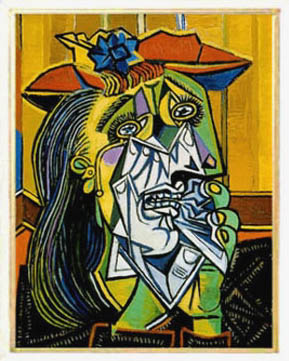
And I guess, thinking about it, that one of the purposes of this blog is to make myself look at paintings that I like more carefully, and to work out, e.g., why I like them, and how the guy did what he did.
I'm certainly not alone in liking this picture. It's one of Picasso's greatest hits, one of the ones that millions of people like. Do a google for "Picasso" "Woman Crying" and you get plenty of stuff to check out.
For example here, I found this:
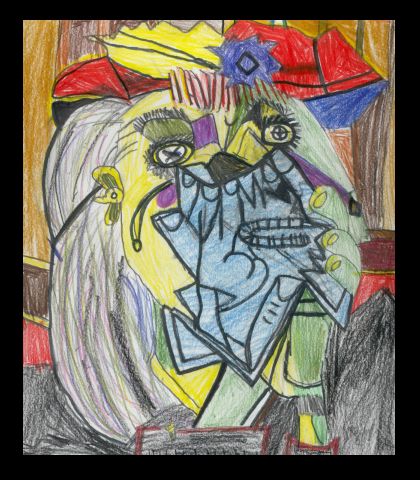
And here, I found this:
As I say, a very popular picture. Those are copies of this painting done by schoolchildren.
It says everything about my skill at looking at pictures that until I took a hard look at this picture a day ago, I never got how Picasso really did the handkerchief. Instead of making it like a regular white handkerchief, he made it white by making it transparent, but in black and white instead of colour. I literally had never seen this properly. I had just gaped at the whole thing, the general effect, and you know, liked it, and thought she looked very sad. But if you had asked me to reproduce this picture, the way the kids who did these copies reproduced it, I'd have got absolutely nowhere. I have yet to scrutinise it remotely as thoroughly as they did. If I did, I'm sure I'd have at least another dozen wonders to recount.
They didn't get her right though. The original is miles more exact, miles better. The draughtsman has her looking startled, and the computer graphics guy only has her going through the motions, as if she were at a funeral. Comparing the original with these copies also made me look at the original much more carefully, and see its virtues by seeing the differences.
The hat adds to the effect, I think. It does indeed suggest a funeral, rather than just a regular sad circumstance. And by having the woman dressed more formally, it makes the extreme … "informality" isn't the word … more like non- or anti-formality of her grief all the more potent, by contrast.
And then there's that characteristic twentieth century thing of the painting being very, very obviously a painting, very obviously not a photograph, and yet packing an emotional punch which draws you in past the obvious non-realism (for example the excessive colourfulness) of what you are looking at, right into the drama. I think it is this contrast which makes this painting such a popular favourite. The painting is both intensely artificial and intensely real.
Such are my thoughts on "Woman Crying".
The other night they showed a movie on BBC2 called Pie in the Sky, about a young guy whose passion was traffic broadcasting. His hero (played by John Goodman) was a broadcaster who could, from his helicopter, sense as if by instinct the motions of the traffic, forthcoming jams, etc., and by issuing some profound instructions to the journeying motorists, could unscramble the mess and see everybody home quckly and safely. When the Goodman character came to work drunk, our young hero got to demonstrate that he too possessed this gift.
There was plenty of sexy romance, involving two of my favourite actresses, Anne Heche and Christine Lahti (separately I mean), Heche being his first-love-next-door (literally) and Lahti the older woman who takes him in hand, lucky boy. The one name I didn't catch was that of the actor playing the young guy himself. (Here's the movie website, and his name's Josh Charles.)
One of the pleasures of movie fancying is discovering lesser know movies that you really like, and then watching them gradually become established as really nice movies that lots of other people turn out to like also, and seeing them get four stars in the Radio Times and start to creep into those lists of people's all-time favourite movies, even though when first shown they seem to attract no attention. What I mean is, they attract the opposite of the sort of jibber-jabber that now surrounds the very mediocre (by all accounts – I've not seen it and don't intend to) Matrix 2.
Here are two more movies that I would place in that category, of delightful, but not often talked about, or not in my vicinity: Into The Night (starring Jeff Goldblum and Michelle Pfeiffer), which is a romcom/thriller and Some Kind of Wonderful (written and produced by John Hughes, starring Eric Stoltz), one of those high school romcom/class warfare teen movies, but just done really well, and very charmingly.
Of course it could be that being a London libertarian, all I ever get told about are special effects, SF, slam bang, "I'll be back" movies, and that somewhere else in the politico-social landscape is a great hubbub of girlie conversation about non-special-effects type date-movies of the sort I find I like more and more.
Nothing profound today. But something wondrously superficial, courtesy b3ta.com, a major fountain of internet weirdness and fun.
I don't know why, since I have deleted all trace of the Cool Cat below from this Blog at the input end, two identical versions of the posting seem as I write this, still to be there, at the reading end.
I think it must be my "server"? It is very slow for all the blogs based there just now. That must be something to do with it.
Don't be surprised if this posting materialises more than once also.
Not a lot here today. I have, however just done a piece about a car advert, cultural nuances etc., for Samizdata, which explains a lot, in a roundabout way, about why I started this blog. I didn't say that there, and link to here, because this isn't looking pretty enough and organised enough yet, but now that you're here, and if you want something which is both me and cultural, read that.
If more Frenchness appeals, there's also this, posted just before my bit. David Carr and I wrote independently and posted at almost the same time.
Here's a quick first response to a blog that came to my attention via comment number four on this posting at Samizdata. Here's the permanent spiel at the top of City Comforts Blog:
Cities, architecture, the 'new urbanism,' real estate, urban design, land use law, landscape, transport etc etc from a mildly libertarian stance. Our response to problems of human settlement is not "better planning" and a bigger budget for local government. But alas, conservative and libertarian (not the same, to be sure) response to land use issues is barren and in denial. Our goal is to help foster a new perspective.
I love it.
In the very first posting I look at, there's a link to what David of City Comforts says is an interesting discussion about car parks at something called Tinotopia. Mr Tinotopia credits Patrick Crozier with asking about why car parks car parks are so ugly at Transport Blog, but I actually think it may have been me at Samizdata, although I was commenting about something Patrick had linked to about how politicians like trains but people prefer cars.
Whoever, I find all this linkage extremely encouraging. David (the City Comforts man), thanks for getting in touch, albeit in a roundabout (get it – a car reference – a type of road junction – oh never mind) way.
I am going to do a lot more rootling around both in City Comforts and in Tinotopia.
Here's a quick first response to a blog that came to my attention via comment number four on this posting at Samizdata. Here's the permanent spiel at the top of City Comforts Blog:
Cities, architecture, the 'new urbanism,' real estate, urban design, land use law, landscape, transport etc etc from a mildly libertarian stance. Our response to problems of human settlement is not "better planning" and a bigger budget for local government. But alas, conservative and libertarian (not the same, to be sure) response to land use issues is barren and in denial. Our goal is to help foster a new perspective.
I love it.
In the very first posting I look at, there's a link to what David of City Comforts says is an interesting discussion about car parks at something called Tinotopia. Mr Tinotopia credits Patrick Crozier with asking about why car parks car parks are so ugly at Transport Blog, but I actually think it may have been me at Samizdata, although I was commenting about something Patrick had linked to about how politicians like trains but people prefer cars.
Whoever, I find all this linkage extremely encouraging. David (the City Comforts man), thanks for getting in touch, albeit in a roundabout (get it – a car reference – a type of road junction – oh never mind) way.
I am going to do a lot more rootling around both in City Comforts and in Tinotopia.
There just about to show Where Eagles Dare on Channel 5, and what with my digital reception being state of the art but my taping of digital being as crap as ever, I'm going to watch it and, more to the point, listen to the start of it.
For how did they pre-announce ("after the break") this movie? Why, with a single ra!-ta-ta-ta-tat! from a drum of course, because the music that starts this movie is as unmistakable as Ravel's Bolero. The film is junk, pretty much, with a plot the Clint Eastwood surely doesn't understand to this day. But oh those opening credits, a mixture of militarised and Wagnerised Elgar (Enigma Variations in particular) on the rest of the orchestra, and Nazi oppression (i.e. scary but with artistic flare) from the drum section. It must have been on the strength of this music that Ron Goodwin was chosen to replace William Walton, no less, as the composer of the music for The Battle of Britain, unless I have my dates in a twist and it was vice versa.
Lion growling. And here it is. Blue mountains. And now the drumming starts. Red gothicky Germanicky lettering with the opening credits. Heaven. Pure heaven. I'm extremely glad that Hitler didn't invade my country, during the years just before I was born, because I just might have made a great little Nazi. As it is, I'll never know, thank goodness.
The one other thing worth mentioning about Where Eagles Dare, unless you are obsessed with those ski-lift/microbus thingies or with the German actor (who actually ran away from Hitler in 1939 but spent the rest of his life playing Nazis in English language movies) Anton Diffring, is that it is where Broadsword Calling Danny Boy got their name. Richard Burton says that into his radio set, a lot.
There was another of Alice Bachini's literature-disguised-as-waffling pieces yesterday that I enjoyed reading, and it is very cultural, under the surface, as it were. She's been tidying her house. Why, she asks herself, has she been tidying her house?
Why do visual aesthetics matter? Well, (for a popular and irrefutable start-off) for the same reason that art, music, beauty, sex and love matter. Because they are pleasing, and enjoyable, and make us happy, and happy people are nicer and better at doing good things and living wonderful lives. If you don't believe me, try putting on a tape of what it's like to have tinnitus all day every day. Or vandalising your possessions with a spray-paint-can and a Stanley knife. Or surrounding yourself only with things you find visually repulsive. The more hours you have to spend in such an environment, the harder it will be for you to get good things done while feeling great. Surroundings matter. Beauty makes people feel good.
I tried to write some complicated comments about this, to do with the falling standards of cleanliness of my class, which is the well educated but badly paid and downwardly mobile class and the fights back when it comes to raising its clever children class. But I don't think you can generalise about these (us) people. Some of us became scruffs in hovels, in about 1965, in a sudden puff of dust. I did. But others rose effortlessly out of the detritus in 1978, and have lived lives of effortless cleanliness ever since.
I do think, however, that in some minds there is a link between dirt and poverty, and between poverty and virtue. The deduction that follows from that is not hard. That could be a new word: dirtue. And: dirtuous. We've all been in dirtuous houses. Anti-globalisation demos are: dirtuous. Yes, we have a new word clutch.
I am watching CSI: Crime Scene Investigation. What is the appeal of this show?
It has lots of beautiful looking Americans. They are dealing with much more miserable stuff than most of us are, but importantly miserable. Murder is importantly miserable. Having to talk sternly to a subordinate for being a bit crap at his work is just miserable and nothing else. Having to rewrite something we thought was perfect is just miserable. We can escape to a world of important misery.
They are dealing with it, thereby reassuring us that such things are being dealt with. It is, in short, the old "trouble in paradise" formula. Paradise lost. Paradise regained by the end of each episode.
Paradise in England means looking okay, and living in a fabulously beautiful place, like Fantasy Oxford, or Fantasy Rural Village, with lots of Fantasy nice people, and Fantasy little shops selling Fantasy produce. The American equivalent is that you look Fabulous. So the CSI people are all in paradise, apart from the obligatory fat guy who makes the others look more Fabulous.
And it's all beautifully photographed. Not only do all the characters look great. It looks great. (Except that they are troubled by important misery.)
Not enough is said nowadays about how great TV looks. Watch a tennis match, or a chat show, or some idiot reality TV show. Switch the sound off. Chances are, every other shot is a Rembrandt. Does that sound daft? Maybe it's because I'm first generation TV and you aren't.
I first saw a decent modern colour TV set when I was about twelve, and it was fabulous. I can still remember the utter amazement of these magical machines. Until then, we didn't have them. Imagine watching, I don't know, test match cricket, in clunky black and white, and then seeing it in full colour. It's like seeing a colour movie for the first time, or a talkie after all you previously had had was a lunatic at an organ. You, on the other hand, grew up with colour TV, and you take it for granted. But when I was a kid, we didn't have it at all.
And CSI makes maximum use of the photographic excellence that is now possible. All those shiny, perfectly lit recreations of bullets going into bodies, of weapons slamming into bodies, of blood dripping from bodies to floors.
Above all there is William Petersen. For once we are spared the spectacle of a Man in Charge who is poised on the edge of throwing a huge temper tantrum. He seems so serene, so content, like a brain surgeon or a concert pianist, patiently going about his work with supreme calm and supreme authority. A hero for the age when yuppies have mutated into grandparents. It doesn't matter what horrors the world throw at us while he is on the watch.
Presumably one of the purposes of a blog like this is to recommend works of art - or, in the case of classical music, performances of works of art - which might otherwise not come to the attention of interested readers. Recommending a recording by one of the all-time greats is somewhat superfluous, although it can still make sense if you've something special to say about it. But perhaps it makes more sense to give a tiny blog-push to a career that has never quite caught fire, or to one which, although crackling along nicely, is still in its early stages.
In this latter spirit allow me to commend to your attention a beautiful Chopin CD, by Jon Nakamatsu.
I first heard this on Radio 3. I often start Saturday morning by listening to the BBC's Record Review, but don't always get up before or while starting to listen to it. Sometimes I doze off again. So it was one Saturday morning about two years ago. When I re-awoke it was to the heavenly sound of this recording, and in particular to track 5, the Fantasy on Polish Airs op. 13, which I notice is listed at the top of the list on the cover of the CD.
And it is no wonder, for it is a wonder. It is not one of Chopin's very greatest pieces, but all disbelief is suspended during Nakamatsu's playing of it, the delicacy and accuracy of which is remarkable. As a reviewer at the site reached by my first link above says:
Mr. Nakamatsu's Chopin interpretation is absolutely beautiful and poetic, and it does not suffer from the quirky eccentricities that some performers add into their interpretations - instead, it is fresh, clear, precise, dynamic, and captivating.
Exactly so.
There are many ways for piano recordings to be wonderful, and being "perfect" is only one of them. Nevertheless this is very special indeed. I can sum up the pleasure I get from this CD by saying, first, that I entirely agree with and like and admire what Nakamatsu is trying to do with each piece, and second, that I have never had more strongly the feeling that the pianist is getting exactly, in all possible respects, what he wants.
Nakamatsu's most recent recording is of the Rachmaninoff Third Piano Concerto, a favourite piece of mine. I have not heard this, but am not as impatient to hear this as you might expect. This is because this is not a piece which responds well to "perfect" performances, or even performances which aspire to perfection. My favourite performances of Rachmaninoff 3 are the ones that go for broke, and which get far further than a perfectionist like Nakamatsu might dare to attempt. I may take all this back when I hear Nakamatsu in this pece, but reviews I've read suggest that my fears may prove justified. (By the way, I now have a copy of the recording that I wrote about at the other end of that link.)
But the Chopin disc is wonderful.
One of the oddities of Samizdata is that comments come in on postings long forgotten. Usually they can be allowed to settle back into the archives, but there was one a day or two ago, on the subject of the the aesthetics of car parks, which I found interesting. Says David Sucher:
Not exactly on point but if you are interested in parking (and the reality is that urbanism starts with the location of the parking lot) take a look at …
… and then he supplies a link to a site peddling automatic car parks.
The original posting said that since car parks make up such a large part of – and an increasing percentage of – the surface of the earth, wouldn't it be nice if they looked a bit nicer? Yes it would.
One way of making car parks nicer would be to just make them nicer, the ones we already have, the ones we now drive into and park our cars in. But another way is to turn parking a car into an automatic storage problem, which has the potential to make car parks far more spacially efficient, and that is very relevant to aesthetics. The aesthetic problem of so many car parks is that they tend to sprawl so horribly all over the landscape.
Benefits of the automatic parking system include: optimization of space utilization, security (vehicle and personal), convenience (all ground level access), lower garage owner's liability insurance, greater depreciation schedule, lower lighting and ventilation requirements (no cars driving around inside; no people go inside), and lower emissions and less pollution (clean parking system).
That sounds like something that would be a lot cheaper to decorate nicely than your usual multi-story.
So even if on the face of it these machines are as ugly as sin, they are nevertheless a great aesthetic contribution to city life, and to life generally. If these things can be got working in city centres, why not eventually at more out-of-town spots like sports stadia and shopping centres?


