

For the last couple of nights I've been watching a fellow Brian, Brian Wilson, former senior Beach Boy, on the telly, playing Beach Boy music, but at the age of about sixty. And I watched and listened with a sort of ghastly fascination.
You can see the problem right there in the name of that group. They weren't called the Beach Boys for nothing. And there was something really odd about watching this sixty year old guy, who looked more like a Democrat Presidential Candidate than a pop singer, singing boy songs, in an old-guy-trying-to-do-a-young-guy voice.
The story is that … Well, other people know the story far better than I do, so let one of them tell it:

BEACH BOYS star BRIAN WILSON has played the 'lost' album 'SMILE' for the first time ever in London.The singer played the first night of a residency at the London Royal Festival Hall this evening (February 20), the first dates on a tour which will visit other cities throughout the UK this month.
The gig itself was split into two sections. The first opened with a fifteen minute acoustic set, followed by a ‘Greatest Hits’ show. During this, Wilson, backed by an 18-piece band, performed a number of songs from 'Pet Sounds', including God Only Knows' and 'Wouldn't It Be Nice'.
After a short interval Wilson then returned to the stage where 'Smile' was played for the first time in full.
The RFH audience were there to worship and to adore, and they did. But me, I just thought, what a pity it wasn't finished and recorded in 1967, like all those other great Beach Boy tracks like Sloop John B, Good Vibrations, California Girls, and the rest of them. What a pity it sounded rough and live, instead of perfectly produced like those old numbers. And sounding rough and ready and live, it didn't sound to me like music that was anything like as great as the audience obviously thought it was.
Beach Boy music, it occurs to me, is like the string quartet repertoire. Once you've heard it done properly, note perfect, perfectly in time, perfectly in tune, then anything not as good as that is just not good enough, and you almost suspect the music itself of being second rate. This was pretty good music, and the playing was often pretty decent. But I wanted perfect young voices, and perfect sounds to back them.
A lot of rock and roll music sounds fine if it's sung by old geezers, forty years after they first did it. The Rolling Stones sound as great as ever, in my opinion. But the purity and innocence of the Beach Boys, rehashed by an old guy, sounds undignified to the point almost of insanity. For me, there was even a whiff of, say, a very old Bette Davis trying to act like a teenage girl. That Brian Wilson has not always been completely, er, in control of his thought processes, only, for me, added to the extreme strangeness of it all, to put it no more strongly than that. But I'm sure that any suggestion of this that the worshippers felt only added to how much they loved the man.. That their hero was prepared to brave the scorn of unbelievers such as I only added to their adoration. And if they felt anything of the sort that I felt but suppressed the thought with another that went: better late than never, well, there I thoroughly agree. It was a remarkable occasion.
The worshippers will buy the live recording of the event, and will love it and treasure it. Me, I actually look forward to a cover version, done as well as those classic early tracks were done, with young voices and perfect electronically synthetic music instead of rough and ready and live music.

Today I was in Oxford Street and spotted – and hastily snapped – one of my favourite things, this back of bus advert:

It's one of my favourite things because it combines three of my favourite things: Johnny Vaughan, London double decker buses, and the Erotic Gherkin. This is an advert for Johnny Vaughan's Capital Radio breakfast show, as you can see if you look carefully.
I'm trying to think of a new building in London which has been such an instant hit. The only other one I can think of which has been comparably successful is what began life as the Post Office Tower, and is now, presumably, called the BT Tower, although by now it could be something else again.
I can't help comparing these two popular hits with that lump out in Docklands, the Canary Wharf Tower, which impresses mostly because it is so big, but otherwise hardly at all. I've recently taken a couple of trips to Docklands. More about that when I've the time, and have mulled over the wording some more.
For another fine use of a bus, see the last of these pictures.
I missed this piece about one of my most favourite musicians, Keith Richards, when it first came out nearly a week ago.
He doesn’t exactly look like your average squire, Keith Richards, with his piratical swagger and a complexion that’s been compared to old cat litter. But Keith, who turns 60 next month, is emerging as one of the most shockingly normal, and English, of rock stars, as well as one of the most self-aware. 'I can be the cat on stage any time I want,' he said some years ago. ‘I like to stay in touch with him.... But I’m a very placid, nice guy – most people will tell you that. It’s mainly to placate this other creature that I work.'Keith’s paternal grandparents were both well respected councillors in Walthamstow, where his grandmother served as the first female mayor. His maternal grandfather was a first world war hero. Keith’s father was among the first to hit the Normandy beaches on D-Day and was badly wounded as a result. He was later cited for conspicuous gallantry. Some discrepancy, then, between the raised-by-wolves legend of Keith’s upbringing and the reality, with its emphasis on duty, rank and sound traditional values. He enjoyed singing 'Zadok the Priest' to the new Queen in 1953 and was a model Boy Scout, as well as a dab hand at sports.
Which precisely accords with my understanding of the particular virtues of his music-making, which seems to me likewise to be very orderly, deeply traditional, and highly disciplined.
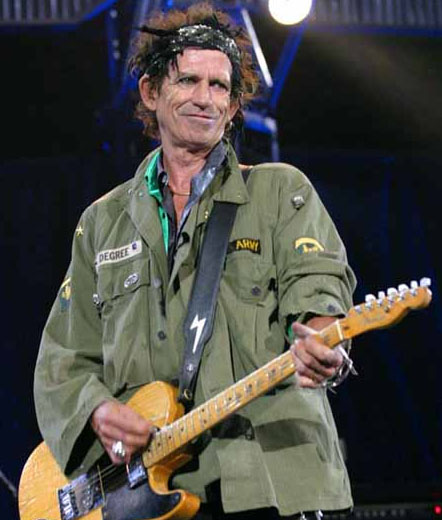
More and more, Rock and Roll seems like World War III, but without so many casualties, and fought by the descendants of the alpha-warriors in the previous two wars, the ones with all the casualties. That is certainly the way the the old Rock and Rollers themselves talk about it. All that "getting out of it alive" stuff. Even the wearing of mock military uniforms starts to look less like a mockery and more like a straight acknowledgement of their true spiritual (and in Richards' case literal) ancestry.
Dave Shaw took a walk last night on what passes for the wild side these days among middle aged geezers like him and him. But Kelly Osbourne, whom he apparently shared the party with, is hardly wild side. She was on Top of the Pops with dad Ozzy last week, singing a potential Christmas Number One Dad/Daughter Duet for gawds sakes. It was very sweet and all, but not exactly biting heads off bats stuff like Ozzy used to do. So I'm told. The real wild child of the Osbourne family is the mysterious Other Daughter who refuses to be on television. How weird is that?
Jonathan Ross also interviewed Ozzy and Kelly on his show last week, and compared Ozzy to the Queen Mother. Quite right. I think the link is that they both have (had in the QM's case) a public reputation for total honesty. Quite how genuine that was with the QM I don't know, but with Ozzy it seems very real. For example, the other night on The Osbournes, Ozzy was in a state about his wife's colon cancer and was being consoled by this Guru character, who was blabbering away in that special language that Gurus use which you can't remember a single word of because it makes extremely little sense, and I was thinking: "What the fuck's that all about?" One microsecond later, Ozzy says: "What the fuck's that all about?" How can I not love the man?
Such magic moments as that aside, the appeal of the Osbournes is that despite all the swearing and adolescent whingeing and moaning, and Oz's very evident history of drug abuse resulting in slurred syllables, they are, underneath all the underclass modernisms, a totally trad family. They love each other. And that mum, how about her? She stays at home, and looks after everybody. No separate career for her. Her only job type job is taking care of about two thirds of Ozzy's job.
What we are witnessing here is the ossification, not to say Ozzyfication, of rock and roll, in the same way that jazz based pop music finally arrived at its terminus in the nineteen fifties, just before rock blew its lid off. It started off being belted out by dodgy negroes in drug sodden brothels, and ended up being sung by Tony Bennet in a cardigan on some TV Christmas special. Now rock and roll has reached the same situation.
It's inevitable. You can't stop this kind of thing happening.
The proof that the rock and role era is ending is that it is more and more making its peace with the stuff it used to hate. Rod Stewart has an Xmas album out now of pre-rock tunes, full of witty, perfectly rhyming lyrics like they stopped writing in 1952. The latest pop babes routinely cover tunes that were written before they were born, and the air is thick with the sound of different generations getting along fine with each other.
Time for another inter-generation war? Is there some other rough musical beast slouching towards Bethlehem? Maybe there already has been, but by definition I hate it and have been ignoring it. (Dance, hip hop, etc.) But what if the Tony Bennet/Beatles discontinuity was a one-off? What if pop music just dribbles on for ever, getting nicer and nicer, more and more like Abba every year, and the rock and roll explosion of Devil Music never happens again? Maybe the next big row will be with a new generation that doesn't like any pop music at all, and prefers to spend all its time getting post-graduate degrees in nanotechnology, or some such freakery.
Not that pop music will necessarily be crap, any more than Mahler is, even though he was using a musical instrument pretty much perfected the best part of a century earlier. Sting's latest tune, for example, another male/female duet, sounded to me musically really good on Top of the Pops, despite the ghastly more-American-than-the-Americans accent that Sting sings in and the overwrought manner of the woman he was duetting with. I'd love to hear that one covered by a batch of kids from the reality TV pop idol fame game circuit.
By the way, talking of the Devil's Music, Ross Noble on Room 101 identified Christian Rock as something that should be wiped out for the challenge to everything properly indecent that it is. Is there anything more nauseating than a bunch of vicars imitating the Beatles? Well, yes, lots of things, but it is nauseating.
As you can tell, I spent the night in, in front of the telly.
It's late, I've just had a pint of lager, and I have a phone call I want to make really soon. So, just to say, by way of meeting my daily quota (one), that Stephen Pollard has up at his recently revamped blog one of his typically argumentative and in-your-face pieces to the effect that Beethoven is just plain better than the Beatles, so there. Which is a lot more true than false, I would say, if you are only allowed those two boxes to put your response in. Sample paragraphs:
We’ve been here before. Christopher Ricks came at it from the opposite perspective in the 1970s, arguing that Bob Dylan’s lyrics were great poetry. A couple of years ago he argued that Dylan’s song Not Dark Yet ranked alongside Keats's Ode to a Nightingale. Others have made similar comparisons, such as Eric Griffiths’ consideration of Talking Heads alongside William Empson in his Cambridge lectures during the late 1980s.I look at what they say, at their specific, detailed, academic attempts to equate the two, and my reaction is simply to laugh. To me, it’s self-evidently preposterous – about as convincing as arguing that a finger beating time on a desk is as musically rich an experience as an Angela Hewitt performance of a Bach Partita.
Okay. Keats's Ode to a Nightingale outscores Bob Dylan's Not Dark Yet in the Pollard great-ometer.
But what about Salieri compared to Benny Goodman at the height of his considerable powers? How about the (numerous) wind quintets of Reicha, compared to … Jimmy Hendrix? Which wins between the Concerto for Two Clarinets in E Flat Major op. 91 by Franz Krommer (1759-1831) – a work of which I am very fond, especially when it is played as well as Kalman Berkes (sprinkle central European squiggles to taste) and Tomoko Takashima play it, on the Naxos CD of this piece, together with the two Krommer solo clarinet concertos op. 35 and op. 36 – and, say, Echo Beach by Martha and the Muffins (also terrific in my opinion)? I'm just trying to establish a principle here, the principle being that Pollard is not making nearly as much sense as he seems to think he is.
Of course a great orange is better than a bad apple, and a great Ferrari is better than a clapped-out Ford Fiesta. But how does a clapped out Ferrari compared to a brand new Ford Whatever-eo, fresh off the Ford assembly line?
What I'm really saying here is: category error! Maybe Christopher Ricks and Eric Griffiths were indeed trying to "equate" this thing with that thing, although personally I doubt that they were doing any such thing. But I don't "equate" the Rolling Stones with Haydn merely because the two of them have some musical virtues in common, which they do.
If I can also find it in five minutes I'll link to the 2 Blowhards piece which says that marking works of art out of a hundred and arranging them in order of merit is a mug's game. Otherwise I'll just mention that one of them did say this, somewhere, somewhen. (Couldn't find it quickly. Maybe part of the previous sentence will turn purple at a later hour.)
However, although as a music critic Pollard doesn't do it for me, as a provocateur journalist he certainly knows his business. He is bating the likes of me with this piece, and I have risen to the bate by responding in the required manner. I hope he's happy. Seriously, I hope he's happy. I mean that. We have many friends in common.
The Dave Barry blog is an endless source of cultural stimulation. Here's a link from him to this article, about a subject of zero interest to me, namely DJs frigging about with CDs and gramophone records in order to entertained the zonked out raving masses. Zero interest until now:
PARIS (AFP) – Want to listen to something really different? Smear yoghurt on your favourite CD. Let it dry. Slide the disc into the player. Crank up the volume. And hear that music in a completely fresh, possibly spine-chilling way.
A joke right? Of course a joke. Otherwise Dave Barry's emailer fan club wouldn't have picked it up and sent it in. But serious also:
Jones' pet area of research is how signals can be transmitted through biological cells, which grow in a so-called "fractal" way, like tree branches.He became intrigued by experimental musicians and DJs who, from the mid-1980s, sanded, varnished or even slapped paint onto CDs to create new sounds to sample.
Yes, that would explain quite a lot.
Music on CDs comes from tiny etched pits in the tracks that represent binary digits, the "0" or "1" that make up a computer code. The code, reflected back by the laser in the CD player, is then processed back into an electronic signal and converted to sound.Mutilating the surface, so that some of the pits are missed, thus changes the sound.
You don't say. But this is where it gets more interesting.
But Jones found that much subtler sounds could be achieved using fungal or bacterial growth, rather than scraping or coating the disc's surface.This is because these life forms introduce tiny errors, on a micron on nanoscale level rather than the far bigger millimetric scale.
In addition, the way fungus and bacteria can shape the sound in weird ways.
My guess is that various members of the slacker generation have already discovered this phenomenon, but didn't grasp its scientific significance.
Bacteria grow by cell division, while fungi grow by branching. Both processes can be controlled by adding malt extract to the disc as food.Jones told New Scientist that he came across the discovery quite by accident, when he was DJing in his bar.
"I often change CDs when my hands are wet with beer," he told the British weekly. "One night I must have changed the CDs, touched the data surface, then left them for use on another night."
The following week, he put on a CD by Nine Inch Nails and found that it would not play properly because fungus had grown on it.
Don't you just hate it when that happens? Besides which, when did a CD by "Nine Inch Nails" ever "play properly"? But now I'm showing my culture.
But the fungus had not ruined the disc. …
Of course not. How could noises made by some nine inch nails be ruined? All they could ever be is different.
… The original audio sequence was there, but it would sometimes change in pitch and there were small staccato noises in the background.
And now the eureka moment.
He asked himself: "What would happen if I purposely grew fungi, yeast or bacteria in direct contact with the media, and manipulated their fractal dimensions?"
That's my question of the year so far.
Yoghurt-on-a-disc was born.Jones says that he has yet to damage any of his discs or players with his pioneering work, but warns that the technique does crash CD players on computers because the software cannot cope.
Ah, the grand tradition of scientists pissing about and calling it research. "Head ache Jones?" "Yes sir. Rather too much fractal fungoid sonic analysis last night, sir." "Take it easy Jones, you're a valuable man." "Will do sir."
The internet will soon be awash with these noises, I think. Fungoid fractal sonics. I hate it already.
I just checked that the date is not April 1st. Unsurprisingly, it is not April 1st. It is September 13th. I mean, how could you make this story up?
Capitalism can be brutal. Whatever the rights and wrongs of it, the fact is that people are downloading-free-from-the-internet-stroke-stealing-whichever lots of music, and Big Music has yet to invent a version of electronic barbed wire which doesn't threaten to reach out and wound the innocent, for instance by wrecking the PC of a listener whose only crime is to want to listen to a CD on it, or else simply by snooping on absolutely everyone in a way which threatens to undermine western civilisation and all that it stands for. So, Big Music is cutting its prices:
Battered by online piracy, the Universal Music Group, the world's largest record company, said yesterday that it would cut prices on compact discs by as much as 30 percent in an aggressive attempt to lure consumers back into record stores.The deep price cut — the only one to apply to new CD's since the format was introduced in the early 1980's — represents a gamble by Universal that more consumers will buy more CD's once the price dips below $13. It also reflects the profound degree to which Internet file-trading has managed to undermine the music business, Universal executives said.
"We are in the middle of a terrible situation where our music is being stolen," said Doug Morris, chairman of Universal, which includes labels like A&M and Island Def Jam and artists like Eminem, Elton John and U2. "We need to invigorate the market, and as an industry leader we felt we had to be bold and make a move."
Under the new pricing scheme, Universal would lower its wholesale price on a CD to $9.09 from $12.02. The company said it expected retail stores to lower CD prices to $12.98, from the $16.98 to $18.98 they now charge, and perhaps to as low as $10. When CD's first arrived on the market they cost $15.98, and have climbed from there.
The usual what-do-I-know? caveats apply with more than usual strength here, but I can't see this working. These lowered prices are still way high enough to keep the thieves thieving, but could do terrible damage to Big Music profits. It's one hell of a gamble. "Bold", like the man says. ("Courageous" is the Yes Minister version of that adjective, as in "stupid".)
I've also noticed another Big-Music-threatening syndrome that rattles about inside my head in circumstances like these. While DVD prices have been falling, I've caught myself saying, when confronted with a price of £7.99 down from £9.99 down from £12.99 down from £19.99: "Wait! There's more to come." A lowered price which I guess may actually only be a lowering price causes me to hold off until they make it an official fire sale.
We'll see.
I've always loved the Rolling Stones, who are being worshipped on BBC1 as I write.
This is because I have always loved classical music, and the Rolling Stones are classical music par excellence.
The Beatles were great, yes, but they were what I would call "imaginative". Their songs were composed, with all their la-di-da tunes that went wandering off all over the place, under the influence of all sorts of drugs, and with all manner of orchestral instruments in the background. The best Rolling Stones tracks are like discoveries. They weren't so much composed as dug up, revealed as always having been there. Their best tunes, by which I simply mean their great, popular rock and roll standards, have the same absolute rightness about them as have the cantatas of Bach, the string quartets of Haydn, the piano concertos of Mozart, the songs of Schubert, or the symphonies of Beethoven. Ah, they're playing Brown Sugar now. Everyone loves that, and count me in.
Lots of people loved the Rolling Stones because they were rebels. I loved them because they were musical … not conservatives exactly, but the originators of something which musical conservatives from then on would always want conserved. I never took to all that sex drugs rock and roll lifestyle stuff. It frightened me back then and it frightens me still. For many of my contemporaries it felt like a personal liberation. To me it looked like the alpha males on the rampage, and alpha males are always scary to all the gamma and delta males, and I was a timid little creature way down the Greek alphabet, plenty of brain but no hormones to speak of. Everyone has their ideal age, and nineteen was absolutely not mine. I think that those who said that all that stuff was a threat to social decency and social order were quite right. But then there was that beautiful music.
If you want to go all Music Professor about the Stones, I suggest you concentrate on the first few bars of those best tracks. The best Stones openings are sheer genius. How they work is: you put together your Stones track (this is if you are a Rolling Stone – I'm not suggesting you try to imitate this procedure with your stupid little band) with the words and the tune, the lead guitar part, the bass guitar part, and the regular drum beat. Then you introduce each bit separately with the least obvious and most rhythmically mysterious one coming in first. Often this would be a guest instrument, like that cowbell thing for Honky Tonk Women. Or it would be a regular instrument played in a really weird way, like the guitar playing at the start of Gimme Shelter. But sometimes it would just be the offbeat lead guitar riff (riff? is that the word?) as in Brown Sugar. Anyway, you add the various musical lines in ascending order of musical obviousness, and finally the machine is up and running. When it works, this kind of thing takes you to musical territory only previously inhabited by such things as the opening of Beethoven's Waldstein Sonata or of things like Mozart's Dissonance String Quartet (where the key and the tune is kept a secret for about fifteen bars much as the Stones start a classic track by keeping the rhythm a secret). Now we've just had the opening bars of Start Me Up, and the game there is you can't for the first second or so work out what the rhythm is. Rhythmically, a parallel would be the opening bars of Schubert's Unfinished Symphony, where you can't tell if it's in 3/2 or 2/3 or whatever it's called. DA di di DA di di, or DA di DA di DA di. Central to all this is Keith Richards, as already stated here: one of my all time favourite musicians.
This all may sound rather Pseud's Cornerish, but the point I want to make here is, it's the music. Not the drugs and the drug busts, Marianne bloody Faithful, the stupid funny voices and the imitations of them by their youngers and worsers on the telly. It's the music. The fact that this music used to emerge from Human Threats to Everything Decent didn't matter. It didn't matter when it became clear to everyone that the Rolling Stones were actually pillars of society and no more of a threat to the Establishment than Dame Thora Hird, and that it will soon come out of old men who wouldn't be out of place as characters in the Goon Show. All that is a good laugh and everything, but is of no consequence to me. It's the music.
As for going to Rolling Stones concerts, I think I would feel much the same about that as I find that I do about going to live football matches. I prefer it on CD.
I still can't get my video recorder to record digital channels properly, but oddly enough I find I'm minding this less that I thought I would. There's something to be said for seeing TV when they show it or not at all. Now that there are so many channels, most of the good stuff will be back again.
Last night I watched a show about the great Chuck Berry – called Hail! Hail! Rock 'n' Roll! The basis of it was a concert arranged in St Louis, featuring Chuck Berry and a lot of his songs of course, and organised by Rolling Stone Keith Richards, who is one of my favourite musicians in the whole world. Richards wanted posterity to have a record of what Chuck Berry sounded like with a crack collection of real state-of-the-art rock and roller musicians backing him, instead of the usual cheap as-founds he usually worked with. So, as well as Richards himself, there were Eric Clapton (who looks disturbingly like BBC trash TV "personality" Jeremy Beadle), and two other black guys whose names I don't quite now remember but should. Robert Cray? Anyway he's done Rolling Stones tours and obviously knows his Rock and Roll stuff. Plus there were walk ons from other celeb fans of Berry, like Julian Lennon and Linda Rondstadt.
I found the effect curiously disappointing. It was as if the confident we-know-how-to-really-do-this bunch of guys behind him managed to turn Chuck Berry's personal style into a more homogenised, all purpose rock and roll sound, less dominated by Chuck himself and more impersonal and industrialised. His normal method was to just show up on his own and whistle up three … in Britain we'd call them pub musicians, and then play, with the backing people just adding whatever they could manage, but with Chuck Berry making all the moves that mattered with his own voice and with his own guitar.
The impression given was that Berry lived and performed as he did because he had a chip on his shoulder about all other members of the human race about a yard deep, ever since he had some underage sex spat with the law and got sent to prison. I wonder. Maybe what he really wanted was to be musically on his own, and he tolerated the attentions of Richards and his swanky rock and roll aristocrat friends not because he really believed in what they were doing for him, but because one week of putting up with these annoying persons would guarantee such a ton of record sales, bioth now and for ever and ever ay-men. In addition to be being a musical and lyrical genius, Berry is also a canny businessman.
The good news was that you could hear Chuck Berry voice, which was still very good and strong, with absolute clarity, and therefore also his truly outstanding lyrics also.
Rock and roll lyrics are for many groups a mere excuse for the bloke at the front to yell incoherently and and for the rest of them to thrash away at their instruments and for the audience to wave their arms in the sky and go mad. Who cares what it says? Who cares what it means? The words are usually inaudible anyway, and thank god. Compared to that, last night was a breath of fresh air. Berry came through on this film as the true poet that he is, not just when singing his songs with their perfectly crafted words, with their rhythms exactly fitting the instrumental patterns, but when prefacing a song about a car dealer with a little impromptu piece to camera about his own little car collection, most of it litearally kept under wraps. Dealers won't now give him a decent price, so he's going to hang onto them and then sell them for fifty thousand dollars, with the "fifty thousand dollars" spoken as if it was the last half line of a Shakespeare sonnet, delivered with all the sophistication and poetic beauty of someone like Ian McKellen. It's a big mistake to see Chuck Berry merely as the man who invented headbanger electric rock and roll, even if he pretty much did.
The weather in London now is pretty much as I imagine it down there in the Southern United States, in "Delta Country", very hot and very humid, so it fitted all this perfectly.
Today there was a totally irrelevant comment, attached by some woman whose husband done her wrong, to this samizdata piece of mine, which was about the last US superbowl football match, which was won by the underdog Tampa Bay Buccaneers. (Samizdata writers get get email notification of all comments on their stuff, however daft the comments may be.) This caused me to re-read what I'd said about the Superbowl, and I also read the comments.
And, I came across a comment of my own on the subject of the singing of Celine Dion. Most of the comments were about sport, so this comment is never going to get rescued and shown to posterity if I don't do the disinterring myself. Here it is:
Yes, the Celine Dion thing is interesting. Normally I can't stand the way this woman sings. I think what I hate is that she performs every damn song she ever sings, invariably about her troubled relationships with her boy friends, as if she was singing God Bless America in a huge and packed football stadium, and what sane woman would do a thing like that? But this time she was singing God Bless America in a huge and packed football stadium.
I really like that, though I say so myself, which I did.
More great pop music commentary from Alice Bachini yesterday, mostly about the pro-capitalist pro-anarchist Sex Pistols. I commented a couple of times, and then I realised that I should send all you gigantic hoards of readers of this over there as well. C'mon everybody.
There's a good piece of culture blogging over at Alice's, about how her generation sat around listening to that Punk Rock music and baaaad-mouthin' their country. (And who am I echoing there? Answers please in the comments section.) Also, there's good stuff about hippies, as exemplified by Neil of the Young Ones. Alice has all the links you'll need.
Did I ever tell you that when I lived in Newcastle during my Youth, I wore thick NHS glasses, and when I took my regular trousers to the cleaners I wore my thin ones, and the youths of Newcastle would yell "Ha way Elvis" at me, which was odd because I do not look at all like Elvis Presley. Question mark. Maybe, maybe not. Anyway, one day I had the shock of my young life when I saw a giant cardboard cut-out of myself, wearing thin trousers, in the window of a record shop. Elvis Costello.
Nothing profound today. But something wondrously superficial, courtesy b3ta.com, a major fountain of internet weirdness and fun.
While googling for a link to the Kempff/Leitner/Beethoven recordings discussed in the posting immediately before and below this one, I came across a site called the Enemies of Classical Music, which ought to be fun.
However, if entry number one, John Ashcroft, is anything to go by, it is not so much fun as dishonest, politically motivated nonsense.
Ashcroft is quoted saying these two things – this:
"The average guy [who] wants to go down and see Garth Brooks at the country concert, he doesn't get a federal subsidy, but the silk-stocking crowd wants to go to watch the ballet or the symphony orchestra, they get a subsidy."
… and this:
"I tend not to be an individual who has invested a great deal of my life in opera. Now the opera gets a subsidy from the National Endowment for the Arts, but, by and large, Willie Nelson and Garth Brooks don't. Those of us who drive our pickups to those concerts don't get a subsidy, but the people who drive their Mercedes to the opera get a subsidy."
Ashcroft may or may not be an "enemy of classical music". From this evidence it is impossible to tell. What he definitely is is an enemy of the unfairness, as he sees it, of subsidising classical music but not other more popular kinds of music.
Personally I go further than Ashcroft does in either of these quotes. (After all, you could interpret his words as a plea for subsidies to the likes of Willie Nelson and Garth Brooks.) I oppose subsidies to any sort of music, Nelson, Brooks, opera, the lot. And I defy Matthew B. Tepper to call me an enemy of classical music just because I don't agree with him about the government subsidising it.
I genuinely believe that subsidies for classical music have harmed classical music, especially what passes for "new" classical music. Subsidies have helped to separate new classical music from new regular music, and thereby helped to drain the life out of it. It's a point of view. And certainly not one based on hating classical music as such.
I won't expand on this point of view now, as I have a busy day in front of me. I need to get my blogging duties done and my living room dusted.
Breaking news. Britain's song apparently got NO VOTES AT ALL in the Eurovision Song Contest.
That could be wrong. But when I checked half an hour ago the UK definitely had no votes, and other countries had over a hundred, and on Liquid Eurovision they were making "no points" jokes.
Yes, by gum, it's true.
I don't watch the tunes, but this year I ignored the voting as well, which I usually like to have on. I was watching the DiCaprio/Danes Romeo/Juliet, and only checked Eurovision during one of the commercial breaks.


