

I must say, I do like this kind of thing. The USSR did fighting okay. And if it never managed to make industry work properly for real, except quite well during the war, it wasn't for want of wanting.

I think it is in St Petersburg. Wherever it is, nice sky. I got to it because the people who took this picture also took this one of a bridge, and I found the bridge, like the one below, here .
In the same series of pictures, just before the statues of these soldiers and workers, there's a statue of Lenin looking visionary and windswept. I hope plenty of these things survive. He was a total bastard, but those total bastard Bolsheviks sure knew how to bully painters and sculptors. The total bastard bolsheviks entirely deserve their places in history's dustbin, but I do hope that a decent number of their absurdly souped-up likenesses are spared.
I love a good bridge, and last night at the Samizdata blogger bash I found out about this site, which Samizdata has been linked to all year long.
I rootled around there, and this is the best looking bridge I've found so far:

Follow the link above for a somewhat bigger version of this fine picture.
The web-address for it includes "princeton", so I'm guessing this bridge is in Princeton, New Jersey. Correctional comment welcome.
In the latest Spectator, Petroc Trelawny, a regular voice in British classical music broadcasting, writes about the current travails of the New York Philharmonic.
Basically, Los Angeles and San Francisco (under the leadership of Salonen and Tilson Thomas) have made the jump, away from safe and solid programmes of Beethoven, Brahms, Mahler and so on that appeal to the traditional but ageing classical audience, and towards more adventurous fare which at least gives them a chance of a future. Meanwhile, the New York Phil has just appointed as its music boss … Lorin Maazel!
Maazel is classical music living dead. He's a fine conductor. But everything I've ever heard him say, or read about him, tells me that he takes the future of classical music for granted, and regards actually having to, you know, do anything to secure that future, anything risky, as being just too undignified for someone of his supreme grandeur to contemplate. He wafts about in his opera cloak, issuing orders to trembling orchestral musicians, his head stuck in a vanishing age, imagining himself to be at the top of his tree, seemingly unaware that it is rotting. He has recently been recording Richard Strauss, and Sibelius (again), for RCA, to, er, mixed reviews. He never seems to have a go at anything recently composed, no doubt on the not unreasonable grounds that most of the stuff recently composed is garbage. But the good stuff has been recorded to death, and if they can't find new music and new audiences, these orchestras will themselves fade away. Taking no risks is the ultimate risk that is doomed to fail.
Salonen, Tilson Thomas, and Simon Rattle in Berlin of course, know that both orchestras and audiences now have to be seduced and charmed and jollied along. Orchestras no longer care to be tyrannised over. If new audiences are not sought out, they will disappear.
At the heart of running a great orchestra nowadays is having a hall to play in with good – preferably great – accoustics. Rattle got that built in Birmingham. Salonen now has it in Los Angeles. I don't know the situation in Berlin, but I've always assumed it to be pretty good there too. (It was good enough for Karajan.) In New York, they have the Avery Fisher Hall. Inadequate, apparently. They've been trying to manoeuvre their way into Carnegie Hall, which has great accoustics, but that doesn't now seem to be working. Instead, they're going to try to refurbish the accoustics in Avery Fisher. Dodgy, apparently, according to Trelawy. Could be a costly failure.
Could this be a moment for another big lump of what David Sucher calls "starchitecture"? (I can't find the actual word here, but the principle of the thing is all explained in this posting – the money raising, and the need to get it right at ground level.) Well, they have thought of that, but the descendants of Avery Fisher have vetoed it, because Avery Fisher Hall would have to be destroyed to make way for the new place and Avery Fisher might not end up being as immortal as he is now. The Disneys of Los Angeles seem to have contrived to behave rather more generously, but there you go, I guess this is New York and a deal's a deal.
All of which is a great pity. I mean, it's not as if they don't have money in New York. The problem now is that classical music is not offering New York anything enticing to spend it on. Except non New York orchestras when they play at Carnegie Hall.
I googled "Rembrandt" and I got here and was impressed by how good the Rembrandt reproductions seemed to be, and how numerous. So I sliced off the stuff at the end of the link, and got myself to here.
This blog being this blog, I tried this, but it was pictorially disappointing. I wanted oil paintings of ships and trains, but all there was was a bit of verbiage about the Italian Futurists.
So I went looking for J. M. W. Turner. He did a famous painting of a train, didn't he? Yes he did. But just below Rain, Steam and Speed, I found Sunrise with Sea Monsters. Sunrise with Sea Monsters?? By Turner? Apparently so.
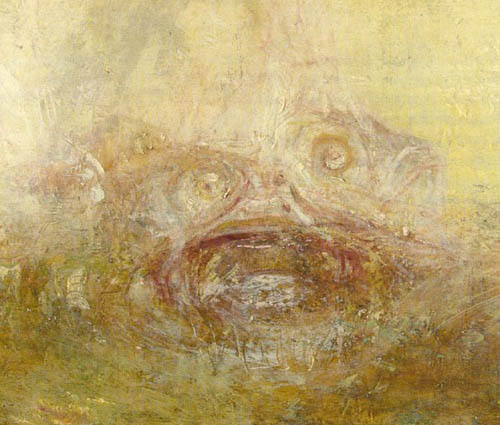
And it's in the Tate Gallery, a walk away from me. I had no idea.
I thought I'd already seen the Turners at the Tate, and maybe I did see this painting, but didn't take it in.
This post by Alice B, about the Israeli version of Big Brother, goes a long way to explaining what I am also on about here. I find most reality TV shows to be never ending excruciation myself, so I mostly don't watch them. But I don't despise them. And I completely agree that you'll never get politics if all you ever obsess about is politics:
I am constantly raging on about how political pundits only look at politics and ignore the zeitgeist. The zeitgeist is what really matters, when you want to understand a culture, and it's all around and also in the mainstream.
On the other hand, I do genuinely love this kind of thing, which is the same very approximate principle I think, but expressing itself a little differently, and I guess not quite in the mainstream. But this is also a very (in the deep and philosophical sense) political statement, I think, by Mr Wheely Man.
I love this, from Lileks today, in a Thanksgiving mood:
It’s snowing right now. Even though it’s nighttime the sky has a pearly grey light – I look up, marvel, and think "#C0C0C0" – and realize I’ve spent too much time on HTML colors.
I definitely haven't spent too much time on HTML colours, but just enough to know what he's talking about and to smile a lot.
SpaceShipOne is the gizmo that Dale Amon reports about on Samizdata, whenever it makes an advance, and I love it.
This picture is a thing of great beauty, I think:

What's fun about this is that it combines in one image two iconic technologies of our time, but two technologies which are worshipped by utterly different people. So where else but here would a picture that combines wind farming and space travelling get linked to? Well, wherever business people are trying to talk past entrenched political positions to get a simple "wow" response, from humans, I guess.
At first glance, the wind machines look small, the SpaceShipOne is only feet off the ground. But the Scaled Composites caption speaks of SpaceShipOne being "in the skies" over the Mojave, so I'm guessing looks are rather deceiving. How tall are those wind things?
Have a read of this posting on the Adam Smith Institute Blog, by Andrew Selkirk, all about how government impinges, and in a bad way, on archaelogy:
Not content with messing up future development, Britain's planning authorities are now wrecking ancient ones too.Friends of mine – I am editor of Current Archaeology – persuaded the Discovery Channel to fund them in reconstructing a Roman villa in Hampshire. Whereupon the planning authorities stepped in. And now it has been reconstructed all wrong.
The classic Romano-British villa is what is known as a winged corridor Villa. There are wings projecting forward at either end, and a low veranda running along the front. In this case, the wings were abandoned on grounds of expense - well, OK, some of the smaller villas have no wings.
But it got a lot worse when the planners stepped in. First they said that only one-story buildings in the modern style are allowed in such an area of outstanding natural beauty. Then the veranda, instead of being left open at the front, had to be built in. Finally they insisted on having a continuous roof instead of a double roof (one over the main building, and one over the corridor, with clerestory windows above the corridor).
The result is a complete farce: looking more like a boring modern farm building than a Roman villa.
And now generations of schoolchildren will visit the site - to say nothing of the millions who will see the TV programme - and get a totally false impression of what a Roman villa looks like. All because of Hampshire County Council's planning officials.Hasn't something gone wrong if planners can even insist that Roman villas should be built how they say, and not as the Romans actually built them?
Indeed.
I'm not quite sure how this works, but I love it. It's Andrew Lipson's version of MC Escher's Ascending and Descending (that's the one where they are going around in a square but upwards all the time) but done with Lego!
Presumably it has to be photographed from exactly the right angle.
Ah. It's all explained here.
I rather think you may have seen this before and that I'm the last one to notice. Oh well.
This strikes me as a good article, which is not surprising given that it was linked to by Arts & Letters Daily. It's Josie Apppleton of Spiked writing about Brit Art, Conceptual Art, Marcel Duchamp's Urinal, and so forth:
In fact, when reduced to the 'idea', most modern British art becomes banal. This is a good sign. Mark Quinn's Self (now lying in the Saatchi Gallery), which involved removing several pints of blood and freezing it in a cast of his head, doesn't succeed on the level of the idea. The idea is 'I am my blood', or something like that. As an idea, it's worse than alternatives, such as 'I am my class' or 'I am my religion'. Self is impressive as a work of art because of the audacity of Quinn's chosen material - and because of the haunting effect of the finished product, which seems to have the waxy quality of a death mask. Nauman's 'Raw War', by contrast, would lose little on being reduced to the idea.There is little point in opposing the art in the Turner Prize with some fixed idea of 'proper' art. The Stuckists, who demonstrate outside the prize every year, show how this position easily slips into caricature. Proper art is paint and canvas, they say – which ends up with a ridiculous fetishisation of the medium. It is as if they attribute paint with almost magic qualities, so that you only need take a few brushstrokes in order for it to be real art. The conclusion must be that, while every primary schoolchild produces art, Damien Hirst does not (one Stuckist recently described his work as 'taxidermy').
In actual fact, painting is just one medium among many - arguably no better or worse than video art, readymades or installations. At a recent debate, the British artist David Cotterrell said that when he moved from painting to other media, he applied the exactly the same standards of self-discipline. It wasn't as if when he painted he was serious, and when he began to use video and interventions he started just messing around.
There are major problems with conceptual art, but modern British art cannot stand accused on these grounds. Rather than demonstrating outside Tate Britain calling for a return to painting, it would be far better to head inside.
I agree about painting not being that big a deal. Painting is a basically obsolete picture making technology, which may hang around in the same way that organs still hang around (in cathedrals and churches mostly, which likewise hang around, but elsewhere also) for as long as there are people who can play the thing, even after the invention first of the symphony orchestra, and then of the recording studio, the subsequent Kings of Instruments that dethroned the organ. Painting is now finding a new lease of life as an adjunct to digital art, much as organs now play along with symphony orchestra, where you paint with a computer rather than a literal paint brush.
But however non-reliant on the trivial insights served up to us by conceptual artists, and however unimportant it may be that the people doing it don't paint that much any more, Brit Art of the Tate Modern sort doesn't seem to me that appealing. I haven't seen anything by David Cotterrell, but from time to time videos produced by other "artists" pop up on our televisions from time to time, usully in connection with the Turner Prize, and they do not inspire. My reaction to these silly little flickerings is to say: sorry mate, Spielberg, or for that matter the bloke who does the Walker's crisps adverts, is doing this stuff seriously and you're not. Whatever you may feel while you're doing it, "just messing around" is exactly what you are doing. "Painters" were, and still are, the best painters around. Is Cotterrell up there with the best video artists? I don't think so.
It really is time I did that piece about why it matters what "art" is, why it matters who "artists" are (or are thought to be), and why it is accordingly reasonable to complain about this or that work of "art", even if it is easily ignored.
On Friday I picked up on a Dave Barry link to a story about how a portable phone went off inside a coffin.
Now, it seems that life, or rather death, was imitating art:
... a very funny 1999 French film (yes, they can be funny, despite their fascination with Jerry Lewis movies) called La Buche began with a scene in which a ringing cell phone at a funeral gets everyone digging their cell phones out until they all realize it's coming from the coffin. I remember laughing out loud when I saw, wondering how long it would be before it happened in real life. Now I know.
Busy weekend. And Monday's stacking up too. So culture vultures may have to feed elsewhere for the next few days.
I own various big art books, in the hope that simply having them in my shelves or in a pile will somehow make me more artistically knowledgeable, despite me not ever reading them very much. One is called A World History of Art by Hugh Honour and John Fleming, mine being the 1991 3rd edition.
On page 500 of this I found a chalk drawing, done in black red and white, but reproduced only in black and white, which I liked but had never known about before. It's of a lady called Isabella Brant, and is by Rubens.
Here it is. It's in the British Museum.

So not, as was promised yesterday, an oil painting by a dead guy, because although there is an oil painting of the lady, I prefer the drawing that I assume came first.
No. That's not right. The drawing did come first, but they were two separate operations. Apparently the drawing was done in about 1622, and the painting about three years later. The painting, I think, lacks that final ounce of humour and sparkle and character, and looks as if he'd said to her: "That's the face, hold that", and she did, but not really.
I prefer her hair in the sketch, although I can't tell if this is because I prefer her hairstyle, or prefer how Rubens drew it compared to how he painted it in the final picture. Which is in the Uffizi in Florence.
And guess what. She was his wife! They were married in 1609. And she died not long after the painting was done. I wonder how. In the painting she looks okay.
There is to be an exhibition/sale of paintings by Iain Faulkner at the Albemarle Gallery, 49 Albemarle Street, London W1 (nearest tube station Green Park), 26th November - 23rd December 2003. (I found out about this because my friend Chris called round and a book had been delivered here for him of Iain Faulkner pictures.)
Says the Albemarle website:
Iain Faulkner was born in Glasgow in 1973 where he was raised and educated. He graduated from Glasgow School of Art in 1996 with a BA (Honours) Degree in Fine Art.From the onset of his professional career, the fashionable and trendy routes of contemporary and conceptual art, adopted by many of his peers, was not an option. He chose instead to follow the more difficult and demanding path of figurative painting wherein clear, concise yardsticks of competence, draughtsmanship and painterly skills can be measured and judged, warts and all.
At the age of twenty-nine, the result of his endeavours during his relatively short career has brought a considerable measure of success with his last four shows in London and New York selling out which is clearly indicative of the public's appreciation and interest in his work.
Here's a Faulkner picture that I found at the Albemarle website.
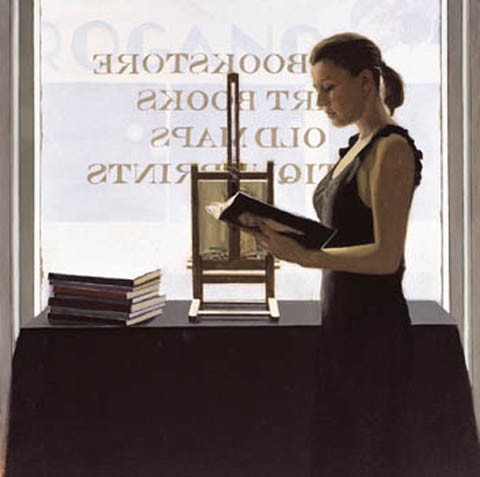
I realise, looking at some of the other pictures at this site, that I am a total prude when it comes to paintings. One of the things I most like about Faulkner's paintings is that nobody is dressed in a way which, if they were dressed that way for real, they'd be embarrassed to show to strangers or I'd be embarrassed to see. See especially the paintings by Stuart Luke Gatherer for the kind of thing I have in mind. (Follow the link from the home page to "gallery artists" and then pick him.) When I encounter a scene where my reaction if I came across this for real would be to say "Oops sorry I'm obviously interrupting" and then to back out, I find myself feeling similarly uncomfortable, although far less intensely, when looking at the painting.
As for the endlessly repeated claim that art is supposed to make you feel uncomfortable, I don't buy that. And I don't believe the people who say that they do buy it are being honest. I think that a picture which they have no problem with, but which they believe makes other people whom they disapprove of uncomfortable, makes them very comfortable indeed, and that that is the kind of discomfort (i.e. not discomfort at all, for them) which they like, and are referring to with all this discomfort propaganda. They no more like being genuinely discomforted by art than I do.
Or then again, maybe I am just not interested enough in paintings, and, painting-wise, am comfortable with what I'm comfortable with, and am not seeking fresh fields to explore. One way to find new stuff to get comfortable with is to find stuff which at first makes you uncomfortable. No, that's not it. The previous paragraph is what I think.
So I had just had lunch with one of my fancy city friends, and I saw this cute little view of the Gherkin, towering over a cute little church. As often happens with photography sessions, the very first picture proved to be one of the best.
Later, though, I realised that something rather more interesting was happening, although I think this picture may have been taken before I realised what it was really of. There were actually men working on the top of the Gherkin! I don't know what they were doing, apart from mountaineering. Window cleaning? Essential maintenance? Anyway, fun picture, I hope you agree.


Is this sufficiently cultural? Trouble is, I've now got a terrible cold and a headache, and a very busy tomorrow, so whether it is or not, it will have to do for today.
Alice Bachini also has some interesting musings about the appeal of classical music.
Music by famous pre-C20th composers is very controlled and ordered and tidy, compared to the stuff that came afterwards. It's pleasing to the ear in ways that make total unquestionable sense, like the harmonies of the spheres. It reassures one that all is well and the miraculous patterns of the universe are reassuringly both unfathomable and still in place.
During the twentieth century a critical mass of people, and I know exactly the feeling myself, lost the urge for tidiness, many advanced-thinking romantics already having lost it during the nineteenth. Something to do with the fact that the world was felt to be getting too tidy. While achieving tidiness was a desperate battle for almost everyone except a few stately home owners, art expressed that same yearning, for a utopia that was as controlled and unmessy as the everyday world was uncontrolled and messy. The wildness of nature used to be regarded as just badness to be subjugated, and turned into ornamental gardens.
But once Everyman finally moved into the Utopia of Tidyness, otherwise known as suburbs, life became intolerably organised for Young Everyman, and crazy rock and roll conquered the universe.
My suggestion for re-establishing the popularity of classical music: a serious but not completely fatal global nuclear war.
Incidentally, the piano sonatas of Beethoven don't sound quite as sweet and nice to me as they evidently do to Alice. But most of them are pretty much like that, I do agree. Beethoven, sweet and nice? Yes. He wasn't all raging and cursing and triple forte.
However, Beethoven's music must have sounded very different to his contemporaries. We hear the similarities between Beethoven and what went before. They heard the differences. And even we can hear that the Hammerklavier Sonata is somewhat disruptive of the harmonies of the spheres.
I don't plan to be seeing the movie Frida until I can sample it on TV, but there's an interesting short posting and comment exchange about it over at Alice Bachini's.
Today I wrote a piece for Ubersportingpundit about rugger, and have little time for anything much here. Sorry and all that.
So a brief reflection on the songs of Schubert and on the idea of artistic progress.
Today I listened to a recent CD acquisition, which was of Markus Eicher, baritone, accompanied by Jens Fuhr, piano, doing a selection of Schubert songs for Naxos, including one of my very favourite tunes of all time, An die Musik. These are two unknown names to me, but the bloke in the market wanted only £1.50, so what was really to lose?
And the thing about Schubert is that I think he makes everyone who sings his songs sound a better singer. I don't know why this is exactly, but I do have a theory, and half an hour in which to offer it here. It shouldn't take that long.
Basically, I believe that the liede, the German indoor, non-electronic, singer and piano, song reached its first and highest peak of perfection with the songs of Franz Schubert.
Artists, especially not very good ones, but including some very good ones indeed, are fond of talking about progress, and the implication of such talk is that art is like science. Each discovery only opens up new artistic vistas. Artists, like scientists, stand on the shoulders of their predecessors.
But this isn't really accurate. To me, it makes no sense to talk of later song writers "improving" on, say, An die Musik. The thing is already perfect. Progress in art is only in such mandane things as how many people can get to read it or listen to it, or how loud you can play it, or how colourful the colours are, or how much money you can amass by creating it. The closer it gets to talking about what really matters in matters artistic, the less the idea of progress really means anything.
What really happens is that artistic circumstances change, often radically. This isn't especially bad or especially good. It's just a fact. One day, you make music with pianos. Later it's done with microphones, and then with microphones and electric guitars. Now it's computers, the internet, and so on. This isn't progress, in any deep way. Nor, which some people also say by a sort of equal and opposite illogic, is it degeneration. It's just that times change.
Within each little genre, however, it does make sense to talk about progress, although even then such talk can be confusing and pseudo-scientific. What happens is that with each little new clutch of the means of artistic expression, there is a quite short period of struggle, and then really very quickly, a plateau of perfection is reached, and from then on it's the devil of a job to do any better than the first best pieces. The very first rock and roll tracks from the late fifties are still among the very best. I recall doing a posting here about a similar moment of early perfection that the reached.
And that's what Schubert's songs are like. There's no sense of strain about Schubert's songs, in the sense that Beethoven's symphonies were a strain, or the more elaborate songs by the Beatles. They often express the extremities of human experience, but they do it with absolute artistic confidence, serenity even. You get no feeling that Schubert thought for one second about being artistically advanced or about making artistic progress, or even gave any thought to the fact that, as far as writing songs for voice and piano, he was standing at the summit of what was to become a vast mountain range, but one that would never get any higher, just different. He simply wasn't thinking about anything except making each song as exactly right as he could make it.
And because he wasn't straining after anything in the way of self-conscious effects, he never asked the singer to do anything that isn't totally right for a singer to be singing. Thus, singing a Schubert song leaves the singer free to sing it absolutely perfectly, undistracted by any stresses or strains, or by any imposed agenda without which it makes less than perfect sense. And that is why singers sound better singers when they sing Schubert than when they sing anyone else. It happens again and again.
Or maybe I just love Schubert. And maybe all I'm saying is that his songs sound perfect to me.
This, just now, is one of my favourite London views. Partly, I guess, it's because it probably isn't a popular favourite. No Parliament, no Wheel, no Tower Bridge or Erotic Gherkin. Just a little clutch of blocks, with only the triple winged roofs of St George's Wharf lending any distinction. But the clouds helped, I think.
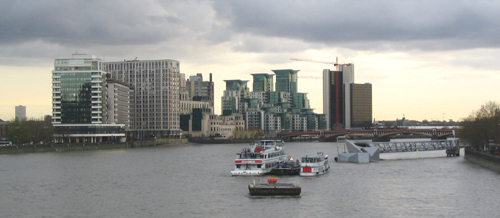
It was taken yesterday, looking up river from Vauxhall Bridge. Unlike some pictures here, it's a convenient shape for a blog posting.
That curious object that looks like a stealth ship is a stopping off point for the boats that now go up and down the river, this one being opposite the old Tate Gallery. You can go by boat from there, downstream, to the new Tate Gallery.
This, just now, is one of my favourite London views. Partly, I guess, it's because it probably isn't a popular favourite. No Parliament, no Wheel, no Tower Bridge or Erotic Gherkin. Just a little clutch of blocks, with only the triple winged roofs of St George's Wharf lending any distinction. But the clouds helped, I think.
It was taken yesterday, looking up river from Vauxhall Bridge. Unlike some pictures here, it's a convenient shape for a blog posting.
That curious object that looks like a stealth ship is a stopping off point for the boats that now go up and down the river, this one being opposite the old Tate Gallery. You can go by boat from there, downstream, to the new Tate Gallery.
I haven't got seriously stuck into Paul Johnson's Art: A New History yet. Instead I've been dipping. Today I chanced upon his caption for this painting:
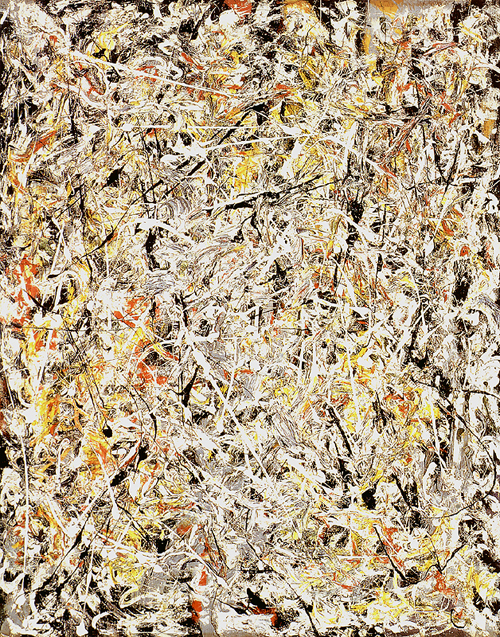
Of this Johnson says drily:
Jackson Pollock's White Light (1950s) illustrates the colour theory and practice of Abstract Expressionism. Much thought went into this inspired linoleum.
Could such opinions as this be part of why such disapproval has been expressed about this book?
Pollocks don't all look like lino.
There is a big piece today on my Education Blog about the early efforts of Yehudi Menuhin to master the violin. Expect more Menuhin-related stuff here.
Johan Woods has kindly appended the following comment to an earlier post here about Malcolm Arnold, in the course of which I compared the career and music of Malcolm Arnold with that of Shostakovich.
Are there any particular pieces from both Shostakovich and Arnold that bears any resemblance to each other, or are they only similar in that of their lives?If one is interested in listening more to Shostakovich (or Arnold for that matter), what do you recommend as a starter?
Paragraph one is quite easily answered. No, I know of no straightforward resemblances. The similarity is more in the way that both wrote very conventional and upbeat film music, and then used the same language to say deeper and more angst-ridden things with their more serious stuff. Also, they are approximate contemporaries. Shostakovich Symphony 9 has an air of circus clown absurdity and angst about it that I also associate with Arnold. My problem is that although I have discovered Arnold, I don't yet know my way around all his works, and know very few of them all that well, yet.
Paragraph two is a swine to respond to. I never know how to recommend music to other people, and when asked to do this I hum and mumble and then offer a very short list of the pieces that first got me interested. But just because I have long loved the First Cello Concerto of Shostakovich, or the First Violin Concerto, or the Second Piano Concerto, or Symphonies 5, 8, 9, 10 and 15, and later 7 and 11, doesn't mean that these are the places for Johan to start. String Quartet 8 is very popular, although I find the final one, 15, a whole lot more moving and intriguing at the moment. I also love the 24 Preludes and Fugues op. 87. As for Arnold, Symphony 5 is a popular favourite these days, but I find 6 more intriguing just now.
I remember once trying to interest a friend at university in classical music. He was a true friend and he was truly showing interest. So I played a succession of pieces that I thought might be accessible, easily "understood", tuneful, approachable, and … nothing. It might as well have been dishwater for all the tastiness he could find in it. Finally I said to hell with it and resumed my listening to Bartok's Fourth String Quartet, which I happened to be playing through at that moment. This is considered fearsomely "difficult" by those who know about these things. And my friend also heard that and loved it, because it was the nearest thing that classical music offers to the kind of drug driven rock and roll he favoured – being violent, rather discordant, full of heavy gypsy rhythms and cross rhythms, especially in the rather dry and edgy sixties CBS recording I had of it by the Juilliards. Indeed he got it a lot better than many people coming to the piece with a background of Beethoven and Mozart listening tend to get it.
In short: sorry mate, pass. Keep your ears open. Buy some cheap CDs, suck, and see. That's what I did.
I think I'm going to want one of these:
SOONER or later, the technologies of the various areas of our lives merge, resulting in a savings of cost, cables and clutter. For the nightstand, you can buy a clock-radio-telephone. In the car, you've got one radio-CD-player-heating-control unit. In your pocket, a Swiss Army knife.But the area around the TV is still a mess. By the time you've installed your cable box, VCR, TiVo and DVD player-recorder, you've built a techno-tower crisscrossed by cables and overrun by remotes. If ever an area cried out for consolidation, the TV room is it.
The industry has taken a few tentative steps in that direction: combo VCR-DVD players fill the shelves at Costco and Circuit City, and Toshiba recently unveiled a $400 TiVo with built-in DVD player. But those early attempts should bow down before the sweet perfection of a new pair of hybrids: Pioneer's new DVR-810H and Elite DVR-57H.
Each of these remarkable machines is a TiVo recorder, DVD player and DVD recorder in a single box, with one remote that also controls your TV.
The TiVo part means that you can freeze, rewind or instantly replay whatever you're watching; record a show (or, rather, a lot of shows) on its built-in hard drive for instant playback at any time; and skip over ads. Above all, a digital video recorder, or DVR, like TiVo permanently disconnects the broadcast time from the – viewing time. By the time TiVo zealots – which is pretty much everyone who has ever bought one - blip over the ads, credits, recaps and promos, they can watch a one-hour show in about 35 minutes. No wonder they never, ever watch whatever junk happens to be on at the moment.
I also think I know how I'm going to do this. I'm not going to be a pioneer purchaser. I'm going to wait until my friends are paying £500 for their Giant Gizmo DVDivo Whatsits, and I'll hem and I'll haw and then eighteen months later I'll buy one for £150. At which point, I rather think, that will be it. Better technologies than this will become available for couch potatoing, but as with CDs and their subsequent rivals, I'll then be happy with what I have.
I picked up some super-bargain CDs in the local gay charity shop yesterday - £3 each – in the form of three Malcolm Arnolds and a Richard Rodney Bennett.
The latter, which I played first, struck me as undistinguished. There was also a piano concerto, and something called "Concerto for Stan Getz", and other bits and pieces with only that wonderful Waltz from Murder on the Orient Express making any great impression. But I'll give it another go soon, and see if anything grips. At least he's trying to be tuneful and popular and entertaining.
The Malcolm Arnolds are much more promising. There's Arnold himself conducting his Third Symphony, and a film music disc, neither of which I've yet listened to, and there's one of his two string quartets, which I have just have listened to.
Arnold is our Shostakovitch. I'm not just saying that. The parallels are really quite striking, most notably in that Arnold also churned out a mass of music for the movies, and that his more serious compositional style is not so much a rejection of all that tunefulness and professional middle-of-the-roadness as an ironic distancing from it, while at the same time not very secretly quite liking all that and doing lots of complicated things with it and weaving into it lots of folk and folk-like melodies, real and made up.
Arnold had no Stalin to torment and stimulate him by issuing life-threatening critiques of pieces that he, Stalin, disapproved of. Arnold's problem with his serious stuff wasn't being officially disapproved of, so much as the Western horror of being insufficiently attended to, first for being too modern, and then later for not being modern enough, although compared to most serious Western composers he did pretty well and was always busy with commissions.
Athough politically he had it easy, Arnold suffered even more severely than Shostakovich did from what are politely called "inner demons", who seem to have more than made up for the lack of external demons but are perhaps not as glamorous for outsiders to reflect upon. He wasn't ever completely unhinged, the way Schumann ended up being, but he suffered from bouts of extreme unhappiness, often provoked by personal misfortunes (notably the loss of a daughter) but then severely reinforced by his own inner temperament. There's a lot of this torment to be heard in his more serious music, together with the effort to keep it at bay. Arnold didn't write as many symphonies as Shostakovich (the score there being 15-9 to Shostakovich) and not nearly as many string quartets (15-2), but the similarities between the two are nevertheless rather striking. To my ear, they both developed a similar musical language, and they both used it to express similar things.
I have worshipped Shostakovich ever since I heard a talented schoolboy at Marlborough thrashing out the first movement of the first cello concerto during a competition, and then immediately acquired the CBS Rostropovich LP and played it to death, and then the fifth symphony. Much later, when I was starting to suffer from the problem of knowing everything and having everything, or thinking that maybe I did, I started listening seriously to Arnold's symphonies. I now like these a lot (and recommend the bargain set of these on Naxos), and I think I'm going to like these two quartets a lot also, especially number two. There's another whole paragraph and more that could be written about how Arnold is also our Bartok, the second of the string quartets being particular provocative of that thought.
Some of those reading this may over the years have whistled that very catchy tune that introduces the BBC TV show called "What The Papers Say". Arnold wrote that. It's a snippet from the first of his English Dances, Set 2, op. 33.
I enjoyed this article by Christine Kenneally, linked to today by the indispensable Arts & Letters Daily.
The concluding paragraphs tickled me especially:
No matter how the connection between language and music is parsed, what is apparent is that our sense of music, even our love for it, is as deeply rooted in our biology and in our brains as language is. This is most obvious with babies, says Sandra Trehub at the University of Toronto, who also published a paper in the Nature Neuroscience special issue.For babies, music and speech are on a continuum. Mothers use musical speech to "regulate infants' emotional states," Trehub says. Regardless of what language they speak, the voice all mothers use with babies is the same: "something between speech and song." This kind of communication "puts the baby in a trance-like state, which may proceed to sleep or extended periods of rapture." So if the babies of the world could understand the latest research on language and music, they probably wouldn't be very surprised. The upshot, says Trehub, is that music may be even more of a necessity than we realize.
That being only the checkmate, so to speak, of a quite extended argument, involving the ways in which animals might appreciate music (the point being that it would have to be their music rather than ours), and much else besides. What I found persuasive was that several times while reading the piece, I found myself asking: but what about …?, only for that exact point to be answered in the next paragraph.
Worth reading all of it, in other words.
Of course, the piece doesn't explain music in its entirety. In particular it doesn't explain how music has changed and developed – and sometimes, I suppose, retreated and regressed – over the centuries. But it does sketch out the biological, species-specific expressive language within the limits of which the human effort to make music has necessarily expressed itself.
In particular, it explains with great finality that music will always be with us.
Now that we live in the historic epoch – which got under way early in the nineteenth century with photography – of Recording, we can look back at the archives of earlier decades and chuckle at those transitional technologies which had only just been devised, but not perfected. Each decade has its characteristic signature gadgets, starting with those cameras, on tripods and with the photographer hiding under a blanket. Model T Fords. Telephones in two separate bits. Propeller driven aeroplanes. Black and white televisions. Vacuum cleaners the shape of giant Swiss Rolls. Ancient tape recorders with giant wheels of tape that you had to cut with scissors. Gramophone records. Portable telephones the size of shoe boxes. Giant genuinely floppy floppy discs. VHS videos and TV screens that stick out at the back are beginning their descent into the same memory banks.
Time was when it was very hard to notice these things in the historic record. We can see the battles and the kings and the queens, the opening up of continents and the industrial revolutions. Spotting the subtle changes in things like eighteenth century tea kettles and coal scuttles and fifteenth century butter churns and pig sties is harder. But now these kinds of details have also become easy for us all to remember, when we see them in the photographs and the newsreels and the ancient TV shows.
So here now is an image that will, I suggest, do a lot to define the very particular moment of domestic history that we are now living through:

A decade ago, none of us had so many of these damned things. In ten years time, the mess will probably have been sorted out. But now – just now – this is a small but definite thing which pinpoints our little moment in history. We now live in The Time of The Multiple Remotes.
Let me itemise these particular remotes for you, for they are mine, and I have just photographed them for you. From left to right as we look: (1) The television, (2) The video, (3) The tuner/amplifier component of my medium fi system (4) The compact disk player, ditto, (5) The digital box attachment to the television, (6) The DVD player, (7) The digital radio that has replaced the (analogue) tuner bit of the tuner/amp. I dare say there'll be more in the years to come.
But I don't really have to spell it all out for you, do I? You probably have just such a collection yourself. I live alone, and my collection adds up to a single control panel, albeit a rather complicated and unwieldy one. All my Remotes occupy the same shelf on my desk.
But pity the families. There, the Remotes move hither and thither like a litter of unruly puppies.
The relationship of the father of the modern family to his various Remotes is a metaphor for his entire life. When a modern man has a family, his life is no longer his own, and because of the multiplicity of all those Remotes, the very "control" which they are supposed to supply slips from his hands. When there was only one Remote, he was its Lord and Master, but not any more.
Luckily he doesn't have time to pay careful attention to all the electronic message receivers and displays these magic wands supposedly command for him, but which actually behave towards him more like a barrier. He has more important things to attend to.
Gabriel Syme didn't like Matrix 3 either.
The only good moment in the film is during the fight between Neo and Agent Smith who angrily and hatefully asks Neo the big WHY. Why does he fight him, why does he fight at all?! Himself, other people, duty, honour, or even something as insipid as love? The answer is Because I have a choice.And. you. dear reader. have. a choice. of not. going. to see. the film.
So that's a no. And as he also mentions, he also didn't care for M2.
I'm waiting for Love Actually to be a rentable DVD and am now brooding on a spoof combination synopsis of Love Actually and Kill Bill, called Actually I'd Rather Kill Sandra Bullock, written and directed by Quentin Curtis. In this, Hugh Grant goes on a revenge spree to kill everyone who had anything to do with his film career to date, which only happened because he fell into an Upper Class Forgetfulness Coma and a succession of comedy script writers and producers with no consciences then decided, all unknown to him, to turn him into a Romantic Lead. It climaxes in a huge fight with Julia Roberts, in which Hugh says: "What I want to know is: Why does there always have to be an American actress in it? I'm fed up with American actresses." Pow, bang, swish, etc. That's pretty much it.
James Lileks reviews the latest Matrix movie in today's bleat. I wish I could just rip off bits of writing as good as this, in among doing a real job. At present I'm seldom managing much of either and if that doesn't change on both fronts at some point between now and my death I will not die very happy, I can tell you.
JL didn't care for Matrix 2:
I thought it was a ponderous, boring mess. Sure, it had a certain buzz, but so does a beached flyblown whale carcass. The metaphysics were sophomoric, the acting stiff and pained, the action without consequence or drama. The FX, while amazing, were just a demo reel for new CGI programs. Nothing meant anything. Why should I root for Zion? The machines had built this enormous civilization for themselves, and the guys down in the Rave Hole hadn’t even figured out how to make decent shoes. …I’m kidding, but not by much. …
And he follows that with a fine description of why I didn't even bother with Matrix 2 and probably won't bother with Matrix 3 despite all the good things he goes on to say about it:
That’s how I felt before I saw the film. Zero investment. So I paid my five dollars and prepared for that unique sensation you get in modern movies: being bored while battered repeatedly in the head.
Exactly. Matrix 3, and for that matter Kill Bill (bored while having your head chopped off by the sound of it), is why television was invented. You can start watching it, but if you don't like it you can stop and immediately do something else sensible, without surrender the money or the evening you paid to own it or rent it or whatever, because you paid nothing.
Nevertheless, JL loved M3:
I loved this one. Yes. Yes, I did. Chalk it up to the same reasons I enjoyed SW: Episode 2 – low, low, low expectations, matinee time frame, need for diversion, juvenile love of spectacle, guilty indulgence in sci-fi nonsense. But it’s a better movie. It looks and feels more like the first than the second. There’s 62% less pontificating. Smith is Smithier than ever. Yes, some of the death soliloquies take a day and a half; yes, every war cliché is on parade with its pants down; yes, yes, yes. Yes there’s the council of Sonorous Robed People discussing the imminent extinction of humanity with all the passion of some suburban selectmen debating a sewer extension; yes the future of the species depending on someone manually piloting a blimp through a drinking straw at 2394 MPH instead of turning it over to the computer; yes yes yes. Yes the final scenes don’t exactly make sense - how did Neo do that? What exactly did he do? What happens now?Doesn’t matter. …
… because the final fight was very good, apparently.
Also, Alice Bachini approves of Kill Bill. See here, here and here.
Key Alice line for me:
But if you can't handle ultra-violence, don't even bother. You'll throw up.
So I'll be sticking with my chick flicks. Plus, I've been listening to Mendelssohn's Italian symphony on the digital radio, conducted by someone they're calling "Marine" Alsop. Digital radio continues to be wonderful.
There's a mostly negative review of the new BritRomCom Love Actually in the New York Times.
There is, however, this enticingly positive little description of a scene which could surely have been the basis of an entire movie:
The funniest and most winning on-the-job romance bubbles up between two people (Martin Freeman and Joanna Page) who work as body doubles on a movie set, miming explicit sex scenes in the absence of the prudish stars. As their naked bodies go through the motions, the two of them chat mildly about traffic and the weather, …
Interesting that the scene that the NYT guy picks on is the one with the least famous actors in it.
I predict that the price of the DVD will begin its slide from extortionate to ultra-bargain just after Christmas, and get to the bottom of the slope pretty quickly.
I think this chair is rather handsome. It's from from Ralph Lauren, who is the bloke on the right.

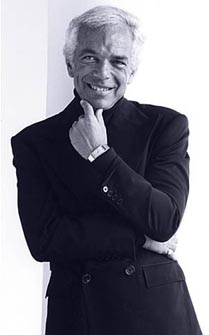
I thought he only did frocks and pullovers and the like.
I'm sure many would regard this chair as by far the worst of this lot. But where, on any of the other four chairs, do you put your coffee? Also, it looks a hell of a lot easier to dust. Plus, you can put things underneath it, such as a Scalextric layout.
This, on the other hand, is the Ralph Lauren sales spiel for the chair and for all the other chairs and other stuff being sold by this operation:
ABOUT POLOOur Philosophy
What began as a tie 35 years ago has grown into an entire world that has redefined how American style and quality is perceived. Polo has always been about selling quality products by creating worlds and inviting our customers to be part of our dream. We were the first to create lifestyle advertisements that tell a story. We were the first to create stores that enable customers to interact with that lifestyle.
As an industry leader, we continue to create opportunities – like Polo.com, where you can find great products, read about adventure, style and culture, find amazing vintage pieces, buy unique gifts, take trips that transport you into the world of Polo and a lot more. Back when all this started, I felt that there were no boundaries for Polo. I'm even more sure of that today.
(signed) Ralph Lauren
I now understand terrorism a bit better. Ralph Lauren himself looks pretty - a superbly bio-engineered grey alpha-wolf - a role model for his generation. But Grey Power in general is not a pretty read.
Give me the grunge look any day. Being grown up and normal means not cursing about how all those damned Other People spend their money, and just doing your own things as you want. But the impulse to curse, and worse, remains.
I've had a busy day and am about to have a busy evening, doing something else. So instead of writing lots of stuff, let me do a shameless (the word always used when people are a bit ashamed) link back to one of my better (I think) Samizdata pieces on a cultural theme, called Art as aftermath, which I think may go some way to answering Patrick Crozier's kind comment on this piece here, about the grunge look in recent movies.
The gist of it is that art not only foresees the future, as Patrick notes; it also harks back to the past. It even does this when the past is miserable and the present is happy. Maybe the reason movies are drab now is that the recent past for lots of people has been drab, partly because of their imperfect housekeeping skills.
Re-acquainting myself with "Art as aftermath", it occurs to me that part of the grunge look may be a trickle down effect from high art. The masses don't get much about posh art, but they get that it is gloomier than popular art, and so, paradoxically, "popular" art has itself gloomier, because it now aspires to being posh art itself. The idea that movies are posh art has always been popular among movie makers. Now that idea has itself become popular. Ergo, movies got gloomier. Yes, I'm sure that's part of it.
Plus, I wonder if there's some artistic law that says: when a war ends you get grunge popular art. Film noire - after all, black not just in colour but in moral and pyschological mood – followed the end of World War II, and I'm sure had something to do with it. Perhaps the dislocation and uncertainty of no longer having a shared purpose? The rise of grunge in the cinema coincided with the end of the Cold War. Maybe that had something to do with it.
In that comment referred to above, Patrick Crozier mentions Bonnie and Clyde. I'd say that B&C is a fine example of a movie whose grim and amoral mood is not matched by the extreme beauty of the look of the movie. Indeed, I'd go as far as to say that this contrast is what the movie itself is all about. In terms of everyday reality, both Bonnie and Clyde are squalid little failures. But they feel as if they've triumphed. So that would make it a key transitional movie, from straight happy-ending optimism to the later grimness. In a way, B&C does have a happy ending, in the form of Bonnie getting that poem published in a newspaper. Says Clyde: "You know what you've done? You've made me someone." And then they get gunned down. Maybe that movie encapsulates the ethic of the post sixties generation: artistic success please, and if that means a mere life that is nasty, brutish and short, so be it. We'll do whatever we have to do to "be someone".
I don't have time for all this, and I certainly don't have time for any more. Have a nice evening.
Something tells me that it won't be long before this kind of thing and this kind of thing get combined.
Move down Isabella. This is truly beautiful.

Michael Jennings, please confine your explanations to Transport Blog.
It even has little Thomas The Tank Engine type eyes, although they are rather far apart.
I followed the rather pretty train picture (the train is pretty - the picture is nothing special) here and found myself browsing through mostly very tedious – well, "specialist interest" – train photos here.
But this picture is very fine, I think:

It's the way the train is so long, and, given the snakelike nature of the track, so very snakey. The train itself is nothing special. The track is the track. But putting the two together gets a photo that I do admire.
Okay, the next posting will about oil paintings by a dead person, or some such thing.
David Farrer has this picture of Concorde up at Freedom and Whisky, taken at Edinburch airport. I'm guessing he took it himself but he doesn't say.

I believe I may have improved its presentation. He has it up as a .bmp, and on my screen it has bumpy things happening at the join between the fuselage and the sky. Also it takes a long time to load, because he had it as a rather big file. On my screen - and maybe yours? - this now looks better. If you want a/the bigger version of this picture, do what I did and copy it from David.
The earlier Concorde picture here showed the shape from below. This is the best I've seen lately of its beak.
Antoine Clarke gave an excellent talk at my place last Friday evening about Concorde, and about the contrasting attitudes of Britain and France to its demise. Basically, British Airways made a success of running it, if you exclude the small matter of how much it cost to build the damn thing! So we mourned and celebrated. Air France couldn't even do that, and were glad to see it go. And France didn't mourn or celebrate, other than giving a media nod to all the mourning and celebrating going on in Britain.
Which is odd, because usually the French State is quite good at these money-no-object flag-waving ikon things, while here in Britain we tend to screw them up.
Although, British Airways also owns London's Wheel (of the "London Eye" as they insist on calling it) and that looks great and works well too.
It's obvious really. Give The Dome to British Airways too. They obviously have the magic touch with these things. After all, for many decades they themselves were one of "these things". Turning national monuments into profitable national monuments is what they do, because when they were privatised they started by doing this to themselves.
This will have to mentioned also at Transport Blog.
Last night, winding down from being Mein Host at my last-Friday-of-the-month evening, I watched a Steven Seagal biff-fest (The Glimmer Men), and I noticed yet again how grim and dark the colours are in the average action movie with lots of stunt men in the credits is these days. This is not an isolated circumstance. Grim, noir-in-colour gloom seems to be the visual order of the day these days. Indeed, when I bought a TV a few years ago, I really looked at the colours of what I was seeing for the first time, and I thought that there was something wrong with the colour balance. Where were the blues and pinks. It was all yellow and dark grey.
The point was rammed home yet again by a review in today's New York Times of a recent BBC TV Doctor Zhivago which has just been shown in the USA. The reviewer, not unreasonably, compares this, as he calls it, "De-Hollywoodization", with David Lean's famous 1965 movie version:
Lean's gloriously vivid colors are gone, replaced with more realistic Russian shades of gray and brown. The film director's sweeping, chimeric landscapes have been ruthlessly reshaped: the sparkling palace of crystal and ice where the lovers seek refuge is once again a drafty old dacha. …Even Lara, described in the novel as "fair," is a dirty dishwater blond.
And it's true. The abiding memory for me of Lean's Doctor Zhivago is not grimness and misery, but all that joyous colour photography of melting snow and spring flowers, despite the fact that this is a movie set in one of the grimmest times and places in all of human history.
If glossy colour is what you mean, most Hollywood movies now are "de-Hollywoodizations" also. Compare the opening battle scene in the recent Gladiator with the battle scenes in something like El Cid, or that naval battle in Ben Hur that simply makes you want to go on a Mediterranean holiday, just like if you were watching Audrey Hepburn visiting that part of the world. Okay Gladiator was Germany and El Cid and Ben Hur were further south, but is Germany really that smoky and depressing? Even battles and Russian revolutions looked up-beat and sparkly in the sixties. Now, if things look sparkly, it's irony, as in American Beauty, or a knowing "homage" as in the latest batch of romantic comedies that hark back to those Doris Day/Rock Hudson glitter fests.
I can remember Cold War movies with the likes of Lawrence Harvey done in the sixties where they even managed to make places like East Berlin look colourful and exotic. The conversation in the foreground was turning cynical and drab, but the photography was still sixties New York advertising first generation wow-isn't-this-just-so-much-prettier-that-black-and-white? Remember how they used to boast about whichever colour photography system they'd used – filmed in "Panavision" – filmed in "Technicolor".
Now, even space travel is grim and depressing. As I remember it, one of the first movies to reflect this new grunge-grimness aesthetic was the second of the Star Wars movies, the one where all the goodies, human and humanoid, get dumped in a rubbish skip. Then followed the Alien movies, all damp and darkness. Now they're all at it. Watching something like that weird one where they all die at thirty starring Jenny Agutter and Michael Yorke, where although the text is grim the subtext and visuals remain happy and upbeat (and it must be admitted rather cheap), is to switch back to a wholly different world, of shiny buildings and sparkling green grass and glittery interior decor. Logan's Run, that was it.
I think part of it, as I say, is first generation colour photography, and the film makers celebrating what they could finally do with their new toys, and then their successors wanting to do something different. But I think the generational dramas within film-making reflect contrasts over time in the world out there.
In the fifties and sixties a whole generation of people came into their inheritance in the form of lovely houses with lovely wallpaper and lovely furniture and happy smiley kids. But the happy smiley kids then faced a problem, when they grew up. What were they supposed to do with their lives? More of the same? There followed a sour grapes generation, who couldn't repeat the same domestic successes that their parents achieved, and who wanted to be told that they didn't have to. This all these grungy movies do. The world's not like that? The world is a grim and depressing, dirty and drippy place, and it's all we can do to stay alive! Aging Generation X couch potatoes can look at their drab and seedy surroundings and say, well, it may not be Versailles, but nor is it the prison colony in Aliens 3.
Grunge world is not true. In fact it is every bit as much of a fantasy world as sparkly Doris Day New York Advertising world. But it is comforting.
Now I'm going to watch some Keanu Reeves thing in the things exploding genre. I wonder what the grungometer reading will be on that one.


