

Email from Michael Jennings:
I have some thoughts on Tate Modern on my blog that you might be interested in.
Indeed.
Meanwhile, I think this is a really fun photo:

Once again, a constant theme here, light games by pointing the camera (or the painter) at the big light source, with distant objects having light in front of them – in the form, I'm guessing, of illuminated gas or dust particles – and nearer objects less so.
The big sun is part of the Weather Project, by somebody or other who is good at talking his way into Tate Modern.
Thinking about it some more, I think what we may be witnessing here is the divergence along two separate paths of, on the one hand, "art" (i.e. paintings, sculptures, stupid objects), and on the other hand the process of attracting people to, and entertaining people in, what are still called "art" galleries.
This is a trend I thoroughly approve of, because on the whole I think that "art" these days is too big for its boots, and depends far more than it realises on the fact that people simply like going to art galleries, regardless of what's in them, simply because they are nice places where you can hear what any person you go with is saying and have a nice cup of coffee and a bun and buy an amusing biro. Discos without the bloody disco music, you might say, and with less disastrous drugs.
If that's right, and it is, it follows that there is no particular reason for "art" galleries to contain only things which Tate Czar Nicholas Serota has decided are art. Why not veteran cars, tea trolleys, old games machines, underwear, hand held weapons through the ages, CD sleeves, potato crisp packets, batteries, food magazine illustrations, shoes, stills from the movies, Christmas cards, ancient photos taken by regular people rather than just by famous photographers, letters from the front, videos of buildings being demolished, etc. etc. etc. etc.???? Who needs art, and who cares whether the stuff in the gallery is art or not?
It would be a nice irony if a temple supposedly devoted to the worship of Modern Art actually became a force for dethroning the stuff.
Whatever. Happy New Year everybody.
On Monday night I attended a dinner party and my hosts had this image up on their wall, which I rather like. It's by Peter Saville, a new name to me, but a very big cheese in the world of graphic design, record sleeves, etc..
I rootled around various websites and the version here is the best that I could quickly find:

It's called "Colour and form" and dates from 2002. Saville was a late-comer, compared to many graphic artists, to computers, but now he loves them.
Once again, it seems that in all innocence I've picked a very well known picture, one of those ones that lots of much Better Informed people know about and like, apart from maybe disliking how many badly informed people like me like it too.
In a way, art is a bit like pop music, in that things which are merely rather nice get copied and experienced on this colossal scale, which seems out of all proportion to the modest niceness of the original object. Add a couple of million square yards of posh writing in praise of these innocuously nice objects and you're going to stir up a lot of hostility, not to the things themselves exactly, but to the enormous fuss that gets made of them. This fuss (which I'm now adding to of course) seems particularly bizarre when you compare it to the total lack of fuss that is made about millions of other objects and images which are just as nice but which don't happen to have got the attention of the Designers.
My thanks to Patrick Crozier for steering me to this.
Quote:
The fact that digital content can be distributed for no additional cost does not explain the huge number of creative people who make their work available for free. After all, they are still investing their time without being paid back. Why?The answer is simple: creators are not publishers, and putting the power to publish directly into their hands does not make them publishers. It makes them artists with printing presses. This matters because creative people crave attention in a way publishers do not. Prior to the internet, this didn't make much difference. The expense of publishing and distributing printed material is too great for it to be given away freely and in unlimited quantities – even vanity press books come with a price tag. Now, however, a single individual can serve an audience in the hundreds of thousands, as a hobby, with nary a publisher in sight.
This disrupts the old equation of "fame and fortune." For an author to be famous, many people had to have read, and therefore paid for, his or her books. Fortune was a side-effect of attaining fame. Now, with the power to publish directly in their hands, many creative people face a dilemma they've never had before: fame vs fortune.
One of the most under-rated ways to organise your life, but one of the most widely practised and most effective (something I discovered while doing career advising and have since seen everywhere), is to work for money, and to do that old chestnut "what you love" not for money, but for love. That way what you love is not destroyed by the demeaning demands of others, and you approach your work without that frenzied involvement that often makes people do their work really badly. (I rather think that I owe part one of that previous sentence to a long ago piece by Michael Blowhard.) Blogging fits into that set-up really well. What that means for me is that for me, fame and fortune are two separate activities.
Patrick Crozier keeps asking me: "How can I make money while blogging, by blogging? Simple answer: I have no idea. Stop trying. Work for money. Blog for love, or fame, if that's your kick.
Gerald Ratner, famous for saying of one of his own products that it was "total crap", has, having long ago lost that job and that business, started a new online jewelry business.
I know and care very little about jewelry of this sort, but one thing does strike me about this website, which is what total crap the photos are. Unbelievably feeble and uninformative. A million and half hits per day, apparently, but how many of those hits will be one hit wonders, wondering why he doesn't use a better photographer? The likelihood that Mr Ratner knows things about his business which I don't is very high, but from where I sit, I don't get it.
Presumably the idea, if there is one, is that a site which loads reasonably quickly is more important than a site which tells you very much about the products. Nevertheless, it really looks to me like they overdid the loading-friendliness and underdid the informativeness with this stie. And anyway, nice pictures don't have to take for ever to load. And surely with jewelry, the way it looks, in detail, is the most important thing about it. I mean, guys in jewelry shops look at the stuff with magnifying glasses. No point in scrutinising these pictures.
Selling jewelry on the internet ought to work really well, but I can't believe that this is how to do it.
Today I had lunch with a real live orchestral conductor, by the name of Julian Gallant. Nice man, as are his wife and brand new baby, whom I also met.
While Olga and baby were in another room feeding and being fed, I asked Julian one of the more interesting things you can ask people who have interesting jobs, or jobs of any kind really, which goes approximately as follows: "You're on your death bed and have only a few minutes to live, and it turns out your grandson has just shown up and he wants to do what you did. What do you tell him? Secret of your work in thirty seconds. Go."
He first answer was simply: rhythm, rhythm, rhythm. Then he said: be clear, clear, clear. Then he said: help them. Rhythm, clarity, help. And don't show off.
Not bad. He didn't have to think very long about it either.
Gallant and his Russian born wife Olga between them run, conduct and musically direct the Russian Chamber Orchestra of London and they also run a closely related enterprise called Ensemble Productions, closely related meaning that they organise events involving other musicians as well, and dancers too. Scroll down here for some future events, some of which I intend to go to myself, and report on here. There's also a link to more information about the Russian Chamber Orchestra.
And then my host took me to visit and have tea and fruit cake with a lady called Elena who is a choreographer. The real thing. She works for all the top London companies, and has also worked on movies, coaching movie stars. Which is hard, apparently.
You blog about it. Eventually it starts to happen.
Over on Samizdata the only thing that got said yesterday was this:
"France is the best country in the world."
I'm très proud to report that it was said at my last Friday of the month soirée, chez moi, by a beautiful young French woman. When beautiful young women attend your events you know you are doing something right, and the abundant contribution made by France to this category of human is, it is universally agreed, one of the very greatest things about France.
France, because of its amazingly corrupt politics and blunderingly anti-American diplomacy, gets a lot of bashing on Samizdata, so this utterance was a pleasing corrective to all that, as were a lot of the comments, to which I contributed. One of my other guests heard it said, and immediately stuck it up. Le blogging, je t'aime.
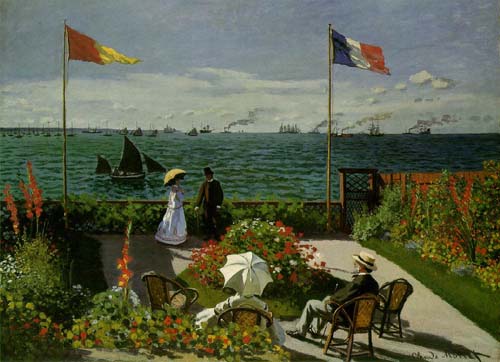
Here are two more correctives, in the form of a very early Monet, Garden at Sainte-Adresse:
And a very late Monet which obviously appeals to me a lot, Houses of Parliament, London:
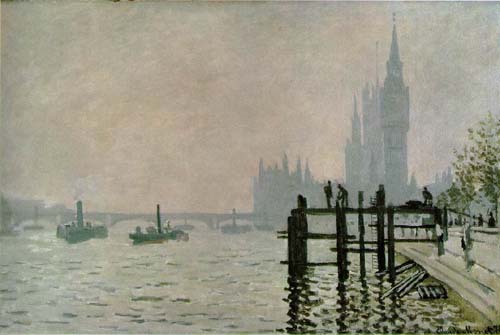
Experienced painters and inexperienced photographers share a fascination with the tricks played by light.
I went looking for an appropriate Christmas Nativity scene with which to wish all of you the compliments of the season, and the picture I liked best from the many choices offered here was this one: Raphael's Sistine Madonna.

What got my attention was the extreme beauty of Madonna herself. She's standing like a supermodel, rather than sitting like a mumsy mum. But the most famous bit of this painting, which I swear I only noticed after I'd picked it as my favorite Mary plus Jesus painting, is right at the bottom, and features two winged child stars of a million posters and Christmas cards (scroll down!).
What's going on? Both the old gent on the left and the lady on the right appear to be aware that something may be up. The lady is looking downwards at the winged ones and the oldy is pointing at something also. Do they perhaps fear that our two grumpy little friends, perhaps because jealous about being upstaged by a mere baby for God's sake, are about to stage some kind of diversion? No doubt there is a learned explanation.
I seem to have extremely "popular" taste in paintings. Time and again, I choose the painting that everyone else likes too, but as often as not utterly unaware of its extreme popularity until after I've noticed it, and hence started to notice others noticing it also. I am to the world of paintings what those people are to classical music who say "Oooh I like that one", and it turns out to be Finlandia or Beethoven's Fifth or the Moonlight Sonata or Barber's Adagio. I'm not wrong and those are all great bits of music. I have good taste in paintings. It's just that I don't have very much.
Anyway, like I say: Happy Christmas.
Interesting thoughts about gangster movies, from Alice Bachini.
It's obvious from everything she writes that Alice is more interested in morals than she is in money (this being her basic complaint about the gangsters), which would explain her relative lack of money and superabundance of morals. She wants more money. Don't we all? But only so that she can stop having to worry about it. Morals she thinks about anyway, whether she has to or not, and if someone gave her a billion pounds, she'd think about morals all the time. She'd only think about money insofar as money can also be a moral issue. Is it fair that I have so much? – What is the morally correct way to spend it? – etc.
I had an interesting discussion the other day with Perry de Havilland, also about movies and preoccupations, which he said he would write about on Samizdata. But he is either busy or not in a Samizdating mood now, so I'll write up the conversation instead.
I asked him what he thought of the latest LOR movie. (I won't be seeing this, but I have no problem listening to people talk about such things.) He said it was very good and admirable, and he really liked it and everything, but that it didn't stir his soul.
His actual expression may have been the much overused "rocks my world", I fear. People really should stop saying that. It was too vivid and individual an expression when first used to work as a regular unoriginal expression for regular unoriginal people to be using every twenty minutes. It grabs my attention in a way that I really resent and feel is deeply undeserved.
Anyway, he didn't absolutely adore LOR3. Then we got talking about other movies that he does like. Memento in particular. And LA Confidential. And then we changed the subject completely and talked about philosophy, and words like "truth" and "epistemology" got used a lot.
At which point I speculated that maybe the reason he adores Memento and LA Confidential but did not adore LOR3 is that Memento and LA Confidential are both about mysterious situations in which the truth – who the bad guys are and what they are up to – is absolutely not obvious, while in LOR3 the situation is clear and the only question at issue is whether the heroes can deal with it. Bingo. In LOR3 the problem is not who the bad guys are and what they are up to. That's all clear, apparently. The problem in LOR3 is whether the good guys, who know exactly who they are, are up to the task they face, morally speaking. Do they have the endurance and fortitude and ability to stick it out and see their way to victory?
Now Perry has done all that, in his Balkan past. "Knowing who the bad guys were there was a no brainer!" Now he is on a quest for truth, and for an understanding of all the various means of arriving at it and identifying it. He is interested in any movie where the agenda is: What the hell is going on here? The mere character, or lack of it, or growth of it, of the people seeking to answer this question is of secondary importance.
Perry himself is satisfied that he is a good guy. The foundations of his character are secure in his own eyes. (For whatever it may be worth, I agree with him.) The agenda, for him, is to make better sense of the infinitely mysterious world out there. In the words of Michael Caine's Alfie: What's it all about?
Part of Perry's present blogging problem, if he has one at all, may be that whereas the agenda for Perry is: Perry making sense of the world; the agenda for Perry is not: Perry immediately telling the world as and when he finds it. First things first. First get to the complete and final Truth. Then announce it. Do not announce confused and even dead wrong versions of the Truth in the meantime, the latter process being a downright interruption of and corruption of and distraction from the former. Which is a great pity because Samizdata is definitely better when he joins in.
I will also deal at a future date with the expression "no brainer", which I also hate.
My own preoccupation, just now and for as long as I can remember and from the moment I learned to talk, is and has always been finding the exact right words to nail things down, so that I can impress the hell out of and energise (and impress the hell out of) other people. Sometimes I wish devoutly that it were otherwise. How convenient it would be to be obsessed with money, how comfortable to be obsessed with domestic comfort.
My preferred method for saying clever things is not to think in silence for days until the perfect phrase comes along. It is to fling masses of phrases every day at the verbal dart boards I have surrounded myself with, and to hope to get a regular stream of quotable and permanently useful bull's eyes. This, I think, accounts for my intense dislike of wallpaper wrecking darts throws like "rocks my world" and "no brainer".
By the way, Stephen Pollard has a list of his favourite movies up at his blog, and the overlap with my list is very high, in the sense that I like a lot well over half the ones on his list. I suspect that he's in a similar phase in his life to me, i.e. searching for the perfect phrases for things by trying out lots. Both his list and mine have characters who are trying to say what is going on around them with the perfect phrase, by saying a lot and hoping that the best of it is clever. I was particularly chuffed to see Metropolitan on his list. If your preoccupation is with, e.g., doing the right thing rather than saying it, you would find Pollard's list, and mine, insufferable.
Did a posting today on Samizdata about these Christmas stamps, and some of the commenters have responded with links to other countries' corresponding efforts.
Other than that, nothing here today. And this week, be thankful for whatever materialises.
This is a photograph I took earlier today, of Perry de Havilland's new computer.
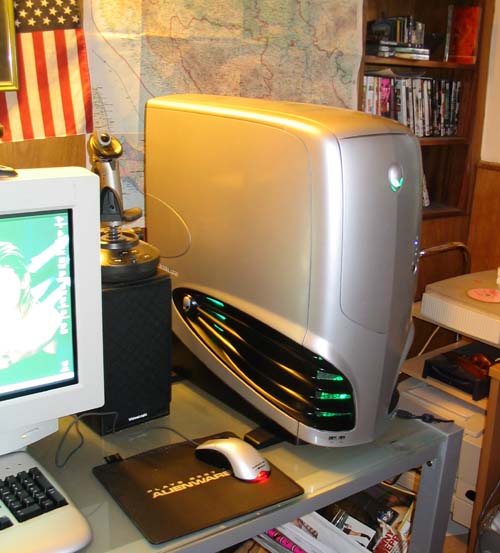
Two points:
First, it looks very cool, and is (not coincidentally) called "the Alien". And not just by Perry, by the makers of the thing. Look at what it says on the mouse mat.
Second, it is mega mega powerful, and cost a whole lot more than most of us would dream of spending on a computer, no matter how easily we could afford such a beast. I asked Perry why he had paid so much. Answer: he's a computer games freak. And computer games work a whole lot better on mega mega powerful computers. Computer games feature lots of special effects which are a lot more special on a machine like the Alien than on the kind of chugger I happily operate on. What is more, Perry added, it is computer games which are now driving computer hardware along. The gamesters are the ones now buying the latest, biggest and bestest personal computers, and the rest of us are quite content to pay a few hundred quid for their cast-offs. Interesting.
Good piece in today's NYT about the trend towards big Hollywood blockbusters opening simultaneously all over the world rather than dribbling into separate national and regional markets over a period of months. This stops piracy, and cuts marketing costs. A staggered release starting in the USA stirs up interest elsewhere which is then met by the pirates if locals can't immediately see the thing in their local cinemas. A worldwide media blitz and a worldwide opening makes more sense.
And in the days of the Internet, serious media blitzes are almost impossible to prevent becoming worldwide.
Also, if Hollywood knows that the word-of-mouth – and the word-of-Internet – is likely to be bad, as was the case with Matrices 2 and 3, a worldwide release gets bums on seats everywhere in large numbers before the w-o-m and w-o-I kicks in.
Result? The latest Lord of the Rings movie took in a quarter of a billion dollars in its first five days.
The global village is getting ever more global.
It makes sense to me. We all saw Saddam captured at the same time, apart from Alice. People everywhere can all read the latest on Brian's Culture Blog as soon as I've done it. Why not LOR3?
(By the way, the w-o-m for LOR3 seems to be good. Jonathan Ross likes it, anyway. Personally I shall wait until it is out on DVD and then not see it on DVD either.)
You wait for ever for a website with painted women, then two come along in one day.
Thanks to b3ta.com.
Instapundit links to this, and this links to this.
I love the Internet. From a deposed despot to decorated damsels in two clicks.
As you can see from Michael Jennings' report on Samizdata, I have finally got my hands on a copy of a book which should probably have been a founding text for this blog, namely Virginia Postrel's The Substance of Style.
The picture of me and Michael is particularly gruesome, is it not? And it raises the more serious question of why it is that geezers like me and Michael, who are not at all indifferent to matters aesthetic, are nevertheless content to attend social events and to be photographed at them, while contriving themselves to look like … well, invent your own put-down. Seriously, there really does seem to be a tendency for people to compartmentalise their aesthetic endeavours. The extreme case probably being the stereotypical artist, who paints genuinely beautiful paintings or makes genuinely beautiful sculptures, but whose home is a dirty shambles and who dresses like an ugly old tramp.
I toook quite a few pictures myself at that Samizdata do, but I think my new Canon A70 digital camera is wrongly adjusted for indoor stuff, indeed for anything which moves, even a little. Can anyone suggest which nob or setting I might need to twiddle? Once I get that right, there may be no more artistically blurry pictures to show off here, but there may be better pictures of people. Thanks for all the kind feedback about those pictures by the way, in the comments, last night, and in emails.
UPDATE: Oh dear.
This counts as "culture" I think. Busy day, so I'm just following an Instapundit link. But it is a real boost for bloggers and blogging, coming as it does from the Economist.
I have the feeling this piece may soon become inaccessible by the direct route, so here's all of it. If it disappears from here too, it means I've had lawyers on me. I hope it stays. (Information wants to be free!) Read the whole thing.
The internet in a cup
Dec 18th 2003

Coffee fuelled the information exchanges of the 17th and 18th centuries
WHERE do you go when you want to know the latest business news, follow commodity prices, keep up with political gossip, find out what others think of a new book, or stay abreast of the latest scientific and technological developments? Today, the answer is obvious: you log on to the internet. Three centuries ago, the answer was just as easy: you went to a coffee-house. There, for the price of a cup of coffee, you could read the latest pamphlets, catch up on news and gossip, attend scientific lectures, strike business deals, or chat with like-minded people about literature or politics.
The coffee-houses that sprang up across Europe, starting around 1650, functioned as information exchanges for writers, politicians, businessmen and scientists. Like today's websites, weblogs and discussion boards, coffee-houses were lively and often unreliable sources of information that typically specialised in a particular topic or political viewpoint. They were outlets for a stream of newsletters, pamphlets, advertising free-sheets and broadsides. Depending on the interests of their customers, some coffee-houses displayed commodity prices, share prices and shipping lists, whereas others provided foreign newsletters filled with coffee-house gossip from abroad.
Rumours, news and gossip were also carried between coffee-houses by their patrons, and sometimes runners would flit from one coffee-house to another within a particular city to report major events such as the outbreak of a war or the death of a head of state. Coffee-houses were centres of scientific education, literary and philosophical speculation, commercial innovation and, sometimes, political fermentation. Collectively, Europe's interconnected web of coffee-houses formed the internet of the Enlightenment era.
The great soberer
Coffee, the drink that fuelled this network, originated in the highlands of Ethiopia, where its beans were originally chewed rather than infused for their invigorating effects. It spread into the Islamic world during the 15th century, where it was embraced as an alternative to alcohol, which was forbidden (officially, at least) to Muslims. Coffee came to be regarded as the very antithesis of alcoholic drinks, sobering rather than intoxicating, stimulating mental activity and heightening perception rather than dulling the senses.
This reputation accompanied coffee as it spread into western Europe during the 17th century, at first as a medicine, and then as a social drink in the Arab tradition. An anonymous poem published in London in 1674 denounced wine as the "sweet Poison of the Treacherous Grape" that drowns "our Reason and our Souls". Beer was condemned as "Foggy Ale" that "besieg'd our Brains". Coffee, however, was heralded as
... that Grave and Wholesome Liquor,
that heals the Stomach, makes the Genius quicker,
Relieves the Memory, revives the Sad,
and cheers the Spirits, without making Mad.
The contrast between coffee and alcoholic drinks was reflected in the decor of the coffee-houses that began to appear in European cities, London in particular. They were adorned with bookshelves, mirrors, gilt-framed pictures and good furniture, in contrast to the rowdiness, gloom and squalor of taverns. According to custom, social differences were left at the coffee-house door, the practice of drinking healths was banned, and anyone who started a quarrel had to atone for it by buying an order of coffee for all present. In short, coffee-houses were calm, sober and well-ordered establishments that promoted polite conversation and discussion.
With a new rationalism abroad in the spheres of both philosophy and commerce, coffee was the ideal drink. Its popularity owed much to the growing middle class of information workers – clerks, merchants and businessmen – who did mental work in offices rather than performing physical labour in the open, and found that coffee sharpened their mental faculties. Such men were not rich enough to entertain lavishly at home, but could afford to spend a few pence a day on coffee. Coffee-houses provided a forum for education, debate and self-improvement. They were nicknamed "penny universities" in a contemporary English verse which observed: "So great a Universitie, I think there ne'er was any; In which you may a Scholar be, for spending of a Penny."
As with modern websites, the coffee-houses you went to depended on your interests, for each coffee-house attracted a particular clientele, usually by virtue of its location. Though coffee-houses were also popular in Paris, Venice and Amsterdam, this characteristic was particularly notable in London, where 82 coffee-houses had been set up by 1663, and more than 500 by 1700. Coffee-houses around the Royal Exchange were frequented by businessmen; those around St James's and Westminster by politicians; those near St Paul's Cathedral by clergymen and theologians. Indeed, so closely were some coffee-houses associated with particular topics that the Tatler, a London newspaper founded in 1709, used the names of coffee-houses as subject headings for its articles. Its first issue declared:
...All accounts of Gallantry, Pleasure, and Entertainment shall be under the Article of White's Chocolate-house; Poetry, under that of Will's Coffee-house; Learning, under...Grecian; Foreign and Domestick News, you will have from St James's Coffee-house.
Richard Steele, the Tatler's editor, gave its postal address as the Grecian coffee-house, which he used as his office. In the days before street numbering or regular postal services, it became a common practice to use a coffee-house as a mailing address. Regulars could pop in once or twice a day, hear the latest news, and check to see if any post awaited them. That said, most people frequented several coffee-houses, the choice of which reflected their range of interests. A merchant, for example, would generally oscillate between a financial coffee-house and one specialising in Baltic, West Indian or East Indian shipping. The wide-ranging interests of Robert Hooke, a scientist and polymath, were reflected in his visits to around 60 coffee-houses during the 1670s.
As the Tatler's categorisation suggests, the coffee-house most closely associated with science was the Grecian, the preferred coffee-house of the members of the Royal Society, Britain's pioneering scientific institution. On one occasion a group of scientists including Isaac Newton and Edmund Halley dissected a dolphin on the premises. Scientific lectures and experiments also took place in coffee-houses, such as the Marine, near St Paul's, which were frequented by sailors and navigators. Seamen and merchants realised that science could contribute to improvements in navigation, and hence to commercial success, whereas the scientists were keen to show the practical value of their work. It was in coffee-houses that commerce and new technology first became intertwined.
The more literary-minded, meanwhile, congregated at Will's coffee-house in Covent Garden, where for three decades the poet John Dryden and his circle reviewed and discussed the latest poems and plays. Samuel Pepys recorded in his diary on December 3rd 1663 that he had looked in at Will's and seen Dryden and "all the wits of the town" engaged in "very witty and pleasant discourse". After Dryden's death many of the literatured shifted to Button's, which was frequented by Alexander Pope and Jonathan Swift, among others. Pope's poem "The Rape of the Lock" was based on coffee-house gossip, and discussions in coffee-houses inspired a new, more colloquial and less ponderous prose style, conversational in tone and clearly visible in the journalism of the day.
Other coffee-houses were hotbeds of financial innovation and experimentation, producing new business models in the form of innumerable novel variations on insurance, lottery or joint-stock schemes. The best-known example was the coffee-house opened in the late 1680s by Edward Lloyd. It became a meeting-place for ships' captains, shipowners and merchants, who went to hear the latest maritime news and to attend auctions of ships and their cargoes. Lloyd began to collect and summarise this information, supplemented with reports from a network of foreign correspondents, in the form of a regular newsletter, at first handwritten and later printed and sent to subscribers. Lloyd's thus became the natural meeting place for shipowners and the underwriters who insured their ships. Some underwriters began to rent booths at Lloyd's, and in 1771 a group of 79 of them collectively established the Society of Lloyd's, better known as Lloyd's of London.
Similarly, two coffee-houses near London's Royal Exchange, Jonathan's and Garraway's, were frequented by stockbrokers and jobbers. Attempts to regulate the membership of Jonathan's, by charging an annual subscription and barring non-members, were successfully blocked by traders who opposed such exclusivity. So in 1773 a group of traders from Jonathan's broke away and decamped to a new building, the forerunner of the London Stock Exchange. Garraway's was a less reputable coffee-house, home to auctions of all kinds and much dodgy dealing, particularly during the South Sea Bubble of 1719-21. It was said of Garraway's that no other establishment "fostered so great a quantity of dishonoured paper".
Far more controversial than the coffee-houses' functions as centres of scientific, literary and business exchange, however, was their potential as centres of political dissent. Coffee's reputation as a seditious beverage goes back at least as far as 1511, the date of the first known attempt to ban the consumption of coffee, in Mecca. Thereafter, many attempts were made to prohibit coffee and coffee-houses in the Muslim world. Some claimed it was intoxicating and therefore subject to the same religious prohibition as alcohol. Others claimed it was harmful to the health. But the real problem was the coffee-houses' alarming potential for facilitating political discussion and activity.
This was the objection raised in a proclamation by Charles II of England in 1675. Coffee-houses, it declared, had produced
very evil and dangerous effects ... for that in such Houses ... divers False, Malitious and Scandalous Reports are devised and spread abroad, to the Defamation of His Majestie's Government, and to the Disturbance of the Peace and Quiet of the Realm.
The result was a public outcry, for coffee-houses had become central to commercial and political life. When it became clear that the proclamation would be widely ignored and the government's authority thus undermined, a further proclamation was issued, announcing that coffee-sellers would be allowed to stay in business for six months if they paid £500 and agreed to swear an oath of allegiance. But the fee and time limit were soon dropped in favour of vague demands that coffee-houses should refuse entry to spies and mischief-makers.
Dark rumours of plots and counter-plots swirled in London's coffee-houses, but they were also centres of informed political debate. Swift remarked that he was "not yet convinced that any Access to men in Power gives a man more Truth or Light than the Politicks of a Coffee House." Miles's coffee-house was the meeting-place of a discussion group, founded in 1659 and known as the Amateur Parliament. Pepys observed that its debates were "the most ingeniose, and smart, that I ever heard, or expect to heare, and bandied with great eagernesse; the arguments in the Parliament howse were but flatte to it." After debates, he noted, the group would hold a vote using a "wooden oracle", or ballot-box – a novelty at the time.
Sweet smell of sedition
The contrast with France was striking. One French visitor to London, the Abbé Prévost, declared that coffee-houses, "where you have the right to read all the papers for and against the government", were the "seats of English liberty". Coffee-houses were popular in Paris, where 380 had been established by 1720. As in London, they were associated with particular topics or lines of business. But with strict curbs on press freedom and a bureaucratic system of state censorship, France had far fewer sources of news than did England, Holland or Germany. This led to the emergence of handwritten newsletters of Paris gossip, transcribed by dozens of copyists and sent by post to subscribers in Paris and beyond. The lack of a free press also meant that poems and songs passed around on scraps of paper, along with coffee-house gossip, were important sources of news for many Parisians.
Little wonder then that coffee-houses, like other public places in Paris, were stuffed with government spies. Anyone who spoke out against the state risked being hauled off to the Bastille, whose archives contain reports of hundreds of coffee-house conversations, noted down by informers. "At the Café de Foy someone said that the king had taken a mistress, that she was named Gontaut, and that she was a beautiful woman, the niece of the Duc de Noailles," runs one report from the 1720s. Another, from 1749, reads, "Jean-Louis Le Clerc made the following remarks in the Café de Procope: that there never has been a worse king; that the court and the ministers make the king do shameful things, which utterly disgust his people."
Despite their reputation as breeding-grounds for discontent, coffee-houses seem to have been tolerated by the French government as a means of keeping track of public opinion. Yet it was at the Café de Foy, eyed by police spies while standing on a table brandishing two pistols, that Camille Desmoulins roused his countrymen with his historic appeal – "Aux armes, citoyens!" – on July 12th 1789. The Bastille fell two days later, and the French revolution had begun. Jules Michelet, a French historian, subsequently noted that those "who assembled day after day in the Café de Procope saw, with penetrating glance, in the depths of their black drink, the illumination of the year of the revolution."
Can the coffee-houses' modern equivalent, the internet, claim to have had such an impact? Perhaps not. But the parallels are certainly striking. Originally the province of scientists, the internet has since grown to become a nexus of commercial, journalistic and political interchange.
In discussion groups and chatrooms, gossip passes freely – a little too freely, think some regulators and governments, which have tried and generally failed to rein them in. Snippets of political news are rounded up and analysed in weblogs, those modern equivalents of pamphlets and broadsides. Obscure scientific and medical papers, once available only to specialists, are just clicks away; many scientists explain their work, both to their colleagues and to the public at large, on web pages. Countless new companies and business models have emerged, not many of them successful, though one or two have become household names. Online exchanges and auction houses, from eBay to industry-specific marketplaces, match buyers and sellers of components, commodities and household bric-à-brac.
Coffee, meet WiFi
The kinship between coffee-houses and the internet has recently been underlined by the establishment of wireless "hotspots" which provide internet access, using a technology called WiFi, in modern-day coffee-shops. T-Mobile, a wireless network operator, has installed hotspots in thousands of Starbucks coffee-shops across America and Europe. Coffee-shop WiFi is particularly popular in Seattle – home to both Starbucks and such leading internet firms as Amazon and Microsoft.
Such hotspots allow laptop-toting customers to check their e-mail and read the news as they sip their lattes. But history provides a cautionary tale for those hotspot operators that charge for access. Coffee-houses used to charge for coffee, but gave away access to reading materials. Many coffee-shops are now following the same model, which could undermine the prospects for fee-based hotspots. Information, both in the 17th century and today, wants to be free – and coffee-drinking customers, it seems, expect it to be.
I missed this piece about one of my most favourite musicians, Keith Richards, when it first came out nearly a week ago.
He doesn’t exactly look like your average squire, Keith Richards, with his piratical swagger and a complexion that’s been compared to old cat litter. But Keith, who turns 60 next month, is emerging as one of the most shockingly normal, and English, of rock stars, as well as one of the most self-aware. 'I can be the cat on stage any time I want,' he said some years ago. ‘I like to stay in touch with him.... But I’m a very placid, nice guy – most people will tell you that. It’s mainly to placate this other creature that I work.'Keith’s paternal grandparents were both well respected councillors in Walthamstow, where his grandmother served as the first female mayor. His maternal grandfather was a first world war hero. Keith’s father was among the first to hit the Normandy beaches on D-Day and was badly wounded as a result. He was later cited for conspicuous gallantry. Some discrepancy, then, between the raised-by-wolves legend of Keith’s upbringing and the reality, with its emphasis on duty, rank and sound traditional values. He enjoyed singing 'Zadok the Priest' to the new Queen in 1953 and was a model Boy Scout, as well as a dab hand at sports.
Which precisely accords with my understanding of the particular virtues of his music-making, which seems to me likewise to be very orderly, deeply traditional, and highly disciplined.
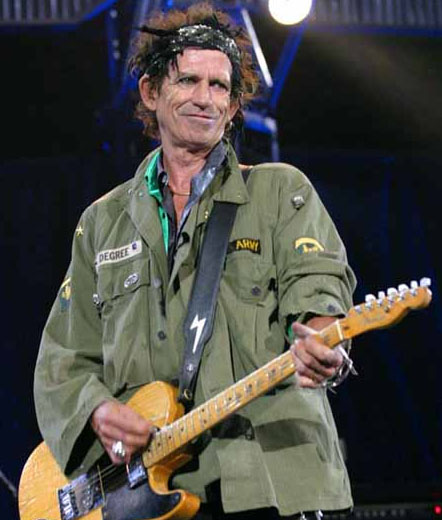
More and more, Rock and Roll seems like World War III, but without so many casualties, and fought by the descendants of the alpha-warriors in the previous two wars, the ones with all the casualties. That is certainly the way the the old Rock and Rollers themselves talk about it. All that "getting out of it alive" stuff. Even the wearing of mock military uniforms starts to look less like a mockery and more like a straight acknowledgement of their true spiritual (and in Richards' case literal) ancestry.
The vanishing kittens are back.

That's picture number 178. There are 195 others. Obviously cute photos of sweet kittens are too nice and too wholesome to be art, viewed individually. But the 14 by 14 rectangle of all of them in miniature that you get by following the "back" link above is momentarily confusing enough to be artistic.
On Wednesday afternoon I found myself just south of Waterloo Station with no pressing need to be home at any time in particular. The sky was cloudless, and the sun bright. I was well wrapped up. So instead of going straight home I went on one of my favourite walks, the one across the Thames from outside the Royal Festival Hall, across the now new Hungerford double footbridge, through Charing Cross railway station, and onwards into the West End and its various second hand CD shops.
I had my camera with me, because I had wanted to photograph the new Sainsbury's in Wilton Road, which is now emerging from its wrapping, and had already taken some very dull pictures of that, earlier in the day. The light spoilt them, by lighting up the top and plunging the street into darkness.
But now this same light became my friend.
I am starting to look at things photographically rather than as a person, and I saw the possibilities in this shot.
I'm on the downstream side of Hungerford Railway bridge and looking upstream through one of the old brick railway arches, and this is the Wheel, and one of the towers of Parliament. No Photoshopping at all.
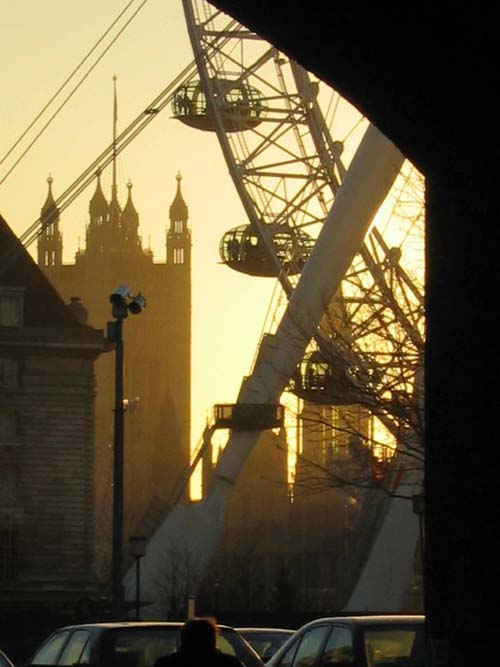
That's it, exactly as it emerged from my Canon A70. I didn't know for sure if it would come out that good, but I gave it half a dozen goes and was confident. I climbed happily onto the deck outside the RFH, past Nelson Mandela:

It's not that I violently object to NM. But I do object to most of the people who worship the man, so I don't much care for this object of their worship either. But even that looked good on this magic afternoon. If he looks larger than life, that's because he is. It's not a great photo, but I thought you might like to see this thing.
The new Hungerford Bridge footbridge gives you a choice of two footbridges, up or downstream of the railway bridge itself. They hang by cable from a series of spikes that are like inverted Vs, and the result is to make the original railway bridge, a girdered object of extreme banality and considerable antiquity, look like a suspension bridge, when in fact it is only the pedestrian bridges which are suspended.
Here's how it looked just before I climbed aboard, looking towards the new Charing Cross station on the far side of the river. I tried messing about with the darkness/lightness settings to lighten things up a little, but in the end I left it as was:

Up onto the bridge. Now I look downstream, to the towers of the city, and as I cross, they come into view. King Midas, in the form of the late afternoon sun during what I believe the movie makers call Magic Hour, has reached out and touched the NatWest Tower, turning it to gold, but has left the Gherkin looking its usual self, for once upstaged. Even those cloddish lumps nearer to us, on the south bank, are turned into things of beauty.
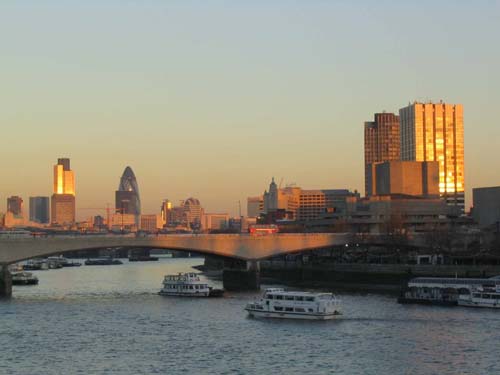
On to the other side of the river, and a look back across the footbridge towards the Royal Festival Hall:
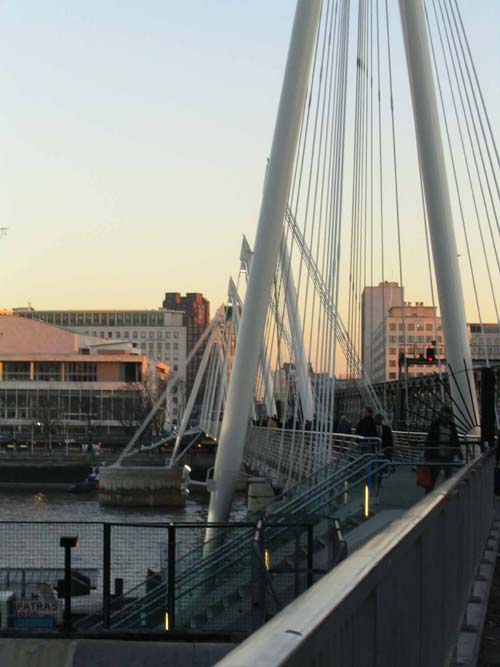
Just before we dive under Charing Cross station, another view of the towers of the city, this time through an artistic foreground of autumn arboreality, and this time including St Pauls:
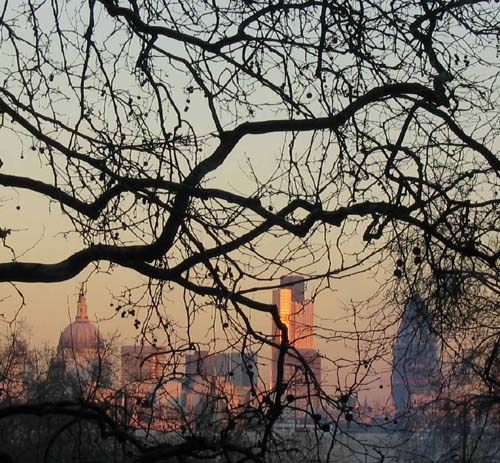
My next few shots were of one of my favourite secret spots of London, by which I merely mean a spot you don't see in the picture postcards. It's a strangely Dickensian little stretch of the walkway through Charing Cross station, which has been tricked out in cream coloured ceramic tiling. I like it. And I guess it was just one of those days, because the most blurred photo I took all day was also one of the ones I most liked when it came up on my computer screen at home:
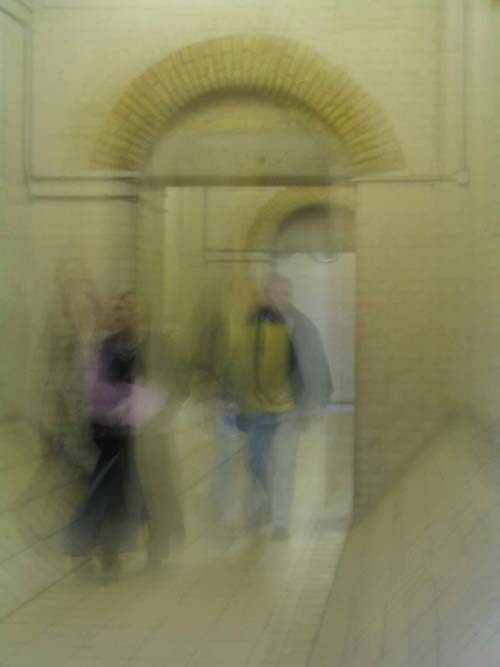
I really like that. It looks like an artist's sketch, probably a watercolour. I love the colours, in fact I love everything about it. It's the arches that make it work.
More snaps, and then the card runs out. Here's the very last picture I took, a few yards further along towards the station concourse. We've moved from ancient to modern, from claustrophic masonry to modernistical metal work. It's a suspension bridge under a building and over a sheltered pavement, approximately speaking:
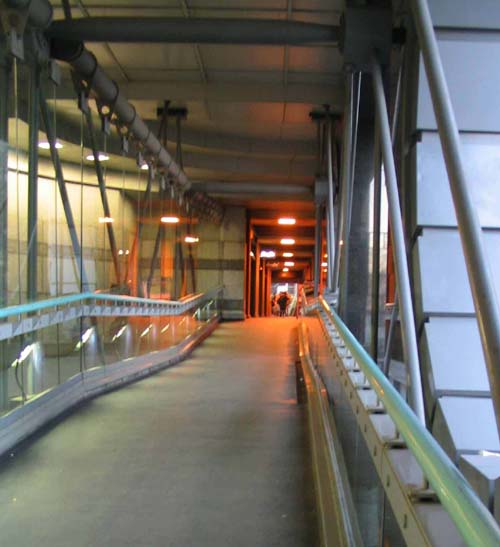
It's not the best photo I took all day, as a photo. But I like what it shows, albeit a little blurrily. And then the card ran out of space.
As usual this happened long before the batteries gave out, the battery life being one of the more remarkable improvements on the old Minolta. That, and the fact that the Canon A70 actually works. Which I now carry with me all the time.
Knowing my tastes in buildings, Michael Jennings emailed me with news of this building in Bangkok. It looks exactly like … an elephant! Well, it looks vaguely like an elephant, once you've been told that it's called the The Elephant Building.
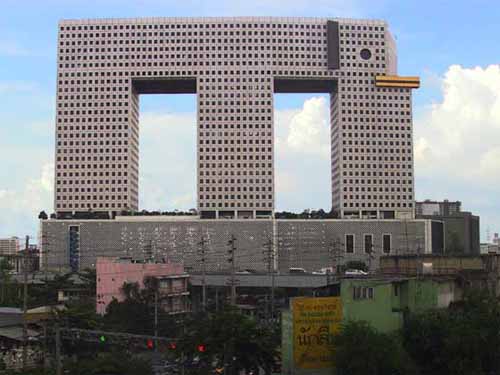
Here's a bigger version of that picture, and to find out what the rest of Bangkok looks like start at this smaller picture of the Elephant and keep clicking. Make sure you get as far as here, and scroll sideways.
Don't think much of its trunk, but I still like it.
I'd love to know how this thing got built. My preferred version is that this ultra modernist purist did his design, like cricket stumps, on steroids, and rectangular, and they all stood around thinking: Christ that's ugly, or whatever that is in Budhhist. Then some bloke had a brainwave. He said: "Hey, if you stuck some eyes in it, and put tusks and ears on it here and here, and cut a bit off at the end here, you could make it look just like an elephant!"
And the modernist said "Noooooooooooo!!!!!!!!", but finished it anyway as ordered, and was then arrested trying to blow it up.
And the technology of visual display continues to race ahead. This from today's NYT:
AN FRANCISCO, Dec. 16 – The Intel Corporation is planning to do to digital television what it has already done to computing.At the Consumer Electronics Show in Las Vegas, which opens on Jan. 8, Intel is expected to disclose the development of a class of advanced semiconductors that technologists and analysts say will improve the quality of large-screen digital televisions and substantially lower their price, according to industry executives close to the company.
Intel's ability to integrate display, television receiver and computer electronics on a single piece of silicon is likely to open new markets for a class of products - including plasma, projection and L.C.D. TV's - that now sell for $3,000 to $10,000.
Intel, as well as other large chip manufacturers, should be able to expand the benefits of Moore's Law, named for Gordon Moore, a founder of Intel, which accurately predicted decades ago that computer chips would continue to double in capacity roughly every 18 months, while their price would continue to fall.
"I think this brings Moore's Law to digital television," said Richard Doherty, a consumer electronics industry analyst who is president of Envisioneering, a consulting firm based on Long Island. He predicted that the low-cost display technology, which can be incorporated into the traditional rear-projection television sets, could lead to lightweight 50-inch screens only 7 inches thick for about $1,000, perhaps as early as the 2004 holiday season.
Wow.
I have long ruminated here to the effect that a whole new era of display will open up when people have more than one TV set, and that's a function of how small they can be made. Think of how the world will change when we can all have our walls covered in TV sets which no more unwieldy than framed pictures are now. You can only listen effectively to one machine, maybe two or three if you count my habit of combining classical music and TV sport (often both together) with other things. But you can have an entire wall full of simultaneous pictures. Any decade now our living rooms will sport those wonderful arrays of TV sets that you only now see in the TV shops, and with coordinated graphics controlled from one keyboard. That is to say, you'll be able to make the screens all combine together to show the same huge picture, or have separate pictures on each TV, or a combination of the two, to taste.
For this reason, much effort will in future go into making not just thin screens, but screens with thin frames, and ideally no frames at all. TVs will be like ceramic tiles, only with changeable graphics. A bit like this, come to think of it.
Movies to nod to: That one with Cher, Michelle Pfeiffer … The Witches of Eastwick? – where at the end the baby devil spawn was watching a whole wall full of TVs, all occupied by Devil Jack Nicholson; and: the original Rollerball, which I recall having walls of imagery; as did Total Recall, I seem to recall. And there must be many more.
Alan Little emailed me today about an interesting piece he has up at his blog about the unease he felt listening to – and liking a great deal – a Wilhelm Fürtwangler recording of Beethoven's Eroica Symphony, which was made in 1944 with the Vienna Philharmonic. However the points he raises struck me as being of more than merely "cultural" interest, as the date and the city has probably already suggested to you, so I linked to and commented on his posting at Samizdata.
I also thank him for linking back to a piece I did here, way back in September, about Hitler's love of classical music.
One of the things I most like about blogging is that your better bits have a habit of sticking around and being linked back to. Not by very many people, true, but the more I experience it, the more I disagree with the "here today gone tomorrow" complaint about blogging. In fact, I would say that the most important difference between being on talk radio (which I still do occasionally but did a lot more in the past) and doing blogging is precisely that blogs are not "gone tomorrow". At present most blogs have a far smaller readership than the audience of the radio stations I've chatted on, but the difference between readership and audience is, for me, all the difference. Talk is indeed gone, almost immediately. Writing can stick around, and the software that bloggers use ensures that at its best, that is just what it does.
I've said it before and I'll say it again. If you are interested in unusual designs, Dave Barry should be on your permanent list of places to go.
Thanks to him and his army of curiosity seekers, I got to look at these deadly disease ties. Amazing.
Busy evening. That may be your lot for today.
I know it's not to everyone's taste, but I love this car. Or, I did.
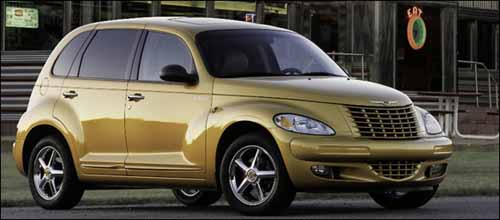
It was an immediate hit, but now sales are slumping. Why the slump?
This is the New York Times report:
What happened? Industry analysts say the fate of the PT Cruiser mirrors that of other halo cars - the industry term for unique vehicles that are meant to cast a favorable light on a company's lineup, drawing customers into showrooms.The PT's experience echoes that of Volkswagen's New Beetle, which arrived on the market two years earlier, in 1998, to even more acclaim. Interest in the car fell after VW failed to offer new versions to keep the excitement going.
But I wonder if "new versions" would have saved the PT Cruiser. My take is that the initial enthusiasm was because this was a truly different car, and that it then slumped because too many other people had the damn thing for you to be a true individualist, different-from-the-crowd guy if you then bought one.
Buy one of the first, you’re a trend setter. By one now, you’re a trend follower.
Last Thursday night I finished watching Krzysztof Kiewslowski's Three Colours Trilogy. Here are my conclusions. I thought of polishing them and sticking them up on Samizdata, but decided not to because that would be too exhausting. So here, all crude and immediate, but delayed, they are:
Blue is a boring story, worse than boringly told. This is a terrible film. Had it been on TV it would have been off in about ten minutes max, and that would have been that, Blue, White and Redwise. To think that brainless posh bimbo Juliette Binoche actually boasts in an attached interview that she found being in Blue more "interesting" than being in Jurassic Park. She spoke proudly of this decision as being a big influence – a path chooser as it were – on her career. I'll say.
Particularly dire is the fact that one of the leading characters in Blue is a composer, and we hear some of his music. This is always a mistake. It wasn't the kind of music such a person would produce. It was the kind of music a film music composer thinks that such a person should have produced, i.e. tuneful and upliftingly cliché ridden. But this was for a classical concert organised by the European Union. Tuneless slop would be the order of the day, so tuneful and uplifting slop is completely unrealistic. The actual composer of this stuff was a guy called Preiser, who also did all the real film music for the other two films.
White is an interesting story, quite interestingly told. Although maybe after seeing Blue, anything would have seemed okay.
Red is a quite interesting story, boringly told.
The only interesting or likeable major character in the three of them is the Pole, Karol. He marries and annoying French actressy type woman, and she dumps him because he is so poor he can't perform sexually, but he goes back to Poland, gets rich, and has his revenge. All the French characters in Blue, White and Red are decorative, boring, stupid, narcissistic and pointless, and doing utterly pointless things. They have very tiny brains (although in their tiny-brained way they do not realise this), and they occupy these tiny brains entirely with making themselves miserable. Sadly from the cinema audience point of view, they do this, what with their brains being so tiny, e-x-t-r-e-m-e-l-y s-l-o-w-l-y. At the final end of the story there is a ferry disaster, which all the major characters turn out to have survived. Only Karol should have. The rest should have been drowned.
By the way, it isn't just that concert in Blue - which in typical Euro style never actually seems to happen, or is at least heavily delayed – that is being paid for by the EU; this entire set of films was made with the help of EU money. This strongly suggests to me that the European Union is doomed. Who but doomed idiots would pay for things like the things in these films to be said about them?
Why are all the French characters so intolerable? I can think of two possible reasons. First, Kiewslowski hates the French and wants to present them as boring idiots, and loves only his fellow countrymen. Second, my preferred explanation, Kiewslowski is himself an idiot, and imagines that the way his French characters behave is somehow elevated and meaningful, rather than stupid.
The European Union money aspect of the situation makes more sense with this idiotic-friendly interpretation of Kiewslowski's attitude to the French, which is strongly shared by many French persons of the European Union sort, I surmise.
Kiewslowski lavishes expensive state-of-the-art camerawork on these French persons as they go about their pointless existences, and thus the effect of watching Blue and Red is of having been kidnapped and imprisoned in a photograph exhibition, where all the captions consist of boring gibberish. Except, it's far, far worse than that, because you have to trudge through the exhibition at a set speed in a set time, reading all the stupid captions, and viewing all the stupidly pretty photos in a set order and for only a set time. My mind kept wandering. If I hadn't been able to rewind to find out what, if anything, had just been said, I would have got completely lost immediately.
In a way, these films are prophecies of the contrasting fortunes of France and Poland during the years following them. France has stagnated prettily. Poland has bounded ahead, crippled only by its amazing unwillingness to accept how much better it is doing than France, and pathetic belief that it must grovel politically to France. Why? People like Kiewslowski is my guess.
I know what you're thinking. Why the hell did I subject myself to this insane ordeal? Well, I kept hoping that things might improve, and during White, after a miserable first half hour spent in France, things moved to Poland and they did. Karol the Pole had a meaningful life, and he got on with it, and what is more he got on with it at a cinematically acceptable speed, giving the stupid French film star woman he had married the comeuppance she deserved. (Why she ended up on the ferry I didn't get. She should have stayed in prison.) Maybe Red would be as much better than White as White was better than Blue. To the end I lived in hope. After all, White proved that this man could entertain (he's dead now thank God), when he was in the mood to do so. That's the first reason I kept watching.
Second, insofar as most of it was rubbish, I kept watching because I knew that, what with me being a Culture Blogger, I would soon have the pleasure of informing the world of this fact. A misery denounced is still a misery, but it's a lot less of one.
Third, I have long been prejudiced against "Foreign Language" films. "Foreign Language" films, by the way, are not just films in a foreign language. They are films which either are in a foreign language, or which might as well be in a foreign language for all the sense they make. Look in Blockbuster under "foreign language", and you'll see just what I mean. English as a foreign language is not just something you can teach to Japanese students. English as a foreign language is the language of critically acclaimed and important films, full of meaningful (a critic-speak word meaning meaningless) camerawork, which happen to have been made in English, due to a commercial oversight by the people who normally ensure that such films only get made in real foreign languages.
Anyway, as I say, I acquired a prejudice when I was a peer-group-dominated undergraduate at Cambridge University against critically acclaimed meaningfully meaningless films, attending many such films, pretending to like them and only later realising that I thought they were mostly rubbish, and I wanted to check out whether my prejudice was still justified. Recently I've been noting a tendency in myself to become grown-up in my movie tastes, and not to like bad American movies either. What was happening? Was I becoming a continental European? Luckily I'm not, but I wanted to check it out.
Also, when some idiot at a party says to me: So, you hate meaningfully meaningless foreign language films do you?, when was the last time you saw one? – I want to be able to say that I saw one this century and that it was indeed rubbish. Blue certainly fitted that scenario.
A final word on all that critical acclaim. It's my understand that this three films were indeed critically acclaimed, and at the time they were emitted in the mid-nineties, I read some of this acclaim. But I made sure I read none of it this time around, googling the thing only to find out which order to watch them in. I will now look at this acclaim, because I expect it to confirm several more prejudices I have, this time not about movies so much as about movie critics. I promise nothing, but stay tuned.
Time I had another posh picture, straight, with no post-modern irony.
Here's one I found earlier:
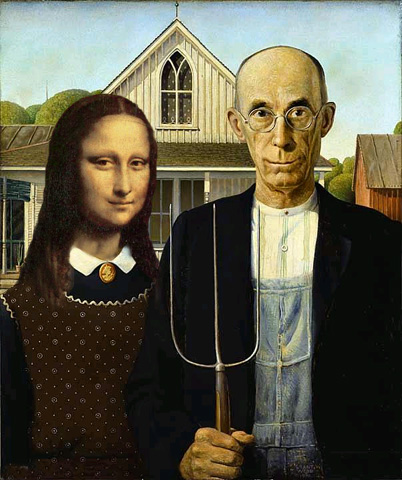
Ah, culture. Seriously, can anyone point me to the original, into which ML is inserted? And I seem to recall that in the original, he isn't so happy, right?
I found it via b3ta.com (again), but can't remember how exactly. It's something to do with these people, who also link to this amazing page, which I am now about to link to from Samizdata, because they'll love it.
Post-modern irony is a hard habit to shake.
This is fascinating, from that always fascinating world newspaper, the New York Times:
MEMPHISON a Tuesday night at a downtown lounge here, Ryan Flickinger, 30, was preaching the economics of hip. Specifically, he was talking about young professionals, the most mobile class in American history, who are choosing not to come to this river city despite what seem attractive amenities: cheap housing, good music, excellent barbecue and a major employer, FedEx, with 30,000 jobs in the area.
"I want to start stealing those people from the cities of Chicago, St. Louis, Birmingham," he said.
His audience was about six dozen members of Mpact Memphis, a group of 900 volunteers in their 20's and 30's who joined in 2001 to try to help Memphis lure people like them. In marketing terms, their mission is to build a brand.
This brand-building is part of a new wrinkle in urban development, said Anna McQuiston, 33, a volunteer at Mpact and the marketing director for a local real estate developer. "It's turning the formula around," she said. "You create an attractive place for people to live. Then the corporations will come after them."
Memphis, which has just over a million residents and is still scarred from the 1968 assassination of the Rev. Dr. Martin Luther King Jr., is one of several cities that have come to see hip as a bottom line issue. In his 2002 book, "The Rise of the Creative Class," the economist Richard Florida wrote that the healthy cities of the 21st century will be those that can compete not for big companies but for educated, creative young people. This "creative class," he argued, will revitalize downtowns, start new companies, attract other entrepreneurs and build solid tax bases. Mr. Florida, a professor at Carnegie Mellon University, says that Austin, Seattle and Portland are thriving in part because they became hip destinations for young talent – offering not just jobs, but cafes, clubs, tattoo parlors, tolerant gay neighborhoods and bike routes. "If places like Buffalo, Grand Rapids, Memphis and Louisville do not follow suit," he wrote, "they will be hard pressed to survive."
It's odd that Memphis, birthplace of rock and roll if I remember my Peter Hall correctly, should need to learn the importance of being hip. I guess all the chaos and insanity that went along with that (see Peter Hall) put them off hipness for about fifty years.
The good news is, as Hall says, they have plenty of hip history to work with.
 These people fear for the future of speed cameras, and not in a good way.
The reason I'm putting this picture here is that I wanted at first to put it up at White Rose, as an example of the direction speed cameras are heading in, ho ho. But I am forbidden to upload pictures to White Rose. I can only put up words there. Which is probably the wisest arrangement.
So then I thought, I'll do a small bit at White Rose, and then link to b3ta.com, where I found this picture. The trouble with that is that nothing ever stays put at b3ta.com and they don't let you link to individual pictures. Or if they do, I don't know how.
So then I thought, I know, I'll stick it up here, and then link from White Rose to here, while giving b3ta.com their credit by linking to them also.
So now I have to explain why this is cultural.
I could just refer you to the slogan at the top of this blog. But I think that there's a little more to say than that. This set of pictures does make the point that computer programmes like Photoshop have opened up a whole new world of popular art (of a sort that the people at b3ta.com specialise in), of such things as kittens with the heads of eagles, famous paintings with moustaches and added captions, celebrity morphing combinations, and, as here, adulterated signposts. How Stalin would have loved it.
Actually, as I think may already have been commented here when I said something similar here a while ago, Stalin would not have loved Photoshop, because his rearrangement and deletion effects depended on people not realising that he was doing this sort of thing, and now everyone does realise.
Changing the subject, I'm now two thirds of the way through Kieslowski's Three Colours. I thought Blue was tripe, and considered leaving it at that. But I gave White a go, since I'd already got it out of Blockbuster, and I'm glad I did because it was much more amusing. So, I'll definitely be viewing Red between now and 10pm tonight when it has to be back in Blockbuster.
They're showing LA Story on BBC 1 TV. I love this movie. Most attempts to combine Hollywood standard issue wackiness with extreme, educated self-conscious artiness make we want to …pause while I invent really crushing put-down … not watch. But for some reason LA Story works (and I've just learned from following that link that Steve Martin wrote it). I own it on DVD, yet I'm watching the broadcast version now. Can't help myself.
For extreme educated artiness, you need look no further than the rehash of the Hamlet graveyard scene, with Rick Moranis as the gravedigger. This ought to be first movie written-and-directed-by Doomed Loser stupidity at its most doomed. Yet I like it. It all adds to the sense communicated by the movie that Los Angeles is one of those Great Creative Cities, in the middle of its Great Creative Moment. Most of the scenes are pure Los Angeles, based on knowing the place, or at any rate knowing it as I imagine it. The talking signpost, the rollerskating in the art gallery, the driving twenty yards to see somebody, the twirly shop assistant (a wondrous creation by Sarah Jessica Parker of Sex in/and The City fame) called SanDeE* who is learning to be a "spokesmodel", the fact that Steve Martin's starting out girlfriend is a gift purchaser, the restaurant run by insane authoritarian Germans who are far too inquisitive. That graveyard scene fits into all that without any spot-the-join misjoining, seamlessly, by which I mean no more seamed than the material around it because this movie has about one seam every twenty seconds. Steve Martin's desperate, aspirational wackiness has never had a better setting. Victoria Tennant got a lot of flack for her effort in this movie. Something to do with her being a hopeless actress, as I recall it. I love her in this. More fun quotes from this movie here.
Gotta stop. Watching LA Story now is completely crazy, because I have three videos from Blockbuster on their new three for a fiver for a week offer, which have to be back this Thursday which is now tomorrow. Trouble is, they're not regular fun movie-movies, they're seriously arty movies, with Steve Martin nowhere in sight. Three Colours Blue, White, Red, directed by someone famous and foreign and unpronounceable. The movie equivalent of having to read War and Peace by the end of the week. I have to start in on those, now, and I may or may not keep you informed. At least there's Juliette Binoche involved.
The unignorable (I put that so I didn't have to start this sentence with a small letter) b3ta.com links to some pages of snow sculptures. This is one of my favourites:

One of the many huge boons bestowed upon us by photography is that inherently ephemeral objects such as snow sculptures can live on permanently in our affections. When we can take ten snaps from different directions, feed them all into our PC, and crank out a 3D image in some form, such as a view of the thing on our screens that we can virtually walk around and in among, if you get my drift (hah! - snow, drift), then snow sculpture will become even more productive as a means of entertainment and spiritual uplift.
Probably this is already possible. When I say "we", I mean when we all do it because it is so cheap and so easy and so routine, and our computer savvier mates can tell us how to do it. And when even I know how to do it.
On the basis of such records, maybe the best snow sculptures could be recreated in more durable materials. In icing sugar, for example.
I once did a snow sculpture myself, when I was at school. There was for a House Exhibition" in which the creative and showy offy among us showed off our various creations, and it coincided with some snow and and with enough coldness to allow snow sculpture to last a bit. So in the courtyard outside the main indoor exhibition area (the house dining hall), and clearly visible from inside, I did a reclining man.
My collaborator in art was, to begin with, a member of the Keynes clan by the name of Randall. He wanted us to do a fake Henry Moore, with a hole where the man's stomach should have been. I vetoed this as pretentious and stupid. I knew even then that a genuine and serious effort to get the man looking right was better by far than some ironically distanced knock-off of someone else's hard won discoveries about the sculpting of the human form. Randall Keynes resigned from the project. Good riddance. I finished it on my own.
Somewhere, I think I even have a photo of this effort.
This striking looking building is ING House, near Amsterdam. They wanted a landmark, and they got one.

This was no accident. It turns out that they've got quite a few.
ING, it seems, is the very corporate embodiment of "starchitecture".
In the last 15 years, the desire of the ING Groep for "special architecture" found expression in highly spectacular buildings. The large orange N of Nationale Niederlande is prominently displayed in Rotterdam on the highest building in the country (1991, Architekt A. Bonnema, Groningen). In Den Haag, the eye-catching Nationale Nederlanden complex with its green and white stripes (1994, Kraaijvanger Urbis, Rotterdam) spans the freeway and is a kind of modern gateway to the city. The architectural quality of the building is controversial but its function as a landmark is undisputed.Examples abroad are the much publicized main office of the ING Groep in Budapest (1995) by Erick van Egeraat (Rotterdam) or the Holland centre of the ING Groep (1996/98) by Pro Architekten (Den Haag) at a striking location within the Warsaw city center.
The ING Groep subsidiary, ING Real Estate, also worked with foreign architects. One striking result is the office building, Ginger & Fred (1995) on the banks of the Moldau in Prague by Frank Gehry.
Clearly ING is collectively of the view that striking buildings are good for business.
I heard about ING House by watching the telly, which I like to do. It was a BBC3 TV (one of the free digital channels) show called Dreamspaces, which is all about the showier sort of modern architecture. They showed a few shots of it. I misheard it as "IMG", but crucially I also heard that it was in Amsterdam, and Googling "modern architecture" and "Amsterdam" got me to a picture of it soon enough. It certainly is distinctive, and you know it when you see it. This mention was in connection with an outfit called Archigram, who produced a design for a similarly insect-like object way back in the sixties. (You can just spy the left hand end of this creature at the top right corner here.)
Maybe this thing leaks and is a nightmare to work in. And maybe it has about as much of a relationship with the ground it sits on as an alien spaceship. I don't know. But I do like the look of it.
It looks to be situated in one of those drearily spread out non-places that the modern world is so full of these days, and which has now replaced architectural modernism as the major real world aesthetic horror story of our time. The occasional self-importantly stupid or ugly building – badly integrated into its surroundings perhaps, maybe technically incompetent and with a roof that leaks – pales into insignificance by comparison with these vast swathes of nothingness.
Dave Shaw took a walk last night on what passes for the wild side these days among middle aged geezers like him and him. But Kelly Osbourne, whom he apparently shared the party with, is hardly wild side. She was on Top of the Pops with dad Ozzy last week, singing a potential Christmas Number One Dad/Daughter Duet for gawds sakes. It was very sweet and all, but not exactly biting heads off bats stuff like Ozzy used to do. So I'm told. The real wild child of the Osbourne family is the mysterious Other Daughter who refuses to be on television. How weird is that?
Jonathan Ross also interviewed Ozzy and Kelly on his show last week, and compared Ozzy to the Queen Mother. Quite right. I think the link is that they both have (had in the QM's case) a public reputation for total honesty. Quite how genuine that was with the QM I don't know, but with Ozzy it seems very real. For example, the other night on The Osbournes, Ozzy was in a state about his wife's colon cancer and was being consoled by this Guru character, who was blabbering away in that special language that Gurus use which you can't remember a single word of because it makes extremely little sense, and I was thinking: "What the fuck's that all about?" One microsecond later, Ozzy says: "What the fuck's that all about?" How can I not love the man?
Such magic moments as that aside, the appeal of the Osbournes is that despite all the swearing and adolescent whingeing and moaning, and Oz's very evident history of drug abuse resulting in slurred syllables, they are, underneath all the underclass modernisms, a totally trad family. They love each other. And that mum, how about her? She stays at home, and looks after everybody. No separate career for her. Her only job type job is taking care of about two thirds of Ozzy's job.
What we are witnessing here is the ossification, not to say Ozzyfication, of rock and roll, in the same way that jazz based pop music finally arrived at its terminus in the nineteen fifties, just before rock blew its lid off. It started off being belted out by dodgy negroes in drug sodden brothels, and ended up being sung by Tony Bennet in a cardigan on some TV Christmas special. Now rock and roll has reached the same situation.
It's inevitable. You can't stop this kind of thing happening.
The proof that the rock and role era is ending is that it is more and more making its peace with the stuff it used to hate. Rod Stewart has an Xmas album out now of pre-rock tunes, full of witty, perfectly rhyming lyrics like they stopped writing in 1952. The latest pop babes routinely cover tunes that were written before they were born, and the air is thick with the sound of different generations getting along fine with each other.
Time for another inter-generation war? Is there some other rough musical beast slouching towards Bethlehem? Maybe there already has been, but by definition I hate it and have been ignoring it. (Dance, hip hop, etc.) But what if the Tony Bennet/Beatles discontinuity was a one-off? What if pop music just dribbles on for ever, getting nicer and nicer, more and more like Abba every year, and the rock and roll explosion of Devil Music never happens again? Maybe the next big row will be with a new generation that doesn't like any pop music at all, and prefers to spend all its time getting post-graduate degrees in nanotechnology, or some such freakery.
Not that pop music will necessarily be crap, any more than Mahler is, even though he was using a musical instrument pretty much perfected the best part of a century earlier. Sting's latest tune, for example, another male/female duet, sounded to me musically really good on Top of the Pops, despite the ghastly more-American-than-the-Americans accent that Sting sings in and the overwrought manner of the woman he was duetting with. I'd love to hear that one covered by a batch of kids from the reality TV pop idol fame game circuit.
By the way, talking of the Devil's Music, Ross Noble on Room 101 identified Christian Rock as something that should be wiped out for the challenge to everything properly indecent that it is. Is there anything more nauseating than a bunch of vicars imitating the Beatles? Well, yes, lots of things, but it is nauseating.
As you can tell, I spent the night in, in front of the telly.
I've just done a posting at my Education Blog that may be of interest to passers-by here, about the unofficial socialising cultures embedded in among the official school-work culture of schools, Cher in Clueless, original Cher dancing on a battleship, etc. Geeks versus anti-geeks. E-ducation. Steven Pinker gets a mention. Go there if that appeals.
Another Dave Barry find. There's something, he says, very troubling about this:

I'll say.
This specially designed mannequin is made of "fiber glass," a special form of plastic that features light weight and durable use. It comes with a shiny metal base. (Metal base is taped at the bottom of the box under a piece of cardboard, near the rod that is taped to one corner of the box.) It is very detailed, with human hair eyelashes. With detachable hands, arms, left leg, and upper body, it is easy to set up and dress. Lovely and unique, this mannequin will easily attract attention. If displayed in your store front, it will certainly increase traffic in your store.
Shock/conceptual/post-modern/whatever art meets retailing.
Jonathan Ross is interviewing Matt Lucas (the fat bald one) of the new comedy hit TV show Little Britain, and Ross is focussing, quite rightly, on the one comic creation of true genius: Vicky Pollard, the fat blonde west country girl who talks extremely fast, in order to get out of the scrapes she gets into.
I'm now going to try to find a picture. Bear with me.
That's not really right. She looks too happy. Normally she's in trouble for having failed in some duty or other, and is trying to fast-talk her way out of it. This even smaller picture is rather better, I think, but it still doesn't really get her.
Whatever. Vicky Pollard is a great TV comedy creation, up there with Loads 'a' Money, and Smashy and Nicey the Cheridee DJs. My congratulations to Matt Lucas.
I spotted Vicky P months ago. I should have flagged her up when I had my first laugh at her.
And the other cultural blogging I did recently, to excuse the fact that I haven't done much here for the last day or so, was in a couple of comments on this, concerning the number of symphony orchestras there are along a (at least symphonically) rather remarkable railway line from Washington DC to Boston, via Philadelphia and New York, and Baltimore, and also (for symphonic purposes) Wilmington, New Haven and Newark.
UPDATE: In a futher comment, Michael Jennings reveals that he does not know how many symphony orchestras there are on the Tokyo-Nagoya-Osaka corridor.
Nothing much today, but I've been culturally busy on other blogs, most notably in this Samizdata posting, which mentions a movie and a TV advert. If I didn't have Samizdata to write for, the piece might have appeared here. It's about the way that the big social distinction nowadays is just above the bottom of society, whereas in former centuries it used to be just below the top.
I was going to link to some wonderfully sweet kitten pictures, which b3ta.com mentioned, but the kitties are now gone. I was going to talk about soft focus photographic backgrounds and the differences between non-human camerasight and human eyesight. It will have to wait.
Very good piece by my friend Alice Bachini about Friends. Personally I read all Alice's stuff but apparently not that many others do, presumably because she is often in what they presumably regard as incoherently egocentric mode. I like it all, but many seem not to. All the more reason, then, for a blog like this which is slightly less obviously egocentric to link to Alice whenever she does a piece which is definitely About Something, other than herself and her worries, ambitions, mood swings, parental obligations, ethical views, etc.
Read the whole thing, but if not then at least this:
Phoebe's character is parallel to Joey's in that she too is considered odd or eccentric, and is apparently entirely happy with this. In this show, she has lately had a sexual encounter with an "old friend", and ends up set to have another one with the grey-haired guy. So if she did that every few weeks, it would add up to a lot of people after a few years. I looked up some statistics lately on average numbers of sexual partners, and my reckoning would definitely place characters like the ones in "Friends", "Will and Grace" and "Seinfeld" in a tiny extremely high top percentage. I think when we watch these shows we focus on individual episodes and tend not to notice the fact that they are way, way more sexually active and successful than most of us here in Ordinary World. But the thing I only got recently is that this is not a mere unrealistic dramatic device: it's a coherent portrayal of a specific kind of person, who is very interesting, and whom we want to learn about, which contributes to the popularity of the shows. Who wouldn't want knowledge about how to be better at attracting the opposite (or indeed same) sex? Even if you never use it, maybe one day you might want to, and it's certainly nice to know you could.Lastly, I want to note that Phoebe and Joey are the characters whose sexual openness is greatest. They do not dump people for being slightly differently aged to themselves, or not conventional enough. They enjoy people older and less conventionally beautiful than themselves, and are able to enjoy the good things without letting prejudices get in the way. This is another kind of sexual behaviour – like having lots of partners – which is traditionally sneered at in some quarters, as a sign of indiscriminateness or desperation. But "Friends" doesn't endorse that view, even though it does present Joey and Phoebe as oddballs and therefore somewhat unfathomable.
I was going to write this post about the use of irony in language, especially urban language, but then it went another way. Maybe later.
And maybe not. That's another problem for some with Alice, I guess. She constantly announces things she's going to do or write about, but then doesn't do or write them. Instead she writes about something completely different, and presumably does something completely different, like eat cakes or buy shoes while agonising about the rightness and wrongness of rightness and wrongness. Which I don't mind at all. What the hell is she, a train timetable? Are you saying you depend upon Alice Bachini writing what she said she'd write about? That's an absurd way to live. Alice Bachini is an oddball and somewhat unfathomable. Deal with it as they say in America.
Ross who wishes he could add a heavy dash of Joey sums me up exactly, except that Ross is far better looking than me.
Armed Liberal (The War on Bad Philosophy 2) had a fascinating post and comment string, way back in March, on the central philosophy of the Islamist suicide bombers and their clerical guides. In the course of it, he quoted Isiah Berlin:
Suppose you went and spoke with …[long list of European Romantic intellectual figures, including Hugo, de Staël, Schlegel, Goethe, Coleridge, Byron] …
Suppose you had spoken to these persons. You would have found that their ideal of life was approximately of the following kind. The values to which they attached the highest importance were such values as integrity, sincerity, readiness to sacrifice one’s life to some inner light, dedication to an ideal for which it is worth sacrificing all that one is, for which it is worth both living and dying. You would have found that they were not primarily interested in knowledge, or in the advancement of science, not interested in political power, not interested in happiness, not interested, above all, in adjustment to life, in finding your place in society, in living at peace with your government, even loyalty to your king, or your republic. You would have found common sense, moderation, was very far from their thoughts. You would have found that they believed in the necessity of fighting for your beliefs to the last breath in your body, and you would have found that they believed in the value of martyrdom as such, no matter what the martyrdom was for. You would have found that they believed that minorities were more holy than majorities, that failure was nobler than success, which had something shoddy and vulgar about it. The very notion of idealism, not in its philosophical sense, but in the ordinary sense in which we use it, that is to say the state of mind of a man who is willing to sacrifice a great deal for principles or some conviction, who is not prepared to sell out, who is prepared to go to the stake for something which he believes, because he believes in it ... this attitude was relatively new. What people admired was wholeheartedness, sincerity, purity of soul, the ability and readiness to dedicate yourself to your ideal, no matter what it was.
No matter what it was: that is the important thing.
And the "void filled with Byronic passion" is what the Islamists mean to fill.
Cultural studies meets counter-terrorism.
As so often, Dave Barry takes you to the things that really matter, like for instance
this photo:

Which just shows that if you hang around flags and politicians for long enough, with a camera, you'll eventually snap yourself a true work of art.
This image is destined to hang around, I think. So to speak.
This is, I think, a fabulous piece of writing, by Denis Dutton about a book by Charles Rosen. By this I mean that I not only agree with just about every word of what Dutton says, but that I also think he strikes exactly the right tone when agreeing, or disagreeing, with Rosen.
Dutton makes the excellent point that an odd effect of the recording of classical music is that performing fashion has recently done a somersault. The first few technically satisfactory recordings of the standard repertoire tried to be as standard as possible, to be that "all round best version" ("safest" version!) that the BBC picks out on Saturday mornings. But now that there are dozens of such standard interpretations, the search is on for non-standard ones. We punters now dig out the eccentricities of early twentieth century virtuosi, and purchase new recordings by similarly wilful artists of our own time, who have suddenly leapfrogged over their more careful contemporaries. Well, that was me making these points. Here's how Dutton makes them:
Rosen is right that recording has altered how we regard musical works, but I’m not so sure he's exactly on the mark here. It does appear that the early recordings of complete sets were purchased mainly for repertoire. But one of the problems facing the classical recording industry today is that the market is saturated with repertoire. What will sell will be a performer – a big name pianist, for example, someone like Evgeny Kissin giving a fresh view of standard repertoire. A discount importer nearby to where I live has bins of CDs of standards – Sibelius symphonies, Brahms concertos, Chopin, and the like, all in adequate performances – for 54 cents each. At that price, the standard repertoire is no longer the issue: it is finding something new to do with it.Rosen notes that "the eccentric and portentously personal interpretations by artists of the 1920s and 1930s" were not suitable for the later decades after the introduction of LPs, when a “faithful reflection of the composition” was more important than a unique, personal performance. He then disparages as a "myth" the notion that pianism was "more free in the grand old days of the past." But listening to the standard, so often tepid and correct, recordings of the 1950s, I’d say the atmosphere then was less free, and that a saturated market for repertoire today has actually forced pianists (or allowed them) to present themselves with something like the swagger of the nineteenth and early twentieth centuries. If, as Nietzsche says, a dying culture goes out in the blaze and sputter of fireworks, then the piano is dying in pretty spectacular fashion, with the likes of Argerich, Pletnev, and Volodos. Rosen does remark that depending on how you listen, some old performances can seem "breathtaking and knuckleheaded, dazzling and revolting." True; but compared to fifty years ago, there are more, not fewer, pianists playing like that.
Dutton is also very good on the defects of classical musical modernism, without just spluttering in rage about it. It is tempting to copy and paste about a yard more of his stuff, but I will content myself with this:
I'd not mind at least some discussion of the possibility that Boulez’s piano music just isn't as good as Liszt's.
Personally I'm not over-fond of Liszt's piano music either, but that's just me.
Thank you Arts & Letters Daily. Thank you, a lot.
What do you think this is?

Gabriel Syme ("Colourful web") of Samizdata links to it, and explains:
A project to create a comprehensive graphical representation of the internet in just one day and using only a single computer has already produced some eye-catching images. The Opte Project uses a networking program called "traceroute". This records the network addresses that a data packet hops between as it travels towards a particular network host. The project is free and represents a lot of donated time.
Well I didn't fully get all that, but it sure looks pretty.
From the Guardian:
In Romania, local media report that the country's "first" institution of higher learning, the University of Arts, in Iasi, was the scene of an official investigation this month after police removed the corpse of a man believed to have hanged himself on the campus. Builders and students at the university had initially mistaken it for a modern work of art.According to Reuters, the body hung for a whole day in a sculpture-laden garden building that had been re-opened for repairs before onlookers twigged to what it was and called the cops.
When the world ends, vital hours will be lost on account of people thinking it's modern art rather than the end of the world.


