

Just to say, I've been pretty busy today, and am out this evening, and will be busy Christmasising over Christmas, so don't expect regular stuff here for the next few days.
I just did a posting at Samizdata, with some surprise architectural speculations at the end about what JK Rowling should do with all her mountains of money.
Plus, I watched this movie last night, and enjoyed it immensely. Great performance by Campbell Scott in the title role.
And that's your lot for today, and maybe also for tomorrow and tomorrow and tomorrow (creeps on this petty blog from day to day to the last syllable of recorded blogging ...). Shakespeare. Macbeth. Towards the end. When things are really starting to depress him.
Anyway, Happy Christmas to all.
Remembering John who? and by what? – is what you may well now be thinking. Well, pay attention.
This afternoon I found myself on the south bank of the Thames, just up river from St Thomas' Hospital. It's the bit where you get this familiar London view:

Then I turned through about forty five degrees and got this rather unusual view of the Wheel:

The light was fading fast, but my little camera makes the least worst light it sees into good light. I actually had to Photoshop it a bit darker.
But enough of such tourist shots, which I only show you to say where I was when I saw what really got me interested, which was what I saw when I turned around some more, and faced away from the river. It was a plaque, which I had never noticed before.

Do what I did. Take a closer look. And be grateful for the lamp in the second picture above for lighting it up. The plaque commemorates a man and an achievement of which I had previously known absolutely nothing.

When I got home I found out more about John By, and was also able to satisfy myself that the phrase "introduced malaria" is not a mistake, but an all too real a condition. More about Malaria here.
Just one of those little London pleasures, and this one is quite recent. As you can maybe make out from right at the bottom of the plaque, it was erected by the Historical Society of Ottawa as recently as 1997.
I am surely going to have more to say here about this gentleman, but for the moment, read this fascinating little aborted tangent, so to speak:
What I have discovered (hence all the links above) is that the intensely networked or linked nature of blogs is what gives it massive value – way beyond that of the internet generally. It's a case of following trusted chains – If A links to B and A is trustworthy, then B is likely to be trustworthy too.Within an organisation, this is even more likely to be true. The trustworthy people will gain connections and the less trustworthy will be sidelined. It's ridiculously like how the brain appears to work. But I won't go there. Suffice it to say that I've spent a lot of my life thinking about things like this.
I really hope that he does "go there", some time Real Soon Now.
Last night I concocted a Samizdata posting on the identical subject, the closing of a play at the Birmingham Rep that was alleged insulting to Sikhs, to one that Perry de Havilland posted about while I was doing mine. So I scrapped mine. He linked to this story, I linked to this BBC report, to this review (which was written before thing got violent), and to this further comment (when the violence had happened and the production had been cancelled).
I ended what would have been my Samizdata bit by speculating (and hoping) that we had not heard the last of this row. Nevertheless, I rambled over much the same ground as Perry had traversed more concisely, so I refrained from posting mine.
But now, it seems that indeed we have not heard the last of this row, and that Birmingham may not even have seen the last of the play itself being performed:
The manager of a Birmingham theatre company is considering staging a play cancelled after a violent demonstration by members of the Sikh community.Mr Foster told BBC Radio 4's PM: "I think it's one of the blackest days for the arts in this country that I've ever experienced.
"If I'm really honest, I think the people who have made the decision ... have actually been cowards and I don't think we should be cowards in this country.
"We can't allow violence to dictate what we produce in this country in artistic forms."
Well said mate.
However, I cannot help wondering if the contrasting attitudes of the boss of the new Birmingham Rep, where the play was cancelled, and of Mr Foster, who now wants to stage the play at the old Rep, might have something to do with the fact that the old Rep looks like a far easier place to defend against a violent mob.
Here's the New Theatre:

I couldn't find a picture of the old Rep, but I did manage to dig up this map, here.
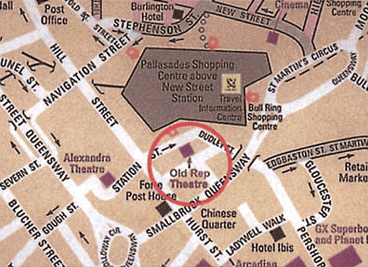
I know which one I'd rather try to stop rioters trying to get into. The new edifice seems to be surrounded only by open country, and to be pretty much made of glass, a hopeless combination. Definitely not a building to be throwing stones from, even if only metaphorically. The old Rep, on the other hand, seems to be stuck in a small street, defended by being flanked by buildings on either side, like the one's in London's West End, and I'm guessing it's much more solidly constructed and less vulnerable to missiles than the new place.
 Ah, and now I have found a picture of what I think must be the old Rep building. It's only a tiny little picture, but it makes my point well, I think.
With only a bit of skill, the Police could probably stop rioters getting anywhere near the old Rep, and if rioters did get near it they'd do far less damage. Plus, if anybody bent on doing damage contrived to sneak in before showing their violent hand, they'd have a far harder time escaping.
This guy linked to this, and from him I learned of this, this being that they have built a skating rink inside the Eiffel Tower. The photo he has is okay, but I found what I believe is a better one here:
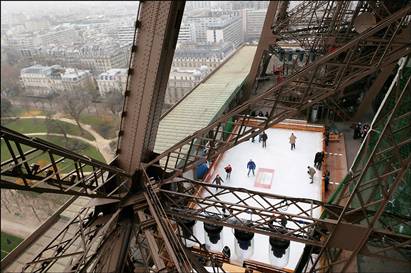
It's all part of the big Paris Push to get the 2012 Olympics.
Interesting the way they're doing cool things in cities, just to get these games. The games themselves, I think, are stupid. But the things being done to get them include some good stuff. Like this.
London is in this race too. With luck we'll get lots of good things too. And Paris will get the damn games.
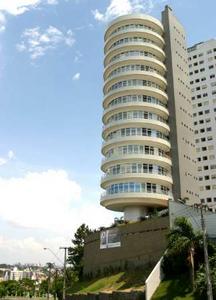 Michael Jennings Skypes with the link to this:
RIO DE JANEIRO (AFP) – An unusual apartment building was inaugurated in Brazil, each of whose 11 storeys turns independently, giving lucky residents 360-degree views of the eco-friendly city of Curitiba.The building is located in a residential neighborhood called Ecoville, in the capital of the southern state of Parana.
It was billed as "the world's only completely revolving tower."
The tower was the latest addition to Curitiba's cutting-edge urban planning, which includes a much-copied bus transit system.
Canada and the United States boast revolving restaurants mounted on skyscrapers, but fall short of Curitiba's newest building.
"It is a great civil construction work of art in modern times," said Alcir Moro, director of the Moro contractor group.
Each 300,000-dollar apartment occupies an entire floor of 287 square meters (3,000 square feet).
Lights, air conditioning and the revolving of the apartment can be turned on and off with a remote control or an oral command.
The owner may also change the direction and speed of the revolutions. At low speed, each floor takes an hour to revolve.
The Modern Movement has finally come full circle.
Happy is the classical music fan who adores a musician who used to be adored by millions but who has now gone out of fashion with younger listeners. Everything is available on CD (as an after-echo of the man's huge popularity) but it is now available second-hand for next to nothing.
 I give you: Yehudi Menuhin.
Correction. The orthodoxy now seems to be that Early Yehudi Menuhin is (and remains on CD) very fine, when his violin technique was faultless. However, this kind of technical fineness is now ubiquitous, and now recordings are better, so ... Late Menuhin, however, is not fine at all, because his violin technique was suddenly not faultless. And he even became one of those sad instrumentalist/conductors, who conducted because he couldn't play properly any more.
I don't go along with any of that, other than the bit about the fineness of Early Menuhin.
On the strength of Early Menuhin genius, and at a time (the 1930s) when 1930s recording quality was all there was, a whole generation of adoring fans bought everything he did, then and later, and either liked the later stuff also or were disappointed. But they bought it. Then they started to die off, and now those unfashionable Late Menuhin CDs languish in cardboard boxes in the market for a quid or two each.
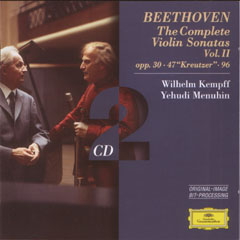
For me the Menuhin experience really began when I listened to a Late Menuhin (1970) recording with Wilhelm Kempff of Beethoven's Kreutzer Sonata, in A major opus 47.
I don't usually like pieces for only violin and piano. I realise this is not a very elevated thing to say, but when I listen to such pieces I think: What is this for? What is it saying? The point being that it had better be saying something, because the actual sound of the thing is so dull. Piano trios now, with all those luscious chords, they're completely different. Ditto most violin concertos. Ditto almost all piano concertos. They sound great. Piano trios and violin concertos and piano concertos sound so great that they can often say nothing at all for all I care, other than: hey listen to this! But a piece for violin and piano has to really say something to me, or I'm not amused. (I find violin and piano music dull in way that I do not find either either solo violin music or solo piano music boring. Why is that?)
Please do not confuse this with objective critical description of actual music. I am trying to describe how I feel about these things. If you feel differently, do not be affronted, just a little bit baffled, and you might even want to stop reading this. Because, above all, I do not want to persuade you that you dislike the sound of a violin sonata even if you actually like it. I would hate to give you a dose of false consciousness.
 Anyway, this is where Late Menuhin comes in. Late Menuhin was, for me, the supreme master of using his violin to actually say things. Every note he plays has a meaning, an emotional charge of some kind. And what is more: a good one, the right one. That Kreutzer sonata performance with Kempff amazed me with its total eloquence, quite unlike anything I had ever heard before when listening to this piece in other hands.
What I love about Late Menuhin, whether violin playing or conducting, is that, faced with a world in which he must suddenly live within technical limits (unlike in his glorious youth), either his own or of the other musicians he must now make do with, his response was not merely to try to correct those technical limitations as best he could (which I am sure he did do his best to do), but also into making every note mean something. Even more than Early Menuhin did. In his youth, Early Menuhin was often (it sounds to me) content to let the music just flow through him, with no technical friction, so to speak. There was no added value (in modern business parlance) but, wondrously, there was hardly any subtracted value either (apart from what the old recording subtracts). Which is how most of the current generation of musicians all try to play also, often very successfully. Perfectly oiled and perfectly functioning music machines, you might say. Personal hi-fi kits. But when, for Late Menuhin, the friction suddenly cut in, he had to live with it, but made damn sure that he always always always, every fraction of each passing second, added something. That's how it sounds to me. His playing became a triumph of eloquence over technique.
For me, Late Menuhin was the Laurence Olivier of violin playing. But whereas Olivier often got on my nerves by imposing his own rather bizarre meanings upon something which already, automatically, means something, namely words, Late Menuhin imposed much better and thought-through meanings, based on a lifetime of excellent music making and musical study, upon something that has no such automatic meaning in the way that words do, namely … music.
When I listen to Late Menuhin playing something like the Mendelssohn violin concerto, I realise that nice though that usually sounds, that too can often mean very little, when many others play it.
The most extraordinary case of a Late Menuhin triumph that I have recently heard is the Late Menuhin recording of the Elgar Violin Concerto.
As I have written here before, this is an extraordinarily difficult piece to bring off.
Two things tend to go wrong with modern perfect-machine performances of this extraordinary piece. First, because the thing is so ferociously difficult to play, and because the idiom (as with the Mendlessohn concerto) is so culture bound and elusive, the perfect machine player, time and time again, does actually introduce a lot of friction. And second, that plunges our poor perfect machine musician into a world he is utterly unused to.
To switch metaphors, the modern musician functions like a perfect window, or tries to. He stands between you and the music, and his idea is to let you see the music perfectly, through him. When this plan goes wrong, his usual recourse is ferociously, even desperately, to clean the window. Which is often counter-productive. Any meaning he may have detected gets lost. Windolene gets all over everything. Blah blah blah. Mess.
Late Menuhin is quite familiar with these dilemmas, because he lived with them every day. He did his share of window cleaning, but what he would also do was, as it were, talk about what you could just about, okay, see through the window. Yeah yeah, sorry about the window, but never mind, look at that, he would say, at that little house next to the trees, with the late blossom on. Look at this tiny wisp of smoke here, these clouds, the strange light at this time of day. And look, there's a storm coming. Through those bigger trees? See it? I'm right you know. (Smile.) A Late Menuhin performance is like a permanent running commentary on the music he is playing.
For my money (which as I say doesn't need to be much) Menuhin's playing is technically adequate, given the extreme excellence and fascination of the commentary that always accompanies it.
To speak thus of commentary is probably not quite right, because it suggests an imposed meaning rather than a meaning found within the music, but this is the best I can do for now.

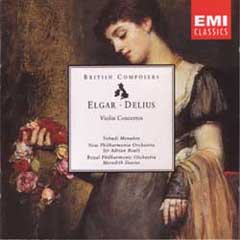
That Late Menuhin Elgar performance, with Sir Adrian Boult, is now almost universally denounced (and thus now seemingly unavailable – I can find no suitable link to it) as not nearly as good as the early one by Early Menuhin with Elgar himself conducting. And this Late Menuhin Elgar recording is a supreme example of all of the above. (By the way my picture of this earlier recording is the Naxos redo, which seems to be somewhat preferred to the EMI version, and is the one I have.)
I had spent decades obeying the critical orthodoxy about this (see what I mean about critics muck you about if you let them) by carefully not listening to it. But following a series of good experiences with Late Menuhin CDs, I finally came upon a second hand version for next to nothing of the Last Menuhin Elgar. And when I finally did listen to it, I loved it. Loved it. Late Menuhin doesn't always play things exactly as he wants to. But you always know how he is trying to play it, and how he is trying to play it is utterly marvellous. That's how it sounds to me. It's somewhat like a great but rather elderly actor doing Hamlet.
(By the way, I rather think that I first heard snippets of this Late Menuhin performance of the Elgar Concerto on a Radio Three Record Review comparison of all the various versions of the Elgar Concerto in which the reviewer hinted at a similar attitude to Late Menuhin to the one I now have. Can't remember who that was.)
I also love Late Menuhin's conducting, and buy everything of that I can get hold of cheaply. But let that wait for another posting.
That's it really. What I'm saying is: It's only a matter of time.
"We understood the whole thing with these players can't be just functionality, that we always concentrated on," she said. "People were using them as fashion statements."
Indeed.
And they're getting smaller and smaller. So …
I have been working on my tips for Billion Monkeys piece. However, this contains many of the things I was going to say, and I disagree with hardly any of it. It's presented as tips for people using portable phone cameras, but all the same principles apply to cheap digital cameras without phones.
I got to this via this having started, inevitably, from here.
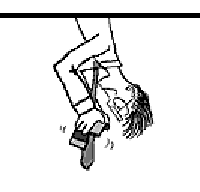 Also, my thanks to Michael Jennings for the link to this, in which the case for digital photography is eloquently stated:
"Whatever did we do before digital cameras?""Probably only took sensible photos."
Precisely. Who wants a world containing only sensible photos? Where's the fun in that?
The cartoonist in question adds to the list of recommendations linked to above that you try hanging from the ceiling. Good idea. But best not while wearing a tie.

I know, another Millau Viaduct posting, but it's really beautiful and why ever not?
And of all the pictures of it I've looked at lately, I think that this is one of the nicest:

I found this here, but my French is not good. So, is the small bridge in the foreground, down in the valley, the Viaduc Lerouge, as the name of the .jpg file suggests? Don't know. And have to say: don't really care.
Anyway, whatever the name of the little bridge, could you possibly have a finer illustration of how bridge technology has come on since the age of stone arches or nothing? Leaps and bounds is the phrase that springs (ha!) to mind.
Richard Morrison (in Times Online) doesn't think much of the Christmas lights in Oxford Street:
Each December in our trendy suburb (Hendon, in case you didn’t recognise the description) people turn their front gardens into veritable winter wonderlands of strobe Santas and fluorescent flowerbeds. True, these gaudy displays may not strike metropolitan sophisticates as being in the subtlest possible taste. But their festive élan cannot be denied.Contrast that with the dismal, dated illuminations in Central London this month. Regent Street has dreary white snowflakes in a blue border. Bond Street, daringly different, has pink snowflakes on a white border. And Oxford Street? Its attempts at yuletide cheer – squat arches on which spotlights swivel like geriatric ballerinas – look like Blitz-era anti-aircraft batteries recreated in secondhand hardboard by someone who failed GCSE woodwork.
Attend any rock concert these days and you see fabulous lighting effects. Even little villages such as Mousehole in Cornwall manage to create magic with their Christmas lights. Yet our capital city has this third-rate stuff. Mayor Ken should intervene. What else is he there for?
Well, I actually quite like them. What's wrong with Blitz-era anti-aircraft batteries? Rather dramatic, I'd say. I'd love to have seen the real thing – without being bombed too nastily I mean. But then, I've never, ever, in my entire life, been to a rock concert. If I had been to lots of rock concerts, I would surely associate multicoloured searchlights with mud and ugliness and cacophony and bursting for a pee, and I wouldn't have liked the Oxford Street lights either. Although what Morrison says is that a Mousehole (pronounced Mowzl by the way) Rock Fest would be better lit than this, so maybe I like these because I haven't seen better.
What does strike me about these lights is how non-Christmassy they are. They're just lights. I don't think they're "dismal", but they do strike me as of a piece with PC plans to not have nativity plays.
Here are some pictures I took of them a few nights ago:


Click and enjoy. Or click and sneer. I don't care.
Note that, in picture 2, a fellow Billion Monkey can be observed in operation, just in front of me and to the left. And yes, as picture 3 makes clear, that's Centre Point up there in the background, helpfully labelled. Don't scoff, it's very useful for checking which way you're facing in Oxford Street after you've emerged from a shop.
What these still photos don't show is how the lights themselves are on the whole not still, and in particular how you can see them twiddling around over Oxford Street from other streets.
But despite not getting them in motion, my digital camera probably makes the lights look more spectacular and dominant than they really are. When light is scarce, my camera goes looking for light, and when confronted by these searchlight beams, it finds a lot of light and goes rather mad. With regular coloured lights that means a bright blur, as per the regular street lights and even the quite normally lit shop windows. But with these searchlight beams it takes a relatively mundane blur and makes it sharper and more dramatic. Which is good. What matters is how reality looks in photographs, not how reality is.
Although, as Madsen Pirie (of this fame) once said, when asked to comment on the truth or otherwise of Ayn Rand's vacuous dictum to the effect that "A is A": "It all depends what you mean by 'is'." And that was years before Bill Clinton made a similar point.
I am enjoying Patrick Crozier's new blog a lot, which I think is basically because he seems to be enjoying it himself so much. He seems liberated, and he tells me that he is liberated.
He kindly gave me a mention recently, on the subject of how, at my two personal blogs, I don't concern myself with my hit rate. Patrick asks himself:
Should I have a counter?I don't have to. Brian, for instance, doesn't. He reckons that it would just get him all obsessed by the hit rate rather than the more important business of writing stuff.
Actually, although I dare say this is exactly what I have said to Patrick over the phone a few times, that is not quite it.
It's not so much that writing is more important. It is more that hit rate conditioned writing is (a) hard work, and (b) different.
Partly I ignore my hit rate because, believe it or not, I do not now know how to count it, and learning this, as with learning anything computational, would be an effort, and an effort that I cannot be bothered with. Commenters: feel free to tell me all about how to do this, and all about how very easy it is. You will be ignored.
If bothering with my hit rate would be a small bother, doing writing of the sort that bothers about its hit rate every day, twice, would be, for me, just too difficult. I already write hit rate conscious stuff for Samizdata, and for this. I am even now busy trying to wangle other weekly and paid blogging gigs. Economically, fussing about the hit rate here wouldn't make sense. It would be too much like hard work.
My membership of the Samizdata team is the basis of whatever clout I have as a blogger, and hence a big part of why people with money to spend on blogging are willing to share some of it with me. But the stuff I fling up at my Culture and Education blogs has only to interest me. You do not like it? Skip it. There are plenty of other blogs.
But, for me, the most important but also elusive reason for doing writing that is hit-rate-indifferent is that such writing can sometimes, I believe, be rather good, and good in a way that might never get written if the hit rate was all the time at the front of the writer's mind.
Some of one's best thoughts can be provoked by stupid – even embarrassing – trifles.
For example, I used once to be embarrassed that I often have classical music on in the background when busy with something else, because, quite frankly, it makes very pretty aural wallpaper, if you happen to like the pattern, so to speak. Proper Music Critics, on the other hand, hardly let a year go by without doing some piece about the Deadly Availability of classical music, as if listening to great music as if it was dance music at a dance where you are not dancing were some kind of crime. When playing a Beethoven symphony, for instance, Official Behaviour says that you should drop everything, switch off the phone, set aside your computer keyboard, and solemnly park yourself in a chair in front of your hi-fi boxes as if settling down for a real live concert, and then listen with a solemn expression on your face and maybe even the odd drop of sweat rolling down your brow. Well bollocks to that. I just put on the music, and I drop everything only during those rare times when the music grabs me and refuses to be ignored. In other words (profound observation): hi-fi boxes reverse the social revolution that classical music went through at the beginning of the nineteenth century, and Great Musicians are back to being domestic servants.
Closely related to embarrassing is just plain dumb, and dumb is closely related to smart. I remember, in this connection, a delightful television programme done by pinko (and therefore non-mainstream) art critic John Berger, in which he got some children to look at a renaissance painting. The children spent a long time discussing whether the Jesus in the painting was a man or a woman. Berger said, and I agreed, that this is a very good observation, about that particular painting and about Christianity in general. I have never forgotten it. But how many times do you get Proper Art Critics giving the time of day to a notion like that? Well, nowadays they probably do it all the time, but I do not think they did so when that TV programme was first shown, about two or three decades ago.
The thing is, responding intelligently to "culture" is all about responding as you really do respond, rather than only as you feel you should and only as you have been taught to. Such shared decencies are not to be ignored of course. Not all the time. But much illumination is also to be found by listening every now and again to your inner twelve year old, who says, when confronted with, say, a crucifixion painting, something like: Cool! Blood! Special effects! And thereby puts his grubby finger on a truth about such paintings that is mostly considered too undignified to talk about.
In my particular case, responding as I really do respond can also mean something like ignoring the Probable Samizdata Majority View. For me, Jane Fonda, despite also being Hanoi Jane, was a terrific movie actress. If you genuinely think that Jane Fonda genuinely was not a terrific movie actress, fine, I can respect that. But if you say that she was not a terrific movie actress because she also sucked up to North Vietnam, then I say you are missing something, something which might illuminate the strengths and virtues of your enemy, something you might not want to think about, but which you should.
While I was writing this, I decided it would do for Samizdata. Then I changed my mind. Wasn't sure if it was good enough, or expressed tightly enough. Here, I don't have to worry about that.
Taller than the Eiffel Tower and longer than the Champs Elysee, the Millau viaduct was today unveiled by President Jacques Chirac to acclaim as a marvel of art and architecture.Its seven slender pillars, the tallest rising to 1,122ft (340 metres), were likened to needles supporting a taut thread in one the many poetic newspaper front pages marking the elegant structure's unveiling to the nation.
That's how Times Online reports its opening, and these Times Online photos were the best I could find of it.

This picture of the bridge under construction, from above, is also very good.
Economically it looks crazy to me. A few more curves on the road and they could surely have saved themselves billions. But what the hell, it looks very fine. And a British architect! Although, I'm not sure it's exactly what you'd call architecture.
This evening I walked home from a meeting past this building, which I've always been rather fond of, in a fascist kind of way.

It's 55 Broadway, the headquarters of London Underground, and it doubles up as St James Park tube station. Click to get it bigger.
Here are some more pictures of this building (and frankly rather better ones), and of others by the same designer, Charles Holden.
When 55 Broadway was built, it was the tallest office building in London. So I guess that means that in those days, cathedrals were bigger than office blocks.
This link to this Samizdata posting today about more Fritz Werner Bach, plus a reminder that I continue to churn out stuff for here, will probably be your lot today.
Well, here is a nice picture of Medellin, which is in Central America somewhere, I think (Columbia?), which I tried to steal from Harry Hutton's picture gallery. "Public" means, I can do that, right? (I mean, what the hell do I know about intellectual property. I signed up for that CNE gig to find out about it, not because I know anything about it already.) But I couldn't make that work.
That big church on the right looks to be quite something, and it still towers over its surroundings.
Flickr seems to be getting very popular nowadays. Can it show pictures as big as I like to, 800 by 600, filling most of your screen? That Medellin picture ought to be as big as possible, I think.
JP, your New York pictures will go up this weekend, I hope, big as possible, but I promise nothing.
This link to this Samizdata posting today about more Fritz Werner Bach, plus a reminder that I continue to churn out stuff for here, will probably be your lot today.
Well, here is a nice picture of Medellin, which is in Central America somewhere, I think (Columbia?), which I tried to steal from Harry Hutton's picture gallery. "Public" means, I can do that, right? (I mean, what the hell do I know about intellectual property. I signed up for that CNE gig to find out about it, not because I know anything about it already.) But I couldn't make that work.
That big church on the right looks to be quite something, and it still towers over its surroundings.
Flickr seems to be getting very popular nowadays. Can it show pictures as big as I like to, 800 by 600, filling most of your screen? That Medellin picture ought to be as big as possible, I think.
JP, your New York pictures will go up this weekend, I hope, big as possible, but I promise nothing.
No time for anything profound today. So instead something superficial, not to say rather sweet.
Three bears, in a playground, just south of Waterloo station, photoed by me about a fortnight ago, and kept on my hard disk for just such an eventuality, i.e. being caught short for a quick posting. (Busy day, blah blah.)
Two pics, the one on the left showing the figures a bit more clearly, the one on the right showing a little more of the surrounding context.


Don't know which is best, so there's both. Click to get either bigger.
This is all part of the welcome trend nowadays in the direction of representational realism in public sculpture. Sculptures these days, have an overwhelming tendency to be of something.
All of which reminds me that I really must get down to writing something about the obligation that so many bloggers feel to sling up any old something at least once a day, rather than just nothing. I feel this obligation myself, and when I have the time to explain why I choose to feel this feeling, I will.
Glenn Reynolds writes at TCS about the trend away from bespoke offices and into working in more public spaces:
The "push" comes from the office environment. If you're reading this column, you have almost certainly also read Dilbert, and I'm tempted to simply cite the comic strip and say "case closed." But there's more to it than that.Yes, the office environment can be unpleasant, and the commute can be nasty and time-consuming (and expensive), too. That's one reason people like to work at home. But working at home has its own problems, since it can be hard to maintain the work/non-work boundaries. And who wants to meet with clients in your den?
On the other hand, offices are expensive. I've noticed a lot of small business people in my area giving up their offices, and having meetings in public places -- Starbucks, Borders, the Public Library, and so on. In fact, a real estate agent recently told me that the small-office commercial real estate market is actually suffering as a result of so many people making this kind of move.
The "push" comes from people wanting to get out of offices. But the "pull" comes from the technology that makes it possible, and from the desire of businesses to cash in. Personal tech like laptops, PDAs, cellphones, etc., coupled with wi-fi and other technologies that allow Internet access from all over, means that you don't need to be at the office nearly as much anymore.
If a home is, in Le Corbusier's words, a "machine for living," then an office is a "machine for working." But nowadays, the machinery is looking a bit obsolescent. The traditional office took shape in the 19th Century, and the shape it took was in no small part the result of technology: the need for people to be close to each other, and to services like telegraphs, telephones, messengers and (later) faxes, copy machines, and computers.
You can pretty much carry all that stuff with you now. And people are doing it.
That means that there's a market for places that cater to them. Right now we're seeing the early phase of that, with amenities that focus on wi-fi and lattes. In time, we're likely to see a lot more than that. …
Indeed. I had a latte in the Pimlico Café Nero earlier this afternoon, and got some blogging work done, in the form of hand scribbled notes aimed at a longish blog posting that I will do Real Soon Now. But although I am not laptopped up and nor were most of the other Café Nerotics, I did see one young woman using a laptop with great enthusiasm. She had headphones on as well and was chatting happily into them. Business or pleasure? Both, would be my guess.
TV took everyone indoors during the hours of darkness and left the streets clear for the criminals (of the sort who didn't own couches and TVs), and the TV shows themselves then set about cranking out the next three or four generations of criminals, by showing them how very exciting it was to be a criminal. Now the Internet is (a) putting on a more intelligent, less criminal-creating kind of a show, and (b) taking us all back into the streets, re-establishing a modern rerun of couples promenading through the streets and raising their top hats to one another.
And if you add (c ) the portable phone, which means that you can already now run great gobs of your business from anywhere, without even sitting down, let alone being indoors in a fixed place of work, it adds up to something not unlike a revolution, or at any rate a counter-revolution.
From time to time I wonder if I should stop bothering about "culture", stick only to the things that already fascinate me, and stop looking over the garden fence, so to speak, at other people's obsessions. However, I go genuinely enjoy rootling around at this site.
Today, my two favourites were this one (done in 1480), with its strangely different sized figures, and this one, which is interesting in that it contains other paintings.
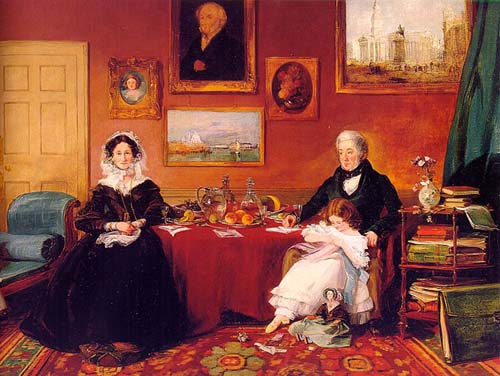
It must have been the case that lots of the people painted by posh painters had lots of other paintings, yet you tend not to see these other paintings in the paintings. So, I find it refreshing that you do in this one. Where is that, in the one on the right as we look at it?
But. notice how the artist (James Holland – 1799-1870) has made sure that none of the picture frames behind his sitters interfere with their heads. The wall behind Father looks a bit of a mess though.
When photographing people I try also to remember about background interference. I am certainly angry with myself when I forget to and it comes out with the faces at the front all stabbed into by background objects or imagery. (Memo to self: I am working on that guide to being a Billion Monkey requested by Scot Wickstein (see comment on this), and must remember to include that, about backgrounds.)
From a Gramophone review (June 2003 issue) by Ivan March of this DVD, of Rostropovich playing Shostakovich Cello Concerto 1 and the Prokofiev Symphony-Concerto:
When he came to know Shostakovich personally in the 1950s Rostropovich wanted to ask him for a cello concerto. Fortunately he never did: the composer's wife later told him that only if he did not ask or mention his wish might Shostakovich produce something out of the musical hat. She was right and in 1959 the great cellist's restraint was rewarded.
And what is more it was rewarded with another cello concerto, Number 2, which was also dedicated to Rostropovich. Not surprising, given how well he played the first one. That old recording he made for CBS (now Sony) with Eugene Ormandy and the Philadelphia Orchestra was one of my most treasured LPs.
This is photo of octagonal booze glass from directly above, lit from directly above (and bit from side also – below as look – hence extra shadow), with camera held out over the glass but away from head Billion Monkey style.

Hence shadow of Billion Monkey hands and Billion Monkey camera but not Billion Monkey head.
Also camera strap. Twice.
Click make bigger.
For the last couple of nights I've been watching a fellow Brian, Brian Wilson, former senior Beach Boy, on the telly, playing Beach Boy music, but at the age of about sixty. And I watched and listened with a sort of ghastly fascination.
You can see the problem right there in the name of that group. They weren't called the Beach Boys for nothing. And there was something really odd about watching this sixty year old guy, who looked more like a Democrat Presidential Candidate than a pop singer, singing boy songs, in an old-guy-trying-to-do-a-young-guy voice.
The story is that … Well, other people know the story far better than I do, so let one of them tell it:
BEACH BOYS star BRIAN WILSON has played the 'lost' album 'SMILE' for the first time ever in London.The singer played the first night of a residency at the London Royal Festival Hall this evening (February 20), the first dates on a tour which will visit other cities throughout the UK this month.
The gig itself was split into two sections. The first opened with a fifteen minute acoustic set, followed by a ‘Greatest Hits’ show. During this, Wilson, backed by an 18-piece band, performed a number of songs from 'Pet Sounds', including God Only Knows' and 'Wouldn't It Be Nice'.
After a short interval Wilson then returned to the stage where 'Smile' was played for the first time in full.
The RFH audience were there to worship and to adore, and they did. But me, I just thought, what a pity it wasn't finished and recorded in 1967, like all those other great Beach Boy tracks like Sloop John B, Good Vibrations, California Girls, and the rest of them. What a pity it sounded rough and live, instead of perfectly produced like those old numbers. And sounding rough and ready and live, it didn't sound to me like music that was anything like as great as the audience obviously thought it was.
Beach Boy music, it occurs to me, is like the string quartet repertoire. Once you've heard it done properly, note perfect, perfectly in time, perfectly in tune, then anything not as good as that is just not good enough, and you almost suspect the music itself of being second rate. This was pretty good music, and the playing was often pretty decent. But I wanted perfect young voices, and perfect sounds to back them.
A lot of rock and roll music sounds fine if it's sung by old geezers, forty years after they first did it. The Rolling Stones sound as great as ever, in my opinion. But the purity and innocence of the Beach Boys, rehashed by an old guy, sounds undignified to the point almost of insanity. For me, there was even a whiff of, say, a very old Bette Davis trying to act like a teenage girl. That Brian Wilson has not always been completely, er, in control of his thought processes, only, for me, added to the extreme strangeness of it all, to put it no more strongly than that. But I'm sure that any suggestion of this that the worshippers felt only added to how much they loved the man.. That their hero was prepared to brave the scorn of unbelievers such as I only added to their adoration. And if they felt anything of the sort that I felt but suppressed the thought with another that went: better late than never, well, there I thoroughly agree. It was a remarkable occasion.
The worshippers will buy the live recording of the event, and will love it and treasure it. Me, I actually look forward to a cover version, done as well as those classic early tracks were done, with young voices and perfect electronically synthetic music instead of rough and ready and live music.
For as long as they keep on parking it there, I'm going to go on photographing it.

A click gets it bigger.
I'm dreaming of a white Christmas. A white something, anyway.
I have already today done a piece linking to two SAU blog postings. Here is another such link, this time to my friend Bunny Smedley's review of this book.
I particularly like Bunny's teasing out of the relationship between art and politics:

Part of the problem here may simply be a case of double standards masquerading as something else. Because Kimball regards art as having an autonomous existence beyond, if not actually above, the stuff of politics, he presumably further holds that if, say, a radical socialist and a High Tory were confronted with an elegant society portrait by Sargent, the two ought to feel more or less exactly the same thing in front of it – that the socialist, certainly, should not feel anachronistic resentment of the world of wealth and privilege reflected in it, or worry too much about gender inequality or sexual politics, or obsess about issues of patronage and power. The Left-wing lexicon of political correctness, in other words, should not be brought to bear upon what's actually there (as Kimball would put it) in the painting. To which most of us would, I imagine, as much out of visceral dislike of political correctness as anything else, nod sagely and say 'fair enough'.But what if the positions were reversed? What if, for instance, the same two viewers were placed before The Death of Marat by Jacques-Louis David? Would it really be incumbent on the High Tory to bite her lip and admire the indisputable formal qualities of the work – while at no point condemning it as a highly proficient, highly regrettable slab of morally unpleasant agit-prop, in which the iconography of a Christian martyrdom is placed at the service, by one of its more creepy if technically competent foot-soldiers, of a murderous and contemptible political regime? David, after all, personally signed death-sentences for something like 300 people, which makes his celebration of the demagogue Marat even harder to stomach. And anyway, he didn't intend his work to be admired in formal terms – he intended it to persuade us to take a positive view of Marat, the Jacobins and the politics they espoused. Are we supposed to forget all that when faced with a strong composition and a brilliantly schematic use of colour? Are we really expected to treat it on equal terms with, say, the Louvre's great Van Dyck portrait of Charles I? Is it somehow wrong to mention Sargent's politics, but right to mention Richter's?
Kimball would, I think, say yes: 'enjoy the work, eschew the politics'. We've seen that already. But there is, surely, at least another possible conservative position, in which it would be possible to comment on the political content of a painting (whether that apparently intended by the artist, or apprehended by the viewer) from a conservative, rather than from a socialist or liberal position. And here it is striking that all the instances of the 'politicisation of art' cited by Kimball involve critiques emanating not from the Right, but from the Left. Boime, Derrida, Alpers, Pollock, Clark: the politics they bring to the enterprise of criticism are no more attractive when focussed on visual culture than they would be were they directed towards, say, solving the problems of poverty or confronting the realities of social hierarchy. Indeed, it is hard not to suspect that Kimball has done this not simply because virtually all such attacks come from the Left anyway, but also because his audience might not find a conservative political critique as patently fatuous and factitious as a politically correct one, which is to say Left-wing one, must invariably sound to them.
As I've said here before, the SAU blog is your fully fledged Culture Blog, in the exact way that this blog is not. Culture with a Capital C. I do bits of Capital C culture, but not in a very Capital C manner, and of course, I intersperse it with personal flummery and chit chat, and my photos of course, and lots of other small c culture titbits about flat screen TVs, computer graphics, and such like. I absolutely refuse to make any kind of lunge for Internet hegemony. This here is not Clapham Junction, let alone Grand Central Station. That's not what I'm trying to do, not what this blog is for. But the SAU blog has real possibilities along those lines.
2 Blowhards is probably, still, the Instapundit of Culture with a Capital C Blogs, but suppose the SAU blog were to have the occasional posting (say one in every half dozen or so) with loads of links in it, to other cultural bloggage (much as the 2Bs do), then they'd have themselves a real Capital C Culture Blog well placed to hegemonise in all directions.


