

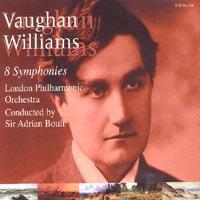
 Tonight I am listening to: A London Symphony by Ralph Vaughan Williams. And I have chosen the mono version done by Sir Adrian Boult with the LPO, from this boxed set of all but the last of the nine RVW symphonies.
I do not offer a general review of this lovely piece, with an exhaustive explication of exactly what makes it so lovely. I just wanted to make what I hope is one interesting observation.
I refer to the second movement, "Lento", and in particular to the lovely tune in this second movement, which we first begin to hear (on this particular recording anyway) at about 6 minutes and 40 seconds.
To me, this tune could have come straight out of the sound track of a Hollywood biblical epic. It would have sounded completely in place had it occurred, not in a piece celebrating London, but in a story celebrating the life of, e.g., Jesus Christ. I'm thinking in particular of the scenes in Ben Hur where Jesus is seen, but only, by us cinema viewers, from behind. We see that archetypal hair-do, evocative of all that is magnificent and history-changing, yet at the same time consoling and loving, but only Charlton Heston gets to see Jesus' face. It's been a long while since I've seen this movie, and heard the actual music that Miklos Rozsa wrote for the Jesus scenes, but I do definitely seem to remember them sounding very similar in atmosphere to this London Symphony tune.
There is, by the way, a distinct whiff of similarly Israelite harmonies in Vaughan Williams' glorious Fantasia on a Theme by Thomas Tallis, and, for that matter, also in the original Tallis anthem which that piece was inspired by.
And now, that tune has come and gone. The third movement is back to the hustle and bustle (and also the Georgian stateliness) of London, as if Israel had never been thought of.
All of which leads me on to wonder about this whole musical nationalism thing. We are constantly told that particular harmonies evoke particular national moods or national landscapes. I wonder. I suspect it may be pure association caused by the constant placing together of certain sorts of music with certain sorts of imagery and certain sorts of national myths and stories, the actual connection being accidental. Had the music chips landed only somewhat differently, Dvorak could have sounded unmistakably Italian and Tchaikovsky unmistakably Finnish.
That the music of Vaughan Williams of all people made me think of ancient Israel rather than of ancient or not so ancient England is a particular irony, because RVW of all people is credited with creating an "unmistakably" English sort of sound, the one dismissed unkindly by Elizabeth Lutyens as cowpat music. (Scroll down to the start of para 2 of the review linked to.)
So: Vaughan Williams. Unmistakably English, except when he sounds unmistakably something completely different.


