

I've been saying here that I like the symphonies of Malcolm Arnold, but I don't actually know them all that well, in the sense that if you played me a bit of one of them, I couldn't number it, whereas with most of the Shostakovich symphonies, which I know really well, I could. What I can tell you about the Arnold symphonies is that I like them in the sense of knowing that I am going to know them better, and and to like them even better, than I do already.
Anyway, encouraged by what Lynn Syslo says here about it, I put on one of the CDs I have of Arnold's Ninth Symphony. I chose the one by Vernon Handley, and was especially struck by the second movement, the Allegretto. The whole thing is great, but this movement especially is particularly beautiful.
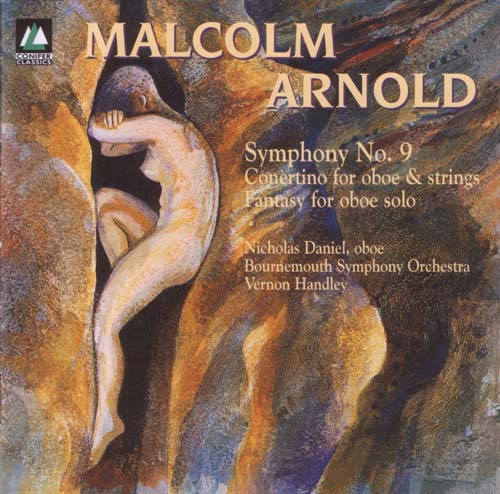
The bad news is that I am now listening to the Naxos version of this piece, conducted by Andrew Penny. I'm at that same second movement. And the impact is nothing by comparison. Handley finds a stillness which I found extraordinary. Penny goes for a more "swirling" effect, but for me the result is very earthbound and mundane by comparison.
Shostokovich definitely looms large as an influence, or at any rate as a definite comparison. What Arnold here demonstrates, like Shostakovich, is a willingness to be very simple. Two instruments, such as a flute playing up high and a bassoon playing down low, carry the tune (and a very love tune it is), without any of those frantic complications that modern "modern" music seems to demand, in order to be modern. Shostakovich's Ninth Symphony is a deliberately frisky little thing compared to Arnold, and more to the point compared to Beethoven and Mahler, but in this respect it is very like Arnold's Ninth.
I remember being very struck by something Daniel Barenboim once said, about Shostakovich, along the lines of: "Look at the score, there's nothing there." He meant this as an insult. But to me, this is a compliment.
Barenboim does lots of "modern" music, all of it that I have heard being, to my ear, utter dross. While he has fun threading his way through the complexities of the "scores" he likes, the audience sits with its arms folded waiting for the damn things to end. Shostakovich, and Arnold, communicate a lot, and often with extremely little. But this is good.
Digressing even more, I've often wondered if Barenboim is responsible for his wife Jacqueline du Pré not having anything to do with Shostakovich, and in particular the two cello concertos. No 1 especially was already a big hit when Du Pré was playing, thanks to Rostropovich. I'd love to have heard what she might have done with this.
All of which began simply as: Try Arnold's Ninth, you might like it!


