

Charles Hazlewood's attempts to interest us in the life and works of Mozart have certainly been getting my attention. Last night I watched the final part of the drama documentary The Genius of Mozart, in and a bunch of actors in ancient outfits both acted out and were "interviewed" about Mozart, while Hazlewood in a modern outfit commented, like one of those modern TV military historians striding about on a battlefield.
Opinions differ about the legitimacy of mixing the rules up like this, but I liked it, a lot. After all, a play is, when it comes down to it, the opinion of our contemporaries about what happened, not the thing itself. And why shouldn't historical characters be interviewed the way real people are interviewed about Dunkirk for the History Channel. I thought that Emma Cunniffe as Mozart's wife Constanze was especially affecting, convincing and memorable.
Talk about mixed feelings. Constanze adored Mozart and was adored back, and she shared her husband's adoration of music. And she knew right away that he was a great composer, what with Haydn telling everyone who would listen. Yet she lost baby after baby. And although Mozart may have been a musical capitalist, he was a sadly incompetent one when it came to making or keeping money, and being married to him was a bit like having another baby to look after.
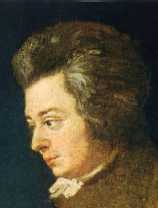 But then there was the music. Hazlewood rightly, both in this drama-documentary and in subsequent shows on BBC4 TV and on BBC Radio 3, made much of Symphony No 40 in G Minor, K550. But then I am hopelessly biased, as this would be the one piece of music, if I were forced at gunpoint to pick just one, which I would choose as my absolute all time desert island favourite.
I recall writing a decade ago or more (towards the end of this) that Mozart's G Minor Symphony seems perfectly poised between the classical and the romantic, the world of outward stateliness of form and the expression of inner feeling. Hazlewood made rather more of the inner feeling aspect, and he made it clear that as far as contemporaries were concerned, this music was all over the damn place, like some kind of natural disaster, like an earthquake or an erupting volcano. That makes sense. Those of us who now love it now hear the similarities between this music and the much more mundane stuff that Mozart's contemporaries were then turning out. Salieri and Mozart, in the age of electro-pop, do sound very alike, and to an ear unused in classical music completely alike, I dare say. But in Mozart's time there was no electro-cacophany to force them to hear the classicism of Mozart's late symphonies, their controlled-ness, their formality, their eighteenth-century-ness.
What applies to Mozart's contemporaries also applies to an expert like Hazlewood, who thinks himself so completely into the shoes and ears of Mozart's contemporaries that he too is liable to, not miss, but maybe under-react to the continuing classicism of Mozart's late works, to the extraordinary way that he managed to pour his musical lava into the regular shaped musical containers of his time, albeit somewhat expanded ones. But this is only a matter of nuance, and I don't want to turn this into some kind of fight. I loved all these shows, and I learned a lot from them.
Things like the movie Amadeus are all very well, but they contain too many made-up non-facts for my liking. The big talking point about this TV series has been how solemn and sensible this Mozart was compared to the Mozart of Amadeus, but the thing I didn't like about Amadeus was the way it convinced everyone that poor old Salieri had murdered him. Nonsense, of course. Mozart died too soon for the same reason his babies did, which was that in those days, people did.


