

I did a posting yesterday on Samizdata about old classical recordings, mentioning these two in particular:
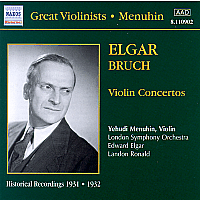
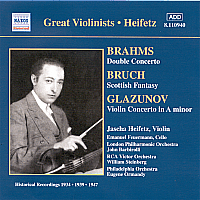
These are this one and this one in this list of Great Violinists.
The comments are piling up, of which I like this one best so far, from Alan Little:
Look at those wartime Furtwängler recordings we talked about a while back: they are out of copyright, and whoever has the master tapes seems to be willing to let pretty much anybody (anybody who is willing to pay, presumably) have a go with them. The result being that there are several CD editions of all of them, and whole usenet discussions about exactly what slightly-off speed the original tape recorder was running at, whether it is better to accept that the tape recorder was running at a slightly off speed and therefore have the CD sounding a little sharp, or to try to correct it and risk introducing some other distortion or "unauthenticity", etc. etc. etc.There's also a marvellous article by Peter Gutmann singing the praises of early recordings by Joachim (the great nineteenth century violinist the Brahms violin concerto was written for) , which goes into how in that era western classical music was improvisational and performers were expected to make more contribution than just "playing the dots" in a technically perfect manner.
Twentieth century classical music making was, historically speaking, very, very strange, and the more I think about it, the stranger I am certain it is going to seem to future generations. Basically, the entire profession "played the dots", to use Alan's phrase. Most of the time they were playing pieces by people they couldn't talk to or play along with, the way the pop people play along with each other (the pop composers and players being all mixed up with each other). The "authentic" phase which erupted once normal recordings had been made of everything only took to extremes a trend that had been established in modified form ever since recording began, and in some ways served to correct some of the extremes (of non-improvisation for example) of those normal recordings.
Soon, the classical (for want of a better word) profession will revert to true normality, with the composers and the players going back to being the same people, improvising confidently, because the composers will be right there on the stage or in the studio and available to encourage or frown instantly.
The reason I get so exercised at what a ghastly non-musician Thomas Adès is is that he is doing the most important thing in classical music right now, on which all else depends, namely composing, but is doing it hideously badly, to enormous acclaim from all the idiot critics, and to utter indifference from the rest of the universe. The critics are touting him as the Next Big Thing, but he is nothing of the kind. He is a weird after-echo of the old twentieth century regime, in the form of a sort of living reconstruction of a Dead White Composer, who relates to current classical music making pretty much as Beethoven does, but with the one little little problem that he ain't Beethoven.
What is needed in the classical world is not a steady trickle of Fake Great Composers, but a healthy flow of genuine lesser ones (from which posterity can be left to pick the great ones at its leisure), who can make use of all those violin and cello skills by writing entertaining music that will pay the rent. Adès doesn't pay any rent. He consumes rent. He is a classical music asset stripper, whose career will last only as long as idiots are willing to throw money at him in exchange for the simulacrum of greatness.
The film people are the nearest thing we have to a profession of this sort, but I have yet to hear anything from that fraternity that is not drearily derivative. The best that they now contribute seems to me to evoke olden times, by writing olden style music, as and when that is needed, for olden times films.
Oddly enough, one of the people who gets nearer than most to doing the job well is the much scorned (by critics rather than by punters generally) Vanessa Mae. But that's a different posting.


