

As I have often confessed here, I think, I am not as disciplined a listener to classical music as classical music listeners are, I imagine, often imagined to be. I just love the stuff so much, and love to have it on, in the background for when I am concentrating on something else, or in the foreground when I either attend to it or it forces itself upon my attention.
Being thus undisciplined, I can report on a phenomenon which a more devoted listener might be less aware of, which is the strange habit of a piece of classical music grabbing me, after three or four hearings of it (perhaps by a different performer) during which it did not grab me. The fact that, during all this, I am making little conscious effort to grab it I think throws this phenomenon into sharp relief, in a way that might not happen if I paid active attention myself, all the time.
Part of it is time, and part of it is the performance. Time, during those early listenings, lays down the foundations of the piece in your subconscious. Your subconscious then gets to work on it, and tunes into it, and works out what it is about, learns the piece's lingo so to speak, and eventually it passes all this up to Conscious Command and your mind is ready to make its Great Leap Forward and fall in love with the thing. Never having fallen in love with a human being, I can only guess that similar mental processes apply with that, but I bet they do. In fact lots of learning experiences are like this. They are not logical accumulations. They are delayed pattern recognition.
The performance can matter, if only because bad (by which I merely mean bad to me) performances can place a permanent barrier between me and the music. I hear, and go on hearing, what I don't like about the performance, rather than the music itself, as if stuck looking at the dirt on a window pane. Sometimes, I listen to one performance a number of times, and … nothing. Then another performance, and it all snaps into place. And then when I go back to the previous performance it all falls out of place again.
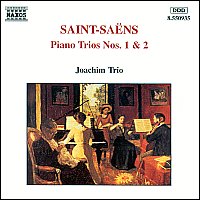 Example. I have two performances (actually several more than that – but I will concentrate on the two that matter for these purposes) of the Saint-Saens Piano Trio No. 1 in F major opus 18, a lovely piece, I think, especially given my general liking for piano trios in general. The first CD of this piece I acquired was done by Ian Brown, Marcia Crayford and Christopher van Kampen, of the Nash Ensemble of London, who are fine musicians all. But, the piece made little impression on me.
Then, I acquired the Naxos CD of the two trios opus 18 and opus 92, and the opus 18 suddenly sounded completely wonderful, as played by Rebecca Hirsch, Caroline Dearnley and John Lenehan, otherwise known as the Joachim Trio. The slow movement is especially wonderful, the way the Joachims play it. So then, back to the Nash players, and in particular to the slow movement, and again: nothing. So, performance does often matter, a lot.
But performance isn't the whole story. I vividly recall first getting to know the Brahms First Piano Concerto, with the recording of it made by Barenboim and Barbirolli in the late sixties. For the first two or three goes, I reacted as the very first audiences and critics probably did. What is that? Where's the tune? It goes nowhere. It's ugly, like a pile of rocks. And then on about the fourth or fifth hearing, it hit me for six, and I have loved the piece (and this particular recording of it most especially) ever since.
These thoughts were provoked by having possessed for some time now the EMI recording of the Ysaye unacompanied violin sonatas by Frank Peter Zimmerman, a violinist I hugely admire, without any great impression being made on me by this music. But now I'm listening to Ilya Kaler play these pieces (again for Naxos), and they sound utterly amazing. The only reason I didn't use these two CDs as an example of what I've written about is that I have yet to go back and try Zimmerman again, to see what happens then.
Naxos. The blogosphere loves you.


