

Yesterday morning on Radio 3's CD Review, Evgeny Kissin was talking about playing Bach. Did he plan to record any? His answer included references to others who were doing it so well that he hesitated. Murray Perahia and Andras Schiff were not surprises, but I was intrigued that he mentioned Daniel Barenboim's live Goldberg Variations, which I possess. I have it on now, and at its quite frequent best I am liking it hugely.
Listening to Barenboim's playing provoked me into thinking what is so special about his playing (when it is special) and what is so unsatisfactory about it (when it is unsatisfactory). And I think I have it.
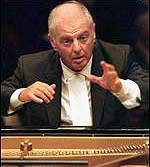 Barenboim as a pianist is still a conductor, and he always was a conductor from the very start of his life as a musician. The only difference is that when playing the piano he is his own orchestra. But Barenboim the interpreter is quite separate from Barenboim the pianist. Barenboim the interpeter stands outside, and watches and conducts (which would be why he finds it no great strain also to be conducting an orchestra while playing the piano). For Barenboim, piano playing involves an out of body experience. The as-good-as-it-gets interpreter of music, Barenboim the interpreter, always wants Barenboim the pianist to do something very good and interesting, but all too often Barenboim the pianist doesn't quite bring it off, either because he may not be the world's greatest pianist (I don't know), or perhaps because he is too busy doing that conducting while he is playing, or perhaps because he is too busy, generally, being Daniel Barenboim. When Barenboim (the pianist) plays, you usually know at once what he (the interpreter) is trying to do. Sometimes he does it, and sometimes not. He is the sort of pianist who makes his own errors glaringly obvious even to someone like me.
When I say mistakes, by the way, I'm not talking about fluffed notes, which are rare with Barenboim, as with any regularly recorded player. What I mean is when he clearly isn't getting the effect he clearly wants.
I think this "model", so to speak, of Barenboim's piano playing explains a lot both about why those of us who admire Barenboim's piano playing admire it so much, and why those who can't stand it can't stand it. I love the exposure, the daring, the accessibility of it all. I can get right inside his playing, simply by stepping into the crowd and looking around me. It's like watching Bernstein conduct. It's all there, out in the open. Mistakes? Well, what do you expect if your reach is so ambitious? But for the can't-stand-it crowd, the very essence of how Barenboim sets about playing the piano is completely, inherently wrong. They often don't like what he is trying to impose upon the music, and they utterly despise the whole idea that he, as an "interpreter", is "imposing" anything on the music, and especially on his playing of the music, in the first place.
With other pianists, someone like me is at a total loss to work out what (if anything) is wrong, because with them, there is absolutely no distinction between "interpretation" and playing. The two are absolutely the same thing.
 On BBC4 TV, straight after that chamber concert I wrote about last night (the one where they all wore black), there was a programme about the Portuguese pianists Maria Joao Pires, teaching students at her home in the country. Here is a pianist whose entire teaching method is based on ensuring that there is never, never any discernible difference between "playing" and "interpretation", to the point where if you need two different words for the process, you simply aren't doing it right. If she ever hears a pupil's head ruling that same pupil's heart, or fingers, she shouts out and complains. Your heart must go straight to your fingers. Your body, your mind, your fingers, all must be one. To hell with the bar line, she kept saying. It doesn't exist.
Which contrasts with that conductor I met, who, asked to pick out three rules for conducting, picked rhythm, rhythm and rhythm. I don't think you could conduct properly if you felt – that is to say talked – about music the way Pires does. Well, you would need a very good orchestra.
If Pires ever addressed a London orchestra the way she talked to her students – "you must feel it in your heart, in your body, you must not be ruled by the machine, it must be organic", etc. – they would sit there stony faced, and then the leader would say something like: "You mean you want it a bit slower." (My instant, intellectually unmoderated response to this woman was: go back to Hell you emotional fascist bitch, and keep your clammy hands off my soul. That is not what I think of her, for she is a very good pianist and her pupils adored her. But it is what I felt, for an instant.)
That Kissin praised Barenboim so highly may also say something about how he functions as a musician. (He too is both adored and reviled.) I wonder if he will ever do any conducting.
Final thought: is this at all a Jew/Gentile thing? Barenboim is very Jewish. I feel rather Jewish too. I'm thinking of that emotion-but-with-emotional-distance thing, which Jews do so well, which I like so much, and which Wagner complained about. It was hearing that word "fascist" come out of my mouth in an earlier paragraph that made me wonder.
A FEW HOURS LATER: Here is now my one word answer to that "Final thought": is this a Jew/gentile thing?: No. These decidedly dubious categories simply disintegrate under the spotlight of further thought. What Wagner saw, or thought he saw, was no longer true by the time he died. And Pires was quoting Mahler, saying: "The score gives you everything about the music except what is important." You could just as plausibly - i.e. not plausibly at all - say that a pianist "conducting" his own playing - or for that matter other people's playing - is like a Nazi dominating himself - and others - in the service of his ideology. So does that make Barenboim a Nazi, just because this may be how he plays the piano, and because he conducts? Forget it.
I don't like deleting stuff of substance, however wrongheaded or ill-thought-out, but this time I was sorely tempted.


