

Knowing my fondness for stylish new bridges, a while ago David Sucher emailed me – and knew that I would like the look and the sound of – this:
The bridge is Mr. Calatrava's first free-standing bridge in the United States. Scheduled to open in April, it is already poised to alter the image of a conservative, decidedly unaffluent community that has struggled with its identity since the decline of the timber industry in the early 1990's. Shaped like a reclining harp with an aquamarine glass deck, the bridge threatens to bring high romance to a river whose niche in the popular American imagination has never rivaled that of the Hudson or the Mississippi.
It's a new footbridge in Redding, California, for crossing the Sacramento River. My personal map of America has no red bits at all, so I don't really know where this is, but it sounds wonderful.
Footbridges have been on my mind a lot because of the three new ones across the Thames in London: the Millenium and the two Hungerfords. As I explained in this posting, walking towards Charing Cross on the downstream Hungerford is especially good fun, because when you get to dry land the fun doesn't end. The footpath dives into a tiled mystery world worthy of a Jack the Ripper movie, and then, in order to find its way to a new (i.e. last decade or so) bit of elevated walkway, it goes over this:
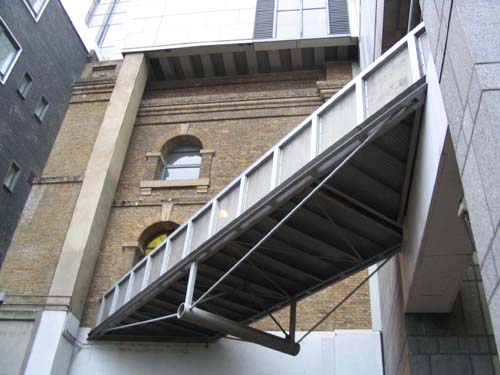
… which I think is nice, although I agree, many may not be that impressed.
You then either nip down some stairs into Villiers Street (get an A-Z – I can't be explaining everything) or you go through the concourse of Charing Cross Station. Either way, you discover that at the top end of Villiers Street, there is another footbridge.
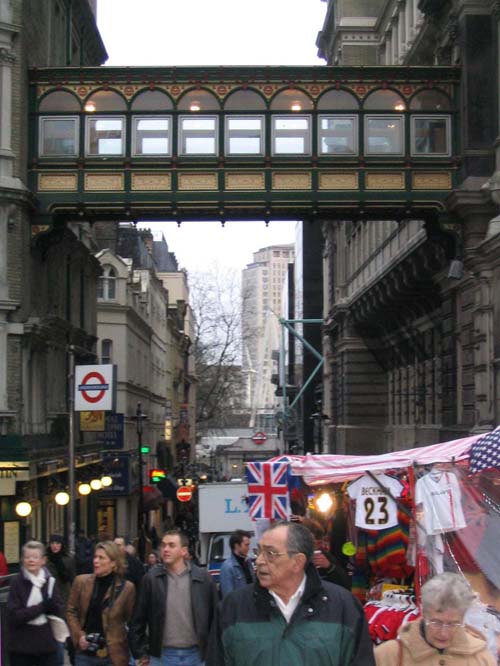
This seems to connect the Charing Cross Hotel, which is right on top of the old, still olden style, people entrance to the railway station (the train entrance having been totally redone) to …well, I'm not sure. The other bit of the Charing Cross Hotel, the other side of Villiers Street? None of the websites involving the Charing Cross Hotel make any mention of this little bridge, even though it surely deserves a nod of recognition. It looks as if it was built at the same time as the hotel and station itself. Anyone able to tell us more about it?
And talking of private, covered and rather mysterious footbridges, I now come to the bridge which regular Brian's Culture Blog commenter Tatyana Epstein told me to photo, and eventually gave up asking about because she assumed I was not interested. But I was and I am. This bridge is the real point of this posting. What delayed me was that I found it rather hard to photograph. Plus, I wanted to do a longish posting about footbridges in general, to get them all out of the way, rather than just a casual snap of this one little bridge, and then have more footbridges in later postings, and more, and yet more, until everyone got fed up with footbridges.
Anyway, Tatynana's bridge connects the Royal Opera House Covent Garden with the Royal Ballet School.
There is something very charming about a balletically beautiful footbridge enabling ballerinas to get from their ballet-nunnery or whatever it is, to their big cathedral, without having to cross the street, where the poor little creatures might be attacked and damaged, or where they might be persuaded by passing graphic designers or record producers to forget their ballet vows.
The new 9.5m span footbridge for the Royal Ballet School crosses Floral Street at fourth floor level and provides a direct link between classrooms and stage for the ballet dancers and staff of the school. The design addresses a series of complex contextual issues and is legible both as a fully integrated component of the Royal Ballet School and the Royal Opera House, and as an independent architectural element with a strong identity.
Yeah yeah.
The skewed alignment and the differing landing levels dictate the form of the crossing, disfavouring ‘neutral’ orthogonal solutions which would result in an inappropriate geometric interaction with the opposing buildings, and accentuate the fact that the bridge is pragmatically planned. The complete bridge structure was pre-assembled off-site before being craned into position in one efficient operation.
Well, if website guff like that is the price of this bridge, then I'll gladly pay it. Nevertheless: pragmatically planned, nonsense. The pragmatically planned answer would have been a simple rectanguloid box at an angle, not unlike the pleasing but aesthetically modest footbridge in the first picture here, but with a lid on it in the manner of picture number two. As it was, designers Wilkinson Eyre used the arkwardness of the site as an excuse to build a really weird and wonderful bridge.
Not having access to the inside of the bridge, or to the roof right next to it, or, to be frank, being such a good photographer, I was unable to take any photos as good as the ones here (scroll down a bit), at the Wilkinson Eyre website, by one Nick Wood, of which those two are my favourites:
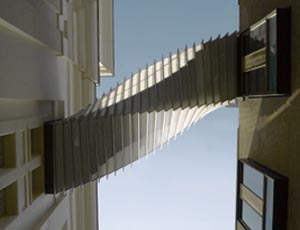

The best I could manage was this, below. Still, at least the picture is black, white and blue, which Tatyana likes.
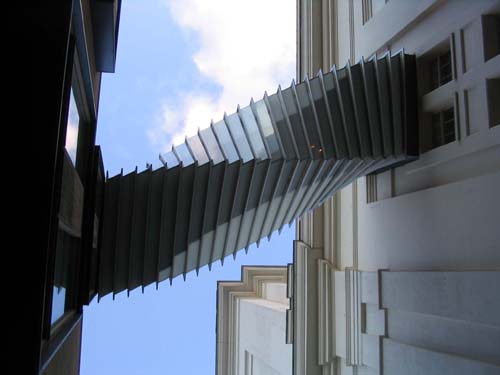
 Plus, on the right, here is a less satisfactory picture which at least gives you an idea of how the bridge relates to its architectural setting, spanning Floral Street way up high. I will have another crack at this bridge in the summer, when there is more light around, and when it lasts a decent length of time and isn't fading into gloom by the time I get there.
I'm really looking forward to my photographic summer of 2004. I'm learning about my new camera all the time. For example I have recently learned how to take adequate portraits indoors (see the picture of my brother Peter in the posting immediately below this one) without flash – about which I feel an entire blog posting coming on. As I discover more about it, I am ever more relieved that it is pocketable enough to have with me always, and not so expensive that I am totally terrified of dropping it in a river or something. Just rather.
It has already reached the point where, if I did drop my Canon A70 into the river Thames, I would immediately replace it with another Canon A70, which is the ultimate accolade. Further Canon A70 news: my good friend Antoine Clarke, in accordance with the logic of this posting has also just bought a Canon A70. He paid around £180 for it, apparently. So that's a three man user group already, consisting of me, Patrick Crozier, and now Antoine. Four, if you count David Farrer who has, if I recall it right, the (very similar) Canon A80. But I digress.
Final footbridge. I once lived in Newcastle, but I was long gone when they got around to building this:
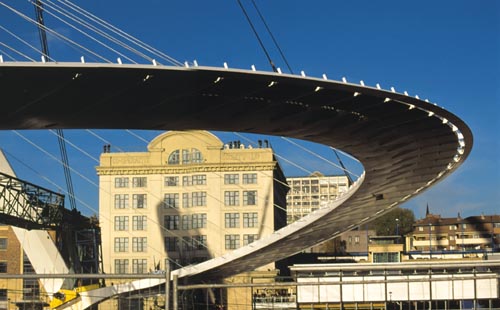
This is another in the Brian collection of Bridges That Are Longer And Curvier Than You Might Think But For Good Reasons (see comments). This one is long and curved so that it can be lifted up in a way that automatically turns it into an arch, while it still remains in one piece. Very cute.
It features in a recent Newcastle based rom-com movie which I enjoyed more than practically anyone I know or know of, called The One and Only. I couldn't find any production stills of The One and Only, featuring the new footbridge or featuring anything else for that matter.
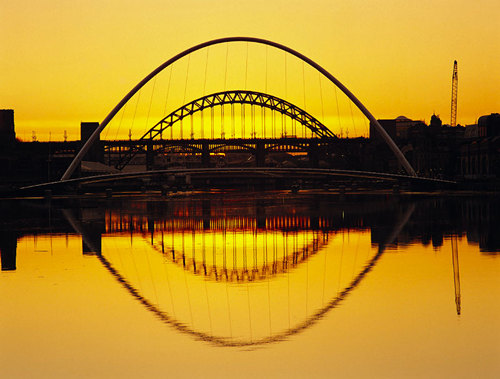
But for some really terrific pictures of the bridge itself, including the one above, go here. That one, above, shows how curvy the bridge is. This picture, on the other hand, is probably the most dramatic, featuring also other bridges beyond it:
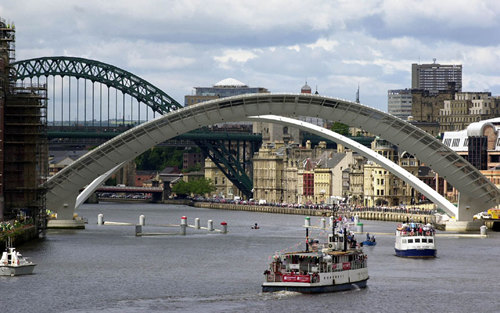
And this one is the most informative, because it shows the bridge in the up position with boats going under it:
Beautiful. I must go there sometime and take a proper look at it. And all the other Newcastle bridges of course.
And with that I will now take a vow of silence on the subject of bridges, for a while.


