
I don't really know what to say about this, other than that it is interesting:
Midland universities are being targeted by fraudsters who falsify application forms to get foreign students on to courses in return for cash.At least seven overseas students have already been expelled so far this term in the region after their applications were found to claim they had qualifications they did not possess.
Nationally 1,000 students have been caught during 2004 using false addresses, names and faked qualifications to get into prestigious British universities – twice the normal rate, according to the Universities and Colleges Admissions Service.
Yesterday, it was reported that an agent for Chinese students had claimed to have fixed places for hundreds of unqualified students over the past three years at universities including Birmingham.
Candidates were reported to be paying thousands of pounds to agents operating in China and Pakistan to cheat their way to a highly-prized UK university education.
Well, maybe there's this to say. How well would these cheats have done if they had been allowed to continue with their studies? How well do they do, if not caught? They sound rather highly motivated to me. Or would they have just tried (do they just try?) to make further educational progress with yet more payments?
The end of the article does supply an answer:
Warwick University described people who tried to falsify qualifications to get in "idiots".
I guess they meant "as" idiots there.
"There is a demand for British higher education around the world. It is one of the things we do well. In a sense it is the jewel in our crown," said Peter Dunn, head of communications."We occasionally get idiots who try to forge qualifications but 99 per cent of the time they are easy to spot."
But what if these fraudsters are only easy to spot if they are, you know, easy to spot? Is Warwick University behaving like those dumbos who say, with perfect confidence: "I can always spot a hairpiece."
It is hardly surprising that they've never yet spotted a fraudulent student that they couldn't spot.
Category: Examinations and qualifications • Globalisation
 [3]
[0]
[3]
[0]
Computer games are, for me, a closed book, if you'll pardon the expression. And like all those who are becoming ever more ignorant of the way the future is unfolding, I worry about it, and in particular I worry that Kids These Days Aren't Getting Enough Exercise.
Well, I've just been reading a fascinating New York Times report.
Two key quotes.
Quote Number One:
Four-year-old Alexander Nyiri, visiting New York with his parents last week, could not resist. He wandered over to the V.Smile TV Learning System set up in the cavernous Toys "R" Us store in Midtown Manhattan and began to play.And play. And play some more.
"He was heading elsewhere, and this game caught his eye," said his father, Lou Nyiri, a Presbyterian minister from Gettysburg, Pa. "He pretty much caught on to it within 5 to 15 minutes. He got the most giggles running Simba into the water."
The object of Alexander's attention – a $60 item from VTech – mimics the basic design of popular video game consoles like Sony's PlayStation 2, Microsoft's Xbox and Nintendo's GameCube. And that is hardly a coincidence.
"We have been looking at data that shows that kids at an earlier and earlier age are starting to play video games," said Julia Fitzgerald, vice president for marketing at VTech Electronics North America. "We wanted to know how we could make this phenomenon work for Mom" – and make it educational.
It is unclear whether video games teach preschool children more about phonics and problem solving than about simply how to tool around in a virtual playground. But everyone seems to agree that the ranks of young video gamers are substantial.A report last fall by the Henry J. Kaiser Family Foundation, a health policy research organization, found that half of all 4- to 6-year-old children have played video games – on hand-held devices, computers or consoles – and one in four played several times a week. Of children 3 or younger, 14 percent have played video games.
"Companies have found that there was an untapped market with the really young kid," said Vicky Rideout, a vice president of the foundation.
Which establishes that this indeed a big "problem", in the sense that lots of kids are definitely involved. So, does this mean that a generation of kids is being immobilised in front of computer screens and toy boxes?
Quote Number Two:
Sony is introducing EyeToy: AntiGrav, its most advanced EyeToy game, letting players speed through futuristic environments on a hoverboard. Control is managed by the way players stand and shift their weight in front of the included EyeToy camera while wearing special armbands. While the $50 game is primarily for older children and teenagers, Mr. Marks and Mr. Brisbois said, tests have shown that children 5 and younger have little trouble picking up its broad objectives.Mr. Dille of THQ said his company was also developing games that would use the EyeToy to control them. One level of a game lets children control SpongeBob's bowling by moving their own arms as if they were bowling.
"A 2-year-old could play that game, as long as the kid is capable of paying attention," Mr. Dille said.
Similarly, Nintendo, long the most child-oriented of the three major game console makers – and the maker of the GameBoy, often a child's first game machine - has created games that use nontraditional control systems. Its Donkey Konga game for the GameCube uses a set of plastic bongos to control the game through beating and clapping – a sort of hand-driven version of PlayStation 2's popular Dance Dance Revolution, which uses a touch-sensitive mat.
Parrin Kaplan, vice president for marketing and corporate affairs at Nintendo of America, noted that while young children may be able to play Donkey Konga games, the bongos were not specifically designed for them.
So there we have it. Yes, there is a "problem" here, if it is a problem that very young kids love computer gaming. But if the problem is that they will as a result become little tubs of mentally alert but physically disastrous lard as a result (like that huge Star Wars baddy who nearly ate Princess Leia), well, capitalism in all its greedy glory seems to be working on that problem.
What a future this will bring for education! Basically what we are talking about here is the nineteenth century British Public School rubric – mens sana in corpore sano ("a healthy mind in a healthy body") – reinvented with twenty first technology. Imagine computer games played on "touch sensitive mats" the size of tennis courts or soccer pitches, surrounded by cameras, which can track all the moves of the different players and stage counter-moves in reply … ah, the future.
Just the principle of computers being able to understand body language and not just typed-in or spoken language is fraught with all manner of possibilities.
Instapundit has been colonised by invaders called "Althouse", "Totten", and such things. And the pieces seem to be longer than usual, and as such things to link to, rather than just little snippets to acknowledge links from.
Today there is an Althouse piece, full of further links, about schoolchildren being used to assist in the US Presidential Election:
I firmly believe that once the state compels young people to attend school, deprives them of their freedom, it owes the highest duty to them to use their time only in ways that benefit them. To see them as a source of free labor or to exploit them for any purpose that is not itself a good reason for depriving the young of their freedom is a great wrong.
Regulars here will all know what I feel about this. Don't compell school attendance, and allow children to play whatever politics they want, and to have real votes, at will.
UPDATE: Don't miss the UPDATE.
More about Mike Tomlinson, from a guy called Ken. He said something nice about something I wrote yesterday for Samizdata, and I followed him back to this.
This Ken does not sit on the fence, Tomlinsonwise:
What is it about education and the teaching profession that gives morons a long career path? Mike Tomlinson has always seemed to me to have the intelligence of a small gnat – I saw him absolutely taken apart by the Education Select Committee, and yet no-one picks up the fact that this may make him somewhat unsuitable for the commissioning of a report looking for the complete overhaul of secondary education as we know it. I admit, I have an in-built hatred of the man following the abysmal and utterly outrageous whitewash of the inquiry into A-Level marking in 2002. But for him to have become the head of Ofsted to me beggars belief – going far, far beyond the Peter principle. He must surely have been promoted three or four levels (at least!) above his level of competence.His report into the overhaul of secondary education merely confirms this to me. Admittedly, there are some good ideas hidden within it – most notably, the realisation that good students can be fast-streamed and reach their potential more quickly than others can – but this is lost in a stream of egalitarian rhetoric of the worst kind. Unfortunately, none of the alternatives hit the point any more, despite the fact there is so much consensus regarding the problems facing our education system. Worse still, there is no constructive political opposition to prevent the adoption in some form of the recommendations of the report.
If you like that, read the other half.
More Arabs are getting educated in India:
Kerala, India]: Thiruvananthapuram, Oct 25 : Arabs in the Middle East are increasingly looking towards India instead of just the US and Europe for education and tourism, said P.V. Vivekanand, editor of the Dubai-based daily Gulf Today.The first Malayali editor of an English daily published from the Middle East was here to receive the Kerala Kalakendram Golden Honours Award instituted to honour internationally acclaimed members of the community.
"If the most favoured destination of many Arabs was the US and Europe till recently, they are today more attracted to India and Kerala. Thailand and Indonesia are also important destinations, but they are now looking towards India especially in sectors like education and tourism," Vivekanand told reporters.
He said a delegation of businessmen from Saudi Arabia was expected to arrive in Kerala shortly and the authorities should see what could be done to get more Arabs into Kerala.
I'm not sure whether this is because India is getting more attractive, while still offering good value for money, which it is; or Arabs getting less stupid at spending their money (or maybe that a new sort of not-so-stupid-with-money Arab is at last coming on stream in enough numbers to make a difference). Any of those trends would be welcome ones.
The bad news would be if the Indian end was simply idiot Indian Muslims teaching idiot Muslimism and nothing but (the nothing-but bit being the idiocy).
Last week I completed my Digital Photography for Beginners course. We spent the last two of the five days learning about Photoshop, that is to say, how to turn your camera into a liar.
On the final morning I participated in an educational ritual about which I am hearing more and more. This is called: "Ticking the Boxes". In my case there were no actual boxes, but the ticks were all present and correct.
What this means is that a piece of paper asks you if everything in the lessons has gone as it should, with the right things being taught, all according to the plan, and all of them learned, also according to the plan, and you reply: yes, yes, yes, yes, yes, yes, etc.
Two of the ticks were not totally correct, namely the final two (although now they are correct). This was because we had yet to perform those final two items of educational advancement. But Sir said put a tick anyway. If one were to take the form literally – that is to say as an organ for discovering the truth rather than as an empty ritual – the final two ticks should have been delayed until the end of the afternoon. But what kind of an idiot would do a thing like that? Tick tick tick tick tick tick tick tick tick.
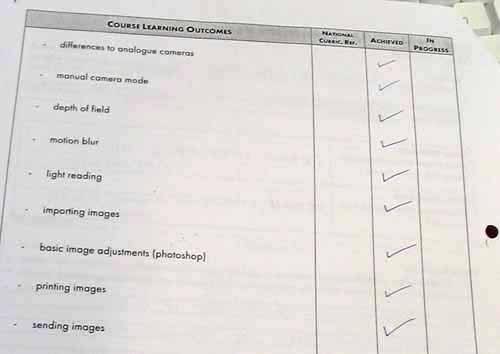
Knowing what I now know about the evils of Photoshop, I realise that you are just going to have to take my word for it that this is what the form I filled in looked like after I had filled it in. But do, for that is how it looked.
In my case the lies I told with ticks were so tiny as to be nigh on invisible, and reality immediately caught up with them. But I am told by others that often, when the boxes are all ticked, the lies told are monstrous. The ticks have no connection whatever with what really happened. But nothing but complication and confusion is caused by telling the truth on these forms by not ticking them in all the places where ticks go, and anyone who does is instantly self-branded as a trouble-maker.
Everyone in the system, from the lowliest school cleaner up to the Minister of Education, and on up to the very Prime Minister himself, knows that the information gathered in this manner has only a random relationship to the truth, but all agree to pretend that the ticks in the boxes do indeed describe reality.
No time for much today. Out partying. Just time to link to this, from Kenya:
Nyanza Provincial Commissioner Aggrey Mudinyu yesterday expressed fear that the province may once again perform dismally in national examinations.Mudinyu said education standards have steadily deteriorated in the province due lack of co-ordination among education stakeholders.
"All has not been well with the education sector in the region and I foresee a situation where our candidates may perform poorly in KCPE and KSCE," he said.
Mudinyu said Nyanza came second last in the last year's national examinations after North Eastern Province, adding that a stakeholders meeting needed to discuss the falling education standards in the region.
And why might education standards be falling? The next two paragraphs throw some light on that:
Mudinyu was speaking at Moi Stadium during Kenyatta Day celebrations. Present were Kisumu DC Wilfred ole Legei, Kisumu Mayor Priscah Auma and provincial police boss Bakari Jambeni.Mudinyu assured the residents of enhanced security as he promised that within one week the police would curb insecurity in the town.
This is a place where the politicians are promising that within a week "insecurity" will be "curbed", and by "curbed" I'm guessing they don't mean got rid of. In a world like that, education is bound to be one hell of a struggle.
One thing's for sure. Just using phrases like "lack of co-ordination among education stakeholders" isn't going to make much difference, if any.
Count your blessings.
I have done a couple of postings with educational themes for Samizdata, today and on Tuesday.
Today's was a response to this fascinating and excellent Guardian article about how a recent tax law change is crippling university entrepreneurial spin-offs. (Has any other media outlet picked up on this story?) And Tuesday's was a response to a seminar I attended which was addressed by Francis Gilbert.
When I write something which would do for here, but which would also do for Samizdata, I stick it on Samizdata, because, frankly, Samizdata is the one with the mass (although please understand that these things are relative) readership. And then I link from here, for those who read this more than they read Samizdata. I like to think that there are a few who fall into this category.
Kirsty Wark, on the telly, has been journeying around Eastern, post-Soviet Europe. And I caught the last bit of a report she did about a very interesting school, different from the usual sort:
As expected, Lithuania's largest cities have the most affluent club settings. The Sarunas Marciulionis Basketball School in Vilnius is perhaps the most well known of the developmental clubs. …
The Marciulionis school is located on an unassuming site which also houses the magnificent Sarunas Hotel. The Sarunas is known as one of the finest overnight accommodations available in Vilnius. Inside the training facility, three full-sized NBA courts lie side by side under one roof. Each of these courts see plenty of training action during the week with some 750 boys enrolled in the various age group training programs. The Marciulionis Basketball School believes in a holistic approach to player development. Every boy enrolled in the Marciulionis school takes classes in the English language and computer science. Formal classes on character development and social etiquette are also a part of the supplemental curriculum. International travel is also one of the basic tenets of the Marcilionis approach. Teams from the school have traveled to 25 countries since it's formation in 1992. The lobby of the Marciulionis school houses one of the most interesting collection of basketball shoes ever assembled. Many great NBA stars (Jordan, Barkley, Drexler, etc.) have donated pairs of the signed shoes for this one-of-a-kind exhibit.
This place was founded by and is named after the great Lithuanian basketball player Sarunas Marciulionis, pictured above right.
I wish there were more schools like this in England, catering for the sporty types, bringing the best out of them instead of the worst, turning them into noble and honourable young men instead of embittered, knife wielding bullies.
When I was a schoolboy, my school, Marlborough, used to play sports against a rival fee-paying school called Millfield, who built their entire system around sport, which meant they were very, very good at it. I can still recall the Millfield rugby team demolishing the Marlborough 1st XV, with a dazzling exhibition of pace and passing from their backs such as I have seldom witnessed since, despite a lifetime of TV rugby watching. Millfield is still going strong, it would seem. But, unless things have changed completely, it costs. A lot. The Marciulionis school presumably demands far less from its parents.
I can't say that I fully understand all the raminfications of this, but it sounds very important, and very good:
A significant number of Oxford colleges are supporting calls for the university to move towards privatisation and independence from the Government.An analysis of Oxford's 30 undergraduate colleges showed widespread anger at government interference and concern about funding.
It also produced claims that a move towards independent status – similar to that enjoyed by leading universities in the United States – could begin within 10 years.
The time frame, predicted by colleges that support a move to privatisation, is half that suggested by Michael Beloff, the president of Trinity College, last week. Mr Beloff said that increased government pressure on colleges to admit more working class students, combined with funding shortages, could force Oxford towards independence within 15 to 20 years.
Several college heads went further, however, stating that privatisation was not only inevitable, but desirable - and would take place more rapidly than Mr Beloff suggested.
You see, me, I thought these places were pretty much "independent" already. So file under: But what does Brian know? As I occasionally have to remind everyone: this Blog is for Brian's Education, as well as being an Education Blog done by Brian for all you ignoramuses out there.
Gratuitous picture there of Michael Beloff, from here.
Daniel Johnson in today's Telegraph:
So the Tomlinson report, supposedly the greatest shake-up of secondary education since 1944, has been endorsed by the Government. In our household the news induced nothing but a sinking feeling of déjà vu. My wife's first response to Tomlinson was to think of our four children: "Guinea pigs again!"Have they forgotten what happened when Keith Joseph replaced the O-level with an exam (the GCSE) which almost everybody could pass? Or how the A-level has been degraded into a muddle of modules and multiple choice?
Today, fewer than one in six school-leavers knows which king signed Magna Carta. Forty years of permanent revolution in our schools has produced the most examined but least educated generation in modern history.
Tomlinson is supposed to be about restoring confidence in our discredited examination system. The report actually does the opposite. Tony Blair insists it does not abolish the GCSE and AS-level. But it does, replacing them with "teacher assessment" of the pupil, who is only required to do an "extended project".
If there were any doubt that the replacement of formal exams by assessment has been an intellectual disaster, the curious case of Prince Harry's Eton art project ought to have dispelled it. For a former chief inspector of schools to be blind to the institutionalisation of cheating shows how deeply the rot has set in.
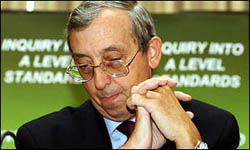 What school did Tomlinson go to, I wonder? And what university? (Are they now pleased with and proud of themselves?)
Times Online did a profile of him yesterday, by Jenny Booth, which will disappear soon, I guess, so here is all of it:
With a lifetime in education, first as a teacher and then as a schools inspector, Mike Tomlinson is seen in government circles as a safe pair of hands with a good record for dealing with tricky situations.Born in 1942, and educated in Rotherham and Bournemouth, he studied chemistry at Durham University and taught in schools in Nottinghamshire and Leicestershire for 12 years. He also spent a year as a liaison officer between schools and the petrochemical industry.
He joined Her Majesty's Inspectorate of Schools in 1978. In 1996, the year after he was appointed director of inspection, he headed the team that went in to run the troubled Ridings School in Halifax for a year, when it was named the worst school in England.
He also helped to restore the education system in Kuwait after the 1990 Gulf War, and to develop a schools inspection regime for China.
He was awarded a CBE in 1997, and in 2000 was made chief inspector after the sudden resignation of his boss, Chris Woodhead. After the bitter antagonism that had existed between schools and Mr Woodhead at the renamed Office for Standards in Education (Ofsted), Mr Tomlinson was seen as the right man to pour oil on troubled waters.
He was not a caretaker leader however, criticising the Government over damaging teacher shortages.
He retired in April 2002, but rather than opt for the quiet life he became chairman of the trust running schools in Hackney, one of England's most problematic education services.
He had been there rather less than six months when Estelle Morris, the Education Secretary, called him in to sort out the mess over A-level grading and standards.
Miss Morris resigned not long afterwards, and it was her successor, Charles Clarke, who asked Mr Tomlinson to take charge of the review of 14-19 education, a much bigger political hot potato.
He was careful to build a broad consensus on his committee, which included representatives from schools, further education colleges, independent schools, employers, vocational trainers, universities, but it remains to be seen whether the far-reaching reforms he proposes will be acceptable to the public.
Interesting man, with an interesting life. But how are the mighty fallen.
This looks like a classic example of a self-reinforcing and collectively self-deceiving committee making a gigantic blunder than very few of them would, individually, have made.
Natalie Solent had an amazing new idea yesterday:
Betcha Prince Harry did get help on his coursework. Not so fast with the chopper, Mr Headsman! So does everybody, as Mr White of the Telegraph sagely observes. Not quite everybody, actually. Last year Jenny Sweetham-Klewlesse (18) of The Old Vicarage, Pootlington Parva, did a Social Studies project completely unaided. Interested reporters can contact Miss Sweetham-Klewlesse behind the counter of her local Little Chef.It can't go on, you know. We need think outside the envelope and find a better way. Surely it is not beyond the bounds of human cunning to devise some sort of system which would actually make it difficult to cheat. Something like, um, gottit, getting all the A-Level candidates to do their coursework in school with no mummies and daddies allowed. No, that wouldn't work - what about the teachers? They have a stronger motive to cheat than anyone. Except the pupils, of course. I know! All the pupils would have to do the coursework the same day. All together in one room. And – and – and no talking to each other. Yes! It's a crazy idea but it might just work – so long as we took away their mobile phones.
Don't look at me like that. We'd give them back afterwards.
Okay, not the mobile phones. They'd have to put them under the desk.
Sorry. Sorry. I've calmed down now. I now see clearly that my idea was ill-judged, not to say intemperate. And contrary to human rights. My party leader has sent me to a local sixth-form college to apologise.
Last night I found myself asking Eamonn Butler of the Adam Smith Institute: why is there still no free market in exams, and why aren't exams consequently okay, like cars or cakes or soya sauce in bottles in the supermarket, instead of a national joke? You'd have to involve industry and a critical mass of the universities he said, and that's hard. But why is this not now happening?
Before I get the usual answer, to the effect that exams are already a "free market" ... exam suppliers may now be "independent", but the government still seems to be the sole or principle customer, with the private sector schools tagging meekly along behind. But why? Why cannot universities and businessmen decide for themselves which exam results they will take seriously, and which not? I'm told that many employers now have their own exams, so clearly lots of employers have already lost faith in the state-purchased exams. So, why don't they shop around?
If the answer is that the government enforces its purchasing preferences on everyone with the force of law, than that means that the exam business already is nationalised, in all but names.
The Government makes a rule. A particular case shows the rule to be ridiculous, and the media get heavily involved. Contemptuous people assemble in crowds saying: rubbish. So, the Government suddenly invents a policy which says that the rule doesn't apply to this particular case after all.
 I'm talking about the case of Dr David Wolfe, an excellent physicist and a superb physics teacher, who, the Government said, because he hadn't passed his GCSE maths, wasn't "qualified" to be a teacher. There can be no exceptions. Curse rage, government is idiotic, media hubbub, David Miliband is a plonker, and hey … how about that? There can be an exception. It turns out there's a "fast track". Some government inspectors can sit in on his classes and declare him qualified.
Read the Telegraph here, or the Guardian here.
I read about this in the Sunday Times here, who end their report yesterday thus:
But this may yet be a story with a happy ending. After the flurry of media exposure last week Wolfe was summoned to the phone. On the other end was "a very nice man" at the Department for Education and Skills. He told him that an assessor from the University of Gloucester would soon come to the school to observe one of his lessons. If it was fine, hey presto, he would be a qualified teacher."It's a complete volte face by the government," says Dingle. "No other head has heard of this 'fast-track' route. Heads up and down the country are saying, 'I beg your pardon?'" Nonetheless, he adds, "This time next week I earnestly hope David Wolfe will be a qualified teacher. Hurrah!"
But the rules remain in place, and not many good but "unqualified" teachers will be as vigorous in challenging them as Wolfe and his many friends have been.
The obvious riposte to this is that there do have to be rules. Well, maybe, in this centralised, nationalised system that we now have, with London in charge of everything, well, then, London has to be in charge, to have rules, and to stick to them. In Brian-world, people just educate themselves as they wish, and get what help they want. The idea that the government could forbid people to learn from some particular individual that they want to learn from would be regarded as ludicrous.
I should have picked up on this story sooner, instead of just babbling on about America. Sorry about that.
Category: Examinations and qualifications • Science
[2]
[0]
Alex Singleton did a Samizdata piece yesterday about an attempt to muzzle The Saint, a St Andrews University tabloid student publication which has apparently offended the muzzling classes. I commented that the muzzlers would only be making fools of themselves.
Sure enough, Joanne Jacobs, the Instapundit of Edubloggers, has already done a posting about this. Something tells me she won't be the last overseas blogger to notice this.
When you do something stupidly left-wing, there is now a whole new global readership waiting to guffaw at you.
This man is a genius. He is also a teacher. My favourite posting of his that I have so far found on an education theme goes like this:
Where I work they have put up a load of posters promoting British education. "That which does not kill you makes you stronger," says one. This is supposed to be an advert for the University of Sheffield.
I got to him via her and her. They were both focussing on another not-to-be-missed posting entitled YOUR CHILD IS AN ILLITERATE CABBAGE. My thanks to both ladies.
Every few days I type the word "education" into google, the "news" bit, and see what comes up. Mostly it is American. Mostly it is politicians. Mostly, the news is bad. Education is terrible. More money must be spent on it. Candidate X will emphasise the importance of education more than his frankly very similar opponent Y. Blah blah blah.
When the news is not American, it is usually even more depressing. Education is vitally important, more money must be spent on it, but where will that come from? Woe woe woe. Etc.
I am always on the look-out for the different story. I look for the particular, and I look for good news. I look for individuals who are making a difference and doing so with their own efforts, rather than merely begging for money or lusting for office.
This, from earlier in the week, even though, like almost everything I seem to have written about this week - such is the Internet - is also American, is the kind of thing I mean:
Actor and comedian Bill Cosby is set to visit four Richmond public schools Monday and speak about the importance of education.His stops will include: Thompson Model Middle School, George Wythe High School and Carver and George Mason elementary schools. The events will not be open to the public.
Former Gov. L. Douglas Wilder, whose mayoral campaign office helped plan Cosby's visit, said his longtime friend will likely talk about "the need to stay in school and the need to end this senseless slaughter."
"He feels a lot of people and a lot of kids have lost the fight within them to be something. And, consequently, they turn on each other," Wilder said of Cosby. "He said, 'Doug, I think they lost the fight.' He means they lost the spirit to achieve. I think he is right."
"A lot of these kids don't look past 25. They don't intend to live forever. They go out and have a baby . . . Get me a nice ride. Have some expensive jewelry. And that is it. They don't look toward middle age. They don't look toward a retirement. They don't look toward raising a family or providing an opportunity for other families."
The actor, who is known for his stand-up comedy and his sitcom role as Dr. Cliff Huxtable, generated controversy in May when he criticized some blacks for their grammar and accused others of not properly raising their children.
Unfortunately for Cosby, part of the reason this is news is because he is friends with a politician, Governor Wilder, who helped set up these talks, and Wilder is being accused of using Cosby for political purposes. But the way I see it, Cosby is using his political connections for Cosby purposes, and this is what matters. And what are mayors for if not to give a helping hand to operations like this?
Cosby is not begging for money, nor is he himself seeking to go into politics. He is simply trying to get a message across, to the people who he most wants to hear it, at the moment in their lives when it might make the most difference. Well done him.

I would like to see a lot of other celebrities follow Cosby's example. Not necessarily with anything so grand as a lecture tour, just by contributing to education. These people are nothing if not communicators, and teaching people to communicate is at the heart of teaching nowadays. Lots of these celebs and ex-celebs have more money than they know how to spend. So, instead of wasting the second half of their lives trying vainly to recreate the glories of the first part of their lives, why don't they grow old with a bit of dignity and become, I don't know, classroom assistants, and take it from there? Bob Geldof would have made a great Headmaster.
The teaching profession badly needs people with a knowledge of life outside school. Clearly the teaching profession can make excellent use of some teachers who know their subjects, how to teach their subjects, and very little else. But it also needs people who have lived a little, climbed mountains, fronted rock groups, driven jet airplanes, built skyscrapers, won Olympic bronze medals and organised hugely successful marketing campaigns.
Or for that matter hugely unsuccessful marketing campaigns, because failure teaches you a lot as well as success. You can bet that before that bronze medal finally happened, there were a lot of cock-ups and disappointments. Everest is not climbed in a day, and with no set-backs or back-trackings. And, the occasional teacher who knows what the inside of a prison is like might be able to pass on some good lessons.
Adam Balling reports on an odd use for a publicly owned school. I got to this from here.
This convention was a fine Orwellian display, complete with doublespeak, ritualized hatred, and the policing of "thought crimes." All who disagreed openly were barred from the radical teach-in at the public school. I was only there because I went in "under cover." That the San Francisco Unified School District rented its space to an exclusionary meeting of terrorist-supporting fanatics – in violation of state and federal laws, and possibly the USA PATRIOT Act – defies description. These people want America destroyed, and are not shy about it.
Towards the end of Balling's report:
The message at this conference was intended to guarantee the outcome of a triumphant Palestinian revolution that would be a nationalist massacre: the ethnic cleansing of Jews. If allowed, the elimination of Israeli society by force – the desired victory – would be genocidal. The Marxists and fellow travelers at Horace Mann Middle School, however, did not call it genocide. They called it "all forms of resistance" against "the imperial rule" of "Zionist apartheid settlers" and on behalf of "the right of return for all Palestinians." Do not be fooled: the only tangible result of these stated objectives would be the mass murder of all but those Israelis who managed to escape. The invading Arab paramilitary would not take the time to build camps.
Quite a lesson. I wonder if Horace Mann Middle School will get into any bother about this. Perhaps it already has.
I'm guessing that Horace Mann would be this Horace Mann, yes? I wonder what he would have thought about this conference.
I'm not the only who takes photos while doing education. As Instapundit reports, with this same photo, war correspondent Major John Tammes does it too. He's teacher.
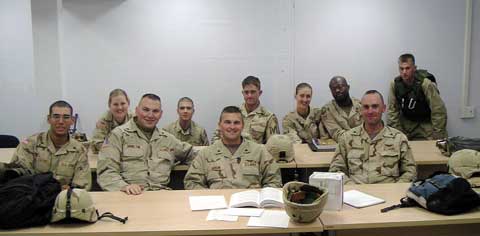
You may recall this Major Tammes edu-photo also.
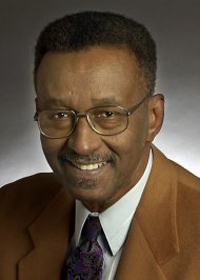 Walter Williams writing yesterday:
I'm wondering just when parents, especially poor minorities, will refuse to tolerate day-to-day school conditions that most parents wouldn't dream of tolerating. Lisa Snell, director of the Education and Child Welfare Program at the Los Angles-based Reason Foundation, has a recent article about school violence titled "No Way Out," in the October 2004 edition of Reason On Line (www.reason.com).As Snell reports, Ashley Fernandez, a 12-year-old, attends Morgan Village Middle School, in Camden, N.J., a predominantly black and Hispanic school that has been designated as failing under state and federal standards for more than three years. Rotten education is not Ashley's only problem. When her gym teacher, exasperated by his unruly class, put all the girls in the boys' locker room, Ashley was assaulted. Two boys dragged her into the shower, held her down and fondled her for 10 minutes.
The school principal refused to even acknowledge the assault and denied her mother's request for a transfer to another school. Since the assault, Ashley has received numerous threats, and boys frequently grope her and run away. Put yourself in the place of Ashley's mother. The school won't protect her daughter from threats and assault. The school won't permit a transfer. What would you do? Ashley's mother began to keep her home. The response from officials: She received a court summons for allowing truancy.
Speaks for itself.
I found the picture of Walter Williams here, where there is further information about him.
Pail – Fail!Right, hon. Fail means you don’t win.
Cane – Fane!
Uh – well, feign is a word. It means you pretend in an evil way.
Cake – Fake! It's hard to describe the gusto she employs to shout out the rhyme. Pride and triumph. FAKE!
Absolutely right. That's a rhyme.
Then she turned over a picture of a duck.
We had a little talk about bad words.
It’s all a minefield. …
Yes, I would imagine it is. Although, what's wrong with "luck", or "tuck", or "muck". Or even "suck"? There's innuendo there, but just ignore it.
I really am fascinated to see what happens with the Lileks/Gnat saga. Will he still be bleating updates on the relationship in ten years time, I wonder?
Here is an interesting if depressing Guardian piece about the baleful effects, at any rate as DJ Taylor sees it, of creative writing courses at university.
This week sees the publication of Concertina, the annual anthology of work by recent graduates of the University of East Anglia's creative-writing course. The noises emanating from this literary hotbed are usually so upbeat in tone that I greeted the remarks recently attributed to Paul Magrs with faint incredulity. Dr Magrs - lately employed as a tutor on the much-celebrated creative-writing course - had been reflecting on the calibre of his students, and the verdict was horribly damning.The bulk of the UEA habitués, Magrs suggests, "tend to be people of about 30 who've burnt out doing something else, who've read some Kundera and some Rushdie and think they're going to reinvent the European novel by writing about their gap year and Ronald Barthes. Somebody even turned up in a beret one year."
No doubt the irritations of the modern academic life can be insupportable at times. No sooner had I finished reading Dr Magrs' piteous lament (he has since moved on to Manchester Metropolitan University) than the printer began to disgorge details of this autumn's inaugural Norwich literary festival. Among other attractions, the event will be sponsoring a "lab" at which half a dozen writers in residence will be offering advice to aspiring talent.
I concur with DJ Taylor in wanting to hold the word "lab" at arms length, given that scientific experiments are not involved here. (See also: "workshop".)
Later in the piece:
Meanwhile, the proportion of novels and poems written by people who are not graduates of, or tutors on, creative-writing courses grows correspondingly smaller. One doesn't have to be a throwback to the age of the man of letters, ear finely attuned to the thump of the creditor's boot on the tenement stair, to wonder whether this is the best training for the embryo writer. Reading the chapters of Jeremy Treglown's new biography of VS Pritchett devoted to the 1950s, I shook my head in horror at the revelation that, even in his fifties, the most influential critic of his day was so cash-strapped that he was obliged to write up his annual vacation for Holiday magazine. And yet a Pritchett safely established as professor of creative writing at the University of Neasden would, you imagine, have lost something of his distinction in the transfer.Back in the 21st century, the fatal urge to cram campus lecture halls with graduates learning how to produce novels or "life writing" continues apace. Last month, a press release winged through the door announcing that the University of Essex is introducing a creative-writing course. No offence either to the university or its very distinguished founding staff, but: why, exactly?
Why indeed? Well, of course, one answer is that people like studying this kind of thing, and who am I, who spent half of today learning to play with Photoshop simply because I felt like it, to complain? However, I certainly don't see any case for taxpayers picking up any part whatsoever of the bills for such bourgeois pleasures.
Dare I hypothesise (and please note that's all it is) that universities actually solve a problem with courses like these? I'm thinking: universities are being nagged to process lots and lots of graduates. And this would presumably be a delightfully cheap way of doing that. Real labs are much more expensive.
Now, where can I get a course in destructive writing?
I have been taking digital photography classes, and have already stuck up a lot (and I do mean a lot) of digital photos of this (and some spiel about it all) on my Culture Blog. Those were taken a fortnight ago. But then a week later I got a few more really nice ones, and I thought, what with it being education - teaching and learning anyway - I'd stick a few of the best up here. Click on the small pictures here if you want to see bigger ones.
At first all I wanted was a home for this lady …

… who is from Peru. She came out really well, I think.
But while I'm at it here are some pictures of the class teacher, André Pinkovsky.
André was at his most dispirited when trudging through the paperwork at the start of the course. He had to get us to fill in lots of forms to inform the local authority of what was going on so they could feel comfortable by having a stack of paper about it all. Necessary, I suppose, but about half of the first morning was taken up with this. When he got around to talking about photography he was happier. And when we got to actually play with our cameras and he could wander around just helping and encouraging us (reinforcing all those facts and concepts all the while) he was happiest of all. It helped at lot that last Wednesday was, I now realise, the last really nice and reasonably warm day of 2004. André's mood was, as I hope you can see, positively sunny. The one on the bottom right is included because I like the colouring, and despite the cropping, which is as it was in the beginning, I'm afraid.


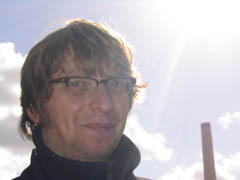

He does not completely look like Alan Rickman in Die Hard, but there is a definite resemblance, reinforced strongly by the fact that, like "Hans Gruber" if not Alan Rickman, he is also German. We tease him about this. He doesn't seem to mind. For in personality he is the opposite of Hans Gruber, very kind and very patient, and is willing to repeat himself, as often as we ask for it.
This is a particularly important quality for the kind of teaching he is doing, I think. Learning something of the fundamentals of photography from scratch, as most of us are doing, means becoming acquainted with a number of alien and interlocking concepts. Shutter speed. Aperture. Depth of field. And the point is that such things are not mere "facts". These are concepts, concepts that he wants us to internalise until they are part of our inner natures as photographers, and that takes time. Which is why they need to be repeated. On the other hand, lots of facts are also involved, and because there are so many of them, they too need to be repeated.
On its own, each fact – each concept even – is reasonably easy to learn, but there are too many of them for us to grasp everything first time around. When we might have been absorbing the next fact, we were still pondering the significance of – or simply trying not to be confused about – the previous one. So, we need reinforcement and confirmation at exactly the moment when we are attending to something. I do, anyway.
This, after all, is the problem with merely reading the documentation, or even reading helpful X-for-dummies type books. The answer to your particular question right now is usually there, but how to find it? And if you do, will it make sense to you, without you already knowing the answer to two other questions? A teacher, if he knows his stuff, can answer your exact question straight away, and if you don't understand his first answer, you can try again until you do, approximately speaking. And, when you forget it all and want to ask the same question again an hour later, you can, if your teacher is like André. In such circumstances the "But I've already told you that!!" style of instruction would be very demoralising.
One of the ways of remaining a good teacher, I think, is to subject yourself to teaching from time to time. That way, you are reminded of how it feels to be taught.
And since I am shovelling pictures onto my blog, I might as well shove up the best of the rest of the pictures taken that day.




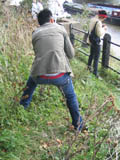

As you can see, I like to take pictures of digital photographers, and that includes taking pictures of myself from a reflecting surface when taking digital photos, as is the case in the photo of the guy in the blue glasses.
Next lesson tomorrow. I leave it to you to decide if they are having any effect.
I have been reading Jo-Anne Nadler's Too Nice to be a Tory, which is an autobiographical essay about the predicament of … well, it's obvious. Here is how she describes (pp. 91-92) that portentous moment when, fresh out of York University, she goes back to London and gets her first proper job.
 'How would you win back the audience we've lost to Capital Radio?'
It was the clincher question in my third and final round of interviews for a job as a trainee producer with Radio 1. Resting on my answer was the prospect of a fairly swanky opening straight out of college. I was shifting nervously, feeling rather sweaty, considering my response. My interrogator was one of three facing me in a deliberately intimidating configuration beloved of the BBC. He went on, 'You know the type, the skilled working class around the outskirts of the M25, out every Friday night at the Epping Forest Country Club, drives a Cortina, furry dice in the back of the car, but it's always independent radio tuned in at the front. What are we going to do about it?'
'Play more Luther Vandross!'
It seemed the obvious answer. It was certainly true that Essex Man liked soul music, of which London's independent station Capital Radio played a lot, while Radio 1 was wall-to-wall Phil Collins, Eric Clapton and the Travelling Wilburys. While I had been a temporarily displaced Londoner myself it had always been a blessed relief to hit Elstree at the bottom of the A1 on the drive home from York. Here was the chance to tune out of Radio 1 and the dirge of ageing hippy rockers and into loud, brash 'dancey' Capital. It was the sign that I was home, in radio terms back in the land of the living. Unsurprisingly I did not add that observation in my response just as I had not played up my YC past when outlining my suitability for the job. Whatever the reality it hardly spelt sex, drugs and rock'n'roll.
I had applied for the job during my final term at university almost as a joke but, without trying, I had apparently obtained the necessary qualifications; an encyclopaedic knowledge of pop music, I had run the campus radio station, I was articulate, ambitious and female – which had marked me out among the applicants. And so, to my great surprise, I was in.
Category: Examinations and qualifications • Relevance
[0]
[0]
Yes, like the man says, Norm Geras interviews Joanne Jacobs.
I didn't know this:
If you could effect one major policy change in the governing of your country, what would it be?I'd decriminalize drugs.
Because Joanne Jacobs favours schooling as usual (but improved by the market), I pretty much had her tagged as more conventionally right wing than that, i.e. perhaps worried about the War on Drugs, but not that worried.
Live, blog, read other blogs, and learn.
Depressing but inevitable, and presumably now being said by governments and by education departments the world over, more or less loudly:
WASHINGTON (AP) - The U.S. Department of Education has alerted school leaders nationwide to watch for people spying on their buildings as a possible sign of a higher terrorist threat.The warning is based on an analysis by the FBI and the Department of Homeland Security of the school siege that killed nearly 340 people, many of them students, in Beslan, Russia, last month.
The review was done to protect schools and not sent because of "any specific information indicating that there is a terrorist threat to any schools or universities in the United States," Deputy Secretary of Education Eugene Hickok said in a letter to school leaders.
The conventional Western view of war is that there are warriors, and there are innocent bystanding civilians - fighting men on the one hand, and the, old, the unfit, and women and children on the other. (Although during the great bombing campaigns of the Second World War that distinction was stretched way past its breaking point.)
War now is different. The stated ultimate aim of the Islamo-fascists is not to fight against the non-Muslim world and extract concessions from. It is to destroy the non-Muslim world, to wipe it out. And destroying the non-Muslim world absolutely includes destroying the non-Muslim world's children. Especially its children. There's no point in getting into a moral flap about this. Killing children is perfectly logical, given that their aim is to destroy the ability of non-Muslim societies to perpetuate themselves.
This means that all kinds of defensive measures for large assemblages of school-age children will now have to be thought about, just as the US Department of Education says.
And – a thought which has only just now occurred to me as I was typing in the above couple of paragraphs – what if the idea that schools are too big catches on, not just because big schools are (maybe, I think, others think) bad educationally, but also because large clumps of children all in one place are a nice juicey terrorist target. Disperse and defend. It's a thought.
The point is – just to make it clear in case it isn't – not that a small school is easier to defend, but that a big school gets the terrorists more bang for their bucks and their bodies, and is hence more enticing as a target and is hence more likely to be targetted.
Will the Pentagon and the FBI and the CIA and the rest of them start agitating for smaller schools, on the grounds that that way the casualties of terrorist attacks on schools are likely to be fewer? After all, one of the reasons why so many children were killed in that Beslan school is that so many children were at that Beslan school.
As I say, it's a thought and only a very slightly baked one at that. I wonder if others will join in with the baking of this notion.
While I'm on the subject of cumulative fractional baking, my thanks to the Instapundit of Education Bloggers for this posting, about this speculation here, and to her (on that posting) few but fascinating commenters there. Not such a "golden generation" after all, it seems.
UPDATE: Joanne Jacobs also posts today about school security against terrorist attack. Originally I put that this was schools in Iraq, that although the information came from Iraq the schools they're worrying about are in the USA. So I guess this might be the same story as the one I'm linking to.
Apologies for taking so long to link you all (?) to Sean Gabb's recent piece entitled Home Schooling: A British Perspective, but better late than never. Says Sean here: "This will be published in 2005 in an American book about home schooling across the world." And if you follow that link, you can also access other writings by Sean on the related matter of truancy (and also this!)
I have read through this piece, which is quite long by the standards of internet link destinations (28 pages in my print out), and my immediate reactions are very favourable.
Sean starts with what has always been his strong suit, some history. Home schooling has a long one. (Only very recently has our Royal Family not home schooled.) And so does the kind of schooling that now causes parents to want to rescue their children from it.
There then follows a description of the legal position with regard to home schooling, both in England, and in Scotland where things are different.
He makes the point that estimating the exact number of people involved in home schooling in Britain is difficult, because these are not people who volunteer details of their child rearing arrangements with the kind of people who do research into such things. They prefer to keep things to themselves.
He itemises and expands upon the various reasons why people choose to home school, under the three headings of: discipline and safety, curriculum and quality of instruction, and religious and ideological dissent.
He describes the extremely varied home schooling methods used, many of the people he refers to, of course, preferring not to use words like "school" or "schooling" at all. He speculates that the effects of home schooling can't be that bad, and seem pretty good, certainly compared with the available alternatives.
He describes the slow build-up among the meddling classes of the desire to meddle in and evntually to expunge home schooling, which is particularly strong in Scotland, and, given that there don't seem to be many harmful educational effects from home schooling, Sean speculates about other motives for this meddlesomeness, mainly, he suggests, ideological.
If I had started at the beginning of reading this piece with copying-and-pasting bits that were especially important and particularly felicitously expressed this post would have gone on for ever. I will confine myself to reproducing here the Concluding Remarks:
There can be no doubt that - whatever may be the numbers overall - the number of children educated at home has increased and is increasing. During the next few years, it is also at least reasonable to believe that there will be a debate over whether the numbers ought to be diminished. On the one side will be the supporters of an activist state, divided as to their motivation, but united in their belief that education should be supervised by the authorities. On the other will be the home schooling parents. Most of these may be hiding, and they will continue to see safety in concealment. Those who are visible can be expected to fight all efforts at regulation with a passion not seen in British politics within living memory.We may, then, be returning to something like the debates of the middle and late Victorian years, when education was considered more than just a matter of funding and standards.
Well, I reckon EUrope etc. rouses the odd spot of passion already. But otherwise, very good. Read it all, or at least dip in it more extensively than I have here.

That's Sean on the right, holding forth at my Last Friday of the Month Meeting in April of this year.
A new school in Afghanistan.

... from Instapundit, taken by his Afghanistan photo-correspondent and emailer, Major John Tammes.
I went from this at Samizdata to this at tBBC, to a comment on this, to this blog, and to this posting there.
Quote:
What is an educational blog?- An additional communication channel between teacher and learner
- A searchable archive of notes and handouts including downloadable worksheets and documents
- Signpost learners to additional resources
- Support questioning and discussion
- Provide a channel for comment, criticism and evaluation
- Open the teaching and learning process publicly to other interested parties
… which sounds, in a way, pretty old school to me. Which just might be the point.
My old Libertarian Alliance partner Chris Tame was fond of the word "hum", to describe a gradually spreading murmur in favour of some hitherto neglected notion.
Well, I think I detect the beginnings of a hum:
But the way the education system is going, it would be more honest simply to raise the school leaving age to 22. University is just something you do when you've finished your A-levels, no matter how badly you might have done or how bored you've been doing them.To suggest to those who are not cut out for even rudimentary academic life that university might not be the best place for them, is to consign them to non-person status.
It's not as if a degree even helps getting a job: all it means is that you've spent longer waiting to find yourself unemployed. If anything, I feel it might impede your prospects. You're just one among a pile of applicants, similarly qualified, none of whom has anything extra or interesting to offer.
I think it's the middle classes that have to start the move away from tertiary education. Concerned parents now insist, ever more anxiously, on finding a university place when they would be doing a lot more for their children by refusing to fund the whole enterprise.
"… the move away from tertiary education …" Well, well, well, fancy that.
 Remember that when people writing in the Daily Telegraph say "middle classes", they mean fairly well off people in the top 5 percent of wealth and income. Middle as in "not the Queen", so to speak.
The really interesting thing about this article is who it is by. Nigella Lawson. That's right, the Domestic Goddess herself, and not just a bit of posh totty on the telly either. This woman is the daughter of a former Chancellor of the Exchequer and now married to a Saatchi Brother. Talk about well connected.
When people like this start talking about "the move away from tertiary education", then you know that something is going on.
I noticed this when it was first published over the weekend, but it took me until now to pass this on. Sorry, but not really sorry, because this is not a notion that is going to go away.
Wonderful what a price increase does to demand, isn't it? For remember, the idea of this price increase is that it falls precisely on those middle (upper) classes. So, the middle-uppers will, in increasing numbers, turn their backs on the universities. Their kids will get started on Real Life earlier than the riff raff.
How long will it be before "university" starts to have the same social ring to it as "comprehensive"?
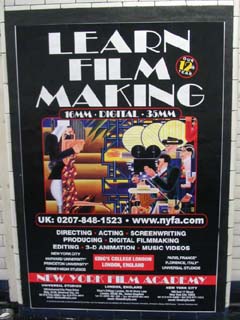 In accordance with my ongoing gratuitous picture policy, I featured a New York Film Academy poster, back in June. They have an offshoot in London, asking:
Are they as good as they claim to be at their website?
. . . i.e. as they claim here.
Someone called Linda Eden-Ellis has commented with an answer:
Yes, they are. The courses are intensive, students are kept very very busy every day and you have to keep up and stay awake - don't go for a rest! You get taught by people from the industry who have invariably done the job commercially – not just academics. The amount of advice, encouragement and motivation students receive on these courses is worth the financial outlay – plus the invaluable thing of networking – you make lots of contacts within the NYFA – people contracted in from industry to teach and mentor and other people on the courses already doing small film projects of their own who might invite you to work with them – if you are any good of course!
Comments, no matter how interesting, on postings from way back are unlikely to be noticed by anyone but me, unless I copy-and-paste them as new postings. Hence this new posting. With the gratuitous photo. Again. But smaller.
I have already linked to this article. Now I have read it.
Short quote:
"They want to make sure that it's good enough to be read by more than just their teacher," said Christopher S. Wright, a third grade teacher at Wyman Elementary School in Rolla, Mo.
That's a thought I have often had, here and there.
It always seemed to me that one of the stupidest things about my school essays was that on the whole only one person, the teacher, ever got to read them. I didn't blame anybody. It was inherent in the primitive technology we all then depended upon. Your stuff either got read by too few people, or was shoved in front of the faces of far, far too many people (i.e. "published" in some way or another), on a scarce and hotly contested piece of territory that involved a fight to get your bit of it. Learners need a happy medium (in both senses), where more than the tiny first few can browse, but no large readership is inconvenienced unless and until it wants to be. Blogging is that happy medium.
As Christopher S. Wright says, once learners blog, they have a built-in inducement to do it better, because the better they do it the more people will read and admire. There is a gradual success path there.
We all know that you typically teach in small increments of challenge, effort, result, reward.
Blogs teach.
I think this is interesting:
A teacher wrote me a letter, saying, "I found it very interesting that the Japanese teachers have students struggle with a problem before they teach them how to solve it. We never do that. We teach them how to solve it first, and then let them work on examples."She said, "I’m a very traditional teacher – I just get up and lecture – but I decided to try something after reading your book. I now start my lessons by letting students try to solve it on their own, and then give my lecture." She said this small change had worked brilliantly for her. She saw a huge change in motivation and engagement in her students.
First they do it. Then theorise about it for them, in a way that then makes sense. Load. Fire. Take aim.
It found this here.
Many adverts work like this. First confuse them with a confusing message. Then explain it.
And TV shows. And newspaper and magazine pieces. First you hit them with some enticing but rather confusing surface facts, perhaps facts which have already got around in a garbled form. Then you say: okay, what's really going on here?
Personally I favour pupils choosing what to be confused about, and on that basis choosing which lectures to attend, or to attend to, but that's beside this particular point. Close, but beside.
On Saturday evening I had supper with my friend and fellow Samizdatista Johnathan Pearce, and very agreeable it was too. We discussed many things, and one of the more interesting things we discussed was one of Johnathan's father's school teachers. Johnathan's father was at school just after World War II, and consequently found himself being taught by, among others, people who had just won the war.
He was apparently taught physics by a young guy, about twenty five years old then, who had, before taking up his post as a teacher, been a navigator in a Pathfinder Squadron. For those not versed in the details of how Britain's wartime bombers went about their grizzly business, the Pathfinders were the ones who went to the target first, and started a small fire on it, which all the bombers would then aim their bombs at. The combination of technical expertise and sheer guts needed to be someone like that is something at which most of us can only, luckily for us, guess.
And one of these young fellows was, as I say, Johnathan's dad's physics teacher. Young, obviously. But also, because young, very keen and energetic. In short, the very essence of Alpha Maleness.
Johnathan's dad goes further, and says it would be interesting to examine the impact upon education, not just of this one young man, but of all the other young men like him who, just after World War II, while still only in their twenties, entered the teaching profession.
Someone like this physics teacher (a) is going to know his physics pretty well, and (b) is hardly likely to be phased by a classroom full of exuberant and potentially rowdy and out-of-control schoolboys.
Now you may say that, now, things are very different, and even the most formidable of men sometimes have a problem keeping in control of classrooms, and I am sure that's true. But the exact chronology of this golden generation of schoolteachers, if that is what they were, is, I think, suggestive.
In particular, ask yourself when these guys stopped teaching. Assume that they were around 25 when they started teaching, fresh from their Avro Lancasters and their tanks and their ships and their Spitfires, and that they retired at around 65. So, add 40 years to 1945, and what year do you get? Well, you don't need much maths for that. The answer is 1985.
Now, 1985 is the approximate time when it is now claimed that education in Britain started to enter its most recent period of being very bad, and in need of much increased central control.
The usual explanation for educational decline, and most especially of decline in discipline and pupil behaviour, is … well, what? Nobody properly knows, other than to note that wider social forces, forces outside of schools, made a big impact upon schools and changed them for the worse. But just what did these "social forces" consist of? All sorts of things, of course, including television, the rights-before-responsibilities mentality encouraged by the welfare state, drugs, the immigration into Britain of some ethnic groups who behave very badly (although others behave extremely well of course), have been blamed for this decline. Other more immediate malign influences on schools have included: idiotic teacher training colleges, idiotic theories of literacy teaching, and, in general, all the stuff you read about here from time to time when I am in a complaining sort of mood. But how about this for at least a part of the explanation? - that during the 1980s a lot of extremely good and, so far as the wider life of the schools they taught in, hugely influential teachers retired, and were not replaced by teachers who were anything like as impressive, and especially not as impressive to young boys. How about that as part of the story of our nation's current educational woes?
Certainly, to judge by the TV adverts being shown by the government now, they would give anything for another generation of men of this calibre and experience of life to go into the teaching profession.
So, there's your answer, start another major war, and hope that a decent number of young men survive it and then, because of the depressed state of the post-war economy, become schoolteachers in huge numbers. Well, not really. But I still say that this is an interesting way of looking at the larger educational picture, usually scrutinised only through a microscope with a label on it saying something like "educational policy".
Here is a gratuitous picture of some Avro Lancasters and of some of the Alpha Males who flew in them and looked after them …

… which I found here.
Sometimes the news you get about education through the wonderful world of the Internet is almost too overpowering to bear:
Truro: Adult education classes offeredThe following adult education classes will be offered in Truro this fall: Quilting, ceramics, Latin dance, Works on Paper, Spanish, yoga, Introduction to the Computer and Introduction to Pilates.
What are "Works on Paper" and "Pilates"?
On the other hand, if this really is what counts as news in Truro, it must be a pretty quiet place, so if what you want is a quiet life …
More local education news here.