
Last Friday the late lamented (blogwise) Jackie D gave a talk chez moi, about fame and all that.
This is the sort of thing she was referring to:
Celebrities such as Jordan, Kylie and David Beckham are becoming more influential to young people than their parents, teachers and even school friends, a study suggested yesterday.Star-struck youngsters are treating their famous role models as "pseudo friends", the research found. However, when hero worship turned into obsession, young fans could be left feeling isolated and lacking in social skills, the psychologists concluded.
Academics from Leicester and Coventry universities studied how celebrities influence young people and their social networks. Previously parents, teachers and friends had always been the key influence on children. However, more recently young people were being exposed to other influences such as pop stars, actors and sporting heroes.
To me what is extraordinary about this "research" is that they have finally noticed. This kind of thing has been going on at least since the 1960s.
The difference, if there is one, is that so many children are, I fear, being prepared for life only by television, which is no preparation at all.
Happy Feb 29. I wanted to put something up here today, however slight.
And this would be all part of why I often put educational stuff on Samizdata rather than here, this being an Instalink to this.
I probably should have said something about this there as well, instead of merely here (see post immediately below here). But Perry de Havilland has now mentioned it.
A commenter named Kelli, who I assume to be English, has already asked about "homeschooling libertarians". Please go there and answer her if you can. As usual, the message here is: do read the Samizdata comments, and of course join in, because you too can then enjoy that big readership, now running at about 6,500 per day, Perry tells me. But do it quick, because Samizdata is a high turnover blog and stories fade from view fast. Some Samizdata comments are inane, of course, but I have already learned a lot about the whole Spanish language in the USA argument, from the comments on the Spelling Bee posting.
Getting back to that BBC report about Home Education harassment, I can find no further mentions today (although my searching skills are not stellar) in the three British broadsheets I regularly link to (Guardian, Telegraph, Indy) about this latest menace to Home Education.
I have a busy afternoon ahead of me, preparing for my Brian's Last Friday meeting tonight, but Julius Blumfeld, to whom thanks, has just emailed me with the link to this, from the BBC:
Some parents claim they are educating their children at home to hide the fact they are abusing them, welfare officers say.The Association for Education Welfare Management has asked the Children's Minister, Margaret Hodge, for the power to check up on home educators.
It says the forthcoming Children's Bill is a good opportunity to change the current practice.
Home educators regard the move as offensive and unnecessary.
It was only a matter of time. Just what will this "checking up" end up amounting to, I wonder?
Let me see if I can quickly dig out a posting here of me prophecying that something along these lines would be happening some time soon.
Well, how about this? - not from me but from Julius, on January 16th 2003:
Yet as more parents home educate their children, it will become increasingly visible. And as that happens, the pressure will grow for the State to "do something" about "the problem" of home education. The pressure will come from the teaching unions (whose monopoly it threatens). It will come from the Department of Education (always on the lookout for a new "initiative"). It will come from the Press (all it will take is one scare story about a home educated ten year old who hasn't yet learned to read). And it will come from Brussels (home education is illegal in many European countries so why should it be legal here?).
Not bad.
The pattern is the same with home education as it is with everything else. Something goes wrong, in the context of harmless, legal activity X. Therefore everyone – not just wrongdoers but everyone – doing X gets screwed around from now until the End of Time by the government.
Child abuse is already illegal. The way to stop it is to punish it as and when it is detected. The way to detect it is for neighbours to keep an eye and an ear out for it. The idea that harassing people like Julius Blumfeld and his family is going to improve anything except the salaries of the harassing classes is absurd.
The other day I had one of those deeply satisfying conversations where someone says to you that (a) you said something very memorable to them several years ago which you had yourself completely forgotten about, and that (b) it had proved to be invaluably useful advice. So, hurrah for me.
Apparently I had said something about visualisation to this friend of mine, and it had worked, and helped her to do really well at university. So, I might as well pass it on to all you millions of people who read this. I say it to a lot of people because it is true, and it is valuable, even if (as I will shortly explain) you have heard it several times before.
The basic point here is very simple: visualisation works.
Suppose you have acquired an ambition, but think of yourself as being someone who "lacks willpower". Suppose, that is, that you often "tell yourself" to do this or that, but then never seem to get around to doing it.
Assuming that you do sincerely want to do whatever it is, the way to get yourself to do something is to imagine yourself already doing it.
Apparently, what I told my friend the university student was: if you are worried about not getting stuck into your university work the way you now want to, the way to do that is to picture yourself doing this work in exactly the way you want to do it. Imagine yourself sitting at your desk in your room, deep into your books, scribbling pertinent notes. Imagine yourself getting tired, taking a breather from work, and then going right back to it half an hour later. In general, picture yourself living and working the way you want to.
And here's the really interesting bit. That's all you have to do. The actual result will then come automatically. If you have never done this, or never done it self-consciously, realising that you were doing it, so to speak, you might suppose that this is some kind of voodoo psychobabble. But it isn't. It works. Picutre yourself doing whatever it is, and then a few days, weeks, months or years later (depending on what kind of task it is) you will realise that, by God, you did exactly what you imagined!
It even works for things which you would think would require all sorts of impoossible-to-guarantee inputs from other people. This is because we all of us actually have lots of bits of good luck, every day of our lives. The trick for living successfully is to programme your mind to take advantage of these lucky breaks, saying and doing, immediately, without thinking about it, exactly what you need to say and do to make maximum use of all the luck that comes your way.
So, imagine yourself having that job interview. Imagine yourself saying all the things you want to say, in exactly the confident yet un-annoying way you want to say them. Imagine the people who are interviewing you saying the things you want them to say. Sooner or later, you – that is to say your subconscious mind – will manoevre yourself into circumstances where all of this happens for real.
Imagine the big things you want to do with your entire life. Picture them, as if you were starring in a movie. Imagine the tiny things you want to get done tomorrow morning. Imagine everything in between. Imagine it, and then forget about it and just do what comes naturally. Then sit down, relax, and imagine it again. What will come naturally is what you have imagined.
Well, not automatically. You could be hit by a car tomorrow morning and die in agony. (Don't picture that for any longer than you have to.) But visualisation will increase your chances of getting what you want.
(Talking of cars knocking you down ... if you picture what you fear, your mind will go after that too. So don't do this. Imaginative aversion therapy, so to speak, doesn't work.)
What does not work is to berate yourself with merely verbal instructions. Verbal instructions (items on on a verbal list for instance) are very useful, but not on their own. The words have to be the captions to pictures. They have to trigger the pictures. Then, they'll work. On their own ("willpower") they won't work.
I've tried this stuff on myself, and every time I try it, it gets results. I told my university friend some of this, and it worked. It does work. The value of this posting is not that you are likely to be hearing this for the first time in your life, although I suppose that this is just about possible. No, the value of this post is that you are hearing yet again from yet another person that visualisation works.
Make it work for you.
I was never told any of this when I was at school, which in retrospect I find rather surprising. I had to read about it in American psychobabble books, which are often not any sort of babble whatever, of course. Why wasn't I told about it sooner? Perhaps because until I was about twenty what I personally wanted to accomplish wasn't the central agenda of my life. (Maybe I was told about it, but I wasn't listening.) I was just doing what was expected of me, or rather what I supposed others to be expecting of me. And I've never been much good at that. But I digress.
Central point here: it works.
This is one of the reasons why I like the idea of putting pictures up on this blog from time to time, as on my other one. Picturing things is very powerful.
It's not that I'm against words. But words work best if they conjure up pictures. I haven't put up any picture with this posting, because the point is: what is the picture that you want? Add it for yourself, in your own mind.
 I have just done a posting for Samizdata provoked by the movie Spellbound. No that's not the Hitchcock one. It's about something they have in American called a Spelling Bee, and if you want to know why Bee? – well, the answer to that has already materialised in the comments section there. Comments also look as if they will pile up on the vexed question of the Spanish Language versus the English Language in the hitherto reasonably united United States of America, at any rate since it was last disunited at the time of the Civil War.
A question I also asked, but have so far not got any answers to, although it's early hours yet, is: do we have anything like Spelling Bees here in Britain, and if not why not?
I think the time is ripe for a national juvenile spelling competition, perhaps organised by a TV company. Not only would this encourage the art of spelling, at a time when many fear that it may be being lost irretrievably and descending into a pre-Shakespearian chaos. It would also do what Spelling Bees have long done in the USA, namely draw the children of immigrants into the national indigenous culture, and enable them to make an early mark on it that is not based on being a criminal, or a mere athlete. (I say "mere" athlete, because athletic success often smuggles in a subtext of "good at running but no brains". The trouble with things like brain surgery is that they take so much longer to make your mark in.) Spelling Bees would challenge that stereotype, but just like sport, the rules of the game would be utterly objective and hence ideal for ethnic minorities who are on the receiving end of racist attitudes in other more complex competitive arenas, or who merely fear that they are.
UPDATE Friday 27th 5pm: the comments on the Samizdata version of this have been trickling in at a nice rate, and are well worth reading - 23 so far.
I'm watching former Cabinet Minister ("Overseas Development" I think she was) Clare Short pretending to be a teacher, in one of these unreal reality TV shows. She starts, poor thing, by thinking that she'll be teaching, when in fact her basic job is child minding and power projection. Child domination in other words. She keeps using the word "please", which is not good news coming out of the mouth of a prison officer.
Her basic problem is that she is in the middle of a hierarchy, and she has a problem with authority. She has a problem with the authority of her superiors (whom she keeps reminding are only pretend superiors, for a week, and generally patronising and refusing to listen to) and even more she has a problem with her own authority. She is in a school and her job is to keep the inmates under control. She is becoming a bossy cow in front of our eyes, being a bossy cow being her job.
I'm torn at this stage between thinking that Clare Short has a point, and that she is a silly cow. As a senior politician, and a Labour one at that, she has been presiding over this system of command and control. Did she think that it could ever be this inspiring utopia that she wants to operate in?
On the other hand, she's just given a talking-to to a young boy which might actually have made some sense to him, and made him into a better person.
And now, there's what looks like a completely pointless mass expedition into the car park by thirty children, and this bossy little git is telling them all with maximum officiousness - and effectiveness, given what he's trying to achieve, which is power over everybody - about what they all "need" to do. But what I would "need" if I was trapped in this insanity would be something not insane and not ridiculous. Now Clare is in charge of this lunacy, and of course, her not being a trained prison officer, it all gets out of control. The prisoners don't do their tasks. Clare starts to beg them to do what the system wants, but why should they?
I'm torn between thinking that Clare Short is ridiculous, and thinking that she is actually quite sensible but that what she is doing is ridiculous.
Now her tutor group are "not cooperating". "Please", she keeps saying.
Please behave like good prisoners. Please stop behaving like bad prisoners.
Oh dear. Now she's making her group give us her Third World propaganda pitch. We Brits ought to moan less and: "We want justice for developing countries!" shouts one of them. Applause. Her superiors are very impressed. They don't care about the Third World. What they care about is that Clare has got her little set of poodles performing like performing poodles. Oh well, better that than wolves devouring each other.
It wouldn't take long for Clare Short to fit right in and become an expert childminder/power projector. She's obviously getting the hang of it. She's learning to give orders with words like "Would you like to …" at the start of them, but in a tone of voice which actually says "I order you to …"
Yes. She's cracked it. And her superiors are exultant. They've converted her.
Interesting programme. I basically agree with the teachers, which is that if you have compulsory school attendance, this is how it has to be done. You can't force people to attend a place like this, and then pretend, and make them pretend, that it is all voluntary. Better to be honest about what is going on. Yes miss, no miss, three bags full miss. This was a "good" school. Poodles and not wolves.
But I now feel the way Clare Short felt at the start. It ought to be possible to do better than this.
I already have a word for this. Sovietisation:
Having taught GCSE since the exam was introduced 15 years ago, I have become convinced that the coursework element of it is a national scandal. I think people outside the profession would be aghast if they knew how widely abused it is.
For the past 10 years I have been head of the modern languages department in an ordinary comprehensive with 1,000 pupils. Many of them are well-motivated children with supportive parents, but we have our share of disadvantaged and disaffected youngsters. Thanks to the commitment and hard work of the staff, our GCSE pass rate has been improving steadily.
League tables compare the performance of one school against another. The same sort of comparisons are made between parallel classes in the same school. So the onus is on teachers to do all they can to maximise their pupils' marks. One aspect of that is ensuring that every piece of coursework is of the highest possible standard.
If a pupil hands in a piece of work that you feel he could not possibly have done on his own, the days are long gone when integrity and honour would have obliged you to question it. If the work is sub-standard, you help the pupil to beef it up. And then, of course, what you do for one, you must do for the others.
This used to be called cheating. Now, it's the job.
Concluding paragraphs:
The consequence is that our pupils achieve a higher mark for their writing than for all the other parts of the exam, even though it is the hardest element. This is never queried by the GCSE board. Why should it be? It is the same in every other school because - I can only assume - my colleagues are also giving their pupils lists of phrases and sentences to use.
When all the written work is complete, the pupils sign a declaration that it is their own work. The declaration is counter-signed by the teacher, with emotions that can easily be imagined.
The truth is that coursework cannot be policed in such a way that teachers do not succumb to pressure to manipulate the results. I believe it is time to put an end to the scandal. Let teachers teach. Don't put them in the position of having to do the exams as well.
Every year the government asks the teachers: how are you doing? And every year the teachers reply: better and better. A steady improvement.
The real killer punch in this story is that the government itself knows that this is what is really going on. How could they not?
But why would they want to admit that their policies aren't working as well as they've been saying? That's the really "soviet" bit.
The teachers aren't the only ones bending the rules.
I do not yet have any idea what to think about this, other than to suspect that whatever the government does, it won't make that much difference:
Maths education is failing on every account and needs a fundamental multi-million pound overhaul, a government-backed review of the subject reported today.
The current system of GCSEs and A-levels is not meeting the needs of students, teachers, employers or universities, the report's author, Professor Adrian Smith, said today as he published the damning 186-page document, the result of a 15-month inquiry into the future of maths in schools.
Less than 10% of GCSE students go on to take A-level maths, and less than 10% of A-level students go on to a maths degree, the report says. Incentives should be considered to halt the "disastrous" decline in pupils taking maths at A-level - examples mooted include waiving university tuition fees for maths students.
Further incentives are necessary to recruit and retain more maths teachers. The report documents a shortfall of 3,400 qualified maths teachers - 40% of maths graduates would have to become teachers to account for the shortfall.
GCSE maths should be split into a two-tier structure covering "maths for life" and maths for further academic study to ensure pupils at both ends of the ability range are properly stretched.
The report calls on the government to set up a "maths tsar" to help revamp the structure and content of the maths curriculum and also to advise ministers.
Ah, a tsar. That's the giveaway. What they appoint a tsar, it means they don't know what the hell to do, and are praying for a miracle.
I suspect that this may be more than a mere error of British education policy, and more like a fundamental historical shift, away from making things, and towards supplying those aesthetic services that Virginia Postrel goes on about. After all, how much maths do you need to be a beautician? Or a lawyer?
If all that physical stuff that the West used to churn out is now going to be made in China, it makes sense for young people to shift their focus away from hard science and towards soft philosophising and grooming and chit-chatting, counselling, marketing, packaging, advertising, showbiz, coming first in reality TV contests. That does certainly seem to be the direction of the culture (and I am certainly in no position to complain about it). And against all that, as I say, I suspect that the government may be powerless.
My thanks to Andy Duncan of Samizdata for noticing that Britain's academics are, apparently, about to go on strike. Unless of course their employers back down in terror at their threat.
Now if I was a betting man, and had to guess the contingent of British society which still possessed the highest percentage of Marxoid buffoons, after the disastrous collapse of Marxism in Eastern Europe, I'm sure you wouldn't give me tremendous odds against it being University lecturers.
But what's really amusing is that they still think anyone at all, outside the ivory tower, cares enough about them to quake in their boots, at their threat of a three hour strike. Well, I've got some news for you dear Marxoid professors. The nation ain't going to be paralysed. Indeed, it's barely going to register at 0.001 on the Richter Scale. Worse than that, it's barely going to register at 0.001 on the Newcastle Brown Ale Scale, on your own campuses. Mine's a large one, and a deep-fried Pizza, please, stout yeoman of the bar.
Yeah. Ha ha. And indeed, if it's "humanities" lecturers and the like, then forget it. The nation will be able to endure being thus held to ransom indefinitely. But surely some university lecturers are actually doing valuable work, which their students appreciate and might actually miss. I can imagine some students and hence some universities actually wanting some lecturers to go back to work at once.
If this strike stimulates a national debate about which lecturers will actually be missed, and how much they will be missed, it will have done British higher education a great favour.
But as for those post-modernist literary wafflers, who have been telling themselves how essential they are for so long that some of them may even believe it, they are perhaps about to get a rude shock. Most people despise them, and would be happy for them to remain on strike for ever. Certainly I do and I would. I seriously doubt if they are so severely stupid as to expose themselves to this kind of public derision, but you never know your luck. Maybe some of them are that daft, and will make prize asses of themselves on Newsnight in the days to come. If I witness any such foolishnesses, I'll let you know.
More seriously, I think this is very good news. It signals that British universities are a-changing, and in a good way. Some lecturers are going to get paid more, and others less, and the lumpen mass of them is frightened.
As I say, good.
There is something particularly compelling about how people are taught to fight, with machines, in war. The machines mean that you have to learn how to use them, and the obvious dangers associated with using them incompetently make the "discovery method" unsatisfactory. Children may safely be allowed to explore the possibilities of what can be done with a set of coloured pencils and a pile of scrap paper, or with a box of plastic bricks or the contents of a sandpit. Allowing a trainee pilot to discover for himself the results of landing an airplane the wrong way, or a trainee soldier to discover what happens when he takes that pin thing out of a grenade while neglecting immediately after that to throw it anywhere … that's a different matter. So military education interests me a lot. Simply, it has to be done, and it has to be done well. If not: disaster.
And what is more, since what people are being trained to do is, among other things, to risk their lives, a lot of thought also goes into creating the sort of men whom other men will follow into battle. This is not merely a matter of teaching people to push the correct buttons and to follow orders accurately. There is more to the training soldiers and their commanders than "training", if you get my drift.
This posting is the first of what I now intend will be several about one particular military leader and educator, the legless World War Two fighter pilot Douglas Bader. (Bader is pronounced "Barder" by the way.)
Bader was a mega-celebrity in Britain, to all those Britons who fought – or who merely endured – World War Two. Tin legs, and a fighter ace. Imagine it. A celebrity biography was written about him after the war called Reach For The Sky, and a film of the same title was made in the nineteen fifties about Bader, starring Kenneth More.
Follow those links and you immediately get that Bader was famous, and that he was courageous. That he was. Not surprisingly, Reach For The Sky (in both its manifestations) concentrated on the personal battles of Bader - his battle to stay alive after losing his legs, then to walk without crutches despite having lost his legs, and then to get back into the Royal Air Force despite having lost his legs. Then, of course, there were his personal battles with Luftwaffe pilots, and subsequently with various German prison camp commandants.
But I suppose most people's knowledge of Bader stops, if it now even gets that far, after: no legs, wartime fighter pilot. (Some might add, "right wing politics", to the short list of Bader attributes. And that's true. He had no liking for socialist politics or policies, and from time to time in his later years he said so. He remained belligerently patriotic to the end of his days.)
What is somewhat less well known is that Bader was probably the most influential trainer of fighter commanders in the World War Two RAF. Although himself captured by the Germans in 1941, his pupil-subordinates continued to fight on after him using his methods, and increasingly, to command those fights.
I have recently acquired another biographical study of Bader, which complements Reach For The Sky nicely, in that it concentrates on his flying and fighting, and on the flying and fighting that he taught to others. It is by Michael G. Burns, and is called, significantly, Bader: The Man and His Men. It says a lot about this book that it is over three hundred pages in length, but that Bader himself gets shot down on page 188.
Here is my first excerpt from this book, which consists simply of its brief (and very much to my point) Introduction:
This book treats Douglas Bader as an officer and professional fighting man. It seeks to discern why and how he was such an outstanding air combat tactician, inspired leader and gifted teacher. The contribution made by Bader's education at RAF College Cranwell and his training as an officer and fighter pilot in the early 1930s was paramount to his wartime success. Cranwell encouraged its officers to be innovative and challenging thinkers. The system turned Bader into a total professional.
Bader championed using the fighter wing instead of the squadron or flight to intercept bombers during the Battle of Britain. What is important about wings is not their marginal effect on the 1940 Battle, but what Bader did with the tactical insights he got from leading the Duxford Wing.
Bader analysed and discussed tactics for months. When he led the Tangmere Wing in 1941, he built it from small combat units not massed squadrons, honing timing to stop-watch perfection. With such a flexible force, he controlled a great volume of sky before and during combat defensively and offensively.
This book explores why so many of Bader's pilots became 'greats'. He moulded his squadrons by controlling postings, and by choosing from the squadron pool only the best to fly with him. They learnt by proximity to him. He had a sure eye for pilots who would learn - men like Cork, Donaldson, Crowley-Milling, Johnson, Dundas and Turner, who subsequently developed distinctively as leaders and significantly influenced the tactical employment of fighters and wings.
The small unit Bader developed in 1941 was the legendary 'finger-four' upon which British fighter tactics for the rest of the war were based; the flexible wing he developed in 1941 became the basis of the mid- and late-war fighter and tactical wings; and many pilots who flew with him in 1940 and 1941 became the leading fighter exponents of World War Two. These are the measures of Douglas Bader's greatness as a warrior.
I will comment no more on this than to note that the word "teacher" occurs in Burns' second sentence.
I was quite right about how being Cecile Dubois' teacher has its ups and downs, and that most of them are downs. Now the poor woman can't make a move or say a word without being all over the blogosphere. Here's how Cecile's latest starts:
After noticing my apparent boredom this morning, my English bitterly teacher said, "And sorry Cecile if I'm subtracting from your learning - because the more work - the more it totals up to my mental breakdown!" And I didn't even acknowledge that one coming. I just nodded smugly to myself, as if she just threw a bag of dog poop past me and I hadn't noticed. Since my mom's NRO piece has been posted, I have had a layer of dignity.
That's the key to all this. A "layer of dignity". Nothing like writing up your entire decision to Take No Further Action about your daughter's difficulties at school on a mega-mega-website with a zillion-per-hour readership.
Meanwhile, Miss Teacher is having whatever layers of dignity she may once have had stripped away from her.
And then, my teacher shockingly showed us all her new ring her boyfriend of three months had given her. The irony is she spends half the time gushing over a Serbian baseball player rather than her boyfriend. …
Yes, I'm starting to feel extremely sorry for this woman. I realise that she's probably her own worst enemy, but Cecile runs her a close second. What the old USSR used to call the "correlation of forces" has definitely tilted in that relationship.
There follow more Cecile recollections about other mad teachers of various kinds. But what if it was Cecile who drove them mad? Final paragraph:
In eighth grade, I had a mad science teacher the first semester who, in her other classes, would elaborate on her love life. When she left, the administration curbed our grades generously. And now I have an English teacher constantly on the verge of a mental breakdown. And this is private school.
Yes it is. And what great places these things schools are for sharpening the teeth of promising comic writers. Which reminds me that we have photographs of Cecile's beautiful smile when she was here in London just before Christmas, but we'll leave them for some other time.
More personal recollections, in a way that reinforces this theme (which I also bounced over to Transport Blog), namely why face-to-face contact makes learning things so much easier, and hence why travelling is still such a worthwhile activity, despite all this new gadgetry we now have, much of it of the sort which you might think would make travelling superfluous.
 This evening I managed to entice Transport Blog supremo Patrick Crozier over to visit me, to explain about how to embed thumbnail pictures in postings. I hope very soon to be concocting a posting for Transport Blog, with lots of thumbnail pictures, which will make use of this knowledge.
Patrick had threatened to email me with the instructions for doing this, but I am extremely glad that instead he was able to call round in person.
There were about half a dozen different button pushings and data inputtings, all of which had to be got right, and only by him watching me do it and heckling me could I be sure that I was getting it all right. Any one of these half dozen things could have gone wrong if I'd done all this for real without Patrick's preparatory tutorial, and if something had gone wrong it would have taken an age to sort it all out.
So far so very helpful, but then in the pub afterwards with Patrick I learned something even more helpful, this time concerning how I could make better use of my Canon A70 digital camera. Crucial to this story is that Patrick also has a Canon A70 digital camera. And what is more he had his with him. And what is even more, I had mine with me. In the pub.
I can't remember why I got talking about my camera. I think I was boasting about some indoor photos I took and stuck up at my Culture Blog, using a tripod to keep the camera still. Ah, said Patrick, there's another thing you can do to deal with that. If you switch the nob on the top from AUTO to P, and then press FUNC, and then press the MF button (which is the lowest one of the four … you know, other buttons that are in a diamond, if you get my drift which you probably don't which is my whole point here) until you get to the bit that says "ISO Speed" and then take it up from 50 to 400, and then take your indoor photos, they'll come out far better.
I didn't have a Flash Card in my camera. If I had, I would have been able to satisfy myself of this truth immediately. As it was, I was able to make the necessary adjustments in the pub but was only able to take some photos after Patrick had gone. Which I did, and very good they looked too.
When people talk about how you ought to "get out more", they're not just talking about you getting drunk more often and propositioning more barmaids and vomitting over more strangers. They are talking about you learning more.
This sort of dialogue can happen in long distance chit chat, over the phone for example. But it is far more likely to happen in face-to-face contact, because when you are face-to-face you talk about all kinds of stuff, and signal all manner of ignorance and invite all kinds of educational comment.
And the other vital thing is that we both had the identical piece of kit. This meant that Patrick could show me then and there what I had to do. Push this, twiddle that, etc. Because here's another Key Point. I have only the dimmest idea of what all that nob-twiddling actually achieved. Had I had to understand the abstract principle being deployed here, which I would have done if I had wanted to get the same principle working on a different digital camera, I doubt if any of this would have worked.
The key point is that I didn't ask Patrick a deliberately targetted question. I was merely rambling, and he then volunteered the information. I didn't know there even was a question.
But of course, now that I have been out (and more to the point, now that Patrick has) I have an actual question to ask Now, distance learning can swing into action, because now I am aware much more precisely of my ignorance. How is it that, whereas before, when I took indoor photos in artificial light, the slightest wobble blurred the picture hopelessly, but now, with my camera's "ISO Speed" set at "400" instead of 50, I was able to take a bunch of amazingly well focussed self portraits simply by holding the camera out and pointing it back at myself, and clicking, with all manner of wobbling going on? I'm guessing that 400 means that the camera opened and shut, so to spea, much more quickly, and hence the wobbling, which was still going on, actually did far less blur damage. Yes? But if that's so, how come the picture still came out properly balanced, instead of nearly pitch black?
And here's another question which I can now ask, this time because I can be reasonably hopeful of understanding the answer. Suppose that, instead of having a thumbnail picture in this text that showed the whole photo of Patrick (only in miniature), I had wanted to have a thumbnail which merely showed Patrick's face, and then when you clicked on it you'd only then get the whole photo. How can that be contrived? I've seen it done. But how is it done?
Answers in the comments section to either of those two questions would be most welcome.
I have a piece on an educational theme over at Samizdata, in connection with this New York Times story. It's about a somewhat tactless libertarian economist, who may nevertheless have done something to improve education in his home town.
As usual at Samizdata, the comments are now piling in, several of them saying that the economist, whom I defended, is a pillock, for trashing his own neighbours in a magazine, no matter how obscure.
But this comment particularly intrigued me, about the – presumably unintended – consequences of the "No Child Left Behind" program that President Bush has introduced.
An American ViewGiven the "no child left behind" with its requirements for validation (= testing) teachers seem to have little control over curriculum and "teaching" is geared towards passing the next test with little concern for "education." All the paperwork that's related seems to be especially difficult to keep up with in the smaller schools in states like Montana, Wyoming, etc. leaving the schools in danger of loosing monetary support from Big Brother, effectively killing them.
There seems to be some scattered trend towards the local citizenry giving up and supporting education themselves but it doesn't appear to be very widespread. The U.S. Dept. of Education seems to have suggested recently that some of these problems can be "worked out." One can only wonder what that means.
Any further comments on that? I leave it to you to decide whether to put them in the peace and quiet of here, or the monkey-fight that Samizdata comment threads often become.
When, as I regularly go, I type "education" into google, most of the stuff I get occupies a sort of parallel universe of political posturing, a world in which press releases are one thing, and what is actually happening is something utterly different and can only be vaguely guessed at. This article, about education in India, is rather different. It gives you a real feeling for what is going on out there. In case it entirely disappears soon, here it is in full. It's today's special story (whatever that means) from News Today (which describes itself as "South India's leading English evening newspaper"):
Coming out in favour grant of full autonomy to educational institutions, Governor P S Ramamohan Rao today said government intervention would affect the quality of education in the country.
Speaking after inaugurating a nine-storeyed staff quarters of the Vellore Institute of Technology (VIT) here, built at a cost of Rs 8.5 crore, Rao said, 'full autonomy should be given to educational institutions which will help improve the quality of education. Even the Judiciary should not intervene in the field of education, leave alone the government', he said.
To realise the dream of President Dr A P J Abdul Kalam of India becoming a superpower, students should enrich their knowledge through various sources and not depend on classroom-teaching alone. Students (mainly those in the engineering and management streams) should be innovative and strive for self-employment rather than depend on government jobs.
'Maintaining law and order, providing healthcare, basic amenities and education are the main focus areas of the government and not providing jobs in the government. It (job) should come from one's own effort', he said.
Referring to a recent study done by a group of economists, he said it had been projected that in the next 30-35 years, India would become the third largest economy in the world after China and the US. However, this growth would be mainly due to its large population rather than in terms of per capita income.
This would not be real growth and only if the country's per capita income was raised, it could see real growth. For this to happen, students should work hard in their respective fields.
Earlier, G Viswanathan, Chancellor, VIT, said there should be no barrier in students from a particular State appearing for entrance exams of neighbouring States as was the case now, according to certain University Grants Commission (UGC) norms.
This barrier, he said, should be removed by bringing in changes appropriate changes in the existing UGC norms.
Viswanathan said governments seemed to be more keen on giving licenses to educational institutions to start colleges or universities rather than verifying if there was need for their being set up. This had led to a decline in the quality of the education as a large number of colleges and universities had cropped up. At present, there were 15,000 universities in the country. In Tamilnadu alone, there were more than 250 engineering colleges, he said.
G V Selvam, Pro-Chancellor, VIT and P Radhakrishnan, Vice-Chancellor, VIT, also spoke.
Maybe it's my Anglo-Saxon prejudice that the way to understand something is to witness an argument about it, rather than just be bludgeoned by unanimous experts. But personally, I that that the way to understand something is to witness an argument about it, rather than just be bludgeoned by unanimous experts.
I also, of course, agree with Governor P S Ramamohan Ra. I think it's great that the government of India is just dishing out "licenses" (whatever that means) regardless, rather then second guessing the people of India about whether there is a "need" for new colleges to be set up. Sounds like the free market in education out there is really motoring, and this really will turn India into a superpower.
I have a busy Monday, so that is probably all for today. Thank you News Today, for doing all the work.
Cécile Philippe of the Institut Economique Molinari, who was in London over the weekend, told me something very interesting when I spoke with her. She only told it to me in a very conversational and unsourced way, but what she said was so interesting that I pass it on nevertheless.
Apparently, she said, French schools are starting to suffer from a wave of "school phobia", on the part of pupils. Certain timid pupils are apparently becoming so frightened of stepping inside their school that they literally cannot do it, and instead they run away.
Cécile, if memory serves correctly, said that this was probably because of teachers becoming more fierce and authoritarian.
The equivalent stories here, if there are any, are of pupils inflicting a reign of terror on a school, and terrorising both the teachers and the other pupils.
Yet, thinking about it a little, these different stories sound to me to be closely related. Both have their roots in a breakdown in the traditional authority of teaches, caused, I believe, by such things as television, rock and roll, and the Internet. Teachers can't compete with all that the way they merely competed with everyday life outside of their schools in former times.
In France, teachers are responding to challenges to their authority by exercising their power ever more fiercely, and some pupils are thus becoming more frightened of their teachers than in the old days. In Britain, meanwhile, teachers don't believe in their right to be this nasty, so the same erosion of authority for them simply takes the form of … erosion of their authority. "Discipline" breaks down, etc..
All of which is hearsay and speculation. But interesting, I think. Need I add that informed comment on this posting would be even more welcome than such comment here usually is, which is to say very welcome indeed.
As I say, busy, but just a quick pointer to this NRO piece, already linked to by Jackie D. It's by Cathy Seipp, the mum of Cecile Dubois, and I think Cathy's final paragraph is exactly right.
I've become more and more convinced that, because of the internet, and because of all the other kit they have in their bedrooms, "freedom for children" is not so much an aspirational political slogan as an accomplished sociological fact. Which totally changes how teachers have to go about things, and how we ought to judge their effectiveness. Ever since I went for the lady on Samizdata, and again in more measured tones here, I've been wondering what it must be like having to be the teacher of Cecile Dubois.
Or, as Cathy puts it:
So even if she hadn't received such an outpouring of support, I think Cecile's regular stops in the blogosphere would have served as an antidote to what happened at school this past Friday. Certainly if a teacher implies a student is a racist idiot one day, and by the next some 200 smart and articulate adults have said she's not and here's why, that rather counteracts the original lesson plan. Now that so many teens have blogs, concerns about doctrinaire teachers may be passé. Our sons and our daughters are beyond their control.
I and Jackie D, and Michael Jennings all get a mention, along with Samizdata of course.
Confession time. I depend on my computer, but I'm very bad at learning new stuff I can do with it. This is because my basic method of learning is to be told things, and I don't spend enough time working on my computer in the company of others.
This definitely has its advantages. You try listening to Bruckner symphonies in an office with half a dozen other people in it. Try turning up to work in your pyjamas. But from the learning point of view, working home alone has severe disadvantages.
I am reminded of these disadvantages when circumstances temporarily give me a taste of life without them, but only in the form of a small taste rather than a steady diet.
At my last last-Friday-of-the-month meeting at the end of January, one of my guests witnessed me mucking about in Photoshop with some photos I'd taken. I wasn't changing them, just showing them. And my guest noticed that I wasn't using the "thumbnails" option to find the pictures I was looking for. And I wasn't. I'd never noticed its existence. Like everything involving computers, it was easy once I knew how, but hard to find out about until then.
It doesn't matter whether you understand the details of this thumbnails thing, or of how idiotically obvious it is. All that matters is that you get the general principle, which is that with computers there are, at any one time, about four dozen obvious things which you might be doing more cleverly, or doing at all, if only you realised that you could. I sort of knew that there must be a way to browse more quickly, the way I've seen people doing it in Windows. The way I do it in Windows, for goodness sakes. But I had never got round to learning about it.
And then, following an absurdly ill-informed posting on Samizdata, I further learned that you can search google for images. Yes! That's right! I've only been using the internet for about half a decade, so how was I expected to realise this any sooner? It isn't as if I've been staring this procedure in the face for more than about ten per cent of my life. No wonder I didn't realise it any sooner.
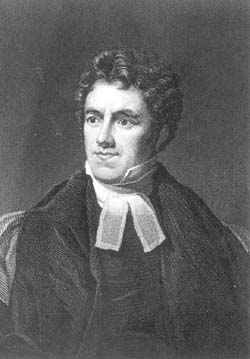 I now celebrate my new found knowledge by sticking up a picture of the famous Headmaster of Rugby, Matthew Arnold which I found in seconds, armed with my new superpowers. And of course with the browsing thing, it'll be easier for me to find this picture again if I need it again.
In order to learn things, it helps to have sympathetic souls hovering in the background making helpful suggestions. A common word for such people is: "teachers". These teachers watch what you are doing, and they say things like: "Do you mind if I suggest something? Tell me to stop if I'm interrupting, but maybe this would help? Please permit me to demonstrate. There. Like that. Please forgive the interruption. Ignore that if it is of no use to you."
You can't find the answer if you don't ask the question, and even then you may not be able to answer it.
And the trouble with computers is that you have so many questions and if you live the life I do, you spend it saying "I wish I'd remembered to ask X that thing about Y when I last met him." So do I now ring him up? It's just a tiny bit too much bother, the way it wouldn't be if he was right here all the time. That way, I could ask him as and when the question reasserted itself in my mind. (And that assumes I was aware of the question.)
This is a posting for my education blog, because it is about education, and why education alone isn't all that it is sometimes cracked up to be, not least by techno-enthusiasts like me, when I'm in a different and happier mood. But, because it is about the value of being in company, and therefore of the value of companies, run by people in direct face-to-face contact with each other for quite a lot of the time, it is also a posting which I will now go and refer to on Transport Blog. For this is one of the basic reasons why people travel to work, instead of just doing it at home. If you do it at home, you don't learn so much.
Don't get me wrong. I've learned a lot doing blogging, a lot more than I was learning before I started blogging. (The difference has been me writing things down rather than just reading them and writing the occasional set piece piece.) But I haven't learned as much about basic computing stuff as I would have if others had been hovering and offering suggestions and answering casual questions.
Busy day today and a busy weekend, so it's probably now a case of see you Monday.
The invaluable Dave Barry (whom I missed severely when he took his Christmas break) points the world to a site where you can learn about virtual knee surgery.
By slicing the "knee" bit off that address I found my way here. I don't get how livingchildren.com gets to be so particularly fascinated by knee surgery, but there you go. Americans, eh? What's the betting money was involved?
I haven't run the knee surgery thing. The photos were enough for me.
I recently acquired a copy of A Devil's Chaplain, which is a collection of essays by the geneticist, and scientific polemicist and populariser, Richard Dawkins. I particularly liked the one called The Joy of Living Dangerously, which is about F. W. Sanderson, who was the Headmaster of Oundle at the beginning of the last century.
Two bits I especially liked:
Sanderson’s hatred of any locked door which might stand between a boy and some worthwhile enthusiasm symbolised his whole attitude to education. Another anecdote. A certain boy was so keen on a project he was working on that he used to steal out of the dormitory at 2 am to read in the (unlocked, of course) library. The Headmaster caught him there, and roared his terrible wrath for this breach of discipline (he had a famous temper and one of his maxims was "Never punish except in anger").
Dawkins now quotes from an old boy of the Sanderson vintage:
The thunderstorm passed. "And what are you reading, my boy, at this hour?" I told him of the work that had taken possession of me, work for which the day time was all too full. Yes, yes, he understood that. He looked over the notes I had been taking and they set his mind going. He sat down beside me to read them. They dealt with the development of metallurgical processes, and he began to talk to me of discovery and the values of discovery, the incessant reaching out of men towards knowledge and power, the significance of this desire to know and make and what we in the school were doing in that process. We talked, he talked for nearly an hour in that still nocturnal room. It was one of the greatest, most formative hours in my life ... "Go back to bed, my boy. We must find some time for you in the day for this."
And I also like this, about how a similar spirit prevailed at Oundle even after Sanderson had died:
His spirit lived on at Oundle. His immediate successor, Kenneth Fisher was chairing a staff meeting when there was a timid knock on the door and a small boy came in: "Please, sir, there are Black Terns down by the river." "This can wait," said Fisher decisively to the assembled committee. He rose from the Chair, seized his binoculars from the door and cycled off in the company of the small ornithologist, and – one can’t help imagining – with the benign, ruddy-faced ghost of Sanderson beaming in their wake. Now that's education – and to hell with your league table statistics, your fact-stuffed syllabuses and your childhood-destroying, endless roster of exams.
Which reminds me, I must do a posting here some time about Mr Gradgrind. Dawkins' whole essay is a loud quarrel with Gradgrind's shade.
I ought not to be encouraging this. But he should. It's his job.
I just think it's funny.
I'm guessing, but I should imagine that this will have a huge effect, because the hunger of Chinese people to get educated far outstrips the traditional means available for them to contrive that. (Commenters, you are welcome to tell me I'm wrong.)
BEIJING, Feb. 10 (Xinhuanet) -- China has selected 151 academic courses as high-quality ones and put them online through the official website of the Ministry of Education (MOE), with a view to giving excellent education resources free to the public, a high-ranking official said here Tuesday.
Wu Qidi, vice-minister of education, said at a press conference that the 151 courses, selected out of nearly 500 courses, was the first step of a national project on improving higher education quality.
The MOE plans to promote 1,500 academic courses in five years and realize the sharing of education resources with the help of modern technologies.
She said the selected academic courses, all given by Chinese professors, were recommended by schools and local education administrations, and gradually approved online by specific jury committees organized by MOE.
According to Wu, China's national academic courses not only emphasize the subject itself, but also include construction of teaching material and teaching staff.
An MOE investigation showed that since 2001, the degree of Chinese students' satisfaction with teaching material and their teachers has increased by 22 percentage points.
Wow. Twenty two percentage points more satisfaction. Imagine that.
Seriously, do you get the feeling of hundreds of cats, solemnly and with due deliberation, being let out of hundreds of bags? I do. The Internet is, I believe, one of those revolutionary technologies which changes everything it touches, no matter how carefully it is supervised. This news report reminds me of things I've read about committees of Elizabethan bishops equivocating for months, and then finally allowing some book to be published.
I know it's a government initiative, but this has got to be a step in the right direction, for the British economy, and for education:
Thousands of children from the age of 14 are to be offered apprenticeships, allowing them to leave the classroom and learn a trade.
Ministers are to announce a new "junior apprenticeship" scheme next month under which 14 to 16-year-olds can spend two days a week at work, one day at college and two days in school. They will learn on the job from skilled workers such as plumbers, joiners, electricians and IT operators.
A briefing note by the Department for Education and Skills says that thousands of 14 and 15-year-olds will be given the opportunity to go out to work as part of the scheme.
The scheme is seen as part of an attempt to plug the skills gap in the United Kingdom that has left industry short of skilled workers. Employers say that one in ten employees are "incompetent". Ministers believe the scheme will also help combat truancy.
For once I agree with those "Ministers". Anything which widens the available options for bored teenagers yearning to be free has to be a good thing.
Which doesn't mean the government won't find a way to balls it up. But despite that obvious prejudice, I'm still glad that our rulers are thinking along these lines. After all, the lives of the kids who give this a try are already totally nationalised, so it's hard to see how this could make things any worse. I know, I know, they'll find a way. But I still say: good luck and I hope it works.
Some teachers, naturally, are worried.
The Internet is paying quite a bit of attention to Samuel Pepys (1633-1703), now that you can read his diary on line. So around now was a good time for a new Pepys biography, and Claire Tomalin's Samuel Pepys: The Unequalled Self has attracted further attention to Pepys. Today I bought it in paperback. Here (pp. 30-31) is one of the more striking passages concerning Pepys' schooling, which took place during the time of the English Civil War:
As a boy with a sense of his own worth, whose schooling so far had been meagre, he must have been avid for education; and serious teaching is what you got at a grammar school, all day long, from seven in the morning until five in the afternoon. Two hours were allowed for lunch in the middle of the day, time to walk to Brampton and back, although the Hinchingbrooke kitchens would have been handier. Huntingdon School had a reputation, made under its headmaster Thomas Beard, who had sent his best pupils on to Cambridge, Oliver Cromwell among them. Latin was the chief subject, and the master's job was to put Latin into the heads of the boys, so forcefully that they could think and write in Latin as easily as in English. Very little else was studied except for some Greek by those who did well with their Latin and a bit of basic Hebrew for the exceptional pupil. Mathematics was hardly mentioned, beyond learning the Roman numerals, which took precedence over the Arabic ones, and Pepys had to learn his multiplication tables when he was twenty-nine.Once past elementary grammar and vocabulary, Latin was taught largely by translating classical texts into English and then back into Latin, the object being to finish as close to the original as you could. It was common for boys to be punished if they failed to talk to one another in Latin, and parents occasionally complained of their sons forgetting how to read English. In any case they did not study English writers — no Chaucer, Bacon, Shakespeare, Jonson or Donne. They learnt instead to compose verses, essays and letters in Latin, and became familiar with a list of ancient authors that included Cicero, Virgil, Horace, Ovid, Terence, Juvenal and Livy. The aim was admirable for anyone who wanted to correspond with foreigners, since Latin was used by all educated Europeans; Milton was appointed 'Latin secretary' to Cromwell when he became lord protector, in order to compose diplomatic correspondence for him in that language. Pepys was a good scholar, able to read Latin for pleasure all his life; and that very skill may have helped to leave his English free and uncluttered for the Diary, the language of life as opposed to the elaborately constructed formulations of the classroom and study.
I guess that in all sorts of places around the world of now, there must be young people experiencing something similar, but this time it is English that is to them what Latin was to young Sam Pepys. English now being the official public language of large tracts of the world.
There is something more about Pepys' education here.
And why wouldn't it? It hurts most other things it touches.
From allafrica.com:
Free schooling has compromised the quality of education in primary schools, a new study says.Although the programme, introduced in January last year, has increased enrolment, the quality of teaching and learning has declined due to inadequate facilities.
According to an unpublished study by ActionAid (Kenya), many parents and teachers have complained about a serious decline in tuition due to class overcrowding and a lopsided teacher-pupil ratio.
The study, which sought to assess the impact of the free primary education on selected pastoralist communities, attributes the problems to the fact that it was hurriedly introduced to fulfil a pre-election pledge by Narc.
Funny how you always seem to end up getting what you pay for.
One of my favourite movie genres is American high school movies, and in recent years, one of my favourite examples of this genre has been Ten Things I Hate About You, starring Julia Stiles, concerning whom it would be inappropriate for me to rhapsodise too rhapsodically in a blog devoted to education by an occasional and would-be teacher, what with her being a schoolgirl in this particular movie.
But my question about this movie has long been: What is that beautiful building? Is it a real high school? I doubt it. I mean, it's just too beautiful. But if not, what is it?
Well, the Internet is a wonderful thing, and I do now know what this building is. I looked
here. Under "Other Info" is a category called "filming location". Click. Scroll down. "Stadium High School, Washington, USA – (Padua High School)." Click. Not helpful.
But now I know what I'm looking for and soon I get to things like this which has the best picture I have so far found of this extraordinary edifice.
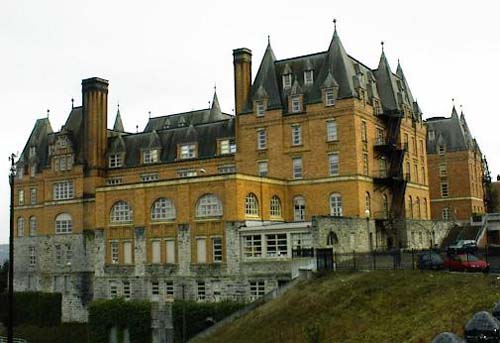
This site also contains an explanation of how such a splendid thing came to be a high school.
"The Brown Castle" is home to over 1700 students. Originally designed to be the Northern Pacific Railroad Tourist Hotel, construction began on the structure in 1891. The depression of 1893 caused the company to abandon work on the structure before it was completed. After being boarded up for a number of years it was acquired by the Tacoma School District. In 1906, Tacoma High School, as Stadium was then called, opened its doors to 878 students and 38 teachers. Renamed Stadium High School in 1913, the Brown Castle has been host to many historical figures, including Presidents Teddy Roosevelt, Woodrow Wilson and Warren Harding, presidential candidate William Jennings Bryan, World War I hero General John "Black Jack" Pershing and John Philip Sousa's band. The Brown Castle, a registered historical landmark, is a source of pride for the students, parents and staff of Stadium High School.
Presumably "being host" means they were guest speaking, yes? If so, not bad.
For my money, this building, despite even the presence of Julia Stiles, was the true star of Ten Things.
Interestingly, there are quite a lot of websites about Tacoma High, but none of them seem to make much – or indeed anything - of the fact that their building was in Ten Things. It's almost like it's a policy or something to pretend it never happened. Would this drum up business of a sort they don't want? Does Hollywood itself make it a condition of use that you don't brag endlessly about what their locations "really" were? Odd.
Anyway, it's a magnificent pile. I was not a bit surprised to learn that it was modelled on a French chateau, indeed I could tell that just by looking. It reminded me strongly of the (also French chateau modelled) Royal Holloway College, which is near where I was raised, in Englefield Green, Surrey.
RHC is even more splendid than Stadium High, but it isn't a school. What is the world's most architecturally splendid school, I wonder? Any suggestions?
Last week I was reminded that I possess a book called A History of Reading, by Alberto Manguel. I possess it but have not yet read it. Like many of the books I buy, this one was remaindered and thus obtained very cheaply, rather than something I deliberately went out to find, and when I got it home I put it on the pile of other such acquisitions and forgot about it. It was only some hazardous looking shelving that made me move it from A to B and while doing that to realise again that I own it. I flicked through it again, much as I must have done in the remainder shop, and it looks very promising.
Looking for something interesting to pass on to you people, and for myself to learn about, I naturally went to the chapter entitled "Learning to Read". In it, on page 71, I found the following delightfully tasty morsel of historical knowledge:
In every literate society, learning to read is something of an initiation, a ritualized passage out of a state of dependency and rudimentary communication. The child learning to read is admitted into the communal memory by way of books, and thereby becomes acquainted with a common past which he or she renews, to a greater or lesser degree, in every reading. In medieval Jewish society, for instance, the ritual of learning to read was explicitly celebrated. On the Feast of Shavuot, when Moses received the Torah from the hands of God, the boy about to be initiated was wrapped in a prayer shawl and taken by his father to the teacher. The teacher sat the boy on his lap and showed him a slate on which were written the Hebrew alphabet, a passage from the Scriptures and the words "May the Torah be your occupation." The teacher read out every word and the child repeated it. Then the slate was covered with honey and the child licked it, thereby bodily assimilating the holy words. Also, biblical verses were written on peeled hard-boiled eggs and on honey cakes, which the child would eat after reading the verses out loud to the teacher.
I used to be scornful of such primitive rituals. But being by nature a lazy person, I have learned a profound respect for the tricks we can all play on each others' – and on our own minds – to get us to remember things, and concentrate on things, and generally to apply ourselves to things. The mind thinks symbolically and metaphorically. So, devise a metaphor to get your point across to it. Leaders of armies know this. Priests most definitely know it. And so do good teachers, I suggest.
Some therapists also know it. Apparently, although I can't recall where I read this, if you are having a recurring nightmare, a way to diminish your chances of suffering from it in the future is to describe it as best you can on a bit of paper, perhaps with a verbal description, perhaps with a picture. Then, set fire to the picture and destroy it. Apparently the brain is, sometimes, satisfied with such subterfuges. Matter attended to, it says. Message received. Fine. On with other things. (And no more nightmares.)
If on the other hand, the image thrown at it is pleasurable and memorable, it makes that connection to, and keeps reminding you of it.
The message here is: reading tastes really nice.
Could this little scenario be part of the reason why Jews have tended, over the centuries, to be so well educated? I should definitely guess so.
Also, I think the above description might throw a little light on the question, which I found myself asking yesterday, of why the children in the picture I posted here yesterday (see immediately below) are all so beautifully dressed.
Michael Jennings did a posting about the surprisingly long history of colour photography, and I put a bit of it on Samizdata and asked about the very early Russian colour photos Michael mentioned. A commenter immediately referred us to the photographs of a certain Sergei Mikhailovich Prokudin-Gorskii.
I found one photograph with an educational theme. It's called Group of Jewish Children with a Teacher:
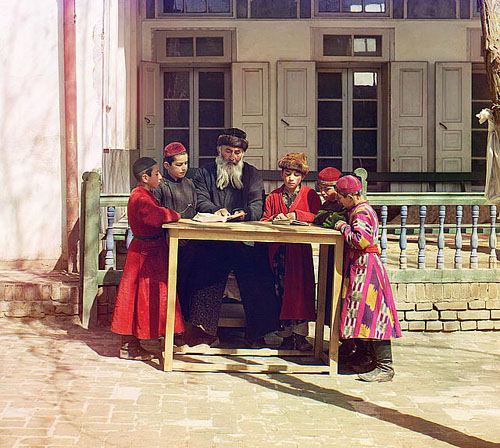
This photograph was taken in Samarkand in 1911.
Yesterday I got an email from Jackie D alerting me to the nonsense that Cecile Dubois is having to put up with at a her school for the crime of disagreeing with affirmative action, and I did a posting about it on Samizdata. Jackie has about this on her blog.
I'm not any sort of qualified or professional teacher, but surely encouraging or even tolerating mockery of an individual pupil by the rest of the class merely because of what that individual has said crosses some sort of line.
I agree with the Samizdata commenter who said that the teacher is not likely to change her opinions about affirmative action merely because of all this transatlantic hullabaloo, but that isn't the point. The point is that education is not just about learning things, but about learning how to learn things. And one of the ways you learn how to learn things is you learn how to argue about things. You do this by mustering factual evidence, by examining and criticising assumptions, by examining and criticising false deductions being made from these assumptions, and so on. You learn the truth about things by learning how to be reasonable about things. If you are a good teacher you do all this yourself, and thus set a good example to your pupils. As it was, Cecile was the one setting the example. I think this not because I happen to agree more with Cecile's opinion about affirmative action than with that of her teacher, but because Cecile seems to have been the one doing the rational arguing, while the teacher was using only ridicule and intellectual gang warfare.
Speaking of intellectual gang warfare I wish I hadn't called this teacher as a quote Grade A Bitch unquote. That was very unreasonable and impolite.
The comments at Jackie D's are particularly worth reading because they don't just blow off steam, the way I did at Samizdata, but also hint at what is going to be done about it all. Cecile and Cathy are "going over to the principal's house for a small party today …". I sincerely hope that all is settled reasonably satisfactorily and that Cathy is able to proceed with her studies at school without too much further grief.
As Jackie D says, Cecile impressed and charmed all of us who met her in London last December, and Cecile's various comments yesterday and today impressed me some more. Some fairly harsh things were said about the appearance of her blog, about the difficulty of reading it, and so forth and so on, by some other Samizdata commenters, things which under the cicumstances could have been phrased a whole lot more politely. This wasn't at all what I had in mind when I asked people to comment on Cecile's predicament in a way that was supportive and encouraging. I mean, you're in a fight with your teacher and they're calling you a racist, and then some guys on a faraway blog tell you that your blog needs a redesign and you need to get a grip on html and your text is all too jammed together, etc. etc.
That's the trouble with bad situations like this. Tempers rise (including mine I'm afraid), invective is exchanged, others perhaps feel that too much fuss is being made rather too fussily and fuss some more.
But now get this. Whatever Cecile may have thought about these impolite complaints about her blogging arrangements, all that she actually said in reply was: you're right guys, my blog could use some improvement along the lines you say.
Classy. Whatever seems to happen to Cecile, or to be said to her or about her, she just keeps right on learning.
On Samizdata I called her Cecile du Bois, following Jackie. I now suspect that the correct spelling may be Dubois, and will go with that from now on unless authoritatively instructed otherwise.
Meanwhile here is a picture of (L2R) Cathy S, Jackie D and Cecile D, which I took at the Samizdata blogger bash last December: