
This is why there should be a free market in education:
The council at the centre of a legal wrangle over the future of a community school wanted to "eradicate" small rural schools, a court heard today.Parents from Hermon school in Pembrokeshire, west Wales, are fighting plans to close it, and have taken their case to the High Court.
Pembrokeshire Council wants the 53 pupils and those from nearby Blaenffos transferred to a £1.5 million school at a third village, Crymych.
In his closing submission in the case, Nicholas Bowen, representing the parents, said the council had "a determination that big is beautiful and small needs to be eradicated".
He added: "What they have left out of the account is the real compelling evidence that things are extremely successful from a parental point of view and from an education point of view in this happy community school.
"There has been no proper consideration of all the arguments put as to why the status quo should be supported.”
He said part of the council’s case relied on planning guidelines which meant the centre of the community was regarded as being in Crymych.
He said: "They have devalued the importance of the community and the importance of the asset, by reference to planning guidelines which have absolutely no proper place in a decision like this."
He said the guidelines were "mumbo-jumbo".
Yesterday Rhodri Williams, for the council, told the court the council had no blanket policy to close small schools, and that the new school at Crymych was just 1.8 miles from Hermon.
The phrase "… just 1.8 miles" says it all.
If there were a completely free market in education, there would surely be someone willing to run a local school in this particular locaity, for all those for whom localness is what matters most.
I recall my mum getting involved in a long drawn out national dispute about small hospitals, which the Powers That Be were then busily closing, but are now busy rebuilding under a different name ("health centres" etc.). The same error was embodied in that decision, which is to measure only some numbers, and to make those numbers better by building bigger, while forgetting other things that are not measured, like miles travelled by the poor bloody punters to get to the new mega-places. (This is especially bad if the poor bloody punters are sick or injured.)
Capitalists often make mistakes of this sort, but when they do, their customers start screaming, desert in droves, take their business elsewhere, and – one way or another – the bad decision is reversed. Often at great expense, but reversed. It's all very public and it makes the private sector look bad because of its best feature, which is that, messily, it does correct the worst of its mistakes. And it is this all too imperfect arrangement that the politicians have finally learned that that they must somehow recreate. Mostly, they try to fake it. That is a start. But one day, I hope we have it for real.
The public sector just steamrollers forward, and uses its own cock-ups as reasons for being given yet more money to waste.
My good friend Adriana is sending me a lot of useful links at the moment, to all manner of interesting blogs and blog postings I would otherwise not have noticed.
Here's another, from Canadian Robert Paterson, who lives in Prince Edward Island, to the north of Nova Scotia.
He's writing about the "one room schools" that used to abound, in that part of the world and in a lot of other places, but no longer:
None of these schools had more than 50 students. Most had closer to 30. They had a wide range of ages and abilities. In practice, the teacher acted as a learning facilitator. Much of the teaching was done by the older students who helped the younger ones. So while the teacher was an authority figure, she was not the sole talker. Most of the teaching was in the form of a series of conversations between the students themselves. She did not claim to know everything either and called on the wider resources and knowledge in the community to help if needed or pointed the child to the library.School was integrated into the full life of the community. All the students lived in their community and walked to school. The teacher lived in the community. Marion Reid had retired from teaching when she started her family. A group of parents came to her house one day and made her a deal – they would bay sit her younger children if she would return to teaching their children.
School was augmented by work and life in the community. Children were not excluded from work or their full responsibility for the community in which they lived. All the children had work to do at home or on the farm and learned a great deal of practical things about how the world worked from all the other adults in the community. They were not apart from the work of their families or the community. While there were always naughty kids – they were naughty in the context of a community that had their eye upon them and where the consequences of doing the wrong thing were immediate and powerful.
Very clever kids found that the community got behind them in their efforts to do well - this is part of the story of Anne and Gilbert of Green Gables.But you say – this was not a very effective school. That is why we needed to consolidate. The kids need the physical resources that come with scale. Not effective?
The kids were fully engaged in their learning and in their full community. Literacy was very high. Now nearly 40% of Islanders cannot read effectively. Next time you watch Ken Burns' film on the US Civil War, think of the literacy of the private soldiers whose letters are featured. I am sure there was bullying of a sort at times but not what we see so often today. It is inconceivable that a community would suffer the mindless vandalism that we see so often today. By walking to school and by participating in the work of the community, kids were in much better shape than today.
This may be a somewhat utopian and rose-tinted view of the past. That's what some of Paterson's commenters argue anyway. But as a possible vision for the future, I think this has real merit. After all, by the nature of the idea, it needn't be attempted on a huge scale. And how could it be worse than what is happening now?
We have isolated our children from a social environment where learning happens as a result of conversation. We have isolated them from those other children who are both younger and older than them. We have isolated them socially from their families and from their communities. We have isolated them from the work of their households and their communities. We have isolated them from adult life. We have isolated them from their bodies. And this is better?
Paterson makes a particular point of the fact that pupils didn't only learn from the one teacher who ran places like these. They were encouraged to study in libraries and to learn from one another. So …
Could we not experiment with a few new/old one room schools again. Imagine what they could be like …
And then comes the inevitable rider, with which I entirely agree:
… especially in an internet world.
A few places like this would be well worth a try.
 I have already linked from elsewhere to this piece by Bunny Smedley, about the National Gallery exhibition Making Faces. On the right: one of the faces they are selling the exhibition with.
Here's how Bunny's piece starts:
I have recently taken to reading lots of books about birth and early childhood development – well, it makes a change from worrying about whether painting's dead, doesn't it? Thus it is that I have learned more over the past month or so than I ever wished to know about the way in which people respond to each other's faces.A newborn baby, apparently, has an absolutely innate interest in the human face – not only his mother's face, either, although within days he can recognise this, but in all human faces. The part of his brain responsible for this achievement develops early, long before birth. Stranger still, within the first week or two he is drawn not only to actual human faces, but to man-made images of the human face, with black-and-white, full-face line-drawings being the preferred media. This fascination is not, however, you may be pleased to learn, primarily aesthetic in motivation. Babies, it turns out, are also amazingly adept both at 'reading' emotion – affection, anger, boredom, amusement – in other people's faces, and at mirroring what they find there. It's part of the way in which we learn to relate to each other – to function socially thorough the course of our lives. One can think of all sorts of reasons why the development of these abilities should have been smart moves in evolutionary terms. That, however, need not detain us. The point is simply that curiosity about our fellow creatures' faces is entirely natural, instinctive and universal. There is, put starkly, nothing we'd rather see, and nothing we are better at seeing.
All of which meshes nicely with the compulsion so many of us feel to take a look at the face of all brand new babies that cross our paths. That way, babies get a glimpse of lots of different faces.
Brand new members of other species are very easily fooled into responding to faked up versions of the signals which excite them. A red blob on a bit of paper, for example, has the same effect as the red blob on mum's beak. That kind of thing. Presumably someone has tried to discover what signals are sufficient to trigger the face response in new humans. Is a real human face needed, or will a badly drawn face on a bit of cardboard suffice? A lot hinges on this, I feel. If humans need "real" face to face contact to get them stirred up, then the educational consequences will be profoundly different to if they will get stirred up by a mere fake face on a screen. Anyone know the answer to that, or where to look for an answer? Maybe new babies can be fooled like this but older ones can't. Don't know, but would very much like to.
Television and children's books would suggest that it doesn't take much to make a child see a face.
It's been all over the front pages for days, and finally I have a comment to offer that goes beyond saying: how appalling.
THE mother of murdered schoolboy Luke Walmsley yesterday branded his killer an "evil bully".Heartbroken Jayne Walmsley spoke out after Alan Pennell, 16, was sentenced to at least 12 years in jail for killing her 14-year-old son.
Judge Mr Justice Goldring told him he could serve longer if he didn't show remorse.
He said: "In your pocket was a flick knife. I have seen it and it is an evil weapon. You thrust the knife into his chest.
"It was not done in the spur of the moment."Although giving evidence you expressed remorse ... I find it difficult to accept."
Mrs Walmsley, 41, said she didn't blame staff at Birkbeck School in North Somercotes, Lincs, for her son's death on November 4 last year.
She said: "He was just an evil boy who was a bully. It was always younger children he picked on. I don't think the school has enough power to get rid of these people."
I generally dislike the modern tabloid habit of deferring to and publicising the legislative opinions of the bereaved, and of crafting new laws in honour of their loved ones, instead of tombstones. But what if Mrs Walmsley's a change in the law to allow schools to expel dangerous bullies more easily than they can now were to be her chosen memorial for her dead son? I just might change my mind about this practice.
Given how notoriously susceptible to peer group pressure children are, could the fashion of burning down your school if you don't like it perhaps be about to spread like … wildfire?
Two more arson stories, to add to these, from Quebec and from Kenya.
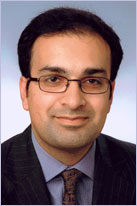 This article by an aspiring Conservative politician Ali Miraj about an unruly visit to a South London school is worth a read. The kids are out of control, but they aren't evil.
His recommendation is that teachers and schools should be, you know, better. Great idea. But the banality of his prescription shouldn't deflect attention from the excellence of his description of how things now are.
The complete lack of discipline was overwhelming and disturbing. My thought - somewhat predictably - was that this would never have happened in my day. It would have led straight to detention. But my day was only 11 years ago. Had things really got this bad in schools?We have all heard the stories about deteriorating classroom behaviour, but it is very different experiencing it at first hand. What these children needed was a firm, metaphorical kick up the backside. They had no respect for authority. It was only when the head of year entered the room and threatened the troublesome children with exclusion that a momentary hush descended.
Then it got worse. A near riot broke out in the neighbouring classroom where my colleague was talking about the attractions of medicine as a career. Half my class promptly jumped up and ran next door to play their part in the fracas. Those remaining looked at me apologetically. "Carry on, sir," said one of them, reassuringly.
He made some headway, however, and satisfied himself that although lacking in respect for authority, these kids were not stupid. Like he says, schools ought to be … better.
If small schools tend to be better schools than big schools, then to allow and encourage small schools to get bigger because they're good is to allow and encourage them to get worse. That's the point made at the top of this article. Interesting.
Strange. You would have thought that what with the emphasis on learning through play in the last few decades of educational theory, parents would now at least know how to play with their children. Yet it seems that parents are now having to be taught how to do this.
My thanks to Arts & Letters Daily for picking up on this article from my local evening paper about dyspraxia, which is partly a reason but academic failure, but mostly an excuse for bad teaching.
Here are the key paragraphs of this particular story, about a boy thus branded, and about the expensive tutoring his parents subsequently set about rescuing him with:
So began 18 months of after-school sessions with puzzles and videos, complemented by special teaching from two other psychologists to teach reading. In addition, most evenings a tutor came to the house to help my son with his homework - the cost was phenomenal. By the end of the second year, the situation was probably worse. He was in the bottom set at school and scored miserable marks in exams. He was below the border line to pass the common entrance. Then came enlightenment."Your son," announced one educational psychologist suddenly, "is not dyspraxic." "What?" I exclaimed. "He just hasn't been taught maths," she continued. "It has undermined his self-confidence to learn everything else at school." The revelation was astounding. She recommended a maths tutor.
"Most of my work," the maths tutor told me "is with pupils from your son's school. They can't teach maths." Neither could he.Desperate, I was told about a maths tutor who it was said could perform miracles, at £90 per hour. To save my son, there was no choice.
"No one has taught him maths," announced the miracle worker, "and he's got no self-confidence." Teachers at the school, he discovered, regularly humiliated my son because of his poor results. "Can you do anything?" I pleaded. "Oh, yes," he said. It was October. The exams were in June.
Over the following eight months I witnessed the most astonishing transformation. A cowed child became a confident student. Understanding maths transformed his mastery of every other subject. His common entrance mark in maths was 83 per cent and he achieved five A grades (over 75 per cent) with the rest Bs (over 65 per cent).
When I cautiously raised with one or two other parents the rather sensitive subject of poor teaching in the school, I was amazed by the response. Oh didn't you know, 75 per cent of the boys doing Common Entrance have private tuition at home? Nobody had declared their hand until after the exams. And when I told my story to an old friend, Anne Alvarez, a well known child psychologist, she told me: "Dyspraxia and other labels put on children are often too loosely used. Many diagnostic labels are used as wastebaskets."
Our son's headmaster recently announced the appointment of a new maths teacher. We later learned that this new teacher had not even passed A-level maths.
The writer of this article implies that the misuse of the word "dyspraxia" is more common in the private sector. But my guess would be that this is merely because in the private sector they at least have to provide some kind of reason for academic failure, or failing that, they have to contrive a plausible excuse. In many a state school, I should guess, failure of this sort could simply be allowed to run its course unchallenged.
Nothing much to say myself today, but I recomment this article by Tavleen Singh, about "Indianising" Indian education. The final paragraph, in particular, told me things I didn't know:
When I last wrote about education in this column, the former Maharajah of Dhrangadhra sent me a copy of a speech made by Lord Curzon at Rajkot’s Rajkumar College on November 5, 1900. In his speech, Curzon urges the Indian princes he is addressing to be Indian. ‘‘Though educated in a Western curriculum, they should still remain Indians, true to their own beliefs, their own traditions, and their own people.’’ How sad that a British Viceroy could see a hundred years ago what our HRD ministers cannot see even now.
At present there seems to be a kind of thesis, antithesis thing going on between teaching in Hindu and teaching in English, teaching East and Teaching West. Singh is, the way she tells it, trying to find the synthesis. Or it could be that she is just an Easterner but a bit cleverer than some of the others. Either way, interesting.
Here's a headline writer who could maybe use a bit of "speacial" (naybe later it will be corrected) education. But then again, I spelt Jacqueline du Pré as Jacqueline "de" Pré yesterday, twice, and only corrected it this morning.
Is correct and standardised spelling something that was born with the printing press and is now dying with the printing press? You can correct it later, so you are less inclined to obsess about getting it right to start with. I fear so.
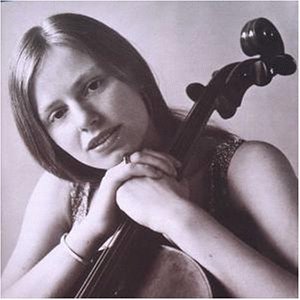 With each edition of Gramophone there comes a free cover CD, usually of classical music excerpts. However, the latest issue's CD also includes a snippet of the late great classical cellist, Jacqueline du Pré, talking about her earliest experience of the cello.
Well, I heard it on the radio when I was very small, when I was four. And, although I don't remember the sound at all, I liked it so much, apparently, that I asked my mother to give me the thing that made that sound. And she did. She gave me a big, big cello, which I learned to play. But she'll be able to tell you more accurately about that.
She was marvellous, because she has a great talent for teaching small children, and she started off by writing little tunes for me when I could hardly play the thing at all, and she added words to these tunes, and on the opposite side of the page she drew beautiful pictures illustrating the tunes. And she used to do these while I was asleep, and I could hardly wait until the morning came, because in the morning I'd wake up and find this beautiful thing waiting for me. And then we'd rush down and play it together. And that really made me very excited about the cello.
I've been linking to quite a lot of American material from here lately, and here's another link to something else American, in the form of a piece by Steven Yates called How I Survived Government Schools.
But although American, it sounds extremely like the government schools here in Britain:
I also do not question that there are teachers out there who care about children and are sincere, serious, and dedicated to their craft. But they are also caught up in schemes like "classroom management" (the euphemism for teachers as social directors, controlling unruly children in today’s politically correct environment of hypersensitivity) and teaching to standardized tests. Many suffer from high levels of stress, and some eventually leave the profession out of frustration. There are too many agendas in government schools not under the control of teachers, or even of principals and local districts. They result from directives coming from Rome on the Potomac, often with huge sums of money as a reward for compliance. In most states, districts either follow the new federal guidelines or they lose federal dollars. Teachers either teach to the test or their recertification is refused! The current buzzword: accountability.In sum, whatever anti-Christian bias exists in government schools is not their only problem. From the start, I perceived an anti-education bias, in the sense of education as what the philosopher Alfred North Whitehead called an adventure in ideas. In this conception, a primary purpose of education is to produce informed, intellectually curious and vigilant citizens for a free economy and a free society. That School-to-Work, Workforce Investment, No Child Left Behind, and other unconstitutional federal programs do not have this as their primary purpose, you can rest assured!
You do not need a resolution by some religious body to remove your children from government schools. You don't even need to be a Christian. You only need a strong sense that your child's mind might be at stake.
For Rome on the Potomac read, I don't know … Babylon on Thames?
Here is a reminder that sometimes "education" isn't quite as nice as it sounds:
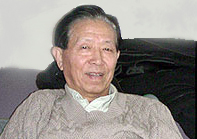
The Chinese military surgeon who exposed the government's cover-up of the Sars crisis was released yesterday after seven weeks of "political re-education", his family said.Jiang Yanyong, 72, a semi-retired general in the People's Liberation Army, had been detained at a secret location where he was forced to undergo daily study sessions aimed to make him renounce a critical letter he had written about the 1989 Tiananmen Square massacre.
I wonder exactly what lesson this man chose to learn from this dose of education, although maybe "detention" would be a better word for what he endured.
The lesson they were trying to teach him was don't make trouble.
A lot of the educational news concerning China is now quite good. This story is a salutary reminder that not all of it is.
Continuous assessment has long been regarded as potentially very inaccurate assessment, since cheating in such testing regimes, by teachers as well as pupils, is so hard to prevent. This is why carefully supervised exams in closed session, with no cribs allowed, were invented.
Here is another reason for such examinations: parents who help their progeny get into university, and who then continue to help them once they are there.
This leads, says Frank Furedi, to the "infantilisation of the university student".
 Micklethwait's Law of Tsardom states that when they appoint a Something Tsar, it means they've given up hope completely of ever solving the problem of Something. See also this Samizdata posting, in which I spell it Czar, which could be a mistake.
There is something especially absurd about the idea of a Bullying Tsar. This is reminiscent of Lenin's classic solution to the problem of bureaucracy in early revolutionary Russia: he appointed a committee to look into it.
Gratuitous Tsar picture on the right there.
Actually, birds of prey attacking bullies might be quite a good idea …
Seriously, I believe that if there can ever be said to be a root cause of bullying, that route cause is the lack of freedom of association. Bullying happens because it can, because the bullyee cannot escape. If bullies just found themselves surrounded by a big blank space instead of other people to torment, they'd stop, because they'd have no choice. Meanwhile, it would help a lot if schools were allowed to simply chuck out persistent bullies, which is the other way freedom of association expresses itself.
This is all part of why the home education option is so important, and why school choice, for children as well as for parents, is so important. And there need to be lots of schools to choose between, otherwise it's not enough of a choice. That means smaller schools as part of the mix.
I doubt if these Bullying Tsars will be suggesting anything along those lines.
I have been blogging elsewhere today (having finally done a Samizdata review of the Bill Bryson book I've been going on about here and there) and will be partying later, so just quick posting, in the form of an observation from Michael Jennings, with whom I took afternoon coffee last Friday.
He said, appropos this idea of blogging as self education, that it has been applying recently to him. He has found himself becoming one of those people who puts together bespoke computers for people, and he's been doing occasional postings about this kind of thing. Mostly, he say, he does this for his own benefit, to arrange his own thoughts. If others want to read it, fine, and if they want to attach helpful comments, that's helpful. But his main purpose is as an aid to his own thought processes.
Much of what I stick up here is done in a similar spirit. And I'm sure that other bloggers do the same.
However, the fact that others might be interested too does make a difference to how well you do this sort of thing, which of course means that blogging may (for show-offs) be a far better aid to self-education than mere note taking. If others are going to see what you put, you make more of an effort. And those helpful comments can be very helpful indeed.
There are two kinds of things in the world. There are the things that catch on because of one vitally brilliant thing that they do which nothing else can do. And then there are the things that catch on because … well, nobody quite knows why. They don't seem to be doing any one thing supremely well which has never been done before, yet still they spread like an ultra-popular pop song. It's because they bundle together lots of solutions, I think. Blogs do this. Blogs do that. And they do this, and that. And that. Which means lots of people start them, and like them, and read other blogs, which means they do that thing even better than you at first might have thought,… blah blah blah. Blogging as self-education is just one of the ingredients in this complicated mix.
And that's all here for today. Have a nice rest of it.
Interesting BBC report about people queueing up to become plumbers. They were inundated not to say flooded with applicants, ho ho I think the last paragraph is the best:
Earlier this year Birmingham University biologist Karl Gensberg left academic life to retrain as a gas fitter, saying he hoped to double his £23,000 annual salary.
Gratuitous picture of my stupid doesn't-work shower:

How long before they start having university plumbing degrees (feminist perspectives on piping, U-bends – a structuralist analysis, plumbing theory, blah blah), which teach you nothing about how to actually plumb, but which you have to have before they let you start doing it and learning it? This will be announced as the solution to the British plumbing problem, but it will just make it ten times worse.
Last night I watched School of Rock, which is now out on DVD.
It's a strange movie. I can't decide whether it has a lot to say about education or nothing at all, whether it tunes in to significant new trends or is pure fairy tale, proving nothing and illustrating nothing, other than the fact that people like to be entertained. On the whole, I would say, the latter.
So, given that I'm somewhat confused about what, if anything, it signifies, I'll retreat to describing what happens. There should probably be a SPOILER warning here. I may well be about to tell you the entire plot. If you don't want to read this, probably best to stop now. But on the other hand, would you really be amazed to learn that the teacher at the centre of this movie, played by Jack Black, is keen on rock and roll, that he infects his pupils with his enthusiasm, that they do a performance of some rock and roll which goes very well, and that this process is at first opposed by surrounding adults, but that said adults end up being won over? Did you expect the movie to end in a mass execution, or to be about a bunch of hard core juvenile rock and rollers who turn against rock and roll and switch to Indian Classical? Or to be about geology?
The fairy tale aspect of the movie is that a bunch of ten year olds prove so quickly to be expert rockers, after only the most rudimentary guidance from Teacher Jack. There is an expert guitarist in the class, an expert drummer, some expert backing singer girls, an expert keyboard player. Weird. It's almost as if they weren't a regular class of children at all, but rather a bunch of child actor/musicians who were chosen from among thousands of auditioners for their ultra-winning personalities and musical and drama excellence.
Which they were, of course, and that's the clue. This movie is at least as much an adult fantasy of juvenile efficacy and biddableness as it is a tale of juvenile assertion. These kids are not real kids – and certainly not typical kids – so much as adult fantasies of what kids ought to be like.
Which makes the placing of rock and roll at the centre of things so strange. The Jack Black character constantly insists that rock and roll is all about getting angry with authority, challenging those in power, screaming back at "the Man", blah blah. Well, maybe. But if so, what kind of rock and roll rebels, when told to do rock and rock, answer by saying Yessir!! and doing it, exactly as Mr Black wants?
At the start of the movie, the children first confronted by Jack Black's bogus substitute teacher are unwelcome to him only in the sense that they are excessively obedient. They all sit in quiet and obedient rows and demand homework and credits and proper teaching. They start out, in other words, as one adult fantasy of how children should be.
And they are then transformed by Jack Black into another such fantasy. The one where the kids all decide that they share their parents' tastes in pop music.
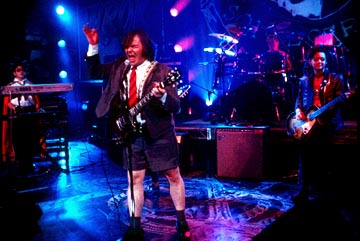 Jack Black appoints himself the lead singer of his juvenile rock and roll group, and in the final rock and roll show, he continues to be the lead singer. If that isn't Embarrassing Dad living out his schoolboy fantasies, I don't know what is.
Rock and roll used to turn schools upside down. Now it is just another school subject. I can remember how at my school all those years ago, there used to be something called the school "Dance Band", which was a dutiful and very pale imitation of the Glen Miller orchestra (which was itself something of a pale imitation of original twenties swing). That wasn't juvenile rebellion either. It was the final domestication of swing music.
It's tempting, so I'll do it, to say that this movie embodies the central self-contradiction of current adult views about education in particular and the life of children in general. Children should be completely free to do … exactly what we want them to do. They should be allowed to respond at an emotional level … with our emotions. They should be free to dream and to live out … our dreams. And then they should get great jobs as financial analysts and have two point four kids of their own.
Ten years olds are indeed extraordinarily willing to get excited about what their parents are excited about. But the stuff they eventually get seriously stuck into is the stuff they choose for themselves.
Meanwhile, further proof that this is as much a movie about adult fantasies as about childhood fun is that there is a rather sweet romantic subplot bubbling along inside this movie, centred on the lady head of the school, played by Joan Cusack. She becomes fond of Jack Black despite and then because of his rock and rollness. She, it emerges, is an ex rock and roll fan, a Stevie Nicks mimic, a former rock chick. But, faced with the demands of her school's parents, she has mutated into the Bitch Head Mistress from Hell who terrifies all of her pupils into sitting in those obedient rows and demanding home work and teaching. Sadly, however, just when Our Jack was about to take off her glasses and say "why you're beautiful" to her, the movie ends, with the triumphant rock and roll performance by Jack Black and the Kids From Fame, sorry, by Jack Black and his class of randomly assembled children.
This movie was written with Jack Black in mind and he holds it all together energetically, daring you not to enjoy it, demanding that you play along with all its absurdities and implausibilities. I did quite enjoy it, more than I feared, less than I hoped.
I see that in my earlier posting about this movie, written long before I'd seen it, I see that I said this:
… Most of the reviews say that it is good old-fashioned frothy Hollywood comedy with its heart in the right place and saved from schmaltz by being well and winningly performed.
That's about right. But this …
And when I do see School of Rock I will seek out the serious educational ideas that are sure to be contained in it, and report back to you all.
… didn't work out so well. Oh well. It makes a change from this kind of thing.
I believe strongly in the power of the short but eloquent speech that hits the bullseye and changes your whole life from then on. Good teaching can consist of steady drip drip drip improving influence. But it can also come in single eruptions of revelation.
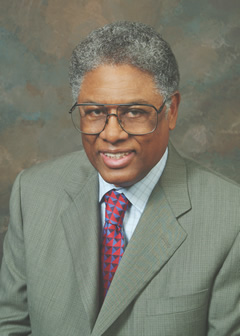 Here's the kind of thing I mean. This is Thomas Sowell (pictured on the right) writing about the value of criticism, in connection with Bill Cosby's recent criticisms of black ghetto foolishness:
Criticism is part of the price of progress. Economics professor Walter Williams has said that a turning point in his education - and his life - came when a schoolteacher in the Philadelphia ghetto chewed him out for wasting his abilities on adolescent nonsense. …My own moment of truth came when a roommate at Harvard said to me one day: "Tom, when are you going to stop goofing off and get some work done?"
Goofing off! I didn't know what he was talking about. I thought I was working hard. But, when the midterm grades came out - two D's and two F's in my four courses - it became painfully clear that I was not working hard enough. I was going to have to shape up or ship out - and I didn't have anywhere to ship out to.
I've heard that Sowell is a "difficult" man, tough, demanding, tricky to handle, etc. If that's true, then this could be why. One of the formative experiences of his life was when someone else was difficult with him, and demanded more from him.
More count your blessings stuff, from Africa. Nigeria, to be exact.
The hydra-headed problem of examination malpracticeis presently growing at an alarming rate and posing a serious threat to the nation's entire educational system, according to investigation by our reporter who penetrated the world of the racketeers.
And Our Reporter (no name given) ploughs into the story with gusto. Assuming, this is, that he didn't cheat himself, and invent the whole story.
At the end of the examination, a yellow coated invigilator who collected our reporter's answer script wondered why he could not shade all the answers into the script despite the fact that prepared answers were passed to him.Said he: "All these questions were solved for you and yet you couldn't finish copying and shading them in your answer sheet." Our reporter had complained to the invigilator who had just collected his answer script that he had not finished shading the answers which were suppled to him by the pot-bellied man.
The pot-bellied man had directed that our reporter should pass over a copy of any prepared answers given to him to a girl who sat on his right at a cramped desk. Our reporter struck the right chord with the girl when he identified himself as a candidate from the Ogba-based tutorial centre -- where she too had registered as a special candidate for the examination. The hall was rowdy.Other candidates who hadn't finished shading their answers into answer sheets for objective questions had withdrawn to seats at the back of the hall, to evade the invigilator who was collecting answer sheets. Just before the Chief Invigilator at the centre had said "pens up" several candidates had freely moved about the hall and consulted with one another. At the beginning of the examination, the candidates were restrained in their behaviour and hid the prepared answers that had been passed on to them from outside. But later they threw caution to the wind.
The girl who sat behind our reporter had collected prepared answers for various subjects which were given to him by the pot-bellied man. These included prepared answers for English Language, Economics and Christian Religious Knowledge (CRK).
And so on. Here's how the piece ends:
Lamenting the situation, Onyechere said that teachers who have been identified for their involvement in examination malpractice are left to go scot free."Some of these teachers who have been identified as facilitators of examination malpractice are still teaching even though they have been reported to examination bodies," he said.
The examination ethics campaigner observed that some schools that have been identified and de-recognised because they are centres of examination malpractice are still used as examination centres. He stated that the entire Nigerian society is under threat so long as the present trend which throws up those lacking in merit to possess academic and professional qualifications they do not deserve.
" Those who engage in examination malpractice to pass school certificate and UME examination pose great danger to the nation today," he said.
He maintained that such persons are likely to continue cheating all their lives and therefore end up as incompetent people in their chosen fields adding that examination malpractice is the root of corruption in Nigeria today.
"Imagine what awaits us when people like this become our medical doctors, engineers, pharmacists and professionals in other fields?" he asked.
It's long been my understanding of matters in Nigeria that this process is already there to be observed.
What seems to be happening here is a huge mismatch between two utterly incompatible cultures, one dead set on solid and long-term individual professional achievement, based on a vast, icily incorruptible apparatus of individual measurement, and the other dedicated to immediate pleasure and immediate profit and team spirit among all those cooperating to melt the ice. The examiners and the examined happily connect in contented little conspiracies, more or less open, and only a puritanical fool goes against the flow.
My eldest brother worked in Nigerian for a while, about twenty years ago. He told me that everything there, everything, was for sale. "Dash", this was called. You provided dash, and you could have whatever you wanted. That would certainly have included exam results. Everyone involved got a slice of the action, and a role in whatever charade was required.
So, things in Nigeria are as they always were, only more so.
The man who paints The Big Picture notes the strange fact that the USA consumes, so to speak, so many more educated (alpha-)people than it can produce, and that this is a big source of US strategic power, and always has been. And he links back to an earlier posting of his, where he asked:
"Will the United States' draconian response to the terrorist threat cause a fundamental shift in the international movement of researchers and perhaps even alter the global balance of scientific power?"
I would suppose that the answer is: yes, a bit. Interesting thought. And whether counter-terrorism is hurting or not, the question of why the USA does the exploitation of educated people so much better than education itself is very interesting.
I got to this from here and to there, inevitably, from here.
I have just been listening to , bought for £2 in the Lower Marsh market. It's Annie Get Your Gun, Broadway revival 1999. For some reason the front cover of this CD wouldn't load properly here, so I've scrubbed it from here (where I originally tried to put it). It evidently didn't like my Gratuitous Picture policy.
Track number two features Bernadette Peters (long a favourite of mine – does this make me gay I wonder?) as Annie Oakley, plus supporting females, offering this reflection on the limits of education:
Folks are dumb where I come from,
They ain't had any learning.
Still they're happy as can be
Doin' what comes naturally (doin' what comes naturally).
Folks like us could never fuss
With schools and books and learning.
Still we've gone from A to Z,
Doin' what comes naturally (doin' what comes naturally)
You don't have to know how to read or write
When you're out with a feller in the pale moonlight.
You don't have to look in a book to find out
What he thinks of the moon and what is on his mind.
That comes naturally (that comes naturally).
My uncle out in Texas can't even write his name.
He signs his checks with "x's"
But they cash them just the same.
If you saw my pa and ma,
You'd know they had no learning,
Still they've raised a family
Doin' what comes naturally (doin' what comes naturally).
Cousin Jack has never read an almanac on drinking
Still he's always on the spree
Doin' what comes naturally (doin' what comes naturally).
Sister Sal who's musical has never had a lesson,
Still she's learned to sing off-key
Doin' what comes naturally (doin' what comes naturally).
You don't have to go a private school
Not to pick up a penny near a stubborn mule,
You don't have to have a professor's dome
Not to go for the honey when the bee's not home.
That comes naturally (that comes naturally).
My tiny baby brother, who's never read a book,
Knows one sex from the other,
All he had to do was look,
Grandpa Bill is on the hill
With someone he just married.
There he is at ninety-three,
Doin' what comes naturally (doin' what comes naturally).
Makes you kinda' wonder what Annie Oakley would have made of Sex Education, don't it?
One of my duties now (for which I am actually paid!) is to write a short weekly piece for this blog.
I've already aired the subject of intellectual property on my Culture Blog. But here is an article on an educational theme which is also about an intellectual property matter. Someone stole Kim Lanegran's PhD dissertation.
Last summer I discovered that he had defended his dissertation three years after I defended mine. I requested a copy of it through interlibrary loan. As soon as the dissertation was in my hands, I flipped first to the bibliography to see which of my works he had cited. Yes, I'm vain."Humph. He didn't cite my dissertation," I thought. I flipped to the table of contents. "Wow, he asked the same questions I did." I read the abstract. "Damn. Those are my words."
My heart pounded. This was my dissertation!
In the acknowledgement, he thanked his beloved for her patience during the years it took him to write it. Write it? He didn't even have to type it; I sent it to him on disk.
He copied many of my chapters word for word. Other chapters were slightly altered so as to make the arguments totally fraudulent. I did research in three African towns; Mr. X said he had studied two other towns. So where I quoted statements by an activist or scholar from town A, he changed the names and said that they were speaking about town Z.
It was equivalent to taking a quotation from Garrison Keillor about life in Minnesota and saying that Woody Allen said it about New York City.
Lanegran righted this wrong, and ended the academic career of the plagiarist, but she was deeply depressed by it all:
While gathering evidence to prove that my dissertation was actually mine, I confronted many dark thoughts about this profession. Mr. X must have thought that he would get away with his theft because nobody reads dissertations. Was he correct? Was all that work simply a hoop to jump through to get the Ph.D.? What is the value of a doctoral degree if dissertation committees take as little care with their students as Mr. X's did with him?His adviser is a prominent scholar I've met at conferences. Although he is not an expert in the country or social movement covered in my dissertation, shouldn't he have known Mr. X's ideas and writing style well enough to recognize that the submitted dissertation did not sound like Mr. X's work? Shouldn't the committee have expected to see the process of Mr. X's arguments evolving or read drafts of chapters? At the very least, shouldn't the committee have told Mr. X to update my literature review and rework some of my convoluted logic and awkward prose?
Is cheating so pervasive that even someone who seeks a career in academe will violate the fundamental principle of giving other scholars credit for their work? If so, what hope do I have of inculcating that principle in students eager to escape quickly with their B.A. in hand?
When people talk about the "expansion of higher education", they need to understand that this is the kind of thing they are talking about, as well as the better things that they obviously also have in mind.
The intellectual property issue here is not just that Kim Lanegran's property rights (if that is what they were) were violated, but that the employers of the plagiarist had been defrauded. He presented himself to them as the writer of something which he had not written.
And since this is all about correctly attributing ideas, I need to tell you that I only found out about this article because I consult Arts & Letters Daily, pretty much daily, and definitely today.
I recommend a read of this article by Peter Oborne, about Oliver Letwin's analysis of the Government in general, and of Gordon Brown's manic meddlesomeness in particular. Here is the particularly educational bit:
Letwin's arguments are partly set out in his speech on 'Gordon Brown’s Big Government' published on Tuesday. He demonstrates, with felicitous use of examples drawn mainly from government reports, how Gordon Brown’s obsession with central control has doomed New Labour's well-intentioned attempts to reform public services. The Chancellor’s insistence on micro-managing every area of public life through Whitehall-imposed targets, endless bothersome initiatives, grants-in-aid, public service agreements, etc., is squeezing the life out of our hospitals and schools.Less and less of the investment intended for the national public services actually reaches its destination. Instead it is captured halfway by the bureaucrats and regulators setting and monitoring the targets, interpreting the data and managing the schemes. Letwin demonstrates, for example, that of 88,000 new posts created in education by New Labour, just 14,000 are teachers and teachers' assistants. Meanwhile the task of the teachers themselves is made far more wearisome and difficult by the New Labour army of bureaucrats. Letwin claims that the new regulations just issued by the Qualifications and Curriculum Authority mean that a teacher in charge of 30 five-year-olds 'is expected to write a report on their pupils' aptitudes and achievements which exceeds the length of Paradise Lost'.
Which of course pulls things in the opposite direction of all this, to say nothing of making the Conservatives sound a whole lot smarter than I did in that posting.
Gratuitous photos of Oliver Letwin and Gordon Brown:


And see also this piece about the burdens imposed by Mr Brown. And by his predecessors, because it didn't start with him.
Yes it is, says Francis Gilbert in this Telegraph piece:
Once, like many of my Left-wing teacher colleagues, I would have been enraged by the idea of selection. However, my experience as an English teacher in London comprehensives and the example of a naughty 12-year-old boy called Rees have taught me to welcome it.Two years ago, I started teaching at The Coopers' Company and Coborn School, which is nominally a "comprehensive". Set up by a livery company during the reign of Henry VIII, it still caters for children from all over east London. Much like the London Oratory, where Tony Blair sends his children, its "faith school" status allows it to interview children and pick bright, articulate students - whatever their background.
Rees was one of our chosen. He was very much an East End lad: highly intelligent and streetwise. He lived with his mother in a tower block and I knew the school he would have gone to if he hadn't come to ours. Many of the children there were unable to read and write fluently and a hard-core would be thoroughly disruptive. In such places it is simply not "cool" to be academic; so many of the students just refuse to learn. Indeed, some are often bullied if they work hard, so the few cleverer children are dragged down.
At Coopers, however, most pupils want to work hard. And when he got here, so did Rees. Seeing him tackling ambitious subjects and clearly benefiting from the experience, changed my mind about selection.
I can hear protests of the cossetted educationalists: "Ah, but what about the schools in his area that are deprived of pupils like Rees by selective schools?" But in my experience it is the disaffected, clever children who are by far the worst behaved. They have too little to do; they have time to be disruptive. And Rees was indeed a badly-behaved boy. When I first taught him, he liked to flick rubber bands and attack some of his school mates if he was not fully engaged.
In an typical comprehensive he would have probably become a serious threat to discipline, but he didn't with us because he soon found himself challenged by his work. I saw a miraculous change come over him as he progressed. He became competitive about his work when he saw that other boys – tough characters like himself – wanted to do well. Because the standard was higher than in his previous school he had to fight harder and much of his energy was diverted and absorbed in trying to succeed.
Here's a link to the school that Gilbert is writing about, where as you can see here he is the Head of English.
The good thing about this is that Gilbert deals head on with the claim that the good pupils raise up the bad, and counters it with the observation that the bad are just as likely to bring down the good.
For me, regardless of the particular consequences in this or that case, selection is but a particular manifestation of the general principle of Freedom of Association. X and Y should only have to associate with one another if both consent. If X wants out, he should be allowed out, however much Y likes him and wants him to stay. If Y wants X out of his property, despite X's bitter regret, tough. That's how everything, including education, should be. For me, any policy other than "selection" is the outrage.
Eduwonk identifies the No Child Left Behind thing as one of the big undiscussed stories in US education right now, pointing out …
How President Bush's mishandling of NCLB has created a mess for his signature education law, alienated even supporters, and potentially hamstrung some school improvement efforts.
I would like to think that this is not only what is happening, but what is now seen to be happening. But that may be too optimistic, and the fear I expressed in that Samizdata piece, that Spend More Money will now make all the running, will be the truth of it, and certainly so in the short run.
In general, when a government announces that absolutely everyone ("no child left behind") in some rather-hard-to-help category of people is going to be "helped", expect trouble – that they won't actually help everyone being the least of it.
This is interesting stuff, which I got via this posting, which I got to from Grand Central Station.
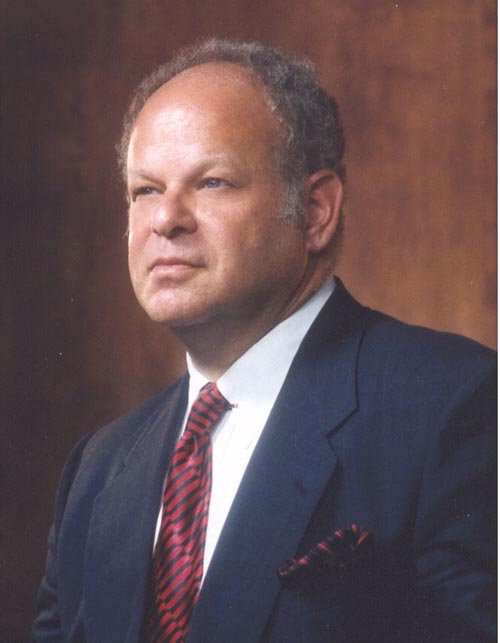
That's a picture of Dr Martin Seligman, and here's some of what Dave Shearon says about Seligman's book Learned Optimism. This is Shearon's summary of and comment on Chapter 8, "School":
Failure devastates us. All of us, upon experiencing failure, quit – at least temporarily. Optimists bounce back and began trying almost immediately; defeat is temporary and achievement is assured. Pessimists, on the other hand, are defined by their failures. They are a failure, and there is no point in a failure continuing to try.Comment: Children are natural optimists, as discussed earlier, and they sure better be in our schools. We often assure failure by such tactics as grading on the curve. We define relative success as failure. Please note that I am not arguing for low standards or namby-pamby, feel good education. I am simply making a point as to how school is experienced for many students. Is it any wonder that educators report "losing" students as they enter the later middle school years, which is approximately the same time that the natural optimism of childhood wanes. These students are suddenly unable to cope with an environment they have been in long as they can remember. How can such a failure not be a complete turn-off?
Working with Joan Girgus, and building on the work of Carol Dweck, Dr. Seligman and his staff conducted a study of 3rd-grade children from 1995 until they finished seventh grade in 1999. They found that children who began third grade with a pessimistic score on the CASQ were at risk for depression and severely-reduced academic achievement. In addition, bad life events, especially including divorce and parental turmoil, contributed to a pessimistic explanatory style. Over all, boys were significantly more depressed at all points along this age range then were girls.
In college, students with optimistic explanatory styles will outperform predictive measures such as SAT scores or high school grades. Students with pessimistic scores will under perform.
Through my (amateur and untrained) career counselling over the years I have found optimism/pessimism to be a key variable. What success I have achieved in this has mostly hinged on helping my punters to identify things they love to do and are good at doing , which they then look forward to doing and are confident they can do, which feeds their optimism, which jolts them pleasurably out of any negative feedback loops they were stuck in and puts them into some positive feedback loops. Often the mere possibility that life could sparkle again is enough to get them up and buzzing – at which point they often then do things that had nothing to do with what they talked about with me, but so what? What I try to avoid doing is simply telling them that they must do this or that, because unless they really want to do it, that just creates yet another negative feedback loop.
I think this is one of the core reasons why I oppose compulsion as a principle, in teaching as in all things, and favour voluntarism as a principle, ditto. People who do what they like doing in the way they like to do it immediately start getting what they regard as good results, which makes them more optimistic, which breeds success which breeds further optimism, etc. etc. (And if I can't make people do what they don't want to do, this won't happen, and I won't spread negative feedback loops everywhere.)
But that's an aside. All I'm really saying here is: I think this kind of stuff works.
Yes indeed, school choice is good, says David Salisbury:
School choice opponents claim that choice harms public schools. Research, however, shows the opposite. A new study published by Harvard economist Carolyn Hoxby addresses the question: "Do public schools respond constructively to competition induced by school choice, by raising their own productivity?" The answer: Yes, they do, and the benefits are greatest where large numbers of students are eligible for choice.
In other words, this will probably look quite good, here in Britain, in five years time.
In the latest issue of Gramophone, there appears a review, by Gramophone editor James Jolly, of Beyond the Notes by the noted pianist Susan Tomes.
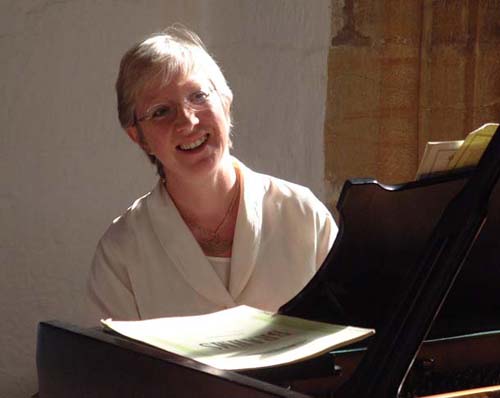
Alongside his review, Jolly also includes a passage from the book, about the celebrated Hungarian musician Sándor Végh, and about his limitations as a teacher:
I particularly remember an occasion in Italy. There was a Japanese girl in the class who was greatly in awe of [Sandor] Vegh, and she told me she was inwardly trembling in all her lessons. He seemed to smell her fear and subjected her to a merciless spate of criticism, mocking her demeanour, her femininity, the way she wilted under criticism, and telling her that she didn't understand music at all. Naturally, her playing got worse and worse. One night towards the end of the course the students gathered in a square in the village and sat round in a big circle. Someone had a violin with them and played a folk tune on it. Someone else suggested that the violin be passed around the circle, and that other people might contribute folk songs from their own country. And so the violin eventually came to this Japanese girl. To everyone's great surprise, she played some sad Japanese folk songs in an entrancing style, sweet, poignant and natural with no trace of the physical stiffness we had all seen in her lessons. This was a very important scene for us all to witness, and I think everyone understood then that a powerful teacher can inhibit as well as inspire.
What a swine! I have lots of this man's CDs, but I'll think hard before getting any more.
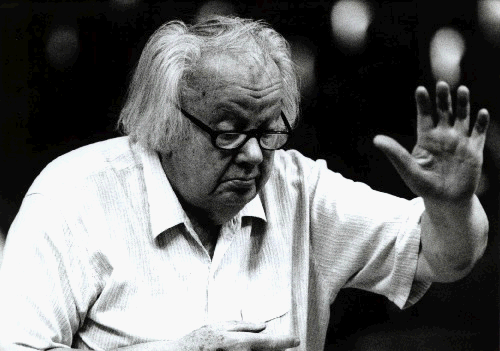
Perhaps if challenged about such cruelty, Vegh might say that the music profession is a tough one and if you can't take grief you should be chased out of it now. Sort of like army basic training. But if the profession is tough it will do that anyway. Why create pre-emptive grief? Why not just try to teach music and music making, and let the grief be postponed for as long as possible? And – who knows? – maybe, if encouraged, the Japanese girl will make it as a performer after all. It's not as if, like a badly trained soldier, a lack of early grief is liable to kill her. Anyway, music is not the same as warfare. (Although maybe I'm being naive about that, and actually it is.)
However, note that the chapter from which this snippet comes is called "Sándor Végh and György Sebök – a tribute to their teaching", so the old monster must have been doing something right.
 Oh no! A Five Year Plan.
Parents and children will be able to choose from a higher-quality of schooling in their local community under education reforms published today by Education Secretary Charles Clarke.Under the government's 'Five-Year Strategy for Children and Learners' plan, every school will be an independent, specialist school with new freedoms to run their own affairs, backed by the security of an historic three-year budget so they can achieve the highest standards for every single pupil.
Mr Clarke said that every reform will be firmly rooted in five key principles: greater personalisation and choice, with the wishes and needs of children, parents and learners centre-stage; opening up services to new and different providers; freedom and independence for frontline headteachers, governors and managers; a major commitment to staff development with high-quality support and training to improve assessment, care and teaching; and partnerships with parents, employers, volunteers and voluntary organisations.
Mr Clarke said that these principles would deliver new guarantees for all pupils and parents and for all those who deliver education and children's services.
In other words, what I said here, towards the end. In other words, this is actually a very good five year plan, as five year plans go.
Tonight I will be attending a soirée chez Tim Evans, and we will no doubt be agreeing about how Tim saw this coming but the Conservatives didn't.
This is their policy! Will they yelp that the Government stole it? (Bad idea. If it's a good idea then it's good that the government is doing it.) Or will they oppose it, and promise merely to throw money at education? (Even worse. Why, until now, was this their idea?)
Right answer for the Conservatives: agree with it, and split the Labour Party. Say: vote for the party that really believes in this stuff, unlike the massed ranks of the Labour Party, beyond the front bit. But that's probably too clever for them.
See also, Tom Utley in the Telegraph covering the same ground. He reminds me that I forgot (c) pretending that the Government's policy is not what it is, which is stupid, on account of being stupid.
Although, this Telegraph leader says that this is an example of the Conservatives leading the debate and that "Labour is on the run".
We shall see.
UPDATE: I keep looking for stuff to blog about on Samizdata, which needs things today, and all I keep finding are further links to add to this posting. For example this one, about the man who is trying to take over Marks and Spencer. He's going to sponsor some schools, apparently.
Adriana (again – see below) emails me about this:

CNET reports that a professor rebuffed by Cisco decided to offer his own networking textbook free of charge. The solution, the tech news site says, highlights powerful new publishing techniques that promise to shake up the textbook industry, offering cheaper alternatives to cash-strapped students.
Bravo. And please keep the links coming, Adriana.
My good friend Adriana, Queen Bee of this, to whom deepest thanks, emailed me with news of an interesting blogger. The interesting thing being that he combines a substantial internet presence with being a teacher (of English), at Radley College, which is one of Britain's posher private sector secondary schools.
My school used to play Radley at cricket, I vaguely recall. And a very nice man called Dennis Silk, who I fondly remember teaching me English many decades ago, by which I mean he liked my writing and had no criticisms of it to offer of any sort, then left my school and went off to become the Headmaster of Radley, from 1968 until 1991.
Gratuitous Radley picture:

Anway, that's enough about me and my old English teacher. This guy's name is David Smith and this is his Radley Weblog.
The two postings which appeal to me most are one about the Twin Towers, with some lovely pictures, and then this one, in which he quotes Peter Conrad writing in The Observer about the Saatchi art fire:
In the annals of cultural catastrophe, this disaster does not register. We are not dealing with an event such as the torching of the library in Alexandria, that shrine to the muses which, when it caught fire 50 years before the birth of Christ, annihilated an entire corpus of classical literature, including 90 tragedies by Aeschylus and 30 comedies by Aristophanes.
Arson has been on my mind here lately, for some reason.
I don't know if D. R. Smith's Radley pupils read this Radley Weblog, or are intended to. If they do, it must be quite an education for them.
It would of course make particular sense for the readers of my blog here to check out everything David Smith writes or quotes under the heading of education.
Here are two Telegraph pieces from yesterday about school choice, the first a news story, and the second a comment piece by Rachel Sylvester. Nice Gerald Ratner comparison:
Shortly before I went on maternity leave at the end of last year, I had lunch with a minister who has impeccably Blairite credentials. The conversation turned, naturally, to schools in my area of London - Hackney. Diane Abbott, the local MP, had just said that the secondary schools there were so bad that she felt obliged, despite all her Left-wing principles, to educate her son privately.What would the minister advise me to do, I asked, if my soon-to-be-born child were about to reach his 11th birthday? 'Oh,' he replied without a second thought, 'you'd have to move.'
Another minister told a friend of mine that if he really wanted the best education for his children, he would have to send them to private schools, while a third member of the Government advised that the only solution for parents with children in state schools was to spend a fortune on private tuition.
Seven years after Tony Blair declared 'education, education, education' to be his top priority, ministers still sound like Gerald Ratner when discussing Britain's secondary schools. Alastair Campbell may have called for the end of the 'bog standard comprehensive', but most ministers talk as if the schools are just 'crap'.
They behave as if they are, too. The Prime Minister had to send his sons half-way across London to find what he considered to be a decent school - the Roman Catholic Oratory - while other members of the Cabinet - Lord Falconer and Paul Boateng - educate their children privately. Several senior ministers have got round the problem by buying an expensive house in the catchment area of a good state school.
Of course, politicians have every right to do what they believe to be best for their sons and daughters. The problem is that most people cannot afford to do the same. In Hackney, 17 per cent of parents send their children to private schools, but what about the rest, many of whom live on council estates and are struggling to make ends meet?
And not everyone has the money to move house to be near a good state school when, according to the Royal Institute of Chartered Surveyors, property prices are 12 per cent higher in the catchment areas of the best. 'Let them move house' is rather like Marie Antoinette declaring 'let them eat cake'.
Gratuitous picture there of a nice house, details of which are viewable here. And if everyone did "have the money", the price of the houses near the best schools would rocket upwards still more.
Happily a cross-party consensus – a cross-front-bench consensus anyway – does seem to be emerging, disguised by the need both parties feel to continue insulting one another. "Why don't they support us?" "They aren't doing enough!" Blah blah blah.
The key to it is the right of popular schools to expand and to profit from that expansion, and the key policy to let that happen is for the money to be in the hands of parents – and via parents in the hands of schools - rather than of local education authorities. In practice this means, to borrow a phrase much used by these guys – education vouchers but not called that. If parents are allowed to choose a school, and if the school is allowed to expand to accept all that money from the parents who want it, then the good schools will take over the universe and the bad ones will disappear. Well, do you have a better idea?
Not that this (or any) political policy will work quickly enough if you are a politician who is shopping around for a good education, now, for your child.
But at least this policy might work eventually.
The world is full of pessimists about whether computers will ever make much of a contribution to education. I am an unashamed optimist, first, because the Internet already is making a massive contribution to education, and second because the standard of computerised teaching will quickly rise to the level of the cleverest schemes doing this, while the rubbish schemes will be quietly forgotten.
So I was especially intrigued by this article in the New York Times, about how the US Army is being taught "tactical Arabic" with virtual reality computer simulations of the problems they face.
In a dusty valley in southern Lebanon, "Sgt. John Smith" of the Special Forces scans the scene in front of him. Ahead is a village known as Talle. His immediate mission: to find out who the local headman is and make his way to that house.All discussions with the villagers will have to be conducted in Arabic, and Sergeant Smith must comport himself with the utmost awareness of local customs so as not to arouse hostility. If successful, he will be paving the way for the rest of his unit to begin reconstruction work in the village.
Sergeant Smith is not a real soldier, but the leading character in a video game being developed at the University of Southern California's School of Engineering as a tool for teaching soldiers to speak Arabic. Both the game's environment and the characters who populate it have a high degree of realism, in an effort to simulate the kinds of situations troops will face in the Middle East. Talle is modeled on an actual Lebanese village, while the game's characters are driven by artificial-intelligence software that enables them to behave autonomously and react realistically to Sergeant Smith.
The Tactical Language Project, as it is called, is being developed at U.S.C.'s Center for Research in Technology for Education, in cooperation with the Special Operations Command. From July 12 to 16, real Special Forces soldiers at Fort Bragg in Northern California will test the game and put Sergeant Smith through his paces.
The user plays Sergeant Smith, while the other characters are virtual constructs. Using a laptop, the user speaks for the sergeant, in Arabic, through a microphone headset and controls the character's actions by typing keyboard instructions.
The project is part of a major initiative, financed by the Defense Advanced Research Projects Agency, or Darpa, to explore new ways of training troops by making use of the large installed base of existing technology, especially laptops.
"I'd like to be able to send something like this to every soldier stationed in a foreign country," said Dr. Ralph Chatham, the Darpa project manager.
Of particular importance is that the soldiers need to learn the body language of a different culture, and not just words. The right words, but spoken in the wrong way, could be disastrous.
Funny how, when a whole bunch of people have to learn and have to be taught, and when the question of fussing about how each of them is doing compared to all the rest is of secondary importance, so long as they all learn it, learning is able to proceed rapidly.
The article goes on to say that this kind of thing requires very powerful computers, of a sort not previously widely available. Part of what uses up all the power is that every individual that our intrepid US soldier encounters has his own reality and his own agenda and his own repertoire of responses, which vary widely depending on how the US soldier treats him.
So, could we now have reached the early phase of a characteristic pattern in the application of computers to everyday life. A new application is roughed out at the theoretical level, and much trumpetted. (In this case "computer assisted learning".) But turning the concept into a working procedure proves to be far harder, and demanding of far more computer power, than was originally assumed, and the thing only starts to come on stream years later, when most early optimists had given up on ever seeing it? Let's hope so.
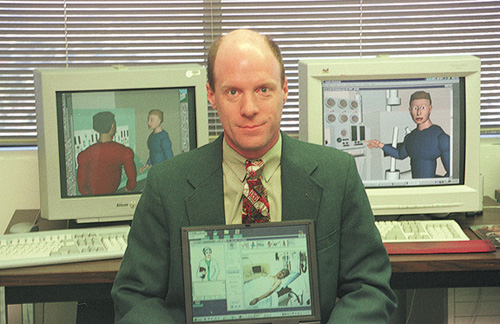
That's a picture of Dr. Lewis Johnson, the director of the Center for Advanced Research in Technology for Education, and one of the brains behind this project.
Is your school a disappointment? Count your blessings.
SRINAGAR, India July 5, 2004 – Kashmir's oldest school was burned down Monday, destroying one of the world's oldest copies of the Quran and thousands of other rare Islamic texts, in a suspected arson attack that some blamed on Islamic militants targeting moderate Muslim leaders.The destruction shocked many in the disputed Himalayan territory, with the loss of the 105-year-old Islamia Higher Secondary School where some of the region's most prominent figures studied and of its 30,000-book library.
The top two stories when I did this post both concerned people setting fire to schools. By comparison, this school in New Zealand got off lightly.
Liz Lightfoot reports on Tony Buzan, for the Telegraph:
Mr Buzan, who built his reputation on helping adults to improve their memory and thought processes, has recently turned his attention to the failings in our schools. I joined him on one of his regular visits to a struggling secondary modern.He believes many teachers and parents make children feel dull and stupid by concentrating on what they do or don't know, instead of on their enormous capacity for self-improvement.
He criticises rote learning for treating memory as if it were a "grey, linear skill" when in fact it is "multi-dimensional and colourful" and works best when people use the creative side of their brain as well as the rational.
The previous posting right here makes, if you think about it, a similar point. There, the phrase "four by four" is connected in the mind of the child receiving the notion, with "four times four". And the absorbed bit of knowledge has, as it were, somewhere to attach itself to the existing stock, instead of just floating in, and then floating out again.
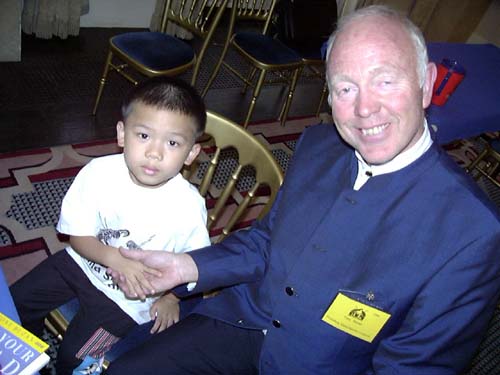
That's a not so gratuitous (given how Buzan feels about pictures) picture of Buzan, at the Mind Olympics.
Arithmetic cartoon borrowed from the Spectator:
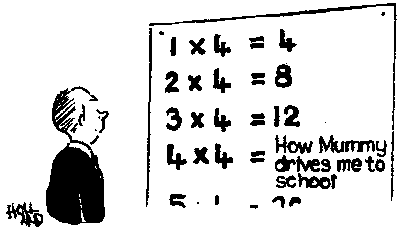
Ha ha. Yes, indeed. But it is with insights like this that arithmetic can actually be brought to life. (To say nothing of this being yet another opportunity here for a gratuitous picture.)
Another bit from the Bill Bryson book I've been reading. I've now nearly finished this book. Still excellent.
One of the more charming oddities of university life are those people who manoevre themselves into positions in the university which are not academic, but for an academic purpose. This is not done out of indifference to academic concerns. On the contrary, the people I am talking about take charge of the faculty air condition system, or (as is the case I am about to refer to) become janitors, out of an enthusiasm for the academic life, but accompanied by an unwillingness to bear the usual burdens of a conventional academic post, in the form of such annoyances as teaching unwelcome pupils, administrative duties, or tiresome instructions from academic superiors. Either that, or the university just wouldn't give them a proper job, so they got an improper one.
I remember people of this sort when I was at university. Their success rate is presumably not much different from that of regular academics. Most just live out their lives in obscurity, and by the end of it all they are janitors, or whatever. But occasionally they hit the big time. Bryson recounts one such success story.
In the 1860s, journals and other learned publications in Britain began to receive papers on hydrostatics, electricity and other scientific subjects from a James Croll of Andersen's University in Glasgow. One of the papers, on how variations in the Earth's orbit might have precipitated ice ages, was published in the Philosophical Magazine in 1864 and was recognized at once as a work of the highest standard. So there was some surprise, and perhaps just a touch of embarrassment, when it turned out that Croll was not an academic at the university, but a janitor.Born in 1821, Croll grew up poor and his formal education lasted only to the age of thirteen. He worked at a variety of jobs – as a carpenter, insurance salesman, keeper of a temperance hotel – before taking a position as a janitor at Anderson's (now the University of Strathclyde) in Glasgow. By somehow inducing his brother to do much of his work, he was able to pass many quiet evenings in the university library teaching himself physics, mechanics, astronomy, hydrostatics and the other fashionable sciences of the day, and gradually began to produce a string of papers, with a particular emphasis on the motions of the Earth and their effect on climate.
Croll was the first to suggest that cyclical changes in the shape of the Earth's orbit, from elliptical (which is to say, slightly oval) to nearly circular to elliptical again, might explain the onset and retreat of ice ages. No-one had ever thought before to consider an astronomical explanation for variations in the Earth's weather. Thanks almost entirely to Croll's persuasive theory, people in Britain began to become more responsive to the notion that at some former time parts of the Earth had been in the grip of ice. When his ingenuity and aptitude were recognized, Croll was given a job at the Geological Survey of Scotland and widely honoured: he was made a fellow of the Royal Society in London and of the New York Academy of Science, and given an honorary degree from the University of St Andrews, among much else.

People like this, when they make their first academic breakthroughs, are often celebrated as Holy Fools. Uneducated illuminati. They are nothing of the sort. They are very well educated, but by themselves.
Via Chrenkoff, I got to this about a lady who has been awarded a prize:
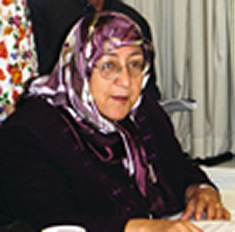
After more than a quarter century of war and instability, the literacy rate of Afghans, particularly women, was among the lowest in the world. When many schools closed in 1995 and the foundations of education throughout the country were in danger of collapse, Sakena Yacoobi and two other concerned Afghan women founded the Afghan Institute of Learning to help address the lack of access to education for women and girls, their subsequent inability to support their lives, and the resulting impact on society and culture. They committed AIL, a non-governmental organization (NGO), to bringing peace and dignity to the Afghan people as they struggle to overcome oppression, devastation, and injustice.
During the Taliban years, AIL ran 80 underground schools as well as mobile libraries in four Afghan cities. By the end of 2003 the organization served more than 350,000 Afghan women and girls in Afghanistan and Pakistan's refugee camps through its girls schools and programs in teacher training, health education, human rights education, women's leadership training, and literacy. With its 470 employees, 83% of whom are women, it is a model and a leader in rebuilding Afghan civil society.
The official citations read: "The Women's Rights Prize of the Peter Gruber Foundation is hereby proudly presented to Sakena Yacoobi, President of the Afghan Institute of Learning, for her courageous vision and leadership in implementing quality education, human rights training, and safe healthcare for Afghan women and children. Despite significant personal risk during the time of the Taliban and in the aftermath of violence and war, she has worked tirelessly to improve the life, opportunities, and social infrastructure of Afghanistan's neediest residents and its refugees in Pakistan."
"The Women's Rights Prize of the Peter Gruber Foundation is hereby proudly presented to the Afghan Institute of Learning for expanding health and education opportunities for women and children in Afghanistan and Pakistan. The unwavering commitment of its dedicated teachers, doctors, and health care providers under the repressive Taliban regime and during post-war reconstruction has truly empowered hundreds of thousands of Afghan women and children, citizens and refugees alike."
This is all part of why Chrenkoff reckons things are now getting better in Afghanistan. Not, he says, that you'll get much about this from the mainstream media. But that's the way with good news. Not very interesting. Not dramatic enough.
Although, he does quote from this guy, the exception who expounds the rule.
Yesterday in the London Underground, I picked up a stray copy of the Camden New Journal, and found myself reading an article about a music teacher. Today I was able to find it in linkable form:
MR MUSIC at Camden School for Girls, John Catlow, is preparing to retire this month after 18 years explaining the mysteries of sharps and flats.
A distinguished former cellist, Mr Catlow, 63, played with the London Symphony Orchestra and was first principal cello with the Hallé Orchestra and English National Opera before becoming a teacher at the school in Sandall Road, Camden Town.
As well as his classroom work, he is currently preparing for a piano and cello recital the day after term ends.
And he is busy doing research before conducting Beethoven’s Eroica Symphony as part of the school’s third Reunion Orchestra Concert, performed by past pupils, on July 11.
Mr Catlow says of his mid-career move to the classroom: "I needed to get out of orchestras.
"I was experiencing stress in my bowing arm and the music profession is littered with former great players just serving out their time. I wanted to avoid that.
"And playing orchestral music isn’t at all demanding intellectually."
So, rather than simply becoming a peripatetic cello teacher, he decided to go the whole hog and teach music across the secondary age range up to A-level.
"Turning to teaching was a shot in the dark," he admits.
"A school isn’t a glamorous environment, and sometimes you don’t really feel like you’re winning. But it was definitely more fulfilling for me in the long run."
And so on. No criticism here. Here's how the piece ends:
… it was Rosemary Cumming, from the school office, who paid Mr Catlow his most significant compliment.A former temporary receptionist told her he was quite simply "the nicest, friendliest person at the school".
I suspect that there is a direct connection between extreme competence and extreme niceness. It doesn't always happen this way, of course. Many extremely competent people exploit their indispensability by being extremely nasty. But if you are extremely competent, and everyone knows it, you may not feel that you have to demand respect from people by chucking your weight around. You have respect already.
I further suspect that Catlow was a whole lot better at teaching for having done other things first, and at a high level of accomplishment. God save us from schools where the only thing the teachers have done is either teaching at school, or, before that, learning at school. Schools need variety on the staff, and people like Catlow provide it.
I bet he had some stories to tell. The LSO in particular is a famous storm centre of anecdotage.
 Okay so I was looking through Daryl Cobranchi's blog for something there recent to link to, and my favourite was this, which has a gratuitous picture of a dog. Gratuitous picture of the dog reproduced here. I know, you wait months for a picture of a dog, and suddenly two dogs in two postings.
But I followed the links in his piece of dog blogging, and I got to something more substantial, in the form of a piece about blogging. It includes this gem of brilliance, from a Sociology Professor:
"It's likely to be a fad," said Robert Wood, sociology professor at Rutgers University-Camden in New Jersey. "In a year or two we'll be on to something new."
What you mean "we", Sociology Professor? You ain't no blogger, that's obvious. If you were, you'd know that blogging is here to stay. Sure enough, he has a very individual looking website of the sort that people who want blogging to drop dead tend to have.
Being into websites he offers this page of websites for teachers, which includes a number of links that could be worth following up.
The Internet eh? You go looking for ways for sneering at someone, and before you know it you find something that might be interesting.
This, for example, took me to this which lead me to this and to this and this, athough I could have missed a few steps there. The pictures look really good.
I think I will now do a posting about this on this.