
Recruiting head teachers is getting harder, says David Hart of NAHT.
The turnover of senior management in schools has reached crisis levels, with headteachers suffering from "football manager syndrome" a conference heard today.
Which is daft. There is no shortage of people wanting to be football managers. Make that the political people talking about football in a desperate attempt to get media coverage syndrome.
Vacancies for headteachers has reached the highest level in seven years and is 20% up on this time last year, according to analysis from the National Association of Head Teachers, revealed at its annual conference in Cardiff.David Hart, NAHT general secretary, said: "Headteacher turnover is reaching critical proportions."
Read the whole thing, as they say.
My interpretation? If you sovietise the education system, but allow other parts of the economy to remain relatively unsovietised, people will flee the sovietised bit, just as they fled from old fashioned Communism. (The answer: A free market in education.)
There's an interesting article by David Hargreaves in the latest Spectator about how he didn't like the school he was at when he was fourteen. So he ran away from it, and, with the help of his parents, ended up attending a much nicer local school. Which would also have been cheaper, presumably.
It turned out better than any of us dared believe. Against the odds, I made friends quickly and easily, started to do some decent work and, three years down the line, won a place at Oxford.
And he went on to become a teacher. In which capacity, he recalls meeting another father who wasn't nearly as nice as his had been:
I've never forgotten bumping into the father of a very bright ex-pupil of mine at some dinner. 'I haven’t spoken to Henry for six months,' he told me. 'As far as I am concerned he has wasted his life.' Shocked and sorry, I asked what on earth had happened. 'He got a second,' came the reply, voice shaking with indignation. 'The third generation of our family at Trinity, and all of us with firsts. I can't even look at him.'
Sounds like Trinity has its limitations as an educational establishment.
Interesting plot to this movie, I think you may agree:
Plot Summary: Raised in African bush country by her zoologist parents, Cady Heron (Lohan) thinks she knows about "survival of the fittest." But the law of the jungle takes on a whole new meaning when the home-schooled 15-year-old enters public high school for the first time and falls prey to the psychological warfare and unwritten social rules that teenage girls face today.
It's the way that "home-schooled" is now a standard feature of American life, needing no explanation. I intend to check this out on video, if only to see how the whole home-schooled thing is treated.
It's Mean Girls. And as is all very proper for a Hollywood movie, not many of us can remember sharing a school with girls like :

Again, I've been wandering the Internet looking for pictures to decorate this. Although, perhaps …
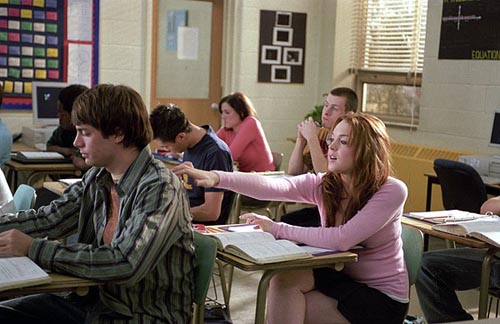
… would be more appropriate for here.
Theodore Dalrymple, writing in the Spectator about the (impeccably legal) corruption of Britain's public services, has this to say about British education:
We cannot even organise a public examination system for schoolchildren in this country so that the results mean what they appear to mean. As for our universities, they blatantly steal the money of foreigners by virtually selling degrees that will soon start to devalue like the mark after the first world war. No longer scholarship and learning, but bums on seats and grade inflation to guarantee yet more bums on seats next year, these are the aim of our institutions of higher education.
I on the other hand like to think that since our universities will be operating in a genuinely competitive international market, all those foreign students will keep them up to the mark, and will thereby be doing us an even bigger favour than parting with their money to us.
Let's hope that I'm right about that, and that Dalrymple is being too pessimistic.
Cecile duBois describes the grief of group rather than individual assessment.
I have a lab report due tomorrow. I should be happy that its a group project, and we share equally the load of work to do. But no - not in this situation.
Her problem is that the three others aren't doing their fair share, but the marks will be dished out as if they are.
I don't mind doing work - but when its four people's shares of work on my back working for the sake of not only my grade, but our grade, I do mind.I recorded the data, typed everything out, printed everything out, stapled together as neatly as possible. But if science teacher is not pleased about a certain thing, if its not 'cute enough' or a number is missing in the data, your precious lab report will be torn in half in the trash.
Earlier, it was by sheer luck I wound up in groups with students who actually worked at least their share – and who actually knew what they were doing, math-wise.
I just hope I haven't lost my wits this time.
For the brutal truth is that …
… If I don't do the work, we all fail.The lesser of two evils: allowing three idiots to keep me as their one-night homework slave than having us all fail. Yeah, I've got to pick my battles. At least they don't read this blog.
Or this one. [P]oindexter comments somewhat pompously (but he has a point):
it's important to learn teamwork and how to engage in collaborative projects - it's a given that others will be slackers and/or ill-suited for the tasks ... welcome to the real world! ... that's how adults spend most of their waking hours: either dodging their share of the burden, or being forced to overcompensate for others' shortcomings ... here's an opportunity for you to exercise true team-leadership and management skills, and learn how to get the job done - without whining, complaining, fault-finding, finger-pointing, etc. ... that's how you'll get to be the one who picks your own team! ...
But I reckon the way to learn teamwork is to join a real team, rather than a fake one put together in a classroom. This is why employers – in Britain anyway, but I bet it's the same in the USA – look for evidence of out of school activities of one kind or another.
I'm not sure exactly why things work so much less well with classroom teams than with teams elsewhere. Partly it is that the results of school work are entirely concentrated in the individuals to whom education is done. The results are not actually collective. Another reason may be that since group work is the exception in school rather than the rule, there isn't very much of it, and the rewards of shirking are liable to outweigh the punishments. As so often in this world, repeat business is the key, and with group work at school, there is less of that than there is in non-school world.
I like Cecile. I like her because when we met in London … I liked her. And I like her because when I said something nice about her, she put it permanently up at the top right hand side of her blog, which means that I am famous throughout the right wing teenage-o-sphere. So, because I like her, and because this blog needs pictures, here is a another picture of her I took in London:

Technically this photo is all over the place, with red eye, and a blurry left side (as we look at it) of her face. But it gets her well, nevertheless.
The pictures on the wall? The owner of them is a good friend. He likes them.
UPDATE FRIDAY: And guess what. Without realising it, I posted all that on Cecile's fifteenth birthday. I must be psychic. Michael Jennings has another picture of Cecile at the same event.
Arts & Letters Daily links to this article, which is about this blogger. First I'd heard of her.
If you are looking for academic angst, you have now found it.
Question: When does a blog turn into a book? Answer: When the blogger stops writing any more and just leaves it there, but when it's still worth reading. Here's another blog-book.
Blog-book. Blook. Have I just made up a new word?
No need to stop reading blooks just because the bloggers have stopped writing them. After all, books have to be finished before we are even allowed to start reading them, but we still read them.
I've just finished a posting at Samizdata which ends thus:
And now I will go and do a posting here …
I.e. here.
… about the educational vibes of combining home working with home educating.
And I reckon if I had to leave it at that, that would suffice.
Put it this way. Here are two big current trends on the up: home working and home educating. Between them they reunite children with the world of work, something educators have been wanting to do ever since an earlier generation of idealistic educators finally succeeded in wrenching these two things apart from each other.
In the present world, where work is work and school is school, all too many children emerge from their schools with their brains reasonably well exercised by year after year of school work, but with a basic ignorance about work work and about how work work is done. That was me, definitely. I remember it distinctly.
School work is all about individually getting ahead and showing promise. Cooperating at school verges on cheating, because the point is that you must do the school work. The point of work work is merely that the work gets done, and so long as you pull your weight in some capacity or another, you earn your pay. Work work is cooperating, and if you cooperate successfully no one expels you for cheating. No, they praise you for cooperating.
And the other thing that school work systematically separates you from is economic reality. The school spends money … the way it spends it. And you do your school work. The connection between work and wealth creation is severed, during a human being's most impressionable years.
(One of the points I make in this Libertarian Alliance piece, of which I am very proud and which people often link to still, even though it was written a decade ago, is that children who grow up in families where money is a constant worry and a constant battle grow up systematically more economically savvy than do those children whose parents are economically more comfortable and less burdened.)
It seems to me that all of these myopias are likely to be somewhat and perhaps even completely corrected if kids are educated in a home where real work work is also being done, even if the only regular message they get is that Dad is now busy and must not be disturbed, because if he is disturbed this will cost the family money.
The complaint about home education is that it isolates children from "reality", and from the wider world, and smothers them in a protective cocoon. What an irony if it was actually this exact trend that reunited education with reality.
Apologies to all home educators reading this who have known about this for years, but the thought has only just occurred to me. Home work work plus home school work anecdotes welcome..
Madsen Pirie writes about the belief that a bad school benefits from the presence in its midst of children from more motivated families.
The idea that academically gifted children, if they attended sub-standard state schools, would somehow inspire and motivate the others, is strange. It seems to belong to the fairy tales which social engineers tell each other round the camp-fires. In the real world such children are often bullied and demotivated, and scorned because study lacks any street-cred. Educated with others of their kind, however, they can become high achievers.
I'm not sure if I agree with that, in fact I'm pretty sure that I don't. Surely both sets of children are liable to influence each other, to the benefit of the bad ones and to the detriment of the better ones, assuming bad and good are what they are. It need not necessarily be an either/or thing. Madsen could be right about the damage done to the good pupils, but still ignoring the improving effect they nevertheless might have.
Not that this means that motivated families should be forbidden to educate their children as they see fit, just because said children radiate positive educational externalities, so to speak. Even assuming they do.
As it happens, there was a documentary on BBC4 TV (which I am watching a lot these days) last night, about a school in Stoke struggling to improve itself. The staff there certainly thought that having their best pupils enticed away by a neighbouring school, as had apparently been happening, was highly damaging to them. But was this because the remaining pupils then suffered, or merely because it lowered the overall exam success rate? They seemed to believe that the pupils left behind did suffer from the example of their betters being now denied to them, and it makes sense to me that this might be so.
My recollection of my own education is rather the opposite, though. I did best when I was near the top of the class. High status caused the juices to flow. As I proceeded to bigger and "better" educational establishments, I got demoralised at how much better than me the best of my numerous rivals were, and I got dispirited. Lower status lowered my energy rate. But did I actually do worse? Or was I merely not so happy? Maybe I would have been happier at less grand places, but have done worse.
As with so many educational questions: complicated.
The Independent on the apparent overproduction of graduates:
At no time during his four-year French degree or in the three subsequent years teaching English in Japan did Paul Escott, 26, see himself working as a full-time cashier in a bookies. Paul came back to the United Kingdom last August, with a view to getting his first UK graduate job - something to match his qualifications and experience. What he found, however, was not what he was expecting."I never thought I'd be taking 50p bets from stoned Jamaicans," he says with a smile. "In some ways I feel like a victim of my degree." Nowadays, he says, degrees are a dime a dozen.
Escott graduated in 2000 with a French degree from the University of East Anglia (UEA), where he spent his time "treating everything as a joke". He had a great time at UEA, and says that university life was the "mutt's nuts". He says he never gave a second thought to career development. "I did any old degree I knew I could pass, without any regard for where it would lead. If I ever made my mind up about anything at university, it was that I wouldn't make my mind up," he says.
Paul is one of an increasing number of graduates who are finding that their time in higher education was worth very little when it comes to getting a job. Although he says his priorities are not financial, and that he is reluctant to spend his life on the career ladder, Paul admits that he is not now where he wants to be.
In a book published last month, Anthony Hesketh of Lancaster University and Phil Brown of Cardiff University explain why cases like Paul's are increasingly common. Their study, The Mismanagement of Talent - Employability and Jobs in the Knowledge Economy, found that the number of graduates being turned out by universities is far greater than the number of graduate jobs available.
So forget about getting a degree then, even if you can?
The authors call into question the traditional notion of a degree being a key to guaranteed career success, saying that university credentials, "do no more than permit entry into the competition for tough-entry jobs rather than entry into the winner's enclosure."
So, you still need a degree to get a top job, even though it only gets you a chance of a top job?
The crucial question is not: Does a degree guarantee you a top job? It doesn't. Not now, probably not ever. The crucial question is: Are some people more likely to get top jobs if they skip degrees and start work at eighteen, or for that matter fifteen, or twelve, or eight? If a degree is insufficient, but still totally necessary for a top job, then it still makes sense for a would-be high fligher to get one. Even that bloke in the betting office may later find that his degree pushes him ahead in the queue.
It may well be that from the point of view of the economy as a whole, "Britain" cranks out too many graduates. But that doesn't mean that individual Britons who bust their guts and their banks accounts to get degrees are necessarily behaving irrationally.
In my opinion, the crucial question for a non-degree inclined eighteen-year-old to ask is: Where is the economy expanding fastest? You are much more likely to get a top job in an industry that is exploding with new opportunities, and is hence not organised and respectable and something that regular graduates yet want to get into.
Still study, in other words, but study different stuff.
One thing's for sure. Idling your way through university, getting a silly dime-a-dozen degree, and then expecting a great career, immediately, as of right, is no longer an option - if indeed it ever was. A top career means that sooner or later you have to start, you know, working. And sooner is better.
I don't think that those authors are right to regard the view that degrees guarantee you a great career as "traditional". I think that what they say, and what I've added, is much more traditional. Degrees get you in the door, but once in there, you have to work and to work intelligently, which is likely to mean that you have got into the habit of working, and of working intelligently, and that you can prove it. And I think most people know this.
Grade inflation. Is it really happening? Hard and fast facts are hard to come by. But here is a hard fact not to say a fast fact. Oxford University is to reintroduce its own entrance tests, for English and history.
I havn't been very fast myself with this fact. I first heard about this from this quite recent Daily Telegraph piece, but according to this Guardian report, the announcement was made over a month ago. But some announcements are noteworthy enough to be worth noting even if you do it very slowly.
The point is that a grade A in A level no longer makes enough of a distinction between the best and the rest. Only if getting an A became harder could Oxford use A levels pick the brightest and best.
This still doesn't prove beyond doubt that grade inflation has been happening. The other explanation is that ultra-clever would-be Oxford students are now a lot more numerous than they used to be. Which could well be, I suppose.
I've just got around to reading this from the BBC, about the rise in Britain of working at home. The key change has been the arrival of broadband connections for millions rather than for a few thousand.
One of the big breaks on the rise of home education in Britain has surely been the rise, at about the same time, of the two-wage/two-salary family, with both parents needing to be away from home during the day, and needing old fashioned schools simply to keep an eye on their kids – even if actual education there is something of a bonus.
The rise of working at home is surely, therefore, going to help home education. Anything which makes it easier for at least one parent (maybe by the two of them taking it in turns) to stay at home, as in this case, is bound to encourage it. And before commenters tell me that there are all kinds of problems with trying to combine working with child minding, I can fully appreciate that. I didn't say it necessarily makes child minding easy; I merely say that for some parents, it makes it easier. And it surely does.
l'm thinking in particular of children who are old enough to work undisturbed for quite long periods of time (something at which home educated children often excel), but who are nevertheless too young to be left at home entirely on their own. That way, Mum or Dad can also get some serious work done.
And here's another educational titbit from this book (see also the previous posting).
This is the last of four entries for the year 1618:
VAGRANT CHILDREN FOR VIRGINIAA scheme was begun to send vagrant children off the streets of London to Virginia, there to be industriously employed. The Virginia Company agreed to take 100 boys and girls between the ages of 8 and 16, to educate them, and to give each of them 50 acres of land at 24 or on marriage.
So, become a vagrant, and end up with an education, and fifty acres. Well, it was actually pretty tough, I should imagine. But it couldn't happen now.
Again, no time for anything very profound today, but I did chance (and it really was pure chance) upon a bit in a book I bought today in a remainder shop, which is a date by date, year by year history of London. No analysis or grand theorising, or not by the look of it. Just history as one thing after another.
Here, as John Richardson tells it, is the entire story of London for the year 1565:
1565HiGHGATE SCHOOL FOUNDED
Sir Roger Cholmeley obtained permission to found a 'Free School' in Highgate village in April 1565, a few months before he died. Already the largest landowner in the area, to provide a site for a school and chapel he had acquired from the bishop of London a piece of land at the very top of Highgate Hill on which previously had stood a hermit's chapel. The school's rules were framed in 1571, which is probablv the year it opened, and a headmaster was appointed of 'good, sober and honest conversation, and no light person, who shall teach and instruct young children as well in their ABC and other English books, and to write, and also in their grammar as they shall grow ripe thereto'. Forty boys, paying fourpence each, from Highgate, Holloway, Kentish Town, Hornsey and Finchley, were to be admitted. At 7 a.m. the boys were at prayer; lessons followed until 11 a.m. and then from 1 p.m. until 6 p.m. This establishment developed into Highgate School, which is still on the same site, next to the remnants of the old chapel burial ground.

Look here for the story as of 2004.
You can also get married there.
There's comment from me over at Samizdata about how well Probus Primary School has been doing lately.
And that may be the lot for today, because I am busy this afternoon and occupied with St George's Day jollifications this evening. I seem to be managing with the at-least-once-a-day routine, and will keep up with it, I trust. But occasionally that means days like today.
Read books and talk quietly amongst yourselves.
I earlier alluded to Alan Little's intention to write about how yoga (his particular brand being ashtanga vinyasa yoga) is taught, and how the teachers of it qualify. He has now done this, and says that there will be more to come.
After describing the bare bones of the system, Alan says this:
Some people object to the system for various reasons. One is that it absolutely requires attendance in Mysore for substantial periods and so is too much commitment in time and/or money for some people. My view on that is: tough. I wouldn’t want to be taught yoga by somebody who wasn’t dedicated and serious; willingness to go to India for several spells of several months and pay substantial tuition fees is one pretty good way of demonstrating dedication and seriousness.
Quite so. Yet another case of education as peacock feathers. By which I do not mean frivolous and pointless rubbish, I mean clear evidence of seriousness as proved by willingness to sacrifice time, money and convenience. It's a principle which explains a great deal in the world of education, don't you think?
As for the actual yoga aspect of it all, my comments would be pretty much worthless. If that's what you want, read Alan himself.
This looks like a useful site. And the book whose cover I here reproduce (the left of the two below) looks like a useful book. Useful, that is to say, if you wish to acquaint yourself at greater length with the opinions and prejudices of people like me.
Review:
Market Education is the culmination of five years of full-time research on a single question: What sort of school systems best fulfill the public's educational goals - at both the individual and the societal level? It is perhaps the most comprehensive investigation of school governance ever undertaken, comparing educational systems from all over the world and from ancient times to the present. To find out more about this book, click here.
Indeed.

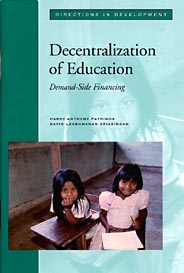
And the review of this little publication (the one on the right) is also interesting:
Despite its brevity (running to just 50 pages), Decentralization of Education is an important book. It describes the World Bank's foray into "demand-side financing," the practice of providing families with financial assistance so that they can purchase educational services in the private sector (rather than having governments own and operate schools). The various case studies discussed reach from the Dominican Republic to Pakistan, revealing just how widespread the practice has become, and how effectively it is reaching even the poorest families.The book's chief weakness is that it does not seize the opportunity to apply the lessons of its case studies to its review of the academic literature on school choice. The first section of the book is a digest of the (mostly theoretical) arguments that have been made for and against school choice. Since a large portion of this literature is badly reasoned and devoid of supporting evidence, it is frustrating that the authors did not apply what the World Bank is learning about demand-side financing to a critical assessment of the arguments pro and con.
It is also somewhat unfortunate that the book takes for granted a major funding role for the state in education, …
Double indeed.
And look, here's a a brand new blog (well it must have been once), by the editor of the School Choices site. It isn't only education stuff. But he does seem often to focus on the intersection between education and the main news agenda, as here:
Quote:
The Coalition Provisional Authority has officially handed control over Iraq's schools to the country's own Ministry of Education [free registration required]. No word when, if ever, control will be returned to families.Saddam, like virtually every totalitarian dictator in history, nationalized or shut down all private schools upon seizing power. The reason why is obvious: it's a lot easier to whip up support for your own regime and antipathy toward your enemies if you control the schools. Centralized government control over schooling is thus key.
What to do?
Iraq's internal religious divisions provide ample prospect for conflict if the nation sticks with an official government school system. Iraqis already realize that settling on a universally acceptable curriculum is a key sticking point.The solution: implement a market-based education system with need-based financial assistance, and let families pursue the kind of education they value for their children without obliging them to force their choices on their fellow citizens.
Question. Does copying and pasting other people's stuff instead of thinking of it all for myself mean I'm cheating? Why no. This is just one more way to learn.
And now, here come the Indians:
Indian students will be the third largest overseas students in the United Kingdom by 2020, outnumbering those from USA, Germany and France, a study indicated on Wednesday.As many as 29,800 Indians are expected to study in the UK by 2020 as against 8,600 in 2005, the study by the British Council and Universities said.
China, however, will have the largest number of overseas students in the UK – 130,900 – in 2020 as against 32,000 in 2005, the study said. It will be followed by Greece which will have 34,800 in 2020 as against 28,000 in 2005.
Britain could earn £13 billion a year from international students in higher education by 2020 in addition to the £3 billion they currently contributed to the economy, the study stated.
A separate government-funded study calculated that education has become one of Britain's most important export industries.
The report by Geraint Johnes, Professor of Economics at Lancaster University, said the economy earned £11 billion annually from 'exports' of tuition for foreign students, training, examinations, publishing and educational programming.
That places education in the same league as exports of oil and financial services, which earned Britain £14.3 billion and £13.6 billion in 2002, according to figures from the Office for National Statistics.
It is also slightly ahead of the British car industry, food beverages and tobacco, which earned £10 billion in exports. Education also dwarfs exports of ships and aircraft, at £6.5 billion, while computer services earned the country only £2.6 billion.
Britain at present has a quarter of the market in foreign students, with 270,000 enrolled in its universities and contributing an average of £16,000 a year each in fees and living expenses to the economy.
The British Council study, entitled 'Vision 2020: Forecasting International Student Mobility', concluded that the total could rise to 511,000 by 2020 if Britain maintained its present track record for recruitment.
However, student numbers would rise to 400,000 by 2010 and 870,000 in 2020 if both the country and its universities were promoted more aggressively in fast-growing new markets.
Demand was rising quickest in Asia, with annual growth in student numbers forecast at 15 per cent in China, 13 per cent in India, and 12.6 per cent in Pakistan.
Chinese students alone would outnumber those from the whole of the enlarged European Union of 25 states by 2020.
Some 145,000 students could be studying in Britain by then, compared with 43,000 now, making China by far the biggest and most lucrative single market for British education.
India would become the third-largest market with 30,000 students, as many as France and Germany combined. Asia would overtake Europe as Britain's main source of foreign students, accounting for more than half of student places.
Fascinating. I kept trying to find a place to stop copying, but kept wanting the next paragraph, and the next, and the next.
I speculated yesterday (see the immediately previous posting) about what impact all those Chinese students will make, upon China and upon the world. What the above report makes me ask now is: what effect will all this have on Britain, and on British education?
I'm interested that education is only "slightly" ahead of the car industry here. I thought the car industry here to be very tiny, but apparently not. I guess it's merely that our car industry isn't owned by us any more. There's still plenty of it.
The Chinese continue to develop their connections with the educational Anglosphere. Says People's Daily:
The Chinese Ministry of Education has signed an agreement with the IDP Education Australia to collaborate on a number of programs.The programs include holding university preparatory courses in China approved by 38 Australian universities, and establishing joint courses between the two countries. The plan will help Chinese college students transfer to Australian universities for further study.
Meanwhile, both sides are cooperating to develop training courses and projects for Chinese government employees and company managers.
I know, I know, it's all very clumsy and government-to-government. And the link to Australia is somewhat comical. But I think this stuff is interesting. What the enormous numbers of Chinese students now studying abroad or being educated in China by foreigners get up to in their lives is going to be one of the world's great stories, however it plays out, of the next fifty years.
Yes, an interesting posting over at Samizdata about a row in Japan about the compulsory respects that must now be paid to some (very controversial) symbols of Japanese nationhood, in Japan's schools. So far, over 200 teachers have rebelled.
Scott quotes at length from this article.
I think that giving prizes to great teachers is a great idea.
Who was the best maths teacher in Britain, last year? Who was the best science teacher in Britain, last year? Is there any award ceremony which tries to find out? I seem to recall some kind of televised (in Britain) event at which teachers were given prizes and celebs took it in turns to recall their favourite teachers, but alas I missed it for some reason. Can anyone fill us (me) in on that?
We'll know when this process has worked. The great teachers will be celebs.
Oddly enough it was this prize, which has had an amazing effect (on space flight), which got me googling for teaching prizes.
A recent Glenn Reynolds TCS article about this X-Prize, and about prizes generally, ends thus:
NASA wonders too, and is establishing its own prize system called Centennial Challenges. At the moment the program is new and relatively small, but I hope that we'll see other government agencies – and private philanthropists – consider the prize approach. It's not a panacea, of course, but it's a way of bringing many minds to bear on a problem, and trying out many different approaches in parallel. I suspect that many of the 21st Century's problems will benefit from this sort of approach, and I hope that the X-Prize example will break new ground, not only in terms of spaceflight, but in terms of all sorts of other problems.
Why shouldn't that sort of thinking apply to teaching?
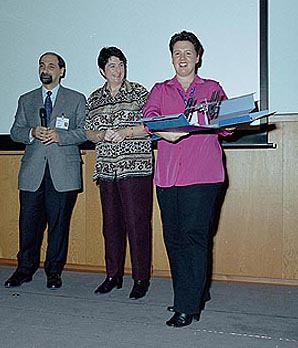 This picture here is captioned as follows:
20 November 2001
Mrs Susan Burr from the Kyle Academy in Scotland wins the 'Most Inspiring TEACH SPACE 2001 Award'.
Well done TeachSPACE. I picked this picture simply because it looked nice, and illustrated the principle, of turning little known good teachers into slightly better known good teachers. It was pure coincidence that once again the space exploration angle asserted itself.
If you want a window into the world of yoga - and more to the point here: yoga teaching – this posting, full of links, over at Alan Little's Weblog could be just the thing for you.
Interesting bit right at the bottom:
Coming soon: further thoughts on how yoga teachers are trained and certified, and why I would sooner trust a system based on the gut feel of a nearly 90 year old guy in India, than any kind of formal examination and certification scheme.
As so often in education nowadays, India leads the world.
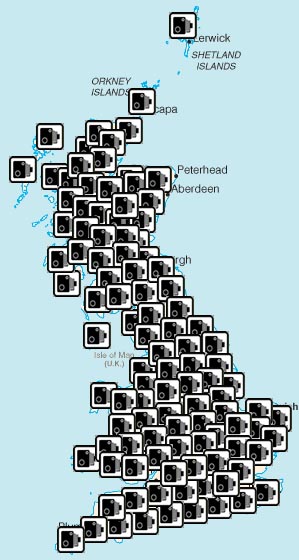 I can stick up pictures here (and here), but do not have such privileges at White Rose. Probably just as well. So this picture – with its obvious civil liberties vibes – goes here, and then I go there and link back to it. It's from b3ta.com, but stuff there tends to disappear rapidly (or such is my fear), so I need to nail it down somewhere else.
The reason this is educational is that I am now feeling the need to learn more about how to do things like attach bubbles of text to people in pictures, to attach captions to pictures, and generally to manipulate graphics as the graphics here have been manipulated, all of which takes a bit of sussing out. I know that once I have learned such things, I will realise that they are all ridiculously easy. Everything to do with computers is ridiculously easy. The difficult bit is finding out which ridiculously easy things you need to learn.
So despite the ridiculous ease of it, and as with so many learning processes, I feel that for things like this I now need some personal face-to-face guidance not to say tuition. Relax, I'm not going to ask you people. I already know who to ring and who to ask.
I think the general pattern here is approximately as follows.
First, you acquire the desire to do something. And then – and this is the important bit – you start doing it. Not load – aim. Load – fire. You learn the abject minimum you need to get going. You then either get fed up and forget about it, or you master your abject minimum and start thinking: You know, I'd actually quite like to really know how to do this. Load – fire – take aim. Fire a few times. Then you see the point of aiming, and you decide you need to learn about it.
Take digital photography. Until digital cameras came along, I couldn't be doing with photography. I had a camera, but it was too much bother and I gave up. The fit with my life wasn't there, enough. Too much bother, too little pay-off. But now I have a digital camera and the fit is very good, what with blogging. So I got started, and learned the bare minimum to get regular results. But now, I am starting to think: Maybe I should really find out about this photography stuff. Maybe I should take a course, or something. And maybe I will at that. The point is, I now have a pile of questions which I know I would like to answer, about how lenses work, how to control light, and what the hell all the settings on my camera mean. Having done lots of firing, I am now in the right frame of mind – slightly informed, respectful of the experts because aware of some of the problems they can solve but which I can't – to start taking serious aim at this thing, and at the things I am photoing. At present, as I never tire of telling my readers and lookersat my Culture Blog, I just click away and pick the best ones. I pick from what I happen to have got. My aim would be to learn how to get what I want, which is a very different matter. In my opinion this is the key conceptual distinction between an amateur photographer and a pro.
But with graphic design I don't yet feel the need for any systematic or prolonged study, yet. What I need is the bare minimum to start getting results. For that, a little personal guidance is in order – a little teaching. But a great big course would be superfluous.
I have done a posting at Samizdata about this article.
Samreen is a ten-year-old Pakistani girl who lives in Machar Colony, one of the biggest and most desperately poor of the 553 slum communities that are multiplying and choking the port city of Karachi to death. Her living conditions are medieval. On reclaimed harbour land, just a mile and a half from the impossibly remote, high-rise financial centre of the city, she shares a small, dark, dirt-floored room, no more than a box, with her mother and four brothers and sisters, hidden away down a narrow, stinking alleyway swarming with people and vermin. All around, as far as the eye can absorb, is a sea of filth, shimmering beneath a hot brown fog. In open sewers, rats,
playful as baby rabbits, mingle with malnourished children struggling to get through the day, labouring for miniscule wages, listlessly scrounging for food scraps and minding the babies, often their own. Generation follows generation quickly here, men and women as easily replaceable as the hovels in which they live. It is a special kind of human waste that comes with this sort of established destitution. And for the hundreds of thousands marooned in Machar Colony and other slums like it, cruelty no longer has a meaning. It is life itself.
Samreen's father has abandoned the family and disappeared, but she works alongside her mother and siblings, earning one penny for an hour's work peeling tiny, slimy shrimps. Every day they share some tea for breakfast. At lunchtime they have a piece of roti bread, made from flour and water, and in the evenings they usually manage to put together a meal of sorts - more roti and a few lentils, perhaps some vegetables if they've earned enough during the day.
Samreen is one of the lucky ones. On weekday mornings, after she's done her first two hours peeling shrimps, she puts on her school uniform and walks proudly to school. Built and run by the Pakistani educational charity. The Citizens Foundation (TCF), her school is an astonishing oasis in the middle of this desert of utter degradation. Entering the school gates she crosses a neatly swept playground planted with ornamental trees, and goes into the purpose-built primary school building equipped with six light and spacious classrooms, a library, an art room, a computer room, clean washrooms and staff quarters. She shares her classroom with 19 other children, roughly equal numbers of boys and girls, each of whom has his or her own desk and chair, exercise books and pencils. On the walls are colourful tissue paper pictures of rabbits, horses and cows made by Samreen and her classmates, the letters of the alphabet and a range of educational posters about volcanoes, dinosaurs and the solar system. Oxford University Press textbooks are piled neatly on the shelves and a string of numbers, cut out and coloured by the children, is pegged to a washing line strung jauntily across the sparkling window. The classroom would not look out of place in one of London's top private primary schools.
At school, Samreen has learnt not only Urdu and English, but also how to use a loo, wash her hands properly, brush her teeth and plait her hair. She can read and write, recite her times tables, work out complex percentages and compose poems that make her teachers laugh. She studies science and uses the school's computers every week. Each term she has three sets of assessment tests, and her mother - who had never seen a school before - attends three parents' evenings to discuss the results. Samreen's grades are excellent.
Samreen is, understandably, thrilled with her school. She adores her teachers, all of whom are women specially trained by TCF, and she enjoys all her subjects, particularly English. One day, she says, her eyes bright with excitement, she wants to become a teacher. To her mother, this is a concept as ungraspable as owning her own home. but instinctively she is proud of Samreen, and endures the beatings she gets from her brother-in-law who is opposed to the idea of education for girls. Although they miss the income Samreen would bring in during the mornings when she's at school, her mother is happy that her daughter is being given a chance in life. "When she grows up," she says shyly from behind her veil, "she won't have to do shrimp-peeling like me. Something better will come along and I can feel I've done my best for her."

Samreen's is just one of thousands of such heartbreaking stories that pour out of the hellish slums housing the dispossessed of Pakistan. Her school, Machar Primary School 1, was among the first of the 180 schools that have been built by TCF since 1995 in 17 cities around Pakistan, each one of them a small drop of hope in the middle of these parched and blighted communities.
The problems TCF is addressing are, of course, immense, but TCF is a remarkable charity. Raising funds through the donations of wealthy Pakistanis at home, through the expatriate community in the oil-rich Gulf region, in the UK and North America, and through corporate sponsorship, it has proved so successful that it now opens new purpose-built schools at a rate of one a week; and last year it received donations totalling £2 million.
There are many reasons why we should be interested in TCF,but one in particular will strike a chord with those in the West concerned about the rise of Islamic militancy. TCF schools offer an alternative to the most extreme of the madrassahs - the religious schools - that often target poor areas and become breeding grounds for Islamic extremism. These schools only came to the attention of the West after September 11, but in many Karachi slums it has long been normal to see walls plastered with graffiti calling for volunteers to join Taleban-style Islamic organisations. Over the past two decades, madrassah schools have sprung up across Pakistan, offering the incentive of a free education. Some of them also offer the prospect of a wage earned through activism for a hardline group. Today, evidence indicates that madrassah schools are not operating in areas where there are clusters of TCF schools.
TCF was founded nine years ago by six wealthy Pakistani businessmen living in Karachi, who had become increasingly disturbed by the level of begging on the streets. "The divide between rich and poor was getting wider and a large proportion of the population was becoming isolated from the mainstream," says TCP chairman Ahsan Saleem, an entrepreneurial industrialist, whose Crescent Steel group has interests in banking, engineering and textiles. "It was a burning issue and a fashionable topic for pious talk at expensive dinner parties. One day, a group of us were coming back from such a dinner and we just felt nauseated. Either we continued to sit back and watch the place decline or we would do something about it We knew the solution had to come from within Pakistan."
The six of them - all highly successful top-level managers - met in August 1995 and began to think seriously about the problems. They addressed poverty, health, intolerance, population, education, water and sanitation, and concluded that the solution to all these issues was education. In Pakistan, education remains desperately, stupidly low on the list of government priorities. The state schooling system, riddled with corruption, has been either non-existent or on the point of collapse for many years. The result is a massive intellectual deficit: out of a total population of 145 million, the country has 28 million children entirely unschooled and 41 per cent of adult men and 70 per cent of adult women illiterate. Ironically, in some areas, the first parents queueing to send their children to TCP schools rum out to be government schoolteachers.
The six businessmen decided to set up a corporate-style charitable organisation to build and run schools offering high-quality education to both girls and boys in the poorest areas of the country. Within four months, the ground had been broken to construct the first five schools, paid for out of the pockets of the founders, and by May 1996 all five were operational. Only once the schools had been running successfully for a year did TCF begin to expand – not through advertising or asking for funds, but simply by taking people to see the reality and letting them spread the word.
Its target is to build 1,000 primary a secondary schools by 2010, which will cater for 350-400,000 children at a time, offering them a high-quality, secular education that is the envy of most government schools and comparable to the country's elite private schools. "We want these children to compete with our own children," says Saleem, whose four teenage children are being educated at the best Pakistani private school and at the American School.
TCF stands out from other non-governmental organisations because it uses modem, professional management techniques. "TCF is one of the best endeavours in the private sector to compensate for the total decay in the government system," says Imran Khan, whose constituency is one of the most backward in the Punjab region. "There is an apartheid in education between the rich elite and the masses and TCF is trying to bridge that gap."
From the donors' point of view, all the boxes can be ticked. TCF has a clear vision, a set of rules, transparency and longevity. No one individual fronts the organisation, and none of the six founders has a role in its management. Just 5 per cent of funds are spent on administration. The rest goes into the building and running of the schools, providing equipment, uniforms, books, milk and biscuits for the children, and specialist training for the teachers, which is done from a central teacher training college in Karachi. All the teachers are women, which in a Muslim society makes the parents more comfortable about sending their daughters to school; and they are transported in TCF vans to and from their schools, which placates their parents. Every teacher is evaluated during the year and attends a refresher course each summer.
"It takes real courage for these women to teach in schools surrounded by this level of poverty," says Neelam Habib. TCF's manager of donor relations. "Their commitment is very high. They all have clear objectives and the results they're getting are wonderful - of the first batch of students to take the Class IX Board Exams, 92 per cent passed and 25 per cent got A grades."
Each school employs at least two women from within the community who are trained in hygiene. Part of their job is to convince parents to send their children, especially the girls, to school. Although many of the schools have huge waiting lists, their task has not been easy. Many men are opposed to educating girls, and it is not unusual for mothers or older sisters to be beaten by male relatives for sending the girls to school. A child at school also means the loss of valuable income. As a result, most of the children work before and after school, often well into the night. One ten-year-old boy, who has no father and whose mother is blind, is responsible for five younger siblings. Every morning, after a breakfast of water, he works two hours before school and then again after school. With his earnings he buys food in the evening for the family. He puts a plate in front of his mother, and she asks him if they have all eaten. When he tells her they have, she eats her fill, and only then does he allow himself and his siblings to eat, sharing whatever leftovers there are.
But despite individual difficulties, the value of these schools is immeasurable. At a cost of £6 per month per child, TCF schools are giving these children the chance to have a real childhood, at least for a few hours of the day, away from the horror of their home environments, as well as the potential for a future outside the slums. Although it is still relatively young, TCF is already providing a model for a professional, privately run system that could be replicated in other developing countries - there is talk of establishing a similar organisation in Brazil. And it has also set up its own support chapters across the world. "Since 9/11, around half of our UK supporters are of non-Pakistani extraction," says Tariq Hussain, a Trustee who helps run the UK chapter of the Friends of the Citizens Foundation, a UK Charities Commission registered charity. "That's a real boost for us."
The professionals who run the UK Friends of TCF on a voluntary basis, are typical of those who have set up TCF chapters around the world. Its trustees, Hussain himself, Khurram Jafree. a successful City investment manager and Dr Azhar Aslam, a Harley Street surgeon, formed the chapter in 2001. Hussain was born in Stranraer, the son of Pakistanis who moved from the Punjab to Scotland in the Fifties. His father, a self-made entrepreneur, built a successful apparel wholesale business primarily to support his children's education. Tariq went to Glasgow University, qualified as a chartered accountant with Arthur Andersen, completed an MBA at IMD international business school in Switzerland, and is now a managing director in the corporate finance department of a global investment bank in London.
"Every summer holiday we used to go to Pakistan to visit family in Lahore. I hated it at first The country was so poor. But it has so much charm that seeps into your blood and you want to give something back. Many years later I was hunting around for an educational cause to support in Pakistan and I found TCF on the internet. I'd never heard of it, but it had been given a UN award. It was transparent, apolitical, and not fronted by any single personality. The more I saw, the more impressed I was. Khurram, Azhar and I asked TCF if we could set up a UK chapter and we currently raise roughly 20 per cent of TCF's annual budget through corporate and individual donations and special fundraising events. Because we come from professional backgrounds we believe donors should be able to see a professional structure and modern teaching methods. TCF likes to be judged by its actions rather than by spin. Donors are encouraged to visit the schools to see how their funds are spent"
And the children themselves are contributing funds, too. To give them a sense of dignity and to encourage pride in their education. the families of all students make a nominal contribution to fees and to the costs of uniforms, books and stationery, depending on their income - anything from 5p to £1 a month. At times, the results are amazing. Two years ago, a TCF boy won a Unilever sponsored international art prize and had his work exhibited at Tate Modern.
There are many incredible stories of these physically stunted, undernourished children who struggle so hard, taking on the responsibilities of adults to make ends meet, so they can attend these schools. There is the 14-year-old girl from a rural community outside Lahore who, working late at night last year, lost all the fingers of her right hand in a food cutter, but went straight back to work and has also, with help from her teachers, learnt to write again. There is nine-year-old Samina who peels shrimps for six hours a day in return for 6p and attends TCF school along with her brother and sister. Her father spends his meagre earnings on drugs and beats their mother for allowing three of their five children to go to school. And there are so many more like them. It is humbling to see the spirit of these children, their palpable energy and purpose, their enlivened hopes. But it is also humbling to witness the compassion and dedication of their more fortunate compatriots who are providing them, against all odds, with life's most valuable gift.
Further proof of the usefulness of the elderly as teachers of the next generation (but three or four). Ray Crist was a scientist. He retired from that at 70. He started teaching - at Messiah (ha!) College. And he stopped teaching there last Tuesday, at the age of 104.
He's decided to go back to being a scientist.
This story from last month reminds me of something Tim Evans said to me at that meeting I talked at a week ago. He said he'd met this American lawyer who'd been representing/lobbying for Home Schoolers in the USA, and the message was that Home Schoolers are a political force that a US politician crosses at his peril.
Despite this threat, I'm optimistic about the future. There is great cause for all like-minded Americans to be optimistic. A new political force is rising up that will prove to be extremely powerful.The "vast right-wing conspiracy" is indeed growing and becoming more organized, as an unlikely group of political activists arise. Homeschoolers are a group that will soon be a force the left will have to contend with.
Unfortunately, in the past, conservative organizations have always fallen short of the effectiveness of liberal groups. The biggest problem with conservative Christians is not their ideas, but their leadership and organization. The culture wars have been fought by highly organized liberal groups and by dozens of unorganized conservative groups lacking commitment and strength.
Yet, that is changing, and homeschoolers are leading the charge.
This week, I went to a program at the state Capitol called TeenPact – a homeschool program dedicated to educating young people about state government. This organization is an unprecedented opportunity for young people to grow in their knowledge about government and interact with lobbyists, representatives, senators and offices around a state's capitol.
If change in America must be founded upon understanding and education, TeenPact is a prime example of how it should be done.
The Homeschool Legal Defense Association is another organization that not only represents homeschool families and fights legal battles in court, but has also begun to spearhead the movement of homeschoolers in politics. Furthermore, with HSLDA's new political action committee, the force will become more relevant in politics.
And I rather think that Tim's lawyer friend was something to do with the organisation linked to in the text quoted above, the HSLDA.
The whole world will be affected by this, in the longer run. Were it not for the example of America's homsechoolers – who are proving and will increasingly prove that homeschooling works well, and better than the average state education system – the rest of the world might impose compulsory school attendance upon itself without any knowledge that there is a superior alternative. But as American homeschoolers have their inevitable impact upon the world, and increasingly make their voice heard in US politics, that self-imposed delusion cannot and will not persist. There is another way to do things. As they said about the Atom Bomb in 1945, the only secret about it is now public knowledge: it works.
Yes, another foray into a foreign language here at Brian's Education Blog.
This probably won't cause nearly as much fuss as the original ban, but it may be a rather neat solution:
Paris-AP - France is set to ban Muslim headscarves from public schools this fall, but may allow students to wear bandannas instead.The education minister tells French radio the bandannas "may not be conspicuous." In January, the former education minister said bandannas would fall under the ban.
Some Muslim girls wear bandannas to cover their hair – an alternative to the traditional head scarf. Some girls feel the bandannas make it easier to blend in to the crowd.
France's president signed the measure into law last month in an effort to maintain the tradition of secularism in the classroom. It bans what French officials call "conspicuous" religious symbols from public schools.France's president signed the measure into law last month in an effort to maintain the tradition of secularism in the classroom. It bans what French officials call "conspicuous" religious symbols from public schools.
The ban has drawn outrage from Muslims in France and abroad. They say it mostly targets their religion.
I guess it all depends what you mean by conspicuous.
This makes an agreeable change from the usual guff:
Education minister Andrew Mulenga yesterday insisted that education was not a fundamental human right according to the Zambian constitution.
The trouble – one of the troubles – with calling education a "fundamental human right" is that it then becomes the obligation of others to educate you, and you can just sit there with your arms folded and wait for it to just be poured into you. Calling it a human right undermines the notion that education might be something which is best achieved by being actively pursued rather than merely poured into a passively open mouth.
Good for the Zambian constitution.
Someone called Kerry has just left a comment on this posting, thus:
Please Help! I have been teaching primary age children now for 14 years and still love my job! I am now a non class-based Special Educational Needs Coordinator and am BEd [hons] trained. My family and I are giving serious consideration to moving to France but I'm told I will be unable to teach as my degree will mean nothing, what can I do? If we were to go we hope to be fluent in French on departure, we cannot speak French as of yet! Also are there English schools there where I could teach? I would be grateful for any help you could offer . Thank you.
I can't help, but can anyone else? Comments will I'm sure be gratefully received.
Joachim C. Fest's Hitler, first published in 1973, is one of the most respected Hitler biographies. Here is Fest's description of Hitler as a schoolboy.
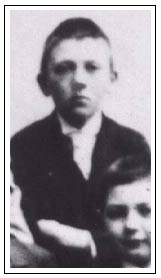 In reality Adolf Hitler was a wide-awake, lively, and obviously able pupil whose gifts were undermined by an incapacity for regular work. This pattern appeared quite early. He had a distinct tendency to laziness, coupled with an obstinate nature, and was thus more and more inclined to follow his own bent. Aesthetic matters gave him extraordinary pleasure. However, the reports of the various grammar schools he attended show him to have been a good student. On the basis of this, evidently, his parents sent him to the Realschule, the secondary school specializing in modern as opposed to classical subjects, in Linz. Here, surprisingly, he proved a total failure. Twice he had to repeat a grade, and a third time he was promoted only after passing a special examination. In diligence his report cards regularly gave him the mark Four ('unsatisfactory'); only in conduct, drawing, and gymnastics did he receive marks of satisfactory or better; in all other subjects he scarcely ever received marks higher than 'inadequate' or 'adequate'. His report card of September 1905 noted 'unsatisfactory' in German, mathematics, and stenography. Even in geography and history, which he himself called his favourite subjects and maintained that he 'led the class', he received only failing grades. On the whole, his record was so poor that he left the school.
This debacle is unquestionably due to a complex of reasons. One significant factor must have been humiliation. If we are to believe Hitler's story that in the peasant village of Leonding he was the uncontested leader of his playmates – not altogether improbable for the son of a civil servant, given the self-esteem of officialdom in Imperial Austria – his sense of status must have suffered a blow in urban Linz. For here he found himself a rough-hewn rustic, a despised outsider among the sons of academics, businessmen, and persons of quality. It is true that at the turn of the century Linz, in spite of its 50,000 inhabitants, was still pretty much of a provincial town with all the dreariness and somnolence the term connotes. Nevertheless, the city certainly impressed upon Hitler a sense of class distinctions. He made 'no friends and pals' at the Realschule. Nor was the situation any better at the home of ugly old Frau Sekira, where for a time he boarded with five other schoolmates his age during the school week. He remained stiff, aloof, a stranger. One of the former boarders recalls: 'None of the five other boys made friends with him. Whereas we schoolmates naturally called one another du, he addressed us as Sie, and we also said Sie to him and did not even think there was anything odd about it.' Significantly, Hitler himself at this time first began making those assertions about coming from a good family which in the future unmistakably stamped his style and his manner. The adolescent fop in Linz, as well as the subsequent proletarian in Vienna, would seem to have acquired a tenacious class consciousness and a determination to succeed.
Sometimes I envy the old-fashioned authoritarians. I really do. They are so certain, so sure, so confident. And at their best, they write so well:
Forcing every child to re-invent the wheel turned out to involve a heavy price in illiteracy, innumeracy and the inevitable frustration that went with these disadvantages. But what mattered was the principle of anti-authoritarianism.For a teacher to enforce standards of social behaviour, not to mention grammar and spelling, was a form of cultural imperialism: an imposition of "middle-class" values on pupils whose own communities lived by very different rules. (And those communities - however delinquent or feckless - were never to be judged or condemned, just as their dialects - however sub-literate or socially incapacitating - were never to be corrected.)
Now the teachers' leaders, who defended this pernicious ideology with relentless fervour against Thatcherite ministers, have the jaw-dropping effrontery to blame its consequences on the very government that tried to curb it.
The president of the NAS/UWT, Pat Lerew, is absolutely right to say that the bullying, anti-social behaviour of today's children is a result of their parents having grown up with "little respect for teachers and others in authority". But they did not learn that disrespect at Thatcher's knee. They learnt it from their teachers - in the classrooms of the 1980s, which were self-consciously dedicated to the idea that no authority figure was worthy of automatic deference, that no rule should go unquestioned and that no goal was worth pursuing except the narcissistic one of "personal self-fulfilment".
This is Janet Daley, commenting on the NUT Conference I have already referred to.
… Now the current generation of teachers - who are far less ideologically driven than their predecessors - are paying the price for that regime of anti-discipline, anti-authority and anti-structure. There is a generation of parents who well and truly learnt the lessons they were taught in school.
Daley says the prisons should be run by the warders, and that Lerew and her cohorts have merely allowed the prisons to be run by the prisoners, and so far as that critique goes, I agree. If I have to choose only between Daley-ism and Lerew-ism, I choose Daley-ism. But in common with the progressives of an earlier time, whom Lerew still goes through the motions of echoing, I want to believe that there are better ways to do things.
How do you get free child care if both Dad and Mum are working full time? Answer: Granny and Grandpa.
A bit tough, perhaps, on the more youthful grandparents who had been looking forward to spending their retirement and private pension plans on Swan Hellenic cruises or bingo. But there is a bright side. Far from being a burden on family resources, grannies can now look forward to being viewed as an asset. Good God, with childcare costs reaching £200 a week in central London, what prudent professional woman wouldn't consider bringing in her mother, or indeed her father, to do the same work at no cost at all?It's one of those beautiful occasions when self-interest, family affection and natural sentiment coincide. At least the grandparents who are complaining about exploitation are being used as nature intended. A scientific study recently demonstrated what we all knew, which is that daughters tend to have more children when their mothers are on hand to take care of them. In return for the hard graft, the grannies get a genetic advantage in the Darwinian scheme of things.
There's no way Europe's ageing population is going to be able to just lounge around and do nothing, or go Swanning off in its entirety on Hellenic cruises. They'll have to make themselves useful. Personally I think that oldies have a great future also, in addition to being underpaid child-minders, as underpaid school teachers.
Here's my plan. The oldies teach, but unlike regular paid-with-real-money type teachers, they won't have to teach any kid who doesn't want to learn and won't behave. In exchange, the oldie-teachers will get paid some pocket money and won't be abandoned in Dickensian oldie-homes. I really think that might work. For the educated ones, I mean.
It seems I may have been making more of a contribution to the world of teaching than I had realised.
But alas, I spent my education blogging time doing a posting about this strange circumstance for here, only to realise that the logical place to put it all was not here but on Ubersportingpundit. And sadly, reporting this diversion is now all I have time for, here, today. I'll try to do better tomorrow.
Speaking of tomorrow, I am meeting tomorrow with a critic of phonetics. Just how severe I have yet to learn, and I don't want to prejudge anything, but it should be most interesting. With any luck at all, this will yield at least one worthwhile post here.
The newspapers and TV are full of stories about how angry the teachers are. This puts it all in perspective:
Like the Grand Old Duke of York, Doug McAvoy, in his 15 years as general secretary of the National Union of Teachers, has repeatedly marched his troops to the top of the hill and then marched them down again.
Under his direction and leadership, the biggest teaching union has religiously opposed every education initiative introduced by both the Tory and Labour governments.
Delegates who give up their Easter break to attend the annual conference - the union's "supreme policy-making body" - have always reserved their special venom for national tests, school league tables, performance-related pay, academic selection, and Ofsted inspections.
For the past 15 years, every conference has climaxed with a series of votes for industrial action on one or more of these issues. On every occasion, the media - usually starved at Easter of domestic news - have helped fan the flames with headlines promising imminent classroom chaos.
Yet in all the 15 years of Mr McAvoy's tenure, the NUT has never once taken national industrial action - a record that fills this latter-day duke not with dismay but pride. For the fact is that everyone who attends the conference enters a virtual world.
The 900 or so delegates, most of whom revile New Labour, know that their resolutions will be rejected by the great majority of the union's 250,000 members, but they pass them just the same.
Mr McAvoy knows that the union's influence on governments of any hue is, and always has been, negligible, yet he presses his case with undiminished enthusiasm.And the media know that the conference is a charade, yet they - we - report its doings as if they really mattered.
Yes, that makes sense. I confess that I had been wondering what all the hoo-hah about a possible teachers' strike was all about. Not much, it would seem.
Not being keen myself on "national tests, school league tables, performance-related pay, academic selection, and Ofsted inspections", you might expect me to sympathise with these rebellious NUT folks. But I hate all that rigmarole because I hate nationalised industries, and that is inevitably the kind of thing that nationalised industries consist of. They are inevitably either cursed with lots of overpaid drones or with lots of over-managed drudges, but also with bureaucratic procedures that offer no automatic means of knowing which is which or who is who. To solve each problem inevitably results in the exacerbation of the other problem. The point about markets is that they at least provide some clue as to whether you are contributing as much as you are being paid or not.
These teachers insist on the perpetuation of nationalised education. They abominate the idea of a total educational free market. They just don't like the politicians telling them what to do, because they regard themselves as all being over-managed drudges. But they would, wouldn't they?
The problem is that people move to houses in the catchment areas of good schools. Lots of parents want their kids to go to a few good, but oversubscribed, schools. An Conservative Education Spokesman Tim Yeo is floundering.
Mr Yeo's suggestion that schools could be prevented from using proximity to a school to determine places would mean that popular schools would have to find other ways to choose from hundreds of families seeking a few dozen places.
Doug McAvoy, NUT general secretary, suggested that headteachers would have to "pull names out of a hat". Mr McAvoy said that it raised the prospect of people who had homes beside good schools having to drive their children to less good schools that could be miles away.
"Parents are not going to like that," said Mr McAvoy.
And in particular middle class parents who have taken out huge mortgages to get near to a desirable school are unlikely to be keen on such a scheme.
But Mr Yeo appeared to contradict what would be a highly controversial proposal by also saying that schools would be allowed to decide their own admission rules.
That would mean schools being able to continue using distance from the school as grounds for admission - which would mean that better-off parents could still buy into catchment areas.
Mr Yeo emphasised that the pupil passport proposals were about expanding choice, particularly for families living in deprived areas."I want all parents to have the kind of choice which at present is only available to those who can afford to choose where they live," he said.
Not being fascinated by the pronouncements of politicians about education, I may have got this all wrong. But it seems to me that Yeo's policy will only work properly if popular schools are allowed to expand, and if it is also accepted that unpopular schools might close, if they persist in being unpopular. But since expansion takes time, any expansion plan is by its nature a risk, and the possibility of your school disappearing is also a risk. And why would the people in charge of schools take such risks unless there is the prospect of profit. For as long as these schools are run by people on fixed salaries that don't increase all that dramatically even if their school gets very popular, why would they take such risks? And if they wouldn't, then this means that there is this vast mob of parents chasing a fixed number of popular school places, and the unpopular schools stay in "business" (the inverted commas being because it isn't really business at all) simply so that there are enough places for everyone.. Which is pretty much the situation we have now. Yeo wants to fake some of the aspects of a free market, while omitting to include various other essential features. And since that would have daft consequences, he wants actually to restrict other seemingly market-like activity, such as schools deciding who they let in. Like I say, floundering.
Or am I missing something? It wouldn't surprise me a bit if I was. It's only politics and I do not give this my full attention.
Even the images you get from google with "school" aren't really that good. This is one of the better ones.

They're barracudas.
Happy Easter.
Once again, we are told how well it all worked, but not, in the end, what "it" actually consists of. What is this "method" that is so wonderful? And to what extent does it depend on having teachers as talented as Thomas himself to make it work? I get the feeling that this man has not been as forthcoming in answering such questions as he would have needed to be to have as much influence on the regular school system as he clearly wanted to and wants to.
But rather than italicise here at length, I will let this further excerpt speak for itself, and then, when I have done some further digging into the Michel Thomas phenomenon, I may then do some further non-italicised writing about him in later postings. But no promises.
In the early 1970s Michel was approached by Andrea Kasza, principal of Norwood Elementary School in the heart of South Central Los Angeles. The principal had a serious and fundamental problem with her five hundred pupils. The school had originally been split between sixty per cent black and forty per cent Hispanic students, but was moving rapidly towards a Spanish-speaking majority. None of the new arrivals spoke English, and there was not a single Hispanic teacher on the staff. 'There were only two who knew any Spanish at all - one of whom was Jewish, and the other Japanese.' There were no government programmes at the time to help, and while Kasza attempted to hire Spanish-speaking teachers, she sought desperately for something to fill the gap. 'I wanted the staff to learn enough Spanish quickly to be able to communicate with the students. I had heard about Michel's Foundation and contacted him. We set up a class for twenty teachers who had no Spanish at all, and they took one of his crash courses.' It was an unqualified success. 'The teachers were very happy with the programme and many of them went on to become fluent in the language.'
During the course, Michel decided he also wanted to work with the young children, which he had not done before, to help them speak English. 'I didn't have the money to hire him for a year, and he did it pro bono,' Kasza said. 'It would never have happened otherwise.' Michel was given carte blanche for a year to teach not just languages but every subject. 'I had thirty kids in the class and divided them into two groups. One used a teacher and one used tapes, and I rotated them. It worked like a charm.' A six-week block was set aside when the primary school children who spoke only sub-standard barrio Spanish were taught nothing but English as a foreign language. 'A child in America must speak English or become a permanent second-class citizen. So they learned English and also had their level of Spanish raised. They learned how to speak and write in both languages in these six weeks.' The second six-week block course was in mathematics, again using a rotating combination of teachers and tapes.
Kasza watched Michel at work and devised a curriculum over time to enable ordinary schools to adopt the method without disruption. The programme started with kindergarten and spread to involve all grades and the entire staff. The Spanish community approved because the programme maintained the use of both languages. The school became recognised as having the best transition programme in the country, and people came from all over the world to study it. 'We developed an outstanding programme,' Kasza said.
'The teachers loved it, the children loved it, the parents loved it and we had great press.'
The courses were given the official endorsement of the California Teachers' Association and the National Education Association. Michel was greatly excited and waited for the various state and federal educational bodies to express interest. 'I waited for the phone to ring. I expected the Education Department to hammer on my door. Instead, there was silence. Nothing.'
'I don't know why people don't support things,' Kasza said. 'It's so difficult to create change. Certainly don't look for it in the language departments of the universities. They're the most resistant to change of any educational group I know. They ignore the practitioners. A new approach means asking a whole department to change its attitude, and that's the problem. In the academic world people get comfortable with what they're doing. What would happen to all those Spanish professors with tenure? They'd have to change their ways. If the man who invented the paperclip needed the approval of a university department we would never have had the paperclip. They would say people had never used paperclips before, so who needs them?'
I have tried typing "education" into google and picking the images option, and I have tried typing "school" into google and picking the images option, but the best source of pictures for here looks like when I type in "teaching" and pick the images option. Best image so far:

Ah yes, those silly, silly women. And in 1917, no men were doing anything silly, anywhere, were they?
Nevertheless, interesting stuff about the cars you need to teach driving. There's a case where the discovery method can't be allowed to just let rip.
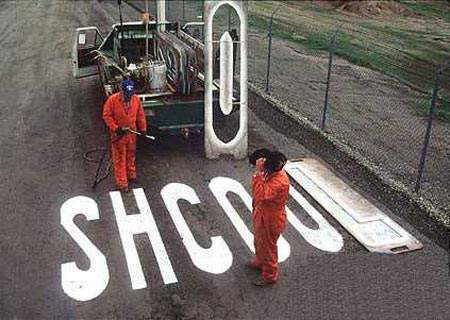
Tomorrow night at the Evans household I am to speak, at the April 2004 "Putney Debate". I use inverted commas because there is not usually much in the way of a debate at these events, more a talk and comment that is mostly in approximate agreement. But education is sometimes different, because when it comes to education there are two entirely distinct paradigms, both recognisable as libertarian, which tend to vie for supremacy. Basically the battle tends to be freedom for parents versus freedom for children. Not that even those two attitudes always conflict, because parents are surely more likely to want the sort of education that their children are going to approve of and make something of. And children are likely to want the kind of education that their parents approve of, because they tend to inherit their parents' tastes and values.
I may say some of the above, but my main approach will be to try to stir up a good discussion about education, and then take notes of anything said that strikes me as interesting, so that I can pass it on here.
I sometimes do a little talk about how to give talks, and the most important thing about talks, I am completely convinced, is that you have to have something you want to say to the people you are talking to. It sounds obvious, and it is, but it is easily forgotten. Yet until today I had failed to ask this question of myself, about this talk. And the main thing I want to say to these particular people, I realised this afternoon, was not this or that opinion of my own on the subject, but: "Tell me what you think/remember/recommend on the subject." Truly. I am genuinely more interested in what they say in the after-talk discussion than in anything I might say to them.
This is because I have come to regard personal thoughts/memories/ recommentations as more interesting than most educational newspaper stories. These mostly seem to consist of statistical generalisations of dubious provenance, and politicians saying that things in general are either getting in general better or in general worse. And I now prefer the particular.
I believe the world of education should follow a laissez faire approach, let people sort things out for themselves – in other words treat education the way the world ought to treat the rest of the economy – not because this will result in an X or Y per cent improvement in educational outcomes of this or that pre-determined sort, but because just what constitutes a desirable educational outcome is best left to free people to decide for themselves. I don't believe in national standards, and in national statistics, and in the arguments that accompany the publication of these statistics. I believe people should set their own standards, and pursue their own preferred outcomes.
I personally believe that teaching people to read is the most important teaching job there is, because reading opens all other learning doors. And I even think that there is a best way to set about doing this, but I don't think that these priorities should be imposed forcibly on people who don't agree with them. I think persuasion will be quite persuasive enough.
That however is a big picture thought, and as I say, I now prefer the small picture thoughts. I find the individual insights of individual people concerning the educational circumstances about which they are truly well informed to be the interesting ones.
As for any individual insights of this sort that I might offer myself, this talk is taking place at the worst possible moment for me. I am about to become one of those Volunteer Reading Helpers, which when it happens will provide a steady stream of insights from me, but that hasn't started yet.
Nevertheless, I'll think of some things to say myself, if only out of politeness.
Anyone grumbling about education in Britain would do well to read the stories that emerge these days from the world of African education.
Consider this:
What appeared to be a peaceful protest by students of Ekiti State College of Education, Ikere-Ekiti, in support of the acting provost whom they preferred to continue in office, turned bloody with several students killed when armed policemen shot at them unprovoked.Two students of University of Ilorin were killed during a recent protest over water scarcity on the campus.
At the University of Lagos, a bus driven by officials of National Association of Nigerian Students (NANS) killed a final year student.
Lagos state University (LASU) records an average of a student killed quarterly by cultists.
Not quite long, Ambrose Alli University (AAU), Ekpoma, Edo state, was in the news when five students were killed on a single day by a cult gang simply because the deceased spearheaded anti-cult campaign on campus.
Student killings were reported at the polytechnic Ibadan, University of Benin, Delta State University, Abraka, University of Calabar, University of Port Harcourt, Enugu State University of Technology (ESUT), Federal University of Technology, Minna, University of Uyo, Ahmadu Bello University, Zaria, just to mention a few.
During this current academic session soon to end, no institution of higher learning in the country was spared the spectre of violent, tragic death of students killed either by police or cultists. To be exact, more of the student killings were caused by cultism – a deadly menace which has remained intractable.
Students killed when protesting over water scarcity. Deadly cults. It puts arguments about top-up fees into perspective, doesn't it?
I have just done a posting at Samizdata entitled Anti-Americanism as teacher testing which may be of interest to readers here, in which I make use of a classroom analogy to explain (at least part of) the current wave of anti-Americanism that the world is now indulging in/suffering from.
The piece isn't really about classrooms at all, but I do deviate a little into education theory, concerning the claim (mostly bogus I think but in some cases true) that "children need limits".
… and the nearest thing to a philosophy of education to be found in this book about Michel Thomas is the following:
'We handicap and hobble and put a heavy lid on the immense innate learning potential of the human mind that is in everyone. Education has become a conspiracy between parents and governments to control children. Every child is institutionalised at the age of five or six and sentenced to at least ten years' hard time until so-called graduation. Children serve time by law, and I call it a conspiracy because parents consent to it and the government enforces it. So children become prison inmates – except unlike prison inmates they do not have a voice with which to protest, or advocates to protect their rights. Children don't have anybody. They have to serve their time unconditionally. After such an experience many naturally feel they have had enough of education and learning. They have no wish to continue. School's over and done with – learning's finished. From childhood on we are conditioned to associate learning with tension, effort, concentration, study. In essence, learning equals pain. The educational experience has been a painful one, and has capped the immense learning potential of each child. This is a tragedy.'
Conventional teaching, Michel argues, closes rather than opens the mind and cripples even the best students, blocking the subconscious because of the tension it creates. 'Why not make use of the full potential of the human mind, by combining the conscious and subconscious? And you can only tap into that if someone is in a relaxed and pleasant frame of mind. It is important to eliminate anxiety and tension. Then and only then is a person completely receptive to learning. People do not want to expose themselves to more pain, or face what they think are their own inadequacies. Yet these are the very people who become most excited when they see that they can absorb and progress quickly and easily.'
Michel's approach overcomes the most stubborn cases, and he insists there is no such thing as someone being unable to learn. He emphatically rejects the idea that a person has to have a gift, or 'ear', to be able to learn a language. 'Have you ever met anyone, however stupid, who cannot speak their own language? Everyone is gifted. Anyone who can speak his native tongue has already proved his gift for language and can learn another.'
To try to find out how he does what he does, I have been reading a biography of Thomas called The Test of Courage by Christopher Robbins.
However, most of this book is about Thomas' experience battling with the Nazis and their various allies, collaborators, sympathisers and apologists. I have searched in vain for a systematic statement of his philosophy of education, for his one or two page explanation of how he does it, whatever exactly 'it' may be. Basically, Robbins is not telling us how Thomas teaches. He is telling us what else he has done, and what experiences he brought to teaching.
But there are a few clues, of which the description that follows, very long by the standards of blog postings, is one. You may not want to read all of it, but I found it fascinating, and inspiring. Is it really possible to teach as successfully as this?
The proof of the system, for anyone who cared to investigate, lay with the students. Sometimes, these came from the most unpromising backgrounds and circumstances, such as a class of fifteen-year-old black ghetto youths in a Los Angeles inner-city school still reeling from the aftermath of the Watts riot. Academic activity had been brought to a grinding halt after a series of student sit-ins developed into violent demonstrations culminating in a full-scale riot which almost completely destroyed the school. Teachers walked out, claiming unreasonable working conditions. The principal had a breakdown and had to be replaced. The new principal appealed for outside help. In the circumstances it seemed an almost quixotic gesture on the part of Michel to volunteer to enter the war zone to teach for a week. 'One of the criticisms of the militant community then was that what was taught to black youth was irrelevant. So I thought the most irrelevant thing I could do was to drive down to South Central and teach French.'
The principal was pessimistic about the entire enterprise. The government had given the school an emergency grant of thirty thousand dollars – a large sum at the time – to clean up the debris from the riot, but not a cent extra for education. Discipline in the school had declined to the point where teachers were forbidden to close classroom doors, as this provoked troublemakers to break them down. Authority was flouted to the point that couples fornicated in the corridors. Most students had no interest whatsoever in learning anything. Some were violent. Michel was warned that he might be exposed to verbal or even physical abuse.
'Just give me a class and I'll handle the rest,' Michel said.
'No, no, no - it's not so simple,' the principal said over the phone. 'You have to come down here first and assess the situation. It's wild!'
'I don't need to come down. Just arrange a class and I'll be there at eight o'clock Monday morning.'
The class to be taught was described as 'consisting of twenty-four recalcitrant eighth-graders, markedly below-average students, severely deficient in reading skills or other basic skills for that matter, but judged to be of average intelligence'. The principal remarked ironically in a letter to a colleague that he was interested 'in determining whether Mr Thomas could take an irrelevant subject, French, and make it relevant'.
Michel arrived at the school to find police with attack dogs patrolling the grounds. Many of the buildings looked as if they had been bombed, the flagpole had been bent to the ground and the Stars and Stripes removed and burned. No undamaged classroom was available, so a storage room was found. The students proved as difficult, academically dull and potentially dangerous as promised. Michel was confronted by the simmering mix of dumb insolence and hostility presented to every teacher who attempted to broach the shield of defiant ignorance. Michel responded philosophically: 'I have always learned the most from teaching students who are very difficult.'
From the first moment he wrong-footed his surly crew, who were unprepared for a tutor whose unspoken maxim was. The student is never wrong. 'Teaching is my responsibility, not yours,' he told the class, assuming a quiet, unhurried manner. 'Don't worry about remembering. That's my responsibility too. I don't want you to take notes. There will be no homework. No tests. The work involved here is mine, not yours.' He asked the class whether anyone knew where French was spoken. There was no reply. When pressed, one student suggested London. Why? Because London was in Paris. Michel made no comment, but quietly began to explain, without sarcasm or censure, that French was spoken in France, and also in a number of African countries. As he elaborated on the importance of the language in Africa, he began to teach, but in such a casual, offhand way that no one felt obliged to object. 'Much of English is French badly pronounced,' he said, illustrating the point with the French pronunciation of a number of words used in everyday conversation: experience, realisation, gratitude. 'In fact, you know a good deal of French already, much more than you realise.'
As he talked, he attempted to estimate the size of the problem facing him. Not only were the students below average, they were completely uninterested in learning at best, and disruptive and potentially violent at worst. Mentally, he divided the class into three groups. The first was made up of those who were shy and tried to hide behind others. The second, and largest, group comprised the passive and indifferent, some of whom had trouble sitting still: they rocked, drummed on desks with their fingers, tapped their feet, moved about, or even slept. Finally, there was a troublesome minority who were defiant or actively belligerent. Even to ask one of these students his name was to provoke an abusive answer. Michel decided to concentrate on the first group – whom he designated the Shy Group – while hoping to bring in members of the second group – the Indifferent Group – over time. He ignored the belligerent faction.
The first objective was to give as many students as possible an early sense of achievement within the first half hour. Using one of his many heuristic techniques – described as 'mental hooks' – he demonstrated to the class that they already possessed a French vocabulary of as many as three thousand words or more. And that these were not 'baby' words, but complex adult words, so they did not have to begin learning as children. He pointed out that most English words ending in -tion, -able, -ence and -ism were the same in French (condition, capable, experience, realism). And that many English words ending in 'y' had an 'e' in French: fraternity, paternity, liberty and so on.
No one was ever questioned directly or allowed to raise his hand. Students were never called on by name but were encouraged through eye contact. If anyone apologised for making a mistake, Michel asked, 'Why are you apologising? Why are you concerned? Eliminating mistakes is my problem. Why are you worrying? You are not supposed to know the language yet.' His gentle, continued insistence that he alone was responsible for each student's progress, and his acceptance of blame for all mistakes, led to an immediate reduction in anxiety and tension. He had removed what he describes as 'the terrible burden of expectation'.
Once members of the Indifferent Group saw the Shy Group respond, they began to take an interest. Those who were usually ignored by their peers, and rarely dared speak up in English, were beginning to form sentences in French. Even the most timid students lost their self-consciousness, while the indifferent were pulled in one by one. No one was ever urged to try harder or respond faster, but was advised to slow down at the first sign of tension or nerves. And while individual students progressed at different rates, the learning process moved very rapidly. Unannounced, informal exercises that seemed effortless were in reality carefully planned, and while the pace seemed relaxed and unhurried, the speed at which learning occurred was
dramatic.
Within two hours Michel was helping any student who bothered to listen through such complex sentences as, 'If I had known you were coming to town this evening, I would have made reservations for us at a restaurant, and would have tried to get tickets for the theatre.' Or, 'I am very glad you are going to come and have dinner with us at the house tonight because I would like to speak to you and I would like to know when you are going to be here because I am going to cook.' By the end of the first day he had the class pretty well in hand, and the interest of the first two groups had been greatly enlarged. He continued to ignore the belligerent group.
Before dismissing the class he felt secure enough to take a strong hand. Speaking in a friendly (in order to show that his purpose was not to punish) but firm manner, he said: 'I came here to teach. To show you that you can learn. That you can learn anything. If you want me to come back tomorrow I want to know I can teach without disturbances. There are some here because they want to learn. I also notice that some of you are not interested in learning. I feel it is unfair that those who want to learn should be disturbed and interfered with by those who do not. So I am going to separate the class and only teach those who want to leam. Will those who do not want to learn French please raise their hands.' Not one hand went up.
The next day started very differently. Everyone was involved, and even the belligerent group was quiet. Minor disturbances were punished by sending the offending student out of the room for ten minutes. The classroom had to be evacuated during the lunch hour, something many of the students feared because the playground had become an unpleasant and dangerous place. Michel told them he would be pleased to let them stay in the room if they could be trusted. Some of the larger, 'belligerent' students immediately volunteered to police the others. 'No. There are to be no bosses. If you want to stay in the room each of you has to accept responsibility for his own behaviour.' The students insisted they could control and protect the room.
After lunch, Michel was still in conversation with colleagues when the bell went. One or two of the regular teachers were sceptical when they heard of the progress achieved by a class generally acknowledged to be made up of hostile, dead-end losers. As the discussion continued there was a knock on the faculty door and one of the students stuck his head in. 'Please, Mr Thomas, the class is waiting.'
One of the most obvious student deficiencies was a general inability to listen, either to Michel or each other. He introduced a game in which he would try to 'catch' someone not listening. The students began to take satisfaction in not getting caught, and after a day the game became redundant. At the end of the third day an extraordinary thing happened: the students pleaded with Michel, and the school administration, to have the class continued for an extra week. This was arranged.
On the fourth day, Michel was reasonably satisfied with the performance of the class but still suffered occasional interruptions when talking broke out. By merely pausing for a couple of moments, these incidents stopped. Although remarkable progress had been made, he decided the intellectual habits of the class could benefit from further tightening. Choosing a minor lapse in attention on the part of several students, he staged a walk-out towards the end of the day.
'I told them I was quitting. I repeated that I was there to teach and could only do that to people who wanted to learn. "I will not teach with disturbances. So fine, I'm leaving."' Although there was an immediate chorus of protests, he left the room and made his way to the common room. 'The purpose of the walk-out was not to establish a reputation as a strict disciplinarian, but to
further train the students as persons willing to control their own impulses out of concern for fellow students and in the interests of their own learning.'
He waited five minutes, but the expected delegation failed to materialise. He feared he had misjudged his timing, and at the end of ten minutes was very tense, alarmed that he had made a serious mistake. He began to think of a way to correct this when five students appeared to say that the class had discussed the matter and had voted unanimously to request his return. As he re-entered the classroom he was touched to find that during his absence the students had swept and tidied the room, and found a chair and desk which they placed at the front for him.
'There is one more thing,' Michel said. 'No bubble gum. I don't want to see it or hear it!'
This was almost immediately ignored, but two large youths from the formerly belligerent group jumped up of their own accord and confiscated gum from the others.
During the lessons Michel had been shocked to learn that none of the students had seen the sea, even though they had lived in Los Angeles, on the Pacific Ocean, all their lives. At the weekend he organised a convoy of minibuses and offered to take anyone who was interested to the beach. The entire class went along. It was an easy, pleasant time, and the group had fun. A genuine affection and friendship had sprung up between Michel and his unpromising class.
Back at school during the second week Michel began to talk about the importance of education not only in getting a job and being successful in the world, but as an end in itself. Learning, he told his students, should be fun. For the first time in their lives they listened and tended to agree. By the end of the week each had drawn up a list of subjects of special interest. Michel organised for various students to take music and drawing lessons, and so on. To the stupefaction of the other teachers, this group of sub-standard, recalcitrant non-readers requested to stay on twice a week after regular school for the remainder of the term, purely for the privilege of meeting and talking with Michel.
Both the principal and the professor monitoring the experiment were profoundly impressed by the results. Black youths who spoke English in the jargon of the ghetto were now speaking grammatically correct, properly accented French. Where truancy had been the norm, attendance for Michel's lessons had been one hundred per cent. Noisy, disruptive behaviour and occasional violence had been replaced by self-imposed discipline that never broke down. Most startling of all was the increase in the attention span of the class, especially in view of the long sessions. Michel had the complete attention of the group all day, while the only control method he ever used was the threat of suspension from the class for ten minutes. Unruly youths written off as academic duds had been transformed into students with a passion to leam. The professor who monitored the class under Michel wrote: 'He uses no aversive controls, never scolds, never raises his voice, never acts as if he were disappointed in a student's performance, never frowns ... The reports I've had from other students convince me that the excitement and satisfaction which I experienced were in no way unusual, but something experienced by virtually all of Mr Thomas's students, whether poorly educated youngsters from the black ghetto or presumably better educated persons with graduate degrees.'
I missed this when it was first posted. It's called "A Free Market in Education", so it's right up my street. It's about the economics of home schooling, and the fact that the Economist is impressed by said economics.
One homeschool family started a homeschool retail business in 1994, and spent the last 10 years learning how to successfully serve other families that teach their own children at home. Nathan and Lindley Rachal have decided to take what they learned as homeschool entrepreneurs to serve other homeschool businesses. They have founded the homeschool books and business association, with a trade journal, "The Connection," and a website at www.hsbba.com. Their mission is to make sure that other homeschool families don't have to "reinvent the wheel" as they step out to bring new products to market.Free minds and free markets have made America great, and homeschoolers are well on their way to establishing a lasting tradition of entrepreneurship in education. As more families choose homeschooling and more homeschoolers serve this market, the "Economist" story will not be the last on homeschool capitalism. Next stop, Wall Street Journal?
Hallelujah!
To be a bit more serious than that, one of the fatal defects of the "progressive" tradition in education has been its besottedness with "democracy" - used pretty much as a code word for socialism, state control, etc. – and its hostility to "capitalism". And the problem with that is that this means favouring freedom in education, but opposing it everywhere else, because "capitalism" is what free people do when they are left to get on with doing what they want with what is theirs. The marriage of progressive educational thinking with entrepreneurial and pro-capitalist thinking is thus a switch of great historic significance.
The fun really starts when entrepreneurial thinking starts to penetrate the lives and thoughts of children, with a continuum being established between the education of themselves that they boss at their schools (or whatever) and the larger enteprises they later boss in the big wide world out there. At the moment, you pretty much have to drop out of education to become any sort of serious entrepreneur.
Here is a useful, as opposed to snide and Guardian-readerish, summary of Conservative Party education policy. Their opposition to university fees …
On universities, meanwhile, the traditional Tory line of slimming down state involvement is reversed: the party is committed to abolishing fees, which inevitably means the state being more involved.
… is highlighted, quite reasonably, and it sticks out like a sore thumb.
The BBC reports how Britain's Universities already operate a market, when it comes to students from abroad, which for these purposes now means outside the EU.
Although it gets little attention, there are already high-cost, variable fees in British universities. They are the focus of a fast-growing and competitive marketing sector.Large numbers of part-time students face variable fees, of course.
But the boom area – big business for many universities – is international students.
For these purposes that means any students recruited from outside the European Union. The latest estimate is that there are about 175,000 overseas, fee-paying students in Britain.
There are no limits imposed on fees for non-EU students. Undergraduate fees of £7,000 - £9,000 a year are typical and they can be much higher for postgraduates, especially on MBA courses.
Universities of all types are now investing heavily in this growth market. Overseas recruitment has grown by about 6% a year for the past five years.
It is estimated that overseas students are worth about £1bn in fee income to universities and contribute about £8bn to the UK economy.
The expansion of overseas recruitment – Tony Blair's initial target was an extra 50,000 students - is one government education target which has been met with room to spare.
Yes, I've already reported on a slice of this particular action.
I googled, as is my wont, "education", and this time, as has become my frequent wont, I tried "images", and stumbled into some Indian medical/educational history. I found my way to the archives page of the Christian Medical College Vellore (in Southern India), which was founded about a century ago by Miss Ida Sophia Scudder MD, who I'm guessing was an American missionary. It's the kind of place that isn't talked about much now, but the pictures at this page evoke a vanished world of White Man's burden, or in this case White Woman's Burden.
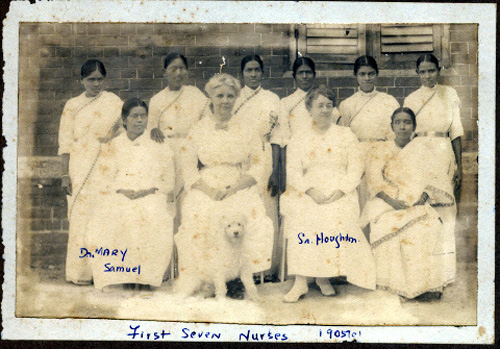
The place still seems to be going strong, as this page of more recent photos, in colour, illustrates.
I enjoy this kind of thing, and I really enjoy the way you can chat about such things on the internet.
More worrying reported here that kids these days don't know how to communicate like they used to, this time the kids being the very young ones.
A recent survey of nursery staff carried out by I Can, a children's charity, revealed that almost all had at least one child in the nursery with communication problems. Ten per cent said they had 10 or more children with difficulties.
They reported that growing numbers of pre-school children could not accomplish simple tasks such as explaining what they were doing, concentrating, speaking clearly and following instructions. They said that children often responded with monosyllabic answers or gestures, rather than appropriate language.
Staff pinpointed several factors for the increase: 92 per cent felt that the lack of adult time spent talking with the children was the key reason and 82 per cent blamed the passive use of television. Two thirds mentioned a trend for parents to talk for their child and others suggested that the use of videos and computers was also to blame. Almost half felt the situation was a matter of extreme concern.
"The hard research evidence isn't there as yet because it hasn't been done," says Gill Edelman, chief executive of I Can.
"But there is a growing body of opinion among professionals that there are more children than there used to be with communication difficulties - and boys are three times more likely to have problems than girls. Early intervention is critical because by the time they get to primary school they may already have developed behavioural problems through frustration.
My fantasy solution is to get all those useless teenagers who now lounge around taking drugs and being disaffected to make themselves useful, by talking to the little tots. Dealing with the reality of such creatures might dissuade them from creating more themselves, before they are ready to look after them properly (see above), and it would help.
On those days when I have been living life as life is generally understood (i.e. working and going out), I sometimes find myself at the end of the day and in need of a quick posting. And it is at times like those (i.e. these) that I am rather more welcoming of emails like this one than I usually am.
Dear Brian,
I would like to invite you to visit our site at http://www.readingsuccesslab.com and introduce you to the Cognitive Aptitude Assessment Software, developed by internationally recognized Psychology Professor Mike Royer, Ph. D. of the Laboratory for the Assessment and Training of Academic Skills, University of Massachusetts Amherst and software developer Jeremy Wise, Ph.D.
With 15 years of research behind them, the Drs. have recently introduced a free reading assessment test designed for home use and ideal for families, homeschool families, those with special learning needs and educators. The Reading Success Lab™ FREE Reading Assessment Test is a unique screening test to identify readers with disabilities. Other free tests typically ask a series of paper and pencil questions regarding a reader's struggles with reading.
Our test actually tests reading skills. The software measures both the accuracy of response (did the reader make the correct answer), and the timeliness of the response (how quickly did the reader make the correct answer). Measuring timeliness indicates whether the reader has mastered the skill or struggles with the skill.
We believe the application of the software for families has proved to meet many of their concerns about learning problems. The soon to be released full assessment software will provide a full diagnosis with recommendations for intervention, all with ease from home. Test the whole family with software customizable to multiple age levels.
If you try the software, like it and consider it a good resource for your visitors, we would appreciate a link from your site. We believe CAAS, is an important resource for all families.
Dr. Royer and Dr. Wise are very eager for feedback and also for an honest discussion about the software, it’s use and application. Please let us know if you have any questions or comments of any kind.
With kind regards,
Debra PaynterCustomerCare@readingsuccesslab.com
Other of our sites we welcome you to check out
http://www.educationalhelp.com/companyprofile.html
http://www.jeremywisephd.com/ for Jeremy Wise, Ph.D.
http://www.jamesmroyerphd.com/ for Mike Royer, Ph. D.
http://www.umass.edu/latas/ to visit the Laboratory for the Assessment and Training of Academic Skills
http://www.cognitive-aptitude-assessment-software.com/ for the Researcher Version
Make of this whatever you will.
In the latest issue of Prospect, Philip Collins writes about the public sector generally, and Ofsted inspections in particular:
The better regulation task force recently asked government to tell it how many regulators now existed because it was struggling to count them. No doubt there could be fewer of them. And, of course, the inspectorate has never been exactly popular with professionals. David Bell, the chief inspector of schools, has recently responded to criticism by saying that Ofsted needs to become more rigorous in its methods, to drop in at shorter notice and leave well-performing schools alone. Inspection in the future will be less burdensome, less intent on naming and shaming and more directly concentrated on dispersing good ideas. This change of focus is possible partly because Ofsted's initial work, attacking entrenched failure, has been a success. Its alarming report on reading standards in London was the catalyst for the national literacy strategy in 1998. Ninety per cent of schools now show satisfactory improvement between their first and second inspection. The proportion of 16 year olds who obtained no GCSEs above grade D has fallen every year since 1994, when inspections were introduced. For all the anguish that Ofsted inspections create, most teachers would prefer to reform the system rather than abolish it. And the information provided is indispensable for parents. Britain probably now has the most transparent schools system in the world. As David Bell said recently: "It is easy to forget what the education system was like without the publication of examination and test results."
Well, that's one way of looking at the public sector. I am of course a public sector pessimist, but Collins writes throughout his piece as if the right (instead of wrong) new procedures, the right (instead of wrong) new reforms, the right (instead of wrong) new initiatives, will finally make it all work well. At one point, for example, he even lists some massive spending increases as prima facie evidence of improvement, when for those of us who oppose the whole idea of a large and active public sector the ever increasing cost of the thing as all part of what a catastrophe it is.
Collins is a sort of friend, in the sense that he is a very good friend of a very good friend, and I therefore wish I could say that I liked his article more than I did.
I take friends, and therefore friends of friends, seriously, not just for their own sake, but as sources of information. I pick up some of my best postings at social gatherings, when trusted individual friends report to me on individual experiences which I can pretty much guarantee are true, and one of the more vivid such recollections I gathered recently was from my friend John Washington. He works at what it is most definitely a good school, by practically any way you care to measure these things. Certainly the parents involved think it's good, or they wouldn't be paying the quite large fees. Yet Ofsted insists on an elaborate inspection of this place every few years.
When I last spoke to John, they had just been having such an inspection. He and all his colleagues had been filling in lots of forms about their pre-prepared written "lesson plans", even though this not a procedure which John actually follows; he just turns up and teaches.
A few things I recall in particular from what John said. One, his guestimate of what all this was costing was "around £40,000 I suppose". Two, the school had to pay this. Three, the amount of paperwork involved filled, if I recall John's hand gestures accurately, about half a room.
Who the hell is going to read this report? And what possible purpose does it serve? It seems to me that inspections like this embody the same error that Philip Collins himself makes in his Prospect article, namely the belief that if enough things are done, and (in this case) if enough "information" is gathered, eventually the gatherers will chance upon the perfect system (in this case of state education). Actually, the endless and ever more expensive search by bureaucrats for systemic perfection is one of the major problems of the system, and will go on being for as long as the search persists.