
Alan Little kindly emails with a link to this posting, and singles out this paragraph as likely to be of particular interest to me:
If everyone in a poor neighborhood were educated to the standard of the average Harvard graduate all of the other problems would be solved. ... [but] ... Schools for poor people are government schools. Everyone who works there is either a bureaucrat or a union member. None of these people incurs any kind of pay loss or risk of firing if the kids remain totally ignorant.
Alan also supplies this entertaining potted biog of the writer of this, Philip Greenspun – gratuitous photo of Greenspun and friend to our right, obtained here – thus:

Philip Greenspun is a guy who made a pile of money by founding a dotcom software company and selling it out to a bunch of venture capitalists just before the crash. Smart move. Now he flies planes and writes a bitingly cynical but sometimes sharp weblog.
Smart move indeed.
I think that countries like the USA (and Britain) may now be entering a period of their history where the pressure to get educated (if not to Harvard graduate standard then at least well above barbarism) is reasserting itself, after a period of educational slackness that may now be ending.
In the first period, you did as well as you possibly could, including educationally, to get as far away from starvation as you could. (A lot of Indians and Chinese are in this phase now.)
In the phase of relative relaxation, if you were willing to work (without much in the way of education) then, wars and slumps willing, you could work, and have a reasonable life. This was the time of "Fordism".
But now, in countries like mine and like Greenspun's, there are just two classes: educated class, and underclass. There is now no "working" class in between, i.e. a class using physical effort, physical skills and little else.
That is of course an exaggeration and an over-simplification. But it's the way things are headed. And that's the sense in which Greenspun is right. He's probably overdoing it to say that we are already there.
By the way, the comments on Greenspun's posting are interesting, especially the ones defending public sector educators, quite eloquently as it happens.
Arts & Letters Daily links to this piece about how academics are now being pushed by their own faculties towards the media.
… As schools vie to attract top students, top faculty, and top-dollar gifts, they count on their bookish professors to leave the library and enter the studio, where their insights on the day's news might help put their institutions on the map."It lends a certain credibility when they see you on television," says Mr. Williams, an expert in military affairs. "It may boost student enrollment in my courses."
For schools aspiring to enhance their reputations, the task of positioning faculty for a "media hit" has become big business. To get their professors into reporters' Palm Pilots, 624 colleges and universities pay between $500 and $900 each per year to be listed with ProfNet, a private database. Some go further by paying thousands to private firms whose sole mission is to get professors quoted in the press.
Spokespeople in higher education tend to agree that the time, effort, and money they invest to get professors quoted in news stories are priceless.
You can imagine all manner of moans about what a bad thing this is. "Dumbing down", "soundbites", etc. etc. But I think that the intellectual dangers associated with universities becoming media backwaters are at least as great as the dangers of media involvement.
I am, of course, biased. My background is political think tanks in general and the Libertarian Alliance in particular, and about half the point of these enterprises is to get political ideas spread around - the other half being to think of and about them. And having been involved in both processes for the LA, I can tell you that far from interrupting or hurting the thinking bit, the media bit actually stimulates further thought.
Ask yourself this. When the history of Britain during the second half of the twentieth century is written, as it is starting to be, which institutions will loom large:a think tanks, or university faculties? And surely a big reason for this is that whereas universities during this period have been wary or even hostile of media engagement, think tanks have lived for it. Has this made think tanks any less inclined to think? I strongly think not.
What think tanks have actually supplied is a kind of media front-end for academics, of the sort their own universities have been unwilling or unable to supply. The think tanks have used universities rather than straightforwardly competed with them. But if you measure intellectual impact – young brain cells stirred up, old geezers made to rethink, worthwhile soundbites crafted and launched, etc. etc. – and compare it with money spent, I reckon the think tanks have done very well, compared to the universities.
 One obvious advantage of the media is that they face professors with something that they don't always get when tucked away safe in their faculties: disagreement. I still treasure the memory of a run-in I had with my old Essex Sociology Professor, Peter Townsend (partly because I wrote it up at the time for the LA), where we generally went for each other's throats on the subject of poverty – what causes it, how to end it, etc. etc. The abiding impression I got from this altercation was that Professor Townsend (gratuitous picture to the right) regarded it as something of a scandal that anyone should dare to disagree with him on his area of academic specialisation. Yet for this very reason, I am convinced that the experience can only have done him good, and maybe a lot of good. At the very least it will have acquainted him a little more forcefully with the ideas and attitudes of those whom he seeks to convert, persuade and convince.
More fundamentally, lots of people arriving at university for the first time are often shocked by how indifferent to ideas many people at universities actually are. I have many friends who have told me that they have had a better education at the hands of things like the LA than they got doing economics at university. Many universities exude the atmosphere not of intellectual hothouses bursting with fascinating ideas and arguments, but of rusty old machines idling along, shovelling a stagnating syllabus from A to B rather than causing anyone to get at all excited about it. A good old ruckus on the television between your crusty old Professor of Biology and the local Creationists, or between the Professor of Physics and some deep green anti-technologists or anti-nuclear peaceniks, might be just the thing to liven things up and get the students interested again, and generally to get people talking to each other again, in animated rather than tired voices.
As for that old "soundbite" canard, a soundbite is just a really well made point that you don't like, or just wish you were eloquent enough to have created but are actually not. The pressure from the media to answer dumb questions with short answers is often immensely stimulating to further thought. Professor Waffler, in one sentence because soon we have to go over to the newsroom: What do you do? Or: Why do you bother? Or: Why should we pay for it? Such questions are, I suggest, not so very dumb and are well worth thinking about until such time as you can answer them with a set of soundbites. And when you've got your soundbites, try sharing them with your students. They might finally get the point of you and of what you do.
As for media whore professors who are nothing but soundbites, well, they'll be found out sooner or later. Yes, there are dangers connected with media involvement. But universities can't be all light. They need a bit of heat. And in practice, I say, the two tend to go together.
This could be a Conservative vote winner.
Disruptive pupils will be sent to tough new day units and subjected to "no-nonsense discipline" under Tory education plans to be unveiled this week.
No doubt the actual details of the policy will involve the odd spot of nonsense, but I'm talking politics here, and politics is always nonsensical.
There are plenty of people in the upper reaches of the Government who understand that discipline is crucial to making state school function adequately, and that the key to discipline is being able to exclude unruly pupils. But lower down in the system are people who fatuously hope to achieve discipline without either violence or exclusion. "Society" must be "inclusive" blah blah. Can't be done. The Conservatives have a strong issue here.
Matthew d'Ancona, in today's Sunday Telegraph, made me smile with this:
A minister close to Mr Blair once asked me what would be a good objective for the Prime Minister to announce in a forthcoming conference speech. I said that he should commit his Government to reducing the percentage of parents who send their children to private schools - not by penalising those schools in any way, but by making the state sector so attractive that parents no longer felt the need to look elsewhere. The minister, normally garrulous and Tiggerish, went strangely quiet.
Much is made, by people in my corner the political opinion map, of the phrase "schoolsandhospitals". But d'Ancona ruminates on the differences between schools on the one hand, and hospitals on the other – between education and health. In particular, he speculates that the Conservatives, who still get nowhere on the health issue and just bleat that they will spend more money, might actually make some headway with their complaints about and policies for education.
Another reason why health is different from education is that the kind of clever, young, opinionated people who make the running in political policy creation are usually right in the middle of that time in their lives when they are least concerned, personally, about health. They are, in short, very healthy. They have no recent experience of serious healthcare, and they face no immediate prospect of it. They have hardly any sustained experience of - or, yet, much fear of - what it is actually like to spend a year in a hospital, or to have to combine staying alive with suffering from a chronic disease. They may learn from some survey or other that "people" care very much about the NHS, but this is a truth they most of them must accept at second hand.
By contrast, these clever young persons have just emerged from a couple of decades of the best that our nation's educational system can offer. They are good at this, and that is pretty much all they are good at. No wonder they take it so seriously, and want everyone else to, and are full of opinions about how to improve it, even if the teachers dread these plans.
However, voters are different, and so are many of the more senior politicians who seek their votes. Voters are old. Voters have young children. Voters have dispiriting jobs, which they seek medical excuses to avoid every now and again. So voters know about health and care about health even if policy wonks care less about it.
But second, and probably more important, is the fact that many millions of voters must surely feel, and with some justification, that they could teach their children, and other people's children, just as effectively as the actual teachers do. They could be wrong, but that is surely how they feel. They all have years of experience of the most important thing that goes on in schools, which is the teaching that goes on in classrooms, and the only reason they don't then teach for a living themselves is that they've more lucrative and interesting ways of spending their lives. If all state school teachers disappeared to the West Indies for permanent holidays, they would rapidly be replaced, by the electorate, and in a way that might very possibly be an improvement. This may not be true, but lots of people surely think this.
But your average voter would have no such confidence if he was suddenly asked to perform a hip replacement. Medicine involves real knowledge, real training. Teaching? Anyone can do that.
So, when people think about health, they think: could be far worse. Don't mess with it.
When they think about education, they think: could do far better. Give it a good kicking. What's the worst that could happen?
Interesting stuff in the Guardian about history textbook battles in India. A change of government there means a change of syllabus:
India's new government is poised to rewrite the history taught to the nation's schoolchildren after a panel of eminent historians recommended scrapping textbooks written by scholars hand-picked by the previous Hindu nationalist administration.Hundreds of thousands of textbooks are likely to be scrapped by the National Council of Educational Research and Training, the central government body that sets the national curriculum for students up to 18.
The move, one of the first made by the new Congress led government, will strongly signal a departure from the programme of its predecessor.
The "saffronisation" of history, say critics of the last government, depicted India's Muslim rulers as barbarous invaders and the medieval period as a dark age of Islamic colonial rule which snuffed out the glories of the Hindu empire that preceded it.
Memorably, one textbook claimed that the Taj Mahal, the Qu'tb Minar and the Red Fort, three of India's outstanding examples of Islamic architecture, were designed and commissioned by Hindus.
Cue Gratuitous Picture of the Taj Mahal:

And a rather good one, I think.
Finally, a private sector in teacher training:
What business has the state controlling teacher training? Why do we need teacher training institutions? Shouldn't introducing teachers to their craft essentially be a matter for schools? Shouldn't the role of universities be confined to encouraging teachers to reflect on their practice and formulate their own vision of education?Such apparently subversive questions are prompted by an approach to teacher training being pioneered by Buckingham, Britain's only truly independent university. The programme is supported – up to a point – by HMC, the body that represents the heads of 240 leading independent schools.
This month, 13 teachers, all mature graduates working in HMC schools, will be the first to complete Buckingham's one-year post graduate certificate in education (PGCE).
Okay, it's a moot point just where in the private/public spectrum your average British university is to be found. But this is definitely a small step in the right direction along that spectrum.
By the way, this is the kind of big media story I am happy to link to, obviously (as Alice Bachini would say). This is because, although it may be big media, the story itself is small. Yes, it includes some numbers, but they are small numbers. 240 heads of independent schools, 13 teachers, and above all, just the one university. Thus, the story is likely to have some vague relationship to the truth.
When the big media recycle the claims of the big politicians to the effect that this or that big number (concerning national exam results for example) has done a small percentage shift in the right or for that matter the wrong direction, I find it all much harder to believe in or to be interested in.
I've already quoted here from the delightful A Short History of Nearly Everything, about the American scientist Michelson. Here is Bill Bryson describing that modest genius of chemistry, John Dalton (1766-1844). Dalton was a school-teacher from a very early age, until – despite his scientific eminence – a very late one.
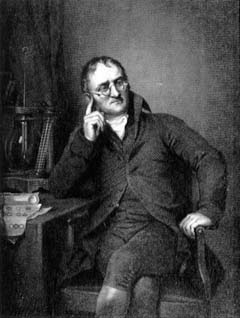 Dalton was born in 1766 on the edge of the Lake District, near Cockermouth, to a family of poor and devout Quaker weavers. (Four years later the poet William Wordsworth would also join the world at Cockermouth.) He was an exceptionally bright student – so very bright, indeed, that at the improbably youthful age of twelve he was put in charge of the local Quaker school. This perhaps says as much about the school as about Dalton's precocity, but perhaps not: we know from his diaries that at about this time he was reading Newton's Principia – in the original Latin – and other works of a similarly challenging nature. At fifteen, still school-mastering, he took a job in the nearby town of Kendal, and a decade after that he moved to Manchester, whence he scarcely stirred for the remaining fifty years of his life. In Manchester he became something of an intellectual whirlwind, producing books and papers on subjects ranging from meteorology to grammar. Colour blindness, a condition from which he suffered, was for a long time called Daltonism because of his studies. But it was a plump book called A New System of Chemical Philosophy, published in 1808, that established his reputation.
There, in a short chapter of just five pages (out of the book's more than nine hundred), people of learning first encountered atoms in something approaching their modem conception. Dalton's simple insight was that at the root of all matter are exceedingly tiny, irreducible particles. 'We might as well attempt to introduce a new planet into the solar system or annihilate one already in existence, as to create or destroy a particle of hydrogen,' he wrote.
Neither the idea of atoms nor the term itself was exactly new. Both had been developed by the ancient Greeks. Dalton's contribution was to consider the relative sizes and characters of these atoms and how they fit together. He knew, for instance, that hydrogen was the lightest element, so he gave it an atomic weight of 1. He believed also that water consisted of seven parts of oxygen to one of hydrogen, and so he gave oxygen an atomic weight of 7. By such means was he able to arrive at the relative weights of the known elements. He wasn't always terribly accurate – oxygen's atomic weight is actually 16, not 7 – but the principle was sound and formed the basis for all of modern chemistry and much of the rest of modem science.
The work made Dalton famous – albeit in a low-key, English Quaker sort of way. In 1826, the French chemist P. J. Pelletier travelled to Manchester to meet the atomic hero. Pelleder expected to find him attached to some grand institution, so he was astounded to discover him teaching elementary arithmetic to boys in a small school on a back street. According to the scientific historian E. J. Holmyard, a confused Pelletier, upon beholding the great man, stammered:
'Est-ce que j'ai I'honneur de m'addresser a Monsieur Dalton?' for he could hardly believe his eyes that this was the chemist of European fame, teaching a boy his first four rules. 'Yes,' said the matter-of-fact Quaker 'Wilt thou sit down whilst I put this lad right about his arithmetic?'
Although Dalton tried to avoid all honours, he was elected to the Royal Society against his wishes, showered with medals and given a handsome government pension. When he died in 1844, forty thousand people viewed the coffin and the funeral cortege stretched for two miles. His entry in the Dictionary of National Biography is one of the longest, rivalled in length among nineteenth-century men of science only by those of Darwin and Lyell.
A comment has recently been added to this posting about Muslim homeschooling, from way back in 2002. I said I was in favour of it. Corey writes as follows:
Hi Everyone,
I think this is a good discussion. I like the freedoms involved in homeschooling my kids. I really support everyone's freedoms to do this. I happen to be a Muslim and even though I wear the headscarf, I am by no stretch an extremist. I have quite liberal views about human rights and social justice and as a Muslim I plan to give my kids more than just a religious education. In fact we'll focus on secular materials most of the time. (The nice thing about homeschooling is that we can still observe our 5 daily prayers together) and I'll be able to teach them some history that wouldn't be available as curriculum in public school. Our public schools over here are very overcrowded and riddled with gangs, drugs and the like. I think, as an educated woman I can find many resources to enrich my children more so than the public school. Even though I'll be homeschooling, I will especially teach my children respect for other people's belief systems and cultures. I feel very committed to that. I think that most people, no matter what religion they are or what culture they come from, try to teach cooperation and acceptance. Lately, there has been a lot of post September 11 backlash against the Muslim community. These hate-crimes and incidents have targetted many school children. Parents really appreciate the option to homeschool, especially if they feel that their child is in danger.
Corey might also be interested in this more recent posting on the same topic.
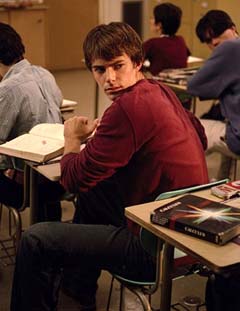 A couple of months ago I reported on Mean Girls, basically because I had just introduced my Gratuitous Picture policy, and this was a fine excuse for pictures. (And of course mentioning this movie again is another picture opportunity. This time I've chosen a snap of one of the boys in the movie for my lady readers.)
However, quite aside from its pictorial possibilities, it seems that it is also quite a good movie.
It certainly, according to 14-year-old Ellie Veryard, serves up many lessons about the joys of all that socialisation that home schooled kids miss out on. The heroine of Mean Girls was home schooled before then being school schooled. And I'm guessing/hoping that if this movie does well in Britain, it will get more people thinking about home schooling, simply because home schooling is an important part of the story.
This looks really interesting. Note how public sector failure seems automatically to have attracted the interest of the private sector. The private sector had to solve the problem, and then it decided to go into the business in an even bigger way.
Clowes: How did you become involved in education reform?Brennan: When we began automating our manufacturing plants in the early 1980s, we discovered our employees were insufficiently educated to do the necessary transactions on the factory floor, so our company went into the education business. Every single employee, depending upon level of education and achievement, was in our classroom for one or two hours a week, using computer-aided instruction.
We had great success with that program – which still continues in our factories – and I recognized that technology has a major place in education reform. But when I tried to carry this message back to the public schools, they weren't interested. It didn't fit their pre-conception of how education should be carried out. Then I recognized that the problem we had in public education was a total inability to effect innovation. That only comes in a market economy, where there are choices.
Computer-aided instruction is the teaching of mathematics, reading skills, language arts, history, social sciences, and so on, by computer. All academic subjects are now deliverable by computer. It's a segment of our education world where a number of companies are aggressively pursuing the continued development of more sophisticated computer-delivered curriculum. Our education company now has a fully supported homeschooling network with high school curriculum delivered over the Internet. We have a very large center of master teachers serving a student population of about 2,500 here in Ohio and we're opening in Pennsylvania.
Sooner or later, computer aided basic education that really works is going to be available free to everyone on the Internet, and everyone is going to know that it is there. There is some way to go before this happens, but when it does, and it will, it will be a different world, my readers, a different world.
I've spent most of my blogging time today writing a ridiculously long piece about the complexities of qualifying out of the group matches at the European Soccer Championships, and a link from here to there is all I can offer today.
Here, gratuitously, is the picture I used to illustrate the kind of stuff I was writing about.

The educational relevance? Well, simply that sporting arithmetic is a great way to teach arithmetic to small boys. I still remember with pleasure the day I explained about fractions to a small boy, by talking about a soccer game.
And I dare say there's even the occasional girl who might be persuaded to take maths a bit more seriously with talk about sport.
In education, small is beautiful. That's what these people think anyway:
Next week is officially Small Schools Week, which means that for the next seven days, education pressure groups such as Human Scale Education and the National Small Schools Forum will join forces to harangue MPs and education administrators with their "small is beautiful" mantra.These organisations believe that, as schools have grown bigger over the years, they have become impersonal "academic sausage factories". Do they have a point? Can children really be taught more effectively in schools with fewer than 100 on the roll?
To find an answer, I went to Ashburton in Devon where, behind the facade of a Victorian merchant's house, is Sands School, a non-selective independent establishment for 11-17-year-olds. It has just 60 pupils. What are the advantages of such a small school?
"Having limited numbers means we can value all our children as individuals," says Sean Bellamy, the head teacher. "In a large school there is such uniformity. Children behave in a prescribed way and wear a uniform. Here the atmosphere is more relaxed - like that of an extended family."
Well, I can imagine some children not liking this particular school at all. An "extended family" of this particular sort might not suit everyone. But if there were a lot of small schools, children could chose a small school that they liked, and dodge the ones they didn't like. Choice would be more than a political slogan, it would be a reality.
At the Sands website, it says it has 75 pupils, rather than sixty. I don't know the explanation for this disagreement.
Last week, the oldest children at Sands were sitting GCSEs, their final exams before leaving. What did they make of their small school? "We have all absolutely loved being here," said Sophie Gibbs-Nicholls, 16, standing among a group of friends. "We have been crying our eyes out because we have to leave."It will be weird going to a big college next year, being taught by strangers. I'm not sure how we'll adapt to that."
Sounds like they might like a small college also. Yet, I somehow feel that the whole idea of a college is that it is big, or at least bigger than a small school. Colleges should, in this respect, resemble the world, the bigness of which we all have to face sooner or later, one way or another. But that's just me. If some people want to found a small college, and a small number of people want to attend it, why should I worry?
Spotted in the London Underground the other day, another gratuitous picture opportunity.

For this.
This seems to be a trend now. Global education brands I mean. Now that communication from one part of the world to another is easy and instantaneous, it is much easier to run multinational enterprises. You don't face costs of the sort that only the British or the Roman Empires, or IBM, can handle. Anyone can now do international, certainly a prestigious film school.
How long has NYFA been active in London? It says "Our 12th year". Does that mean NYFA has been in London twelve years. Guess so, but could well be wrong.
Are they as good as they claim to be at their website?
Here is Bryson's description of the education and achievement of America's first Nobel Prize winner.
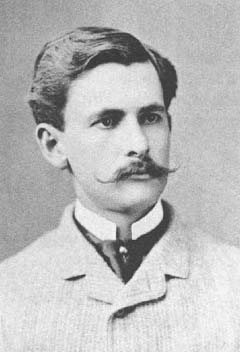 If you needed to illustrate the idea of nineteenth-century America as a land of opportunity, you could hardly improve on the life of Albert Michelson. Born in 1852 on the German-Polish border to a family of poor Jewish merchants, he came to the United States with his family as an infant and grew up in a mining camp in California's gold rush country where his father ran a dry goods business. Too poor to pay for college, he travelled to Washington, DC, and took to loitering by the front door of the White House so that he could fall in beside Ulysses S. Grant when the President emerged for his daily constitutional. (It was clearly a more innocent age.) In the course of these walks, Michelson so ingratiated himself with the President that Grant agreed to secure for him a free place at the US Naval Academy. It was there that Michelson learned his physics.
Ten years later, by now a professor at the Case School in Cleveland, Michelson became interested in trying to measure something called the ether drift - a kind of headwind produced by moving objects as they ploughed through space. One of the predictions of Newtonian physics was that the speed of light as it pushed through the ether should vary with respect to an observer depending on whether the observer was moving towards the source of light or away from it, but no-one had figured out a way to measure this.
It occurred to Michelson that for half the year the Earth is travelling towards the Sun and for half the year it is moving away from it, and he reasoned that if you took careful enough measurements at opposite seasons, and compared light's travel time between the two, you would have your answer.
Michelson talked Alexander Graham Bell, newly enriched inventor of the telephone, into providing the funds to build an ingenious and sensitive instrument of Michelson's own devising called an interferometer, which could measure the velocity of light with great precision. Then, assisted by the genial but shadowy Morley, Michelson embarked on years of fastidious measurements. The work was delicate and exhausting, and had to be suspended for a time to permit Michelson a brief but comprehensive nervous breakdown, but by 1887 they had their results. They were not at all what the two scientists had expected to find.
As Caltech astrophysicist Kip S. Thorne has written: 'The speed of light turned out to be the same in all directions and at all seasons.' It was the first hint in two hundred years – in exactly two hundred years, in fact – that Newton's laws might not apply all the time everywhere. The Michelson-Morley outcome became, in the words of William H. Cropper, 'probably the most famous negative result in the history of physics'. Michelson was awarded a Nobel Prize in physics for the work – the first American so honoured – but not for twenty years. Meanwhile, the Michelson-Morley experiments would hover unpleasantly, like a musty odour, in the background of scientific thought.
Why is adult life, when it is, better than the life of a child? For many adults it isn't, for the simple reason that when they were kids they didn't have to work that hard or struggle that hard, but as adults they do.
But for many adults, life is just massively better then it was when they were kids, and for them, I think that the reason for this is that when they were kids they had to do things they didn't like, and above they had to do things with certain other kids whom they did not like and who did not like them. Simply on happiness grounds, I think "streaming" into different types is a good thing. As an ex-nerd, I recall finding the jocks intimidating and scary. I'm sure the jocks found the nerds like me annoying, and perhaps intellectually intimidating. So why the hell were we forced into each others' company so relentlessly? Why couldn't the nerds have gone to a nerd-school, and the jocks to a jock-school? At the very least, could not the life of a one-regime-fits-all school at least have some slightly different regimes embedded within it? Insofar as the schools I went to did, I enjoyed them. Insofar as I was forced into jock-company and jocks were forced into my company, I would … rather have been somewhere else.
Occasionally, on holiday, I would blunder into some fragment of life where the company was totally congenial and appreciative of me, and where I immediately set about learning the rules of the place, so that I would fit in. Because I wanted to fit in. It was like going to heaven for a week, and it made me a massively better person, immediately. Then it would stop and I would have to go back to school. Then they let me out permanently, and I was allowed to search for places where everyone liked me and where I liked everyone, and where monster-jocks were polite visitors, and life got good and has stayed good ever since.
I know why I was supposed to endure the monster-jocks, and why they were supposed to endure me. That is to say, I know the words people use to excuse this absurdity. Spending time with uncongenial people whom you hate and who hate you is "good for you". You learn to understand other points of view, other attitudes.
No you don't. You learn to hate other points of view and to hate other attitudes. You love what you are allowed freely to acquaint yourself with, dipping into it, and venturing further if you fancy it. That's how you learn to love. I'll say it again because it is so important. Forcing people into each others' company who do not appreciate each others' company teaches not love, or respect, or toleration, or even merely silent politeness; it teaches hatred.
All of which was intended to be a mere preamble to a comment on and link to this, this being a BBC report about how having special jock schools can make jocks less nasty and less unhappy.
I knew that.
Specialist sports colleges could help tackle anti-social behaviour among teenage boys, a report suggests.The study found boys were more likely than girls to raise their sense of self-worth through specialist sports colleges.
The research by Northumbria University found sports college pupils' confidence was significantly higher than those at a comprehensive school.
They were also more confident about their physical appearance.
Specialist schools are state schools which follow the mainstream curriculum, but have a particular emphasis and expertise in an area, such as technology, science, languages or sports.
The majority of secondary schools in England now have specialist status.
Good. In fact I would go as far as to say that this could be a major improvement in British education that has happened in the last fifteen years or so, to set beside the way that primary school education in the 3Rs etc. has recently changed from being mostly of a derangingly despicable incompetence to being patchily adequate.
It seems that my blogging duties here, and here, could be clashing.
A schoolgirl tennis player will have to juggle her debut appearance at Wimbledon with her A-level exams on the same day.Katie O'Brien, 18, is hoping organisers at the tournament – which starts on Monday – will give her a late on-court slot for her match so that she can sit her French and Maths exams in the morning.
The teenager was shocked to find out she had won a wild card entry on Friday despite losing a play-off final in London a few days earlier.
I blame Wimbledon. Getting to play despite failing the entrance exam? A clear case of declining tennis standards.
On Monday I visited my Mum, as mentioned here, and while there I talked also with my brother Toby, who is a UKIPer.
The report I wrote yesterday about our conversation has become the trigger for a very satisfactory Samizdata comment storm about matters European and EUropean, as I write this still blowing.
After writing that, I then googled "Toby Micklethwait", which I haven't done lately, and I found my way to this:
This is my contribution to the BBC charter review.
That's all the explanation you get, in the page I googled my way to. Presumably, what Toby is referring to is this. I am not encouraged that "Micklethwait" is spelt so very wrongly in the web address. This suggests to me that no very great attention was paid to what he said.
Which, if true, would be a pity, because after Toby's what-you-would-expect-from-a-UKIPer denunciation of BBC bias (concerning the idea of Britain getting out of the EU – surprise surprise), he then veers off into this:
Finally, perhaps off topic, it seems to me uneconomic to spend billions of pounds on language education in schools, and then to fail to spend the few millions needed to ensure that there are free to air television channels in French, Spanish etc. Such channels should be purchased from abroad. The best programs for learning languages are quiz programs (preferably with text on screen), followed by nature programmes, and then news. Fast moving comedy is very difficult to understand in another language.If proof is required that TV affects language learning, then I point out that dwellers in Copenhagen understand Swedish well, whereas in Esbjerg they do not. The difference is not in the schooling, it is in the TV.
What an interesting observation. He is quite right that our government, or at any rate a fragment of it, has for some time been in initiative mode about language teaching in schools. We now have a strategy to make more people learn foreign languages.
Toby's idea is the best I've heard for achieving greater foreign language knowledge in Britain, and, as he says, at a trifling cost. Just sling a few cheap and cheerful foreign language channels up on regular don't-pay-as-you-watch TV, and let nature take its course. Excellent.
So good is this idea that I reward brother Toby with two gratuitous pictures of him, looking studious and educational, and looking happy, taken a year or two ago at a Christmas family gathering at his home in the leafy suburbs of Surrey.


A few learned comments on this TV helps language learning idea would be very welcome. Does it really do this? Is Toby (and am I) getting too excited about this idea? If he is right, are there some other examples to throw into the pot from elsewhere in the world? I do recall reading in all kinds of places that lots of people have learned English by going to the movies and listening out for the English words to go along with the subtitled words at the bottom. But how about TV? Do Spanish speaking Americans learn their English (assuming they want to learn it) by watching Anglo-TV? Do Europeans learn English by watching British and American TV?
If the idea survives scrutiny in the comparative privacy of here, I can then give this notion another push on Samizdata. If I get no comments here, I'll stick it up on Samizdata anyway.
Apart from the idea itself, is there any way to access the place where this piece got posted, and most especially any replies to it? I tried ringing Toby to ask this, but he seems to be extremely busy just now. He is, presumably, among other things, UKIPing, helping to reinforce their success. If so, it makes sense.
This is stale news, because it comes from the "in fact" bit in the May 2004 issues of Prospect (paper only). But I have only just now noticed it, and it interested me a lot:
Britain is now the only major country in the world where French is the main foreign language taught in schools.
This was apparently in The Times, on April 8th 2004.
So, we are, linguistically, the least Francophobic major nation?
But think about it some more. Everyone else either has English as their first language, or else teaches English as a foreign language. So all that is really being said here is that English as a foreign language is universally more popular than French as a foreign language in all "major" nations (which excludes French ex-colonies), which we all surely knew, plus that Britain takes French more seriously than Australia, the USA, etc., ditto. So, no real proof of British pro-Frenchness. Just a trick of the facts, you might say. It was obvious all along.
That may be it for today. I had grief with my internet connection earlier today, only recently rectified, and am soon out for the evening.
This looks like a really interesting little row.
One of Hounslow's most successful schools has been severely criticised by a website claiming to represent some of its students.The Heathlands School, in Wellington Road South, has some of the best results of the borough's schools, and was recently awarded specialist science status, to much acclaim.
However, apparently not everyone is happy with this, and a website, called www.voiceofheathlands.co.uk' has been set up by an anonymous group, who claim to be students, but are only contactable by email.
I tried to get to that website, of course I did, but got no result. Maybe if you click that link you'll get luckier.
What is more, googling for Heathlands School didn't even clarify for me exactly which school this is. Not this one, I'm assuming. And certainly not this one.
They say that their aim is to ask questions, criticise and flag up issues which they feel are of concern at the school.It is unclear, however, whether the website is a genuine attempt to get across students' views, or whether it is merely a half-term prank.
Meaning, I presume, that "This is local London" doesn't know who to ring, or does, but isn't getting any answers. I can tell them a guess/answer: neither exactly, and both, a little bit, I daresay. What it most definitely is is politics. "Flag up issues". That's politics-speak for grab hold of some problems and shout about them, thereby making them worse and very possibly insoluble.
Hounslow Local Education Authority has refused to comment on the website.
Don't know what's hit them, in other words. Website? Website? What's that? What do we do? How can we close it down? Ought to be a law against it, blah blah blah. Say nothing. We must have a meeting, and then say nothing more eloquently.
The authors of the website claim to have set it up because: "We felt it was about time to do something, and raise our voice against the wrongs we saw.
Like I say, politics. "Voice". "Voice" means poltiics, every time.
"Through experience, we knew that talking to the school, through the school council, would achieve nothing, so we looked for a more powerful means to bring our message forward."
The point about a website is that you don't need anyone's permission to say what you want to say. You don't have to get it past any editor, who may have fishes of his own to fry. And there is not a lot of expense involved.
And everyone else can ignore you, or of course start their own website and say you're prats.
Their main complaints, which are posted on the website, are that the specialist status is making the school selective, rather than open for all.They also criticise the political leanings of their teachers, and an assembly on the benefits of Margaret Thatcher's leadership, and cast a sceptical eye over the relationship the school has with local multi-national pharmaceutical company, GlaxoSmithKline (GSK).
Which certainly makes this sound like a lot more than a mere "half-term prank". Interesting that these clearly left-wing websiters at least perceive the teachers to be – or try to present them as – Thatcherites. I wonder what they really are. My guess is, they gave Thatcherism a respectful look-in, in some school discussion/debate they organised. They refused to present a united front of wishy-washy leftism. That would be my guess. But that could be quite wrong, and maybe these teachers are indeed gung-ho pro-capitalists. If so, hurrah! This will be even more fun.
Regarding the specialist school status, and the school, as a whole, they claim: "Many students feel that they are ignored, and have no way of channelling their views.
"Most students on the school council feel it is a puppet organisation.
Well, not an organisation that the school's actual bosses will allow to take over the school, that's for sure.
"The school used to be so proud of being unselective."
Not all of it, evidently. Otherwise, why the change? Maybe, they were just so good that thousands more people suddenly wanted to send their kids there, and they had to choose, because they didn't have enough room for everyone, whereas before, anyone could come.
The issues surrounding GSK were: "The school's close relationship with GSK is looked down upon by the majority of pupils in the upper years of the school.
"The introduction of Lucozade into the school canteen blatantly suggests that the school has some kind of agreement with GSK, which produces Lucozade, which it is not open about."
They continued: "Also, we have complained for many years, through the school council, that we have trouble affording the food in the canteen.
"This has always been ignored; prices continue to rise, and we are told it is a matter which the school has no influence over, due to the private catering company setting prices.
"We would like to know why the school has the influence to introduce Lucozade, but cannot make the food affordable?"
The students also raised concerns that there were now plasma screens in reception, a lot of extra CCTV cameras around the site and a painted tennis court, which has little benefit'.
Politics, politics, politics. What did I tell you? Not that they don't have a point. Maybe on this matter, they do. If the real agenda of GSK is to sell Lucozade, that is a bit tacky, I think.
However, they did admit that: "Heathlands is a good' school, which achieves some of the best public exam results in the area, and has a highly-respected reputation."The exam results have a lot to do with the commitment and dedication that the staff show towards pupils."
So, Thatcherite bastards and committed and dedicated teachers. Or are the teachers divided between these two groups? I'm guessing not, or they would have said this.
No one was available to comment from Heathlands School at the time of going to press.
And they don't know what's hit them either.
It will be interesting to see if this story goes anywhere. Maybe I should try to help turn Heathlands School into a Global Focus of Fascination, as per Cecile Dubois.
But anyway, fascinating. What an interesting mixture of things going on here. As with the previous post, material for many novels.
I support - and will seek to provide aid and comfort to - both sides in this row. I support under-age trouble-making websites and Thatcherite schoolteachers.
But sadly, I fear that the shut-down of the website is permanent. Those teachers knew at once who was behind it, and threatened expulsion if they kept on with it. It's over, in other words. If so, shame.
More reportage on the state of the English language and of English language teaching in India.
M Thambidurai, Former Education Minister, Tamil Nadu, said: "Promoting one particular language is not necessary. When one says that English is not our language then even Hindi is not our language. Our mother tongue is better for us."But learning English has been seen as a necessity largely due to the high demand for English-speakers, thanks to the boom in call centres.
So it is no wonder why the underprivileged see English as a stepping stone to a better future.
But then the article morphs into being about "finishing", for Indian girls who want to be Western Wives.
Many Indian girls dream of foreign-based husbands, so that they can live a better life abroad.
But for that to happen, they must improve their English skills.
Only then would they strike the right balance between playing traditional daughters-in-law and conducting themselves adequately in Western societies.
This has given rise to several finishing schools.
They are preparing for entry exams, personality development programmes, language and hobby courses – anything to make them better wives when they begin their married lives in the US, Canada or Europe.
I wish all concerned well.
People should be writing Dickens-type novels about this stuff , and producing elaborate TV soap operas set in five different countries. No doubt they are.
I hesitate to say for sure, because you never really know with mere news reports, but on the face of it, this is absurd, and guaranteed to make it massively harder for schools to maintain discipline.
Politicians and education bosses today defended controversial plans to penalise schools by up to £10,000 if they expel a pupil.They warned that the money to teach permanently excluded children had to come from somewhere and, if penalties were not introduced, it might have to be found by cuts to school budgets.
The city's education authority is proposing the penalties in a discussion document which has drawn an angry response from teachers and union officials.
Head teachers who have spoken to the Leicester Mercury accept that if they exclude a child the school should pay back the money it received to teach them - £3,149 on average for a secondary school pupil.
However, they are unhappy with the idea that they should be penalised extra money - up to £10,000 for a child who has special educational needs such as behavioural problems.
It is not a bit clear to me that they should have to pay that £3,149 back again, let alone another £6,851 on top of that. After all they did teach the child, and presumably whoever was in charge of the child wanted the child to go on being taught there, or there wouldn't be all this grief about the child being expelled. As for being fined (equals semi-compelled) to teach absolutely anyone who goes to their school (special "needs" – God how I hate that word), no matter how indifferent, hostile or violent that child may be about it, that just seems to me to be wicked, and not in a good way.
If teachers are forbidden to use violence, and they are, and if as well as that they are forbidden to expel or exclude, they are simply at the mercy of any pupil who or consortium of pupils which decides to misbehave, as are all the pupils at the school who actually want to do some learning.
Ronald Reagan's funeral is today. Here's an intriguing educational titbit from his Autobiography:
Another newcomer in Dixon that year was a new English teacher, B. J. Frazer, a small man with spectacles almost as thick as mine who taught me things about acting that stayed with me for the rest of my life.
Our English teachers until then had graded student essays solely for spelling and grammar, without any consideration for their content. B. J. Frazer announced he was going to base his grades in part on the originality of our essays. That prodded me to be imaginative with my essays; before long he was asking me to read some of my essays to the class, and when I started getting a few laughs, I began writing them with the intention of entertaining the class. I got more laughs and realized I enjoyed it as much as I had those readings at church. For a teenager still carrying around some old feelings of insecurity, the reaction of my classmates was more music to my ears.
Probably because of this experience and memories of the fun that I'd had giving readings to my mother's group, I tried out for a student play directed by Frazer – and then another. By the time I was a senior, I was so addicted to student theatrical productions that you couldn't keep me out of them.
Prior to Frazer's arrival in Dixon, our high school's dramatic productions had been a little like my mother's readings: Students acted out portions of classic plays or out-of-date melodramas. B. J. Frazer staged complete plays using scripts from recent Broadway hits and he took it all quite seriously. In fact, for a high school English teacher in the middle of rural Illinois, he was amazingly astute about the theater and gave a lot of thought to what acting was all about. He wouldn't order you to memorize your lines and say: "Read it this way ..." Instead, he'd teach us that it was important to analyze our characters and think like them in ways that helped us be that person while we were on stage.
During a rehearsal, he'd sometimes interrupt gently and say: "What do you think your character means with that line? Why do you think he would say that?" Often, his questioning made you realize that you hadn't tried hard enough to get under the skin of your character so you could understand his motivations. After a while, whenever I read a new script, I'd automatically try first to understand what made that particular human being tick by trying to put myself in his place. The process, called empathy, is not bad training for someone who goes into politics (or any other calling). By developing a knack for putting yourself in someone else's shoes, it helps you relate better to others and perhaps understand why they think as they do, even though they come from a background much different from yours.
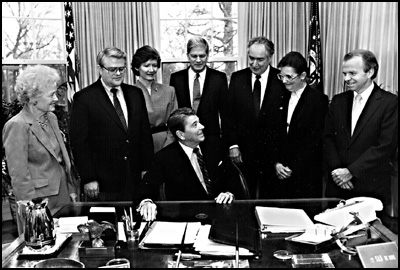
It seems that cheating is getting easier.
But be warned. If you do it, they'll take your money and only fail you at the eleventh hour.
Here is a report on the next chapter in this horrible story:
A German court yesterday jailed the teenage ringleaders in a class of students that tortured a schoolmate for months and posted film clips of the abuse on the internet.
Good.
This is mind-boggling. Like RC Dean, I hardly know where to begin, so I won't. Suffice it to say that, at any rate in some parts of the USA, you are now, as a parent, expected to boggle the mind of your offspring.
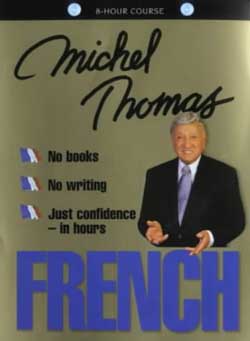 I've made a start with these CDs.
Reactions.
I am not completely convinced by his accent, and it is vital, when learning something, to believe in the veracity of the material being presented. Next time I meet a real Frenchman, I will listen to particular things very carefully, and ask for clarification on certain points. I suspect Michel Thomas of having spent his time in France in the south of France. Maybe that's the difference.
I didn't know that it is necessary to emphasise the last syllable of a French word, or risk incomprehensibility. I assume he's right about that. But again, it sounded vaguely south of France rather than France as a whole. But I presume him to be right about that.
But, those few quibbles aside, I am very impressed. So far I have listened to about half of the first CD, there being eight CDs in all. So, early days, and maybe later I'll want to revise some of what follows. Nevertheless, for the time being …
The most interesting thing about the Michel Thomas teaching method is that everything he does is done the way it is done in order to keep the victim relaxed, i.e. for the victim not to be a victim. Whenever a pupil (a much better word) hesitates or gets it wrong, he corrects them, without implying any blame. Indeed, he starts not by pitching right into teaching, but by saying that his method of teaching places the responsibility for the pupil learning on the teacher, rather than on the pupil, and that the pupil has to be relaxed, and not worrying, either about these French lessons or about anything else. The only thing that the pupil has to do is relax, listen and keep on listening, and to join in with the answers as required. He mustn't do homework, or take notes, or make any effort to remember things.
The presentational method of the CDs is to have a couple of pupils responding to Thomas' instructions, exactly as he wants you to respond. Every so often there is a bleep noise, at which point you must hold the pause button down and say the answer, and then resume, and see if you got it right. Usually, you did. Because he just told you the answer a moment ago.
There is no bullshit here about how there is no such thing as teaching, only learning. Michel Thomas is a teacher, and he is very clear about that.
Because of the presence of pupils, these CDs serve not only as lessons in the subject being taught, but also as lessons in how to teach (by which I simply mean the technique for transferring knowledge from mind A to mind B), which for me made them doubly valuable.
The most interesting feature of all of this "keep them relaxed" method is that not only does Thomas almost never criticise (he did a tiny bit when he told a pupil not to guess); he also goes very easy on the praise. What matters to him is the continuity of the learning process, learning being its own reward. You are pleased not because Michel Thomas says how wonderful you are, but because you have learned a lot of stuff and are getting answers right.
Thomas is teaching not just French as such, but French to people who already know English, and he makes use of the enormous overlap between the two languages, so pronounced (as it were – actually pronounced a bit differently) that one ancient French guy whose name I have forgotten said that English is just French badly pronounced. Any English words ending in –ation or -ary, for example, are actually French words, and you already know them. Interesting, and enlightening, but of course that kind of method wouldn't work for English people learning Chinese or somethiong.
It also occurs to me that the Michel Thomas method is actually quite "mechanical", in that Michel Thomas himself could do it to a new pupil pretty much automatically. This says two things to me. First, it explains Michel Thomas' enormous, all-embracing confidence in his ability to teach, say, French, to anyone. Teaching French to someone new whom he has only just met is, for him, no harder than doing up his own shoe laces, and, simply, he knows how to do it. I thought I knew that stuff about "teacher expectations", but believe me, until you've sampled Thomas, you have never experienced unconditional and total teacher confidence to compare. Thomas made his judgement of you and decided on his expectations of you right at the start. You are a human, and you have one of those human brain things between your ears. Ergo, given that he knows how to teach it, you will learn it. It is that simple.
And second, the mechanical nature of the method means that it ought to be extremely easy to put it all onto a computer, and make it part of the repertoire of a teaching machine. But that's a different line of thought.
One caveat though. In addition to knowing my regular quota of English French words, I already know quite a lot of French French, having done French at school for quite a while, and having then visited France a number of times. In order to really judge Michel Thomas' excellence as a teacher, I really ought to try some other language of which I now know nothing or next to nothing. When I'm done with the French CDs, I might just do that.
I saw this article in the Telegraph several days ago, but then failed to find it at the Telegraph site. Now I have found it, whether because it has only just appeared, or because it was there all along and I only just found where, I do not know.
Anyway, it is very well worth reading. Madsen Pirie has a different take to the usual right wing buffer position on the private sector, reported on in the Telegraph piece that his piece links to:
Independent schools are too expensive for most people; they provide a service that is bought by only seven per cent of the population. Yet polls have shown repeatedly that most of us would like to send our children to an independent school if only we could afford it.One of the reasons for their high cost derives, paradoxically, from their charitable status. If they were profit-making companies that distributed their profits to shareholders, there would be incentives for them to keep costs down and operate efficiently. They would try to sustain dividends and share values by seeking savings.
The schools' charitable status has the perverse effect of encouraging them to plough any surpluses into yet more capital investment in facilities and equipment. Money that a private firm would distribute is instead put towards a new library, sports hall or information technology centre.
These additional facilities can be justified as extra selling points. They make the school more attractive to potential customers. The glossy brochure highlights the extra amenities as a competitive advantage, giving the school an edge over its rivals. A school that fails to add a modern science laboratory or an IT centre risks losing potential pupils to those that do. One headteacher recently compared this to an arms race in which schools spend on ever more expensive facilities simply to stay abreast of their rivals.
Let's be clear that it is not the idea of charity as such which is doing the damage here, but the concept of Charitable Status, and what it forbids you to do.
Concluding two paragraphs:
Several educational entrepreneurs are now talking in terms of new private schools that would charge fees not very different from the costs of a state education. The Conservative Party's "school passports" would allow parents to choose such schools as alternatives to their local state schools. These schools would come without the centuries of tradition or the luxurious facilities, but they would offer a high quality education at an affordable price. There could be chains of successful schools reproducing the winning formula and management methods that bring results.The future of private education may well be one of diversity of products and prices. There will still be luxury private schools at the top end of the market, as there is still British Airways first class travel. But just as easyJet and Ryanair have brought the joys of flight to many more people than could afford it before, so it may be time for new types of fee-paying school to spread the benefits of private education to a wider public.
Presumably Madsen has this kind of thing in mind.
It's gratuitous picture time! I snapped it today, in London.
Here's the story: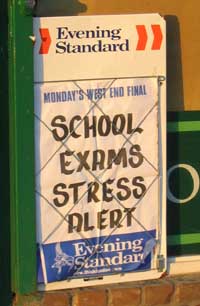
Exam stress has become so serious that government health advisers are to issue guidelines to doctors on coping with severe cases.The National Institute for Clinical Excellence (Nice) will set out the best way to treat teenagers suffering from depression triggered by exam pressures. GPs will be guided on whether to prescribe counselling, psychotherapy or anti-depressant drugs.
I find this extremely depressing. So do I need counselling, psychotherapy or anti-depressant drugs?
Hello. It sounds as if they're having problems with exam cheating in China.
I always interpret announcements that they're going to jolly well do something about stopping whatever it is as the proof that whatever it is is happening but not necessarily that whatever it is will be stopped.
So this tells me something, but not what Vice Minister of Education Yan Guiren wants to tell me:
Vice Minister of Education Yuan Guiren on Saturday pledged that great efforts would be made to prevent any kinds of fraudulent practices in coming university entrance examination, which will be held from June 7 to 9.Yuan said this year saw the largest number of university entrance examinees since the exam was resumed in 1977 after the 10-year-long "Cultural Revolution". All relevant departments must strengthen exam discipline and resolutely crack down on any forms of exam corruption.
He pledged that severe punishment will be imposed on three types of exam cheating, including finding scapegoat to attend exam, sending exam-related tips by telecommunication devices and group fraudulent practice in exam.
Chinglish, is that called? It takes a bit of decyphering, but I believe I managed.
"Nowadays, exam cheating means are modern and advanced. Once the examination papers are divulged in one place, it will soon spread widely. Therefore, examination paper must be carefully guarded," he continued.
So, Chinese students are at least getting the hang of all this modern and advanced gizmology then.
I did some education blogging today at Samizdata, about India. It's good news, I think.
There's a useful article in the Telegraph today about Montessori schools, the problem being that there is no central, franchised control of such schools, and anyone can claim to have started one.
I wrote about Montessori, with some links, here.
From Instapundit to something somewhere, to something else at that same somewhere … it's a common path. So I've just now gone from this to this (on account of having developed an interest in Intellectual Property issues – never mind why), and the I scrolled up to this.
It's is about SAT tests. I sense, on the basis of little evidence that I can point or link to, but just a general feeling, that in Britain, SAT tests are becoming more important.
Partly it's because SATs are such a big deal in America, and news from America now gets here faster and more voluminously than ever. Partly, it's because of the increasing muddle that is the British exam system. And partly, as Britain becomes more ethnically and culturally diverse, tests which hack their way past all that stuff and dig out inborn intelligence become more significant. And no doubt several other reasons I can't think of now.
Basically what she's saying is: SATs aren't perfect, but they work pretty well, despite energetic efforts to prove otherwise.
I missed this nearly two weeks ago. But Alex Singleton of the ASI Blog didn't.
Here is an article bemoaning how little teachers are paid in the USA, compared to orthodontists.
And here are the gratuitous pictures used in the article to help explain what else teachers do to make ends meet.



Answer (reprise): a free market in education.
Actually, that would probably result in quite a few fabulously well paid teachers, a lot of adequately paid teachers, and even more very, very badly paid teachers, desperate to get plum jobs but mostly never getting them. Like acting in other words.
The reason that teachers are "underpaid" and orthodontists better paid is that poking about in people's brains is a lot more appealing than poking about in their mouths.
Also, most of teaching is basically child-minding rather than actual teaching, and any old twat can learn to do that, whereas not any old twat can orthodont. Orthodonting even adequately is hard. If done incompetently, huge damage would routinely result after only a few hours of idiotic orthodonting. How often do idiot teachers do the kind of serious and irreparable damage to a pupil that an idiot orthodontist would do almost every time if he was an idiot? Therefore people are rationally willing to pay extra for properly qualified orthodonting.
Plus, nobody can agree what good teaching is, whereas there is widespread agreement about what good orthodonting is. Therefore, people are rationally willing to pay a lot for an actual agreed product, but they skimp on that which cannot be rationally decided on. Instead they (rationally) pick with a cheap pin. The more of a free market in teaching there is, the less this is true, but it would still remain somewhat true, I think, no matter how free the teaching market.
There is more widespread agreement about what a good school is (as opposed to "good teaching"), so people pay fortunes to buy, in fees or in mortgage payments to be in the right area. But this money doesn't find its way through to the mere teachers, on the whole, for the reasons stated above.
Nevertheless, a few free market teachers do already get paid a lot. I have already written here about Tony Buzan and Michel Thomas. They both get paid a lot. As do British TV's star history (two links here) teachers.
Cecile Dubois' classmates, and her English teacher, have found out about her blog:
There has been an incident in one of my classes today. I have shot myself in the foot, but I will get back up and still carry the torch of writing. I forgot to log out of my Microsoft account at school, and my weblog somehow was on the screen. And people noticed my blog and started reading everything. They googled me, I suppose, and read 'My Conservative Outburst'. A 'source' (I'm thinking 'Harriet the Spy' now) has called me and informed me of the chaos in her classroom. Some students whom I mentioned in Feburary are pissed off, possess a short temper, and are plotting amusing pranks to pull on me. The bright side is this produces weblog material, but the megative side is that I'm transforming from Cecile Dubois, sweet innocent nice girl into Cecile Dubois, professional back-stabbing bitch. I guess you need both qualities to live in the real world. The thing is some kid who I most likely showed my weblog to, ratted it out to the English teacher, who now is reading every single entry.My source suggested I not post for a while, but as a loyal blogger, I will post and bite the possible emotion 'humiliation' in the head this time. My source told me that it is hard for her to defend me now. As a journaist wannabe fellow human being, I shall not mention her name. The difference between us is that she cares what other people think about her, or me.
'Don't you want to have everyone like you?' she asked. 'You shouldn't make enemies!'
I smiled and thought of the good ol' days in grade school when I had no friends. Everyone would pinch me, chase me, shouting 'Spider, Spider, Worm, Worm'. Ah, I miss those days. I didn't purposefully make enemies, they just aggravated me so, I put them on my frown list. Now, I have a decent number of good friends, who don't associate themselves in any way with any of my English classmates. I'm not saying that my classmates in English are bad people--they're differennt from those I'd regularly hang out with. Its a good thing to take different classes and work with different kinds of people--it not only builds your patience, but prepares you for life. So, I take the bull by the horns and begin to actually enjoy, somewhat their company--which means talking in class. I do all my assignments which I enjoy, and chat with them casually.
My spellchecker puts red squiggly lines under: weblog, blog, googled, Feburary, weblog, megative, Dubois, Dubois, weblog, blogger, journaist, and differennt.
But I absolutely do not want to be megative about Cecile. This is one of the funniest postings of hers I've yet read, especially the bit at the end about Michael Moore. Placing a bet on Cecile Dubois (I mis-spelt Dubois as "du Bois" in that posting – apologies all round – spellcheckers eh?) when they had only just been issued and she'd just detonated her first big blog story (the Conservative Outburst thing), was one of the smartest things I've done lately, because from then on my name has been up in lights at her blog saying she is a potential genius. Now she is starting to shed the potential bit, and I too am starting to look like a genius, for spotting her so early and so quotably. I feel like a theatre critic when he sees his first "Brilliant – will run and run" bit stuck up outside an actual theatre, and what is more outside a show that actually is brilliant and actually is running and running.
More seriously, how many more pupils will follow Cecile's example and start their own blogs? And then get read by all their classmates and teachers, along with the rest of the universe? We're talking major shift in the Correlation of Forces between teachers in old-fashioned command-and-control regimes and pupils. And between pupils who really know how to write and the rest of them. (Before you know it, literacy might end up being cool. There's a thought.)
So here's another bet: within the next six months, a command-and-control school will forbid pupils to blog as a condition of continuing attendance. Each way bet: they won't make the ban stick, because the Blogosphere will do its thing, just like it did over Cecile's original Conservative Outburst.
Here now is a gratuitous picture of Cecile's mother, because (a) I have it (having taken it in London just before Christmas), and (b) I like it:

This lady is a major part of why Cecile Dubois is probably going to be such a big writing name. Nepotism. Don't knock it. You can learn a lot about your chosen trade from a parent if the trade you have chosen is the one they already ply. They can open a lot of doors for you. And then tell you how to conduct yourself once you're in, this being one of the big reasons they let you in in the first place.
We all sort of knew this, didn't we?
Almost a third of young teenagers have so little passion for reading that they cannot name a favourite story book, according to a poll that suggests most youngsters' reading tastes are prompted by the big screen.A survey of 300 seven- to 14-year-olds, heralding the launch in September of a national storytelling festival for children, indicates that a love of books withers as children get older. Across the age range, one in five has no best-loved read.
The poll, published by the Prince of Wales Arts and Kids Foundation on the eve of the national release of the latest Harry Potter film, Harry Potter and the Prisoner of Azkaban, reveals that the schoolboy wizard is the most popular read of those children naming a favourite book, with just over half placing it in their top three.
JRR Tolkien's Lord of the Rings trilogy, also acquiring new life and new audiences in cinemas, is popular with 25%, followed by Roald Dahl's Charlie and the Chocolate Factory.
The findings were yesterday described by the children's laureate, Michael Morpurgo, a patron of the foundation, as confirmation that "a great welter of children simply don't read".
If you define education as reading, then clearly movies, TV, etc., are undermining education. But what if understanding pictures – how to make them, how to use them, how they work – is now more of what education does consist of, and should consist of, than in the pre-TV age, and in particular the pre-digital age? That makes sense to me.
Ask me which are the stories I now have a passion for, and most of the answers are movies, not books. So I am a traitor in the camp of the readers, like one of those teachers pointed to in the report above who lacks a passion for books, by which they mean story books.
I still read books, for history, technical understanding and social theorising. But less and less do I read them for diverting stories. When I do read a good old-fashioned sit-up-and-beg story, I am as likely as not reading it because of the social theories and history embodied in it, rather than for fun. (Example: I'm now scrutinising Dickens' Hard Times, which is a fascinating source of educational rumination, in this spirit of non-entertainment. If I want to be entertained by Hard Times, I get a video adaptation of it.) There are a few middlebrow contemporary exceptions, like Susan Isaacs and Nick Hornby, whose contemporary stories I read as and when I encounter them (preferably at knock-down prices a year after they've come out), but I almost never now read "literature" for fun. Would this make me a force for evil as an educator?
I still think the 3Rs are crucial, if only to read and type the captions on the pictures and to keep count of all the pixels and megabytes etc.
Devoted readers of everything that I write - and I know that such people exist because I met one in 1995 (although I pity the poor bastard now) – will be aware that this posting could just as easily have gone on my Culture Blog. I put it here because writing good stuff for here is harder. This is because by simply not being asleep I am immersed in my Culture, but the world of Education does not now (yet – keep reading) force itself upon my attention quite so completely or so often, and in order to write about it even half-adequately, I have either to think a little, or to steal – or as we bloggers call it: link.
As regulars here will know, the policy here, now, for reasons which this posting has been all about, is to have gratuitous pictures, often only marginally relevant to the matter in hand, to arouse the interest of readers and keep their attention, stop them staring out of the window or sending text messages to each other instead of paying attention to me, etc. So here is a gratuitous Harry Potter picture:

There is an obvious danger to putting up pictures here, which is that my readers won't bother to actually read what I've put, but will merely guess its meaning by looking at the pictures, and thereby acquire extremely bad "reading" (not proper reading at all of course) habits which will stand them in very bad stead in their future lives. But this is a risk I believe I must take. After all, if I can't persuade you to want to read this stuff, you'll never learn to read properly. The point to grasp is that (a) all these squiggles do actually mean something, and that (b) you must decypher all of them.
I found this picture here. You want to read? Read all that.
I have no *!*!*!*!* idea what this is about, but it sounds as if it might be interesting:
SANTA CLARA, Calif. and SHANGHAI, China, June 1 /PRNewswire-FirstCall/ -- On the heels of its first-ever Lifelong Learning Forum held in Madrid, Spain in March, Sun Microsystems, Inc. (Nasdaq: SUNW – News) today announced the Java(SM) Education and Learning Community (JELC). Spearheaded by Sun, the JELC's mission is to gather a global community of key educators, administrators and technologists to share best practices and strategies for creating, managing and implementing next-generation education infrastructures. Sun announced the availability of the JELC portal at the eLearning Center of Excellence Forum hosted in Shanghai, PRC in conjunction with Sun's first Asia Pacific SunNetwork Conference.Founded on the principle of open collaboration, the JELC plans to address a variety of issues of great importance to the education community, including teaching and learning new technologies, vocational retraining, bridging the digital divide, and achieving full global access to top education materials and courses. To make this happen, Sun is convening education stakeholders and decision-makers, including ministers of education, Information and Communication Technology (ICT) ministers, K-12 and higher education institutions, as well as partners such as independent software vendors, standards boards and humanitarian organizations.
Is this just a fancy way of selling boxes of kit and complicated phone conversations, or is something more honourable and interesting than that involved here? I'd love any comments from the informed, i.e. from those whose knowledge of such matters is more than my *!*!*!*!*.
I asked a few days ago: When should school start? – in connection with the often repeated claim that children in the UK start school too soon.
Sally had just commented thus, and since the original posting was several days ago, you may miss it:
I used to think UK school started too early, when I lived in Europe and saw how good the early years education of friends' kids was. I've had three children go through UK reception and primary now, and no longer think it's the timing, but WHAT they do in school, that is the problem. The kids are stressed out by inadequate teaching I'm afraid - somtimes not the teachers' fault as, eg the National Literacy strategy is, well, a bit rubbish. When my children have had good teachers it has been like watching a huge weight lift off them, it isn't the reading or writing instruction itself that is the problem, but the way it is done (and some of the teaching is so muddled that older children will be just as stressed). Though the school day IS very long for the youngest children.
One day, I, or somebody, is going to give here a blow by blow (metaphorically speaking) account of exactly what good teaching of the 3Rs actually consists of.
Anyone know of such a piece of writing I could link to?