
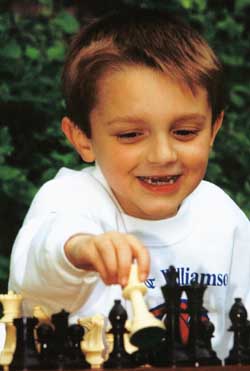
 I interrupt my Christmas holidays with news of Peter Williams, and of the battle that his parents are embroiled in with Hampshire LEA.
Who is Peter Williams? Well, among other things, he is a chess champion:
A seven-year-old chess champion has been pulled out of school by his parents after a row over skipping lessons to practise the game.Peter and Carol Williams decided to teach their son Peter at home in Alton, Hampshire, after the local education authority refused to give him time off for training sessions.
Peter's school, St Lawrence Primary in Alton, had blocked a request to give him a day off every week to play chess.
Peter has dazzled experts with his talent for chess since the age of five - beating scores of older children and adults.
Most recently, the prodigy won the top prizes of £100 and £120 respectively in the Central London Adult Rapid Play and Adult Long Play championships.
He has also won several junior tournaments, including the mini squad under-nines championships last year.
Peter said on Tuesday: "I like the money and the trophies. I want to be the best."
His father added: "Peter is the best chess player of his age in the country.
"We just want him to have the very best chance.
"We wanted him to have time to study and, as children of his age learn best in the morning, we wanted to take him out of school one day a week.
"But the school and the local education authority were treating it as truancy. It's a disgrace really."
Mr Williams said he expected Peter will remain out of school until he is old enough to go to secondary school, where he hopes the timetable will be more flexible.
This report by Alice Mascarenhas, of a chess tournament in Gibraltar, includes some stuff about what sort of boy Peter Williams is:
Gerard Matto, at seven years of age, is one of the youngest local players, playing for the first time in the Amateur Tournament. He had made friends with Peter Williams who has been playing since the age of five. Now, also seven years of age, he is one of the main hopefuls in the English camp, participating in the international tournament.Having a bit of fun, and after a game, I caught them pawn flicking. They insisted on teaching me how to play anti-chess. A challenge I could not refuse.
Peter is a great Harry Potter fan, and often believes he is a magician himself when facing a chessboard. But not surprisingly, he keeps his moves a secret and just like young Matto is not daunted by any of the adult players.
Peter smiles and tells me cheekily he plays because "you can make loads of money". But on a serious note he is a natural at the game and obviously enjoys the challenge.
"You have to concentrate."
So what else do you enjoy other than chess and reading Harry Potter? "That's easy, educational studies," came back the reply.
It certainly doesn't sound as if Peter Williams is going to degenerate into a vegetative state if he pursues those educational studies that he so much enjoys at home, with his parents, rather than at a school which is determined that he must fit into their routine, no matter what.
I wonder if that remark about "loads of money" is making any difference to how those LEA edu-crats are now treating this case. I say, good for you mate. But I wonder if they approve quite so much.
Both of those reports are somewhat out of date, the first one dating from the summer of 2003. However, having finally heard about this ruckus via Daryl Cobranchi's blog in the USA (such are the ways of the blogosphere), I emailed Peter's mother, and I got an instant response, which you can read at Samizdata by following the trackback below (this being the posting that is going up first). Daryl Cobranchi has posted the address of a Hampshire edu-crat and a Hampshire councillor, whom you can write to if you want to join in this argument. My suggestion (based on what I learned when I was an Amnesty International volunteer a long time ago): be polite and phrase your points in the form of questions rather than put-their-backs-up assertions which might be wrong. Lots of polite letters should be the procedure. No doubt this has now been happening for some time.
Here is an imperfect but just about legible scan of the Failure Notice that Hampshire LEA sent to Peter Williams (snr.), also a bit of a while ago.

Charming.
I'm now on holiday from Edu-blogging, having broken up on Friday. I start again in the new year, when the schools do. One more post will definitely follow soon in which I announce the date of resumption, which I don't yet know, because I don't know when the schools start.
There may be posts during the next week or two. It's just that I don't promise any, and it may be completely blank for a while.
Another Lileks/Gnat moment.
"How do they make chickens?" she asked as I ate."Well, they grow them, from eggs, and then when they’re old and tired, they fall asleep and they get turned into food."
"On a farm?"
"Technically, yes."
“What's tegnigly?"
"It means it's like a farm."
"Do you want to be a farmer when you grow up?"
"I am grown up, and no, I don't. It's hard work."
"Well if I was on a farm and the animals were there but the farmers weren't I would make ham out of the pigs. How do you do that?”
"Well, again, you wait until they . . . ah, sleep."
"You're so smart, daddy." She beamed. "You know everything. You know states and history. How did you know this?"
"I read books. But you never stop learning."
"You don’t?"
"No. Because there’s always something new to learn, and always something old."
"Like what?"
"Well, there’s the newspaper, which tells you about yesterday, and books that tell you about stuff that happened a long time ago."
"Even . . . thirty years ago?"
"Sure."
And it's true.
But, before that comes this:
… She went to the Girls’ Room herself. And if I can quote her directly, to ensure that she will HATE ME however many years hence when she reads this: …
He knows he's doing it, but he just can't help himself
Which comes first? The daughter he loves more than anything in the world, or a snappy paragraph in an Internet scribble he doesn't even get paid for? No contest:
…
No, even copying and pasting it would be wrong. Personally I love it all, but out there there must be a lot of people who think that this man still has a few things to learn.
Enough Gnattering for now.
I've only just spotted this, from Alan Little's blog, about son Jack:
Sunday Family Life Vignette: Maria and I are having dinner in the kitchen. Jack has finished his dinner and is watching Jungle Book in the living room. Or so we think. Jack comes running into the kitchen, grabs a wooden spoon from the sink and runs back out. I decide I should go and see what he's doing with it. What he's doing with it is trying to spoon spilt soil back into one of his mum's plant pots. For which he clearly deserves a big hug.I figure this is well above a chimpanzee level of reasoning, both in terms of understanding cause and effect (soil spilt -> mum not pleased) and premeditated tool use.
So there it is, in case you didn't spot it.
Not having any kids of my own I have no real idea, but this seems like fine parenting to me. Jack clearly knew he had done something bad, so no lecture to that effect was needed. On the contrary, well done for realising it, and well done for doing something intelligent about it.
I know what you're thinking. What the hell business is this of mine and who the hell am I to be judging Alan's skills as a parent? Answer: if you blog things like that, the whole world is then entitled to discuss it.
See also Gnat, daughter of another doting (and blogging – Lileks is a blogger in all but software) father. Here's the most recent Gnat reference that I could find:
A lazy day at home – well, for the kid, anyway. After all the hurly-burly and excitement of the big trip to Chicago, a day spent with Play-Doh and Spongebob is just the ticket. I love to hear her laugh – not just the babbling laugh of a kid delighting in something infantile, but that short single-syllable Ha! that sounds very adult, and suggests she gets the joke on a higher level.
What happens when Gnat and Bob get old enough to be reading such stuff? That's not a sarky complaint disguised as a question, I'm really looking forward to that, especially if they – I don't know – want to join in the conversation, perhaps with blogs of their own. (Question: who is the world's youngest Real Blogger?)
Or maybe there will be Conversations, after which Feelings will be Respected, and then a great Jack silence, and a great Gnat silence. Hope not.
My guess is that having a blogger dad who blogs about you will be like growing up in the Royal Family. It will be years before you realise there's anything unusual going on, and many more before you get how very unusual it actually was. In this case it'll be: Wow, you mean your dad doesn't blog about you? How very peculiar.
Key quote from this Belmont Club posting:
The school management argued that while pencil sharpeners could be proscribed the attacker could not be prevented from returning.
This is the report that Wretchard was commenting on.
I've said it before and I'll say it again. Education, like any other human endeavour, is either a tyranny or a shambles or both if you can't kick unwelcome people out (using whatever force is necessary to accomplish this), or if those who don't want to be there aren't allowed to leave.
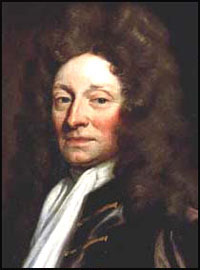 Christopher Wren (1632-1723) was a great architect, and also a great scientist, although the distinction between those two callings was less clear in his lifetime than it is now. Here is how Adrian Tinniswood, in his Wren biography entitled His Invention So Fertile, describes the education of his portagnist:
Throughout the worst period of his father's trials and tribulations, the mid-1640s, Christopher Wren spent much of his time away at school in London. In Parentalia, the collection of family memoirs which is still a core source for Wren studies, his own son records that he was 'of tender health', and that his constitution 'was naturally rather delicate than strong, especially in his Youth, which seemed consumptive'. As a result, until he was nine he was taught at home by his father and a domestic tutor, the Reverend William Shepheard. ('Home' at that time was the Deanery at Windsor, although the family still spent extended periods at East Knoyle.) Then in about 1641 the boy went as a boarder to Westminster School, a natural choice for any child of Wren's background: it was run by the notorious disciplinarian Richard Busby, a firm believer in King and corporal punishment. During the war Busby managed to combine these two interests by birching any boys who showed signs of deviating towards the Parliamentary cause, although since he thrashed any boy at the least provocation, one wonders whether Royalist children really had any preferential treatment. His enthusiasm for the King was such that John Owen, Dean of Christ Church, told Oliver Cromwell that 'it would never be well with the nation till Westminster School was suppressed'. Much the same sentiments, although from a different perspective, were expressed by one of Wren's contemporaries at Westminster, Richard South, later to become one of the Restoration court's most popular preachers. South said that 'Westminster School was so untaintedly loyal that he could truly and knowingly own that in the very worst of times he and his companions were really King's scholars as well as called so'.
Other contemporaries included John Dry den and John Locke. There is something satisfying about the picture of these four boys, who would make their names as architect, Anglican divine, poet and philosopher, working together at their Latin and Greek primers (written, incidentally, by Busby himself and sold to his pupils as a profitable sideline). The headmaster had also translated Euclid into Latin, so although it was unusual for mathematics to figure in school syllabuses of the day, Busby's entrepreneurialism extended to the teaching of geometry.
The earliest of Wren's writings to survive dates from these early schooldays. It is a Latin letter to his father from Westminster and endorsed across the bottom in Dean Wren's hand, 'Written in his tenth year':
Reverend Father:There is a common saying among the ancients which I remember to have had from your mouth: that there is no equivalent which can be given back to parents. For their cares and perpetual labours concerning their children are the evidence of immeasurable love. Now these precepts so often repeated, which have compelled my soul to all that is highest in man and to virtue, have superseded in me all other affections. What in me lies I will perform as much as I am able, lest these gifts should have been bestowed on an ungrateful soul. May the good God Almighty be with me in my undertakings and make good to thee all thou most desirest in the tenderness of thy fatherly love. Thus prays thy son, most devoted to thee in all obedience.
Given the date of this precocious exercise in filial devotion – probably the autumn of 1642, and possibly to mark Christopher's tenth birthday in October of that year – it would be nice to think of it as a childish message of support for the increasingly beleaguered Dean. But that is being sentimental. The letter is more likely just a Latin exercise by a rather bright young boy who is eager to show off to his father.
Perhaps because he was still quite a sickly child, perhaps because of the change in family circumstances, Wren left Westminster in 1646, when he was still only thirteen. Already he had seen his father go from eminent divine to humiliated and disgraced ex-parson. He had seen his uncle, one of the most prominent churchmen in England, thrown into the Tower of London and left to rot. And, of course, he had seen the religious and political belief-systems that had informed the whole of his childhood ridiculed and discredited and dismantled. What effects did these things have on him at the time?
We don't know. We don't know if he was proud or pious or just plain bored as he sat with his sisters in the rector's family pew at East Knoyle and watched his father stand at the candle-lit altar elevating the Host, or if he had any inkling that the angels and Old Testament figures which hovered over the chancel walls were an expression of pro-Catholic sentiment that was tantamount to treason. We don't know if he cried when he was told how soldiers had ransacked his father's Deanery, or when he heard that his uncle had been sent to the Tower.
It is a little easier to guess at the long-term consequences of Wren's childhood experiences. A career in the Church was no longer an option. The hopes in that direction that the Dean must have had for his son vanished with Matthew's imprisonment. More interestingly, the collapse of Laudianism may account for Christopher's lack of religious zeal in adulthood. He became a conventional and reasonably orthodox Anglican, but apart from his son's statement chat at the end of his life in the 1720s he spent his time in 'Meditations and Researches in holy Writ', there is little to show that religion was particularly important to him. Did the treatment meted out to his father and uncle teach Wren the fragility of political life? The importance of being on the winning side, whichever side that happened to be? The idea that it was better to abstain from political controversy altogether, that he should keep his mind 'invincibly armed against all the enchantments of Enthusiasm', as a colleague was to put it years later?
I think it did. Like any of us, he was angry and frustrated at times, pleased with himself when things went well and exasperated with others when they didn't. But he was also a supreme pragmatist, well able to switch allegiance if it was in his interest to do so. His son's summary of his character in Parentalia, written soon after his death in 1723, suggests that the events of his childhood had taught Wren the dangers of extremism: 'He was happily endued with such an Evenness of Temper, a steady Tranquillity of Mind, and Christian Fortitude, that no injurious Incidents, or Inquietudes of human Life, could ever ruffle or discompose; and was in Practice a Stoick.' It is also tempting to think that having had his world turned upside down politically, spiritually and personally in the 1640s, he saw in the scientific studies that would occupy half his life a means of placing that world on a systematic and rational footing.
I love this.
HARRISBURG, Pa. – The Pennsylvania attorney general's office Monday sued an online university for allegedly selling bogus academic degrees – including an MBA awarded to a cat.Trinity Southern University (search) in Texas, a cellular company and the two brothers who ran them are accused of misappropriating Internet addresses of the state Senate and more than 60 Pennsylvania businesses to sell fake degrees and prescription drugs by spam e-mail, according to the lawsuit.
Investigators paid $299 for a bachelor's degree for Colby Nolan – a deputy attorney general's 6-year-old black cat – claiming he had experience including baby-sitting and retail management.
The school, which offers no classes, allegedly determined Colby Nolan's resume entitled him to a master of business administration degree; a transcript listed the cat's course work and 3.5 grade-point average.
Well I reckon there must be plenty of cats that are really quite good at baby minding and shop minding, certainly good enough to be worth some sort of qualification. But I agree, maybe not an MBA.
Strictly speaking, you are only supposed to cat blog on Fridays, but I've decided to overlook that.
More here.
Nuanced observations from Harry Hutton about what he will be doing next (and why), in the education line:
Just called the British Council to see if they’ll give me a job. The thought of teaching English again fills me with acute suicidal instincts, but I'm running out of money and it's either that or sell one of my kidneys. The British Council is better than most language schools. It's run by the UK Foreign Office: all the other language schools I worked at were run by drunks. They could use this in pamphlets as their "unique selling point." It would be an improvement on "Creating Opportunity for People Worldwide," which is the current slogan.THE BRITISH COUNCIL
At least it's not run by a drunk.And when people ask me what I do I will no longer have to stare at the floor and mutter that I am a teacher "but I do other things as well". I can look them squarely in the eye and say, "I work for the cultural arm of the British Embassy, and if I don't get some respect around here I shall have you all shot."
The other advantage of working for the British Council is that there are no British Council inspections to put up with: they don't inspect themselves. Other schools have to be "accredited" by the BC, which means that every so often some bearded fuck with a clipboard will appear in your classroom, poking his long nose in. Usually, he wants to see your lesson plan, which I never have, lesson plans being strictly for poofs in my opinion. "Oh," he says, "You don't have a lesson plan," and writes something on his clipboard, deeply shocked by such depravity. When the class is over you get feedback, and he will express disappointment that you aren't using the phonetic alphabet. And do you want to know why I don't use the phonetic alphabet? Because my students couldn't tell the difference between a plosive, a fricative and a poke in the eye with a burnt stick. And if I tried to force them to learn it they would rise up and pelt me with fruit.
… and about the same amount as that more. Ever since I called this man "terse" he has been mouthing off like one of those mad people in the street.
However, the point about having a job that supplies you with a good answer to the question "And What Do You Do?" is a very good one. As are the points that follow about how "Teacher Talking Time" mustn't be too high. Don't you dare teach the buggers, in other words.
By the way, the comments at Harry's blog are often worth reading. They are even sometimes quite funny, which is rare with comments at funny blogs, in my experience. (See Barry, Dave.) This bit of comment, for example, from "dsquared", is good, and relevant to proceedings here:
Of course, some economists question whether there are not productivity implications if you have a system where only the second-raters are left to carry on actual production, while people more able than themselves try to prevent them, but that's a problem for the future. It's rather like Atlas Shrugged but with more box-ticking.
Ah box ticking ...
Category: Languages • Sovietisation • The reality of teaching
Yesterday afternoon I had my last visit to before Christmas, and, in retrospect, it went okay, although at the time it was a strain.
When I got there, it transpired that Boy One and Boy Two had hatched a plan, to the effect that I should see both of them together for an hour, rather than each one in turn for half an hour. Okay I said, since it's my last visit before Christmas. At that VRH course we were warned about taking them in numbers greater than one, but I agreed, on the clear understand that if I didn't enjoy it, and that if they didn't behaved as I wished them, it would be back to the old system.
Not having done any regular teaching of boys of that age I was startled at the transformation that overtook Boy One especially. Boy One, when with me alone, is the soul of mature politeness, not to say charm. When he's trying to get me to do what he wants, he is very nice, very plausible, very winning, and we get along excellently (for I too can turn on the charm when I am seeking things that I want). But when faced with me together with Boy Two, whom Boy One obviously regarded as a puppy below him in the puppy hierarchy, Boy One focussed most of his attention on shouting at Boy Two with a view to subjugating him. Ingratiating himself with me was cast aside. I spent most of my time telling them to keep their voices down, Boy One especially, please, or I'll get into trouble.
Boy Two, who tends to be a tad despondent with me alone, seemed rather happier and livelier, which was probably because of the general air of relative anarchy that prevailed, compared to the one to one sessions, plus the fact that he had a bit of company of his own age, which he seems to like a lot. When with me alone he tends to fidget in a rather alarming and One Few Over the Cuckoo's Nest sort of way. There was none of that today. When physically irked, he would run to the other side of the room.
I have been urging both Boys to do some reading, or at least submit to me reading to them, so that the idea of books as sources of information and entertainment is fixed in their minds to work its future magic, even if the notion has no effect now. They submitted to another two pages of King Arthur and his endless conflicts with the diabolical Morgan le Fay, the source of all trouble in Arthur-land, it seems. Then they mucked about with coloured pens and paper. Then they played cards.
These cards are of the ones with soccer internationals, each card having a picture of a soccer star and a list of individual information, like country, year of birth, weight, height, number of international goals, number of years of international soccer, and so on. The cards are divided … oh to hell with it, who cares what the rules are? But the point is: these rules involved comparing the information on your card with the other fellow's card.
I seriously don't think that they realised they were reading.
It was a long hour. They seem to welcome the fact that I will reappear in January, which was pleasing to me, but at the end of it all, I was tired.
What looking after twenty such, all in a pack for a whole day must be like, I dare not speculate.
I'm not sure myself what I think of it, especially when governments are so heavily involved, but one of the biggest education stories that has emerged while I've been writing this blog has been educational globalisation.
The BBC presents two contrasting views of this process. Our Education Minister Mr Clarke is for it, and wants only to encourage it, although politicians encouraging something doesn't necessarily mean that it will actually be very encouraged. Here is a BBC report of his globalisation thoughts yesterday:
The UK must be a serious player in the global market for students if it is to prosper, says the Education Secretary, Charles Clarke.He told a British Council-organised UK International Education Conference in Edinburgh that this was worth £10.4bn a year to the economy.
However, as a result of this report, I found myself following a link back to a warning given by Robert Reich to British higher education:

Britain has been warned of the dangers of following America in the "marketisation" of higher education.The warning came from Robert Reich, a professor of social and economic policy at Brandeis University and a labour secretary in President Clinton's administration.
I've had a busy day and am still studying Reich's thoughts, but a cursory look-through suggests that this is a particularly important point:
There is also along with the marketisation of higher education there's a greater and greater emphasis on vocational and pre-career university courses and the advertising and marketing of vocational and pre-career - accounting, law, economics, finance, engineering, applied sciences - these are becoming very, very popular, undergraduate curricula in these areas are expanding dramatically, a faculty who are teaching in these areas are paid better and better. And so more seriously the classics – literature, history, some of the basic sciences - have become poor stepchildren. Because you see it follows that as you envision higher education as a system of private investment for private return and as that sinks into the public's mind it naturally follows that the concept of a liberal arts education or an education in humanities or the education in broad-based social sciences or in classics or whatever has less and less justification in the public's mind.
But is there not also another explanation for the decline of the humanities, which is that the potential consumers of these services are distressed by the nature of the product. "Liberal arts education" is surely the bit of US higher education that has degenerated most spectacularly in recent years. This is where bias, ignorance, and hostility to all the kinds of values of the kind that such an education used to promote has run riot most riotously. Vocational courses have a built-in mechanism to enable their quality to be assessed. How well to the products of such courses then do in their careers? This, I submit, has kept them up to the mark and created meaningful competition, in a way that relates to what those customers want from such courses. No such mechanism is built into humanities courses.
And there is also the simple fact that only a few are drawn towards the academic life. The recent trend towards marketisation has accompanied something which might have happened anyway, without such marketisation, which is simply: expansion. Do more higher education, and you are not going to churn out the exact same proportion of historians and literary critics, unless you are very foolish. Could Reich be blaming marketisation for something which is actually just plain common sense, and if he is right to blame marketisation, would it not make more sense to praise marketisation for registering the wisdom of such an alteration of educational emphasis? Would America really be a better country had the universities unleashed a million more humanists, or whatever they are called?
Just a couple of thoughts, which are of course related. I have more homework to do about this piece, but that's no reason for me not to link to it in the meantime, as I hope you agree.
 It's
It's … Ben Durham, the 21-year-old blind-side flanker, was the beating heart of Oxford's dominant forward effort, both with ball and in the tackle. Still, despite Oxford's attempts to keep him, Durham’s brain is even more sought after, and next September he heads for the City to work for Goldman Sachs, eschewing a professional rugby career with Gloucester."I’ve been at Oxford four years now and I should probably think about leaving," Durham, who earned a first class degree in economics and management and is studying for an MSc in economic history, said. "I played as a professional with Gloucester until my second year (at Oxford) and I found it quite dull. I should imagine if you are Jonny Wilkinson it's fantastic, but being a professional in the Premiership does not appeal.
"With an Oxford degree behind me I think I should go and explore some wider options. Besides, they (professional clubs) won't pay me enough."
Durham, who was educated at Pate's Grammar School in Cheltenham and studies at Keble College, won his third Blue and enjoyed a first win. "I'm glad we won, or I might never have left Oxford," he said. Instead of making hay in the mud at Kingsholm come September, Durham aims to start his job in UK mergers and acquisitions at Goldman Sachs, the American investment bank. This may even have been his last game.
"If I play I want to play good rugby, not just kickabout stuff, but you never know, I might get bored in the City," he said.
Steve Hill, Oxford's director of rugby, has not given up hope of keeping Durham. "Ben is one of the brightest boys we’ve had in the team," Hill said. "He's expressed an interest in being captain and he has secured serious funding from research bodies at Oxford to stay for another three years if he wants it. Maybe his bank will defer until after next Christmas."
Decisions, decisions.
Good to remind ourselves that for some, education still manages to work out quite well.
Oxford won 18-11.
Worried about your child or pupil not talking until quite old?
There is a joke about a German child who said nothing until he was about eleven, when one day he did speak, to complain about something. When asked why he had not spoken sooner he said: "Because until today everything was satisfactory."
 Take heart from the fact that apparently something similar really did happen in the case of Thomas Carlyle, later the author of many learned books and writings. Young Thomas said nothing for year after year. His first spoken words, as recounted by pinko thesp Corin Redgrave on Quote Unquote last Sunday came when Carlyle was, if I remember it rightly, seven. Then, an aunt (or someone) poured boiling water on him, and apologised profusedly to young Thomas. Who then said:
"Thank you madam, the agony has abated."
Relax. He's just hasn't yet had anything important to say.
I can find no Internet reference to these words. But more about Carlyle is to be found here:
Thomas Carlyle was born in Ecclefechan, Dumfries and Galloway, as the son of a stonemason and small farmer. He was brought up in a strict Calvinist household. At the age of 15 he went to [the] University of Edinburgh, receiving his B.A. in 1813. From 1813 to 1818 he studied for the ministry of the Church of Scotland, but abandoned this course and studied law for a while.Carlyle taught at Annan Academy (1814-16), at Kircaldy Grammar School (1816-18), and privately in Edinburgh (1818-22). …
It's off message, but I also like how Tennyson defended Carlyle's marriage, to someone equally strange, against various critics of it:
"By any other arrangement, four people would have been unhappy instead of two."
UPDATE: I tried again, and this time I did find a reference to this literary late talker tale. And apparently it was Macaulay, not Carlyle at all.
Macaulay also wrote many books and writings.
More on turning your hobby into your career, from last Saturday's Telegraph:
Six months into to his first year at Leeds University, Nick House ran out of money. He'd blown all his grant on partying, hanging out on the burgeoning Leeds club scene and throwing the odd party.
So, like any desperate but resourceful student, he went to see his bank manager to appeal for an extension on his loan. "I remember being handed a form," says House, with a wry smile. "It said something like 'reason for loan (tick box) books/education/training/computer equipment/other'."
House ticked "other" and added the explanatory couplet "nightclub promotion". Needless to say, he was refused a loan.
But the plucky young man, who during the past few years has been largely responsible for revolutionising the student events scene in the UK, wasn't to be deterred.
House looked at Leeds's lively network of 20-30 nightclubs – crammed at weekends, rattling the rest of the time – and dreamt of filling them with the hedonism-hungry student population. He hired a club and raised the cash for his own off-campus, exclusive NUS night called "In Your Dreams". Investing £1,000 of his own money, he printed flyers and hired a DJ. More than 400 Leeds students turned up and had a great time, but House lost a small fortune."I was too emotionally involved," he says. "I had fun, got a huge ego boost and gained lots of cred, but I lost money because I was a naive 18-year-old. I knew nothing about print costs, venue hire, distribution, DJs or profit and loss. They even charged me for the hire of the lighting rig, which is a joke."
House learnt from his mistakes. These days his student promotions outfit, Come Play, lures about 20,000 students into nightclubs across the country every week of the term.
And of course this story is also a reminder that as higher education gets to be a mass experience and not just an elite experience, that makes the student a major entrepreneurial target.
One thing puzzles me though. At the top of of the story it says that Nick House ran out of money. Yet later he manages to invest £1,000 of his own money. What gives? Or more exactly, who gave?
The BBC1 TV show Hard Spell is big news in India, because girls of Indian descent came first and second.
This BBC report tells more, although "disequilibrium" is surely a poor example of a word which is hard to spell.
Much of the coverage that I read in the Sunday papers yesterday was were very critical of the show, on the twin grounds that it was cruel, and that in any case spelling doesn't matter.
A. A. Gill, for example in his TV complaint column in the Sunday Times Culture section, had this to say:
No television ever made is worth an 11-year-old’s tears. I was really shocked by this show. How could anyone imagine that it was entertaining to watch small children being pressured to the point of breaking down with so little enjoyment? It was cruel, plain and simple. The evening news had just told us that umpteen kids are being excluded from schools every day. Last week, Tony Blair made tackling bullying a priority. Well, you get out of children what you put in. This programme publicly picked on, humiliated and bullied kids when we should all be respecting and protecting their status and their importance to our future.Now, you may think I'm overreacting to a game show. Well, perhaps I have an interest. I'm excused spelling – I have a note from my mum. The truth is, it doesn't matter, not a jot, not a tittle. Spelling only matters in Scrabble and to retired civil servants who write dull letters in green ink and teach their budgerigars not to split infinitives. I just pressed the spellcheck on my computer – 805 words misspelt out of 1,200 – and you know something, the bottom line is I get paid the same for the wrong ones as for the right ones.
The claim that spelling is unimportant is bollocks, or bolix as A. A. Gill would perhaps spell his proudly illiterate version of that ancient insult. The proof? That if the Sunday Times were to print Gill's writings in the misspelt form that he boasts of submitting them in, they would make very, very public idiots of themselves, and in fact would never live it down. (Look what has happened to the reputation of the Grauniad, as it is affectionately known, on the strength of about as many typos in a year as A. A. Gill claims to perpetrate in each of his pieces. Clearly someone at the Sunday Times has to be able to spell, even if it isn't him. Imagine what A. A. Gill himself would say if road signs, or the writing on the front of CDs, or the instructions for his DVD player, were routinely miss-spelt. What a W-A-N-K-E-R.
Nor is the perhaps excessive pressure that this first batch of kids have been put under an incurable state of affairs. The show just needs to be managed a bit differently and a bit more humanely, and no doubt it will be next year. Because this thing is here to stay, I'll bet you. And a good thing too, I say.
Anything that gives the swot tendency a bit of national recognition is surely worth encouraging. I'm not saying that we should deliberately make children cry on national TV and on principle, merely that this is a risk worth taking in order to create what I will, I feel sure (I hope anyway), soon become an impressive national institution.
More from the Department of Count Your Blessings, from Nigeria.
Leader from the Vanguard of Lagos. Quote:
Poor funding and inept management of schools have, according to NAPTAN, resulted in acute classroom over-crowding, non-existence of library facilities and poor remuneration for teachers, which consequently dampens their morale.Worse than this, however, is the pervasive instances of certificate forgery, examination malpractices, cultism, murder, arson, gangsterism and other criminal tendencies in the educational system. That is the extent of the havoc wrought on schools by a succession of shortsighted leaders.
What is to be done?
But, before the country can record any progress in her educational system, all stakeholders in education must realize the pervasiveness of value disorientation in the system, and appreciate the need for a re-awakening of appropriate values to wean the society back from the precipice of a free fall. A re-awakening of socially acceptable mode of conduct in students, parents and teachers will put an end to cultism, examination malpractice, sexual permissiveness, and all other vices that have, over the years, been militating against the educational development of the nation.It is only when peace and security reign supreme in our schools that the quest for their rejuvenation can be realised.
Envious eyes are caste towards Japan. More spending is needed, to provide technological education fit the modern world. Things must be done better. Everyone must behave better.
In other words: they have no real idea what the hell to do.
Good luck fellows. You're going to need it, by the sound of things.
As it says at the top of allafrica.com where I found this: "There's no place like Africa …" Maybe just as well.
And as has been said here before, using the word "stakeholders" won't do you a bit of good.
I see that in my report from the day before yesterday of that VRH refreshment meeting, I really left out the most important thing I learned, which is that reading is not the sole purpose of VRH. Paul The Boss even said that he somewhat regretted the title of the organisation, Volunteer Reading Help, because it missed out other important things, like children just talking, with an adult, and just becoming more confident. Once they see the basic point of words, and can say them confidently, then the next step, of reading them and writing them, comes far easier.
Paul The Boss even used a word I had never heard before – "oracy" – which apparently he heard Parliamentary Under Secretary of State for Schools Stephen Twigg use in a speech about a year ago. Paul The Boss suspected Stephen Twigg of having made the word up, or that the word was at least something made up by New Labour. But he liked it anyway, or he wouldn't have mentioned it.
So, is oracy a real word? You be the judge. I have the strong impression that we have the education academics to thank for it, and that before 1990 it definitely wasn't a word. But one thing's for sure, which is that Stephen Twigg did not make it up.
However, the fact that someone like Paul The Boss finds this word useful makes me respect it, despite its likely recent academic origins. What Paul The Boss has in mind is a general confidence with words, spoken as well as written, although whether the academics mean exactly that by it I don't know. And we VRH volunteers are there not just to get our charges reading, but, if that fails, simply to get them talking. Confident in speaking with an adult. Used to the idea that words can communicate, that communication, indeed, is possible.
Associated with this is an ethic of voluntariness. We aren't there to compel these kids to do anything they don't want to do. If they want to play games, fine, that's what we do. If only because playing games does often involve reading in various ways, as was the case today when Boy Two and I played a card game that involved him reading the names of soccer players and their countries.
What separates all this from the aimless chaos of a badly run primary school is that each child has our undivided attention for the duration of the session. Just sitting and doing nothing and getting bored, it is absolutely not.
Category: Brian's brilliant teaching career • Education theory
A posting today at the SAU blog is by one of my favourite educational commentators, . It is basically a written down version of what he said on this occasion.
Gilbert supplies his own summary:
As a consequence of my encounter with the state education system, I believe that there are five policy changes that might begin to solve our country's educational problems.1. Take the education system out of state control;
2. Allow schools to set their own admissions policies;
3. Disband the National Curriculum;
4. Introduce a standardized reliable series of external tests; and
5. Offer improved child care facilities to the parents of very young children.
That shouldn't take long!
And while you're at the SAU blog, check out Elaine Sternberg's review of Alan Bennett's play The History Boys, now in repertory at the National Theatre.
While embedding the links into the above verbiage, I noted that the Samizdata piece I did after attending Gilbert's SAU talk, and the Bennett play, are both, centrally about the matter of the measurability and the immeasurability of education. Bennett argues that the immeasurable shouldn't be neglected, and I argued that immeasurability is no excuse to put the government in charge of everything.