
I caught a snatch of a London TV news report this evening about how German universities are trying to persuade British students to do their degrees in Germany, for free. No need to worry about loans and top-ups if you go there.
What they didn't explain was what was in it for Germany. Is it that they can't stand their own students and figure that they'll get slightly better ones this way? Are they trying to make sure they learn and teach English idiomatically, complete with up-to-date swearing?
Touting for business I could understand, but where is the business here?
Google google – this is the same story. Yes, the mentioned a woman called Lemmens on the TV.
Quote:
LONDON - Free higher education in the home of Western civilization's most provocative thinkers, a chance to learn a second language - and a legal drinking age of 16? It's a formula that might appeal to both stressed parents and students alike!Germany is willing to accommodate what could be a dream for many American families, worried about the skyrocketing cost of higher education.
“Our idea is to get the best people to the universities,” said Nina Lemmens, the London-based director of the German Academic Exchange Service, the DAAD.
This week, Lemmens has been promoting the free international degree program in English to British students, who also are worried about higher college fees. But she explained the German universities also are keen on recruiting American and other international students for their tuition-free programs.
Maybe the snag is you have to be extremely well schooled to qualify. But, does anyone have any further light to shed on this apparently rather odd little sales trip?
Is it perhaps some insane unintended consequence of German quota-fulfilment arrangements, where they are desperate for educational bums on seats because that's how they are paid, even though the bum-owners pay nothing?
There is a fascinating article by Cherryl Barron in the latest Prospect (April 2004 – paper only so far as I can work out) about the reasons for the Indian computer software miracle.
The emergence of India as a software superpower is still generally attributed to the cheapness of its programmers and software engineers. But the underlying reasons are more complex and interesting, lying in the subcontinent's intellectual and pedagogical traditions.Software is ubiquitous. It is at the core of processes in every strategic industry, from banking to defence. And the depth of India's advantage in software suggests that it poses a bigger challenge to the western economies than even China. China, strong in manufacturing and computer hardware, has been almost as unimpressive in software as Japan. Indeed, no developing country has ever taken on the developed world in a craft as sophisticated and important as software.
Indian software aptitude rests on both the emphasis on learning by rote in Indian schools, and a facility and reverence for abstract thought. These biases of Indian education are usually considered mutually exclusive in the west, where a capacity for abstraction is associated with creativity. In India, learning by rote is seen by most conventional teachers as essential grounding for speculation.
An educational tradition that spans learning by heart and exalting excellence in higher mathematics is just right for software. It fits the mentality of computers. These are, after all, machines so fastidious as to refuse to send email with a missing hyphen or full stop in an address. Yet no product on earth is as abstract, boundlessly complex and flexible as software. It cannot be seen, heard, smelled, tasted or touched and is, to borrow Nabokov's description of chess – a game invented in India – a "spectral art."
India's software accomplishments reflect those extremes. Indian firms dominate a world elite of over 120 companies recognised for producing outstandingly accurate software, those which have earned a CMM Level-6 tag, software's equivalent of the Michelin 3-star rating. These establishments – of which America has less than half the Indian total—are certified to be following an exacting, detail-ridden methodology developed at Carnegie-Mellon University in Pittsburgh for producing reliable code.
At the other pole of cyber-sophistication, most of the reigning US technology giants – Microsoft, General Electric, Texas Instruments, Intel, Oracle and Sun Microsystems – have established software design and development facilities and even R&D laboratories in India to take advantage of the world-class brains produced by the Indian institutes of technology, willing to work for an eighth of the starting salary of their US counterparts.
This next bit also alludes, perhaps without intending to, to what used to be wrong with people educated in India.
Western programmers' view of their craft tends to stress its more rarefied dimensions, such as this description by the US computer scientist Frederick Brooks: "The programmer, like the poet, works only slightly removed from pure thought-stuff. He builds his castles in the air, from air, creating by exertion of the imagination. Few media of creation are so flexible ... so readily capable of realising grand conceptual structures."Yet "pure thought-stuff" is also an encapsulation of ancient India's contributions to the world's scientific heritage. In about 600 BC, before the Greeks, some schools of physics in India developed atomic theories, based not on experiment but purely on intuition and logic. Some western physicists marvel at how much closer the imaginative speculations of Brahmin atomic theory have come to current ideas in theoretical physics than those of any other pre-modern civilisation.
"The Indians advanced astronomy by mathematics rather than by deductions elicited from nature," the science writer Dick Teresi has noted in Lost Discoveries. Indian mathematics was also distinctively airy-fairy. Whereas Greek mathematics was largely extrapolated from mensuration and geometry, the ancient Indians most distinguished themselves in abstract number theory. Zero, infinity, negative and irrational numbers – all concepts that the Greeks dismissed as ludicrous – were Indian concepts.
Airy-fairy. "Pure-thought-stuff." Yes, that sums up the cliché stereotype Indian university graduate of my (older) generation. Very big on abstraction, can talk the hind leg off a donkey, but no bloody use for anything except becoming a bureaucrat and driving the Indian economy – what little there used to be of it – ever deeper into the dust.
Spatial extension and quantities of objects were far less interesting to pioneering Indian mathematical minds. In fact, the Indian leaning towards abstraction – so deep-seated that theoretical physicists and mathematicians still outrank every other sort of egghead in status – explains India's relatively poor showing, historically, in more practical sciences. The sinologist Joseph Needham observed that more practical study would have entailed defying Indian caste rules about contact between Brahmins and artisans. Similarly, the progress of ancient Indian knowledge of physiology, biology and anatomy was held back by the taboo on contact with dead bodies.
All of this brings to mind a remark by Peter Drucker from long ago to the effect that computers have provided something never before seen in the world, namely: paying jobs for mathematicians.
Could it be that the way that computers have enticed all these airy-fairies and pure-thought-stuffers away from being government bureaucrats will turn out to be their most important beneficial contribution to the Indian economy? Yes, these people are doing splendid things with their computers, but think of all the abysmal things they used to do and might still be doing instead, were it not for computers.
I can confirm the excellence of Indians at maths with one extremely anecdotal anecdote. By far the cleverest attender (way ahead of me) of those Kumon maths sessions I occasionally mention here was an Indian boy of about eleven or twelve. (One of the "slumbering giant" glories of Kumon is that it enables Kumon instructors to accept and help to educate pupils who are cleverer than they are. I think this is the single most impressive thing about Kumon. Think about that. But I digress.)
Barron ends as she began, by contrasting India with China:
It was the supreme pragmatists, the Chinese – whose intellectual traditions favoured practicality and action over airy speculation – who were the technological geniuses of antiquity. They invented paper, seismographs, the magnetic compass, the wheelbarrow, irrigation, ink and porcelain. But reasoning for its own sake was of so little interest to them that, unlike the Greeks and Indians, they never developed any system of formal logic. It hardly seems accidental that it is through the manufacture of physical objects that China is making its mark today, while India floats on the ethereal plane of software.
As regulars here will know, I have been trying recently to liven up this blog with pictures. And I think it says something about the priorities of Indian civilisation just now that when I typed "India" and "Mathematics" into Google, the pictures were all either terrible or irrelevant. How do you illustrate an ethereal plane? Just an Indian guy in front of a blackboard covered in mathematical symbols would have done nicely, but I could find nothing like that.
Lots of stuff about Ramanujan, though.
Perhaps you recall that I've been reading about the great language teacher Michel Thomas. I have recovered the book about him which I temporarily mislaid, for which thanks to the relevant people. I've not yet encountered any bits about the man's own remarkable teaching methods, but I did encounter this fascinating bit about the man's own education. Thomas was born in Poland, but while still a child he moved to Germany.
By the age of sixteen Michel began to feel that he had outstripped the school he attended and no longer felt challenged. 'I was anxious to get it over with.' He developed a plan in which he would take extensive private instruction instead of school work, enabling him to gain a year. He took the idea to the principal, who instantly rejected it.
Undeterred, he started shopping around for alternatives, an outlandish concept for a student at that time. He chose a Gymnasium attended by children of the militaristic upper-class Junkers, a school known to be rigid in its educational methods and unforgiving in its academic standards. ('It certainly had no Jews.') But the principal, although a severe disciplinarian of the old school, was sympathetic to a teenager's passion to learn. He accepted the scheme.
At the same rime, Michel sought out a private tutor. He chose a highly educated intellectual in the city, Dr Karl Riesenfeld, a musicologist who wrote opera reviews and literary criticism in the highbrow publications. 'He was a walking encyclopaedia. I explained I wanted to leave school early and go on to university, and that I wanted him to teach me personally.' When pressed, Michel admitted that he had not yet spoken to his family about the idea. Not surprisingly, the professor turned him down. Michel refused to take no for an answer.
Riesenfeld tried to brush him off, saying he was busy: 'Besides, summer is coming and I will be travelling.'
'Fine,' Michel said. 'I'll come with you.'
He was passionate and persuasive, and the professor finally agreed to talk to Michel's family, and that if they consented something might be worked out.
 That same evening at dinner Michel decided it was a good time to speak to his aunt and uncle about the various far-reaching arrangements he had made for his life. 'I've quit school and I'm not going back.' He explained he had left his old school and was intending to go to a more demanding establishment, finish a year early and go to university. 'I gave them my reasons and told them what I had achieved, that a Junkers Gymnasium had accepted my plan, and that this brilliant man was prepared to talk to them about private instruction. I must say they were impressed by my initiative.' He was granted his wish, and was also allowed to travel with his chosen Aristotle.
They visited the Alpine resorts of Austria, the Italian Dolomites and the cities of northern Italy. Michel studied every day, and discussed history and art, hour after hour. 'I started looking at history through different eyes than those at school. The professor was a learned man, but brought people and places to life. I began to see great historical personages not as figures detached in time who fought some war, but as real people. I started to question what they were like and what motivated them. I developed critical thinking and evaluation – not accepting what I was told and read, which was very un-German at the time. It was one of the greatest learning experiences of my life.' He had previously been weak in mathematics, a subject he had no interest in and for which he was convinced he had no ability, but the professor changed all that. 'Through challenge and love I became a reasonable mathematician. He showed me that there is nothing so complicated that it cannot be made simple, and the concept of reducing complexities later became a cornerstone of my teaching.'
Today I attended the fortieth birthday party of my friend Alastair James, at his home in south London and I write in haste, to have something up here today even though it is Sunday.
I got to know Alastair via libertarianism, the Libertarian Alliance - to which, among much else, he contributed this LA publication. (Link to the LA website not now working, link to follow.) He now works for Deloittes, in the management consultancy bit, and he has recently been interviewing the Deloittes graduate intake.
He said that the quality was very high, and that they were all intensely focussed and ambitious, and that they had all been doing all manner of extra-curricular activities like white water rafting up the Zambezi etc., which would look good on their CVs, and because they would look good on their CVs. Their business acumen and general level of managerial savvy was remarkable, and far higher than that of Alastair's own generation, or of the generations before that. But ... they couldn't write.
Not couldn't write as in couldn't write as well as Charles Dickens or Edward Gibbon (I cross-examined Alastair on this exact point), but couldn't write as in couldn't communicate clearly in writing, to anyone, not even to each other. Their grasp of English grammar was tenuous to non-existent. Not having actually read anything these crown princes had written I can't quote you chapter and verse, but that was the guts of Alastair's complaint.
I asked Alastair if they could they speak clearly. A bit more clearly, but not very, was the answer. Alastair explained how he got them to say what they had been trying and utterly failing to say in writing, and he then said: go away and put that, and then come back and we'll see how you did. And they couldn't do that either. They couldn't write clearly, even when they were stressing and straining at it flat out, not as if their futures depended on it, but when their futures actually did depend on it.
These are not underclass rejects. Quite the opposite. This is the cream of the crop, the human fizz on the champagne of Western Civilisation. Graduates. Post-graduates. Super-graduates. The next generation of leaders. And they can't communicate properly.
Depressing. And in fact Alastair later told me that the state of education is indeed one of the things about the world which now most depresses him.
I get the feeling that I may end up as a teacher of English grammar. Maybe, when I've mastered the art of teaching English grammar, I'll apply to Deloittes for a job. The subject I will teach will be called "uncreative writing".
I've been reading the English version of China's 'People's' Daily. See also: China refutes US censure on human rights, and the sneer quotes to describe Taiwan 'election', which is rich coming from them, and which is why I have sneer quoted the 'People's' bit in 'People's' Daily by way of retaliation.
Anyway, according to this story, the Chinese are working their kids hard. Mere school is only the beginning of the story.
Two tough times begin when regular school ends on Friday afternoon for Xiao Di, a grade-two pupil in a primary school in Beijing's Dongcheng District.Here is her schedule:
Sightreading and music theory on Friday evening.
Math and English on Saturday morning.
Piano on Saturday afternoon.
Dance on Sunday afternoon.
Sunday morning free? No! It is reserved for homework assigned by her teachers at her regular school.
What is all this frenetic activity in aid of? Have the children, or rather, their parents, got a problem?
Yes. Why all this frenetic activity?
"It all boils down to one word – competition,'' says Hong Chengwen, a pedagogy specialist at Beijing Normal University.All this, especially the math and English, has something to do with preparing for junior high school in the immediate future.
But junior high is not the ultimate goal, nor is senior high, though both are vitally important stepping stones in the children's long road to getting established in a successful career.
It is university entrance, though still a long way away, that is behind all this week-end fuss today.
"A high score in the college entrance examination makes all the difference between the success and failure for a student. At least, a significant portion of the students – and their parents – think so; in spite of the fact that we educators and the educational authorities repeatedly trumpet the value of pluralistic approaches to success,'' Hong says.
The college entrance examination is a one-shot deal. You make it, you win. You don't, you lose – with not much chance of a second chance, says Hong of the harsh reality the students must face.
But do art and music have anything to do with university enrolment? Yes, they do. Universities are being given more and more power over who they may take in as students, and many of these schools are eager to recruit artistically accomplished or athletically gifted students to help boost their image at music, art and sports events organized among universities. These "special-skill students,'' as they are referred to, therefore have a better chance of getting into prestigious universities, because their artistic or athletic skills can count as part of their entrance-exam scores.
"Universities are being given more and more power over who they may take in as students …" That's an interesting little titbit, isn't it?
But, earlier in the game, some "key" junior high schools also pick for enrolment the "special-skill'' pupils and those who excel in the "killer'' math and English courses, from the primary schools.
And as if all that isn't enough …
Beyond the competition factor, many dads and mums want their children to develop in an all-around way. This helps explain why so many kids are studying dance, singing, piano, painting and so on, even though it is obvious to all that only a very small number of the children have any chance of becoming professional artists or musicians.
So, ferocious competition to get into university, and they have to be "all-rounders".
My guess would be that all this is approximately true. And isn't it interesting that this is now how the rulers of China now want the world to see them?
Here's a Boston Globe article about home education.
This was my favourite bit:
Bryanna Rosenblatt says her public school friends envy her, because they all think she's home in her pajamas all day. But she keeps herself on a regular routine: up, showered and dressed by 8 a.m., tackling a curriculum of her own design. Clonlara School, a Michigan-based home-school program, offers an accredited online high school that tracks Bryanna's classes, and will provide a transcript come time to apply to college.Home-schoolers who don't correspond with online high schools are creative in how they document what they do, so that they can demonstrate to school districts - and later to colleges - what they are learning. Many are diligent in logging daily activities, with each tallied in a different column. Playing Monopoly is math. Chess is critical thinking. Collecting stamps is history. Attending concerts is fine art. Pen pals and e-mail count as writing.
Bryanna is a pretty, ponytailed girl who likes to keep her hands jammed deep in the pockets of her black sweatshirt, emblazoned with CKY, the culty band that celebrates skateboarding, skits, and stunts. Her home-schooling experience is much more structured than her mother, Tammy Rosenblatt, had ever envisioned. Since Tammy decided to home-school Bryanna in kindergarten, she's always imagined Bryanna following her intellectual abilities into unusual educational opportunities. But Bryanna craves structure. She found some textbook catalogs in her mother's car and insisted that she get some. And she sets aside a few hours a day to lead herself through school books about literature, science, and algebra.
"I felt like a failure when she wanted textbooks," says Tammy. "I didn't think we home-schoolers were supposed to use them. But I also know that we're supposed to be flexible."
This reminds me of a favourite cartoon. Scruffy parents, very small boy in very smart suit, including collar and tie. Caption: "Yes, we wanted to raise him as an anarchist, but he wouldn't be told."
That Clonlara home-school program is presumably this.
A Brian's Friday is drawing to a close, and my speaker, Antoine Clarke, who was, as always, most eloquent, is rambling to me about education while he makes himself a cup of tea.
 Antoine tells me that he has just been visiting the Friends Reunited website, and they have ancient tests up there which you can take. Old 11+ exams, and GCSEs, but not O or A levels.
Antoine tried all the papers they had. The 11+ paper dated from the late 1940s. The GCSE paper was about 1990. The subjects, for 11+ were: verbal reasoning, maths, and science; and for GCSE they were: maths, physics and biology.
His worst score was verbal reasoning for the 11+, and his worst score in the GCSE was 80 per cent, which was in maths. Antoine is bi-lingual in English and French and has taken numerous exams in French as well as in English, and he says he has never gained a "pass" score in a French maths exam.
Looking at the standard of the exams generally, he thought that the GCSE would have been tough for his year at school when he was ten, but that most of his mates would have passed at any time after that.
His conclusion is that the modern English GCSE exam is primary school standard for the 1970s, and doesn't compare at all with the 1940s 11+.
In short, dumbing down is no myth.
The headline makes the point on its own:
School Trains Girls to Be Good Wives
Which makes you wonder if perhaps it might make sense to have another headline about how:
School Trains Boys to Be Good Husbands
No link for that because I made it up. And I suppose the good schools already do teach this. (Get a job.)
Deep thanks to Dave Barry, where MOTW comments as follows, on a related educational theme:
When I was in college (1998), those students in the Business College were required to attend an Etiquette Dinner. It was a five course meal and several faculty attended. This was to teach students how to engage in small talk, to know which fork to use, where the napkin goes, don't talk with your mouth full, etc. It prepared them so that when the student was out at a business lunch or dinner, they would not embarrass themselves and ruin their career with a horrendous lapse of manners.You may laugh and poke fun at this, but manners really are largely lacking in society today.
And there is plenty more about education as it used to be, in the Good Old Days when people held their forks correctly instead of only using them to poke fun. Worth a look.
I love this comment, from S. Weasel, on this at Samizdata today, which speaks for itself:
You know, bob, promoting the importance of education using horribly mangled syntax has got to have a cracking good joke in it somehow. I just can't think what it is.
No, that is the joke and you just cracked it.
I've recently put two stories up at Samizdata on educational themes. The first is a straight copy and paste job, with a only a small burst of preliminary chat from me, of David Gillies' comment here on this posting, about academic cheating. I also linked from Samizdata to this highly recommendable recollection by Natalie Solent, on the same subject, also written in the first person.
And the second is a reaction to this Telegraph article about how a British mum has been jailed for failing to prevent her daughter's truancy.
Susan Elkin, writing in yesterday's Telegraph, thinks that things have been improving:
When my father, a former teacher in Deptford, south London, heard that I was starting my teaching career at a notorious secondary boys' school in the area, his laconic comment was: "Well, if you survive there, girl, you'll cope anywhere."How right he was. It was 1968. I was 21 and had come straight from an appalling "child centered" teacher training college that had managed to teach me absolutely nothing in three years about classroom realities.
I was the first woman to teach in that macho, multi-cultural environment, where boys were frequently caned, "slippered" or cuffed about the head and everyone shouted continually. Learning was the least of anyone's concerns.
The expectations of staff, parents and pupils were off the bottom of the scale. Pupil crime rates probably outstripped those in the nearest prison. You could smell the boys' stinking urinals from 100 paces. And several of the staff were definitely not the sort to whom any caring parent would entrust her children. Criminal Records Bureau checks lay more than three decades into the future.
Reflecting on all this 36 years and four schools later, as I look forward to retirement from teaching this summer, I am struck by just how much things have improved.
… and what is more, you can't help noticing, how much things have improved thanks to government oversight, command, control, training, standards, and – who knows? – perhaps even initiatives.
It does make me wonder though, whether what we might perhaps be reading about here is actually a case where the observer has influenced her own findings. Such has been Susan Elkin's effectiveness and career moves that things in her vicinity have indeed been improving, but outside of her influence, not so much so. Maybe that's the real story.
Mind you, you could say exactly the equal and opposite things about all the defeated grumps who say that things have only been getting worse and worse.
This certainly makes a change from the usual stuff you read.
A British University is going to set up shop in China:
The University of Nottingham is to open a campus in China.This £40m project, agreed with the Chinese education authorities, will be the first time a UK university has opened a purpose-built campus in China.
The first Chinese students are expected to start courses in September - with the start-up academic staff being deployed from the UK.
The university says "internationalisation" is an important part of higher education's future.
And so do I. After all, what with cheap international phone calls, and email, the internet, etc., it has suddenly become a whole lot easier to organise this kind of operation.
Any, er, problems?
Addressing human rights concerns, the university says: "We shall extend to our China campus our approach of working with Chinese institutions, presenting students with a balanced viewpoint, and teaching in different ways (with more independent thinking)."We think this will go well with reform and modernisation in China itself."
Fingers crossed, in other words.
The boss of the China operation is a revealing choice.
The vice-president of the Ningbo campus will be Professor Ian Gow, formerly director of Nottingham University Business School.
It figures. These days, the business of China is business.
The other day I was out photographing, and not long after taking this picture, I chanced upon these statues:


Here's what it says on the plinth that the girl is sitting on, somewhat photoshopped, to make it easier to read:

Royal Military Asylum? What's that? Well, it turns out it's this.
Quote:
The armed conflict between Britain and its allies with Revolutionary France (1793 to 1815), ending with the Battle of Waterloo on 18 June 1815, was known as 'the Great War'. During the more than twenty years of almost continuous warfare, one million men and boys from the British Isles bore arms in the armed forces, the Army or Royal Navy. At the beginning of the nineteenth century, the population of the British Isles was about 14 million. This meant that over seven per cent of the population had served in the conflict. By the time the war ended over 315,000 of those who took part had been killed.
Which meant a lot of orphans, to be looked after, or else just abandoned.
And it was the Duke of York, he whose military incompetence is immortalised in the nursery rhyme "The Grand Old Duke of York", who took it upon himself to do something to look after these children.
… The Institution was modelled on the Royal Hibernian Military School (1765 - 1924), Dublin, that had been founded and funded by The Hibernian Society for the destitute families of rank and file soldiers of the Irish Establishment.
So how did this "Asylum" operate?
From its inception, the Asylum provided the country with the first large scale system of education of working class children. For this purpose, the monitorial system of education was used, first introduced by Joseph Lancaster (1778-1838), a Quaker. It involved one or more teachers who gave lessons to monitors who, in turn, taught up to 20 of their fellow students. The Asylum children were taught reading, writing and the four rules of arithmetic. Within a few years, Lancaster's system was replaced by the almost identical 'Madras' system developed by Dr. Andrew Bell, an Anglican minister at an orphanage in Madras, India. Bell so impressed the Duke of York that his system of monitorial instruction was introduced not only at the RMA but throughout all regimental schools of the British Army. It is, however, fairly certain that Dr. Bell and the RMA Commissioners being of the Established Church strongly influenced the outcome of the battle for dominance of the Madras System.Within a short time, boy monitors of 13 and 14 years of age from the Asylum were sent to India, the West Indies, the Iberian Peninsula, Canada and distant stations of the empire to introduce the monitorial system of education to regimental schools. The passages of two boys shipped to Canada became the subject of a dispute as to who would bear the £5 cost of the return passage.
One of the most remarkable features of the Army's co-educational RMA on so large a scale was, for the time, an exceptional development. Considering the Army's total lack of experience in caring for children, the attention given to soldier's daughters as well as sons was unprecedented. An all-female staff supervised the girls. The most interesting and indeed sad occurrence in the short life of the 'Female Establishment' was its demise and the eventual denial of entry to girls. Interestingly, the decision to deny entry to the daughters of soldiers came about at the instigation of, and on fallacious evidence provided by the aging matron Even so, in retrospect, the exclusion of female students was a deplorable and ungracious decision by the Commissioners.
For the girls, however, there was an eventual happy ending.
In 1892, the RMA was renamed The Duke of York's Royal Military School and, in 1909, moved to new premises constructed on the Downs of Dover, Kent. In the late 1980s, the daughters of soldiers were again accepted for entry to the School in equal numbers to boys.
I recommend the whole thing. This "monitorial" system sounds like a very good principle to me. One of the most obvious things that some children ought to be able to contribute to society is to teach other children.
I knew nothing about any of this until today.
I love Laws. Not law Laws, that the Police moan about if you break. I hate most of those. I mean Laws like Murphy's Law or Parkinson's Law, and before I die I hope to have one named after me. I am extremely proud of Micklethwait's Law of Negotiated Misery, and will go on saying this until others take up the mantra and save me the bother. Micklethwait's Law of Negotiated Misery is true. It explains something very important about the world, which is why so many people are so miserable all the time, despite rising living standards, DVDs, etc. It is blackly humorous, which is very important for these Laws, and it is in general a most excellent Law which I commend to you with pride and enthusiasm.
Here is another.
Re my friend who was complaining at the end of the previous posting here today about the quality of her education, she now strikes me as a fine example of Micklethwait's Law of Educational Complaint, which says that the better educated a person is and the better they subsequently do in life, the more loudly they complain about their early education. My two favourite examples are Einstein, who moaned all his life about the blundering fool who first taught him science, and Yehudi Menuhin, who still rages about the man who first taught him violin.
But I would reckon those those those two long-dead pedagogues did, you know, okay. I mean, science to Einstein? Violin to Menuhin? They must have been doing something right.
In contrast, all the people you meet who seem utterly convinced that their education was wholly excellent seem, as a general rule, to be completely useless human beings, good for nothing except droning on about how their schooldays were the happiest days of their lives, despite the fact that they were beaten senseless by their teachers, sexually molested by their fellow pupils, made to do completely stupid things in vile weather or hideously drafty and dirty classrooms, etc. etc., none of which "ever did us any harm", etc. etc.
Frank Furedi in the Telegraph, on cheating at university:
Last week, I received a letter from a young colleague working in a university in the North East. She had recently examined 48 third-year undergraduate essays and found that at least 15 of them were plagiarised.When she raised the matter with her senior colleagues, she was instructed to treat the essays as "poor work" and mark them down. But she was also warned not to take any steps that would lead to disciplinary action against the cheating students because that would be a "messy business".
Plagiarism is indeed "messy". Among undergraduates, the practice usually involves copying someone else's work and presenting it as one's own.
Acknowledging a source, even of just a paragraph, is part of an ethos of intellectual honesty that academia must take for granted. That is why in previous times, immediate expulsion or, at the minimum, failure in a course were seen as an appropriate response to plagiarism.
At the root of this tendency is surely the practice of asking people how well they are doing, and believing their answer no matter what. (This is one of the things I here mean by the word "Sovietisation".) In this case, "continuous assessment", by the teacher who is doing the teaching, amounts to self-assessment, and is an invitation to the teacher to help his pupils cheat, instead of to stamp it out.
This is one of the big reasons why you have exams. It's a lot harder to cheat during an exam. If exams are the key measurement of success for each student, then they will also be the key measurement of the success of a teacher, and then the teacher won't want to cheat. Cheating would merely be self-deception on his part, the postponement of the bad news and the failure to correct it, as well as deception of the pupil of course.
I think exams are well worth taking. (Employers certainly seem to think so.) In addition to being semi-objective, they also measure the ability of the exam victim to handle information under conditions of high stress, a most important ability in the modern world. Do you forget it all a month later? So what? That's what happens to most information you handle when you are a working adult. Life would be unliveable if we remembered everything we ever "learned". (I have said this before here. But this is not a problem, because this is true enough to be worth repeating.)
A friend recently complained to me that when she was at school she learned lots of stuff, but now can't remember any of it at all (in fact she forgot it all immediately), and this now angered her. Why didn't I learn something worth learning, she now asks, that I wanted to learn? Good point, and she is now busy learning things she really does want to learn. Meanwhile, I think she almost certainly did learn more than she now realises.
The government is continuing to do something about education. Now the something that it is doing is that it is going to sack a lot of the people whom it had previously hired to do all its previous somethings:
Did the Budget signal a change in the government's attitudes to schools and colleges?Are ministers about to trust schools and teachers to do their own thing? Is there about to be a bonfire of targets?
The decision to give more money directly to head teachers while, at the same time, cutting the number of jobs in the ministry could certainly be spun into a message which suggest that the days of "Whitehall knows best" are over.
It was certainly a bad day for the staff of the Department for Education and Skills: 31% of them will lose their jobs by 2008. That is 1,460 fewer headquarters civil servants.
If they could all be retrained as teachers - preferably of maths, IT or foreign languages - Gordon Brown would have made a useful contribution to solving the teacher shortage too.
I can't see these people ever wanting to be teachers. They, more than anyone, know what torments the government now heeps on teachers for they now do the heeping.
Here's my prediction. The targets and initiatives will remain in place. But, it will now be even more impossible for schools to get straight answers from the DfES about whether the DfES agrees that your school has met these targets and done its duty by these initiatives, and thus whether your school is therefore entitled to the money which meeting these targets and acting on these initiatives ought theoretically to entitle it to. And once the DfES has finally agreed that you are entitled to the money, there will be even more agonisingly prolonged delays than there are now before you actually do get the money.
I've been loafing about today, not working, or blogging. But I have recently discovered that one of the posher schools in London, Dulwich College, produced the following two ex-Dulwichians (?): P. G. Wodehouse, and Bob Monkhouse. Coincidence I wonder? Probably.
PG I got from a book of biographical pieces of his called Wodehouse on Wodehouse, and Monkhouse I got from watching a TV show about him earlier this evening.
Most comedians of the Monkhouse generation were born with dirty shovels in their mouths, and milked their miseries for the rest of their lives. Fair enough. But that wasn't Monkhouse. He had no miseries to boast about. He prevailed in the comedy universe by applying the skills of a highly educated man to the business of producing jokes in the manner of a factory turning out cars, or perhaps a better metaphor might be: supplying jokes for audiences like perfectly fitted suits, because he was a great judge of an audience. (Most of the criticism he suffered was because he did a lot of TV, and with TV you can aim your stuff at this or that audience all you like but there will still be members of quite different audiences also watching, and not like it nearly so much. TV made Monkhouse rich, but it also got him a lot of criticism.)
Wodehouse also worked very hard, and harder than he liked to pretend. (I recall him using the word "loafing" to describe what he did with the first few years of his life.) But he too churned the stuff out. If he got less complaint than Monkhouse this was because people who didn't and don't want to read his books never did so merely because they couldn't be bothered to switch over to another book, or to switch off. Books are not read nowadays except by the entirely willing.
This is straying into the territory of my Culture Blog, but I am leaving it here, as today's educational effort.
What I'm trying to say is: here were two very successfully educated people, which says to me that Dulwich College may have been and may still be a very good place to be educated.
Certainly when you live in London and you ask about good schools, Dulwich always crops up as a money-no-object peak in the mountain range of educational goodness. I seem to recall I even gave a talk there once, which passed off smoothly and politely enough.
I've just googled to the effect that this guy also went to Dulwich. Monkhouse started out as a comic artist. The two of them were mates there, apparently.
During the first period of a man's life the greatest danger is: not to take the risk.
- Kierkegaard, Journal, 1850
I can keep appointments for something like a radio broadcast or a medical examination. But I am appalling procrastinator. (I do daily postings at my personal blogs because if I didn't, entire months would go by postingless.) If there is no fixed moment when I have to start, and I am able to postpone by a few more hours, then I do, and the hours pile up for ever.
An example of this is that a really quite long time ago, I did a posting with a title that began something like "". Since which time there has yet to materialise any Douglas Bader 2 posting of any sort. This I will now correct.
Douglas Bader was the man who was a young star in the Royal Airforce but who had both himself and his career cut short when he lost his legs in a flying crash. Only the Second World War gave him a chance to get back into the RAF, and he duly distinguished himself in that conflict and became a classic Great British Hero.
Here is a description (again, from this book) of how they made (and still make I assume) RAF officers.
The Senior NCOs had the greatest responsibility for teaching the Flight Cadets the ways of the Service, instructing them in ground school and on the drill ground, berating them, exemplifying authority and responsibility, inculcating self-respect, self-discipline and self-control. Bader and many others recalled that it was the Senior NCOs who taught the cadets how to become officers.Each squadron had an NCO drill instructor - a flight sergeant or a sergeant - who was responsible for training cadets to the high standards of drill practised by the Cadet Wing. Before attaining that, cadets would not be allowed to join their squadron on parade. There was a Wing Sergeant Major who was the Senior Drill NCO. He was the final arbiter of a cadet's fitness to join the Wing on parade. Every morning, the two squadrons were called by bugle to the parade ground, and inspected - meticulously, ruthlessly. Each Saturday morning there was the Colour Hoisting Parade.
Drill and flying were the two most important parts of the daily routine. Academic and ground studies were secondary, but not markedly so. Cadets had to undergo a great deal of drill. First, there was basic drill, then arms drill. It took about a month of intensive foot and arms drill every working morning to reach the standard required to perform as a team with the Squadron and the Wing.
A good way of fostering team spirit and formation, drill was an important part of training. It stimulated team work, and required concentration and alertness. It taught cadets all about parading and ceremonials, for they too would have to command and supervise such things one day. Later, as Fourth Termers, cadets had to command the Wing on parade. Bader became under-officer of his 'A' Squadron.
Does drill count as "education"? Maybe not. But a few generations ago it would have, because boys used to do this kind of thing at school.
I did drill at school. I was made to. Bastards. But it was good exercise, and if I'd been allowed to choose I might have chosen it. I especially liked the music that was always played: Elgar's Pomp and Circumstances marches.
The serious thing that drill teaches is cooperation. It isn't the only kind of cooperation you'll ever do, but it is one of them, and it has one huge merit when compared with something like sports: it is extremely easy to do. Practically anyone can do drill.
And when it comes to "educating" soldiers, drill is essential. I know, I know, what's a libertarian doing having nice words to say about drill? But unless you are a pacifist, you have to acknowledge that there are times when (a) you have to fight, in a group, which means (b) that you had better do some drill. Armies that do drill fight better.
Lots of civilians regard drill as an inherent insult to their individual humanity, and in a sense it is just that, and on purpose. But if you have experienced the difference that drill can make to a body of soldiers (or in Douglas Bader's case airmen) then you will have learned something (not everything, but something) of the difference between effective and efficient cooperation and the more usual sort, which only brings to bear about 15% of the available energy.
This is a lesson worth learning. Those who refuse to learn it - as I refused to learn it at my school (I just marched back and forth in a state of contemptuous resentment) - shouldn't be forced to go through the motions. But if you volunteer for it, you could really learn some worthwhile stuff.
The way to correct procrastination is to devise a drill for yourself, and then do it.
I have been reading this book about the great language teacher Michel Thomas.
I have not got very far yet, and not very far is as far as I may be getting any times soon, because I am afraid I left my copy of this book at the house where this sparkling dinner party was held. (I am under less time pressure, because it is now after midnight, and I am doing Thursday's post now, so as to be able to do all the stuff I have to do today without worrying about my daily duty here.)
Anyway, I have already learned something of great interest about Michel Thomas, which is that his prowess as a teacher is rooted in his remarkable ability to remember the important events of his life, from the earliest times. He accordingly remembers exactly how he learned things, when he learned them, and accordingly he remembers how to teach. When he teaches others, he is, as it were, teaching his extremely young self in the exactly the way that he either was well taught, or wishes that he had been well taught.
Michel Thomas remembers his early life because, essentially, he decided, extremely early on in his life, that he would like to remember everything. So he did. And he did this by constantly replaying these important early scenes in his mind.
Great teachers are those with a way above average ability to remember their own learning experiences. Discuss.
I am under intense time pressure, but do still have time to report some more of the conversation with a French person that I had yesterday about the teaching of reading. See below. Forgive me, no link to that or to anything else, I'm too rushed.
Apparently, in France, they have also been afflicted with "look and say" or with the "whole word" method for the non-teaching of reading. Only they call it the "global" method. And it has been around in France for several decades now, and is doing just the same damage there as it has in the Anglo-Saxon world, including rampant dyslexia. Google for the "Reading Reform Foundation" if you want to know more about the Anglo-Saxon version of this catastrophe. Or you can find it in my permanent links section.
I didn't realise that the educators of France were as stupid as ours, but apparently they are.
Yesterday morning I sent the form in saying I would like to contribute to this enterprise. One of the reasons I did this was that I was about to meet up again with a dear friend who knew that I had been meaning to do this for some time now, and who I knew would at some point ask me if I had done this. I wanted to be able to say yes, and today I was able to do that.
This friend also asked me: what is the absolute most important thing to teach a child? I said: reading. Not writing, nor arithmetic. If you can read, you have a chance of learning how to write, or how to arithmetise (?). Learning how to write is meaningless if you can't read, and learning how to add and subtract (probably a better way to turn arithmetic into a verb) won't help you learn to read. So: reading. Reading opens the door of civilisation. Not being able to read keeps that door firmly shut. A little bit of help to a child at an early age can make a lot of difference, I think, which is what I put on the form as my reason for volunteering.
Me becoming a reading helper is bound to make this a more interesting blog to read, once this process gets under way (assuming that these people can find a use for me). I will keep you informed of progress, as and when it materialises. Expect no names of people, places or institutions (other than the one I have just linked to). But I for one, expect to learn a great deal about the state of education by becoming the lowest form of teaching life now in existence, and about whether I may ever be able to make myself into some kind of seriously effective educator.
As a first step, I much prefer this to picking some sort of training course, with a pin.
A nerd-friend who wishes to remain anonymous emailed me with a link to Paul Graham's excellent essay entitled Why Nerds Are Unpopular, pointing out that Graham is also the person who wrote this.
I wrote about this piece here. But, having re-read Graham's piece, I am appalled at how completely I misunderstood it, saying of it, this:
Notice that Graham doesn't say that "in the abstract people in poorer countries are monstrously cruel to one another". He merely notes that cruelty happens, without claiming that the people being cruel are cruel by their inherent nature. Yet he makes that exact claim about children. I think he's flat wrong, and that children, like adults, are nice or nasty depending on the pressures they face. A few are truly evil, even in a nice world. A few are saints, even in a nasty world. Most children, like most adults, go either way, depending.
The only explanation I can offer for that is that I hadn't read the piece other than the bit I quoted, from near the beginning.
Here's a big chunk from the middle of Graham's piece:
Teenage kids used to have a more active role in society. In preindustrial times, they were all apprentices of one sort or another, whether in shops or on farms or even on warships. They weren't left to create their own societies. They were junior members of adult societies.Teenagers seem to have respected adults more in the past, because the adults were the visible experts in the skills they were trying to learn. Now most kids have little idea what their parents do in their distant offices, and see no connection (indeed, there is precious little) between schoolwork and the work they'll do as adults.
And if teenagers respected adults more, adults also had more use for teenagers. After a couple years' training, an apprentice could be a real help. Even the newest apprentice could be made to carry messages or sweep the workshop.
Now adults have no immediate use for teenagers. They would be in the way in an office. So they drop them off at school on their way to work, much as they might drop the dog off at a kennel if they were going away for the weekend.
What happened? We're up against a hard one here. The cause of this problem is the same as the cause of so many present ills: specialization. As jobs become more specialized, we have to train longer for them. Kids in preindustrial times started working at about fourteen at the latest; kids on farms, where most people lived, began far earlier. Now kids who go to college don't start working full-time till 21 or 22. With some degrees, like MDs and PhDs, you may not finish your training till 30, which is close the average life expectancy in medieval times.
Teenagers now are useless, except as cheap labor in industries like fast food, which evolved to exploit precisely this fact. In almost any other kind of work, they'd be a net loss. But they're also too young to be left unsupervised. Someone has to watch over them, and the most efficient way to do this is to collect them together in one place. Then a few adults can watch all of them.
If you stop there, what you're describing is literally a prison, albeit a part-time one. The problem is, many schools practically do stop there. The stated purpose of schools is to educate the kids. But there is no external pressure to do this well. And so most schools do such a bad job of teaching that the kids don't really take it seriously-- not even the smart kids. Much of the time we were all, students and teachers both, just going through the motions.
And here is how the piece ends:
It's important for nerds to realize, too, that school is not life. School is a strange, artificial thing, half sterile and half feral. It's all-encompassing, like life, but it isn't the real thing. It's only temporary, and if you look you can see beyond it even while you're still in it.If life seems awful to kids, it's neither because hormones are turning you all into monsters (as your parents believe), nor because life actually is awful (as you believe). It's because the adults, who no longer have any economic use for you, have abandoned you to spend years cooped up together with nothing real to do. Any society of that type is awful to live in. Occam's razor says you don't have to look any further to explain why teenage kids are unhappy.
I've said some harsh things in this essay, but really the thesis is an optimistic one - that several problems we take for granted are in fact not insoluble after all. Teenage kids are not inherently unhappy monsters. That should be encouraging news to kids and adults both.
Mea culpa.
I agree with my nerd-friend that this really is an excellent piece.
Once again, the hormone theory of adolescence is challenged. Society is to blame for adolescence, not hormones.
Where I think I really do (still) disagree with Paul Graham is when he says that kids are kept away from work merely because they are useless. I think they have been kept away from work because a lot of powerful people thought that was a good idea, including parents. If they can be persuaded that it was not a good idea to render teenagers useless, and I believe a lot of them have been so persuaded already, then we are well on the way to solving this problem.
I don't think teenagers are inherently useless, any more than they are inherently "teenagers". If we wanted to make better use of these people, we could.
But none of that in any way diminishes my admiration for this piece of Graham's, or my gratitude to my friend for reminding me of its existence.
My friend the teacher in Kent emails as follows:
I thought you might be interested to know that I have managed to escape the school I have been teaching in. I have been offered a job at another school nearby and will be starting in September.
The final straw for me came when I had a detention class a few weeks ago. I had about six pupils in for a variety of offences - lack of work, misbehaviour in lessons etc. I don't have too many of these detention classes as few actually bother to turn up if I set them, but on this occasion about six did.
I attempted to get them to sit at a table each and gave them a book to do some work from. Chaos erupted. They weren't there to do work, they told me. They never do work in detentions. Other teachers just let them sit there. Well, I said, in my detentions you do. Result - boys began running around the room, jumping on tables and swearing at me. The Head of Department comes into the room, looks around, and walks out. I dismiss the boys (who are left some have run off already) telling them they have failed the detention and it will be reset.
I filled in the incident report forms and took them to hand into the Head of Years concerned. In the Staff Room I met the Head of Year 10 (most of the miscreants were from that year) to be told to stop writing so many reports as he couldn't deal with them all. He subsequently speaks to my Head of Department who meets me later to tell me I am too strict with the boys and shouldn't use detentions as a punishment. Instead, detentions should be an opportunity to have little chats with the boys and get to know them better.
I start looking for a new job that evening. I visit a number of schools to have a look round and the one I like best is the nearest and, although the intake is less able than my current school, the ethos is quite different. The Head is very visible, seen around the school talking to staff and pupils alike. He egularly pops into the department to see what's going on. If there is any misbehaviour, he'll yank them out of lessons himself. This is quite different to my current school where the Head has never visited the department in the two years I have been there. Many pupils have no idea who he is as he seldom leaves his office.
The school I visit is immaculate. No graffiti, little litter. Windows and lockers intact. My current school is covered in graffiti, strewn with rubbish and has numerous broken and cracked windows, including the main entrance to the bloc where my department is situated. The boys don't have lockers at my chool as they would be wrecked within minutes.
I go back a couple of weeks later to have an interview at the school I like. The demonstration lesson goes well, the kids enjoying it and an observing Headmistress says it was fantastic. Some of the kids (I later learned) went up to the Head of Department and told her "You must employ this teacher!"
The interview goes well - but one issue is raised - the Head of my Department has stated in his reference that I have problems with kids due to my "rigid discipline." I explain the situation at my current school which is greeted with shock and incredulity. High standards of discipline are fundamental at the school I am visiting. I am offered the job straight away and accept (beating six other candidates).
The next day I return to my old school. I have a cover lesson in a different department. As I enter the room to see if any cover work has been left (there usually isn't and wasn't) there is a loud crash behind me. The door has been pulled off its hinges and now lies in the corridor. The boys inside and outside the room claim to have seen nothing.
I send for the Head of Year 10. He's too busy. I send for a members of senior management. They're all in a meeting and too busy. The Bursar is sent to collect a list of names. I have a few, those that I know, but some have refused to give names and there is no register available. I write a report and stick it in the Head's pigeonhole. Later in the day he sees me in the Staff Room and ignores me. Nothing is done about the door as far as I know.
At least I'll be gone by September.
Michael Jennings emails with the link to this, and comments that outing her was a bit unfair. Indeed, unless she outed herself, which seems unlikely. Anyway, too late now, so …
Quote from the BBC story:
Pupils at a Hull primary school have just learned that "Mrs Kent" the music teacher is in fact the Duchess of Kent.The Duchess has secretly been giving music lessons at Wansbeck Primary School, Longhill, east Hull, for the past eight years.
After a visit in 1996, she offered to help boost the school's arts teaching.
Head teacher Ann Davies said: "Her enthusiasm with the children brings out the best in them and thanks to Mrs Kent music is now a strength at the school. …"
Interesting, and impressive. I hope that the BBC reporting of this doesn't somehow derange it and make it impossible to continue with.
It sounds as if Aussie Prime Minister John Howard favours a free market in education, and is doing something about it. The pips - the Philips anyway - are starting to squeak:
PROPHECIES of doom for public education are becoming self-fulfilling. One of our nation’s greatest achievements, a universal education system open to one and all, irrespective of class or religious belief, is being demolished by ideologues intent on destroying anything prefixed "public": public health, public broadcasting, the traditions of the public service and, of course, any vestiges of public ownership.The young John Howard was educated in the public system. It must have played some part in his brilliant career yet, as prime minister, he lashes out at public schools, slandering them as places of subversion and moral squalor. Little wonder that parents, confused and concerned, remove their kids from the system and send them to independent schools. Just as I started to write this column, I got a phone call from a senior educator with the latest figures. The market share for public high schools? Down to 52 per cent.
In the past 12 months, I’ve travelled all over Australia talking to school principals – hundreds of them, heads of primary, secondary and private schools. And let the record show that even the heads of major independent schools are deeply concerned by the trends. They know that if the public school system is effectively trashed by a combination of "impropaganda" and a turning of financial screws, Australia’s entire education system is imperilled. And that what looks like "choice" will become chaos.
Any Australians with opinions about that?
Here are two stories involving Muslims being urged to embrace "modern" education. Here's an Indian BJP man urging Muslims to get educated (and join the BJP):
Seeking to diospel the general perception that BJP was "anti-minority", Joshi said "the mere fact that the Muslims are less in number than the Hindus in the country does not make them a minority. The community can contribute as much as anybody in economic development if they take up modern education in a big way."
Funny. I thought that is what a minority is. Perhaps Mr Joshi could use a little more education himself.
And here's a Pakistani politician pushing women's education:
"Sindh government is anxiously working for promotion of cause of education, raise the academic standard and universalisation of education in the province." He was talking to a delegation of edducational experts, teachers, intellectuals and journalists of Sindh who met him at Chief Minister House here Wednesday.
Presumably "universalisation" means educating females as well.
Politics is only politics. But these kinds of pronouncements are bound to have consequences, if not immediately among educators and bureaucrats, then in the minds of the next generation of Muslims and women.
No time for prolonged thought about it, but this is interesting:
Academics at Birmingham University have condemned moves by the university authorities to ban 300 of their personal websites.The university's decision to stop hosting staff websites on university computers follows a series of controversies over links to allegedly anti-semitic content.
As at many other universities, staff have been able to set up sites on a university server on any subject they like. Under new guidelines, from March 31 they will have to demonstrate that content is "relevant and legitimate to their academic or administrative work".
Instant, off top of head reaction: the University is quite within its rights. Here’s how the story ends:
A spokeswoman for the university said: "It is important that our website accurately reflects the business of the university. Personal websites that are relevant and legitimate to academic or administrative work are being re-registered through a process of peer review."She added that staff were free to create websites using external internet service providers.
That seems to me the key line. A "ban" sounds more like they aren't free to do this. But, as always, I'd be interested to read any comments.
Further thought: although the University may be entitled to do this, maybe it is not wise. Universities ought to be havens of free speech etc. (Not that they ever are.)
Today I received this very pleasing email, of the sort that makes doing this feel very worthwhile:
Hello Brian,I came across your education blog yesterday and spent a good few hours trawling through it. Your posts are thought provoking, intelligent and highly relevant to anybody interested in education issues and libertarian principles. I have a 3 year old daughter, and my wife and I will be (and we are now) home educating her. I am glad to see that your posts and your contributors comments retain a balanced level of intelligent debate and do not resort to personal abuse and poorly reasoned waffle, seen on other forums. I look forward to reading your blog (and commenting) in future!
Simon Bone - Reading, UK
Many thanks, Simon. I especially like the bit about trawling through the archives. I don't suppose much of that goes on.
I agree about the nature of the comments here, and look forward to reading any which you may honour us with. Longer reports of progress with your daughter would also be welcome, unless of course you prefer to keep that private. Maybe generalised advice based on the experience, rather than particular dramas – that kind of thing.
Whether that appeals or not, the best of luck with your daughter and her education.
I did ask Simon Bone's permission (I now address everybody) before reproducing this particular email, since it included a reference to a child. But be warned that I regard all incoming emails in connection with this blog as fair publishing game, unless it is stated otherwise.
Especially ones as nice as Simon's.
I enjoyed reading this article very much, linked to by the wonderful this.
This man is the living embodiment of Peter's Parry.
A Peter's Parry is something practised by people who have a very nice job which they do very well, but who wish to avoid being promoted to a nasty job which they will do badly. The Peter's Parry, in other words, is the answer to the problem faced by so many of us, of the Peter Principle, which states that we all rise to our level of incompetence and then stay there for ever until we retire or die.
A Peter's Parry consists of doing something inessential very badly. I recall Professor Peter himself mentioning the case of a man who was highly competent at what he did, but who would, every so often, park his car in the space reserved for the Managing Director.
David Lester understands this sort of thing perfectly, as he vividly explains:
I went to the first graduation ceremony at the college in 1973, but I have never attended one since. I have not attended a faculty meeting since 1972. I found that I liked my colleagues much better if I did not listen to their silly comments in such meetings. I rarely go to division meetings (I belong to the college's division of social and behavioral sciences), but I do try to make most meetings of the psychology program.I used to lunch with colleagues, but I found that their continual complaints about the administration and the students soured my attitude toward the college. I switched to lunching with students for a while (faculty members and students share the same cafeteria at my college), and some became good friends of my wife's and mine. (Our annual Super Bowl party rotates between our house and that of one of my students and her husband.)
These days, I eat in my office and check the sports news online. For many years, I had my name removed from the faculty e-mail list so that I had no awareness of what activities were taking place at the college – I missed the president's Christmas party on several occasions because of that – nor what issues were making the faculty and staff members angry. Now I have had myself placed back on the e-mail list, but I direct all collegewide messages to a folder that I rarely peruse.
I do not pick up the telephone in my office, and my voice-mail message informs callers that I do not check for telephone messages. Callers are told to e-mail me.
None of this makes the man unsackable, but it does make him unpromotable. He has thus been free to get on with his life at a lesser college greatly to his liking, of scholarship, travel, matrimony, and above all, to judge by what he says about his students, teaching – and free of the distraction of being made to run any aspects of his college that do not interest him.
The teaching profession contains many such, I think.
A good example is perhaps the history teacher in Lindsay Anderson's movie if ..., who rides into his classroom on a bicycle. No danger of anyone wanting to make him a headmaster.
I remember an old gent who taught at Marlborough when I was there, of whom the following is a typical report, of a snatch of conversation. Boy: "I've been doing gym sir." Old Gent: "How nice for Jim." Not very witty. Not "inappropriate" enough (as we now say) to get him the sack. But, definitely inappropriate enough (when added to all the other similar reports) to rule him out for further promotion, which in his case would have meant the tedious burdens of being made a House Master.
I went looking (i.e. googling) for "Blaise Pascal" and "Phonetics", in order to sort out the connundrum here (see comments), but without success so far. I have as yet found nothing except a string of links to writings about information technology which mentioned phonetic alphabets in connection with the rise of printing, and then later the fact that Pascal invented a primitive adding machine.
But I did chance upon this (where there is apparently some kind of phonetics/Pascal nugget that I have yet to find), a compendium of quotations. From there to another compendium of quotations about education was an easy step. Of these, this, from Benjamin Franklin, on the economics of education, was new to me:
"If a man empties his purse into his head, no one can take it from him."
How true. That would go a long way to accounting for the way that the graphs measuring education mania and measuring crime have both gone upwards together. The latter trend would intensify the former, as a method of protecting wealth.
For "crime", don't just read the private sector version. Although some of the means of acquiring education can be taxed, in a very crude and approximate way, the final state itself, of actually being educated, is far harder to tax than it is to tax physical wealth.
This process makes itself felt most strongly in the relationship between parents and children. Handing physical wealth on to children is hard, in most parts of the world. So, handing on education replaces the handing on of physical wealth as the means by which our selfish genes assert themselves in the modern (i.e. heavily taxed) world.
British state schools are now being graded according to how successful they are, and there are now a lot of stories flying around about children who are discouraged from attempting courses the exams at the end of which their teachers think they are liable to fail, even if those same teachers think that the course itself would be good for the child's education.
Teacher Francis Gilbert writes to this effect in today's Times T2 Magazine, now available to read at timesonline (but not for long if you are not British – if I understand things correctly).
Times have changed a great deal since I went to school in the early 1980s. Teachers are under pressure to get results, and results are usually put first in most institutions. I know this from bitter experience as an English teacher. When I started teaching in the early 1990s, league tables were unheard of and most teachers did not think much about their classes' results. This changed when the first league tables were published in 1992. I remember the day I learnt that I was teaching in a school which was officially the worst in England – only 3 per cent of students achieved five or more GCSEs at A-C grades.Most of the staff, as they sat amid exercise books in the dog-eared staffroom, hunched over chipped mugs of coffee, were unutterably glum. No one said much. Only one jokey teacher alleviated the gloom by pronouncing proudly: "We are like Millwall. We’re bottom of the league but we’re hard."
It was tough teaching in that school at that time because it felt as though all the staff's efforts to educate the underprivileged, difficult children who filled its classrooms counted for nothing and were not recognised. Even worse, we were pilloried in the press because of our low ranking. The way that society viewed schools like these made me revise my views about wanting to be a parent to troubled children, which was my initial reason for joining the school. I saw that I would get no thanks for this, and would become unhappy if I persisted with this altruistic attitude.
So I changed. Toughened up, one might say. I left the inner-city school and taught at a succession of schools where results were pretty good. Now I keep a vigilant eye on my results, because I have to. As a result, I find that sometimes my head is in conflict with my heart. I know that most students who want to study English at A level benefit from the experience, but I am also aware that some will find A level difficult and will fail to get a good grade. The idealistic teacher in me would like to sign such students on to the A-level course, but the hardened realist with a beady eye on his results exclaims: "No, no! They are bound to land up with a rotten grade. Don’t let them on the course."
This sort of conflict occurs a lot today. What is best for the student is not necessarily best for the institution that wants to be top of the league tables. The obsession with results makes teachers forget why they are teaching.
There are probably some at the DfET who think that if they improve the current measuring system enough it could end up perfect, yet the truth is that educational excellence, like economic excellence, will always elude the measuring systems of bureaucrats. Gilbert is adamant that some of his best teaching has been of the sort which would never show up in government statistics.
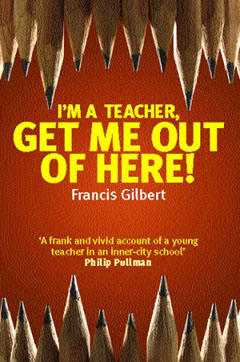 It is my understanding that this is not an actual excerpt from Gilbert's recently published book, I'm A Teacher, Get Me Out Of Here.
This, on the other hand, is lifted straight from that book.
Coincidentally, just as I thought I had finished this posting, this email arrives:
Hello BrianI heard this and thought of you.
Teacher Francis Gilbert was on Radio2's Drive Time programme this evening (wednesday 11th March), promoting his book "I'm a Teacher Get Me Out of Here!"
Though he described himself as being of the left and wanting equality, he delivered a tirade against a crushing bureaucracy he likened to something out of 1984, and said that he was disillusioned by "what the left had done." Notably, as questioned why schools weren't free to devise their own curriculums, something utterly uncontroversial as far as I'm concerned but seemingly unthinkable in today's political climate.
Host Johnnie Walker even chipped in agreeably, pontificating that anything the government tried to run it messed up!
All this on primetime national radio. Cause for optimism?
Regrds, Kit Taylor
Thanks. Very interesting, and of course smack on the nail I also was banging away at.
Although I rather think that Kit has allowed the recent occurrence of February 29th to pollute his dating system. I know the feeling.
Also, although "regrds" is an acceptable abbreviation , I can't be so happy with "curriculums". "Curricula", I think. The way I see it, if emailers are not corrected, how can they learn?
Follow up email from Kit!
Actually, now I think on Francis Gilbert something even more interesting in the interview.It was along the lines of -
"I can go to the corner shop, and I can buy a good quality jam or a cheaper one. I have that option. But if I want my daughter [aged three] to learn french or classics, the choices aren't available."
If advanced by the Tories, I'd be unsurprised if such a notion were attacked as Thatcherite extremism. What's interesting is that Gilbert's comments were not apparently derived from ideological dogma, but the product of a "man in the street" intuitively questioning why a system that was working well in one aspect of his life wasn't being applied in another that wasn't.
Thanks again!!
This comment materialised just now, on this:
hello... i'm from Poland, and I am preparing myself to the math championship... This championship is in English. could someone please send me a www page, on which I could find same excericises? THaks! maciekkowalski@yahoo.co.uk
Any offers? We'll overlook that he can't spell "maths".
Where would I be without helpful emailers? (See also: immediately below.)
One of my many unpaid research assistants, Tim Haas, emails me with update news from the BBC about the recent threat to regulate Home Schooling.
Here is the original scare story that this all refers to.
Says Tim:
Of course the headline and subhead ignore the real story - that the welfare manager who called for more stringent regulation because of a case of home educator abuse was completely wrong - but the rest of it isn't so bad.
Indeed. Sample quote from the new BBC story:
A leading education welfare manager has apologised for stating wrongly that a child, who died from natural causes, had been subjected to abuse.
Jenny Price, general secretary of the Association of Education Welfare Managers, said she regretted that the information, published in good faith, had been incorrect.
And, having had complaints from home educators, Mrs Price says it is clear some education authorities "do not fully understand the home education ethos".
You can almost hear the angry phone calls, can't you? Phrases involving "fingers" and "burnt" suggest themselves, or even other phrases involving "stick" and "hornet's nest".
I can't remember when I said it, but I definitely did say, here, some time or other ago (yes – I said it here), that the Home Education "commmunity" (which really is something of a community) is too dangerous a beast to be simply steamrollered by the state education machine. If Home Education was at all severely messed with, the politics of this would be horrendous for the messer, I think.
Here's what I put here on May 12 2003, apropos of whether Home Ed might ever spread to France. I apparently talked with someone about how …
… any government which took on the home-schoolers of Britain would have got itself the Political Enemies from Hell. Think of all those terrifyingly bright children who'd overrun morning television. Consider the fact that many home-schoolers have considerable demonstrating experience. I may not hold with their political views about war, peace, etc., but these people do know how to lay on a good demo and to mobilise the media. And they must be, almost by definition, among the most intellectually self-confident people around.
Of course I hope that isn't just wishful thinking, but I really do think that.
My warmest thanks to Alan Little for emailing me about a posting on the Alien Landscape Weblog called On the evils of easy grading.
It's about the economics of education. Education as currently organised is a gigantic waste of juvenile energy. Teenagers - I would say: by definition (this is what a "teenager" is) – sit around doing extraordinarily little, and the truly scandalous bit is that the cleverer they are, the truer this often is. Result, they behave like "teenagers".
Key paragraphs:
But, you say, we're talking about teenagers here. Teenagers lack judgement and maturity, and if you let them out without a keeper, who knows what they'll do?
Teenagers behave that way today, of course. But that's not because that's all they're capable of. Remember the old Soviet saying "As long as they pretend to pay us, we'll pretend to work"? Teenagers, like their older counterparts, rarely put forth their best effort unless they have a reason. Since diligence and maturity don't shorten their sentences, and immaturity and laziness don't get them into real trouble or lower their standard of living, it's not surprising that they're not really trying. There's no biological reason that they're incapable of being productive, useful adult citizens, it's just that there's no payoff for them. If they've got marketable skills and their own place, property, and liberty that they can improve through hard work, common sense, and ingenuity or lose through laziness, impulsiveness, or viciousness, they'll be just as inclined as anyone else to straighten up and fly right. It's clear that they're not pushing themselves to their limits, so I don't see any reason to believe anyone's assertions about just what their limits are based on observations of today's teenagers.
I have the feeling that the claim that smart kids do less work may be false, in lots of cases if clearly not in all. Smart kids generally have smart parents, and smart parents often "clean up" those confused signals by attaching rewards to each item of educational progress, and punishments to educational torpor or general "teenager"-ness. (Remember the girl who got a Cadillac, just for doing well at school?)
Nevertheless, the point about the non-biological-ness of teenager-ness is surely right. I did a sociology degree, and I actually learned quite a lot from doing it. The main thing I learned is that what my sociology teachers called "society" or "social structure" - and what I, under the influence of libertarian writers and pamphleteers and economists was starting to think of more as an "incentive structure" (although not yet with those sort of exact words) - matters.
One moment in 1945, all Germans adult males are fighting you and must be treated with extreme suspicion. Then something big happens in the big wide world out there ("Germany" surrenders in the war) and immediately all German adult males start to behave entirely differently. All of them. Society. (And in this case "history".) Explanations of previous, hostile German behaviour based on the immutability of the German version of human nature simply must be wrong. They are certainly woefully insufficient. Biology, that is to say, is not a satisfactory explanation of what is happening, even if it does have some bearing.
So yes, teenagers must have the energy to be a nuisance and the psychological energy to defy what passes for authority in their lives. But whether they behave like "teenagers" or not is a function of the society they find themselves in. Hormone theories of teenager-ness are excuses used by people who are presiding over unsatisfactory social arrangements, blaming the victims of these arrangements instead of changing the arrangements. It's the same with the theory that slaves (i.e. black people) are inherently slavelike. Or, many home-edders and home-ed supporters like me would add, the theory that children are inherently childlike.
I realise that I have a problem with biological and sociological/economic theories. I believe strongly in both. (Does this make me rather rare, apart from the general public I mean?) Young humans do have a definite nature, which is different from puppy nature or kitten nature or junior crab nature. But how that nature asserts itself is radically different depending on the social/economic influences that impinge upon it. Nature and nurture.
I could elaborate, but that's more than enough profundity for one post.
FINAL final point: I have just been wrestling with how to categorise this posting. I picked three from my list that seemed particularly pertinent, but could have picked at least half a dozen more. This shows, I think, how much the Alien Landscape man and I are thinking along similar lines, not neccesarily answering all questions the same way, but wrestling with lots of the same questions. So thank you again Alan.
Category: Economics of education • Examinations and qualifications • Parents and children • Sovietisation
Incoming email from Susan Godsland, who runs this. Did I see this? Not until you emailed me, Ms G. Thank you.
Quote from this Telegraph story:
Over seven decades of communism, education played an important part in preparing children for their place in society. Young people left school with a good grasp of the basics, drilled into them by traditional teaching methods. Since the Soviet flag was lowered over the Kremlin, Russia has taken part in international comparisons in which its secondary pupils have performed well above the international average for maths and science – and better than their peers in Britain.
Vladimir Putin's government, however, is not happy with the system and is looking to countries such as Britain to provide models for teaching methods that they believe will improve young people's creativity and entrepreneurial instincts.
Presumably Susan fears that something like this is about to happen in Russia, this being an essay about how the phonetics-based teaching of reading and writing got replaced by new and inferior methods.
The English language contains approximately half a million words. Of these words, about 300 compose about three-quarters of the words we use regularly. In schools where the "whole language" is taught, children are constantly memorizing "sight" words during the first three or four grades of school, but are never taught how to unlock the meaning of the other 499,700 or more words. Reading failure usually shows up after the fourth grade, when the volume of words needed for reading more difficult material, in science, literature, history, or math cannot be memorized quickly enough. The damage to children who have not been taught phonics usually lies hidden until they leave the controlled vocabulary of the basal readers, for more difficult books where guessing, or memorizing new words just does not work. The result is that textbooks in the middle and upper grades are "dumbed" down to a fourth or fifth grade reading level.
This is the real reason why the SAT scores have dropped to such low levels during the last three decades.
It is a little bit off at a tangent, but I include also this next bit, which I knew nothing about until now.
From the time the alphabet was invented until the time of French scientist and mathematician Blaise Pascal, reading was taught by memorizing the sounds of syllables, and then stringing them together to make words. But Pascal found that by separating the syllables into their letter parts, one could learn to read more effectively and efficiently. His method was intended only to assist in the very beginning stages of reading, when a child is learning the printed syllables of his own language.

Former teacher and researcher Geraldine Rodgers puts it this way: "It was only for this purpose that Pascal invented it [phonics], to make the previously almost unending memorization of regularly formed syllables ... unnecessary. But phonics works, and has since 1655. So it is not surprising that it was invented by one of the most towering mathematical and scientific geniuses in history, Blaise Pascal ..."
With luck those Russians will stick to Pascal's methods when it comes to teaching reading and writing, and only introduce that "creativity" stuff later on. But thoughts of babies and bathwater inevitably present themselves to the mind of the anxious Telegraph reader.
It's a different world over there:
When I was 13, I started to think about what kind of car I wanted when I started to drive. I saw an EXT in a music video and thought, "Hey, having a pickup truck is way cuter than having a car." I started babysitting every week to save money for one. Then I went on the Cadillac Web site and saw how much it cost, and I thought that's a lot of babysitting. …
And here is why this is all here:
… Finally, my parents told me if I got a 3.0 G.P.A. or higher on my report card, they'd buy me any car I wanted, within reason.
Education, education, education.

I started working on my dad. I kept telling him, "Have you seen the new Cadillac pickup trucks, Dad? They're really cool." After school I'd drag him down to the dealership in Fullerton to look at them. About three months ago, my dad bought a ranch in Park City, Utah, and I made him go to Jerry Seiner Cadillac, the dealership in Salt Lake City, to check out their EXT's. Dad kept asking me, "Do you really like this car?" I told him I loved it.
Once a parent makes a promise, I guess you have to bully him to make sure he keeps it. So did he?
My birthday was Jan. 3. I wanted to spend it with my friends in Orange County, but my dad urged me to come to Park City. He said he was throwing me a party and inviting my favorite snowboarder, J. P. Walker, so I agreed. The party was at a restaurant called Easy Street, which has a big picture window that looks out on the street. I was waiting at the table thinking, where is this guy? So my parents suggested I open my presents. The last one looked like a watch box, but when I opened it, there were car keys inside. I looked out the window and saw a brand new EXT parked in front of the restaurant. It was the color I wanted: "Out of the Blue." I couldn't believe it. I was like, "Oh my God, are you serious?" I ran outside in the falling snow, climbed into the truck and sat there for a bit. Then I called my friends back in California on my cell. The whole thing was like a car commercial.
Driving my EXT makes me feel powerful, safe and very high. I feel as if everybody is looking at it, maybe because the color is so vibrant. You can make the cargo bed longer by folding down the rear seat, lowering a panel and removing the window. My dad said, "Now you can carry hay to the horses," and I was like, "I don't think so."
No. You said: "I don't think so." People are not like words; they say words. Are you learning anything at your school?
Some people may think my dad spoils me, but he knows how happy it makes me to drive. Cars are my thing. I'm never ungrateful for anything my parents give me. I feel totally blessed.
Indeed.
My dad drove my Escalade out to California last week. The first time I drove up to the school, about 25 girls came running out to look at it. "That is so cool," they cried. "We hate you!" It was like a dream come true. I felt like, "Wow, I'm a princess."
The joy of peer group hatred.
And the trouble parents in the USA go to, to make their children study for their exams.
Thanks to this blog for the link.
I like the idea of daily postings, and I even like them at the weekend. There is something satisfying about an uninterrupted posting record. But what to put today?
Well, this morning I encountered yet another policy initiative here, but this one is different. It is from the Conservatives, and it just might do some good, if only by making the people who ought to be suffering to suffer.
But I thought about it a bit and decided that the political implications were at least as interesting as the educational implications, so I said what I had to say about this at Samizdata rather than here.
But then I wanted to say here that I'd said all this there, as is my wont here, and that ought to involve me saying in more detail why I liked the sound of this policy. Basically what it is is education vouchers, dressed up as something else. Funding follows parental choice. Popular schools get more money and expand. Unpopular schools get less and wither away. That kind of thing. Good idea, I think. For why: see all my previous posts here since this blog began.
Luckily a commenter called Tim Worstall has commented in more detail, and says the kind of thing I had in mind better than I could. Quote:
You leave out some other implications of the policy: vouchers will quite obviously not pass through the LEA's : at one bound the system will be free of a bureaucracy that swallows 30% of all input. This has the interesting side effect of making state education equally funded with private at £5,000 or so a year per pupil (at the level of the school), without higher central government spending. And even more: removing education spending from local council budgets (where it currently rests along with the LEA's ) goes a long way to making local taxation more reasonable and responsive to local spending.
There will of course be an outcry from the LEA staff as the implications sink in, that they're all going to be out of a job soon, and yet there is even a solution to that inherent in the cunning plan. The number of LEA employees with teaching credentials is within a fag paper of those teaching posts unfilled by a shortage of trained graduates.
So, real choice in schooling, abolition of a bureaucracy, solve the teacher shortage, end the "resources" crisis in state education and go at least halfway to getting a handle on council tax.
Maybe my old flatmate will actually get re-elected, into Govt this time, and I can look forward to some falconeration? Maybe just the odd quango post to start with? Usual rules, all meetings held standing up, pay of those attending publicly calculated minute by minute, any decision costing more by that meter to take than is at stake immediately made by the Chairman and, most important, a sunset clause.
For the benefit of Zanzibarian (and such like) readers of this, "LEA" stands for "Local Education Authorities". But what does that bit about his old flatmate mean? Maybe he will explain in a further Samizdata comment.
Anyway, as the American blog-commenters say: what he said.
I did some googling, and I rather think that Tim Worstall must be this guy.
Wilbur Wright was born in 1867, and younger brother Orville in 1871. The Wright brothers were the first people in the world to build and fly an airplane. They first did this on December 17th 1903, when they got their contraption to fly, under the control (and it was control – he wasn't just perched on board) of Orville, watched closely from the ground by Wilbur. On flight number four, they got their airplane to stay airborne for almost a minute and to cover a distance of getting on for a thousand feet.
But how did they get their start as aviation's ultimate pioneers?
The Wright Brothers by Fred C. Kelly was first published in Britain in 1944, and presumably before that in the USA, although I don't know when. My edition is a Panther paperbeck published in 1958. The quotes that follow are the first few paragraphs of this book.
From earliest years both Wilbur and Orville Wright were motivated by what Thorstein Veblen called the instinct of workmanship. Their father, the Reverend Milton Wright, used to encourage them in this and never chided them for spending on their hobbies what little money they might have. But he did urge them to try to earn enough to meet the costs of whatever projects they were carrying on. "All the money anyone needs," he used to say, "is just enough to prevent one from being a burden on others."
The economic theme is an interesting one. I believe that this is now under-emphasised. This posting is about the Wright brothers and their education, not about my opinions, but modern education strikes me as not only educationally quite easy to criticise but also an economic absurdity. I can quite understand that looking after the elderly and the very young is sometimes necessarily expensive, but it ought not to cost as much as it does to look after the young and the vigorous. And teaching them to fend for themselves economically should be all part of teaching them generally, as it was for the Wright brothers.
Anyway, on with the mechanical stuff:
Both brothers were fascinated by mechanics almost from the time they were conscious of interest in anything. The childhood events most vivid in the recollections of Orville Wright have had to do with mechanical devices of one kind or another. One of the high spots was the day he attained the age of five, because he received for a birthday gift a gyroscopic top that would maintain its balance and spin while resting on the edge of a knife-blade.Shortly after that fifth birthday, and partly because of his inborn enthusiasm over mechanics, Orville began an association with another boy that had an important influence on his life. His mother started him to kindergarten. The school was within a short walking distance of the Wright home and Orville set out after breakfast each morning with just enough time to reach the classroom if he didn’t loiter. His mother bade him return home promptly after he was dismissed and he always arrived punctually at the time expected. When asked how he was getting along, he cheerfully said all was going well, but did not go into details. At the end of a month his mother went to visit the kindergarten to learn just how Orvie was doing. "I hope the child has been behaving himself," said the mother to the teacher.
The teacher stared at her in astonishment. "Why," said she, "you know, since the first few days I haven’t seen him. I supposed you had decided to keep him at home."
It turned out that Orville had almost immediately lost interest in kindergarten and instead had regularly gone to a house two doors from his own, on Hawthorne Street, to join a playmate, Edwin Henry Sines. With an eye on the clock to adjust himself to kindergarten hours, he had stayed there and played with young Sines until about a minute before he was due at home.
Orville’s father and mother were not too severe when this little irregularity was discovered, because the boys had not been engaged in any mischief. On the contrary, their play had been of a sort that might properly be called "constructive." The thing that had occupied them most was an old sewing machine belonging to Sines' mother. They "oiled" it by dropping water from a feather into the oil-holes!
Both Orville and Wilbur followed their father's advice and earned whatever money they spent. One source of income was from wiping dishes in the evening, for which their mother paid a flat rate of one cent. Sometimes she employed them to make minor household repairs. Orville seemed to find more outlets for money than did Wilbur, who was more saving, and from time to time borrowed from Wilbur – but he kept his credit good by sticking to an arrangement they always made that the next money earned should be applied to the debt.
One of Orville's early money-making ventures was the collecting of old bones in near-by alleys, vacant lots, or neighbors' yards, and selling them to a fertilizer factory. He and another boy first did this as a means for raising funds with which to buy candy for use while fishing. They accumulated a weight of bones that seemed to them must represent a small fortune – and were somewhat shocked when the buyer paid them only three cents.
At first, Orville's associates in his projects were boys of his own age rather than Wilbur, who was more than four years older and moved in a different group; but a day came when the brothers began to share curiosity over a mechanical phenomenon. In June, 1878, when Orville was seven years old and Wilbur eleven, the Wright family left Dayton, because the work of the father, who had been made a Bishop of the United Brethren church, was shifted to Cedar Rapids, Iowa. And it was in a house on Adams Street, in Cedar Rapids, not long after their arrival there, that an event occurred which was to have much influence on the lives of Wilbur and Orville – as well as to have its effect on the whole human race.
Bishop Wright had returned from a short trip on church business bringing with him a little present for his two younger sons.
"Look here, boys," he said to Wilbur and Orville, holding out his hands with something hidden between them. Then he tossed the gift toward them. But instead of falling at once to the floor or into their hands, as they expected, it went to the ceiling where it fluttered briefly before it fell. It was a flying-machine, a helicopter, the invention of a Frenchman. Alphonse Pénaud. Made of cork, bamboo, and thin paper, the device weighed so little that twisted rubber bands provided all the power needed to send it aloft for a few seconds. As the brothers were to learn later, Pénaud, an invalid during most of his short life, had not only invented, as early as 1871, various kinds of toy flying-machines – both the helicopter type and others that flew horizontally – but was the originator of the use of rubber bands for motive power. Simple as was this helicopter – they called it the "bat" – Wilbur and Orville felt great admiration for its ingenuity. Though it soon went the way of all fragile toys, the impression it left on their minds never faded.
Not long afterward Wilbur tried to build an improvement on that toy helicopter. If so small a device could fly, why not make a bigger one that could fly longer and higher? Orville was still too young to contribute much to the actual building of larger models, but he was keenly interested as Wilbur made several, each larger than the one preceding. To the brothers' astonishment, they discovered that the bigger the machine the less it would fly; and if it was much bigger than the original toy, it wouldn't fly at all. They did not yet understand that a machine of only twice the linear dimensions of another would require eight times the power.
Orville, meanwhile, had distinguished himself in another way, by organizing an army. …
But that's another story.
What fascinates me is how very "progressive" this all is. There is the skipping of the kindergarten, but the parents not minding. There is the economic stuff, which, translated into progressive-speak, would now be called "involvement in the local community". And there is the direct connection between play and subsequent achievement, with the very age of aviation itself first coming to the attention of the brothers in the form of a toy, powered by a rubber band. (I used to play with airplanes just like that myself, although they were not helicopters.)
In general, if you want technological innovators, the lesson seems to be (at not just from the story of the Wright brothers): let them mess about with technology. Let them have experience of technology, "hands on" experience. Book learning, if you want inventors, is necessary in a rudimentary form, but it is absolutely not sufficient.
Ms Dynamite is to launch her own school of urban music.
She wants to find budding young street talent and give them a chance to get behind the mic in a studio.
She'll take some of the classes herself, passing on songwriting and performing skills that have helped her win a Mercury Music Prize and a number of Brit Awards.
So Solid Crew and Big Brovaz will also give lessons. Ms Dynamite's school of cool will be named Diddymite and source youngsters from seven years of age to 19.
No venue has yet been found, but the school will be based in Lambeth, South London.
The Sun says she has put an amount of her own money into the project, while also receiving local authority and youth initiative grants.
The academy will run classes during weekends and holidays, and Diddymite gurus will also visit schools.
The school will be run by Marisha Skyers, a cousin of Ms Dynamite's boyfriend, Dwayne Seaforth.

Interesting. My guess would be that the key person here is this Marisha Skyers. If she is good at this, then it might just work.
A common attitude to this kind of thing is that the world needs more "qualified" and "trained" pop musicians like it needs a thousand more holes it its head. But I reckon that children who get excited about something – anything, that is mind expanding and works better if you work at it and which requires being organised and determined and cooperative, are much more likely to make a success of their lives than children who sit in classrooms being bored by more "useful" or "relevant" kinds of life preparation.
Besides which, my understanding of music these days is that the most important instruments involved are electrical and IT based, rather than things made of metal and wood that you scrape or blow down or pluck at. And learning about electrical kit has got to be good, educationally.
I've categorised this posting as "The private sector", and I hope that's right. Anything which spreads educational power away from the State Education Monolith run from London is good news, I think.
I wish them and all who learn with them every success.
Main reservation: "Diddymite" sounds like something you spread on toast and eat, with Ked Dodd doing the advertising. Not cool at all, in other words. But that's me showing my age.
Or aphorisms as they used to be called, culled from the Oxford Book of Aphorisms. A rather scary one to start with:
Education does not consist merely in adorning the memory and enlightening the understanding. Its main business should be to direct the will.
- Joubert, Pensées, 1842
Hm. I say: inform it, and inspire it, yes, but … direct it?
This is better:
Books we want to have young people read should not be recommended to them but praised in their presence. Afterwards they will find them themselves.
- Lichtenberg, Aphorisms, 1764-99
Actually I don't see the harm in a recommendation, so long as you don't slide into directing the will, and keep going on about it. Make your recommendation, but then give it a rest.
The self-educated are marked by stubborn peculiarities.
- Isaac d'Israeli, The Literary Character, 1795
And I like this:
Those who are slow to know suppose that slowness is the essence of knowledge.
- Nietzsche, The Gay Science, 1882-7
This I like, too:
You can't expect a boy to be vicious till he's been to a good school.
- Saki, 'The Baker's Dozen', Reginald in Russia, 1910
Here is one that makes a lot of sense of universities these days:
The University brings out all abilities, including stupidity.
- Checkhov, Notebooks, 1892-1904
This is very true:
To teach is to learn twice.
- Joubert, Pensées, 1842 (again)
And this, finally, nicely summarises the case against the discovery method of learning:
Experience is a good teacher, but she sends in terrific bills.
- Minna Antrim, Naked Truth and Veiled Allusions, 1902
Got to rush. Out to dinner. Probably too much yesterday, not much at all today, but that's blogging for you.
Peter Drucker is undoubtedly the most famous ever writer about "management". Here is a description of his childhood from chapter 1, "A Singular Education", of The World According to Drucker by Jack Beatty.
The war haunted Peter Drucker's childhood, though, as we will see, it also expedited his career as a writer. He and his friends taught themselves to read "by scanning the casualty lists and the obituaries with the big black borders, looking for names we knew, names of people we loved and missed." To them war was a permanent condition of the world. "None of us could imagine that the war would ever end," Drucker recalls. "Indeed every boy my age knew that 'When I grow up' meant 'When I get drafted and sent to the front.' "
A few years later, when Drucker was a senior in high school, his class was assigned to review the first crop of books to appear on the war. "When we then discussed these ... in class, one of my fellow students said, 'Every one of these books says that the Great War was a war of total military incompetence. Why was it?' Our teacher did not hesitate a second but shot right back, 'Because not enough generals were killed; they stayed way behind the lines and let others do the fighting and dying.'" In this the members of Drucker's generation shared something in common with the generals. They were spared. Drucker is conscious of his luck in being too young to be used as cannon fodder by those murderously incompetent generals. "Those of us who have been spared the horrors in which our age specializes," he wrote in Landmarks of Tomorrow (1959), "who have never suffered total war, slave-labor camp or police terror, not only owe thanks; we owe charity and compassion."
If the war brought fear, the peace brought hunger. The winter of 1919-1920 was grim. "Like practically every child in Vienna," Drucker writes in his sparkling autobiography, Adventures of a Bystander (1979), "I was saved by Herbert Hoover whose feeding organization provided school lunches. They left me with a lasting aversion to porridge and cocoa – but definitely saved my life and that of millions of children throughout ontinental Europe." An "organization" did all that good. One sees the biographical roots of Drucker's concept of organization as an instrument of human creativity.
This government does love a good shake-up, doesn't it?
This time they want a six-term school year, so students can do their exams a bit sooner and apply to universities a bit sooner, which will apparently help.
There has to be an easier way to arrange that.
This sounds quite well organised. Quote:
Topics will include state-of the-art CALL (computer-assisted language learning) technology, Communicative Language Teaching, vocabulary acquisition, grammar testing and oral skills assessment. In addition, there will be a session focusing on the highly anticipated new generation TOEFL that is expected to come out next year. "The workshop's dynamic approach is to present innovative and practical teaching methods and techniques, as well as assessment strategies, that Taiwan's teachers can readily adapt to their own classrooms," notes Smith. "At the same time, an active exchange of ideas between the presenters and the audience will be encouraged."
On the other hand – for as we all know "dynamic approach" could just mean doing bad things with other people's money, a lot - if the Taiwanese state sector is the sole customer and Mr Smith is an apparatchik working for the sole supplier, then may all of them be drowned by an enormous tidal wave.
The American International Education Foundation describes itself as a "non-profit foundation". Non-profit is obviously not good, but foundation at least suggests that there may be other foundations prowling around touting for the same business. I dare say plenty of people are actually profiting from all this.
Anyone know more about this? Is this a basically Chinese-American operation? Or is it bigger than that?
I'm in two minds about this report. Is this good teaching, or not? I'm inclined to think that maybe it is rather good teaching. What do you reckon?
A 17-year-old boy jumped out of a second-floor window at Miami Beach High last week after betting his teacher he was strong enough to do it and not get hurt.
He won the bet, landing unharmed. No immediate word on whether he got any money out of it.
The teacher has been reassigned to a non-teaching job at a regional ACCESS Center while police and school officials investigate the incident.
The science class was in the middle of a lecture on evolution on Wednesday when the student -- whose name was not released -- began talking about jumping out the window to prove his point, according to the police report.
The teacher, Yrvan Tassy Jr., bet him $20 that he would hurt himself if he jumped, police said.
Yes, I suppose this is not really how teachers should conduct themselves. But I can't help thinking that (a) since the boy won his bet and was indeed undamaged, there was no harm done, but that if (b) he had been damaged, that would have been a valuable lesson for the lad which would have stood him in good stead in the future.
My thanks to the newly located Dave Barry for the link. And for this comment, from someone called Ivoirienne:
I fail to see why the teacher is being investigated for encouraging the scientific testing of his hypothesis. This is purely in line with the education principals of critical thinking and experimentation.
Besides, I've had several students I would love to make this sort of bet with. I've simply been prevented from doing so by the fact that I teach in a windowless grey box.
Probably just as well. And a certain Sean explains it all thus:
Can't you just see how this really happened though?
The teacher is doing the class teaching thing and the kid interrupts with some inane comment about jumping out the window. Teacher, being frustrated by the interruption, figures the kid is full of sh&t and says , 'whatever, an exploding $20 says you hurt yourself if you do it.
Kid jumps and teacher stands there dumbfounded watching his career go out the window.
Yes that's probably how it all happened.
I don't understand the relevance of the "exploding" bit, but the link will make a nice posting on White Rose, where RFID is a four letter word that is intensely disapproved of.
I wonder if this is a great as Eryl Crump of the Daily Post (whoever he/she is and whatever that is) thinks it is:
A NEW and unique Welsh qualification is exciting educationalists and business leaders, Education Minister Jane Davidson claimed yesterday.
The Assembly's education supremo said the new Welsh Baccalaureate had been approved by university authorities and gained the support of the CBI.
She told the Daily Post: "The Welsh Bac is innovative. It's a new qualification developed by the Welsh Joint Education Committee and the Welsh Assembly Government. The Welsh Bac is distinctive, modern and proudly Welsh."
It feels like someone believes in it. On the other hand, Jane Davidson is a politician and it could all be hype and nonsense.
Read on, and the central idea simply seems to be that children need to be eased into productive work and prepared for productive work, rather than just taught nothing about productive work for a decade and then chucked into the dole queues, where they have to work it all out for themselves. Reading between the lines, as you generally have to do with newspaper education stories, it would appear that the children pick up marks for things like getting to work on time and being polite instead of neanderthal, having had a wash beforehand, and for being able to cooperate.
That last point is interesting. The traditional school doesn't really teach cooperation. It teachers individual intellectual skill. It trains individual minds.
But, on the other hand, maybe what employers want is precisely that: trained minds. They can teach all that stuff about punctuality, politeness, washing, etc., but only if it's worth it – if the person they are teaching the basic boring stuff to is worth bothering with. After all, if someone is smart, and can read, write and add up, it isn't hard for him to realise the importance of such stuff. All he has to do is something he may not have been doing at his school, which is look at the world through the eyes of those around him, rather than just through his own eyes.
Even so, I found the report interesting. Is devolution starting to work, I wonder? Even if it only unleashes a little healthy competition with English education, it might do some real good.
The independent schools are getting grief from the "Office of Fair Trading". Perry de Havilland comments here.
This brings to mind that old chestnut of a complaint about government interference in markets. If you have lower prices than your competitors, you are "undercutting" them and indulging in unfair competition. If you charge more than your competitors, you are indulging in predatory pricing. If you charge the same as your competitors, you are indulging in collusion.
The complaint this time is that independent schools are colluding.
The Office of Fair Trading is nothing of the kind. Independent schools should stay independent, and should be allowed to charge whatever they like for their services. If they all get together and agree to the same price, that should be their right. If you think they are all overcharging, then set up a school and undercut them yourself. The only morally decent way to interfere in a market is to participate in it. Otherwise, butt out.
This article by libertarian Wendy McElroy, entitled The Separation of School and State, contains much wisdom and many links of interest.
Sample quote from near the end:
My purpose is not to dispute with parents who send their children to public schools. I believe the system is a brutal failure, but parents must decide for themselves. I advocate extending alternatives far beyond the typical private versus public school debate, and even beyond homeschooling.
In particular, McElroy links to this article by Michelle Malkin which I missed when it first came out. Here's how that starts:
New Jersey's child welfare system, like most state child welfare systems, is a corrupt and deadly mess. Children are lost in the shuffle, shipped to abusive foster homes, returned to rapists and child molesters, and left to die in closets while paperwork piles up. So whom does the government decide to punish for the bureaucracy's abysmal failure to protect these innocents?
Homeschoolers.
And what does the government think will solve its ills?
More power and paperwork.
My kind of quote. The piece ends equally well:
A crackdown on innocent homeschooling families to cure the incompetence of government child welfare agencies is like a smoker lopping off his ear to treat metastatic lung cancer. It's a bloody wrong cure conceived by a fool who caused his own disease.
Amen.
This is fascinating:
For pupils of Southlands School in Kent, the term "French exchange" no longer means three nerve-wracking summer weeks with a family of strangers.
Instead, the school has bought and renovated its own property in France and - unique among schools in Britain - uses it all the year round, not just during the holidays. All 1,200 pupils have the chance to use it for language lessons, outdoor activity trips and class projects. Southlands isn't a rarefied public school with a big budget, but a community comprehensive in New Romney.
"What we wanted was a little bit of France, in France," says the head teacher, Eamonn Cahill, who worked with the assistant head, Siobhan Stevens, to find the right property. "In fact," adds Stevens, "it took seven years and we saw an awful lot of not quite right places."
Then she heard of a possibility in the commune of Azincourt in the Pas de Calais, the place the English have always called Agincourt. This, as all schoolchildren should know, is the site where, on October 25, 1415, Henry V, leading his "Band of Brothers" of some 6,000 men weakened by illness and hunger, defeated a French army of 25,000.
The mayor, Bernard Boulet, suggested that a derelict former cafe on the edge of the village might be suitable for the Southlands project. "He was right," says Stevens. "It needed a lot of work, but it clearly had potential and was only an hour's drive from Calais."
It sounds like a really good operation. Like all good operations, it is succeeding (assuming that this Telegraph report of its success is to be believed) because the people who have to make it work are the ones deciding about it. Yes, there is lots of government money – British, French and EUropean – swilling about, but nobody in London, Paris or Brussels commanded Southlands School to do this. They are doing it themselves. Governments everywhere please note. And if it works out so well it becomes seriously famous, please refrain from commanding - or even "encouraging" - any other schools to do something similar. Let them decide for themselves.