
I missed this story when it was published, on the 24th.
First few paragraphs:
Philip Green, the retail billionaire, is planning to build the country's first fashion and retail academy in an attempt to "produce the next generation of entrepreneurs".The owner of Bhs, Top Shop and Miss Selfridge has donated £5m to what would be the first specialist college to train 16- to 19-year-olds for a career in fashion retail.
The college will train 200 school-leavers a year in marketing, finance and fashion buying and Mr Green – who recently tried to buy Marks & Spencer – hopes it will open for business in September 2005.
Mr Green, who left school at 16, said he had been driven to invest in the scheme by his difficulties in recruiting good staff for his own business. "We need to do something to produce the next generation of entrepreneurs," he said. Mr Green said it was often difficult to tell the difference between graduates and those who had left school with only A-levels.
"If you ask a lot of these people why they went to university they don't really know. It's either because they think it's what you are supposed to do or because it gives them another three years before they have to go out to work.
"If you get underneath it all some of it really defies logic. We take on A-level people and graduates who are three years older but are only earning £500 more. That's quite scary given that it probably costs them £30,000 or £40,000 to get there."
A-men.
I recall how, during the Cold War, you could quote anonymously from some speech, evidently made by some extremely discontented old buffer who no longer cared about little things like being sent to die in a prison camp. The economy is shit. Nothing works. Repairing a fridge takes for ever. The country needs industrial managers willing to be responsible for things, honest government officials, a sober army, far less poison in the air and in the water, far more adventurous use of modern technology, better manners, young people to behave themselves, trains to run on time, blah blah blah, it's all going to hell, etc. etc. And then you revealed that the man who was saying all this was none other than Mr Brezhnev, in his main Supreme Lord High Everything speech to the XXXXXXXth conference of the Communist Party of the USSR. He was nominally in charge of everything, yet he never got what he wanted either.
This reminds me of that:
He gave a frank assessment of the education system's failings, particularly for 14 to 19-year-olds."Too much of the work does not stretch the ablest pupils enough,” he said.
"Too much of the work leads some pupils to switch off entirely and to turn to truancy and disruption.
"Too much of the assessment is an excessive burden rather than a stimulation.
"Too many students leave school without knowing their grammar and being properly numerate," he said.
"There is too much of a division between the academic and the vocational streams of study. …"
So who is this discontented old trouble maker? Why it is Mr Clarke, the politician supposedly in charge of Britain's state education system.
Further to my reference yesterday to Professor Instapundit, he is doing some election coverage for Guardian Unlimited, and via that I came across these photos, taken by the man himself at the University of Tennessee.
It all looks idyllic.
This one, which he also uses to entice you in, but which I do not understand at all, is my favourite:

His religious-theme photo for the Guardian is a fun snap also.
Georges Lopez, the teacher and reality movie star whom I wrote about here and here, has lost his case against the makers of the movie he was the star of:
It was a moving portrayal of everyday life in the rural classroom, and became an huge and unexpected French cinema success when it was released in 2002.And, as the star of the prizewinning documentary film, Etre et Avoir, Georges Lopez felt it was only fair that he should get a cut of the &euor;2m (£1.3m) profits.
The director disagreed, triggering an acrimonious lawsuit which has raised uncomfortable ethical questions about the exploitative nature of fly-on-the-wall film-making.
This week a Paris court ruled that the schoolteacher, who allowed his tiny one-class village school to be filmed in lessons and at play over the course of a year, had no grounds to demand a €250,000 (£170,000) payment.
This was essentially a contract argument. What was the deal? According to that deal, do the film makers owe Lopez any money? No, said the French court.
Lopez himself says that this is an intellectual property argument, which means that tomorrow, I may well be writing about this case in my weekly bit for here.
Personally I think Georges Lopez should have stayed away from the courts, and written a book about his life and his educational beliefs. And it need not have been a long book. That is, he should have turned the massive reputation that the movie bestowed upon him, into a river of cash. It would have sold a bomb, would definitely have been translated into English, and I would definitely have bought a copy. As it is, his saintly image has been hurt by his decidedly unimaginative behaviour. Now, he says, he is going to appeal.
Sad. Everyone knows you make nothing from the movie that makes you into a star. It is your next few ventures that make you your money, even if they flop. And in his case, who says they would flop?
It seems that there are quite a few things about the world and its ways that Monsieur Lopez has himself yet to learn. Yet one more proof of how brilliant people can be in one setting, and then how inept they can then be when they stray beyond that.
Alice (as "in Texas") has some thoughts about universities:
>But that's the irony: universities probably would still have some kind of place, if they just updated their ideas and got real. The trouble is, they are too insecure to confront that. But unless they come to terms with the fact that knowledge is growing itself outside universities now, and that for all sorts of reasons, people are not going to pay huge sums of money just so an institution can rubber-stamp its learning-location as well as its examination score, they are doomed.Which is to say, genuinely intelligent people will opt out of them, so their standards will spiral down and down. And the people at the Justin Timberlake conferences won't notice what parodies of themselves they have become, of course.
I don't think I agree. The great thing about going to university is all the other people who go, from among whom you are almost bound to find human gold. You get to drink and **** and talk all night with them, and unless and until the world invents another way for the semi-brainy and brainy-brainy to find one another at That Age, the university idea will still have plenty of life in it. People will curse and rage against these places for being so silly, but other people will still want to go. The Internet may well replace lots of the academics, but lots of other academics, instead of being rolled over by it, will learn how to make the Internet an ally rather than an enemy.
I mean, I'd love to have had someone like this as one of my professors. Reading him every day or two is good, but chatting with him every week or two would be even better.
Dare I suggest that Alice's fulminations are evidence of the geographical fallacy, as I like to think of it, which say: geography (i.e. geographical proximity) doesn't matter any more, because of Modern Communcations.
Also, universities have been through very bad times before. In the nineteenth century, it is my understanding that British universities, instead of, as now, being rotten with third-rate "humanities" bullshit artists who publish far too much, were rotten instead with third-rate theologians who didn't publish anything at all. Science, meanwhile, was being developed in spite of the universities rather than because of them. But eventually Science took over the universities and made a new golden age for them.
But that last bit is somewhat of a guess. Better-than-guess comments, anyone?
Gratuitous university picture:
… which I googled my way to via here.
Busy day today at digital camera class, but here's a link to an article about blogs in education. I've not read it yet, but Jackie Danicki of tBBC has.
This is a story I hear a lot these days:
Children are missing out on life-changing adventure pursuits because teachers fear they will end up in court if things go wrong, says Ofsted.Outdoor activities such as canoeing, rock climbing, archery and sailing are in decline as schools opt for less risky courses or drop adventure training altogether, says David Bell, the Chief Inspector of Schools.
Teachers have been prosecuted, and one was imprisoned for 12 months last year, over the drowning of a boy on school visits. Schools also fear compensation claims from parents if children get injured.
In a report to be published today the inspectors say outdoor education is a minority area in most secondary schools, despite some excellent examples of courses led by teachers with vision.
"The benefits of outdoor education are far too important to forfeit and by far outweigh the risks of an accident occurring," says Mr Bell.
"If teachers follow recognised safety procedures and guidance they have nothing to fear from the law."
And circles are square. No they are not, says the rest of the Telegraph piece. Circles are circular, squares are square, and the law is fast making childhood adventure that any adult can be held responsible for damn near illegal. Following "recognised safety procedures" isn't a guarantee of no grief, but is itself grievously burdensome.
Concluding paragraphs:
John Dunford, general secretary of the Secondary Heads Association, said: "The fact is that accidents can happen. With so many parents turning to the courts at the first sign of a problem, schools are right to be extremely cautious in their approach to the organisation of outdoor activities."Regrettably this has created a situation in which many teachers have felt unable to take on the additional responsibility.
"This has led to a reduction in the number of visits which are a vitally important part of the educational experience, especially for children from families that could not otherwise afford them."
Indeed.
From Instapundit to Dean's World to Iraq at a glance and a description of a TV programme about a school:
The teacher said: ‘we learn those kids the morals and ethics of Islam, how to respect the people, we are studying the Koran, and learn it by heart, the pupils here are so happy and proud of their future as they'll grow as good men'Till now, I asked myself: 'so what?..what’s wrong with this system, since it is an ordinary school, and does not hurt anyone, let them learn what they want to learn, but without harmful outcomes'..
However …
Future troubles began to be clear half an hour from the beginning of this movie.The kids were talking about the Jihad and how they are ready to be one of AlMujahideen, their parents were so happy with their 'courageous and strong' boys, and that they would get AlJannah (the paradise) sooner or later.
Then, the manager of this school and some also bearded guests came by (obviously the big leaders) and started to talk in front of a crowd of teachers and boys explaining how the United States want to spoil their youth and destroy Islam, how they came to Afghanistan to destroy and make an end to Islam and how they want to control the Islamic world and many other thoughts, and then began to shout and scream: 'God bless our great leader Osama bin Laden, God bless our great leader Mullah Omar’ ‘Death to America'..'Death to America and her collaborators' and the crowd replied in a louder and scary voice the same 'great' words of their supervisors!
So attract innocent kids, put them in this religious school which resembles the jail, no one kid has the time to talk or see anything except his teacher and the Koran, wash their brains completely for years and fill it with hatred and hostile ideas using dangerous strict thoughts in the name of Islam, and then, It's obvious from the environment of this school what will the 'graduates' be.
The word 'education' covers a multitude of sins.
This really hits home with me:
Remember the essays you had to write in high school? Topic sentence, introductory paragraph, supporting paragraphs, conclusion. The conclusion being, say, that Ahab in Moby Dick was a Christ-like figure.Oy. So I'm going to try to give the other side of the story: what an essay really is, and how you write one. Or at least, how I write one.
…
The most obvious difference between real essays and the things one has to write in school is that real essays are not exclusively about English literature. Certainly schools should teach students how to write. But due to a series of historical accidents the teaching of writing has gotten mixed together with the study of literature. And so all over the country students are writing not about how a baseball team with a small budget might compete with the Yankees, or the role of color in fashion, or what constitutes a good dessert, but about symbolism in Dickens.
With the result that writing is made to seem boring and pointless. Who cares about symbolism in Dickens? Dickens himself would be more interested in an essay about color or baseball.
How did things get this way? …
That's all I've read so far, but he certainly has my attention.
If I ever get to teach writing, I hope it will be by helping my pupils to write about what they want to write about, and to think about what they want to think about. Letters soliciting career advice. Explications of the Premier League scoring system and what difference three points for a win instead of two has made. Why rap is great despite what parents and teachers (and I) say about it. Why I am bored. Which were the best movies this summer. Why girls are stupid. Why boys are stupid. Why boys are still stupid but …
You can be logical and entertaining and informative and persuasive about anything. I strongly agree that confining it to being logical and entertaining and informative and persuasive about English literature is a big mistake.
Thanks to Arts & Letters Daily (which really is daily for me) for the link to this.
On the other hand, if you really are interested in symbolism in Dickens …
Here are two more reports, about how home schooling is on the up and up, in Scotland:
The latest figures produced by the Scottish Executive show there were 480 children educated outside school in Scotland, who were known to the authorities, in 2002/03. The number represents a 38% increase compared with 2000/01, when there were 349 children in the same category.Over the past five years, the number of children excluded from Scottish schools for violent behaviour has increased by almost 18%. A study of young people in Glasgow last June revealed that 20% of young boys, including primary children, carried knives to protect themselves.
A spokeswoman for the Home Education Advisory Service (HEAS), told Scotland on Sunday: "The most common reason which people give us for considering home education is fear of violence and bullying at school. They fear that their learning is being disrupted, and that it’s making their lives miserable.
"Many fear that the system is unable to cope and keep the small number of children who cause problems from ruining it for the rest of them.
... and in the USA.
In Florida, the number of home-school students has nearly tripled over the past ten years. Nationally, the United States Department of Education says the number has swelled to more than a million kids. Home-school experts say it's even higher.Oregon researcher Brian Ray, of the National Home Education Research Institute, estimates two million kids are now taught at home.
"In the last four years, we think home schooling has grown at least 30 percent," says Ray. "Study after study, many of which I've done, have shown that home-schooled children are well above average – 15 to 30 percentile points above on standardized achievement tests."
Ray points to last year's first and second place winners of the National Spelling Bee – both home-schooled. And now even Harvard University says it accepts home-schooled applicants.
My bet is that it won't be long before Harvard goes looking for home schooled applicants.
This is a depressing article, about cyberbullying. It's timesonline, which means non-Brits may soon lose it, so I'll quote at length:
INCREASING numbers of children are falling victim to cyber bullies, who have adopted the internet as their preferred weapon of humiliation and abuse.Police experts and children's charities are concerned at the increase of cyber-bullying, which is estimated to have risen by at least 30 per cent over the past two years.
E-mail, text messages and website chat rooms are the new forums for threatening children by stealth, out of sight of parents and teachers, around the clock.
Bullying claims the lives of around 20 teenagers a year and thousands more suffer physical and psychological torment. Charities are voicing concern that this new phenomenon is "growing like wildfire".
In 2001, mobile telephones were among the most popular Christmas presents for children. Since then, cyber-bullying has risen by at least 30 per cent, Kidscape, a leading children's charity, says.
Yet as teachers crack down on abuse in the classroom, police admit that cyber bullies can be harder to identify and quash than their traditional counterparts.
In May Mouth2Mouth.tk turned from an innocent internet forum for local children in Hemel Hempstead to chat into a vicious gallery of hatred and abuse. Within months, one humiliated teenager had tried to kill herself and another had lost all his friends after abusive messages were given out in his name.
Parents and anxious teenagers contacted Liz Carnell, who runs Bullying Online at www.bullying.co.uk, a charity set up to counter cyber abuse.
"It was appalling. There were death threats, racist messages and threats of violence. So I spent an entire weekend answering all the messages and telling the abusers the damage they were doing," she said.
Cyber bullying began, Ms Carnell believes, after children were given mobile phones for Christmas in 2001. Initially, they made silent phone calls, but since then the abuse has transferred increasingly to public humiliation on the internet.
And so on.
If this is true, then it is of course depressing. If it is being exaggerated, and if actually bullying on the Internet is intrinsically easier to avoid than bullying face-to-face in a school (my suspicion), then that too is depressing. Expect (as David Carr would say) lots of internet regulation "for the sake of the children".
My strong belief is that bullying happens when there is no escape from it. It happens, that is to say, when it can. In a well ordered and intelligent world, bullies cannot bully, because their victims just go away. If the bullies as a result take over a space which is not theirs, the owner of it then chucks them out, if he has not done so already, and if he has any concern for his own interests.
And my internet-ignorant guess is that cyber-bullying is at least greatly intensified by the existence of social systems where escape is not possible, i.e. schools where attendance is, if not legally compulsory, at the very least extremely difficult to get out of.
After all, if you cyber-bully someone, but never actually meet them to deliver, and to share with your sniggering cohorts, those all-important lines that go: "What are you talking about? – Miss, I don't know what he's talking about – What have I done? – He's shouting at me for no reason", why bother? Cyber-bullying, in other words, only really works if combined with the old-fashioned, pre-Internet kind.
But I'd love to hear from people who know more about the nuances of the Internet than I.
 I've just done a posting about a Kim Howells outburst on Samizdata. (The posting was on Samizdata, not the Kim Howells outburst.) It was one of those pieces where I only realised at the last second that it would do for Samizdata, instead of merely for here.
I was going to include this rather striking photo of the man here, along with the rest of the original posting, but for Samizdata it was beside the point. But here it is here anyway.
I find writing for Samizdata hard, and for here relatively easy, or that's how it is at the moment. Here I have the mind fix that I have no "readership" to alienate with bad writing, just the occasional passing freak in pyjamas. This may not be true, but I find it more relaxing to assume.
At Samizdata, there are many, many, fully-dressed readers to worry about. Samizdata postings have to be of a certain standard, and that can be worrying.
So now you know. I think that all six of you are trash.
Christie Davies has some intriguingly provocative views about science teaching. Basically, he's against it.
A knowledge of science we are assured is essential for a proper understanding of the modern world. It is not. Very few English people whether adults or teenagers have any serious knowledge of the sciences but this does not hinder them in any way when it comes to earning, buying and selling, taking care of their children, playing elaborate games on their computers, tinkering with their car engines, giving up smoking or choosing between one fool and another at election time. It would not assist them in any way to understand the properties of silicon or carbon monoxide or lead tetra-ethyl or serotonin or the nature of thermodynamics or electro-magnetic fields, even though these underlie their activities. Implicit local skills and understandings are enough. The English are competent in their ignorance. Those who have studied national curriculum science are if anything more ignorant but also more competent than their elders. They have a purely nominal knowledge of science like that conveyed by a glossy encyclopaedia or human interest science documentary film from which all difficult thinking have been carefully excluded. It is lowest common denominator science learned by rote, Gradgrind's dream. It is a worthless piece of paper on a par with a Weimar thousand mark note. For those who can not even manage 'nat cur sci' there is tendentious environmental science and for the great uncertificated majority complete incomprehension – National curriculum one, enlightenment nil, sullen resentment considerable.
Personally, I think children should be allowed to learn what they want, how they want. Anything gets tedious if other people are telling you what to study and how to study it.
If teenagers were rewarded for being useful, and if science really is as useful as is so widely assumed, then plenty of children would learn science, and learn it well, of their own free will. And many more would learn it for the sheer fun of it. And Christie Davies is right that much science teaching all too often drains the fun out of it, and that more recent science teaching also empties the exercise of any great value.
But what if Britain needs lots of scientists, and we don't have them? The answer, says Davies, is immigration. Foreigners have always done the boring and unwelcome British jobs. Hah!
The other night I had a virtual conversation (the mechanics of which I hope to blog more about Real Soon Now – but which for the moment I will ignore) with the Dissident Frogman, who is the man who designed - and more to the point engineered (so to speak) - this blog. I finally told him about the Comment Problem, and, fingers crossed, he has now fixed it.
The Comment Problem has been about number four or five on my list of Important Things To Do for as long as it has existed, and I apologise profusely to all those who have been hit by it, and in general for taking so long to deal with it. If deal with it I have. What happens is, you post a comment, with all the numbers, like you are supposed to, and instead of sticking it up, it comes back at you with some snarky irrelevance about how you have done it all wrong, and you say: well to hell with that no more comments from me at this damn place.
But, the other night, I told me he had found something wrong with the set-up of the Comment System. He didn't know how it had happened, but he had, he said, fixed it. Which sounds promising, I think you will agree.
Here's what I suggest. I will append a string of comments to this posting, with a view to seeing if anything goes wrong, and if you want to check out if things have been fixed, try posting comments here too. The more there are, from more people, the more grateful I will be. Then, if (IF) nothing untoward happens, I will declare the system working (touch wood and hope to die blah blah blah) and invite the resumption of comments of substance, on other postings.
Once again, my apologies for this craziness. I don't know who's or what's fault it was originally, but the delay in sorting it was definitely down to me. However, as I say, with luck, touch wood, it may now have been solved. As I also say, thanks in advance to any who join me in checking this out.
Outstanding letter in today's Times:
Studying at homeFrom Danielle Shanks
Sir, I'm a 15-year-old, home-educated student and for me, leaving school was one of the best things I've done. I left about a year ago, thoroughly miserable after being bullied for three years and after various meetings with teachers about it, which achieved nothing.
I am now doing a correspondence course.
Contrary to the popular belief, it is actually quite easy to make new friends outside of school. I've kept in touch with one friend from school and I play the violin, so I go to an orchestra every Saturday, where I've met new friends. I'm also a member of " Education otherwise", which is a home-ed organisation, where I write to various pen-pals.
How sociable is school anyway? You have all your cliques, but if you don't fit in you can be ostracised.
Yours faithfully,
DANIELLE SHANKS,
56 Vaux Crescent,
Walton on Thames,
Surrey KT12 4HD.
September 20.
Here is the link to Education otherwise. Otherwise, I think it says it all.
Here's a headline to savour:
House parties planned to educate voters on educationThe nation's largest union is teaming up with teachers and liberal political groups to sponsor simultaneous, education-themed "house parties" in Palm Beach and Broward counties and across the country Wednesday night.
The social calendar will never be the same.
Bring your concerns about public schools, not booze or funny hats.
Yes. What do you think this is, a party? This is education we're talking about. You're not here to enjoy yourselves.
Organizers hope the first-ever National Mobilization for Great Public Schools gets more people focused on education issues before the general election and beyond.
So, that would be "educate" as in propagandise, and "education" as in spending lots more money on schools.
While the event is billed as nonpartisan, the main sponsor is the National Education Association, the 2.7 million member union and teacher professional group that has endorsed Democrat John Kerry. Co-sponsors include MoveOn.org, the Web-based liberal organization that regularly bashes President Bush.
And they'll be doing some non-partisan Bush-bashing.
The federal No Child Left Behind law, the cornerstone of Bush's education-reform program, is billed as a key discussion topic. A Web site previewing the festivities claims "the White House and Congress are failing to provide the basics. Worse, the White House now plans to cut education programs in the first budget after the election."
Which makes me think that "No Child Left Behind" may not be as bad as I had been
assuming.
This guy certainly thinks that it is doing some good.
The president began putting the first part of his education reform package into place literally hours after he took the oath of office. The morning after the inauguration, he and Mrs. Bush listened carefully as Reid Lyon and other top education researchers presented their findings at a White House forum on reading pedagogy. The president made it clear that he wanted federal reading policy to go "wherever the evidence leads."From his gubernatorial days, Bush already had a good idea that the evidence was leading straight to phonics. Following Lyon’s advice, he had pushed local districts in Texas to adopt phonics-based curricula and saw reading scores in the state shoot up, particularly for minority kids. The number of third-graders – 52,000 – who failed the reading test at the start of the Bush governorship declined to 36,000 when he left for the White House and has since dropped to 28,000, now that all his reforms are up and running. Since then, the evidence has become irrefutable. After reviewing dozens of studies – some using magnetic resonance imaging to measure differences in brain function between strong and weak readers and among children taught to read by various methods – the National Reading Panel, commissioned by Congress, concluded in 2000 that effective reading programs, especially for kids living in poverty, required phonics-based instruction.
Within a week of taking office, the Bush administration devised a strategy for getting a $6 billion "Reading First" phonics initiative past the relevant House and Senate education committees. The administration was offering school systems a deal that went like this: "The federal government will give you lots more money than ever before for early reading programs. Nothing obligates you to take the money. But if you do take it, the programs you choose must teach children using phonics." Hardly a single legislator raised doubts about tying federal reading dollars to instructional approaches backed by a consensus of the nation’s scientific experts.
This "scientific experts" stuff strikes me as somewhat questionable, but I'll leave those questions for another time.
Just to say ...
Education seen as cost, not investment
... that I think those doing the seeing (here - free registration required) have a point.
Australia has neglected its financial responsibility on education by not matching the funding increases to schools and universities made by other countries, according to a report released yesterday.
Education people think education should get more money. Stop the Internet, I can't handle the excitement.
"There is only one explanation for this: education has become a lower public priority," the deans say in the report, New Teaching: New Learning. "Despite rhetoric to the contrary, education is presently viewed as a cost rather than an investment by Australian politicians."
"New" teaching and "new" learning sounds like it's all going to cost a lot more, very soon. Just how much of an "investment" it will be, on the other hand …
I recall noting this plan when it was just a plan. My heading, I see, was India launches an edusat, but actually, the plan was to launch it in June. So. Mid-September. Not bad.
BANGALORE (Reuters) - India's space agency said it successfully launched the nation's first satellite for educational services on Monday, which is expected to boost distance learning in a country with a huge rural population.The Indian Space Research Organization (ISRO) said in a brief statement on its Web site (www.isro.org) that the satellite was placed in its intended orbit 17 minutes after take-off at 4 p.m. from its spaceport at Sriharikota, 50 miles north of the southern city of Madras.
That's www.isro.org and here is the press release.
Excerpt:
EDUSAT carries five Ku-band transponders providing spot beams, one Ku-band transponder providing a national beam and six External C-band transponders with national coverage beams. It will join the INSAT system that has already got more than 130 transponders in C-band, Extended C-band and Ku-band providing a variety of telecommunication and television broadcasting services.
Educated India is starting flex its technological muscles.
There's trouble a't' uni':
The row over performance related pay between Nottingham University and its lecturers reached a new deadlock today as the Association of University Teachers fulfilled its promise to stage an academic boycott of the university.
Later they quote AUT assistant general secretary, Matt Waddup, and my guess would be that the key paragraph in this story is this one:
"We believe that the university is placing its international reputation in serious danger," he added.
Universities in Britain are morphing from (exaggerating only somewhat) places where locals tread water to places where foreigners race through the water and do not want to be interrupted. They are going global, and doing global business. Thus, I classify this story under "globalisation" as well as just "higher education".
Result: a world in which universities demand actual performance, as opposed to mere charming eccentricity, but also one in which unions have a whole new kind of economic success to threaten and to want in on. Guess: there'll be more of this kind of thing.
I claim no expertise in the whole exams-are-getting-easier debate. I merely suspect, like lots of others, that they are. But this does sound seriously ridiculous:
Pupils were awarded A grades in one of Britain's most popular GCSE maths exams this summer despite having only achieved half marks.Students needed to score just 45 per cent in two exams to achieve an A grade in an exam set by the Edexcel board. Combined with their coursework scores, this meant that just 51 per cent was needed overall.
The papers were sat by 80,000 pupils this summer and more than half got an A or A*. The figures were condemned as "ludicrous" by maths experts.
So, if you are concocting your CV, and you have GCSEs on it that are not Edexcel GCSEs, be sure to say so. On the other hand if they are Edexcels, keep quiet about it.
I say optimistic things about robots here from time to time, so here is some criticism of that approach to using computers.
Amazon quotes Publishers Weekly, re this book:
Hawkins designed the technical innovations that make handheld computers like the Palm Pilot ubiquitous. But he also has a lifelong passion for the mysteries of the brain, and he's convinced that artificial intelligence theorists are misguided in focusing on the limits of computational power rather than on the nature of human thought. He "pops the hood" of the neocortex and carefully articulates a theory of consciousness and intelligence that offers radical options for future researchers. "[T]he ability to make predictions about the future ... is the crux of intelligence," he argues. The predictions are based on accumulated memories, and Hawkins suggests that humanoid robotics, the attempt to build robots with humanlike bodies, will create machines that are more expensive and impractical than machines reproducing genuinely human-level processes such as complex-pattern analysis, which can be applied to speech recognition, weather analysis and smart cars. Hawkins presents his ideas, with help from New York Times science writer Blakeslee, in chatty, easy-to-grasp language that still respects the brain's technical complexity. He fully anticipates – even welcomes – the controversy he may provoke within the scientific community and admits that he might be wrong, even as he offers a checklist of potential discoveries that could prove him right. His engaging speculations are sure to win fans of authors like Steven Johnson and Daniel Dennett.
However, in my defence, I don't get excited about robots to educate because they will be super-intelligent. It's more that I surmise that they will make nice (and very cheap and parent-friendly) pets, and that tots may enjoy conversing with them, even if they are fairly dumb. Maybe even because they are fairly dumb.
I got to this via Instapundit, whom I am consulting a lot just now because I enjoy the Dan Rather thing so much.
Gratuitous picture …
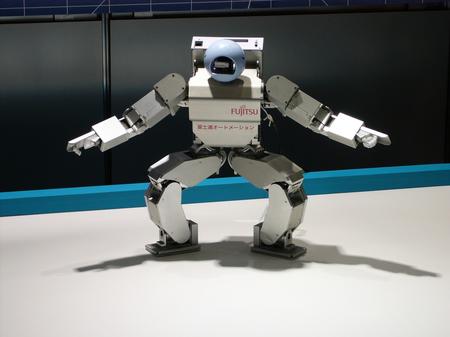
… of a Fujitsu Robot demonstrating its goal-keeping skills. I found this picture here.
(Actually, a goal-keeping robot sounds like a fantastic soccer training idea. Ideal for the obsessionally aspiring striker to hone his skills on, while also learning some technology management skills. Maybe this boy should be given one. (Idea for Ubersportingpundit posting. (I owe them something.)))
Further evidence of what children are capable of learning for themselves.
Literacy has to be taught, but the ability to use, and if necessary to invent, language is inborn. But, you have to do it young, or it doesn't work. Old people do not invent new languages.
Scientists have witnessed the birth of a new language, one invented by deaf children.A study published today shows that a sign language that emerged over two decades ago now counts as a true language.
It began in a school for the deaf in Managua, Nicaragua, founded in 1977. With instruction only in lip-reading and speaking Spanish, neither very successful, and no exposure to adult signing, the children were left to their own devices.
Their first pantomime-like gestures evolved into a grammar of increasing complexity as new children learned the signs and elaborated. Now it has a formal name: Nicaraguan Sign Language, (NSL), and is so distinct that it would not be understood by American and British signers.
David Carr comments at Samizdata.
Anthony Daniels (aka Theodore Dalrymple), now a regular contributor to the Social Affairs Unit Blog, says that young British blacks, or to be precise, young British Jamaicans, do badly at school not because of racism (the claim of a recent report – echoed by The Guardian) but because of the culture with which they have now surrounded themselves. Other racial minorities have thrived despite vicious racism against them. So what's with the Jamaicans?
If raw racial prejudice is not the explanation, then, what is the explanation? I think it is twofold. First, there is a marked lack of stability in the households of young blacks i.e. Jamaicans. This instability is seen in white lowest class households, of course, where it has precisely the same effects, except that the girls are less distinguishable from the boys, from the point of view of failure. Relative poverty does not in itself preclude constructive achievement among children, but when combined with a kaleidoscopically shifting spectrum of social pathology, it most certainly inhibits it.Perhaps even more important is the culture that the young Jamaicans have adopted for themselves, both in England and Jamaica. It is not exactly a culture that promotes high endeavour in fields such as mathematics, science or English composition, to put it mildly. It is a culture of perpetual spontaneity and immediate gratification, whose largely industrialised and passively consumed products are wholly worthless sub specie aeternitatis. The young Jamaican males may have been sold a bill of goods by an unscrupulous entertainment industry, purveying drivel to morons, but they have bought it with their eyes open. Seen from the outside, at least, this culture is one upon whose valuelessness no execration could be sufficiently heaped.
By refusing even to entertain cultural characteristics as a possible explanation of failure, the combined forces of the Mayor, his commission and The Guardian are in fact serving to enclose the Jamaican black males in the wretched world that they already know and that already encloses them. They are, in effect, saying to them that the fault is not with them, their tastes and the way they conduct themselves, but with society as a whole. They are condemning them to a world of violence, drugs and familial insecurity.
Teacher Jane Smith comments:
Anthony Daniels is spot on – I have taught in London schools and his argument about Jamaican youth culture fits my own experiences. Teachers are however unwilling to say this publicly for fear of being branded racists. A problem which Daniels does not highlight is the fear that teachers have that parents will play the racism card if their children are put in detention or do badly at school. Thank you for an excellent article.
Comments from teachers (and from current pupils come to that) count at least twice here.
 More Tsardom:
The Government today appointed a new maths "Tsar" tasked with turning around years of decline in the subject.Celia Hoyles, who starts her job as chief mathematics adviser next month, will "champion" the subject at all levels, from primary schools to university and beyond.
Education Secretary Charles Clarke said the appointment of Prof Hoyles was "critical" to revitalising maths education.
England is short of about 3,500 maths teachers, equivalent to more than one for every comprehensive in the country, a major inquiry found earlier this year.
Students, teachers and employers were all being let down by the current system, according to Professor Adrian Smith’s Government-backed inquiry into post-14 maths.
Mr Clarke said he was "delighted" with the appointment of Prof Hoyles, who is currently working at the University of London's Institute of Education.
"I believe this appointment is critical to the success of the mathematics strategy we outlined earlier this year," he said.
"The road ahead will be filled with opportunities to revitalise the study of mathematics and raise the profile of mathematics for everyone, not just pupils in schools and their teachers."
Prof Hoyles said: "I am thrilled to accept the role of chief adviser for mathematics, and look forward to the challenges ahead."
You get the strong feeling, don't you, what with all the "sneer quotes", that the writer of this report detected an air of false optimism about the show that was laid on in front of him. "Delighted". "Filled with opportunities". "Thrilled". Above all there is that gruesome word "challenge", which means insoluble difficulties of all kinds.
The original idea of a Tsar was that there was only one of him, and his word was law. But what happens when two Tsars bump into each other in a government corridor, both chasing the same money, or demanding the same slice of the school day or of the National Curriculum? Who wins? And what happens when the Tsar comes up against, you know, the Minister of Education?
Last time I was in touch with her family, the news of Goddaughter II was that she is hoping to get to Chetham's School of Music, on the back of her cello playing, which is apparently improving fast.
The great thing about Chetham's is that (a) it produces lots of excellent musicians, and,(b) just as vital, it produces lots of excellent non-musicians, people who excelled at music when they were kids, but who then went on to do other things in later life, with equal enthusiasm and distinction. Chetham's supplies great music education, and great non-music education. No wonder Goddaughter II's family are so keen on her to try to get there. Hope she does it. Even if she doesn't, the attempt will stretch her in all the right ways, I think. (I hope.)
And now here is another story, this time culled from googling about strangers, of a kid with one great talent, who is about to have his education built around that.
Spanish football giants Real Madrid have added a seven-year-old boy from Brighton to their ranks of superstars.Niall Mason impressed Real at a two-week summer course at the club so much that they asked him to join their prestigious Escuela Deportivo de Futbol Federation Madrid.
He becomes the latest English player on Real's books following the signings of David Beckham, Michael Owen and Jonathan Woodgate.
Niall will train twice a week for eight months at the academy with his schooling continuing at a local English school.
The Mason family, including his mother Mimosa, father Russell and three-year-old sister Maya, are all moving to Madrid where they will live in a flat close to Real's Bernabeu stadium.
Sounds like a somewhat Spanish family already, doesn't it? Well, good luck to them all.
Everything depends, with a story like this, on the way that the adults handle things. Do they bet everything on Niall becoming a soccer star, and then treat him, and make him treat himself, like a total failure if that doesn't work out? Or do they teach him soccer, and teach him the kind of things that a star institution like Real Madrid can teach him about life in general, and thereby prepare him well for whatever life may bring him.
I'm optimistic about Niall's chances. I don't think that Real would have gone to all this bother for Niall if they didn't like the look of his family background as well as his soccer skills. And I have enough respect for Real as educators ("Escuela Deportivo de Futbol Federation Madrid" sounds like they take all this pretty seriously), not only to hope that things will go well for Niall, but actually to think it, regardless of whether he ever makes it in big time soccer. Sorry: "Futbol".
Besides which, the Real futbol team may find themselves needing him quite soon.
Lew Rockwell writes about home schooling versus school schooling, and about phonics versus whole word literacy teaching.
Long-time readers may recall a column titled, "A Tale of 2 Children," wherein I compared two 3-year old children, one of whom was being taught to read by his parents and one who was destined for public school. The two children are now 5 years old, and I recently examined their progress.The child in kindergarten is not yet reading, but he has learned his complete alphabet now. The homeschooled child, on the other hand, surprised me by reading at an error-free fifth-grade level on the San Diego Quick Assessment test. I verified his competence by asking him to read selections from C.S. Lewis' "Prince Caspian" to me, a book with which he was previously unfamiliar. While he occasionally stumbled on words such as versification and centaur, (he pronounced them "versication" and "kentaur"), his comprehension was reasonably good as well.
Suddenly, it was not so hard to understand how homeschooled children, on the average, test four years ahead of their public-schooled counterparts.
The problem with public schools and reading is not hard to grasp. Whole language, the favored method, is a disastrous approach to reading that is destined for failure. Children who learn to read while being taught this method learn to read in spite of it, not because of it. …
Yes, that's how it seems to me also. Read more about the phonics method here.
By the way, every time I visit a phonics site, such as the one linked to above, I look for a step-by-step description of how to teach reading in the best phonics way possible. After all, these people are adamant that there is a best way. So what exactly is it? I want to have a how-to guide to read. First do this. Test it like this. Then do this. Test this like this. Then do this. Then do that. Practise it like so. Reinforce it like so. Learn to spell this list of words. And so on.
The trouble is, when I think I may have found such a guide, I either find I have to pay for it, which seems odd given that these people are trying to spread literacy and not just to make money. Or else I find myself reading yet another argument about why the method they favour is the best one, or, even more tangentially, why other methods are bad. Which is absolutely not the same thing as the best method itself. These arguments are important, and it is important that the best team wins them. But an explanation of why a method works is a quite distinct matter from the thing itself.
Can any of you phonics-persons help me? Please note that I will fisk you/it mercilessly if you merely show me yet another argument about why your particular brand of phonics works, or indeed any method which ever digresses into this related distraction. I want the thing itself, and nothing else. This must be available, to read and to link to, somewhere on the Internet. If it isn't, then it damn well ought to be.
Yes, that's what they say.
I try not to go on about America all the time, but this was too juicey a quote to ignore. Thank you Google for picking out that sentence.
Here's the paragraph it comes in:
And, while charter-school supporters point to other studies and anecdotal information to show that charter schools can work, vying studies don't demonstrate who is right and who is wrong. They simply demonstrate that the possibility for success of children in charter schools is an unknown. Our children's education is too important to try experiments to see what works best.
But if people are dissatisfied with what they are getting now, and if nobody is actually going to die or even suffer acute pain during these experiments, and might actually be a lot happier and learn more, then what's wrong with parents who want to giving them a go.
After all, there are a lot of public sector schools where parents would love it if the outcome was an "unknown", instead of the all-too-known that they are instead stuck with.
I think I know what these authors were trying to say with this amazing sentence, but the words they actually used show, I think, how out of touch they must surely be with lots of parents. They've said things like this to their friends and co-educrats so often, to such warm applause, that they truly didn't realise what they'd put. When they talk or write about "experiments", they, and their usual audiences and readerships, see evil right wing monsters inflicting cruel tortures on furry white animals and chucking defenceless kids off an experimental cliff. But lots of others will simply see them turning their backs on the obvious way (experiments) to make progress and to add to the store of human knowledge, in this case to the knowledge of how best to impart knowledge to the next generation.
I have already reported on Gems, the Dubai-based private education supplier. Here is more, today, from thisislondon.co.uk:
WE have budget airlines and hotels – and now the 'no-frills' public school. 'Economy class' education could become a feature of the British landscape with the emergence of a new kind of independent school.Dubai-based company Global Education Management Systems (Gems) is planning to open 200 schools charging from £5,000 to £10,000 a year depending on the class sizes and facilities on offer.
The schools may not boast grand settings like Eton, Harrow and Winchester - where fees are up to £20,000 a year – but the company claims they will be a good, affordable alternative to State education.
I didn't get that Gems were "planning" (whatever that may mean) anything so ambitious as this. Well, I do now.
And this report continues:
Meanwhile, the think-tank Civitas, which believes more parents would opt for private education if they could afford it, has hit upon a similar idea.
Today it opens a public school in a rented room at a sports centre in Queen's Park, North West London.
The New Model School has just one class - reception year - and charges £900 a term. It will expand each year until these pupils reach 18 years of age. Civitas hopes to create a chain of low-cost schools.Former schools inspector Mike Tomlinson has welcomed no-frills schools. But a spokesman for the Independent Schools Council said last night standards might suffer.
Maybe. But the business of the higher cost suppliers might also suffer. Keep your ears open for the phrase "educational cowboys".
Britain might finally be getting Tesco education. Well, Sainsbury education, maybe. Or perhaps "EasySchool". Check out this new school here. And here is the Gems website.
My thanks to Helen for the phone call that got me googling for this.
Education as a global industry proceeds inexorably.
Singapore is selling education to Indians:
NEW DELHI – Affordable fees. Global curricula and world-class faculties. Close to home. A 'safe mix' of the best from the West and the East.These are among the advantages Singapore offers Indian students as it positions itself to be Asia's education hub.
With these advantages, Singapore is a better option than even the United States, according to some parents and students who visited a two-day roadshow that ended here yesterday.
And Dubai is selling education to Scotland (although in this case "Dubai" sounds more like a flag of convenience):
A DUBAI-based company that claims to provide "no frills" private education is to open its first school in Scotland next year.Global Education Management Systems (Gems) charges fees of £5,000 a year, up to half the cost of a traditional private school. It already has acquired 13 schools south of the border and is now carrying out market research with a view to expanding into Scotland. Its aim is to become the biggest provider of private education in the UK within the next five years.
In the Gulf states, about 40,000 children are currently educated in Gems schools, which are geared to providing high teaching standards rather than luxurious surroundings and facilities.
Sunny Varkey, an Indian entrepreneur who recently signed a deal to take his chain into Afghanistan, heads the Gems group. He plans to use Gems’ position as a limited company to invest in school facilities, claiming it will give him an edge over most independent schools, which find it difficult to raise money for new buildings due to their charitable status.
A spokeswoman for Gems said it had conducted market research and found that there was demand in Scotland for their schools. She added: "It's our intention to expand right across the whole of the UK. We are moving north of the border. I would say, realistically, it will be about a year but if a plot of land came up, it could be much sooner than that."
There's no business like global ed-business.
Mark Holland has been out and about, biking if it's fine, windsurfing if it's wet, and on his travels he encountered some students, studying:
Also out on the water today were a flotilla of mostly learner kayakers mixed in with a few who knew their stuff.Speaking to a couple of them afterwards I learnt that they are at the local uni studying for a BA Honours Degree in Adventure Education. I didn't laugh honest. In fact I'm rather jealous. …
I'm not. This is my idea of hell on earth. But, each to his own.

Michael Brooke comments:
My degree - Business Studies with a focus on arts management - had a couple of compulsory terms of Leisure Studies, which wasn't anything like as relaxing as its title suggests.It turned out to be surprisingly fascinating, though, drawing on history, culture, politics, sociology and technology (cheap air travel, television, the internet) to examine the changing ways in which we've made use of our leisure time and how our attitudes towards it have differed.
I've recently taken a holiday, which I have spent entirely on chucking stuff out and organising what remains, nesting in other words. Very satisfying.
I did a piece for here today, about graduates having a tough time getting jobs, and at the last moment I realised it would do just as well onto Samizdata. So there it is, and the comments are piling up interestingly.
No surprise here:
Broadband is having a marked impact on children's education in the UK by helping them make the most of the internet as a research tool.According to a detailed survey of 50 UK families by the Future Foundation, two-thirds of children with broadband access are spending more time using the internet for academic purposes, including research and revision.
Yes. The very same electric boxes, which, in their first form, television, wrought such educational havoc, are now, in their later and more civilised and wordy form, helping to sort out the mess.
Broadband has certainly been a huge education for me.
Just done a big Samizdata piece of the sort which a couple of months ago I thought I might be incapable of ever again, and am busy for the rest of the day, so that may be all here. So maybe no more here today, and of course nothing promised over the weekend, but have a nice one.
... although I'm only guessing it's Dad.
I took this photo through my grubby front window, looking down into the park at the foot of the tower opposite. Faces are not clear, with "Dad" even being hidden by the leaves of a tree, and the swingee moving too fast. Even onlooker sister is obscure, what with the dirt on my window and the tackiness of my camera. All of which is good. The individual faces are not the point.
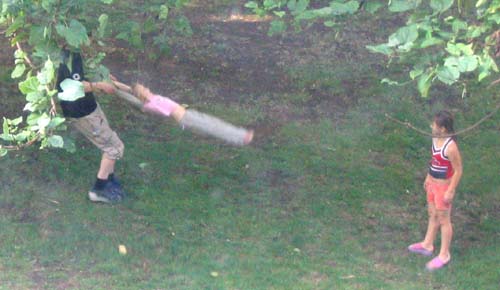
What are they all learning? Trust. All sorts of physical stuff. Courage in the face of danger. (It could, after all, go horribly wrong.)
It was really fast, by the way.
Michael Jennings PhD (who has just got himself a fine new job and is therefore an example of a successful education) emails with a link to this article by Gregg Easterbrook about the relative merits of the Big Name US colleges compared to the less well known ones which are damn near – and sometimes absolutely - as good. But, he says, as the gap narrows, the obsession among parents with getting their children in to the Big Names only gets more obsessional:
As colleges below the top were improving, the old WASP insider system was losing its grip on business and other institutions. There was a time when an Ivy League diploma was vital to career advancement in many places, because an Ivy grad could be assumed to be from the correct upper-middle-class Protestant background. Today an Ivy diploma reveals nothing about a person's background, and favoritism in hiring and promotion is on the decline; most businesses would rather have a Lehigh graduate who performs at a high level than a Brown graduate who doesn't. Law firms do remain exceptionally status-conscious—some college counselors believe that law firms still hire associates based partly on where they were undergraduates. But the majority of employers aren't looking for status degrees, and some may even avoid candidates from the top schools, on the theory that such aspirants have unrealistic expectations of quick promotion.Relationships labeled ironic are often merely coincidental. But it is genuinely ironic that as non-elite colleges have improved in educational quality and financial resources, and favoritism toward top-school degrees has faded, getting into an elite school has nonetheless become more of a national obsession.
So what is my comment supposed to be about that? No problem. Michael Jennings PhD supplied comment as well as the link:
My personal experience is that the quality of the education varies a bit between famous and less famous but solid universities, but not really all that much. (Less elite universities will also often make special arrangements and give special attention for talented and successful students when they get them, too). What does vary a lot is the talent, ambition, and general interestingness of the students. I studied at a solid but obscure Australian university, a well known Australian university, and an internationaly famous university, and the number of interesting people I found to talk to increased steadily with the reputation of the institution.
I went to Cambridge (England) and screwed it up, being slung out after two years. (I should have left after one.) Then I went to a lesser university, and made it work much better.
Gratuitous picture:

Ivy. You knew that.
Deepest thanks to Antoine Clarke for emailing me the link to this. This being Professor Instapundit himself, holding forth for Tech Central Station about the educational benefits of computer games, one in particular:
A while back, I speculated that videogames were good for children. My focus there was primarily violent computer/videogames (and porn!), but on further reflection I think that even non-violent videogames just might be helping America's kids.I came to this realization when I heard my daughter and one of her friends having an earnest discussion:
"You have to have a job to buy food and things, and if you don't go to work, you get fired. And if you spend all your money buying stuff, you have to make more."
All true enough, and worthy of Clark Howard or Dave Ramsey. And it's certainly something my daughter has heard from me over the years. But they were talking about The Sims, which has swept through my neck of little-girl-land faster than a mutant strain of flu through Shanghai. Thanks to The Sims, they know how to make a budget, and how to read an income statement -- and to be worried when cash flow goes negative. They understand comparison shopping. They're also picking up some pointers on human interaction, though The Sims characters seem a bit dense in that department at times. (Then again, so do real people, now and then).
And, shortly, The Sims 2 will up the stakes. Among other things, it will allow you to "Mix Genes: Your Sims have DNA and inherit physical and personality traits. Take your Sims through an infinite number of generations as you evolve their family tree." What more could a father want, than a game that will teach his daughter that if you marry a loser, he'll likely stay a loser, and your kids have a good chance of being losers, too?
All joking aside, though, I'm impressed with the things that these games teach. …
Indeed.
Thanks again Antoine. I would probably have got to it on my own eventually. After all, Instapundit himself linked to this piece. But my surfing is erratic and certainly doesn't, as they say in America, cover all the bases. So emails to interesting pieces are always extremely welcome.
However, I still haven't got around to sorting out brian@brianmicklethwait.com, so try brian@libertarian.co.uk instead. Sorting out brian@brianmicklethwait.com is no doubt extremely easy. As are the 7,354 other things I also need to do urgently, a lot of them before I can do any of the others.
Maybe there's a computer game I need to play, where you are rewarded for doing lots of little things right. Maybe all computer games are like this. So, thing 7,355: get into computer games (apart from Solitaire I mean). I will not be doing that actually.
Not much time tonight, so your basic link, quote and: "interesting".
I didn't just forget about blogging during August; I also didn't read most blogs any more. I got right out of the blogosphere and into the normalsphere. So now I've been catching up with my favourites, and one of them now is the Social Affairs Unit blog. And there I found this rather good piece by Digby Anderson, saying that there's too much schooling these days. How true.
Quote:
The precise numbers need to be spelt out. This institution, schooling, is now allowed and funded to monopolize young people's time for more than 4,000 days or 25,000 hours. Yet it takes a commercial organization only a dozen or so hours to teach someone to drive a car and a commercial language school will get you proficient in a foreign language in several weeks. The state's Little Pied Piper children leave after tens of thousands of hours in state schooling institutions inarticulate in their own language.Set aside for the moment the arguments about just how little they learn in all those hours, weeks and years. What is never challenged is the assumption that school, or schools called universities, are the right places for children and youth. The assumption is that they should be there and nowhere else. The assumption is revealed in all its thoughtlessness in the literature of the anti-child labour lobby. Where should children not be? At work, of course. And why not? 'Why not, do you really want to push toddlers up chimneys again or have them rooting on rubbish tips or selling their bodies as they do in South America?' No, but then I don't want adults forced up chimneys either. Nor do I want them on rubbish tips or selling their bodies. That is nothing to do with children. It is about work no-one should have to do.
Once this nonsense is put aside, why should children not be at work? Because they will be exploited? Surely their parents would not let them be and nor would a regulatory government. So why not? It comes down to this. Children should not be at work because - wait for it - their proper place is at school. Where school is concerned all the worries of the anti-child labour lobby are thrown aside. They who are so worried about employers coercing and exploiting children don't care that schools have much more power to coerce and exploit children. They don't care that the schooling institutions can keep their charges working for no wage, in many cases, without any demonstrable educational benefit for years on end.
It doesn't require much imagination to think of jobs in comfy air conditioned offices - not rubbish tips - or in the fresh air and under adult supervision that teenagers could be allowed to do. But the politicians have no imagination. The schooling wheeze has been allowed to grow and grow with no evidence of success. It is time to cut it back. It is not justifying its awful custodial powers educationally and it should not be there merely to do state childminding. I am not sure at what age what is more or less compulsory schooling should cease, perhaps 11. However what there can be no doubt about is that the uncritical attitude to schooling institutions which regards them as the natural place for young people to be for 19 years should cease immediately.
Interesting.
I would start with lowering the school leaving age to thirteen, the beginning of teenagerness. But my longer term aim would be zero. (And by the way, I don't think votes at zero would be nearly such a bad idea as you probably do.) It was going to be only "interesting", but I just couldn't help myself, could I?
Just got an email, from someone who heard it, saying that when David Carr was on Radio 5 this evening – for the Libertarian Alliance - re the latest flap about obesity, smoking, and how the public is begging for more state controls and restrictions and illegalisation – and apparently DC said compulsory education should be done away with. Hurrah.
Yesterday I, Patrick Crozier and Michael Jennings met up, for Michael to help me with my computer (thank you Michael) and then for the three of us then to go for coffee in Café Nero. There I did something I only do occasionally, which was glance through a Sunday paper, as in paper paper.
I was struck by the number of education or education-related stories there were, in the Sunday Times news section alone. And they weren't all clumped together in an education section; they were scattered about in the general news. I bought a copy, and the various supplements and appendages came in very handy for covering up the windows of my bathroom and toilet while workers on scaffolding are busy tarting up the outside of my flat and those of my neighbours.
The first story I noticed was about Jasper Conran giving loadsamoney to a fashion academy. Something tells me that this will work. I mean, will this place be cool or what? I think: cool. Sub-zero, in fact. Yes, I can really see these specialist academies working well. And if not, it won't because the idea is an intrinsically bad one.
Story two is classic Sovietisation, about pupils being expelled from a school to makes its pass rate higher. The measurement, the pass rate, is supposed to measure educational effectiveness. But it also builds in malign incentives. Next step, more orders, ordering people not to succumb to the malign incentives.
Story three is Atticus commenting on Education Minister Clarke's contribution to the healthy eating initiative or whatever the hell it is, pointing out that Clarke himself is not a model of slenderness. New blogger Guido Fawkes echoes the sentiment, and has a picture to prove it.
Story four is a letter from David Milliband saying that Chris Woodhead is wrong about A-levels and they are actually a fine fine thing. But then he would say that. What's the betting that when Milliband finally gives up on politics and tries to get a more sensible job and a more sensible life for himself, he stops pretending, and admits that what Woodhead et al say is right? Just like Woodhead himself did when he gave up?
Story five is only tangentially educational, but importantly so, I think. It is about giving children a vote, in "youth mayor" elections, on the off chance that this might make them less apathetic. I'm for it. In fact I think "youth" should get real votes. I think that adulthood – rights and responsibilities, voting, driving, criminal responsibility, leaving home if you want to, the lot – should cut in at the beginning of teenagerdom. If you don't want adulthood at that age, fine, don't bother with it. But if you do want to get stroppy and claim the privileges of adulthood, the system would stand ready to deal with you sensibly, instead of being utterly bewildered like it is now. I can see no problem with thirteen year olds voting in all elections.
Story six concerns middle class kids shunning university and going straight to work instead. (Sounds like they've been reading my previous posting here, although of course they haven't.) This is excellent. Student loans are working. Universities are being recognised by smart go-getting youth as posh dole queues, and not places the ambitious really need to stagnate in. If you do go to such places, have a plan about what you are there to do, and get stuck into it. Splendid, splendid. What's the betting that in fifty years time only the thickos go to uni and the smart ones all get great jobs at thirrteen (see story five above).
Story seven is about Americans sending their ill-mannered brats to good manners camps, and story eight is (another tangential one this) about a kid who wants to be the youngest person ever to climb Everest. Good on him. A young man with a plan. He's bound to learn a lot, even if it's only that getting permission to climb Everest (quickly enough to be the youngest) is harder than he thought. I wish him luck.
Oh yes, and did I mention the stuff on page one, two, three, six, seven, eight, ten, eleven, etc. etc.? The small matter of what happened to that school in Russia. I wonder what lessons will end up being learned from that horror.
It's amazing the newspaper had room for anything going on in the world that is not education related.
By the way, these are all timesonline links, and for foreigners especially these tend to go dead pretty quickly. Or maybe it's merely expensive – which for the blogosphere is the same thing. So if you are curious about any of them, follow them soon, or you may not be able to follow them at all.
My friend David emailed with a link to a piece by Gary North, holding forth on why the job market loves college graduates. Sample quote:
… A college graduate has shown that he has been willing to suffer enormous boredom, broken only by weekend parties, for five or six years. (Very few students get through in four years, as their savings-depleted parents will tell you in private.)Here is someone who has survived years of a system designed by bureaucrats to produce bureaucrats. He has either been subsidized by his parents (50% of college students) or else has paid his own way (that’s the one I want to hire). He has put up with years of academic nonsense spouted by left-wing bureaucrats who could not hold a regular job in industry, let alone run a business.
Here, in short, is a certified drudge. Better yet, he has been certified at someone else’s primary expense: parents, taxpayers, and collegiate donors with more money than sense.
At this point in concocting this posting I got stuck, because I really don't know whether North is right or not, or what. But an interesting link should not depend on me having something smart to add to it, so here it is anyway.
Gary North includes another interesting link later in his piece, to something called Cooperative Education. Worth checking out. The idea is to improve on the cost and inefficiency of years of higher education, followed by potential job market disappointment.
This definitely remains the biggest school related story just now, with this other horror, also related to the French headscarf ban in schools, not far behind.
But in some ways I found this story to be the most interesting educational titbit in the mainstream media recently.
I have been banging on about educational globalisation here for months. So I am not a bit surprised to see the kind of people whose reaction to any problem is to try to ban it, trying to ban the importing of teachers by rich countries from poor countries, regardless of all the longer term benefits that might result from such a migration.
A clampdown on the poaching of teachers from developing countries to plug recruitment gaps in British schools was agreed yesterday by the government.Education ministers of 23 Commonwealth states signed up to a package of measures designed to tackle the plundering of teaching expertise by the UK and other states. The poaching has put at risk flagging international efforts to achieve universal primary education within a decade.
This sounds like a classic case of scapegoating to me. They were never going to achieve universal primary education within a decade, and this sets in motion the process of explaining why it isn't their fault but is someone else's.
Instead of moaning about "poaching", why don't these places try to get this thing organised as a valuable export industry? How about some kind of transfer fee system, or something similar. Don't ban it guys. Profit from it. If you are so good at training internationally desirable teachers, be proud, and get rich from it.
New light on dyslexia, from Yahoo!:
Westerners shudder at the idea of reading even the most basic street signs and instructions in Chinese, a language with 6,000 characters to memorize to be considered fluent.A new set of brain images shows why: Reading English-style alphabets and Chinese characters use very different parts of the brain.
The results also suggest that Chinese schoolchildren with reading problems misfire in a different brain region than the one used in reading alphabet-based languages like English. This demonstrates that the learning disorder dyslexia is not the same in every culture and does not have a universal biological cause, researchers said.
Interesting.
This looks like being another spur to literacy. Learn to read so that you can read Wolf Brother by Michelle Paver.
Lesson: there's money in children's books.

After my long break I had to think quite hard about how to put pictures up.
Another lesson: you forget knowledge you don't keep using.
Yes, here I am, back at the chalk face, as promised, just like lots of others.
I had in mind to do a piece about the cruelty of the English weather, which has just turned good after several weeks of wetness, but instead I resume with a link to a count your blessings story, this time about a bunch of school kids in southern Russia who have been kidnapped by an armed gang of (presumably – unless they're disgruntled alumni) Chechen anti-government fighters/terrorists/bandits/freedom fighters/whatevers. They are threatening a kill ratio of fifty kids for every hostage holder killed by the forces of law and order.
Kind of puts in perspective stories like this about the maternal agonies of the first day of school for your kid. Or for that matter stories like the recently media-dominant claim that A-levels are now too easy. (Here is a link to Chris Woodhead saying just this several years ago. He's one of many.)
The blogging pause has been a success. I wouldn't say I am now gung-ho with edublogthusiasm. But I was getting rather blogged out when I stopped, and was neglecting fundamental organisational tasks which I am now tackling better. It was all a good experience, both the regular blogging and the break from it, and a tiny taste of what being a regular teacher must be like and of why teachers need holidays too. Even if their kids don't get kidnapped by terrorists.
As of now, the rule will be: something (however feeble) every week day, and maybe other stuff on Saturdays and Sundays, depending on my mood and thought processes.
However, and it may be a big however, I am still having mysterious internet connection problems. (Fifteen minutes ago I was in despair about even being able to put this posting up.) So although the plan is normal service, service may actually be somewhat abnormal for a while yet.
Good luck in and best wishes for the coming academic year to all of my readers for whom such wishes make any sense.