
I see that the Independent has done a piece about that Bill Cosby speech:
Scholars of race issues in the United States have a new text to ponder, from Bill Cosby, arguably the country's most beloved black entertainer and an icon of the African-American community. Its message was harsh: Poor black people – or some of them – are "knuckleheads" who mangle the English language.Two weeks ago, Mr Cosby criticised the black community in a speech in Washington DC to mark the 50th anniversary of Brown v The Board of Education, the court ruling that led to the desegregation of schools.
He said that after all the sacrifices earlier generations made to win racial equality in America, there were blacks today, in the poorer class, who let those pioneers down. "The lower economic people are not holding up their end of the deal," he said. "These people marched and were hit in the face with rocks to get an education and now we've got these knuckleheads walking around."
I wonder how much the Internet contributed to this story getting an airing in the British press.
This will be very stale news to Americans, no doubt, but it contained a lot of up to the minute news to me. It's a piece by Ross Neverway, who has just got a place at Harvard, in today's Telegraph:
So what about the cost? The headline figure of £25,000 a year - tuition fees plus living expenses - is far beyond my family's means. However, I was advised by a Harvard graduate who teaches at my school not to let this bother me, and it was the best piece of advice I received.Harvard admits students on merit and without any reference to their ability to pay, which is known as a "needs blind" admissions process. Details of an applicant's financial situation remain sealed until a place has been offered. The help the student's family will need is then assessed and scholarships awarded accordingly, to American and international students alike.
I was fortunate enough to receive a scholarship of £20,000 a year. That Harvard, thanks to its huge endowment, can be so generous is one of its greatest strengths. Typically, about 10 per cent of each year's intake is made up of international students drawn from 60 or more countries. In my year group – the class of 2008 – there will be 30 students from the UK, chosen from the 217 who applied.
What particularly impressed me was that Harvard seemed intent on wooing me to accept its offer, though I did not need much convincing. Last month, I attended the "visiting program" weekend to sample Harvard life and get a better idea of the nature of my next four years.
I was given every opportunity to meet faculty members, fellow applicants and current undergraduates, and inspect the campus and its facilities. Founded in 1636, Harvard was America's first university and is now probably the world's foremost educational institution.
Okay, those last two paragraphs are comment rather than news, but I agree with Ross. It's very impressive, and he's a lucky guy.
I've been waiting decades for this headline:
Cut-price private schools set for launch
Here's the story, which is from today's Independent, in its entirety. I don't want anyone not being able to read this in a year's time, and I particularly want to be able to read all of it myself.
A right-wing think-tank will this week launch a national chain of cut-price primary schools in a drive to open up private education to middle-income families.The first New Model School will start work in September, charging less than half the average fees of many independent primary or "pre-prep" schools.
Teachers have already been appointed, and tomorrow the school starts advertising for pupils to join the inaugural class of five-year-olds.
The programme has been devised by Civitas, a conservative-leaning policy group, which says that both the state and private sectors are letting parents down.
Surveys consistently show that more than 50 per cent of families would like to educate their children privately. In practice, fewer than 7 per cent can afford the fees.
Dissatisfaction with the state system reaches a peak at this time of year, particularly in urban areas, when thousands of parents find their children do not have a place at the most popular schools.
While the average private primary school charges £7,000-£8,000 a year in the South-east, – beyond the means of most parents – the New Model School is asking £3,000.
The school's founders say they have created a blue-print that can easily be replicated, and could help families to opt out of the state system.
"Our intention is revolutionary. It's a challenge to both the public and private sectors," said Robert Whelan, deputy director of Civitas. "Much of the state sector is failing. The independent sector is also failing a lot of parents by not providing a sufficiently wide range of products."
The school, based in an old Victorian building in the Queen's Park area of London, is promising to have its pupils reading and adding up after just one year. French will be taught from the start, and Latin from the age of seven. Its behaviour policy is described as "firm".
The New Model School is still considering whether or not to adopt a Latin motto, but Civitas insists it will not be a "crammer" and will instead emphasise music, art and PE, subjects that Ofsted inspectors have said are often squeezed out of the national curriculum.
Civitas is not the first organisation to question the high fees charged by private schools. The independent sector is already under investigation by the Office of Fair Trading over allegations that schools have colluded to keep fees high - something that the schools deny.
An international firm called Gems – Global Education Management Systems – is in the process of opening its own chain of private schools in Britain at significantly reduced prices.
The former chief inspector of schools Chris Woodhead is also said to be planning a similar scheme.
But Dick Davison from the Independent Schools Council said that the criticism is unfair, as most of the fees charged by his members are taken up in staffing costs. Lower charges, he said, would lead to fewer teachers, or a lower standard of teachers in many private schools.
I know Robert Whelan of Civitas. He's a good guy (although that doesn't mean I endorse everything else Civitas is saying and doing) and I wish him and all the others involved in this every success. Here's a link to the enterprise.
Tony Buzan is this guy. He is most famous, it seems, for his invention/discovery/renaming of the "mind map".
Here is an example of a mind map, which I found here:

Click on that picture to get a bigger version, in which the words are easier to read. I know, they're in German. But nevertheless, you get the picture I'm sure. The idea is to organise all your thoughts in a way that is memorable. Buzan is very big on memory, on training the memory, on proving to people that they have much better memories than they realised.
I live a simple life. Whenever it gets complicated, my reaction is to try to simplify it again. And then to carry on doing one simple thing at a time. This is why I took to blogging with such enthusiasm. It fits with the way I like to function. But even blogging can get complicated. With me, the complication takes the form of a whole series of complicated blog postings which I want to write accumulating in my mind, but which don't get done because none of them is capable of getting finished in time to be a today's posting. This posting is actually an example of this. And I made a conscious decision a few minutes ago to just write the damn thing, quick and dirty as the American engineers like to say, rather than do it as a great set-piece performance that I would be able to link back to for years, confident that it said everything about … it.
So maybe I should be using a Buzan mind map to get to grips with all of that, and with all the other unavoidable complexities of my life. Trouble is, the very process of making a mind map now seems to me to be too complicated. Easier to just rough out a rough and ready TO DO list, and then knock over three or four of the items on the list and go to bed happy, in the knowledge that I at least got some stuff done today.
On the other hand, I have friends who have actually used mind maps, and who are very enthusiastic about them. I'm sure these friends are right, and that I am fending off what could be a very useful tool for thinking and for living. My life actually is about to get more complicated, which I'll tell you all about in a big set piece posting Real Soon Now, and then I may have to start mind mapping myself or sink under the complications of it all.
I first heard about Tony Buzan when they had a show on BBC2 TV a few weeks back, in which he was given a group of bright by very troublesome kids to teach for a while. His aim was to turn them into "geniuses", which he failed to do. But he did get them behaving a whole hell of a lot better and smarter than they had been, and the man sure impressed me. He also impressed the professional official educators who were commentating on all this. He didn't do as well as he had hoped, but he did a lot better than most of them reckoned he would, and some of them seemed decidedly embarrassed.
Not that there's anything very mysterious about what happened. A really smart guy taught about six kids for a longish time, and taught them a lot. Which is exactly what you would expect. Simply, most teachers are (a) not as smart as Tony Buzan, but much more importantly (b) living lives that are about a thousand times more complicated than just teaching six kids day after day.
I seem to recall one of them, for example, performing the amazing trick of remembering all one hundred and six (or however many it was – I forget) cars in the car park outside. Memory again, you see.
But many teachers wouldn't have done as well as Buzan no matter how clever they were and no matter how simple the circumstances. This is because Buzan's basic method is to persuade and to inform rather than to command.
As all regulars here will know, I believe persuasion and information to be the wave of the future in education. There may still be some life yet in the old command and control methods, but in the longer run, I believe these methods to be doomed, and that the teaching profession needs to get out of that business. But, easier said than done, I realise that.
This is a real blog posting, so no link to someone else's piece in a newspaper.
Philip Chaston, who writes for Airstrip One, is in my kitchen, attending what remains of my last Friday meeting this month, and is moaning about the standard of young criminals these days.
Philip is no heavyweight boxing champion, but he tells me that from time to time, juvenile would-be muggers try to mug him outside Epsom railway station, which is apparently quite a rough place. Philip just shouts at them and they retreat in disarray.
The moral of this, says Philip, is that our education system is such garbage that even criminals aren't properly prepared for their chosen careers.
Patrick Crozier asked: "Why don't they get properly kitted up? If I was robbing people, I'd have the necessary equipment with me."
"These kids are seriously stupid", says Philip. "They can't even rob me efficiently."
More doom and gloom, to echo what those Cambridge professors (see previous posting) were saying:
The education system is "in danger of implosion" because of falling standards, North-East business leaders have warned.And proposals to revamp schooling between the ages of 14 and 19 will do nothing to address the North's serious skills shortage, according to the CBI.
It discussed a plan to replace GCSEs and A-levels with a four-tier assessment at a regional council meeting this week.
The proposals, unveiled in February by a working group headed by former chief inspector of schools Mike Tomlinson, were designed to ensure everyone leaves school with basic skills.
But CBI North-East director Steve Rankin said: "Falling standards will not be addressed. There's a real need to concentrate on three things: basic numeracy, basic literacy and attitude."
This educrat reply does not inspire confidence.
A spokeswoman for Newcastle City Council said: "Pupils deserve to be congratulated on their success, which we are sure they will take with them into working life. Newcastle Local Education Authority already has a number of successful strategies in place to improve levels of literacy and numeracy."
"Successful strategies are in place." Not: "You are wrong, our kids can read and count." So, the problem is as it is said to be by the complainer, in this case the CBI man. And a "strategy" being "in place" means that so far no improvement in the situation has actually occurred. Right?
Plus, note that the spokeswoman doesn't even say that there is a "strategy in place" to deal with "attitude", so God knows what is happening to that.
Incidentally, Patrick Crozier has been looking over my shoulder and has been saying: "I can't believe it throws out numeracy". What did be mean? It turned out he meant my spellchecker. It puts a squiggly red line under "numeracy". Great. My spellchecker is illiterate about numeracy.
This is interesting. I don't know how true it really is, but it sounds bad, doesn't it?
Secondary education in England is collapsing under the twin strains of Government pressure on schools and deteriorating pupil behaviour, a report by Cambridge University's faculty of education said yesterday.
Painting a grim picture of bored, aggressive children, hostile parents, and teachers at the end of their tether, the study said the Government's interventionist policies had brought schools to the point where they could no longer deliver what was expected of them.John MacBeath and Maurice Galton, both professors of education at Cambridge, blamed a rigid, overloaded curriculum, prescribed teaching methods, large classes, imposed targets and "high stakes testing" for creating an atmosphere of "tension and stress".
It was all aggravated by the Government's obsession with the country's performance in international league tables, which meant the pressure on children started from the age of five.
The straw that broke the camel's back was the Government's policy of "inclusion", which forced mainstream schools to admit pupils who were disturbed or had learning difficulties and would previously have gone to special schools.
I'm glad that inclusion got included in the list, and that it was granted the honoured rank of "last straw that broke the came's back".
Busy doing other stuff today, so a steal from John Holt, from chapter 16 of his book Teach Your Own:
 While teaching fifth grade, I thought often about educational leadership. For a long time, I had no idea what it was. Slowly I began to see that the atmosphere and spirit of my classes were largely determined by the students themselves, above all by two or three who, whatever might be their schoolwork or behaviour, were in fact the real leaders. Of the five fifth grade classes I taught, all of which I liked, the last was much the best – the most interesting and active, the most fun for me, the most valuable for the children. But by all usual standards it should have been one of the worst; only three of the children were really good students, and more than half the class had serious academic and/or emotional problems. What made that class the best was the two children who (without knowing or trying) led it.
One, a black boy, was by far the most brilliant student I have ever taught, and not just school-smart but life-smart, smart in everything. The other, a girl, just as much a leader, was a very poor student, but exceptionally imaginative and artistic, and also smart in the real world. What made these children such a joy to be with, and such a powerful influence on the other children, was not just their obvious alertness, imagination, curiosity, good humour, high spirits, and interest in many things, but their energy, vitality, self-respect, courage and above all, their true independence. They did not need to be bossed, told what to do. Nor were they interested in playing with me, or against me, the old school game of "You Can't Make Me Do It." No doubt they were helped by the fact that I, unlike so many adults, obviously enjoyed and valued those qualities in them that they most valued in themselves. But I did not create these qualities, they brought them to the class. What without these children might have been a miserable year turned out to be the most interesting and exciting year I ever spent in a schoolroom.
Read Natalie Solent on school league tables:
What absolutely terrifies state schools is not that the tables will fail to measure school performance accurately but that they will succeed.
I rather think that the line of argument in the initial complaints, back in the days of raw results, was selected in the confident expectation that, for reasons of politics or technical difficulty, no one would ever work out a metric for value added. That made it safe to complain that the tests were unfair while not looking as if you were objecting to being assessed per se. Teachers rightly sensed that your average salesman or bank employee isn't going to weep over teachers having to undergo performance assessment when it is routine in his or her own job. Anyway, now it turns out that it was not a safe line of argument. Someone has bothered to work out a means of measuring value added. Oh sheesh kebabs.
Next question: how do you measure the "added value" of an education blog?
This is the worst case of bullying I can recall reading about since starting this blog:
Students making up an entire class in Germany have been accused of filming their torture of a new pupil and posting clips on the internet.The 11 pupils, aged between 16 and 18, went on trial yesterday, facing between them a 31-page list of charges that include beating, kicking and sexually humiliating their victim, identified only as Dieter, 18.
The attacks started weeks after Dieter joined the Werner-von-Siemens school in Hildesheim, near Hanover. His classmates took him to a store-room, where they stripped and severely beat him. They went on beating him at least twice a week over two months.
Different students participated in torture sessions, which became more frequent and cruel. By the end Dieter was being stabbed with screwdrivers, forced to eat chalk and to chew cigarette butts as well as occasionally having a bucket placed over his head while his attackers took turns pummelling him with their fists.
The students are charged with a total of 26 attacks. They allegedly filmed the abuse with a digital camera.
Nothing to add.
Incoming email from Barry Wood, full of interesting (although hard to classify) stuff and much appreciated:
Hello Brian,
I'm a regular reader of your blogs, both of which I find very informative and enjoyable. I thought you might be interested in something I came across in a local newspaper (the Surrey Comet).
Richmond Council has apparently launched a programme called "Competitive Edge" which aims to reintroduce competitive sport "to teach the children that losing is part of life".
Isn't it amazing that the day has come when the re-introduction of competitive sports to schools is news enough to merit headlines?
The wider aim – it says here – is to "help drive down truancies, teenage pregnancies and law-breaking." A pretty big claim but a welcome straw in the wind, all the same.
A friend of mine told me that all her school's canoeing and hill-walking classes had been greatly curtailed. Pressure from insurers, I believe.
I mention all this because awareness of 'resilience' as a crucial part of character seems to be growing. Thanks to authors like Martin Seligman in the US it has moved from the area of "fad" to a statement of the bleedin'-obvious backed up by hard science.
Here, resilience does not receive the emphasis it should, I believe. Instead children are bombarded with so many instructions to "live their dream" that an important part of the equation is left out.
That is the ability to cope with setbacks, to cope with failures and to overcome them.
all the best
Barry Wood
I met up for coffee, salad and chat on Sunday with my friend Elena. Elena has a quite good law degree, and has been job hunting, which was becoming pretty dispiriting on account of her fearing to be imprisoned in an office. But now it looks as if she has found a job with a real future. It seems that she may be about to become a waitress.
 Let me explain. She has already started doing the training to become a waitress for Carluccio's, a chain of shops and "caffés" (I'm guessing that this is Italian for "café"), started in Covent Garden, London, by Antonio and Priscilla Carluccio in 1991.
Elena has only been doing the training for a few days, but was already full of praise for the whole experience. Did you know that there are fourteen separate processes involved in serving someone in a Carluccio's Caffé? Apparently so. She told me what many of these processes were, but I realise that I have forgotten. But I can tell you that - if my scribbled notes of our conversation are to be depended upon - Carluccio's has 7 business objectives and 2 philosophies. Also, trainees can read The Book, whatever exactly that is.
If you click on People at the Carluccio's site, you find this:
Carluccio's is a fast-growing, exciting restaurant and food business. We are serious about real Italian food and serious about training. The most important thing for us however, is finding the right people. We are looking for enthusiastic, hard working people with a passion for Italian food who thrive on working in a busy environment.
I get the very strong feeling that in Elena they have found just such a person. It wasn't so much the details of what she said as the obvious warmth of her response to the people she had met and the trouble they were taking to prepare her for her responsibilities.
You might say: but waitressing is a dead end job. Not, I believe, waitressing for Carluccio's, if you are as enthusiastic about waitressing for Carluccio's as Elena is. Nor are all those "rational" jobs, jobs "with a good future", actually such rational jobs with such a future if you hate doing them, clock watch until you leave the building each day, and them want to forget all about them.
 I urged Elena to take the job, for the simple reason that she seemed to eager to take it. She has always been interested in the nuances of food – what's healthy what's not etc. She cares a lot about aesthetics, and she approves strongly of the aesthetics of the Carluccio's places she has seen. Carluccio's sounds like an impressive operation, that she would learn a lot by working for, with all manner of avenues for advancement. (That law degree might yet come in handy.) The Carluccio's training schemes are very highly regarded, and have won many awards, so Elena said. Simply to have done such training will itself be to have acquired knowledge well worth having, applicable in many other endeavours - knowledge of Italian food, and, perhaps even more significantly, knowledge about how to train people.
We believe in developing people to the very best of their ability. Our approach is to coach everyone to acquire an exceptional knowledge of Italy and Italian food.Our staff training is thorough and challenging, sometimes tough, but a lot of fun! Antonio and Priscilla enjoy being involved in many aspects of training and imparting their knowledge of Italy and Italian food.
The future of the developed economies is partly computers and automation and clever stuff like that. Yes. But it is also in things like Carluccio's, where the organisation and discipline and preparation traditionally only associated with things like motor car manufacturing is brought to bear on the (actually rather complicated – if you think about it as thoroughly as the Carluccios have thought about it) process of making people feel happy and welcomed and content when they visit a caffé. As well as all those computers, the future consists of people like Antonio and Priscilla Carluccio, and in due course people like Elena, telling the computer geniuses exactly what to do with their computers.
Alright, Carluccio's wouldn't suit me, and probably not you either. But that is not my point. My point is that it sounds as if it will suit my friend Elena very well.
In general, I am impressed by the speed with which a good training scheme tells everyone involved, employer and employees, whether they are going to get along and do for each other what each wants. (Nothing is more grating and dispiriting than a "company philosophy" which you do not personally care for, or which you regard as all very well in theory but not actually being followed.) Elena has, as I say, only been doing her training for a few days, yet already she seems to have absorbed an enormous amount of information. More fundamentally, she has quickly learned that Carluccio's is a world in which she is likely to feel at home, among people whose approach to life and whose "philosophy" is in tune with hers.
Working for Carluccio's will also leave time for Elena to pursue other interests, such as writing (perhaps as a freelance for magazines, and perhaps even as some kind of blogger). It will not, in short, feel like being in a prison.
By the way, in case anyone wonders why I am making such a fuss on an "education" blog of a mere "training" scheme, well, the following is my answer, which rather to my surprise I heard myself saying to Elena last Sunday: "All good education includes training - all good training includes education."
What I have in mind with this bon (in my opinion) mot is that even the most humdrum training scheme has a philosophical dimension, a meaning dimension, a dimension which addresses the question "Why?" as well as the question "How?" And all good education involves understanding something of how things get done, as well as their abstract nature and philosophical justification and a pile of written down facts about them.
To put it another way, if you like Italian food and the idea of serving it well for a living, then Antonio and Priscilla Carluccio sound like a couple of very good philosophers to get an education from.
Buona fortuna Elena. Is that how they say it over there?
Yes, more pretty pictures. Pretty pictures get people interested, and curious to find out what the text says. Plus, pictures are fun. (That, at any rate, is the thinking behind all the pretty pictures you see in children's books.)
First, a replay of an advert that has already been featured here, which I now see everywhere, this time on a bus:
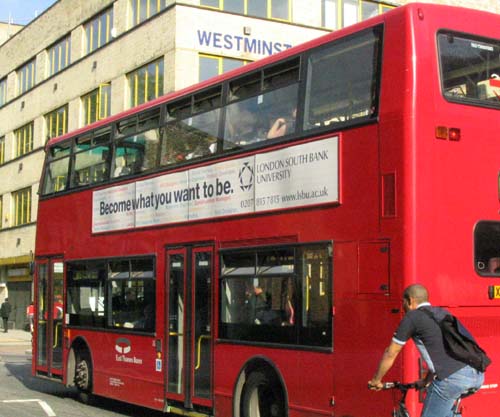
Yeah mate. Get yourself a degree from London South Bank University and you won't have to spend the rest of your life riding about on a bike!
And the other two were both taken from the telly over the weekend, while I was watching the test match.
"learndirect", however exactly you spell that (the capital letters or not thing I mean – personally I would greatly prefer Learn Direct), is actually not such a bad operation if my recent experience is anything to go by, even though I presume it is run by the Government. I rang them last week in connection with finding out about digital photography courses, and they were helpful.
This, for me, is the most interesting one:

These people seem to be actually sponsoring the cricket, and this advert suggests thoughts about all manner of things that may or may not be happening in the world. But for here and now, I'll just stick with the pictures.
Yes. they are indeed sponsoring the cricket, or at any rate the broadcasting of it. Here is their logo again, this time with the Lords "Media Centre" (alias: Space Pod) in the picture.

Not that I have any idea how good Computeach actually are at teaching … Compu.
Category: Higher education • The private sector • This and that
From Chinaview.com:
BEIJING, May 22 (Xinhuanet) – Over 700,000 Chinese have furthered their studies in foreign countries since China implemented its reform and opening up policy in 1978, and the number keeps increasing, according to Cao Guoxing, an official of the Ministry of Education.Cao said 170,000 students have found jobs in China after they finished their studies, 350,000 are still studying or doing research abroad and the rest chose to work in foreign countries.
The Ministry of Education has worked hard to bring back the overseas Chinese students. By the end of 2003, 77 percent of the presidents and 80 percent of academicians in the Chinese Academy of Sciences and the Chinese Academy of Engineering have an overseas education background, Cao said.
I have no clear idea of what the consequences of all this will be, but it is a safe bet that there will be consequences, for China and for the rest of us.
Here's how the story ends:
Statistics of the Beijing municipal bureau of personnel show that around 50,000 students chose to work in Beijing after finishing their studies abroad, who have created over 3,800 enterprises of new and high technology.
And that, I surmise, is only the beginning of the story.
Here is an interesting piece about teachers fleeing the bureaucracy and indiscipline of English schools and working abroad.
Key quote:
"The vast majority of schools abroad hire teachers to teach," says Albert Hundspeth, who's been head teacher at British schools in Prague and Cyprus. "You are relieved of a lot of the administration that is normal in the UK system, and plenty of British schools abroad don't do the SATs tests." On the discipline front, because the schools are fee-paying there's a higher chance that the students will be well-motivated."
Imagine it. Teachers being hired to teach.
This is very strange:
English teachers are demanding an apology over the "worst ever" Shakespeare question in a test sat by 630,000 pupils last week.The 14-year-olds taking the compulsory exam on the Bard were asked in the paper on Macbeth to write as if they were agony aunts for a teenage magazine.
The question, in the paper devised by the Qualifications and Curriculum Authority, told the pupils: "In Macbeth, Banquo warns Macbeth about the witches' influence. You give advice in a magazine for young people.
"You receive this request: 'Please advise me. I have recently moved school and made some new friends. I like spending time with them but my form tutor thinks my work is suffering. What should I do? Sam.'
"Write your advice to be published in the magazine."
Bethan Marshall, a lecturer in English at King's College, London, said it was "the silliest question I have ever seen. It is a pointless, contrived link with the play which could be answered without any reference to it," she said.
Trevor Millum, of the National Association for the Teaching of English, asked: "What has this got to do with Shakespeare?"
I distinctly remember an exam at Essex University which was supposed to be about computer programming, which was actually a mere intelligence test. I'd done no computer programming work all year, but passed with flying colours.
Macbeth contains one of my favourite quotes of all, which I can imagine a lot of teachers liking, because it sums up their entire lives, or what they hope is their entire lives:
Thou shalt get kings though thou be none.
This is said by the Third Witch, to Banquo. The First Witch: "Lesser than Macbeth, and greater" – just before the quote above – is almost as good.
When the usual suspects orate about how the internet is going to "revolutionise" education, I am interested, but it usually turns out to be an exaggeration. Some promising and/or worthwhile stuff is being suggested or offer, but the world is not going to be transformed. But when the US Navy says things like this, I find myself being more impressed.
I think that the reason for the contrast between these two reactions is that the US Navy, unlike civilian educational organisations, makes a point of dishing out orders to people, and of being obeyed. Not orders to everyone, of course, but to a lot of people. "Now hear this!", as they say over their ship's loudspeakers. (They do in the movies anyway.)
 So, when US Naval officers announce that naval medical education is going to be revolutionised by being made available on line, there is an air of "whether you like it or not" about this pronouncement that is absent when civilians talk about revolutionising things.
This last stricture does not apply to actual revolutionaries. They cannot yet give orders but they mostly intend to. Civilian educators, on the whole, disbelieve in giving orders. They believe in things like arousing enthusiasm, and in attracting attention with pretty little pictures. They believe in "engagement". They believe in the voluntary principle.
The US navy believes in pretty little pictures also, as the particular pretty little picture that I have used to decorate this posting illustrates. But read what it says. It says: "Naval Medical Education and Training Command." Command. Civilian educators don't like to use words like "command" these days.
Personally, I think that the civilian educators are a lot more right than wrong. But I further believe that following the logic of not using the word "command" will have revolutionary consequences, and that a lot of these same civilian educators are liable to end up as revolutionees.
Joanne Jacobs, who is indifferent to pictorial content on account of having sufficient content of her own, links to this picture, which unlike her I here reproduce:
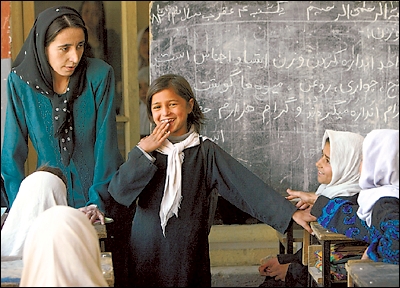
Here's how the accompanying Christian Science Monitor story starts:
A second-grade math class in Kabul, Afghanistan, met in the school breezeway with a blackboard on wheels. The young scholar was shy about speaking in front of her class. A proud teacher watched. A classmate reached out her hand to offer support.This scene, so natural, so universal, was nonexistent in Afghanistan for many years when the Taliban were in power. Laws prohibited women and girls from attending school or even leaving their homes.
A breezeway sounds like something out of doors.
Instapundit linked to Assymetric Information about this, and that's how I found this, about the contribution made by women in recent decades to increased GDP. This contribution, says Jane Galt, has been made possible by the massively reduced time now needed to run a home, cook meals, clean up, do laundry:
My mother stayed home with us. By the time I was ten, she was going bonkers. There simply wasn't enough to do in the house . . . and my mother, mind you, had gone in for gourmet cooking in a rather large way, producing elaborate dinners that took hours to prepare. She was the mainstay of the PTA, the building's co-op board, and so forth. Nonetheless, there simply wasn't enough to keep an active woman occupied after the children were in school.Women in the house, other than those with small children, became economically useless to their families once labour-saving devices and modern food processing made 90% of their labour obsolete. So they went to work.
Thus, I'd argue that the GDP growth we experienced when women went to work is measuring the same thing as other kinds of GDP growth: the movement of labour resources from less valued to more valued uses.
However:
This has created a problem, of course: women's work used to be compatible with child care, and now it is not. And the business world is still largely designed for men: it is not structured to accommodate professional women who stay home with young children. On that, more later.
And this posting should remind me to got back for the"more later" that she promises.
Commenter lindenen echoes that last point:
All those kids who decide to shoot up their classmates, would they have sunk to this level if someone had been parenting the kids? I think there are a lot of indirect negative effects that we are only just beginning to deal with.
Agreed.
If you think about it, raising children is all about – and I know it's uncool to quote yourself but uncoolness be damned - this (see my immediately previous posting):
In the longer term, I believe that the "answer" to children abusing drugs is to rearrange the immediate incentive structure that the average school-child now faces. If more children made a more immediate contribution to the world, and got immediate rewards for doing so, and more immediate punishments for not making such a contribution, then drug abuse, which would not be rewarded and would be punished, might diminish, although it would never completely go away.
When Old Fashioned Mum did her housework, her kids either helped (even if it was only by not being a nuisance) and were praised, or were a nuisance and got scolded. They got attention, nice or nasty according to whether they were contributing or not contributing. But when New Mum goes to work, all that stuff gets switched off. New Mum therefore, in a very basic sense, separates children from the realities of the world, personified by … herself.
And people who live in an unreal world, stripped of all economic rationality, do drugs. Drugs make unreality a whole hell of a lot more exciting, and don't result in any income being foregone. There may later be disapproval, but it is not immediate. The drugged gratification is immediate. lindenen is right. Kids whom Mum neglects are liable to shoot up.
And far too many schools are like neglectful Mums. At least those sniffer dogs (again: see previous posting) mean that someone is paying attention.
David Carr writes at Samizdata about the use of sniffer dogs in schools, and wonders why there is so much less fuss about that than about prisoner abuse in Iraq, i.e. he disapproves.
Me, I think that if you favour compulsory schooling, you have to accept that (a) schools are then prisons, and that (b) since you get drug abuse in prisons, you are also liable to get it in schools, and that meanwhile (c) a school where drug abuse is controlled is probably better than one where it isn't.
In the longer term, I believe that the "answer" to children abusing drugs is to rearrange the immediate incentive structure that the average school-child now faces. If more children made a more immediate contribution to the world, and got immediate rewards for doing so, and hence more immediate punishments for not making such a contribution, then drug abuse, which would not be rewarded and would be punished, might diminish, although it would never completely go away.
Note that I do believe that there is such a thing as "drug abuse". I do believe that marijuana, to take a favourite example of the pro-drugs enthusiasts, is potentially a quite harmful drug. I do not regard this as inconsistent with favouring the legalisation of all drugs. Drugs are dangerous, but only directly dangerous to those who take them. The harm that drug abusers do to themselves shouldn't be a criminal matter, any more than the harm done by alcohol abusers should, in itself, be a crime. The crimes that abusers commit as a result of their abuse should, on the other hand, be treated as the crimes that they are.
And while we're talking about crime, I think that the age of criminal responsibility, as of economic and political emancipation, should now be lowered, to the beginning of teenagerdom. Votes at thirteen. Criminalisation for crimes at thirteen, no compulsory schooling from thirteen onwards, etc..
Children are powerful, as soon as they want to be (i.e. as soon as they become "teenagers"), and no good comes from attempting to sustain a political regime based on unreality, or on such irrelevancies as the fact that many children of that age are stupid. So are many adults, but that doesn't mean that stupid adults get locked up in schools indefinitely and searched by sniffer dogs for the drugs that they would then also use in huge quantities.
There is another posting here about how the market educates, plus yet another about how modern technology empowers children. Expect these Real Soon Now.
More from the count your blessings department:
Fari Dube, the deputy headteacher of Bulawayo's Nkwalongwalo primary school, said that before the WFP donated maize to make porridge, children used to faint in their classrooms. "In truth, some of the staff are also starving."
That was just a throwaway bit at the end of the piece.
The WFP is Robert Mugabe's lot, the maize they so graciously donated having first been stolen.
It shows, though, how serious people are about education in those parts.
In my previous posting on Brian's blog I was planning to leave the School from Hell I was teaching at and start somewhere new in September. I left much sooner.
I arrived one morning at my department to find a boy out of lessons, when challenged I was met with the usual torrent of abuse. The Head of Department (HoD) came out (somewhat surprisingly) to see what the commotion was about and told me he was a known troublemaker and that I should go to my room and lock the door. "Lock the door?" I asked. "Yes" was the reply, "to be on the safe side."
I hid in my locked room and waited. The boy began banging on my door and issuing a variety of threats. I tried to ignore him, so he went outside and began banging on my window. At this point I summoned help on the phone that fortunately (only) I had in an adjacent store room. Someone actually came and took him away. Good. The next proper lesson I had resulted in another assault on me (being pushed around etc.) I phoned for help again and had someone taken away. Double good. So far, so good. Just another 'normal' day at this school.
The next day I find a note in my pigeon-hole from a member of the Senior Management Team (SMT). My facility to have pupils removed for misbehaviour was being withdrawn as I was using it too much. My HoD knew nothing of the decision, nor did the support staff who actually did the removing. The Head had already said that pupils could not be sent out of rooms (as they merely went and disrupted other lessons) so I just had to cope with them – without any support.
That was it. I was furious. I asked the support staff what they thought of it and they couldn't understand it. Other teachers thought it ridiculous. I went to see one of my colleagues who'd had similar problems. I found him at the back of his room, head in hands shaking. He'd just had another day of teaching at this school. "That's going to be me anytime soon" I thought to myself.
I made up my mind. Next morning I phoned in sick. And the next. I went to see my GP who, after explaining the situation wrote me a three week sick note for 'stress'. I wrote a letter to my Head explaining that I would not be returning.
I now had to find a supply job for the Summer Term ...
Last night I attended a talk given at the Evans household by Max Gammon, one of the regular Friday evening meetings that Tim Evans and I take it in turns to host (he on the second Friday of the month and me on the last). It eventually became an argument between Christians and Atheists, but before that, Gammon made many interesting points about the degeneration over the years of the National Health Service.
One point of relevance to this blog he made with particular force, which is how bad it was when nurses stopped being trained in wards, doing nursing, and instead did an "education" in classrooms and seminar rooms. In Gammon's mind there was clearly a direct relationship between what many people regard as "education" and that other, much more malign modern tendency, "bureaucracy".
"Education", in other words, came across as more like malignant disease than as a modern blessing.
As for the ruckus about Christianity, I felt, as the devout Atheist that I am, that if Gammon had confined himself to saying that Christians make better nurses, or that a revival of Christianity might make it easier to run hospitals, I might have gone along with him. But instead he went out of his way to present Christianity as the logical outcome of his analysis of the NHS. Paul Coulam, veteran of many Samizdata comment wars, was present, and he put the case against Christianity with his usual lack of equivocation, egged on by the likes of me growling from the floor, and by Patrick Crozier, who pointed out that an identical nationalised degeneration had occurred in the railways and nobody blamed that on the decline of religion.
Nevertheless, a most stimulating and enjoyable evening.
Why do I get the feeling that this may not be about, you know, education? Not about essays, homework, algebra, and such, anyway.

Learn more here. Actually, it seems to be rather more that kind of thing that I expected. I assumed it was older woman young guy "education". But no, it's priests and catholicism, etc.. Education, in other words.
I've already quoted here from How To Be A Star at Work by Robert E. Kelley on the subject of Dwight D. Eisenhower's mentor relationship with a superior which helped him learn the ropes of military bureaucracy. Here's another quote from that same book, which emphasises a regular theme here, which is the way that schools, by their nature, are not good at teaching you how to work cooperatively. The good news is that Kelley, unlike even most of his "Star" cooperators and initiative-takers, reckons that he can teach this.
When Lai and Henry were hired at Bell Labs, they had very similar credentials: 3.8 GPAs from top-ranked electrical engineering programs, summer internships at computer companies, and glowing recommendations from professors. Yet each took a very different approach to the assignment they were given for their first six months. In the morning, they took classes in telephone technology and in the methods Bell Labs uses to conduct its work. Afternoons were spent on break-in projects – work that needed to be done but would not jeopardize crudal projects if done badly.
Henry holed himself up in his office as if he were writing his dissertation or studying for a bar exam. He collected volumes of technical documents to acquaint himself with the latest ideas. He began learning how to use exotic software programs he thought might be helpful in his work. He would surface only for a bathroom break or a mandatory staff meeting. "What's going to count," he remembers thinking at the time, "is whether I can prove to my coworkers how technically smart I am."
Lai set aside three hours each afternoon to work on her assignment. In whatever time was left of her workday, she introduced herself to coworkers and asked questions about their projects. If one of them needed a hand or was facing schedule pressures, she volunteered to help. And even though Lai was new to the workplace culture, her colleagues appreciated her willingness to help them out, especially given that their problems were not hers.
One afternoon, a colleague couldn't get a program to work in a software project that was due the next week. Lai thought that a new programming tool that she had picked up in an advanced course could handle the problem. She offered to work on a solution while her colleague focused on the larger project. Her coworker was grateful to have help fixing the program so that he could keep to his schedule, and he also appreciated the information on the new tool.
When some sophisticated software tools needed to be installed in everyone's office PCs, the traditional but very unproductive company process forced each person to install it by trial and error. Lai had experienced the same cumbersome installation process during an internship and thought it made more sense for one person to do it for all the machines. Since no one was specifically responsible for the work, she stepped forward to take on the job. When it turned out to be tougher than she realized, requiring two weeks rather than the four days she had planned, Lai could have backed off, but she saw it through.
"Once I got up the learning curve, it seemed silly to make everyone else go through the pain I did," she says. Volunteering for the project forced her to come in early and stay late for several days so that neither her work assignment nor her class work would suffer.
On another occasion, a colleague who had been scheduled for a dreaded all-night lab testing session had to attend an out-of-town funeral, and another staffer had to fill in. More physically than technically demanding, these sessions take place from midnight to 7:00 a.m., the only period when the computers can be freed up to accommodate large-scale testing. At a hastily called staff meeting, the veterans kidded one another about grabbing the "plum assignment." At the point where the staff expected the supervisor to assign someone arbitrarily, Lai volunteered.
"I figured that it was most important to get accepted into the team, and what better way than to help them out?" she said.
Even the drudge work of a midnight shift, she said, was like a mini-apprenticeship. "I got a quick peek into the work they were doing and what kind of things I would need to know. Sure, some of the work I did for them was grunt and gopher stuff, but ... to meet the schedules, they needed a hand. Since my schedule was more flexible than others', it made sense for me to help out. Plus, they got to know me and my capabilities."
After six months, both Henry and Lai had finished their technical classes and their first assignments. Both of their projects were successful and judged to be technically competent. Indeed, Henry's work may have been slightly more technically proficient than Lai's.
But when it came to workplace reputation, Henry came up short. While he was known as a nice guy, he also was pegged as a loner. Henry was seen as technically adept, but there were question marks about his ability to share his skills with coworkers. He carried on as if he were still in school, where individual performance is the rule, Lai was seen as an initiative taker, someone who saw a problem that was not her responsibility and stepped forward to solve it. Lai had been able to create the impression of being in the lab group for much longer than six months. Managers noticed this, of course, and already were looking at her as a candidate for fast-track assignments.
Our observations of Henry, Lai, and dozens of other Bell Labs engineers show that any newcomer in a unit of professionally skilled, competitive workers must demonstrate the initiative skill within the first six to twelve months. Otherwise, the new hire will be relegated to the pack – labeled, perhaps, like Henry, as competent but not productive in ways that benefit the group. In the late 1980s, when managers across the country were forced to cut staffs, the workers who hadn't shown initiative, like Henry, were often vulnerable.
Yet learning how to take initiative effectively is not taught in school or even in the workplaces that now demand it. Even where it is taught, learning on the job is not easy. Stars have the initiative moves down, but most can't teach them to others.
More news from the world of edbiz:
NEW YORK, May 12 /PRNewswire/ -- Berkery, Noyes & Co., the leading investment bank specializing in the information market, adds Christopher Curran, a veteran of the education industry, to its senior staff, the firm announced today.
Mr. Curran is the latest addition to the senior staff at Berkery, Noyes, the longtime leader in investment banking for the education market. As Managing Director, Curran will provide mergers and acquisitions advice, financial consulting, and strategic research services in the K-12, college, corporate training and for-profit education markets.
Mr. Curran, most recently a Managing Director at Eduventures, Inc., brings a wide range of education, management, and consulting experience to Berkery, Noyes. At Eduventures, a global leader in education strategic research consultancy, Curran managed all business development functions, consulted on client growth strategies, and developed the company's consultative sales methodology.
I suppose this is the sort of verbiage that goes with free market education. I'm for it, I further suppose. But … yuck.
More British educational export business in China, this time by the London School of Economics. This from the BBC:
The London School of Economics is taking its summer schools to China this summer for the first time.
The courses will be run in partnership with Peking University.
Dr John Board, head of the LSE Summer School programme, said: "We are delighted to be offering this selection of flagship courses from our London programme in Peking."
"It is a step into a new market but one we are confident will attract interest."
The bosses of British universities sound more and more like businessmen, which would be because, more and more, they are businessmen.

The weekend before last I went to a party at Sandhurst. I have already written here about British army education, so I made a point of asking around amongst the guests about educational matters. I struck gold. I had two conversations in particular which I have kept meaning to report on here. Sorry for the delay, but I know that I can remember all the bits that matter.
Sandhurst, for those who don't know, is the place out to the west of London where they incubate the new officers of the British Army, and conversation one was with a Sandhurst history lecturer. I asked him what he lectured about.
The most interesting bit of his answer concerned his choice of historical campaign to describe for his students. He deliberately chose a losing campaign, the invasion of Russia by Germany during the Second World War, as viewed from and experienced by the German army.
He mentioned the way that the German army is renowned for the initiative and independence entrusted to and shown by its junior officers, but, he pointed out, all that changes when things go seriously wrong. Then, the people at the top exercise tight control, which all adds to the grief.
I like the idea that young officers are asked to think about what army life is like when things go badly wrong. This is, if you think about it, an indoor, classroom, version of what those sergeants shout at their charges out in the open air. Are you tough enough for all this misery?!? Because it is misery, you little …!!!
For some reason I found myself asking if he could always spot the future high fliers. He said he could spot them, but that he could never tell if they would fly high in the Army, or in Civvy Street. This strongly suggests that the education of British army officers is relevant to life generally, and not just to army life, right? Yes he said, that is so.
This latter proposition was spookily confirmed for me by conversation number two, which was with a guy who had worked for most of his adult life and still worked for Motorola, the US based (but worldwide in operations) portable radio company. The man I talked with, whose expertise seemed to be government regulation (a very big deal in the teleommunications trade, alas) explained that, just like the German army, Motorola's people are famous for the amount of creative freedom they're allowed. The atmosphere, he said, was "collegiate", rather than based on command and control. You could work for years with Motorola people, he said, and develop a profound sense of just how good they were, but still not know what their official position was in the official pecking order.
Until things go wrong, as they famously did when the tech-boom went bust just a few years ago. Suddenly – and the guy described it all very eloquently – the survival of the company involved making brutally harsh decisions in the space of a few hours, so fast did the orders collapse and the money start haemorrhaging out . Command was abruptly centralised. Hideously expensive outsiders, who knew how to do command and control, were hastily brought in. About half the worldwide work force of nearly two hundred thousand were fired, pretty much overnight. Bloody hell.
Since that traumatic time, forms of business expertise that Motorola had tended to neglect in the good old days, most notably marketing, were bought in, at further vast expense, but in ways that are, I am told, showing results. A friend in her early twenties with whom I attended the party later told me that whereas not so long ago Motorola portable phones were rather passé now they are "cool".
Payment by results in Denver:
DENVER — As a teacher of emotionally disturbed children, Jeremy Abshire sets goals for each of his students. Geronimo, 14, an American Indian who knew only the letters for "Jerry," will read and write, and sign his true name. Shaneesa, a meek 12-year-old reading at a first-grade level, will catch up to her middle-school peers and attend regular classes in the fall.Under a proposal approved by teachers here and to be considered by voters next year, if Mr. Abshire's students reach the goals he sets, his salary will grow. But if his classroom becomes a mere holding tank, his salary, too, will stagnate.
"The bottom line is, do you reward teachers for just sitting here and sticking it out, or for doing something?" said Mr. Abshire, who has been teaching for four years. "The free market doesn't handle things that way, so why should it be any different here?"
Yes and no. The hard bit with schemes like this is setting the goals fairly. Ambition, if you think about it, is liable to be penalised. Canny manipulation of the targets so that they are easily reachable is liable to be rewarded. Yet reaching for the stars has definite merit as a teaching attitude, doesn't it?
What really happens in that "free market" that public sector people talk about so much these days is not just that they set targets and reward you for reaching them. The other way they check up if you are working well is: they watch you to see if you are working well. Your boss works next door, and he can tell. He did your job, and he can tell if you are doing it well or not, even if the "results" now say different.
One of the most depressing things about the public sector is when it mimics the "free market" inaccurately, generally by putting lots of bureaucratic procedures in place, to measure "achievement" which end up getting in the way of achievement. In the real free market there is a constant tension between measuring work accurately, and the threat that such systems pose to the actual doing of the work enthusiastically.
So, I wish this Denver scheme well, but say of it: watch out. There will be problems as well as miracles, although probably in the opposite order to that order. The miracles will come first, when the scheme starts out working pretty much as it is intended to. But then will come the problems, made all the worse by the now immense prestige and hence political untouchability of the new regime, when canny operators learn to manipulate it into a regular reward system for everyone, even though most of them are just running the same old holding operation that the scheme was supposed to get rid of.
Sorry, but when it comes to the public sector I am a pessimist, and never more so than when they are faking up a market, but without actual consumers, waving money, allowed to bugger off if they don't like the product, etc., etc..
My thanks to Chris Cooper (he's the one holding the knife), who emailed me about this article.
A new brain-imaging study indicates that a specially designed program for second and third graders deficient in reading boosts their reading skills while prodding their brains to respond to written material in the same way that the brains of good readers do. The same investigation found that the remedial instruction typically offered to poor readers in the nation's schools doesn't improve their skills and fails to ignite activity in brain areas that have been linked to effective reading."Good teaching can change the brain in a way that has the potential to benefit struggling readers," says pediatrician Sally Shaywitz of Yale University School of Medicine.
At least one in five U.S. grade-schoolers with average or above-average intelligence encounters severe difficulties in learning to read, researchers estimate. In 2000, a panel of educators and scientists convened by Congress concluded that reading disability stems primarily from difficulties in recognizing the correspondence between speech sounds and letters.
And towards the end of the article the difference made and not made by different kinds of supposedly remedial teaching are spelled out:
At the end of the school year, only poor readers in the experimental program showed marked gains in reading accuracy, speed, and comprehension, the researchers report in the May 1 Biological Psychiatry. Good readers still exhibited the strongest literacy, but the poor readers who received phonetically based instruction had closed the gap considerably.After poor readers completed the experimental program, their brains displayed pronounced activity in several of the same left-brain areas that are active when good readers do reading-related tasks. In an earlier study of poor readers, Sally Shaywitz and Bennett Shaywitz found that one of those neural regions remains inactive as these kids grow up. Preliminary evidence from other researchers indicates that this structure, located near the back of the brain, fosters immediate recognition of familiar written words and is thus crucial for fluent reading, Sally Shaywitz says.
Students who had completed the experimental tutoring program still displayed improved reading scores and associated left-brain activation when measured 1 year later.
Bruce D. McCandliss, a neuroscientist at Weill Medical College of Cornell University in New York City, calls the new report a "landmark study." It builds upon similar findings by other research teams that tracked much smaller numbers of poor readers given phonological instruction, he notes.
Said Chris in his email: "More support for teaching reading by phonics?" It would certainly seem so.
Natalie Solent links to this story:
Zimbabwe renewed its offensive against "racist" private schools yesterday by arresting headmasters and members of governing bodies, who are accused of raising fees without permission.Teachers and others in the private sector went into hiding as the government warned a delegation of concerned parents: "We will do to you what we did to the white farmers, and we will take over your schools."
Says Natalie:
The dragon is eating its own tail: 90% of the children in these schools are black, and include the children of members of the cabinet, including Mugabe himself.
I wrote about the cricket manifestation of this process for Samizdata yesterday.
Not good.
I have no time for anything much today, but this has got to be today's most striking British education news story:
A history teacher was at the head of a network of football hooligans jailed today after conducting a violent pre-planned brawl along the platform of a busy railway station.Dave Walker, head of year at Turves Green boys' technology college in Birmingham, was jailed for two years and three months for his "vital role" in orchestrating fighting at Maze Hill, south east London, in April 2002.
Walker, 37, who called himself "Three Lions", posted messages on internet forums setting up the confrontation between 30 Charlton supporters and 15 Southampton fans before a match in London, Kingston crown court heard.
Like quite a few of the most dramatic criminals (expect a TV play about this guy any month now) he seems to have lead a double life.
In a statement, headteacher, Ken Nimmo, described Walker as an "outstanding teacher" with an "exemplary record" and said he was saddened by events.He said: "David Walker was an outstanding teacher who contributed a huge amount to the many successes of the boys here."
I bet he was especially good at explaining military history. (See below!)
Here is the bit that deals with Wellington's schooling, at Eton. Note the mention of the Wall Game.
I found the picture of Wellington here.
Since Wellington's refusal to be overawed by Napoleon primarily stems from his invincible self-assurance, which in turn came largely from the nature of his schooling, it is worth while examining his psychology up to the time, in the summer of 1793, when he, in an action pregnant with symbolism, burned his violin and embarked on a serious professional military career.

Wellington's remark about the battle of Waterloo having been won on the playing fields of Eton might well not have been a reference to the cricket pitches. An Eton historian, Lionel Cust, believes he was more probably alluding to 'the mills at Sixpenny Comer', which was where the boys went to fight one another. It was there, where the Wall Game is now played, that Wellington had a fight with Robert Percy 'Bobus' Smith, although sources differ on the outcome.' In the three years that he was at Eton before being withdrawn, probably but not certainly for financial reasons, Wellington entirely failed to distinguish himself in any capacity. 'A good-humoured, insignificant youth' was all a contemporary, the 3rd Lord Holland (admittedly later a political opponent), could remember about him there. Although it might be too hard to call him 'the fool of the family', as the Eton beak George Lyttelton did in one of his letters to the author Rupert Hart-Davis, he was intellectually far behind his eldest brother Richard, who had so shone at the school that he chose to be buried there.
A glance at the Eton College register for the three years that Wellington was a pupil there, from 1781 to 1784, shows how many of his contemporaries were drawn from the aristocracy. Although Winchester and Westminster had rivalled her socially in the past, by the late eighteenth century Eton was pulling away to become, as she unquestionably was by the early nineteenth century, the grandest school in the country. Wellington was educated with the offspring of three dukes, a marquess, thirteen earls, five viscounts, seven barons and a countess whose title was so ancient that it also went through the female line.
His Etonian contemporaries were a colourful lot, and provided a number of his senior officers later on. Robert Meade, son of the 1st Earl Clanwilliam, was a lieutenant-general by 1814, as was William Lumley, son of the 4th Earl of Scarborough. Hugh Craven, son of the 6th Lord Craven, was a colonel in 1814, a major-general in 1825, and shot himself in his house in Connaught Place in 1856 owing to his losses on the racecourse at Epsom. At least his exit was intentional; Lord Barrymore, son of the 6th Earl of Barrymore, died in an accidental explosion of his musket while conveying French prisoners from Folkestone to Dover in 1795. George Evans, son of the 3rd Baron Carbery, died at Reddish's Hotel in London from a burst blood vessel on New Year's Eve 1804, and George de Grey, son of the 2nd Baron Walsingham, was burned to death in bed at his home in Upper Hariey Street. Robert King, son of the 6th Baron Kingston, was tried at Cork assizes in 1798 for the murder of Henry Fitzgerald, who had eloped with his sister. It was a pretty dear-cut case but, astonishingly even for eighteenth-century justice, he was unanimously acquitted by the House of Lords.
One of Wellington's school contemporaries. Henry Fitzroy, son of Lord Southampton, married Anne, Wellington's sister, but he was less fortunate in two others. Lord Holland, son of the 2nd Baron Holland, and Charles Grey, son of Earl Grey, became leading Whigs and political opponents of his. Holland was later a bitter personal critic, describing Wellington in his memoirs as 'destitute of taste, wit, grace or imagination', and a man whose vanity even 'exceeds his ambition' and who little care[s] what troops he leads or what cause be serves, so that he, richly caparisoned in the front, be the chief pageant of the show and reap the benefit of the victory and the grace of the triumph'. (The Whig hostess Lady Holland, an heiress of forceful personality, great beauty and ten thousand pounds a year, had heard Robespierre speak to the National Assembly during her five-year Grand Tour and had been most impressed.) The exaggerated loathing of the Whigs for the man who threatened and finally defeated their idol Napoleon was to be a constant feature throughout Wellington's career. They emerge from this story not as witty, brilliant, big-hearted Olympians of politico-social mythology, but as quotidian, nit-picking, mean-minded quasi-traitors.
Napoleon went to Brienne Military Academy speaking a Corsican patois and returned speaking French, but there is no suggestion that Wellington had even a smattering of an Irish brogue before attending Eton. Indeed throughout his life Wellington felt himself to be markedly superior to the Irish, once saying, albeit perhaps apocryphally, that they required 'only one thing to make them the world's best soldiers. White officers.' He is also believed to have quipped that his own Irish birth no more made him an Irishman than being born in a barn made one a horse.
Eton gave Wellington a belief in himself and his capabilities that his ten subsequent years of doing very little indeed entirely failed to dent. There are suggestions that he was taken away from school not because the Wellesleys were too poor after the death of his father the 1st Earl of Mornington in 1781, but because his academic prospects were so unpromising. This is somewhat discounted by the fact that Lady Mornington took him to Brussels, where the cost of living was noticeably lower, and where Wellington was taught by a local lawyer.
Further evidence that British universities are at least semi-trading in semi-markets:

It's an advert in the tube, meaning (for non-Londoners) the London Underground railway. A bit blurry I'm afraid. Taken on the move. But you can just about make out that it's London South Bank University, and that this is their website.
More news, this time from timesonline (David Carr – thanks for the email), about British educational institutions doing business in Asia:
ELITE British schools are setting up in China to feed a growing appetite for public school education as expectations grow that a ban on foreigners and Chinese studying together will be lifted.Making the running is Dulwich College International School in Shanghai, which will be the first of four schools that the 400-year-old institution is setting up in China.
The South London school, which already has an international school at Phuket in Thailand, is not alone in looking eastwards for future growth. Harrow and Shrewsbury have schools in Bangkok.
At Dulwich in Shanghai, students will wear a formal uniform of shirt, tie and jacket, with grey slacks, raising the prospect of blazers and school ties on Shanghai’s promenade, the Bund, for the first time since the Second World War.
More Dulwich stuff, from me, here, here.
Commenting today on this posting here, Satya, who writes this blog says:
It is indeed interesting to follow the way trade in education is evolving. Some time back, I had looked at India's education imports and the possibility of India exporting education by leveraging the (Indian Institutes of Technology) IIT brand - India's strongest educational brand. See my posts here and here.But there is another interesting exports opportunity quietly growing in education - developing countries are exporting teachers to the developed countries. Indian teachers have been going to the US, the UK and many other countries to teach.
This kind of thing has undoubtedly emerged as one of the Big Stories while I've been writing this blog.
We all know why it is happening. Cheap international phone calls and even cheaper email make it far easier to arrange and maintain the quality of international relationships and faraway ventures and events than it ever was. It would have been crazy if the world – truly now the world – of education had not been deeply affected by this global trend. And especially so when you consider that a lot of educational material of great value can now be transmitted and distributed instantaneously, over thousands of miles and on a bewilderingly huge scale, simply by someone no more computer-literate than I am pressing a few buttons on keyboard.
My deepest thanks to Satya for the comment, with all its useful links. His education blog supplies a mass of detailed information about educational developments in India, and as I keep saying here, educational developments in India are also one of the Big Stories in the education world now.
More international business for Britain's universities:
A record number of university applications this year includes a threefold increase in students from some of the former communist countries joining the European Union on Saturday.Official figures from UCAS, the universities and colleges admissions service, published today, show a surge of interest from the 10 accession countries.
But now here's the tricky bit, for the universities:
These young people will be treated as home students, paying £1,150 a year in fees instead of the overseas charges of £8,000 to £19,000.
Ah.
Nevertheless, an interesting development. Do you get the feeling that it is perhaps going to get rather harder to get into a British university from now on?
And, perchance, more expensive. After all, it sounds like the only way they are going to be able to charge more to all these Eastern Europeans is going to be to charge more to the locals also.
As Dave Barry's judi says, do as I say, not as I do:
ORLANDO, Fla. – A federal drug agent shot himself in the leg during a gun safety presentation to children and his bosses are investigating.The Drug Enforcement Administration agent, whose name was not released, was giving a gun safety presentation to about 50 adults and students organized by the Orlando Minority Youth Golf Association, witnesses and police said.
He drew his .40-caliber duty weapon and removed the magazine, according to the police report. Then he pulled back the slide and asked someone in the audience to look inside the gun and confirm it wasn't loaded, the report said.
Witnesses said the gun was pointed at the floor and when he released the slide, one shot fired into the top of his left thigh.
That'll teach 'em.
Last night I hosted a talk by Sean Gabb, and ripped off a report of it for Samizdata. I fear I exaggerated the speed and extent of the collapse of the Eastern Roman Empire, following the plagues of the mid sixth century. But the impact of plague on events was most interesting.
Basically, when a political system is presided over by a tiny elite of literate conquerors who speak one language, but who rule people who speak other languages, plague spells deep trouble for that elite.
This elite doesn't perpetuate itself biologically. It perpetuates itself by teaching its alien language to a regular few of the upwardly mobile locals. So teachers are a key part of this process.
When plague strikes, half the elite die, including half the teachers. But the other half of the teachers then have to turn their hands to more important matters, filling in for their former dead superiors. Thus, the process of replenishment and perpetuation ceases. In large parts of the old Eastern Roman Empire, ruled by a Greek speaking elite, this elite melted away, throughout what we now call the Middle East.
And to me, even more of a revelation, the Black Death (mid fourteenth century) killed off French as the governing language of England. I never knew this.