
I seem to be focussing on movies about education a lot just now. I'm not the only one. Professor Glenn Reynolds has been watching Spellbound, the documentary movie about a spelling competition in America:
And that's another thing that struck me: It is a cliché to say that all the contestants in a national competition like the Spelling Bee are winners, but it's true. Watching these kids, I knew that they would all do fine in life. The qualities of focus, discipline, perseverance, and coolness under pressure that such contests require aren't the stuff of many movies about adolescents. But they serve people well later in life, as I'm sure these kids will discover. It's nice to see a film that makes that point, too.
And in his next and latest MSN column he explicitly links this to the quality of US education.With characteristic generosity, Reynolds includes links to other education bloggers (by the way that is not a snide way of complaining that I got excluded – this blog would not have been appropriate for the Prof's purposes):
There are a lot of educational bloggers who cover these kinds of topics in a lot more depth than I can. Joanne Jacobs (from whose blog these examples come) and Kimberly Swygert are two good examples, and their blogs have links to many more. You should also look at Erin O'Connor blog, Critical Mass, which does the same thing for higher education.
This stuff matters. America is richer than the rest of the world because we have smart people who work hard, under a system that encourages them to do so by letting them keep (most of) the fruits of their labor. But America's wealth isn't a birthright. Like our freedom, it has to be earned by each successive generation. It can't be protected by legislation, it can only be protected by hard work.
Part of that hard work lies in educating the next generation. It's pretty clear that we're dropping the ball in that department. Instead of worrying about outsourcing, maybe we should be worrying about that.
The examples from Joanne Jacobs were quotes from other people.
Anyway, is America dropping the ball? It doesn't look that way to me, but maybe they are. Certainly these Indian computer programmers have got them scared. Anyway, the answer is for the American home-schooling movement to rise up and conquer the entire country.
It seems that wherever you look, you find good news about India, and about India's economic development. That India is now busily taking computer jobs away from Americans has been one of the big world economic stories of the last six months.
Here's more news of India pushing ahead, this time in the form of an educational satellite:
BANGALORE: Teaching over 20,000 students at a single go is no mean task. But making it possible and making classrooms barrierless will be India's Edusat – the world's first dedicated education satellite to be launched by India.A pilot project of Edusat, that will provide satellite-based distance education, was launched in Karnataka on Wednesday.
While Edusat (Gsat-3) is to be launched in June this year, a pilot project has already been launched to test its efficacy. It will presently run on the Insat -3B, already in orbit. Chief Minister S.M.Krishna launched the pilot project in Bangalore on Wednesday with a live conference across Mysore and Bellary.
In the first phase around 70 engineering colleges of the Visveswaraiah Technological University (VTU) will be linked to multicast interactive multimedia.
I know, I know, a "Chief Minister" launched the damn thing. But that doesn't necessarily mean that he will be in charge of it. After all, the Indian public sector doesn't yet have the silly money to waste that is the basis of all the West's educational failures nowadays. With luck, there'll be plenty of greed and selfishness involved in the management of this new wonder gadget.
How soon before the Indian education business goes global, by which I mean so global that it becomes the next big economic story about how India is gobbling up the universe?
What a blessed change this all makes from the days when the only news that ever came out of India was about misery and starvation.
UPDATE: India has just bought itself a new aircraft carrier. From Russia, which tells you who's on the up and who isn't. Well, second hand. Pre-owned, as my video store calls it.
I'm very fond of these short biographies that they do nowadays. If you can have short stories, why not short summaries of great lives? But for Brian's Education Blog purposes such books can be tantalisingly insufficient. That Lenin book I quoted from yesterday is a foot crusher if dropped, or it would have been when it first came out in hardback. Which is why it went into such fascinating detail about the nuances of the man's education. Christopher Columbus by Peter Rivière, on the other hand, one of the Pocket Biographies series done by Sutton Publishing, is only 111 pages long.
So this is all it says (in paragraph one of Chapter One, "The Early Years", on page 8) about the education of its hero:
Christopher Columbus was born in Genoa in 'about 1451. His father, Domenico, was a weaver, and his mother, Susanna Fontanarossa, also came from a weaving family. We know of a sister, Bianchinetta, and two younger brothers, Bartolome and Diego, who were to be his companions and supporters throughout Us life. He received little in the way of formal education and the claim that he attended the University of Pavia, where he is meant to have studied geography, astronomy and geometry, is almost certainly not true. If later in life he was recognized for his knowledge of these subjects it was because he was self-taught. As a young bov he was engaged in his father's business, although at an earlv age he started going to sea. This was not altogether surprising since, along with Venice, Genoa was the great trading city of the Mediterranean.
And with that Columbus immediately sets to and discovers America, or whatever it was he actually did to it (see Introduction).
Still, for those who prefer short postings …
Incoming email:
Brian,
I am a recently retired computer analyst (20 years).
I would like to teach but don't want to get involved in the public school mess.
My question to you is: Is there a way I could earn any income by teaching home schooler's technical computer subject material?
Or: Is there some other way to earn money thru home schooling, for example, writing course material about computer related topics?
This is an idea I had but I know nothing about home schooling except that it is becoming more popular and will probably continue to do so if the public schools don't revamp the education system.
I would appreciate any ideas you may have.
Sincerely, Michael Hansen
Ideas and responses anyone? I should guess that this kind of knowledge is now swilling around the Home Ed movement like an ocean and no one is going to pay a cent for it. But what do I know? The Agony Midwife posting system has worked well in the past, where I put up the Dear Brian letter, and my commenters deal with it. So maybe something good will happen with this one.
If my scanner worked better I would probably do more postings based on the early lives of celebrities. I should do more anyway, because they are interesting to read, I think.
They can also be very interesting to do. Today, for instance, I was rootling about in chapter one of Adam B. Ulam's book, Lenin and the Bolsheviks (first published as The Bolsheviks in 1965). Did you know that Lenin had an elder brother, Alexander, who joined in a terrorist plot to assassinate the Tsar and who was hanged when Lenin was seventeen? Maybe you did, but I didn't.
Ulam then describes (p. 19 of my 1975 Fontana Library paperback) what was happening with Lenin's education while all that was going on:
While Alexander was awaiting first the trial and then the execution, Lenin was finishing his eighth and final year in the Simbirsk gymnasium. Graduation from high school was, for a European adolescent, a formidable and often a traumatic experience. It required not only a successful completion of what corresponded to the American senior year of the school, but also in addition a special examination in several subjects. This examination, the so-called "test of maturity", consisted of written and oral questions and exercises prepared not by the local teachers but by the ministry of education or by the professors of the regional university. Nothing was spared to endow the occasion with awe and tension. The strict secrecy about the content of the examination, the barricaded rooms where it took place, the virtual impossibility of beginning professional training if one failed a subject, make the most strenuous American and English academic tests appear innocent and relaxing in comparison. Nervous breakdowns were not uncommon among the students, most of whom were, after all, not older than eighteen or nineteen.
With the earlier noted exception of logic, Lenin completed his high school course with the grade of "excellent" in every subject, including religion. The high school certificate included also such categories as "behaviour in class", "interest in studies", etc. In all these respects his conduct was adjudged "exemplary". The final written examinations took place in the week of his brother's execution. Lenin passed them with the highest distinction, being awarded the gold medal of the Simbirsk gymnasium (both Alexander and Anna [Lenin's parents – BM] had received the same award) as the first student in the class.
It makes you wonder whether all the would-be Al-Qaeda suicide bombers whom the Americans are now hunting to death have younger brothers, and if so, what they might get up to in the future.
A different slant on the obligations of adults towards their children to many of the usual slants you hear nowadays:
In a nutshell, Dr. Laura believes that many of the aspects of adult life that I had always considered complicated and messy and finely nuanced are in fact simple and clear-cut; that life ought to be neatly fitted around duty and responsibility rather than around the pursuit of that elusive old dog, happiness. This is what makes her the most compelling advocate for children I have thus far encountered, because the well-being of children often depends upon the commitment and obligation of the adults who created them. If you want to know whether the divorce culture has been a disaster for children, tune in to the Dr. Laura show one day. The mainstream media have a cheery name for families rent asunder and then patched together by divorce and remarriage: they are "blended families." But the day-to-day reality of what such blending wreaks upon children is often harsh. The number of children who are being shuttled back and forth between households, and the heartrending problems that this engenders in their lives, is a sin. Every June, Dr. Laura fields multiple calls having to do with transporting reluctant children across vast distances so that court-ordered visitation agreements can be honored. Whereas an article in Parents magazine or the relentlessly upbeat family-life columns in Time might list some mild and generally useless tips for dealing with such a situation (have the child bring along a "transitional object," plan regular phone calls home, and so forth), Laura throws out the whole premise. What in the world are the parents doing living so far away from each other? One of them needs to pick up stakes and move. "I can't do that," the caller always says. "Yes, you can," Laura always replies, and when you think about it, she's right.
This being the Dr Laura in question, Dr Laura Schlessinger, who is apparently a big name in the USA. The book review article quoted from above is in the Atlantic online, and the writer of it, Caitlin Flanagan, reckons that Dr Laura is better at broadcasting than she is at book writing, but that her old fashioned ideas about duty towards children, and duty generally, are a breath of fresh air.
The trouble with denouncing divorce as a bad way to bring up children is that if you do it, or even (as here) side with someone else who is siding with someone else who is denouncing it, you risk offending friends, and for that matter relatives. Five persons in one or other of these categories spring to my mind immediately, and further thought would surely throw up as many more. But surely it's true. The best way to raise kids is for them to have a mother and a father, who live together or failing that very close to one another and who get along, or who at least do a reasonable job of pretending to.
That doesn't mean that the government should mandate this method and forbid all others. It merely means that this is what tends to be best and what parents should all do if they can, in the opinion of this pulpiteer. Yes, in thousands upon thousands of cases these single parent households are better for the children than those regular ones, and yes again, gay people can't do regular families very easily (although I'm sure that many gays fake family regularity with extraordinary completeness) and shouldn't be legally prevented from doing their own alternative versions of families. As I have said recently in another place, politically I'm libertarian, but my moral and behavioural preferences and aspirations are conservative.
Here's an interesting way for a school to get better exam results: make clever pupils sit the exam instead of stupid ones.
KUALA LUMPUR Jan 26 – The Kedah Education Department would investigate allegations that a school in the state had substituted candidates during the 2002 Ujian Penilaian Sekolah Rendah (UPSR).
Education Ministry Director-General Datuk Abdul Rafie Mahat said Monday the State Education Department had been instructed to conduct a detailed investigation with regard to the allegation.
"The Ministry views the matter very seriously. We want to investigate allegations that Sekolah Kebangsaan Pulau Chapa in Kedah had substituted weak pupils with top Standard Five achievers to sit for the UPSR examinations," he said in a statement.
Well, if you can have substitute teachers …
Talking, as I was in the previous posting, about charismatic teachers and their charming pupils in the movies, this looks like it could be fun. Yes folks, it's School of Rock of , starring Jack Black, who I thought was great in High Fidelity.
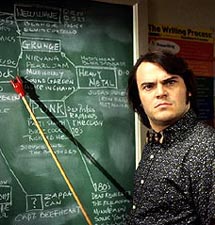 Here's a synopsis:
Synopsis: Dewey Finn is a hell-raising guitarist with delusions of grandeur. Kicked out of his band and desperate for work, Dewey impersonates a substitute teacher and turns a class of fifth grade high-achievers into high-voltage rock and rollers. The private school's uptight and skeptical head, Principal Mullins, watches on as the 'new sub' preps the kids for Battle of the Bands.
It's nice that he's called Dewey – a little educational philosophy in-joke there.
Reviews seem to be mostly good and I will definitely see this at some point, although probably only when it comes out on DVD in Britain. Most of the reviews say that it is good old-fashioned frothy Hollywood comedy with its heart in the right place and saved from schmaltz by being well and winningly performed.
And when I do see School of Rock I will seek out the serious educational ideas that are sure to be contained in it, and report back to you all.
On Saturday evening BBC4 TV showed Etre et Avoir, Nicolas Philibert's documentary about Georges Lopez, the French teacher in a primary school in the farming country of the Auvergne. It has been a huge surprise hit in France and is now being given award nominations and awards over here, and you can entirely see why.
There was one of him and about twelve of them. The children all got to know him well, he got to know all of the children well, and we got to know all of them, him and the children.

If there is to be orthodox, compulsory education, then this is clearly the kind of thing it ought to consist of. Georges Lopez was firm, fair, kind, attentive, and clearly loved his charges in just the way that you would want a teacher to do. He taught the 3Rs with care and certainty. He socialised with them and taught them manners, and was never himself anything but polite and respectful. He took them on trips in the surrounding countryside.
When one of the boys was distraught about his father's severe health problems, there was Georges, talking him through it, offering salient philosophical advice and comfort. ("We try to stay healthy, but then illness comes, and we must cope with it.")
I tried to sustain all my usual objections to educational compulsion, which this most definitely was despite the kind and considerate manner in which it was being administered, but honestly, I couldn't sustain them. Given the alternatives offered by their actually existing environment, this was the best deal that these children were going to get, by far. I couldn't blame Georges for the rules of his culture and the times he lived in. He was doing his best, and his best was very, very good.

There was one rather scatter-brained and mischief minded little kid with a splendidly photogenic face (he is now a celebrity, you can bet) called Jojo, who wasn't naturally bookish or logical, more your imaginative, romantic type. There was a lovely scene where Georges got Jojo to understand that there was no limit to how high numbers can go. ("Can you have more than one hundred? Can you have two hundred? What about three hundred? A thousand? Two thousand? Three thousand, … ten thousand, twenty thousand, … a million, two million, three million?" Jojo dutifully supplied the answer that Georges was looking for, which was "Yes you can", but was rather bored by it all, and would clearly have preferred to be talking about the interesting little human drama that was happening over the other side of the room. And eventually, George did defer and switched to talking about that drama. But not before he had stretched Jojo's brain like a piece of chewing gum. And of course, in the final scene, when they were all saying goodbye, Jojo was among those most sorry to be leaving. He loved Georges more than almost any of them. At least Georges, although firm with him, was also kind and gentle. I bet lots of others weren't nearly so patient when they were telling Jojo what to do.

The other scene that stuck in my mind was when another kid was filmed doing his homework, surrounded by his entire family. Mum, Dad, a brother, and an uncle I think it was. On and on it went, with Dad in particular sweating away at the mysteries of higher arithmetic. The camera stayed absolutely still. It looked like a Rembrandt. Boy and family doing homework. Beautiful.
A particularly pro-French thought. When they were all saying their final goodbyes, they all said goodbye with the ceremonial three-times-over left-right-left French kisses, boys and girls alike. My own bit of culture contains no such ceremonial interchange. This one was peculiarly appropriate for this particular moment, and very flexible. It could be distant and correct, like getting a medal from the President, or affectionate, as between members of a family. You could see Georges adapting the atmosphere to suit each child, with the last boy being particularly formal and distant. ("Au revoir Monsieur!")
There was one girl to whom Georges made a point of not saying a final goodbye. She was due to go to another much, much bigger school, and she was distraught. She was seriously bad at communicating, with anyone, but was just about okay with Georges and the small classroom with its small number of other children. She sat with Georges, rocking with repetitious grief and fear at the horrors to come. Georges did most of the talking, combining firmness and gentle concern as best he could, expressing confidence, while offering the poor girl the chance to come and visit Georges and tell him how she was doing. Okay? "Oui."
With a little bit of luck, it helped. And quite possibly this talk made all the difference to her entire life to come. It wouldn't surprise me.
Georges himself is (and I guess it's was by now) to say goodbye to teaching soon after this film was in the can, and when he told his kids about that they were not best pleased. A lot of the appeal of this film is the feeling you have while watching it that this is a fast vanishing world. This kind of kindness, politeness and personal attention may soon be a thing of the past.
After the film was so successful, there was then a huge row about how much of the money that the film so unexpectedly made ought to go to Georges Lopez himself. A lot, was Georges' opinion. I don't know how that all finished, but in any case that's a different story.
I'm glad about the pictures decision. I can feel it working already.
There's no doubt that my Culture Blog has been a whole lot more fun than this one in recent days and weeks, and part of it is pictures. I've mulled it over, and I've decided I'm going to put pictures here too, as and when it suits. And this one is fully worthy of the honour of being Brian's Education Blog Picture Number One:
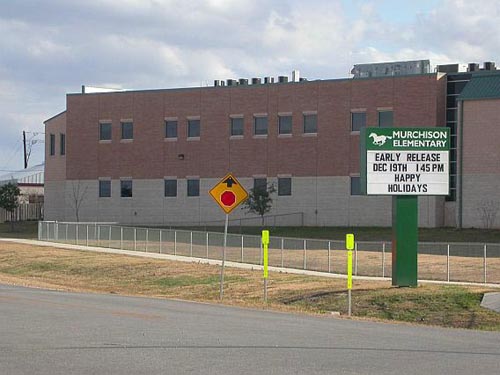
This is the Eyesore of the month for January 2004, at this site of that name.
Of this eyesore, James Howard Kunstler says:
Hmmmm. This typologically ambiguous building in Pflugerville, Texas (just north of Austin) is the K-through-6 medium security education facility. It's encouraging to know that the inmates were slated for "early release" this year. Ask yourself: what kind of citizens would an institution like this produce? And where do they go from here?
My thanks to Michael Blowhard for the link to this.
Here are two interesting articles from economist.com about university finance, a short one, and a longer one.
Key paragraphs, from the short one (with that link again to the longer one):
There are, broadly, two models for running universities. They can be autonomous institutions, mainly dependent on private income, such as fees, donations and investments, or they can be state-financed and (as a result) state-run. America's flourishing universities exemplify the former, Europe's the latter (see article). Britain's government wants to move towards the American model. The subject of next week's rebellion is a bill that would allow English universities (Scotland and Wales are different) to charge up to £3,000 ($5,460) in tuition fees, instead of the current flat-rate £1,125. Students will borrow the money through a state-run loan scheme and pay it back once they are earning enough.
It is a very limited start, laced with sweeteners for students from poor backgrounds. The best universities worry that the maximum fee should be many times higher. But it reflects an important shift in thinking. First, that the new money universities need should come from graduates, rather than the general taxpayer. Second and most crucially, it abandons the egalitarian assumption that all universities are equally deserving.
The government is right to be trying to move towards the American model. The European model is a shambles. Pit they're going so slowly. That's the gist of it all.
I'm finally starting to be comfortable with what I'm supposed to think about all this. I still find it hard to stay awake but I do now know what my opinions are, and why I hold them.
My friend Jackie D has written a short story entitled DIERESIS. I think it's called DIERESIS anyway, although that could just be a subheading. It is about a drunk kindergarten teacher.
If I understand the situation correctly, the story couldn't be called "The Drunk Kindergarten Teacher", because this story is part of a collective blogosphere-based attempt to write lots of Drunk Kindergarden Teacher stories. No, I don't quite understand that either.
Dieresis apparently means this. This is presumably a reference to the name of the story's other central protagonist, who is called Zoe with two dots over the e.
You learn something new every day. Even if you knew this particular thing already, that remains true as a general principle. If you don't, you should.
Comment Number One at Jackie D's posting of this goes thus: "Hey that was kind of twisted! I liked it." So, you have been warned.
Unlike many "short" stories, this one actually is quite short. So if you regret reading it, you won't regret having spent very long reading it.
Moral (for me): teachers can sometimes be extremely nasty and peculiar.
Here's an interesting article, by ex-BBC man Steve McCormack, who switched to teaching for the usual wanting-to-make-a-difference reasons. Now he's giving up. For all the usual reasons again.
A frighteningly large (i.e. not insignificant) minority of children behave atrociously:
After school in the pub one Friday, my concern about the pupils' attitude was confirmed when a gaggle of teachers from abroad began to compare notes. One, an Australian with 10 years' experience, said that until she came to England, she'd never had a pupil refuse to do something outright; in this school, it had happened three times in a week. Colleagues from France and South Africa agreed. The widespread lack of respect for teachers and teaching that they were coming up against in Britain would be unthinkable in most schools back home.
Everyone in public life in the UK needs to wake up to this fact. Something fundamental is going wrong. Not with all children, granted, but with a frighteningly large proportion. Year on year, it's getting worse. Pupil behaviour explains why so many teachers leave early, and I can't see any hope on the horizon of things changing.
The bureaucratic burdens are getting too heavy for normal humans to bear:
In every school, pupils have to meet targets – from the grades that they should hit by Year 9, say, to learning five new Spanish words a week. But the teacher who has to dream these targets up has, on average, more than 200 children to think about. All of their targets have to be written down, discussed with the student in question, and the pupil's performance monitored against them. The scale of the operation means that the quality of thought and implementation plummets. It's another factor chipping away at morale.
As pure story-telling, as opposed to public philosophising, you can't beat this next bit. McCormack has finally decided that he's had enough:
Then, of course, fate got out its emotional knife and gave it a good twist. Out of the blue, pupils and teachers paid me kind compliments and said they wished I were staying. On the last day of term, my wonderful Year 10 tutor group unexpectedly floored me by showering me with presents and touching comments.
But what I think is the key paragraph comes just before that one, and it goes like this:
This job is about imposing your authority for benevolent ends. A few teachers can do this naturally. Most have to work at it, and use tricks, techniques and a bit of acting to get their way. I was firmly in the second category, but found the process, day in day out, draining. So I decided to leave school at Christmas and return to journalism.
There, it seems to me, you have the collapse of state education in one paragraph. Our brightest and best simply don't believe in doing the centrally important thing that state education now requires, which is the imposition of their own authority, by which they actually mean power. McCormack is aware that for schools as we know them to work properly, orders must be given, and obeyed. Yet he refuses himself to do it any more.
He presumably believes that someone should do this, but he isn't willing to do this himself, given the circumstances in which he is expected to work.
You can write my concluding paragraph for yourselves.
David Carr comments interestingly at Samizdata on this story, which is about a trend towards offering financial education in schools. The best news is that they are selling it to schools as "extra-curricula", but no doubt if it gets anywhere the clamour will begin for it to become compulsory.
The subject of taxation is included, which naturally fills Carr with forebodings. Will it just be pro-tax propaganda? Maybe, but the effects might nevertheless, he says, be interesting:
… this could be welcome because even if it transpires that this is really all part of a lefty 'get-them-while-their-young' programme, the effect might be to start prodding young brain cells in directions that their teachers never intended them to go.
The Internet pulsates with complaints about propaganda in the classroom, but I hear rather less about the actual effects of such propaganda. After all, Younger Generations do constantly erupt in rebellions which make nonsense of what their teachers were supposedly stuffing into their heads.
Or do they? Do these "rebellions" actually just consist of Younger Generations taking the philosophical axioms they have been taught to their logical conclusions?
The Telegraph had a story last week, which I've only just read, referring to grumbles about Ofsted inspections. My favourite paragraph of the story is the final one:
A third more schools have been failed or put in the "serious weakness" category since September than over the same period last year. They include Grey Court in Richmond upon Thames, Surrey, one of the Government's Beacon Schools. The school was failed and put into special measures by an Ofsted team three months after its Beacon status had been renewed and Her Majesty's Inspectors had judged teaching there to be good enough to permit it to become a specialist computer and science college.
I am always confused about government education policy, but this time I really think I'm entitled to be. Do Her Majesty's Inspectors have nothing to do with Ofsted?
No wonder teachers don't want to be head teachers any more.
In a comment thread provoked by a posting about the French school head-scarf ban (of interest to readers here in its own right of course), the somewhat tangential but interesting matter of whether Christian religious fundamentalism deranges the teaching of biology in the USA was raised. llamas commented thus:
Both claims – that evolution may not be taught, and/or that Creationism is mandated to be taught on an equal footing with evolution – are specifically outlawed by US Supreme Court decision. Epperson v Arkansas, 1968, Freiler vs Tangipahoa Board of Education, 1997, and Epperson v Arkansas, 1987.
Every time somebody tries one of these 'creation-science' stunts, it gets lots of media time, and, no doubt, self-satisfied tut-tutting from the more-enlightened French. Noone ever reports what happens the next day, when the lawyers call, and the proposed policy is ditched because it is so self-evidently against the law. This is a popular election-time stunt in some parts of the country, where a candidate seeks to curry favour with a tiny minority of fundamentalist Christians. For example, Kansas Board of Education, about 2 years ago. Everyone reported what the Board said it was going to do. Noone reported the injunctions that prevented them from doing it. And it never happened.
There's more in a similar vein, and that was the point of view which carried the argument.
Last night I was obliged, temporarily, to switch off the comments system here. This blog, and my other blog too, came under severe automated comment attack. There were several hundred comments in the space of a couple of hours. I was out late and only got home an hour into the process. All the comments have been cleared out, and a random number system has now been installed, like the one already in use for the comments at Samizdata. New comments are trickling in as per usual, so there doesn't seem to be any great problem with this.
My deepest thanks to Perry de Havilland of Samizdata, and especially to the Dissident Frogman, for their prompt and excellent assistance. First, the crisis was stemmed. Then the solution was put in place which ensures that this particular crisis can't happen again.
Another learning experience. Brian's Education continues.
Further to the Europe/America University thing, see below, there has been another highly pertinent and Brian's Education Blog Relevant comment at Samizdata from "Scott" (who just might, judging by the email he used, be this guy. Anyway, F. Scott Kieff or not F Scott not Kieff, Scott has this to say:
What's too bad, for Europe at least, is that it actually does a good job in the initial training of scientists and engineers. I have a friend whose engineer father (himself a Belgium emigré) who'll only hire Europeans because he finds them more diligent and better trained. I've also been told that less Americans go for the PhD, rather, they get the BS (bachelor of science degree) and then go for paying jobs right away. So, European students take up the slack.When another friend of mine was earning his mech e phd at a Berkely, there were several Euro students, especially German. I got an earful from them about the problems they faced in Germany. They were proudly patriotic (for Germany), but readily admitted that their future was here. Before the same friend gained tenure, there was concern about giving an American tenure instead of trying to lure in another Euro scientists. So, there is high demand.
I say the more the merrier, and merry they do seem to be working here.
Scott's comment was only a comment and evidently typed in hastily, so I've cleaned up some of the spelling and grammar, which I trust he doesn't mind. Not sure about "Berkely".
Otherwise, good point, n'est-ce pas? Or should that be: nicht wahr? (Sp? UPDATE thankyou Tim H) Europe must be doing something right, educationally speaking.
Although, maybe what they are doing right, educationally speaking, is not having such a vibrant economy, tempting those being educated out into it to earn immediate money, instead of pressing on with education. After all, Eastern Europe has long been crammed with highly intelligent, super-educated people. And they got so highly educated precisely because unless they did this, they'd not be able to earn any decent money at all. In America, anyone half decently educated is quids in – dollars in, I should say – by comparison.
Still, the point stands. If Europe wasn't cranking out any educated brains, there couldn't be any brain drain to America in the first place, could there?
A comment from Michael Jennings on this which I reproduce (and see also this posting here where similar points to Michael's are made) here, in full:
I did a (scientific) Ph.D. at Cambridge. I know lots of really bright Germans who have come to Britain to do PhDs (because German graduate education is a shambles and British isn't, at least for the moment), have got British PhDs, and have then gone to American universities for research careers, never to be seen again. It is partly the salaries, but it isn't the salaries as much as that America is where the good people to work with are, and British academics spend a huge portion of the time coping with the bureaucracies imposed upon them either directly or indirectly by the British government, at the same time as they have swallowed lots of appalling management speak in how they administer themselves. Allowing Oxford and Cambridge, whose colleges are traditionally endowment based organisations similar to US private universities, to essentially be nationalised is a great catastrophe. This is a process that has been going on for decades, but the urge of this labour government to control and manage them (by, for instance, reducing their independence to control who they admit) is just appalling.
On the other hand, the academics are generally fairly squishy leftists who have generally accepted and indeed encouraged government controls and voted for Tony Blair. They complain about the bureaucracy and the low pay without yet really putting it together in their heads what caused it.
And the great thing about the US university system is the diversity of the institutions. You have private universities, state universities, federal research institutions, the odd city university, Jesuit universities, and various other things. This constitutes something like competition. And if you are American and poor but bright, the cheapest option to you is probably to go to the best state university in your home state. This probably doesn't have the cachet or going to Harvard but the quality of the education will not be much worse (and if you are good enough, you can then go to Harvard as a grad student anyway). And if you are lucky enough to live in California or Michigan or somewhere else with a really good state university, it really isn't much worse than going to Harvard.
Michael Jennnings
Jonathan Wilde, who runs Catallarchy.net, emails with news of this story in the Washington Times about a blog called Truck and Barter. The reason he does that is because the article is about a favourite subject of mine, namely the use of blogging as an educational technique, for the blogger.
And as you would expect, Kevin Brancato reacts to this favourable media response, here.
The Washington Times doesn't care to just reproduce email answers to questions, but Brancato has no such hesitations! Here are his clutch of selected Q&As, which I found more interesting than the Times article:
Does keeping up a blog help with a student's writing skills?It has certainly helped mine. In fact, "help" is too weak of a word; people tell me that I now write like a blogger. As a undergraduate math major, far more time was spent solving equations than writing clear convincing prose. I knew that if I wanted write well, I'd have to work hard at it. My demanding and sophisticated readers provide both a tremendous impulse and a large reward for churning out original and interesting material.
ability to interpret data?Keeping up a blog has sharpened and quickened my data analyses, but more importantly, it has made me question how data are used by many professional journalists and policy wonks. I find that the most interesting questions don't have authoritative answers--especially in economics. For most issues, the story that needs to be told is usually far more complex than the one fed to us by big media.
or does blogging reinforce bad grammatical habits given the freedoms of the 'net'
When a student submits a finished essay, only a professor will read and criticize his work. But a blog post invites criticism from anybody. As with any poor habit, bad grammar can be reinforced by the lack of self-criticism or indifference to the criticism of others. But good grammar is essential if a blogger wants readers – and other bloggers – to take him seriously.
I have yet to see a serious blogger whose use and understanding of grammar has become worse over time.
Would you have a couple of minutes to share your thoughts on the topic and how blogging may have impacted your growth as a student?
Besides making writing easier, Truck and Barter greatly expanded the range of economic issues that I deal with. Since starting the blog, I've looked into and posted about hundreds of issues that otherwise I never would have examined in detail. Some of these are very political, like income inequality in the U.S.. Others were just fascinating, like the market for digital disposable cameras. Still others are largely ignored by a popular press focused on bad news, like the dramatic improvement in the quality of healthcare over the past 50 years. Econoblogging has forced me to observe how economies really work, which has made me question deeply the relevance and accuracy of standard economic theory.
That confirms all my prejudices in favour of blogging as an educational technique. You write and think better because of all those readers, and even your grammar improves. You study more and you study better. Having to write sharpens your mind.
The Washington Times also mentions this weblog which is all about the use of weblogs to educate.
So Jonathan Wilde, thanks. All education relevant emails are welcome, but this one was especially helpful.
I have been prioritising Samizdata, so please forgive the slimness of postings here of late.
One thing I just put up there is of definite relevance to this blog, which is this short but informative review of Judith Rich Harris' book The Nurture Assumption.
What this says is that children turn out the way they do because of their peer group, rather than because of how they are raised by their own parents.
Come to think of it, this is something that distraught parents have been yelling at the tops of their voices for years, and once someone says it, the evidence for it jumps out at you from all around. Anxiously virtuous West Indian mums doing their anxiously virtuous best, and ending up with a weapon-wielding gang member. Fifties parents giving birth to a generation of sixties children, who in their turn raised the Punk Generation. Obvious really.
Incoming email from Debbie Hepplewhite of the Reading Reform Foundation:
Hello again Brian! A Happy New Year to you!
Likewise. And to everyone here, now I come to think of it.
I have posted some comments about one of the government National Literacy Strategy programmes designed as an 'intervention' programme for Year 1 children who are not making the greatest progress in their reading.
This programme is called the 'Early Literacy Support' (ELS) programme and parents should be very concerned.
When you look at the reality of the detailed instructions intended for Year 1 teachers and designated literacy teaching assistants, it is clear to see that the programme bears no resemblance to a phonics programme. …
… I posted the details about the ELS programme on the messageboard of the Reading Reform Foundation website.
Now messageboards are the Brazilian jungle to me. The Internet only came alive for me when a great light shone down from heaven upon me, a chorus of heavenly nerds sang, and I found blogging. However, the messageboard Debbie refers to is, I presume, this. And the comments she posted that she refers to in the email are, I'm guessing again, these.
Excerpt:
The RRF has called for the withdrawal of this entire National Literacy Strategy early intervention programme. It is designed to be delivered by teaching assistants to identified children in the second term of their first year.
The programme is absolutely appalling. To anyone who knows about synthetic phonics teaching it is absolutely flawed from beginning to end.
I am feeling compelled to write about it again and to press harder for its withdrawal. Whoever wrote this programme arguably knows nothing about the early teaching of reading and writing and it is certainly and absolutely not commensurate with the research on reading. We cannot tell who is the author as we are given no information about the authorship.
It is worthy of a full enquiry and it typifies the methods of learning to read which the 'searchlights reading model' promotes directly and indirectly.
To date, the RRF has had no direct response, nor indeed any response, to it's call for the withdrawal of this programme.
Grammarians would quibble about that "it's" there, but I'm sure I've perpetrated far worse here many times.
To be more serious, this sounds like extremely bad news. I just hope that when the havoc caused is duly noted, it will not be blamed on phonics by unscrupulous look-and-sayers But, I fear that it will be.
The University funding crisis should interest me, but it doesn't. As Mark Holland (and I seem to be back in the land of Blogger archiving misery now, so let me tell you now that what follows is the entire posting I'm referring to) puts it:
At least in the part of the blogoshere I visit I haven't seen much comment about University top up fees. I think I know the reason. It's so bloody boring. The same goes for foundation hospitals.
He forces himself to philosophise a bit:
In an ideal, for me anyway, world the state wouldn't be involved in education or healthcare. Any steps any government, but especially a Labour one, could or would make in reform would only be a small step as far as I was concerned. But as Mao Tse Tung said, "A journey of 1000 miles begins with a single step". Blimey, if Mao had the parlimentary Labour party as his followers he'd have never have left base.
Well quite, which would be because it's a journey most of them are determined not to make. That's all Mark can manage on the subject.
However, in the Telegraph today, there is some strong stuff from Tony King, my old Professor of Government at Essex (and he he reveals in this piece that he is still there and still that). I remember him as a plain speaking lecturer, and ever since I have always read or listened to whatever he has had to say whenever I encountered it. In that respect he hasn't changed either.
"Universities are underfunded." That phrase falls trippingly off the tongue of every university vice-chancellor, but what does it mean in practical terms? The truth is that most people outside universities have no idea how far the whole of British higher education has been degraded in recent years, and the reason they have no idea is that every teacher at every British university – from the vice-chancellor down – is engaged in a conspiracy of silence. They have no desire to engage in such a conspiracy but they have no choice, because to say publicly what is wrong at their own university is to run the risk of damaging that university, even though conditions may be worse elsewhere.So we cover up. We moan, but we refrain from revealing a fraction of what we know. British higher education has become highly competitive. Most of us are loyal to our own university. We do not wish to harm it, let alone give a competitive advantage to other institutions. We therefore remain silent – and the public are thereby deceived. Britain's universities still have areas of tremendous strength but they increasingly resemble those elegant mansions in the American South that one sees in films, with imposing facades in front but decay and ruin concealed behind.I am one of the lucky few. I am a refugee from Oxford, having decided in the mid-1960s that Oxford was too inward-looking, insufficiently "hungry". I moved to the new University of Essex and have been there ever since. I am happy there, surrounded by first-rate colleagues, and have no intention of moving. Essex is proving more successful in maintaining standards than many universities, including more famous ones. But across the system all is not well, and it is time somebody said so. The statistics are gloomy but convey little. It is what is happening on the ground that is really disturbing.
That certainly made me want to finish the piece. I did, and as usual with King, was not disappointed. This paragraph is particularly depressing:
But there is also a third pressure, just as insidious as the pressure to teach more and more students. It is the growing pressure of what we euphemistically call "administration" but which Americans, more graphically, call "crud" – the junk-work equivalent of junk mail: assessments, audits, feedback, the full apparatus of "accountability", data protection, students' rights, fear of lawsuits – the familiar litany that affects every institution in Britain, universities not least. People used to suggest that teaching and research were opposed. Now the enemy of both teaching and research is bureaucratic regulation and harassment. I used to spend about five per cent of my time on administration. I reckon I now spend 30-40 per cent. Again, it is the students who are short-changed.
Which, by the way, together with all the other pressures on King and his colleagues, means that the success that Essex has had in "maintaining standards" has only been relative.
This is an interesting link, to a clutch of pieces complaining about the state of Japanese education. I don't know what the Daily Yomiuri is, but if these pieces are anything to go by, they have much the same worries about education in Japan as we do in England.
Children and young people in Japan increasingly lack an awareness of the concept of public spirit, a bond that connects people. This situation is worrying to many.
The academic abilities of our children have declined, and their zeal for study, both in school and out, is the lowest among the developed nations.
Bullying and truancy are still serious problems in schools. An emerging issue is the number of young people who do not work, either through disinclination or through an inability to find jobs.
They worry that their children are being stuffed with too many facts. So they relax. The children then misbehave or just arse about, and they now want to screw the lid back on.
Also, the government must inculcate patriotism into the next generation. The law must be changed!
In connection with the patriotism debate, there's also this observation:
Many Japanese believe that the historical period in Japan from the Meiji Restoration to our defeat in World War II was a terrible one. This is a result of the War Guilt Information Program carried out by the General Headquarters of Allied Powers during the postwar occupation period. The psychological damage resulting from that program lingers today.
Is it psychologically damaging to feel bad about the ghastly truth? Doesn't that just mean that your powers of moral criticism are in full working order? Would it be more healthy to imagine that nothing bad happened, so that they you would feel entirely good about your country?
One of the things I particularly like about the Internet is how you just never know who in the world – literally who in the world - might end up reading what you put. But this stuff reads like it was written for a strictly local Japanese readership. But was it? Question: did this material originate in English, or was it translated, and if so in what crcumstances, and for what purpose?
It's interesting what can turn up when I type "Education" into google, which I do from time to time. This was a particularly intriguing titbit.
News of a paper entitled "Cyber and Home School Charter Schools: How States are Defining New Forms of Public Schooling".
Cyber and homeschooling charter schools have suddenly become a prominent part of the charter school movement. Such schools differ from conventional schools by delivering much of their curriculum and instruction through the use of the internet and minimizing the use of personnel and physical facilities. This paper examines how these alternative charter school models are emerging within the larger public school and charter school communities with particular attention to recent developments in California and Pennsylvania . In these two states public scrutiny of cyber and homeschooling charter schools has led to considerable debate and demands for public accountability. Of particular concern is the need to modify the regulatory framework to accommodate cyber and homeschooling charter schools as well as consideration of the differing financial allocations that are appropriate for schools that operate with reduced personnel and facilities and the division of financial responsibility between state and local educational agencies.
My instant reaction is that "of particular concern" is for people who care about "regulatory frameworks" to bugger off to Timbuktoo and die. Instead of "defining new forms of public schooling", why don't these people just let other people go ahead and do them? Especially when these schools only require "reduced personnel and facilities".
It's on the up. It's far cheaper. Before you know it there'll be no excuse for public money being spent on education at all. And then what? Answer, we must regulate the damn thing until it is good and expensive again, and only highly qualified people are allowed to do it, and in good and expensive ways.
But that's probably just me. They probably have their hearts in approximately the right place.
You can read the whole thing, in one of those absurdly unwieldy pdf files that occupy sixty pages of uncopiable text when they could have been presented as ten copiable ones.
Anyway let's have a look at the final paragraph of this thing, to see where they're coming from.
As we mentioned earlier, existing research that examines nonclassroom-based schooling is limited. New research efforts will need to focus on school-level analysis that can assess the effectiveness of instructional programs, organizational and governance structures, resource use, and the accountability mechanisms that nonclassroom-based schools employ. Ultimately, new research will assist us in deciphering the viability of sustaining these alternative schooling models under the context of increased state and federal demands.
"Deciphering the viability ..."? Alternative schooling "models"? "Under" the context ...? I still can't tell if these people are meddling class meddlers, or fighting the good fight from within the heart of the beast, and talking the beast's language in order to outwit him.
My life is too short to be ploughing through stuff like this. Maybe your life is longer.
Category: Free market reforms • Home education • Sovietisation
Here's an essay about the rise of the amateurisation of nearly everything with obvious educational vibes attached to it. I found it at a blog which a friend of mine recommended to me, as one of the best on general trends in technology, the internet, etc.
Quote:
But it's not only equipment that separates the professional from the amateur, it's also access to information. The dramatic increase in available information constituted the second shift towards mass amateurisation (and was the first that the internet provided). Suddenly it became effectively effortless to research information online and to connect with communities of people interested in the same things. Film-makers could meet one another, animators find out each other's tips and tricks, audio-professionals could learn from and collaborate with their peers. Before the internet, large swathes of technical information had no accessible forum in which to be exchanged had previously been disseminated top-down via training courses, Universities and within industries. That remains true to an extent today but to a much lesser extent – today much more information is available to everyone – one way or another. This has had a parallel effect quite outside media production – helping to amateurise almost every field of human activity from fixing cars to fixing people. For good or ill, self-diagnosis tools, support groups and dedicated information resources are increasingly helping people to figure out what's wrong with themselves and even (sometimes) to fix it.
And the reference to Universities shows that he knows it.
The traditional school was based on doling out scarce information. But now, the environment outside the school pulsates with information, and often the classroom is one of the most informationally impoverished environments most of us ever now experience. In a word it is boring.
The answer from your internet savvy teacher now is that without "education" you can't make any sense of all that "information" out there. Well, depending on your definition of "education" that may well be so. But the anti-classroom come-back is that you can surely get this "education" on the internet too.
Speaking for myself, I don't just get facts from the internet. I also get the schemas and frameworks to make sense of and to arrange all these facts. I get understanding, as well as information.
Once again, a piece that I at first wrote, about this, for here, has ended up there. And this time the version there was actually posted here, before I realised. Ah, that old Samizdata hit rate!
UPDATE: Not feeling well. so no more today.
This sounds familiar, doesn't it?
The Department of Education and Umalusi, the independent body that certifies and ensures the quality of matriculation examinations, today hit back at critics who lament about the quality of this year's matric results.
Both Umalusi and the Department of Education contended that the improvements in the matric pass rate signified a "first step to quality" education.
Director-General for the department of education Thami Mseleku said the criticism by some academics, media and commentators alleging that pupils' marks were inflated and question papers simplified were baseless.
Mr Mseleku said such negative comments displayed a lack of knowledge about the processes of quality assurance and the job done by Umalusi.
And it also sounds bad. "First step to quality" sounds really bad. They're not talking: education better. They're talking more like: educational collapse now happening at a decreasing rate. I mean, "first step"? That could mean anything. So I assume the worst.
For the second time today I started doing a piece for one of my little personal blogs, and ended up sticking the result up at Samizdata. First there was this cultural piece, and now there is this, about Chinese private sector education.
Better there than here even for regulars here, because there may be lots of interesting comments. On the other hand, there may also be lots of stupid comments, but that's the chance you take with Samizdata.
Incoming email:
Hi Brian
My daughter is in her GCSE year and I am confident that she will pass sucsessfully. However, after much discussion it is clear that school is no longer beneficial, and she is becoming increasingly stressed and upset in that environment. If I had been more knowledgeable in the past I would not have sent her to school. I am unsure of the regulations in the UK, maybe you could tell me: can she be homeschooled for the last six months before her GCSEs?
Thank you for your help.
Rebecca Hayes
Rebecca: the only help I can really give you is to put this email up here, and ask those who really are sure of their ground to answer your query by commenting. My thanks in advance to anyone who can do this.
My understanding is that there is no big problem about any of this, but my "understanding" is too much of a guess to be any use. You obviously need to be sure. I hope one of us here is able to help you to be sure.
If it doesn't sound too patronising, Rebecca, it's great to see a parent willing to have "much discussion" with her child. Not all parents have the sense to do this, or they only do after something truly ghastly has already happened. Whether we here can help or not, I wish your daughter and you all the best, and all future educational happiness and educational success.
This is interesting:
The playground at the Jacques Prevert primary school, beneath the flight path of Charles de Gaulle airport, is typical of many in the Paris suburbs. There are Turkish and Chinese children, Laotians, Senegalese and Algerians. A minority are white.From her classroom, Rachel Boutonnet can see them chasing each other round as she writes out grammar exercises on her blackboard. "Some of their parents say I'm a bit too serious," she says. "But I'm not here to amuse the children. I'm here to teach."
"Grammar," she writes. "Articles and nouns. Cut the words into syllables."
She doesn't look trad, but she is, very:
… with her best-selling book, Secret Diary of a Teacher, she has lit a fire under France's educational establishment. In it, she describes her year at the main teacher training college, where she found a culture so intellectually vapid and soul-destroying that many trainees became depressed or lost their vocation.
I strongly urge reading the whole article, because picking out the "most interesting" bit has already been done, by the writer and the editor. Forced to pick only a couple more paragraphs, these would be the ones:
"We were constantly taught that the important thing was to give children the desire to learn," she says. "I disagree. I think all children want to learn. The important thing is to give them the desire and capacity to work."
She believes this is even more important with immigrant children who need all the help they can get in a new culture. "They need a grounding in the basics so that they can move up in society," she says.
As the report notes, all this is highly relevant to the argument about Muslim headscarves.
As I say, read the whole thing.
The idea that freedom works best in a shared culture, where what everyone wants to learn is much more automatically what they will end up being most glad to have learned, but that, where there is no shared culture to start with, the heat of a shared melting pot should be switched up by an old-fashioned pedagogue is one of those basic education propositions I'm always on the look-out for.
Were I faced with a similar teaching problem to Ms. Boutonnet, I would prefer to think of it as hard selling rather than pure compulsion, but in practice it might well amount to the exact same thing. That's if I was up to it.
I'm not in Edublogging mode right now. Normal service, as already stated, will only resume next Monday. But today, while concocting this posting on my Culture Blog, I was struck once again by the educational value not of television as such, nor of the internet as such, but by the two together.
The telly told me about a new skyscraper I'd not heard of, and google got me to all the info about it. Without the telly I wouldn't have known what I was looking for. Without the internet I wouldn't have gone looking, and found it.
It is a common pattern in the history of new communications that when a new method arrives, it gives new value to older ones, despite widespread theorising to the effect that the new method is nothing but a threat to the old one. The printing press thrashed out new stuff to talk about. TV sells books. Now, the internet makes of a snatch of telly reportage.
I'm not in Edublogging mode right now. Normal service, as already stated, will only resume next Monday. But today, while concocting this posting on my Culture Blog, I was struck once again by the educational value not of television as such, nor of the internet as such, but by the two together.
The telly told me about a new skyscraper I'd not heard of, and google got me to all the info about it. Without the telly I wouldn't have known what I was looking for. Without the internet I wouldn't have gone looking, and found it.
It is a common pattern in the history of new communications that when a new method arrives, it gives new value to older ones, despite widespread theorising to the effect that the new method is nothing but a threat to the old one. The printing press thrashed out new stuff to talk about. TV sells books. Now, the internet makes of a snatch of telly reportage.