
The world is full of pessimists about whether computers will ever make much of a contribution to education. I am an unashamed optimist, first, because the Internet already is making a massive contribution to education, and second because the standard of computerised teaching will quickly rise to the level of the cleverest schemes doing this, while the rubbish schemes will be quietly forgotten.
So I was especially intrigued by this article in the New York Times, about how the US Army is being taught "tactical Arabic" with virtual reality computer simulations of the problems they face.
In a dusty valley in southern Lebanon, "Sgt. John Smith" of the Special Forces scans the scene in front of him. Ahead is a village known as Talle. His immediate mission: to find out who the local headman is and make his way to that house.All discussions with the villagers will have to be conducted in Arabic, and Sergeant Smith must comport himself with the utmost awareness of local customs so as not to arouse hostility. If successful, he will be paving the way for the rest of his unit to begin reconstruction work in the village.
Sergeant Smith is not a real soldier, but the leading character in a video game being developed at the University of Southern California's School of Engineering as a tool for teaching soldiers to speak Arabic. Both the game's environment and the characters who populate it have a high degree of realism, in an effort to simulate the kinds of situations troops will face in the Middle East. Talle is modeled on an actual Lebanese village, while the game's characters are driven by artificial-intelligence software that enables them to behave autonomously and react realistically to Sergeant Smith.
The Tactical Language Project, as it is called, is being developed at U.S.C.'s Center for Research in Technology for Education, in cooperation with the Special Operations Command. From July 12 to 16, real Special Forces soldiers at Fort Bragg in Northern California will test the game and put Sergeant Smith through his paces.
The user plays Sergeant Smith, while the other characters are virtual constructs. Using a laptop, the user speaks for the sergeant, in Arabic, through a microphone headset and controls the character's actions by typing keyboard instructions.
The project is part of a major initiative, financed by the Defense Advanced Research Projects Agency, or Darpa, to explore new ways of training troops by making use of the large installed base of existing technology, especially laptops.
"I'd like to be able to send something like this to every soldier stationed in a foreign country," said Dr. Ralph Chatham, the Darpa project manager.
Of particular importance is that the soldiers need to learn the body language of a different culture, and not just words. The right words, but spoken in the wrong way, could be disastrous.
Funny how, when a whole bunch of people have to learn and have to be taught, and when the question of fussing about how each of them is doing compared to all the rest is of secondary importance, so long as they all learn it, learning is able to proceed rapidly.
The article goes on to say that this kind of thing requires very powerful computers, of a sort not previously widely available. Part of what uses up all the power is that every individual that our intrepid US soldier encounters has his own reality and his own agenda and his own repertoire of responses, which vary widely depending on how the US soldier treats him.
So, could we now have reached the early phase of a characteristic pattern in the application of computers to everyday life. A new application is roughed out at the theoretical level, and much trumpetted. (In this case "computer assisted learning".) But turning the concept into a working procedure proves to be far harder, and demanding of far more computer power, than was originally assumed, and the thing only starts to come on stream years later, when most early optimists had given up on ever seeing it? Let's hope so.
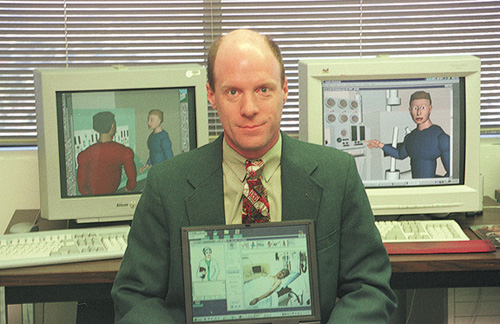
That's a picture of Dr. Lewis Johnson, the director of the Center for Advanced Research in Technology for Education, and one of the brains behind this project.