
I'm not the only who takes photos while doing education. As Instapundit reports, with this same photo, war correspondent Major John Tammes does it too. He's teacher.
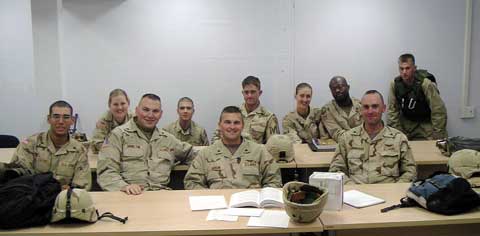
You may recall this Major Tammes edu-photo also.

I have been taking digital photography classes, and have already stuck up a lot (and I do mean a lot) of digital photos of this (and some spiel about it all) on my Culture Blog. Those were taken a fortnight ago. But then a week later I got a few more really nice ones, and I thought, what with it being education - teaching and learning anyway - I'd stick a few of the best up here. Click on the small pictures here if you want to see bigger ones.
At first all I wanted was a home for this lady …

… who is from Peru. She came out really well, I think.
But while I'm at it here are some pictures of the class teacher, André Pinkovsky.
André was at his most dispirited when trudging through the paperwork at the start of the course. He had to get us to fill in lots of forms to inform the local authority of what was going on so they could feel comfortable by having a stack of paper about it all. Necessary, I suppose, but about half of the first morning was taken up with this. When he got around to talking about photography he was happier. And when we got to actually play with our cameras and he could wander around just helping and encouraging us (reinforcing all those facts and concepts all the while) he was happiest of all. It helped at lot that last Wednesday was, I now realise, the last really nice and reasonably warm day of 2004. André's mood was, as I hope you can see, positively sunny. The one on the bottom right is included because I like the colouring, and despite the cropping, which is as it was in the beginning, I'm afraid.


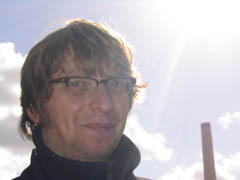

He does not completely look like Alan Rickman in Die Hard, but there is a definite resemblance, reinforced strongly by the fact that, like "Hans Gruber" if not Alan Rickman, he is also German. We tease him about this. He doesn't seem to mind. For in personality he is the opposite of Hans Gruber, very kind and very patient, and is willing to repeat himself, as often as we ask for it.
This is a particularly important quality for the kind of teaching he is doing, I think. Learning something of the fundamentals of photography from scratch, as most of us are doing, means becoming acquainted with a number of alien and interlocking concepts. Shutter speed. Aperture. Depth of field. And the point is that such things are not mere "facts". These are concepts, concepts that he wants us to internalise until they are part of our inner natures as photographers, and that takes time. Which is why they need to be repeated. On the other hand, lots of facts are also involved, and because there are so many of them, they too need to be repeated.
On its own, each fact – each concept even – is reasonably easy to learn, but there are too many of them for us to grasp everything first time around. When we might have been absorbing the next fact, we were still pondering the significance of – or simply trying not to be confused about – the previous one. So, we need reinforcement and confirmation at exactly the moment when we are attending to something. I do, anyway.
This, after all, is the problem with merely reading the documentation, or even reading helpful X-for-dummies type books. The answer to your particular question right now is usually there, but how to find it? And if you do, will it make sense to you, without you already knowing the answer to two other questions? A teacher, if he knows his stuff, can answer your exact question straight away, and if you don't understand his first answer, you can try again until you do, approximately speaking. And, when you forget it all and want to ask the same question again an hour later, you can, if your teacher is like André. In such circumstances the "But I've already told you that!!" style of instruction would be very demoralising.
One of the ways of remaining a good teacher, I think, is to subject yourself to teaching from time to time. That way, you are reminded of how it feels to be taught.
And since I am shovelling pictures onto my blog, I might as well shove up the best of the rest of the pictures taken that day.






As you can see, I like to take pictures of digital photographers, and that includes taking pictures of myself from a reflecting surface when taking digital photos, as is the case in the photo of the guy in the blue glasses.
Next lesson tomorrow. I leave it to you to decide if they are having any effect.
Sometimes the news you get about education through the wonderful world of the Internet is almost too overpowering to bear:
Truro: Adult education classes offeredThe following adult education classes will be offered in Truro this fall: Quilting, ceramics, Latin dance, Works on Paper, Spanish, yoga, Introduction to the Computer and Introduction to Pilates.
What are "Works on Paper" and "Pilates"?
On the other hand, if this really is what counts as news in Truro, it must be a pretty quiet place, so if what you want is a quiet life …
More local education news here.

The weekend before last I went to a party at Sandhurst. I have already written here about British army education, so I made a point of asking around amongst the guests about educational matters. I struck gold. I had two conversations in particular which I have kept meaning to report on here. Sorry for the delay, but I know that I can remember all the bits that matter.
Sandhurst, for those who don't know, is the place out to the west of London where they incubate the new officers of the British Army, and conversation one was with a Sandhurst history lecturer. I asked him what he lectured about.
The most interesting bit of his answer concerned his choice of historical campaign to describe for his students. He deliberately chose a losing campaign, the invasion of Russia by Germany during the Second World War, as viewed from and experienced by the German army.
He mentioned the way that the German army is renowned for the initiative and independence entrusted to and shown by its junior officers, but, he pointed out, all that changes when things go seriously wrong. Then, the people at the top exercise tight control, which all adds to the grief.
I like the idea that young officers are asked to think about what army life is like when things go badly wrong. This is, if you think about it, an indoor, classroom, version of what those sergeants shout at their charges out in the open air. Are you tough enough for all this misery?!? Because it is misery, you little …!!!
For some reason I found myself asking if he could always spot the future high fliers. He said he could spot them, but that he could never tell if they would fly high in the Army, or in Civvy Street. This strongly suggests that the education of British army officers is relevant to life generally, and not just to army life, right? Yes he said, that is so.
This latter proposition was spookily confirmed for me by conversation number two, which was with a guy who had worked for most of his adult life and still worked for Motorola, the US based (but worldwide in operations) portable radio company. The man I talked with, whose expertise seemed to be government regulation (a very big deal in the teleommunications trade, alas) explained that, just like the German army, Motorola's people are famous for the amount of creative freedom they're allowed. The atmosphere, he said, was "collegiate", rather than based on command and control. You could work for years with Motorola people, he said, and develop a profound sense of just how good they were, but still not know what their official position was in the official pecking order.
Until things go wrong, as they famously did when the tech-boom went bust just a few years ago. Suddenly – and the guy described it all very eloquently – the survival of the company involved making brutally harsh decisions in the space of a few hours, so fast did the orders collapse and the money start haemorrhaging out . Command was abruptly centralised. Hideously expensive outsiders, who knew how to do command and control, were hastily brought in. About half the worldwide work force of nearly two hundred thousand were fired, pretty much overnight. Bloody hell.
Since that traumatic time, forms of business expertise that Motorola had tended to neglect in the good old days, most notably marketing, were bought in, at further vast expense, but in ways that are, I am told, showing results. A friend in her early twenties with whom I attended the party later told me that whereas not so long ago Motorola portable phones were rather passé now they are "cool".
Get a load, as they say in the USA, of this guy, a teacher with a difference.
Fritz Kraemer, a refugee from Nazi Germany who tutored generations of America's leading generals in historical and geopolitical thinking, died in Washington on Sept. 8. He was 95.From 1951 until his retirement in 1978, he worked in the Pentagon as a senior civilian counselor to defense secretaries and top military commanders. His son, Sven, a Pentagon official, said that Mr. Kraemer's title often changed but that he occupied the same map-covered office from which he would be called on to prepare briefings, often on short notice, on such diverse subjects as political developments in Southeast Asia, economic prospects in China and French views on nuclear weapons.
But his influence on national policy was felt most visibly, perhaps, in a friendship he struck in 1944 when he was a private at a Louisiana Army camp during World War II. There, he met Henry A. Kissinger, also a private and another refugee from Germany, whom he helped guide toward a career that reached the highest echelons of government.
In cold-war years, long before Mr. Kissinger moved from Harvard to the office of secretary of state, Mr. Kraemer pursued his antitotalitarian views, participating in formal and informal seminars at staff colleges and within the Pentagon, where Donald H. Rumsfeld referred to him as "a true keeper of the flame."
He also developed close and mentoring relationships with many officers who either occupied or would rise to powerful positions, among them, Gen. Creighton Abrams; Gen. Alexander M. Haig Jr.; Gen. Vernon A. Walters, who later served as ambassador to the United Nations; and Maj. Gen. Edward G. Lansdale, the theoretician of counterinsurgency.
If you want to read all of it, hurry, because this is the New York Times, and that has a habit of disappearing behind all the usual barriers that all we bloggers hate.
There are those who say that Dwight D. Eisenhower was a less than perfect leader, and say, for instance that he could and should have finished matters in Europe in 1944-45 at a date nearer to 1944 than he managed to. Nevertheless … Supreme Commander Allied Forces Europe, President of the United States (for two terms). The man was clearly doing something right. Here's an explanation of what, from the book How To Be A Star At Work by Robert E. Kelley:
Harvard Business School professor Abraham Zaleznik, an expert on the mentoring process, writes about President Dwight Eisenhower, who had a mediocre record when he graduated from West Point. He seemed headed for a lackluster career as a lower-level army officer when, during World War 1, he was assigned to support duty at a desk job. Meanwhile, his classmates were on the front lines of the French-German border gaining valuable combat experience and winning battlefield promotions.After the war, it was Eisenhower who realized that if he wanted a distinguished career in the army, he had to find someone to show him how to understand the institution in ways he couldn't learn at West Point. So he sought out a highly respected commander, General Fox Connor, and requested a transfer to serve with him.
Eisenhower was fortunate that Connor warmed up to the mentoring prospect. The two men, Zaleznik notes, bonded like father and son-it was Connor who showed him the lay of the land in the army and challenged him to live up to the high expectations a mentor places in a follower.
Eisenhower later wrote that what he learned under Connor was "… sort of like a graduate school in military affairs and the hurnanities, leavened by a man who was experienced in his knowledge of men and their conduct." Eisenhower later won an appointment to the prestigious Command and General Staff School, where he graduated first in his class and launched his brilliant career. He owed it all, he wrote years later, to his mentor.
So okay, Eisenhower didn't learn how to finish world wars quite as quickly as he might have, but he certainly learned how to get great jobs.
I did a piece yesterday on Samizdata about the piece I did here about the training methods used by the British Army. And a comment has appeared there of just the sort I was hoping for, from "gearweasle", whoever he might be.
EDIP, Explain, Demonstrate, Imitate, Practice: another child of WWI 's Charles R. (Skipper) Allen's four step training method for training shipyard workers in the United States, and revamped in WWII by AT&T's Michael J. Kane (working for the US's Training Within Industry program).Kane's revamped method was Allen's four step method expanded to seven steps:
1. Show workers how to do it.
2. Explain key points, tricks, knacks
3. Let them watch you do it again.
4. Let them do the simple parts of the job.
5. Help them do the whole job.
6. Let them do the whole job -- but watch them.
7. Put them on their own.Anyway, the USA in 1940 had just realized it needed to begin production on a massive scale, and was going to have to train millions of people in war work, while losing millions of trained people to the armed services.
Training Within Industry, an advisory service formed by the National Defense Advisory Commission, developed eventually three training programs (JIT, Job Instructor Training; JM, Job Methods; and JR, Job Relations), which was well written about by Bird McCord in: Chapter 32: Job Instruction, in Training and Development Handbook 2nd Edition – a guide to human resource development, edited by Robert L. Craig, sponsored by the American Society for Training and Development, ISBN 0-07-013350-6.
The easy read of the "J" Programs is the 1943 Reader's Digest (US editions, sorry) series of three articles over the months of September, October, and November. Gives good feel for "how they did it", that is, how they trained the trainers to train the people who did the jobs, and how to train them how to look at the jobs.
And for a fascinating overview of what it meant to conceive and start up these gigantic coordinated industries – just for airpower – read General Henry Harley "Hap" Arnold's Global Mission. Wowser.
Postscript. Come to think of it, EDIP is only the JIT portion of the "J" Programs; they also worked on worker relations (Job Relations), and motion economy training (Job Methods).
Well, I don't know how many of us will be doing all that homework, but you do get a sense of the sheer power of the USA and its culture from that. I do, anyway. It may all sound rather impersonal ("human resource" development, etc.), but it's all part of the American dream. If they treat you as a human resource, they are at least treating you as human, which for a lot of people then was a big step in the right direction.
There has been argument here already about whether mere "training" has anything very much to do with the profundities that constitute "education". I say that training has a lot to do with education.
Think about how much is got across in the "training" that the gearweasle man describes. I don't think these guys (and girls) only learned how to fly (or build) an airplane, or to wire up a telephone exchange. I think they learned a whole attitude, a whole new confidence in their own power to get things done, things in general.
Okay, it all sounds a bit Big Businessy, in a bad way (in bed with the Government) as well as a good way (big because so well organised). But these guys were the people who took the USA from the Great Depression, through World War 2, to the deadlock in the Cold War that the next generation was able to turn into another huge win. And now we are witnessing this latest Iraq operation, which, whatever you think of its wisdom or moral justification, has been a miracle of coordinated human skill and savvy such as the world seldom witnesses.
Meanwhile, over at 2Blowhards, Michael has been taking art lessons, and isn't impressed.
I went to the first class last night, and was reminded of what a ripoff most art classes are. The woman teaching it seems nice and for all I know is a good artist, so I have nothing against this class specifically -- it seems like an OK version of the standard thing. It's the standard thing that's a ripoff (and that, in a sane art world, would be a scandal).
Last night's class, like about 3/4 of the art classes I've taken, followed this model: the teacher has set up a subject, whether a model or a still life. You bring a bunch of art materials with you. You draw and paint. The teacher wanders around, giving each person a little time and a few hints. You pack up and go home.Like I say: what a ripoff. It's amazing the schools charge for this, and just as amazing that eager students put up with it. Would it be too much ask an art teacher to do a little actual art instruction? To have a little something prepared? To structure a series of classes so that the bit you learn this week joins together with the bit you learned last week, and you leave the term having acquired some genuinely new skills, and able to do things you hadn't previously been able to do?
Seems like a reasonable thing to demand. So why doesn't that get supplied?
… I guess I assume that what it represents is a coming-together of four things: asinine progressive-education ideas (let the student discover art for himself!), laziness and convenience, the continuing-ed business, and annoying modernist (ie., anti-technique, anti-skill, pro-self-expression) ideas about art. Do you think I'm off here? Or that I'm missing some other element?
I see nothing wrong about any of that, but maybe I can add something.
Consider that bit I did here about the Army, and how seriously they set about their teaching. Or consider, for that matter, the example of another kind of teaching that Michael does consider.
… Imagine, say, a cooking school or a cooking class. Now, imagine showing up, being confronted by a roomful of tools and ingrediants. And a teacher who says, "OK, class, cook! Every now and then I'll come around and give you a little criticism and help!" I know I'd be pissed. How about knife skills? Poaching? Grilling?
Cooking - and I'm guessing here but it seems to me, etc. etc. – still retains some semblance of pedagogic rigidity, in the sense that "good" and "bad" cooking are widely regarded as being distinguishable. If you cook an omelette (one of the few cookery things I'm quite good at doing) for a minute or two and watch for when it is done and then dish it up it, you can get a very good omelette. Cook the omelette for half an hour and then give the ruins ten minutes in the fridge, and you will absolutely not get a good omelette. I don't know any omeletteer who would disagree about that. It would be wrecked. Get your cooking seriously wrong, and you might even kill people.
If the Army gets its teaching wrong, it will definitely kill people. They teach right, or people die. In such a world, the mind of the teacher is going to be concentrated wonderfully on doing the job a certain way, the right way.
But what they hell is the right way of doing art these days? The artists have spent the last hundred years trying to explain that there is no right way, that anything goes.
And the irony is that Michael Blowhard – with his exuberantly wide-ranging willingness to appreciate and to enjoy, and to pass on by if he doesn't enjoy with a mere "well it's not my thing, but if it's yours, then fine" – is now doing his bit to reinforce this atmosphere, as well as to undermine it somewhat by asserting his tendency to enjoy more traditional, that is to say artistic-skill-based, varieties of art.
I want techniques -- the "art" and "expressive" end of things I'll take care of myself. Or I won't. But I certainly don't want some teacher I don't know trying to take charge of that end of things. But techniques? I'm eager to learn, and I'll pick 'em up where I can get 'em. Yet the art-instruction establishment doesn't want to give them to me, or even, apparently, sell them to me.
When Michael says "techniques", he's not referring to the technique for writing outrageous press releases, or the technique for how to dress on TV in such a way as to cause maximum anger to the bourgeoisie. He means brushwork, etc. So does anyone teach this old-school art technique stuff? Still?
I stay "still?" because in my opinion another reason why anything goes in painting these days (can of worms opening warning force eight to nine) is that painting has, in terms of its contribution to the real-world economy out there, been pretty much replaced by photography. Painting's days of economic glory and artistic centrality are over. Anything goes in painting for the same reasons that you can, within the limits only of the criminal law, do anything you like in a bombsite.
Short second last paragraph. Big subject. Which I'll get back to, but mostly in another place.
The British Army is an organisation for fighting, right? Well, yes. But consider instead: The British Army is an organisation for teaching. And add: The British Army is an organisation for teaching people how to teach.
I asked my education-how-about-that? question (see posting below) to a friend of mine who is a British Army Captain. First, I got a big spiel about the decline of education in Britain generally. But then, we really got down to business, because my friend had a lot to say also about how the Army itself educates.
He started with "EDIP".
?????????
"EDIP" stands for: Explain, Demonstrate, Immitate, Practice.
First you tell them what you are going to tell them how to do. Then you show then by doing it yourself. Then you make them to do it. Finally you make them do it over and over again until they've got it as second nature.
That's what teaching in the Army consists of. But there's more. My friend then talked about how you, in general, set about teaching, about how you set up a lesson, about what you do before EDIP and after EDIP.
I need to look at my notes.
"Preliminaries, setting up – seeting plan – what are you teaching? – do you have all the kit you need?"
Before you launch in on the "explain" bit, where you tell them what you're going to tell them, you tell them why it matters, and why they personally will benefit from paying attention. Big picture, individual incentive. Incentive might mean a test at the end which they'll have ot pass. Fail and you have to do it again, etc..
After that you do EDIP, and then, at the end of the lesson, very important, you do that test. You check that what you thought you had taught them you actually did teach them. Failure to understand this distinction will risk many lives in very fraught circumstances. You have to be sure that they actually learned it.
And then finally, you look ahead to the next lesson and tell them what that's going to consist of.
Central to the Army ethos is that if you want to really learn something, there's no better way than to learn how to teach it. Thus, one of the first steps (not the final step as you might expect) in a major Senior Officer type career is that you become an instructor at somewhere like Sandhurst.
Second, although my friend the Captain made a great performance out of all this, he himself doesn't do that much teaching himself. He leaves that to his N(on) C(ommissioned) O(fficers), the Sergeants and Corporals who are the human backbone of the British Army and always have been. So in other words, the reason my friend is so fluent about How To Teach is that he has already been involved in teaching his subordinates How To Teach. Be an ace sniper by teaching sniping. Be an ace teacher by teaching teaching. The British Army is an organisation that teaches teachers.
Finally, if my prose has become somewhat excitable in this posting, this is because as soon as I started to write this I jumped back into the mood of the original conversation, which was also extremely enthusiastic and animated.
I had pushed a major Army button with this education question. I cannot promise that all of the above detail is exactly correct. I probably got important things somewhat wrong, and I can just about guarantee that I left important things out. But this I can tell you for sure. Asking a Captain in the British Army about how he sets about the business of teaching is like opening a window into his soul. To say that this is what he does, or what he thinks about a lot, is to underestimate it. This is what he is. This, minus all the state secrets that obviously can't be used by way of illustration, is it. This is the fundamental question to ask these guys if you want to know who and what they are.
Ask them about what fighting is like, and half of them don't know. The other half have no way of telling you, other than to refer you to certain books which hint at the reality of it. But ask them about teaching, and it's like uncorking a shaken champagne bottle.
I expect to be asking this question to many more teachers in the months and (who knows?) years to come, as and when I encounter them, and I expect many further fascinating answers.