
On Saturday evening I had supper with my friend and fellow Samizdatista Johnathan Pearce, and very agreeable it was too. We discussed many things, and one of the more interesting things we discussed was one of Johnathan's father's school teachers. Johnathan's father was at school just after World War II, and consequently found himself being taught by, among others, people who had just won the war.
He was apparently taught physics by a young guy, about twenty five years old then, who had, before taking up his post as a teacher, been a navigator in a Pathfinder Squadron. For those not versed in the details of how Britain's wartime bombers went about their grizzly business, the Pathfinders were the ones who went to the target first, and started a small fire on it, which all the bombers would then aim their bombs at. The combination of technical expertise and sheer guts needed to be someone like that is something at which most of us can only, luckily for us, guess.
And one of these young fellows was, as I say, Johnathan's dad's physics teacher. Young, obviously. But also, because young, very keen and energetic. In short, the very essence of Alpha Maleness.
Johnathan's dad goes further, and says it would be interesting to examine the impact upon education, not just of this one young man, but of all the other young men like him who, just after World War II, while still only in their twenties, entered the teaching profession.
Someone like this physics teacher (a) is going to know his physics pretty well, and (b) is hardly likely to be phased by a classroom full of exuberant and potentially rowdy and out-of-control schoolboys.
Now you may say that, now, things are very different, and even the most formidable of men sometimes have a problem keeping in control of classrooms, and I am sure that's true. But the exact chronology of this golden generation of schoolteachers, if that is what they were, is, I think, suggestive.
In particular, ask yourself when these guys stopped teaching. Assume that they were around 25 when they started teaching, fresh from their Avro Lancasters and their tanks and their ships and their Spitfires, and that they retired at around 65. So, add 40 years to 1945, and what year do you get? Well, you don't need much maths for that. The answer is 1985.
Now, 1985 is the approximate time when it is now claimed that education in Britain started to enter its most recent period of being very bad, and in need of much increased central control.
The usual explanation for educational decline, and most especially of decline in discipline and pupil behaviour, is … well, what? Nobody properly knows, other than to note that wider social forces, forces outside of schools, made a big impact upon schools and changed them for the worse. But just what did these "social forces" consist of? All sorts of things, of course, including television, the rights-before-responsibilities mentality encouraged by the welfare state, drugs, the immigration into Britain of some ethnic groups who behave very badly (although others behave extremely well of course), have been blamed for this decline. Other more immediate malign influences on schools have included: idiotic teacher training colleges, idiotic theories of literacy teaching, and, in general, all the stuff you read about here from time to time when I am in a complaining sort of mood. But how about this for at least a part of the explanation? - that during the 1980s a lot of extremely good and, so far as the wider life of the schools they taught in, hugely influential teachers retired, and were not replaced by teachers who were anything like as impressive, and especially not as impressive to young boys. How about that as part of the story of our nation's current educational woes?
Certainly, to judge by the TV adverts being shown by the government now, they would give anything for another generation of men of this calibre and experience of life to go into the teaching profession.
So, there's your answer, start another major war, and hope that a decent number of young men survive it and then, because of the depressed state of the post-war economy, become schoolteachers in huge numbers. Well, not really. But I still say that this is an interesting way of looking at the larger educational picture, usually scrutinised only through a microscope with a label on it saying something like "educational policy".
Here is a gratuitous picture of some Avro Lancasters and of some of the Alpha Males who flew in them and looked after them …
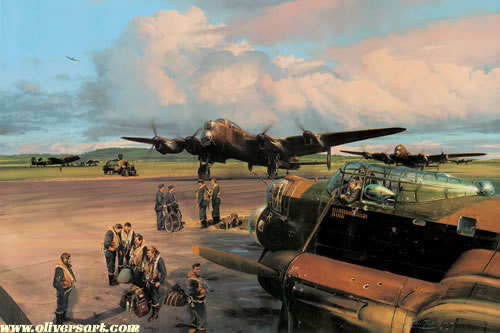
… which I found here.
Fear not! There are six (at least) ex Army lads in teacher training at Stirling right now. I have enjoyed my practical sessions as I have found, as you state, that there is little they can say or do that phases me - I've seen or done worse myself on a dark night in the Wanchai, Hong Kong (ahem!)
We feel like Michelle Pfeiffer at times in Dangersous Minds - waiting for the opportunity to practice our unarmed combat, hai karate a desk into two bits or something similar just to get them to sit down....
We do need more mature MALE teachers though. We are about ten on the course of 60 odd so well outnumbered by the girls.
The alpha male syndrome didn't only apply to males. My sister went to an all-girls school where most of the teachers were also female. One day one of her teachers - whose funny name and slight foreign accent the pupils had simply noted without curiosity, the way they do - was away. It emerged that the teacher was one of the guests of honour at a ceremony at the Dutch embassy to honour heroes and heroines of the Dutch Resistance. My sister was extremely impressed and saw this teacher with new eyes.
PS Grisly not grizzly, unless speaking of bears. Sorry. It's the teacher in me coming out.
Natalie: Sorry Mizz
dave t: Good for you and your army mates. Fascinating, and I'd love to hear more.
But it isn't just the fact of ex-services people going into teaching that interests me; it is the scale of this effect just after the war, and the huge variety of people who had just been through all those make-a-man-of-you, grow-up-fast experiences.
One of the big differences between Britain and the USA since the war is that for Britain, there have been wars, but they were mostly fought by relatively small numbers of specialists. The Americans have tended to fight wars (Korea, Vietnam, Gulf Wars 1 and now 2) involving many more Americans, and that has surely influenced(and will influence) American society profoundly - education, but also politics, business, everything. (It has, I speculate, and just as a single for-instance, done much to divide American politics into two ferociously quarrelsome camps such as we hardly now have in Britain.
In many ways, it's not just guys who've seen the elephant, so to speak. Any male(or person)who's been through the military and exposed to the wringer of tough discipline and deprivation of civilian comforts comes out a different individual.
The lack of male teachers in schools all over the world is an interesting phenomenon, and one of the most difficult tasks facing education ministries and private concerns alike is trying to entice more males into teaching. Unfortunately, the free market solution, increasing the benefits and/or pay for males would simply raise cries of discrimination from the feminists.
Even after so much government encouragement to get more male teachers here in Singapore, I still find myself somewhat outnumbered at the training institute(but I certainly don't mind the extra eye candy!). The ratio is something like 40% male to 60% female in the teaching population.
In general the same was true on the other side of the Atlantic. My civils/sex ed class teacher was of that generation. On the other hand, the math teacher from that generation was terrible. Neither had any trouble keeping a classroom under control. _None_ of the teachers I had in high school had that problem. For grammar school, I had nuns. No one -- no one! crossed _them._
In general, the US teaching profession tries to avoid male teachers. A friend of mine came back from Vietnam with his previous degrees in Pysch and Education and could _not_ get a job teaching. Even before the recovered memory scandals they were terrified of alpha males (Don tends to think of himself as liberal and sensitive, but he's very much an alpha type.). He went into the family business, and now writes SF.
The main problem we are finding as ex Army instructors is trying to get away from the old explanation-demonstration-imitation-confirmation techniques so beloved of the weapons classrooms and move towards the peer-assessment to aid learning type of thing. But then a lot of the techniques such as follow up, feedback and look forward to the next lesson etc are already ingrained into our teaching practice.
It is all very interesting - I would also point out that not one of the ex Army lads (plus one ex Army girl) has been picked up about classroom presence. The experience of teaching big hairy Jocks fresh from the wild night before to handle weapons safely obviously has its advantages!
I left school in 1966 and went to university. I most emphatically did not want to teach. However I noticed, even then, a tendency for some of my fellow school students, having failed to get into university to apply for what was then Teachers Training College - largely on the premise that it was better than working for a living and not that it was something they wanted to do. I would suggest that not actually wanting to do the job must have some impact on your performance.
One other factor which I think had a huge impact on school life was the raising of school leaving age from 15 to 16 in about 1976(?). This led to a lot of disgruntled 15 year olds (being taught in part by the people described above) who had been expecting to leave and suddenly had an extra year to do, just as they were at their adolescent worst. Effects like that take a long time to clear from the system.