
Today, in need of a little face-to-face guidance in the matter of my Paradise Primary activities, I rang the London headquarters. (I see two boys, twice a week for half an hour each, one-to-one, encouraging them to read, talk, be happy, etc.) I asked for Paul The Bo, but instead spoke to the equally helpful Lady Assistant. And it turned out that they had a refresher afternoon for volunteers this very afternoon. Would I like to attend that? I could fit it in, and I did. The gathering consisted of Paul The Boss and four volunteers, me included.
I found both the event itself, and the personal chatting with Lady Assistant on the phone, and then with Lady Assistant and Paul The Boss before the formal proceedings began, both useful and encouraging. Basically, they said, I need not worry too much about whether Boy Two is proving a bit of a "challenge". I should just carry on carrying on, doing my best, and it would almost certainly help, they said. Fine by me.
(Boy One seems to be doing very well, although as we bloggers often say: what do I know? You do your best and hope for the best, with VRH stuff as with so many things.)
From one of the other volunteers I learned that there is at least one way that I have things very easy, which is that I do my stuff in the same place in Paradise Primary every time. She has to duck and weave and find a free spot in her much overcrowded school, and never knows from one gig to the next where she will be, or where the kids will be that she is supposed to be helping. The school knows the problem but can do nothing about it. I just go in and am started within a couple of minutes, in the same place as always. Count your blessings Brian.
Apart from the somewhat tedious travel, which I have yet to get systematised properly, my only other complaint (a minor one) is that I have yet to develop much in the way of a relationship with the school staff. They are very kind and polite, but mostly they just let me in and let me get on with it. They often thank me profusely, but it's hard to tell how much difference I am really making in their eyes. Trouble is, they seem too busy for me to feel comfortable really asking them things, plus it probably doesn't help that I go there towards the end of the school day when everyone is probably eager to be off home, in circumstances of maximum excitement and confusion.
Paul The Boss suggested that if I looked at the Paradise Primary website (by the way Paradise Primary is not this place and nor is this its website) for future school events I might invite myself to, but I couldn't find anything.
Be patient, said Paul The Boss. In fact said everyone (every other volunteer having been at it longer than me).
Paul The Boss also advised that with Christmas approaching, any primary school is likely to be in a more than averagely fraught mood just about now, and that if I just keep showing up until the end of the term, with no fuss, that would be best. Leave all that developing-increased-contact-with-staff stuff until the new year, when things will probably have calmed down a little.
A most helpful event. Basic message from Them to Me: relax, be patient, you're doing okay.
The always useful Adriana (of this fame) emails with the link to this, the technical nuances of which I can't say I understand very precisely, which in its turn links to another posting, about a University … saying no to blogging as an educational technique. Right? (Or maybe just pissed off with an insubordinate subordinate. It all rather reminds me of this.)
This bit, however, I do understand:
… Ubiquitous networking and portable devices provide a backchannel environment that changes discussion in the classroom in a profound way. …
Any teacher who sells himself as the fountain of knowledge (rather than as a person who introduces his pupils to the fountain and gets them interested in it and drinking of it, without pretending to control it or to know all of it) is asking for trouble nowadays, and has been for many years, surely. I mean, surely this is problem that has been with teachers for as long as their pupils were able to obtain their own choice of books.
Nevertheless, the latest wave of electronics, which now makes information nearly ubiquitous, like oxygen, has altered the balance of power. To make sense of books, it helps a lot to have teachers who explain them. This electronic stuff now explains itself.
The last big lurch of this kind that happened that I can remember was when TV took off its black bow tie and went into colour, and when rock and roll got into its stride. But at least the clever ones remained dependent upon their god almighty teachers. But now here's this damned Internet, which is TV and rock and roll for the scholarly types, for the university students. Tellly and rock and roll destroyed the authority of the average school teacher type. Now, the Internet is destroying the authority of the average university professor type, whose interpretations and simplifications are now just a few among thousands that the clever student can access.
Portable devices have a particularly revolutionary effect on education, because pupils, who tend not to have fixed work places, so this turns the world into being totally computerised, having only a moment ago been not computersied at all. So portable computer power turns computers into a permanent threat to the "authority" of any teacher silly enough to regard them as an enemy, rather than as one of the objects of the whole exercise.
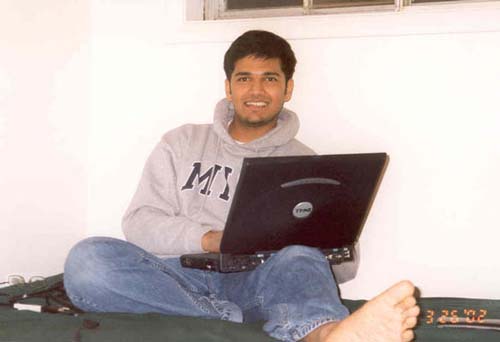
And blogs will also have particularly revolutionary effect on education, because they are the friendly front end of the Internet. Like a good teacher, they help you to find your way through the infinity of the information that is now out there. They are a threat to editorial writers of the traditional sort. And they threaten teachers who want to go on deciding what everything means on behalf of their pupils, instead of helping them decide for themselves.
Gratuitous pictures, of happy student above, which I found here, and of kid with laptop computer, being helped by a nice teacher, which I found here.
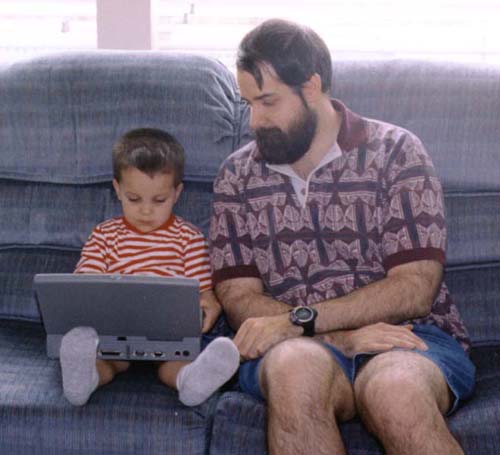
And, by connecting the kids to each other, never mind to the big wide world, networked computers are the ultimate note handed around at the back of the class, and as such another gigantic kick in the gonads for the orthodox teacher from whose sacred mouth and white-board all wisdom is still supposed to flow.
In sensing some of this, if it did, this university was definitely on to something.
This is very entertaining:
Ofsted, the government's education standards watchdog, has admitted that parts of an inspection report given to a top Birmingham school were copied from a report on another school more than 100 miles away.Lordswood Girls' School - judged in government league tables to be the best in the country for improving pupil performance - is planning to sue Ofsted after discovering that two pages of a critical review were identical to an earlier report on Parkside School in Bradford.
'When I realised my school's report contained judgments on areas that the Ofsted team had not inspected during their visit, I became suspicious,' said Jane Hattatt, the headteacher at Lordswood. 'I thought: "What would a stupid child have done if they wanted to pretend to have completed work they had not done?" [So I] typed key phrases into the internet to find where they came from.'
The fact that an Ofsted report contained inaccurate information from another school will be highly embarrassing for the institution. Parents looking for the best schools read Ofsted reports closely and a good report can lead to a school being over-subscribed. Bad reports can have the opposite effect.
By the look of things, this is a case of sheer incompetence, rather than of anything more malevolent. However, it's not the kind of thing you want from school inspectors, is it?
See also this posting here.
The Telegraph reports on an interesting, and if you are the worrying sort (as I am basically not), :worrying report about the rise and rise of stage schools:
Some of the most famous actors and actresses in Britain are warning parents not to send their children to stage school because they say that many provide poor training and exploit pupils commercially.The actors, including Richard Griffiths, Samantha Bond, Julian Glover, Paul McGann and Sam West, say that even children desperate to act would do better to complete a conventional education first.
The reason, they say, is that some stage schools are more concerned with making money than with teaching.
The actors' concern, which is shared by the National Council for Drama Training, has been prompted by a sharp increase in the number of full- and part-time drama schools catering for children, some as young as four.
An obsession with fame and popular culture generated by television programmes such as Big Brother and Pop Idol has been cited as one reason for the increase in the number of courses, and some schools have their own theatrical agencies. The theatrical directory Contacts 2005 lists hundreds of full- or part-time children's courses at fees of up to £7,000 a year.
Sam West, who starred in Howard's End and the BBC's Cambridge Spies series, said that many schools were little more than "glorified modelling agencies" which, at best, were interested only in children who would look good on television and could make it as presenters.
I wonder. Isn't the underlying truth here that almost nobody, statistically speaking, makes it as a successful actor, so no matter what you do to become an actor it will probably fail, and the more people try this, the more true this will be.
So the big question becomes, is actor training a worse education than "conventional education", and I'm not persauded that it's any worse. We are constantly bombarded nowadays with the claim that our economy is becoming less about making things and more about "service", and that's because it's presumably true. And is not "service" a lot to do with presenting yourself to others – audiences you might say – in whatever way will be most appreciated. Trade after trade nowadays, it is constantly said, is "all about presentation".
I reckon all those little failed actors might turn out to be just as useful as all the failed Sam Wests who now roam the earth, with their heads full of drama texts and just bursting to write essays about everything, of a sort that only other essay writers want to read, and not many of them because they are too busy writing their own essays?
I also think that there is a lot to be said in favour of children being exploited commercially much more than they are now. It's called work, and I think children become insufferable little drones if they do not do any of this. But, if they do do work, they ought to be paid, i.e. "exploited".
For many children, might actor schooling not be just a way to avoid the grind of regular education and to do something fun instead? This Telegraph report certainly suggests that there is great enthusiasm for these places. Also, it is probably better exercise, something which conventional education has been doing huge damage to in recent years.
More generally, I wonder what impact all these actor schools will have upon the wider culture. (Think about the impact that art colleges have had, for example on pop music. These are similarly useless places on the face of it.) What sort of things does actor training prepare you to do, assuming what you do will not be doing much in the way of normal acting in theatres, films, etc.? In the future, there will surely be entire new industries as yet undreamed of, that will make use of all these ever more widely dispersed drama skills.
For instance, what happens to global culture when it becomes as easy to converse on television, so to speak, as it now is to converse over the phone? Actor training will be quite a good preparation for that. As more and more of everyday life becomes like a performance, actor school alumni may actually find themselves at a competitive advantage.
Perhaps all these actors will fan out across the globe and become English as a Foreign Language teachers. Quite good ones, I mean. Teaching Indians and Chinese how to to TV telephoning to the white Anglosphere.
Just a few thoughts, from a useless essayist.
Nice school:

Shame about the knifing.
More about music teaching:
Scientists have discovered an unusual tip for parents who want their little darlings to grow up to be musical geniuses - teach them Mandarin Chinese.Psychologists at the University of California in San Diego found that children who learnt Mandarin as babies were far more likely to have perfect pitch - the ability to name or sing a musical note at will - than those raised to speak English. Perfect pitch, though common among the great composers, is extremely rare in Europe and the US, where just one in 10,000 is thought to have the skill.
Diana Deutsch, who led the research, believes the explanation lies in the different use of tones in the two languages. While the meaning of English words does not change with tone, the same is not true for Mandarin and other tonal languages, such as Vietnamese, Thai, and other Chinese dialects.
For example, in Mandarin, the word ma has four meanings. Depending on tone, it can mean mother, horse, hemp, or be a reproach.
Interesting. Which by the way is another word that means lots of different things, depending on how you say it.
Jessica Duchen writes:
… I'm working on a piece for BBC Music Magazine's education issue comparing the merits of different types of schooling for budding musicians in Britain. I've talked to 5 musicians so far and am about to talk to another 2 or 3. So far, the following points have leapt out at me:1. Nobody under the age of 35 has yet had a good word to say about music provision in UK state schools.
2. Most of the musicians who went to a conservatoire say that they regret not having gone to university.
3. Most of the musicians who went to university said it was very, very hard to combine academic work with enough practising.
4. Private education at a good school today costs an absolute fortune, even if you win a 'music scholarship'.
I'm reaching the conclusion that what counts is really only your personal fibre. If you've got the guts and the determination, it doesn't matter where you study. All these places are getting it wrong in their own sweet ways. Self-reliance is the only possible answer.
So: all schools are rubbish, and only if you put yourself in charge of your own education have you much of a hope of doing what you want successfully, and only then in spite of whatever school fate has dealt you.
Sounds about right.
This is certainly true: that pupils who have a sincere desire to be something they are willing to tell you about are a whole hell of a lot easier to teach than the ones who, when asked, shrug their shoulders and say, whether sincerely or just because they think it's none of your damn business: "Don't know."
 Here is Harry Hutton's latest Killer Fact:
Mussolini was expelled from school for knifing one of his classmates. He went on to become a primary school teacher (Mussolini, not the classmate).
Indeed he was (although I cannot verify that it was a knifing of a fellow student that broke the disciplinary camel's back) and indeed he did.
It's off topic somewhat, but I really do admire Harry Hutton's blogging a lot. It's not hard to get and to keep the attention of readers when you already are famous. His writing, it seems to me, is a model of how to use blogging to get famous, although perhaps he already is famous and I hadn't noticed. His postings are terse and to the point. No attention is presumed upon. I think my own blogging style may now be being influenced by him. If so, good.
I recently hailed Scrappleface's new book. Someone (maybe Harry Hutton himself if all others fail) should do one of Harry Hutton's best bloggings.
Harry Hutton has been a teacher for quite a long time, and many of his more penetrating postings are on educational themes.
Category: Blogging • Famous educations • The reality of teaching
 [1]
[0]
[1]
[0]
Yesterday I visited Paradise Primary again, and this time I tried something different. I dressed well. Smart suit. Smart shirt. Tie. A new pair of shoes. The idea was to make my two charges more biddable, to impress them. I remember reading, somewhere, that what determines the behaviour of boys in a classroom is not what the teacher does in the class, but what the boys perceive the teacher to do outside the class. What counts is the perceived position of the teacher in the pecking order out there in the big, wide, bad world. Dress better, and you look more important in this world, and hence to the boys. Ergo, they pay attention to you.
Whether it was coincidence or causation, the boys were more biddable. Boy One even asked me about my smart clothes. Why are you wearing such smart clothes? – he asked. Because I am doing something important, after this, I said. Not that this isn't important, I added hastily, but this other thing is, you know, really important. So how about we do some reading now, Boy One? Okay, says Boy One, and we do.
Boy Two also submitted to some reading.
I don't want to give them more informative nicknames than this, because I don't want to impose my expectations upon them, and nicknames are bound to embody expectations. The One and Two thing is strictly a matter of chronology. Boy One goes first, then Boy Two
Later, I had another look at the Volunteers' Handbook, and it seems I can relax about whether we do any actual reading or not. Playing games, drawing pictures, which is what I have actually been doing with them a lot of the time, and generally establishing a relationship, is quite sufficient to start with. I am tempted to scoff and am sure that some of the readers of this may scoff, but then I think, these people do know their thing, and have had a lot of experience at it. I shall be guided by their guidance, and will relax about us having to do reading every time. I may even read them the bit in the manual where it says we don't have to do any reading. This may amuse them, and get them thinking about the uses of reading.
Next time, I will try dressing down to my usual standard, and see what difference that makes. If they refuse to do any reading, what with me so dressed down, I now know that this doesn't matter.
GEM has been mentioned here before, although I think I called it Gems before, which is surely wrong. Anyway, now here's a BBC report about their expansion in England:
The largest chain of private schools in England has bought into the state sector for the first time.Gems – or Global Education Management Systems - has taken over a group set up to turn around failing state schools.
It recently took over a chain of independent schools, offering what it calls a cheaper, "no-frills" approach to private education at its 13 schools in England.
The company, set up by a Dubai millionaire, has 50 schools worldwide.
It is taking over a non-profit company called 3E's which was the first private firm to be awarded a contract to open and manage a state school.
3E's was brought in to set up Bexley Business Academy in Kent and has a 10-year contract from Surrey Council to run two schools in the county.
It was originally set up as a subsidiary of the successful and oversubscribed Kingshurst City Technology College, Solihull.
A new profit-making company, 3E-Gems Ltd, has been set up to take over 3E's' existing work and bid for other contracts in the state sector.
A trust is being set up to put some of the profits back into the education sector, it says.
Any mixture of state and private sector activity can go awfully wrong, with the private sector only making the state more efficient at churning out the wrong things. Nevertheless … interesting.
And that may be your lot for today. Today it is a Paradise Primary again (before which I have many other things to attend to), and after that I will be socialising. Don't you just hate it when you have a life? It gets in the way of blogging something terrible.
Francis Gilbert, a here at BEdBlog, has this to say about Charles Clarke's latest policy initiative: Lancel Hendricks.
Gilbert writes so well that it is hard to pick out any few key paragraphs. They're all key paragraphs. The gyst of this Telegraph piece is that Mr Clarke's new policy says that schools must include badly behaved boys like Lancel Hendricks, no matter how badly they behave. But Gilbert taught Lancel Hendricks and knows from experience that forcing Gilbert to teach Lancel Hendricks was a recipe for disaster for all the other pupils in Gilbert's class.
 Solid evidence of whether or not educational standards are actually declining is hard to come by. Here is some though:
The John Barras chain of public houses is installing calculators beside its darts boards. Declining standards in mathematics have left younger players unable to do the sums, the chain claims.
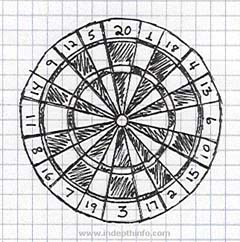
This is quoted by Giles Smith, at the top of an article about "darts education". (Gratuitous darts board picture there, drawn on maths type paper!) Smith then cracks a lot of jokes which I quickly got bored with. I preferred the other quote he stuck at the top, from darts champion Phil "The Power" Taylor:
Darts is fantastic for honing your maths skills. They should introduce darts calculations into the GCSE maths syllabus.
… although, like so many, Phil "The Power" Taylor jumps from "X might be a good idea", to "X should therefore be compulsory". But this habit is an educational defect shared by many more persons than Phil "The Power" Taylor.
I planned to have only one posting today, and I always try to avoid the USA, what with there being so many USA education bloggers covering their stuff themselves, but this BBC story is too good to miss:
Are pupils at the world's first "gay" state school victims of segregation or symbols of progressive thinking?The majority of pupils at Harvey Milk High School in New York are gay and were bullied at their previous school for their sexuality.
Harvey Milk refuses to be classified as a "gay school" even though that is the general perception of it from opponents and supporters alike. But it says its unique brand of segregated education fully deserves its public funding.
It says it provides for a small population of victimised and bullied pupils who are made to feel so freakish in mainstream high schools that they are falling behind in lessons, too scared to go to school and missing out on a proper education.
I am strongly inclined to favour that most extreme form of segregation that consists in children only going to schools they like going to, and teachers only teaching children they liked teaching. If that happened, segregation of all kinds would probably flourish.
So, this strikes me as a quite big step in the right direction. It insinuates a Political Incorrect (i.e. correct) idea into the minds of people who are otherwise only capable of thinking Politically Correctly (i.e. incorrectly). Good.
At its heart is the entirely correct idea that the answer to bullying – the only answer if you rule out punishment of bullies violently enough to make them desist – is to separate bullies from their victims.
Dramatic survey news:
Britain will be left out of a major international survey of education standards because the government did not provide enough information.
Very wise.
Emily Yoffe has a piece up about her learning to shoot, and Instapundit quoted, among other bits, this bit:
So anathema are guns among my friends that when one learned I was doing this piece, he opened his wallet, silently pulled out an NRA membership card, then (after I recovered from the sight) asked me not to spread it around lest his son be kicked out of nursery school.
I spent yesterday afternoon with my two young (male) Paradise Primary customers spelling out words like SHOOT, BANG, ZAP, etc., in big capital letters (and also doing such things as combining the two Os of SHOOT with a front-on picture of a double barrelled gun held by a mad monster), which they thought most satisfactory.
Once again, I have a busy day today, busier than I had anticipated, so again, not much to say. Please blog quietly amongst yourselves, or read your books.
Busy day today, Volunteer Reading Helping at Paradise Primary, and then out again this evening.
This was the most interesting thing I was quickly able to google to. It begins thus:
Research has failed to establish whether increasing education levels drive economic development or whether economic development affords improved education.
Quite so. Rich men's wives have diamond necklaces. So get rich by buying your wife a diamond necklace. Well, I can imagine circumstances in which this just might work.
But goodbye for today. More substantial fare tomorrow, I hope.
 Sean Gabb's latest Free Life Commentary, Number 128, is up. It is an uncompromising attack on the entire principle and practice of State Education. Sean describes the present mess, and concludes:
The only answer is to get the state entirely out of education. The education budget should not be expanded, or its administration reformed. It should simply be abolished. That £49 billion - now, I believe, £63 billion - should be handed back to the people in tax cuts; and these should be directed at the poorest taxpayers. The schools should be sold off or given away, and the bureaucrats be made redundant. The people should then be left to arrange by themselves for the education of their children.The argument that parents would not or could not do this falls flat on any inspection of the third world, where parents make often heavy sacrifices and choose often highly effective schemes of education. There is also the experience of our own past. A generation ago, E.G. West showed how growing numbers of working class people in the 19th century paid for and supervised the education of their children. The beginning of state education in 1870 should be seen as ruling class coup against an independent sector that looked set to marginalise its legitimation ideology. And that reaction was promoted on the basis of fraudulent statistics.
Left to themselves, it is inconceivable that parents would not do substantially better than those presently in charge of state education. How they might do this is for them to decide. Some would pay for a conventional independent education. Some would send their children to schools run by their ministers of religion, or by charitable bodies. Some would educate their children at home. Many do this already, by the way; and Paula Rothermel of Durham University caused a stir in 2002, when she looked at a sample of children educated at home and found they performed consistently better in standard tests than schoolchildren - indeed, she found that the children of people like bus drivers and shop assistants were receiving a better education than those committed to the care of state-certified teachers. Parents could hardly do worse than the present arraignments manage. They could easily do better.
This is not a "left" or a "right" wing cause. It is about allowing children to get an education which is not directed to moulding them to believe as suits the convenience of their betters, and which really will enable them to make the best of their own lives.
Such are precisely my opinions. The only reason I do not belabour my readers here every day with such views quite as relentlessly as I might (aside from the fact that this would make this blog even duller), is that opinions is all that they would be, coming from me. I have very little direct experience of what Britain's education system is like in reality (although I am now beginning to acquire it). Sean Gabb, on the other hand, has taught for the last several years in one of the less stellar (i.e. not one of these) of London's universities, and daily confronts both what the products of Britain's state education system are like, and, equally important, how those products compare with the products of the education systems in other countries. When he compares, for example, the English fluency of young English people with that of young African people (as he does earlier in this piece), he has actual direct knowledge on which to base such comparisons.
On the other hand, Sean has been an uncompromising libertarian for just about as long as I have know him, and this is a case of prejudices refined and informed, rather than merely deduced from his relatively recent day-by-day experiences as an educator. Sean, like me, is predisposed to judge state actions to be, on the whole, bad, and the actions of free people to be, on the whole, good. Some would say that such prejudices render our particular views on education nearly worthless. I would say (and I'm sure Sean also) that if you do not have such prejudices, you should.
As for the Department of Education, I'd like to see an experiment: let the position go unfilled for four years and see if it has any impact on the educational abilities of the nation's youth. I'm guessing no one would notice if we didn't have a Secretary of Education. Everyone just keep on doing what you’re doing, and get back to us.
Same here. But teachers and schools here would definitely notice. Suddenly, the only initiatives and shake-ups would be their own.
My good friend Adriana has emailed me about a blog posting entitled BLOGs: are they the new holy grail in education?, which has obvious Brian's Education Blog relevance.
It is the work of an academic at something called the European Center of Knowledge Management. At one point he uses the phrase "sustainable development" without any sneering. Personally, I think that the only sustainable development worth a damn is a series of unsustainable developments laid end to end. Also, his commenters (his students – I'm guessing) get into the usual guilt-ridden flap about whether the Internet increases inequality. Answer: make internet connections even cheaper, and even less dependent than now upon complicated and unguardable fixed infrastructure. In other words, let capitalism carry on moving rapidly in the direction which it is now moving rapidly in anyway.
But, these ideological complaints aside, this is worth a look, if only to learn about how blogging is getting around, and how all manner of people are sensing that they could use it too. The comments are particularly good for sampling that particular atmosphere.
This, for me, was the most interesting paragraph:
Today, more than ever before, I am convinced that virtual learning has a bright future, particularly since it allows each and every learner to develop his own learning path, fully adapted to each individual's context. At least that is what virtual learning is able to do, which does not automatically mean that all what we call today e-learning fits this definition. Well designed virtual learning allows for diversity in learning, eventually allowing almost individualised education. In order to develop more accessible educational facilities in deprived regions or amongst the less fortunate, virtual learning has a huge potential.
I think he is quite right about the way the Internet individualises education.
The comment thingy is, as of now, and as helpful emailers have pointed out to me, refusing to supply a Turing Number, only a red cross.
This is, I am told by my Blog Software Guru, being attended to. He doesn't think it should take him long.
English language triumphalism from Paul Johnson in the latest Spectator.
The new world is going to be a world of three Great Powers, China, India, and The Anglosphere, with Continental Europe (France in particular) going nowhere, and with the English language carrying all before it.
An EU report says that French children are falling behind in their English lessons:
What seems to have impressed the commissioners is that French youth is slipping behind other EU countries in its ability to understand English, actually regressing in the years 1996–2002. By contrast, the Spanish, traditionally monoglot, are moving ahead. Under a 1990 law all Spanish children are now taught English from the age of eight, and in some regions from six. In the Madrid region there are 26 bilingual schools and colleges in which courses – with the exception of Spanish literature and mathematics – are taught in English. By 2007 there will be 110 such establishments.Mr Raffarin, the French Prime Minister, accepts the logic of the Thélot report and will implement it. Mr Chirac, of course, being 'anti-Anglo-Saxon' to the bone, countered with a high-minded plea for cultural diversity. 'Nothing could be worse for humanity than to move to a position where everyone speaks the same language.' Really? Come off it, Jacques! While France hesitates about what to do, the Indians are in no doubt. The wisdom of Macaulay in pushing the spread of English during his spell as a legal adviser in India is now being endorsed by events. As India emerges as a major economic power, several million Indians are now finding English speech essential – indeed, among the vast numbers employed in outsourcing, it is their livelihood.
This is the kind of grandiose world-view prophesy that has a way of being overtaken by events. What if India and China both break apart (China in particular well could) and the relative political stability of Europe suddenly looks a better bet than its senescence and resulting plummeting birthrate (of which Johnson makes much) does now? What if the high hopes now being placed in the Anglosphere come to little? I like the idea of having thoughts like this nailed down in a posting, so that I can look back on them in a few years time and see how true they really were.
On the other hand, I think that this continental news site – which I commented on last night at Samizdata, at which, at some point not so long ago, they decided to do an English offshoot as well, thereby multiplying many times over their potential readership – may be yet another sign of the times we now live in.
For decades, English speakers haven't had access to Europe's leading newsmagazine. DER SPIEGEL and the award-winning Web site SPIEGEL ONLINE, with their second-to-none news coverage, rich story mix and clear, sharp European view, were obscured by an unbreachable language barrier.Until now.
Indeed.
Tangenting somewhat, but on general topic of this blog, the page of Spiegel Online that I linked to from Samizdata also has, if you scroll down, references to headscarf bans in Germany and a Neo-Nazi teacher in Bavaria who has been resigned.
Co-education may be natural but that doesn't make it good, says Cynthia Hall, head of an independent girls' school in Oxfordshire.
From the BBC:
Mrs Hall is headmistress of the School of St Helen and St Katharine in Abingdon and current president of the GSA, which represents 200 independent, single-sex schools in the UK.She told its conference: "It makes me mad when I hear heads of co-ed schools dismiss single-sex education with the comment that the co-ed classroom is natural, as if being natural is all the justification one ever needed for anything.
"I believe that most girls benefit enormously from being in a single-sex environment during their school years."
A survey published by the association found that 90% more of its schools' girls chose physics or chemistry at A-level than in all schools nationally.
Mrs Hall said girls' education could suffer when they were taught alongside boys.
"In the teenage years, when girls are finding out who they are, the ability to camouflage in order to fit into a given environment is a highly perilous quality for girls," she said.
"It particularly makes them vulnerable to verdicts of others about their own incompetence."
"These years for girls coincide with the equally important years for boys in which they are testing out their strength, voicing claims they cannot yet deliver, seeing how much they can dominate the world around them."
From later in the same report:
A 2002 study by the National Foundation for Educational Research suggested girls in single-sex comprehensives achieved better results than girls in mixed schools, especially in GCSE science.It also suggested separate schooling particularly benefited those at the lower end of the ability range.
… which makes sense. If you're at a co-ed school, you can cheer yourself up for being bad at school work by impressing the boys. No boys to impress, and exams, work, etc., are the only game to play.
Alan Little, a Yoga enthusiast (and regular BEdBlog commenter – I particular like his most recent one here), links to some Yoga pictures. Always on the lookout for gratuitous pictures for here, I explored.
I know I shouldn't mock, but some of these pictures cry out to be the basis of a caption competition, my favourite one for these purposes probably being this one, although it's a tough call:

Seriously though, these pics do give you a much better idea of what Yoga at least looks like, when performed by highly qualified Yogans.
The guy in the blue shirt doesn't seem to be doing very much in any of the pictures. I'm guessing he's there in case any of the performers ties him/herself – shoelace style – into such a tight knot that he/she needs emergency help getting untied.
The other thing that struck me about this demo is the splendour of the new building – the Yashasvi Wedding Hall in Mysore – in which it is being given. Anyone who thinks India is still only dust, poverty, and big white cows with huge horns meandering about slowing everything down from very slow to even slower should update his ideas. And since I was "struck", I guess that has to include me.
Jeff Jacoby writes, of Arafat the monster:
Perhaps his signal contribution to the practice of political terror was the introduction of warfare against children. On one black date in May 1974, three PLO terrorists slipped from Lebanon into the northern Israeli town of Ma'alot. They murdered two parents and a child whom they found at home, then seized a local school, taking more than 100 boys and girls hostage and threatening to kill them unless a number of imprisoned terrorists were released. When Israeli troops attempted a rescue, the terrorists exploded hand grenades and opened fire on the students. By the time the horror ended, 25 people were dead; 21 of them were children.
I recall a comedy show once where there was a gag about someone nasty who had died, and they said: "Doctors describe his condition as satisfactory."
Or to put it another way …
This story reminded me that a century ago, one of the greatest criminal minds of the time was Professor Moriarty, Sherlock Holmes' great antagonist.
A criminal gang of professionals and academics led by a Sicilian professor defrauded the European Union of millions of pounds in a fake youth training programme, Italian police claimed yesterday after a string of dawn raids across the country.Among those arrested was the ring's alleged mastermind, Prof Salvatore Messina, 51, a Sicilian academic with the Université Paris 13 in France, who also lectures at the University of Palermo.
So what subject did Professor Messina … profess? Ideally, he would be some kind of (im)moral philosopher, of the sort for whom crime is merely the revolutionary impulse of a repressed class, in this case the professor class, striking back against late capitalist hegemony. Nothing so elevated, I'm afraid.
Prof Messina is president of the Permanent Observatory for Tourism in the Mediterranean (OPTM), and edits a quarterly entitled Sicilia, L'isola del Tesoro, (Sicily, the Treasure Island) which the OPTM publishes. The other six arrested were all described as being in Prof Messina's entourage, including a former assistant in Sicily's regional department for professional training.
Treasure Island! No doubt this magazine title was one of the clues that told the Italian police that they were onto something.
As higher education becomes bigger and bigger business, we can expect more stories like this, I fear. My hearties.
There is a fascinating piece in the Telegraph about a course that cures stammering:
In August last year, I attended my first session of the McGuire progamme, an experience I can only describe as liberating. The main focus is on learning a technique called "costal breathing". It involves using a different part of the diaphragm – the muscle below the lungs – to generate a deep, full breath, generating the power to push out the words.What makes the programme distinctive is that it is a speech therapy course run for stammerers by recovering stammerers. This creates a sense of honesty and trust: everybody in the room knows everybody else's biggest secret.
At the end of each course, all the students make a speech in front of hundreds of people. Difficult enough for most non-stammerers, this is a test of nerve, composure and technique. When I stepped down from the platform, the feeling of elation – the freedom of finally being able to express myself fully – was overwhelming.
This is how singers and woodwind players are taught to breath, if I am not mistaken.
Link to the McGuire Programme website here.
And here's another political row (see also this earlier posting) being fought out on the terrain of school history textbooks, this time the one between Taiwan and mainland China. China View says that Taiwan and mainland China share a common history, which is true. But China View stirs this truth in with the claim that therefore Taiwan simply cannot in the present or ever in the future be politically independent from mainland China, which is false.
I think a lot of the success of Lego is that when you read a report like this you don't only think: blatant marketing.
SINGAPORE : Southeast Asia's first Lego education centre opened in Singapore on Thursday.It features not only a galore of Lego blocks to teach basic physical science to pre-schoolers, but also a Mindstorms programme – which allows students to build robots - using the principles of mechanics.
The centre will cater to students from pre-school to teens and has tied up with local education provider Crestar to offer seven different curriculums ranging from design to physics.
So far, an estimated 800 students have signed up for classes which begin next month.
Four more centres are expected to be launched by 2007. – CAN
It is blatant marketing. Get them young, build brand loyalty, get them addicted. Yet despite all the obvious commercial calculation, this is not like getting kids addicted to potato crisps or hamburgers or rap music videos. Here, you feel, is a case where commerce and education, as claimed, really do go hand in hand. They really might be teaching some real design and some real physics here.
 As I ruminate upon education, I find myself attracted by a topographical model of education involving intersecting circles, like those diagrams they use to explain how the different colours come together to make TV work. There are three circles. These denote: the interests of the child, the interests of the child's parents, the interests of the child's teachers. When a proposed item of education occupies none of the circles, no worries, it just doesn't happen. When it occupies only one of the circles, there is conflict. When it occupies two, the third party tends to get bullied into line. The child has to do it, the parents have to put up with it, or a teacher is found who will provide it. Best is when all three areas overlap.
This Lego thing has the feel of being in all three circles. Your first reaction might be: this is only in a completely irrelevent fourth circle occupied by those dubious individuals who hover on the outside of education looking to further their own interests but to make nothing but trouble for children, parents and teachers. Junk food salesmen, sex fiends, etc. But here is a hoverer who has parachuted himself right into the middle of the intersecting circles.
Which of course makes it very clever marketing.
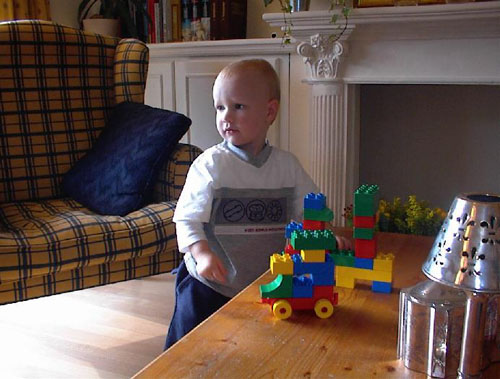
I found this Lego picture here.
From time to time I purchase a copy of the news digest magazine, The Week (although I'm afraid that link is only to puff telling you to buy it in paper form), and thanks to the November 6th 2004 issue I learned about an Asia Times article from last month about a toxic textbook which is being distributed in Japanese schools.
Says The Week, in its summary of this article:
If Japan, unlike Germany, has always been reluctant to take full responsibility for its crimes during the Second World War, says Tang Liejun, at least it used not to deny them. But that's what's being attempted in a new history book being distributed in Japanese schools. Far from acknowledging the rape and pillage carried out by Japanese troops, this "toxic textbook" insists Japan invaded its neighbours to "liberate" them from Western imperialists and to "bring prosperity to their peoples". By persisting in regarding this as a hostile occupation, China, Korea and other Asian countries show rank "ingratitude", the book complains. It calls into question the Nanjing massacre, in which Japanese soldiers raped and murdered 200,000 civilians, and fails even to mention the hundreds of thousands of Korean and Chinese "comfort women" forced into sex slavery for the invaders. We've given up expecting contrition from the Japanese, but this "ennobling" of their past barbarism is completely unacceptable. It might spare their children some "pain and guilt", but in the long run it will only perpetuate the hostility towards Japan felt by so many of its Asian neighbours.
The Asia Times article includes this quote from the book:
"It seems that up to now Asian people still mistakenly regard Japanese as invaders, [but they] risked their lives and cooperated closely with weak or strong peoples in Asia in fighting the Western big powers in order to advance the worldwide colonial liberation movement; Asian peoples' equating of Japanese with the Western imperialists is totally ungrateful and against morality, [since it was the Japanese] who came to their help and inspired them to get independence."
I know I keep banging on about the Internet and its effect on education, but it does seem to me that the Internet is bound to have an effect on little nationalised intellectual ghettoes of the sort that this textbook is trying to perpetuate and strengthen. As Tang Liejun says, the Japanese may never apologise, but it seems unlikely that it will be possible to keep them in universal and permanent ignorance of what it is their Asian neighbours are saying they should apologise for. They are bound at least to learn that their neighbours see things differently.
The BBC reports on a fairly typical piece of public sector failure, in this case of the inelegantly named UKeU. See also these earlier BBC reports, here and here.
The basic problem seems to have been that the people running this thing thought that a good educational idea (even assuming that this is what it actually was which it probably wasn't) is enough for the whole wants-to-be-educated world to come pounding on your door. But, in business in general, and most definitely in education in particular, there is a little thing called reputation. You have to have one of these, it has to be good, and it can take a while to establish it.
And the other problem, of course, is that shovelling stuff onto the internet and exchanging emails with students is no longer rocket science, and is being done by other universities. As Americans would say: wow, never saw that coming.
The attitude of the Minister who inherited this mess reminds me of those comedy sketches about maintenance men who say "Who installed this then?" when the answer is: "You did, mate." You, as in this government. You set it up.
Current Minister Howells says that the "marketing" was poor.
However …
... he would not call the failure of the project a disaster because he was interested in the lessons learned.
Ah. A learning experience.
Category: Computers in education • Higher education • Politics
[0]
[0]
This has obvious educational implications, especially in an age of rich and competitive parents. (See the posting below about which are the world's best universities.)
Some neurologists recently have wondered whether their field is the next frontier in elective medicine. The specialty now tries to protect ailing brains from conditions such as Parkinson's disease or migraine headaches. But doctors' efforts one day may extend to normal brains."This is coming, and we need to know it's coming," said Dr. Anjan Chatterjee of the University of Pennsylvania.
Got you, Doctor.
As he envisions it, cosmetic neurology one day could mean not only sharpening intelligence, but also elevating other dictates of the brain – reflexes, attention, mood and memory. Studying for the SAT? Take this drug to retain more of those pesky facts. About to report for duty at the fire station? These pills will improve your reflexes. Here's the 800 number. Ask your doctor.These are not only theoretical musings. Last month in the journal Neurology, Chatterjee noted that some current drugs already may have many of these effects. In one study, for example, emergency-room patients given a memory-altering drug appeared to be spared some symptoms of post-traumatic stress. Another small study of pilots in flight simulators suggested that those taking medications for Alzheimer's disease performed better, particularly under emergency conditions.
Chatterjee reserves opinion but says the idea speaks to the basic purpose of medical practice.
"I'm not arguing that this is a bad thing, and I'm not arguing it's a good thing." Before doctors are caught by surprise, he said, they need to be prepared. "What I'm hoping to do with this is get people talking."
And if for some reason they can't talk, there is presumably going to be some kind of operation to fix that.
I had already started on this posting before I even got to the bit about getting people talking. So I guess here is a doctor who knows how the world works, as well as just the brains in it.
My thanks. Arts, letters and a lot else.
And (for the second time today) … a Times Online link, this time to a story about laptop computers.
Quote:
There are plenty of reasons for St Cecilia’s to be popular. Sheer newness and glossy, high-tech appearance for a start. Even the head teacher, Jeffrey Risbridger, admits that from the outside St Cecilia’s, with its large plasma screen flashing up the names of guests in the foyer, looks more like a plush new office block than a high school. But it is the school’s laptop policy that may be its biggest lure for parents and pupils.St Cecilia’s, building its way to a full complement of 900 pupils, currently has just 11, 12 and 13-year-olds on roll. But every one of its 300 pupils has their own laptop, picked up in the morning and used across subjects until the school day ends at 2.30pm. If they then want to stay on to complete homework the building is open – and the laptops are available – until 6pm.
The laptops are a vital part of a state-of-the-art information and communication technology (ICT) scheme in which the latest radio technology and extended battery power are used to avoid the need for cables. Every classroom is equipped with electronic whiteboards, upon which teachers flash up their lessons, consigning the old-fashioned handout to history.
As I have said here before (and I will have to dig up the link later because I can't now find it), this kind of thing only works if you have staff who are committed to making it work, as this school obviously does.
Nightmare scenario: this school is brilliantly successful, and is copied by other schools who think that flinging money at computer companies will guarantee success, even if the staff don't have a clue about how to use all their new toys, and think that the toys will rise up magically and do their job for them.
The bad news about this school and its laptops is that they can't be taken home and worked with there, because they would then be stolen by marauding gangs of less educationally advantaged youths. So I guess the next step is to fix it so that the pupils can access all the same material from their home computers, with some kind of networky thingy arrangement.
See to it, Professor Jeeves.
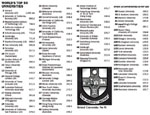 Times Online has a list of the top universities in the world, arranged in order of merit, first issued by the Times Higher Educational Supplement. I've copied it to my site so that it won't vanish, and you can read it by clicking on the diminished version here. I found it by clicking the graphic here.
Here is the Times Online piece about it.
Here's how the list was compiled:
Universities were placed in the table with the help of findings from a survey for the THES of 1,300 academics in 88 countries. They were asked to name the best institutions in the fields that they felt knowledgeable about.The table also included data on the amount of cited research produced by faculty members as an indicator of intellectual vitality, the ratio of faculty to student numbers and a university's success in attracting foreign students and internationally renowned academics in the global market for education. The five factors were weighted and transformed against a scale that gave the top university 1,000 points and ranked everyone else as a proportion of that score.
My first reaction on reading the list was "How real is this?", but that sounds real enough, even if it is weighted slightly towards what people think are the best universities, and they could be out of date, as well as just plain wrong of course. It will be interesting to see how things change, say, during the next five years. That's if they do this again.
This list will feed the frenzy of parents trying to bribe/threaten/cajole/beg/prostitute-themselves etc. for places for their worthy or worthless little darlings. "But Michigan is only thirty-first best!" Blah blah blah.
Here's who won:
Harvard, whose faculty members have won 40 Nobel prizes, emerged as the world's best university by a considerable distance, with second-placed Berkeley rated 120 points behind at 880.2. …
And here's how Oxbridge did:
… Oxford scored 731.8, slightly ahead of Cambridge on 725.4.
Here are the totals in the top fifty, broken down by country: USA 20, UK 8, Australia 6, Canada 3, Switzerland 2, Japan 2, Singapore 2, France 2, Hong Kong 2, China 1, India 1, Germany 1.
What hits me is (a) how large the Anglosphere looms, and (b) how badly continental Europe does. I would have expected Germany in particular to do a lot better. I guess chucking out all your Jews is not smart, higher-education-wise.
My beloved London, with 4 of the UK's 8, did particularly well. Hurrah.
More from this book.
Following on from the success, such as it was, of Firelight, Spielberg's next effort as a film maker was Amblin, and this, given that he had already made some movie industry insider contacts, got him the serious attention of Hollywood. So much so that Hollywood made him an offer which he did not refuse …
A couple of months later Amblin was ready for unveiling. Since the negative was held at the Technicolor lab within Universal Studios, the twenty-four-minute movie was handily situated for a providential borrowing.
Universal's president in charge of TV was thirty-two-year-old Sidney Jay Sheinberg, and after a feature screening one night. Chuck Silvers prevailed on him to watch 'this young guy's short film'. Sheinberg agreed and was suitably impressed. He liked the way Spielberg had selected the performers and developed their relationship, he admired what he saw as the maturity and warmth in the movie. Taking in the close-to-mirror image of himself that Spielberg presented in the hastily arranged follow-up meeting was something else again. Sheinberg recalls a 'nerd-like, scrawny creature' appearing: 'The surprising thing was that he looked just like me.'
'You should be a director,' he informed Spielberg.
'I think so too,' came the rapid agreement, 'but I'm still at college. I haven't graduated yet.'
'Do you wanna graduate college or do you wanna be a film director?'
A TV contract at Universal or back to college? Oh, real tough. Spielberg quit college so fast – to hell with graduation – he didn't even stop to clean out his locker. His seven-year deal was drawn up and signed a week after the offer was made.
This article is getting attention from fellow ed-bloggers (here and here).
Final sentences:
… One of the real benefits of homeschooling is that the student learns from the beginning that his/her education is his/her responsibility and not the responsibility of the parent/teacher. Homeschooled children are usually self-starters who are very flexible. They learn to do research, to look for information on their own, and to make good use of whatever resources are available. As a result, they are able to educate themselves far beyond the level of the typical public schooled child.
I am about to become a lowest-possible-form-of teacher. Consent is one prejudice I bring to this. Another is that teaching means inflaming and then encouraging and assisting the above quality, of self-starterdom. In practice that means: when they are concentrating on learning something that they have chosen to learn do not interrupt.
Like consent, an easier rule to expound than to follow. We shall see.
Usually I try to skip past American stuff when googling for education-related dramas, but this is too choice to ignore:
LITTLE EGG HARBOR, N.J. – A National Guard F-16 fighter jet on a nighttime training mission strafed an elementary school with 25 rounds, authorities said Thursday. No one was injured.The military is investigating the incident that damaged Little Egg Harbor Intermediate School shortly after 11 p.m.
Police were called when a custodian who was the only person in the school at the time heard what sounded like someone running across the roof.
The pilot of the single-seat jet was supposed to fire at a target on the ground 3-1/2 miles away from school, said Col. Brian Webster, commander of the 177th Fighter Wing of the New Jersey Air National Guard. He does not know what happened that led to the school getting shot up.
''The National Guard takes this situation very seriously,'' said Lt. Col. Roberta Niedt, a spokeswoman.
School board President Mike Dupuis said he's mindful that a firing range is nearby.''Being so close to the range, that's always in the back of our minds. It is very scary." AP
Indeed. Now that's what I call attacking education.
Often when schools get attacked – fire being the popular weapon of choice – it turns out that the miscreant went there, but did not enjoy it and got angry about something. Could this be the story here?
Hated school. Joined Air National Guard. Took revenge.

Probably not.
UPDATE: Daryl Cobranchi calls it ONE MORE REASON TO HOMESCHOOL.
It would be easy to dismiss this as a load of old politicised garbage …
Astana. November 5. KAZINFORM. 5-9 November Turkey Minister of National Education Hussein Chelik will visit the Republic of Kazakhstan, our correspondent has been told in the press service of the Education Ministry of Kazakhstan.In the course of the visit it is planned to sign the Agreement on cooperation and in the sphere of education between the ministries of the two states. In Astana the Turkish Minister will visit some educational institutions, such as the Kazakh-Turkish High School, Kazakh Gymnasium # 38 and the Gumilyev Eurasian National University.
Besides, in Turkistan the guest will study the activity of the International Kazakh-Turkish University named after Yassavi.
… and I'm sure that a lot of it is just that. This could, of course, just be a taxpayer funded holiday for a bunch of parasites. At best it is an accurately recycled government press release.
However, we live in a world where the cooperation being suggested here is now a lot easier for actual people, as opposed to politicians, to do for real and to make good use of. So if there are people at both ends of this deal who want this stuff to work, then it might. I wish them luck. And if the politicians are merely trying to get the process of them not interrupting organised, then well done them too.
 From a book by Andrew Yule about Steven Spielberg:
An early introduction to his goal of filmmaking in Hollywood came courtesy of Universal Studio's guided tour. Originated by the company's founder 'Uncte' Carl Laemmle in the 1920s, the tours had just been reinstated following two years of extensive updating; Spielberg bought his ticket during a summer vacation in Canoga Park spent with cousins.
Hiding behind soundstages after the tour bus had departed, the seventeen-year-old wandered the studio for several hours. This was his home, he decided, this was where he belonged. Some crazy kind of osmosis would take-care of the details. As luck would have it, director John Ford was in a rare expansive mood when he found himself confronted with the intruder. While showing off his collection of Western prints to the choked up, profusely sweating youngster – who could scarcely believe his luck - the crusty veteran had two pearls of wisdom to impart. 'When you understand what makes a great Western painting, you'll be a great Western director' came first. Next: 'Never spend your own money to make a movie.' His final words: 'Now get the hell out of here.'
Before he did, Spielberg also met Chuck Silvers, a senior editor on the lot, who listened sympathetically to his tales of amateur moviemakmg. A pass was handed out for the next day so Spielberg could return without having to pay, and so he could bring along a few of his 8mm shorts. After viewing his work and offering a few words of encouragement. Silvers explained that he didn't have the authority to write any more passes. He wished him good luck, and told him to stick with his moviemaking. That was enough for Spielberg.
Next day, and for the rest of me Summer, wearing a suit and swinging a briefcase that contained a sandwich and a few candy bars, he breezily walked past the guards and gave a friendly wave. The hope was that he would pass master for 'some mogul's kid'. It worked. Disappointingly, it was the only thing that did. Despite virtually squatting in offices on the lot, no one among the writers, editors and dubbers to whom he spoke showed any interest in what he had to offer. Their indifference sent Spielberg back to Phoenix more determined than ever to produce something that would change their minds.
Borrowing $400 from his father, he produced and directed 140-minute science-fiction movie, Firelight, a tale of hostile UFOs. Employing mainly student actors from Arizona State University, it had aliens harassing the Earth's scientists, running circles round the National Guard, and stealing an entire city to reassemble it on their own planet. It was great fun to shoot at weekends, with Spielberg using all his powers of persuasion to have the local airport shut down a runway for one scene, a hospital to throw open its emergency room for another. Sister Nancy found herself enrolled in the venture, playing a kid reaching up in her backyard toward the mysterious light in me sky. 'Steve had me looking directly at the sun,' she, recalls. '"Quit squinting!" he'd yell.
Although it was shot silent, Spielberg had a sound strip applied to Firelight. There was a sense of considerable pride when his father hired the local cinema (Worid Premiere! March 24, 8 pm!) and the movie was shown for one heady night only in Scottsdale. It recovered its cost and came out, on a box-office gross of $500, with a clear $100 profit. Spielberg regards it as a tragedy of sorts that most of the film was promptly lost the day after the premiere in the family's move to Saratoga, a suburb of San Jose. So he should, for what remains contains lighting effects of space ships hovering and swooping that would not have looked out of place in many a Monogram or Ed Wood epid, even a Roger Corman programmer (scratch that; Spielberg's effects were too good, and in colour.
 Someone called "Kate" has just added an interesting comment to this posting here, which I mention (a) because it is an interesting comment which y'all might want to read but would probably otherwise miss, and (b) because Kate supplies a link to her own blog, which looks very interesting and very fun.
Gratuitous picture there of someone whom Kate hasn't married yet.
Today I visited a primary school, in the company of the man who runs the London bit of Volunteer Reading Help. I am fixed up to help a couple of children with their reading etc., two afternoons a week, for about half an hour each.
For the time being I will refer to this place as Paradise Primary, because frankly, that is how it struck me. Maybe that pseudonym will change, but my guess is that it won't need to. (Maybe there will be times when it is a bit ironic.) The place has a website, and is crammed with photogenic stuff, the most photogenic things of all being, of course, the children. But for reasons I need not elaborate on, there will be no link to the website, and certainly and absolutely no photos. Quite apart from anything else, I have just signed a Confidentiality Agreement. Suffice it to say that I am looking forward to doing this very much, and am already sure that it will massively improve my understanding of the realities of education in London, which is, educationally, one of the most fascinating places in the world, what with all the different cultures and ethnic groups that are here represented.
Acronyms abound in education, much as they do in Tom Clancy novels. (CINCLANT, SACEUR, DEFCON, etc.) So, for instance, today, they gave me an information sheet about Paradise Primary which listed the Head Teacher, the School Secretary, and something called the SENCO. The School Secretary guards the front door of Paradise Primary and the person I will check in and out with every time I visit. And the SENCO is, approximately, and assuming that I heard it right and am remembering it right, the Special Educational Needs Coordinator.
Already, I am learning.
A recent Islamabad news item:
Pakistan's Education Minister Lt Gen (retired) Javed Ashraf Qazi has said that a few of the Madarssahs or religious schools situated near the country's border were involved in terrorist activities.According to Dawn, Qazi who accompanied the outgoing US ambassador Nancy Powell to a community school in Nirola said that the government was keeping a close watch on the activities of seminaries suspected of being involved in terrorist activities and was contemplating serious action against them.
He further added that the government was seriously trying to streamline the madarssahs into a compact system and had even entered into collaboration with the Wafaqul Madaris in this regard.
"Streamlining of madaris is going on at a good pace and the ministry in collaboration with Wafaqul Madaris is taking every possible measure for timely Madarssah reforms," the report quoted him as saying. (ANI)
As I wonder what I'm going to add to that, I'm watching a BBC4 TV show about Who Runs America (scroll down to the final one), and an FBI terrorist chaser is being interrogated about his work by a bloke from the BBC. Yesterday there was a Presidential Election in which the War on Terrorism was the number one issue.
It may be that all this effort will eventually come to be thought of as a huge overreaction to what was actually a quite minor problem. But that will only happen if there are no more major terrorist successes, and personally I'd settle for that. The FBI guy is talking about this War being "won". But if that happens, it will be because, one day, people realise that hey, we aren't thinking about that Terrorism thing any more. He won't get a big parade. He'll just find his department downgraded, and if he is personally felt to have done well, he will simply find himself assigned to other duties.
Meanwhile, for the time being, the interest that the rest of us have in the nature of Islamic education is going to be about more than just how they teach things like the 3Rs.
At school, I was a bad flute player, and for some stupid reason I found myself entered into a school music competition, playing a piece that was technically beyond me. Come the competition, I sloped despondently onto the platform, noted with relief that the large hall in which all this was happening was almost empty, and in a state of resignation began to play. To my amazement, I got it all right. Note perfect. That hideous passage that I had never once got right when practising went perfectly. Twice. Amazing.
Then the bad news. The bastards decided that I should repeat my performance in the school concert. For the school concert they cherry picked the music competitions, getting the best of the prize winners to reprise their various triumphs. A reasonable procedure. Trouble was, they decided to include my unrepeatable fluke in this showcase event.
I wish that I had point blank refused to play in that concert. Instead I buckled, and played, and duly messed the piece up, this time in front of five hundred schoolboys.
It actually wasn't really compulsion, because I could have refused. It was very heavy influence, emotional blackmail, dishonest argument and a blatant obsession with their interests (filling the slots in their damned concert) and a blatant disregard for my interests. But it wasn't compulsion, pure and simple. I could, as I say, have just said no. What they might then have said to me, I don't know, but I do not think they would have tortured me, in the way that for other acts of misbehaviour or defiance they did torture us. It was, you might say, impure compulsion.
Because it was compulsion, but because it was impure, I learned two things from this episode rather than just the one. I learned that I thought that compulsion of children is wrong. But I also learned that, had I really been thinking clearly, I could have resisted the compulsion.
I learned that children should be free, and also that, if they really choose to be, they are free.
Whenever I expound my views on the wrongness of compelling children to do things that they really, really don't want to do, someone in the compulsion team says: I remember being made to do … physics, basketball, sculpture, flute playing, whatever. At first I thought it was stupid, but I'm glad I was made to do it. Allowed to make my own decisions, I would have been a less well educated and well prepared adult. I would have done nothing. Hurrah for compulsion.
I can offer no simple and smart put-down of this kind of argument. But I am about to start pursuing a career as some sort of teacher, and if I can (probably a foolish fantasy but there you go), I will resist compulsion as a teaching method.
I will persuade. I will advise, urge, try to convince, try to sell the culture in general and the relevant bit (such as reading or sums) in particular, with all the eloquence and charm that I can muster. But the final decision about what my pupils do will be theirs, not mine.
Easy to say. But I wanted to record this ambition before reality starts to pollute it. As so often, my most important reader is myself, later.
Here's an answer to the bullying problem:
UTSUNOMIYA – A 23-year-old unemployed man who murdered his former high school classmate has been arrested after he turned himself in, police said.Tsutomu Yoshihara, from Imaichi, Tochigi Prefecture, said the victim used to bully him at school …
That'll teach him.
Meanwhile, in Fiji, they are fretting about other kinds of violence, by teachers upon pupils:
Such punishment in schools, which are supposed to be custodians of values of peace and tolerance, can only lead to children growing up to become violent adults.
Supposed by whom? Plus, is the next bit actually true? In Britain the rules about teachers attacking pupils have tightened a lot recently, but the resulting adults are not noticeably less violent. More, if anything.
Why can't they just say what they surely think? – which is that adults hitting kids is horrid, and they ought to do a lot less of it.
Meanwhile, in Pakistan, the students of the Punjab University are showing the world what they are made of:
THE recent clash between students of the Social Work Department (SWD) at the Punjab University (PU) and Islami Jamiat Talaba (IJT) activists has raised the question of security for students and teachers, especially females, living on campus. Unfortunately, the PU administration, consisting of retired army personnel and higher authorities including the PU Chancellor, who is also the Punjab governor, and other federal high ups are quiet on the issue.The incident took place last Tuesday when some students from the Space Science Department (SSD), allegedly involved and backed by IJT, beat up students of the SWD. The SWD chairman saved the students by hiding them inside the library. The incident is a result of the IJT’s attempt to control all PU departments, which is not liked by the majority of the SWD faculty. That is why some 'students' also misbehaved with some teachers, leading to tension in the Academic Staff Association.
Sounds like a Tom Sharpe novel.
This, meanwhile, turned out to be less exciting than the headline.
PROPOSALS to build 10 all-weather floodlit pitches has divided a community because of yobs.Residents attended a meeting on Friday about the plans to build the astroturf pitches near Whitchurch High School in Cardiff.
The school would have use of them before 4pm and they would then be available for community use and for the capital’s five-a-side football league in the evening.
Some residents on neighbouring Clos Treoda and Glan y Nant terrace worry that the pitches will be a magnet for loud youths causing trouble at night and cause car parking chaos.
But many think these facilities are what is needed to keep youngsters out of trouble.
I think that many have a point. Gathering young people together to do something improving to them, no matter how improving it is, is not a complete answer to society's problems if, after a couple of hours of improving them, you then spit them out in a great gang onto the streets, at nine o'clock at night.
More educationa related violence news, from Israel, South Africa, Wales (again – the real thing this time), and of course the USA (most of that is USA stuff).
Have a nice week.
More on the safety ligitation threat in today's Telegraph:
Teachers should abandon school trips because of the danger of being sued in the event of an accident, a union has warned.A new test of the "educational validity" of trips should be introduced to cut down on unnecessary risks, said the NASUWT.
Last month, education watchdog Ofsted said too many schools did not take children on outdoor activities because they feared they would be sued if there was an accident.
Canoeing, field work trips, rock climbing and other pursuits help pupils develop their physical and social skills, according to the Ofsted report.
But Chris Keates, the union's general secretary, said society had become "increasingly litigious" and no longer understood the idea of a genuine accident.
That last bit sounds about right. But of course, being a union, all they can do is refuse to do whatever it is. No positive suggestion is being offered here. Still, they are at least flagging up the problem.