
Interesting BBC report about people queueing up to become plumbers. They were inundated not to say flooded with applicants, ho ho I think the last paragraph is the best:
Earlier this year Birmingham University biologist Karl Gensberg left academic life to retrain as a gas fitter, saying he hoped to double his £23,000 annual salary.
Gratuitous picture of my stupid doesn't-work shower:

How long before they start having university plumbing degrees (feminist perspectives on piping, U-bends – a structuralist analysis, plumbing theory, blah blah), which teach you nothing about how to actually plumb, but which you have to have before they let you start doing it and learning it? This will be announced as the solution to the British plumbing problem, but it will just make it ten times worse.

Last night I watched School of Rock, which is now out on DVD.
It's a strange movie. I can't decide whether it has a lot to say about education or nothing at all, whether it tunes in to significant new trends or is pure fairy tale, proving nothing and illustrating nothing, other than the fact that people like to be entertained. On the whole, I would say, the latter.
So, given that I'm somewhat confused about what, if anything, it signifies, I'll retreat to describing what happens. There should probably be a SPOILER warning here. I may well be about to tell you the entire plot. If you don't want to read this, probably best to stop now. But on the other hand, would you really be amazed to learn that the teacher at the centre of this movie, played by Jack Black, is keen on rock and roll, that he infects his pupils with his enthusiasm, that they do a performance of some rock and roll which goes very well, and that this process is at first opposed by surrounding adults, but that said adults end up being won over? Did you expect the movie to end in a mass execution, or to be about a bunch of hard core juvenile rock and rollers who turn against rock and roll and switch to Indian Classical? Or to be about geology?
The fairy tale aspect of the movie is that a bunch of ten year olds prove so quickly to be expert rockers, after only the most rudimentary guidance from Teacher Jack. There is an expert guitarist in the class, an expert drummer, some expert backing singer girls, an expert keyboard player. Weird. It's almost as if they weren't a regular class of children at all, but rather a bunch of child actor/musicians who were chosen from among thousands of auditioners for their ultra-winning personalities and musical and drama excellence.
Which they were, of course, and that's the clue. This movie is at least as much an adult fantasy of juvenile efficacy and biddableness as it is a tale of juvenile assertion. These kids are not real kids – and certainly not typical kids – so much as adult fantasies of what kids ought to be like.
Which makes the placing of rock and roll at the centre of things so strange. The Jack Black character constantly insists that rock and roll is all about getting angry with authority, challenging those in power, screaming back at "the Man", blah blah. Well, maybe. But if so, what kind of rock and roll rebels, when told to do rock and rock, answer by saying Yessir!! and doing it, exactly as Mr Black wants?
At the start of the movie, the children first confronted by Jack Black's bogus substitute teacher are unwelcome to him only in the sense that they are excessively obedient. They all sit in quiet and obedient rows and demand homework and credits and proper teaching. They start out, in other words, as one adult fantasy of how children should be.
And they are then transformed by Jack Black into another such fantasy. The one where the kids all decide that they share their parents' tastes in pop music.
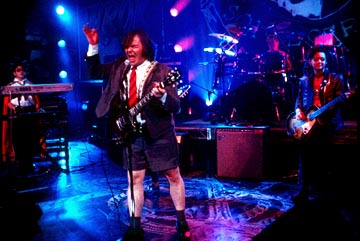 Jack Black appoints himself the lead singer of his juvenile rock and roll group, and in the final rock and roll show, he continues to be the lead singer. If that isn't Embarrassing Dad living out his schoolboy fantasies, I don't know what is.
Rock and roll used to turn schools upside down. Now it is just another school subject. I can remember how at my school all those years ago, there used to be something called the school "Dance Band", which was a dutiful and very pale imitation of the Glen Miller orchestra (which was itself something of a pale imitation of original twenties swing). That wasn't juvenile rebellion either. It was the final domestication of swing music.
It's tempting, so I'll do it, to say that this movie embodies the central self-contradiction of current adult views about education in particular and the life of children in general. Children should be completely free to do … exactly what we want them to do. They should be allowed to respond at an emotional level … with our emotions. They should be free to dream and to live out … our dreams. And then they should get great jobs as financial analysts and have two point four kids of their own.
Ten years olds are indeed extraordinarily willing to get excited about what their parents are excited about. But the stuff they eventually get seriously stuck into is the stuff they choose for themselves.
Meanwhile, further proof that this is as much a movie about adult fantasies as about childhood fun is that there is a rather sweet romantic subplot bubbling along inside this movie, centred on the lady head of the school, played by Joan Cusack. She becomes fond of Jack Black despite and then because of his rock and rollness. She, it emerges, is an ex rock and roll fan, a Stevie Nicks mimic, a former rock chick. But, faced with the demands of her school's parents, she has mutated into the Bitch Head Mistress from Hell who terrifies all of her pupils into sitting in those obedient rows and demanding home work and teaching. Sadly, however, just when Our Jack was about to take off her glasses and say "why you're beautiful" to her, the movie ends, with the triumphant rock and roll performance by Jack Black and the Kids From Fame, sorry, by Jack Black and his class of randomly assembled children.
This movie was written with Jack Black in mind and he holds it all together energetically, daring you not to enjoy it, demanding that you play along with all its absurdities and implausibilities. I did quite enjoy it, more than I feared, less than I hoped.
I see that in my earlier posting about this movie, written long before I'd seen it, I see that I said this:
… Most of the reviews say that it is good old-fashioned frothy Hollywood comedy with its heart in the right place and saved from schmaltz by being well and winningly performed.
That's about right. But this …
And when I do see School of Rock I will seek out the serious educational ideas that are sure to be contained in it, and report back to you all.
… didn't work out so well. Oh well. It makes a change from this kind of thing.
I believe strongly in the power of the short but eloquent speech that hits the bullseye and changes your whole life from then on. Good teaching can consist of steady drip drip drip improving influence. But it can also come in single eruptions of revelation.
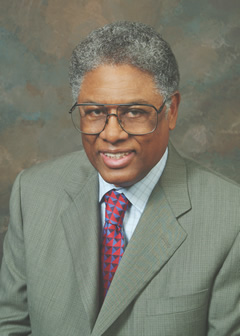 Here's the kind of thing I mean. This is Thomas Sowell (pictured on the right) writing about the value of criticism, in connection with Bill Cosby's recent criticisms of black ghetto foolishness:
Criticism is part of the price of progress. Economics professor Walter Williams has said that a turning point in his education - and his life - came when a schoolteacher in the Philadelphia ghetto chewed him out for wasting his abilities on adolescent nonsense. …My own moment of truth came when a roommate at Harvard said to me one day: "Tom, when are you going to stop goofing off and get some work done?"
Goofing off! I didn't know what he was talking about. I thought I was working hard. But, when the midterm grades came out - two D's and two F's in my four courses - it became painfully clear that I was not working hard enough. I was going to have to shape up or ship out - and I didn't have anywhere to ship out to.
I've heard that Sowell is a "difficult" man, tough, demanding, tricky to handle, etc. If that's true, then this could be why. One of the formative experiences of his life was when someone else was difficult with him, and demanded more from him.
More count your blessings stuff, from Africa. Nigeria, to be exact.
The hydra-headed problem of examination malpracticeis presently growing at an alarming rate and posing a serious threat to the nation's entire educational system, according to investigation by our reporter who penetrated the world of the racketeers.
And Our Reporter (no name given) ploughs into the story with gusto. Assuming, this is, that he didn't cheat himself, and invent the whole story.
At the end of the examination, a yellow coated invigilator who collected our reporter's answer script wondered why he could not shade all the answers into the script despite the fact that prepared answers were passed to him.Said he: "All these questions were solved for you and yet you couldn't finish copying and shading them in your answer sheet." Our reporter had complained to the invigilator who had just collected his answer script that he had not finished shading the answers which were suppled to him by the pot-bellied man.
The pot-bellied man had directed that our reporter should pass over a copy of any prepared answers given to him to a girl who sat on his right at a cramped desk. Our reporter struck the right chord with the girl when he identified himself as a candidate from the Ogba-based tutorial centre -- where she too had registered as a special candidate for the examination. The hall was rowdy.Other candidates who hadn't finished shading their answers into answer sheets for objective questions had withdrawn to seats at the back of the hall, to evade the invigilator who was collecting answer sheets. Just before the Chief Invigilator at the centre had said "pens up" several candidates had freely moved about the hall and consulted with one another. At the beginning of the examination, the candidates were restrained in their behaviour and hid the prepared answers that had been passed on to them from outside. But later they threw caution to the wind.
The girl who sat behind our reporter had collected prepared answers for various subjects which were given to him by the pot-bellied man. These included prepared answers for English Language, Economics and Christian Religious Knowledge (CRK).
And so on. Here's how the piece ends:
Lamenting the situation, Onyechere said that teachers who have been identified for their involvement in examination malpractice are left to go scot free."Some of these teachers who have been identified as facilitators of examination malpractice are still teaching even though they have been reported to examination bodies," he said.
The examination ethics campaigner observed that some schools that have been identified and de-recognised because they are centres of examination malpractice are still used as examination centres. He stated that the entire Nigerian society is under threat so long as the present trend which throws up those lacking in merit to possess academic and professional qualifications they do not deserve.
" Those who engage in examination malpractice to pass school certificate and UME examination pose great danger to the nation today," he said.
He maintained that such persons are likely to continue cheating all their lives and therefore end up as incompetent people in their chosen fields adding that examination malpractice is the root of corruption in Nigeria today.
"Imagine what awaits us when people like this become our medical doctors, engineers, pharmacists and professionals in other fields?" he asked.
It's long been my understanding of matters in Nigeria that this process is already there to be observed.
What seems to be happening here is a huge mismatch between two utterly incompatible cultures, one dead set on solid and long-term individual professional achievement, based on a vast, icily incorruptible apparatus of individual measurement, and the other dedicated to immediate pleasure and immediate profit and team spirit among all those cooperating to melt the ice. The examiners and the examined happily connect in contented little conspiracies, more or less open, and only a puritanical fool goes against the flow.
My eldest brother worked in Nigerian for a while, about twenty years ago. He told me that everything there, everything, was for sale. "Dash", this was called. You provided dash, and you could have whatever you wanted. That would certainly have included exam results. Everyone involved got a slice of the action, and a role in whatever charade was required.
So, things in Nigeria are as they always were, only more so.
The man who paints The Big Picture notes the strange fact that the USA consumes, so to speak, so many more educated (alpha-)people than it can produce, and that this is a big source of US strategic power, and always has been. And he links back to an earlier posting of his, where he asked:
"Will the United States' draconian response to the terrorist threat cause a fundamental shift in the international movement of researchers and perhaps even alter the global balance of scientific power?"
I would suppose that the answer is: yes, a bit. Interesting thought. And whether counter-terrorism is hurting or not, the question of why the USA does the exploitation of educated people so much better than education itself is very interesting.
I got to this from here and to there, inevitably, from here.
I have just been listening to , bought for £2 in the Lower Marsh market. It's Annie Get Your Gun, Broadway revival 1999. For some reason the front cover of this CD wouldn't load properly here, so I've scrubbed it from here (where I originally tried to put it). It evidently didn't like my Gratuitous Picture policy.
Track number two features Bernadette Peters (long a favourite of mine – does this make me gay I wonder?) as Annie Oakley, plus supporting females, offering this reflection on the limits of education:
Folks are dumb where I come from,
They ain't had any learning.
Still they're happy as can be
Doin' what comes naturally (doin' what comes naturally).
Folks like us could never fuss
With schools and books and learning.
Still we've gone from A to Z,
Doin' what comes naturally (doin' what comes naturally)
You don't have to know how to read or write
When you're out with a feller in the pale moonlight.
You don't have to look in a book to find out
What he thinks of the moon and what is on his mind.
That comes naturally (that comes naturally).
My uncle out in Texas can't even write his name.
He signs his checks with "x's"
But they cash them just the same.
If you saw my pa and ma,
You'd know they had no learning,
Still they've raised a family
Doin' what comes naturally (doin' what comes naturally).
Cousin Jack has never read an almanac on drinking
Still he's always on the spree
Doin' what comes naturally (doin' what comes naturally).
Sister Sal who's musical has never had a lesson,
Still she's learned to sing off-key
Doin' what comes naturally (doin' what comes naturally).
You don't have to go a private school
Not to pick up a penny near a stubborn mule,
You don't have to have a professor's dome
Not to go for the honey when the bee's not home.
That comes naturally (that comes naturally).
My tiny baby brother, who's never read a book,
Knows one sex from the other,
All he had to do was look,
Grandpa Bill is on the hill
With someone he just married.
There he is at ninety-three,
Doin' what comes naturally (doin' what comes naturally).
Makes you kinda' wonder what Annie Oakley would have made of Sex Education, don't it?
One of my duties now (for which I am actually paid!) is to write a short weekly piece for this blog.
I've already aired the subject of intellectual property on my Culture Blog. But here is an article on an educational theme which is also about an intellectual property matter. Someone stole Kim Lanegran's PhD dissertation.
Last summer I discovered that he had defended his dissertation three years after I defended mine. I requested a copy of it through interlibrary loan. As soon as the dissertation was in my hands, I flipped first to the bibliography to see which of my works he had cited. Yes, I'm vain."Humph. He didn't cite my dissertation," I thought. I flipped to the table of contents. "Wow, he asked the same questions I did." I read the abstract. "Damn. Those are my words."
My heart pounded. This was my dissertation!
In the acknowledgement, he thanked his beloved for her patience during the years it took him to write it. Write it? He didn't even have to type it; I sent it to him on disk.
He copied many of my chapters word for word. Other chapters were slightly altered so as to make the arguments totally fraudulent. I did research in three African towns; Mr. X said he had studied two other towns. So where I quoted statements by an activist or scholar from town A, he changed the names and said that they were speaking about town Z.
It was equivalent to taking a quotation from Garrison Keillor about life in Minnesota and saying that Woody Allen said it about New York City.
Lanegran righted this wrong, and ended the academic career of the plagiarist, but she was deeply depressed by it all:
While gathering evidence to prove that my dissertation was actually mine, I confronted many dark thoughts about this profession. Mr. X must have thought that he would get away with his theft because nobody reads dissertations. Was he correct? Was all that work simply a hoop to jump through to get the Ph.D.? What is the value of a doctoral degree if dissertation committees take as little care with their students as Mr. X's did with him?His adviser is a prominent scholar I've met at conferences. Although he is not an expert in the country or social movement covered in my dissertation, shouldn't he have known Mr. X's ideas and writing style well enough to recognize that the submitted dissertation did not sound like Mr. X's work? Shouldn't the committee have expected to see the process of Mr. X's arguments evolving or read drafts of chapters? At the very least, shouldn't the committee have told Mr. X to update my literature review and rework some of my convoluted logic and awkward prose?
Is cheating so pervasive that even someone who seeks a career in academe will violate the fundamental principle of giving other scholars credit for their work? If so, what hope do I have of inculcating that principle in students eager to escape quickly with their B.A. in hand?
When people talk about the "expansion of higher education", they need to understand that this is the kind of thing they are talking about, as well as the better things that they obviously also have in mind.
The intellectual property issue here is not just that Kim Lanegran's property rights (if that is what they were) were violated, but that the employers of the plagiarist had been defrauded. He presented himself to them as the writer of something which he had not written.
And since this is all about correctly attributing ideas, I need to tell you that I only found out about this article because I consult Arts & Letters Daily, pretty much daily, and definitely today.
I recommend a read of this article by Peter Oborne, about Oliver Letwin's analysis of the Government in general, and of Gordon Brown's manic meddlesomeness in particular. Here is the particularly educational bit:
Letwin's arguments are partly set out in his speech on 'Gordon Brown’s Big Government' published on Tuesday. He demonstrates, with felicitous use of examples drawn mainly from government reports, how Gordon Brown’s obsession with central control has doomed New Labour's well-intentioned attempts to reform public services. The Chancellor’s insistence on micro-managing every area of public life through Whitehall-imposed targets, endless bothersome initiatives, grants-in-aid, public service agreements, etc., is squeezing the life out of our hospitals and schools.Less and less of the investment intended for the national public services actually reaches its destination. Instead it is captured halfway by the bureaucrats and regulators setting and monitoring the targets, interpreting the data and managing the schemes. Letwin demonstrates, for example, that of 88,000 new posts created in education by New Labour, just 14,000 are teachers and teachers' assistants. Meanwhile the task of the teachers themselves is made far more wearisome and difficult by the New Labour army of bureaucrats. Letwin claims that the new regulations just issued by the Qualifications and Curriculum Authority mean that a teacher in charge of 30 five-year-olds 'is expected to write a report on their pupils' aptitudes and achievements which exceeds the length of Paradise Lost'.
Which of course pulls things in the opposite direction of all this, to say nothing of making the Conservatives sound a whole lot smarter than I did in that posting.
Gratuitous photos of Oliver Letwin and Gordon Brown:


And see also this piece about the burdens imposed by Mr Brown. And by his predecessors, because it didn't start with him.
Yes it is, says Francis Gilbert in this Telegraph piece:
Once, like many of my Left-wing teacher colleagues, I would have been enraged by the idea of selection. However, my experience as an English teacher in London comprehensives and the example of a naughty 12-year-old boy called Rees have taught me to welcome it.Two years ago, I started teaching at The Coopers' Company and Coborn School, which is nominally a "comprehensive". Set up by a livery company during the reign of Henry VIII, it still caters for children from all over east London. Much like the London Oratory, where Tony Blair sends his children, its "faith school" status allows it to interview children and pick bright, articulate students - whatever their background.
Rees was one of our chosen. He was very much an East End lad: highly intelligent and streetwise. He lived with his mother in a tower block and I knew the school he would have gone to if he hadn't come to ours. Many of the children there were unable to read and write fluently and a hard-core would be thoroughly disruptive. In such places it is simply not "cool" to be academic; so many of the students just refuse to learn. Indeed, some are often bullied if they work hard, so the few cleverer children are dragged down.
At Coopers, however, most pupils want to work hard. And when he got here, so did Rees. Seeing him tackling ambitious subjects and clearly benefiting from the experience, changed my mind about selection.
I can hear protests of the cossetted educationalists: "Ah, but what about the schools in his area that are deprived of pupils like Rees by selective schools?" But in my experience it is the disaffected, clever children who are by far the worst behaved. They have too little to do; they have time to be disruptive. And Rees was indeed a badly-behaved boy. When I first taught him, he liked to flick rubber bands and attack some of his school mates if he was not fully engaged.
In an typical comprehensive he would have probably become a serious threat to discipline, but he didn't with us because he soon found himself challenged by his work. I saw a miraculous change come over him as he progressed. He became competitive about his work when he saw that other boys – tough characters like himself – wanted to do well. Because the standard was higher than in his previous school he had to fight harder and much of his energy was diverted and absorbed in trying to succeed.
Here's a link to the school that Gilbert is writing about, where as you can see here he is the Head of English.
The good thing about this is that Gilbert deals head on with the claim that the good pupils raise up the bad, and counters it with the observation that the bad are just as likely to bring down the good.
For me, regardless of the particular consequences in this or that case, selection is but a particular manifestation of the general principle of Freedom of Association. X and Y should only have to associate with one another if both consent. If X wants out, he should be allowed out, however much Y likes him and wants him to stay. If Y wants X out of his property, despite X's bitter regret, tough. That's how everything, including education, should be. For me, any policy other than "selection" is the outrage.
Eduwonk identifies the No Child Left Behind thing as one of the big undiscussed stories in US education right now, pointing out …
How President Bush's mishandling of NCLB has created a mess for his signature education law, alienated even supporters, and potentially hamstrung some school improvement efforts.
I would like to think that this is not only what is happening, but what is now seen to be happening. But that may be too optimistic, and the fear I expressed in that Samizdata piece, that Spend More Money will now make all the running, will be the truth of it, and certainly so in the short run.
In general, when a government announces that absolutely everyone ("no child left behind") in some rather-hard-to-help category of people is going to be "helped", expect trouble – that they won't actually help everyone being the least of it.
This is interesting stuff, which I got via this posting, which I got to from Grand Central Station.
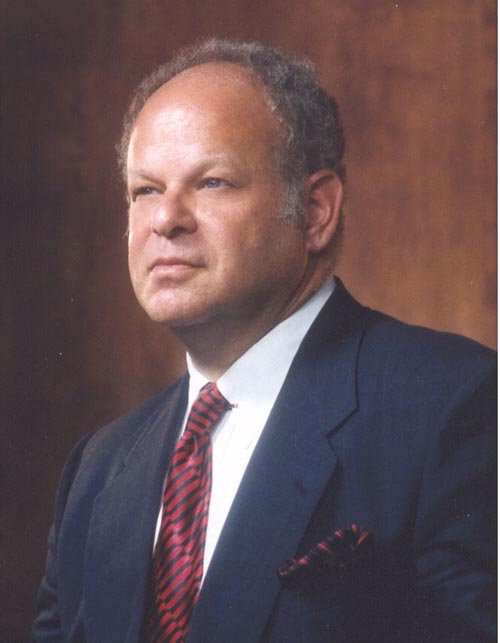
That's a picture of Dr Martin Seligman, and here's some of what Dave Shearon says about Seligman's book Learned Optimism. This is Shearon's summary of and comment on Chapter 8, "School":
Failure devastates us. All of us, upon experiencing failure, quit – at least temporarily. Optimists bounce back and began trying almost immediately; defeat is temporary and achievement is assured. Pessimists, on the other hand, are defined by their failures. They are a failure, and there is no point in a failure continuing to try.Comment: Children are natural optimists, as discussed earlier, and they sure better be in our schools. We often assure failure by such tactics as grading on the curve. We define relative success as failure. Please note that I am not arguing for low standards or namby-pamby, feel good education. I am simply making a point as to how school is experienced for many students. Is it any wonder that educators report "losing" students as they enter the later middle school years, which is approximately the same time that the natural optimism of childhood wanes. These students are suddenly unable to cope with an environment they have been in long as they can remember. How can such a failure not be a complete turn-off?
Working with Joan Girgus, and building on the work of Carol Dweck, Dr. Seligman and his staff conducted a study of 3rd-grade children from 1995 until they finished seventh grade in 1999. They found that children who began third grade with a pessimistic score on the CASQ were at risk for depression and severely-reduced academic achievement. In addition, bad life events, especially including divorce and parental turmoil, contributed to a pessimistic explanatory style. Over all, boys were significantly more depressed at all points along this age range then were girls.
In college, students with optimistic explanatory styles will outperform predictive measures such as SAT scores or high school grades. Students with pessimistic scores will under perform.
Through my (amateur and untrained) career counselling over the years I have found optimism/pessimism to be a key variable. What success I have achieved in this has mostly hinged on helping my punters to identify things they love to do and are good at doing , which they then look forward to doing and are confident they can do, which feeds their optimism, which jolts them pleasurably out of any negative feedback loops they were stuck in and puts them into some positive feedback loops. Often the mere possibility that life could sparkle again is enough to get them up and buzzing – at which point they often then do things that had nothing to do with what they talked about with me, but so what? What I try to avoid doing is simply telling them that they must do this or that, because unless they really want to do it, that just creates yet another negative feedback loop.
I think this is one of the core reasons why I oppose compulsion as a principle, in teaching as in all things, and favour voluntarism as a principle, ditto. People who do what they like doing in the way they like to do it immediately start getting what they regard as good results, which makes them more optimistic, which breeds success which breeds further optimism, etc. etc. (And if I can't make people do what they don't want to do, this won't happen, and I won't spread negative feedback loops everywhere.)
But that's an aside. All I'm really saying here is: I think this kind of stuff works.
Yes indeed, school choice is good, says David Salisbury:
School choice opponents claim that choice harms public schools. Research, however, shows the opposite. A new study published by Harvard economist Carolyn Hoxby addresses the question: "Do public schools respond constructively to competition induced by school choice, by raising their own productivity?" The answer: Yes, they do, and the benefits are greatest where large numbers of students are eligible for choice.
In other words, this will probably look quite good, here in Britain, in five years time.