
This man is a genius. He is also a teacher. My favourite posting of his that I have so far found on an education theme goes like this:
Where I work they have put up a load of posters promoting British education. "That which does not kill you makes you stronger," says one. This is supposed to be an advert for the University of Sheffield.
I got to him via her and her. They were both focussing on another not-to-be-missed posting entitled YOUR CHILD IS AN ILLITERATE CABBAGE. My thanks to both ladies.
Every few days I type the word "education" into google, the "news" bit, and see what comes up. Mostly it is American. Mostly it is politicians. Mostly, the news is bad. Education is terrible. More money must be spent on it. Candidate X will emphasise the importance of education more than his frankly very similar opponent Y. Blah blah blah.
When the news is not American, it is usually even more depressing. Education is vitally important, more money must be spent on it, but where will that come from? Woe woe woe. Etc.
I am always on the look-out for the different story. I look for the particular, and I look for good news. I look for individuals who are making a difference and doing so with their own efforts, rather than merely begging for money or lusting for office.
This, from earlier in the week, even though, like almost everything I seem to have written about this week - such is the Internet - is also American, is the kind of thing I mean:
Actor and comedian Bill Cosby is set to visit four Richmond public schools Monday and speak about the importance of education.His stops will include: Thompson Model Middle School, George Wythe High School and Carver and George Mason elementary schools. The events will not be open to the public.
Former Gov. L. Douglas Wilder, whose mayoral campaign office helped plan Cosby's visit, said his longtime friend will likely talk about "the need to stay in school and the need to end this senseless slaughter."
"He feels a lot of people and a lot of kids have lost the fight within them to be something. And, consequently, they turn on each other," Wilder said of Cosby. "He said, 'Doug, I think they lost the fight.' He means they lost the spirit to achieve. I think he is right."
"A lot of these kids don't look past 25. They don't intend to live forever. They go out and have a baby . . . Get me a nice ride. Have some expensive jewelry. And that is it. They don't look toward middle age. They don't look toward a retirement. They don't look toward raising a family or providing an opportunity for other families."
The actor, who is known for his stand-up comedy and his sitcom role as Dr. Cliff Huxtable, generated controversy in May when he criticized some blacks for their grammar and accused others of not properly raising their children.
Unfortunately for Cosby, part of the reason this is news is because he is friends with a politician, Governor Wilder, who helped set up these talks, and Wilder is being accused of using Cosby for political purposes. But the way I see it, Cosby is using his political connections for Cosby purposes, and this is what matters. And what are mayors for if not to give a helping hand to operations like this?
Cosby is not begging for money, nor is he himself seeking to go into politics. He is simply trying to get a message across, to the people who he most wants to hear it, at the moment in their lives when it might make the most difference. Well done him.

I would like to see a lot of other celebrities follow Cosby's example. Not necessarily with anything so grand as a lecture tour, just by contributing to education. These people are nothing if not communicators, and teaching people to communicate is at the heart of teaching nowadays. Lots of these celebs and ex-celebs have more money than they know how to spend. So, instead of wasting the second half of their lives trying vainly to recreate the glories of the first part of their lives, why don't they grow old with a bit of dignity and become, I don't know, classroom assistants, and take it from there? Bob Geldof would have made a great Headmaster.
The teaching profession badly needs people with a knowledge of life outside school. Clearly the teaching profession can make excellent use of some teachers who know their subjects, how to teach their subjects, and very little else. But it also needs people who have lived a little, climbed mountains, fronted rock groups, driven jet airplanes, built skyscrapers, won Olympic bronze medals and organised hugely successful marketing campaigns.
Or for that matter hugely unsuccessful marketing campaigns, because failure teaches you a lot as well as success. You can bet that before that bronze medal finally happened, there were a lot of cock-ups and disappointments. Everest is not climbed in a day, and with no set-backs or back-trackings. And, the occasional teacher who knows what the inside of a prison is like might be able to pass on some good lessons.
Adam Balling reports on an odd use for a publicly owned school. I got to this from here.
This convention was a fine Orwellian display, complete with doublespeak, ritualized hatred, and the policing of "thought crimes." All who disagreed openly were barred from the radical teach-in at the public school. I was only there because I went in "under cover." That the San Francisco Unified School District rented its space to an exclusionary meeting of terrorist-supporting fanatics – in violation of state and federal laws, and possibly the USA PATRIOT Act – defies description. These people want America destroyed, and are not shy about it.
Towards the end of Balling's report:
The message at this conference was intended to guarantee the outcome of a triumphant Palestinian revolution that would be a nationalist massacre: the ethnic cleansing of Jews. If allowed, the elimination of Israeli society by force – the desired victory – would be genocidal. The Marxists and fellow travelers at Horace Mann Middle School, however, did not call it genocide. They called it "all forms of resistance" against "the imperial rule" of "Zionist apartheid settlers" and on behalf of "the right of return for all Palestinians." Do not be fooled: the only tangible result of these stated objectives would be the mass murder of all but those Israelis who managed to escape. The invading Arab paramilitary would not take the time to build camps.
Quite a lesson. I wonder if Horace Mann Middle School will get into any bother about this. Perhaps it already has.
I'm guessing that Horace Mann would be this Horace Mann, yes? I wonder what he would have thought about this conference.
I'm not the only who takes photos while doing education. As Instapundit reports, with this same photo, war correspondent Major John Tammes does it too. He's teacher.
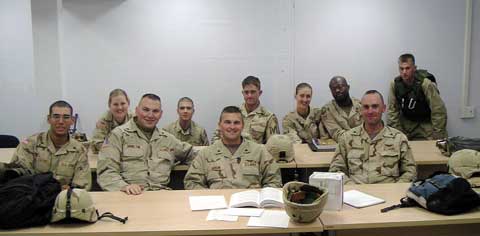
You may recall this Major Tammes edu-photo also.
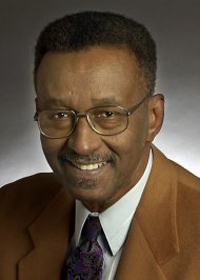 Walter Williams writing yesterday:
I'm wondering just when parents, especially poor minorities, will refuse to tolerate day-to-day school conditions that most parents wouldn't dream of tolerating. Lisa Snell, director of the Education and Child Welfare Program at the Los Angles-based Reason Foundation, has a recent article about school violence titled "No Way Out," in the October 2004 edition of Reason On Line (www.reason.com).As Snell reports, Ashley Fernandez, a 12-year-old, attends Morgan Village Middle School, in Camden, N.J., a predominantly black and Hispanic school that has been designated as failing under state and federal standards for more than three years. Rotten education is not Ashley's only problem. When her gym teacher, exasperated by his unruly class, put all the girls in the boys' locker room, Ashley was assaulted. Two boys dragged her into the shower, held her down and fondled her for 10 minutes.
The school principal refused to even acknowledge the assault and denied her mother's request for a transfer to another school. Since the assault, Ashley has received numerous threats, and boys frequently grope her and run away. Put yourself in the place of Ashley's mother. The school won't protect her daughter from threats and assault. The school won't permit a transfer. What would you do? Ashley's mother began to keep her home. The response from officials: She received a court summons for allowing truancy.
Speaks for itself.
I found the picture of Walter Williams here, where there is further information about him.
Pail – Fail!Right, hon. Fail means you don’t win.
Cane – Fane!
Uh – well, feign is a word. It means you pretend in an evil way.
Cake – Fake! It's hard to describe the gusto she employs to shout out the rhyme. Pride and triumph. FAKE!
Absolutely right. That's a rhyme.
Then she turned over a picture of a duck.
We had a little talk about bad words.
It’s all a minefield. …
Yes, I would imagine it is. Although, what's wrong with "luck", or "tuck", or "muck". Or even "suck"? There's innuendo there, but just ignore it.
I really am fascinated to see what happens with the Lileks/Gnat saga. Will he still be bleating updates on the relationship in ten years time, I wonder?
Here is an interesting if depressing Guardian piece about the baleful effects, at any rate as DJ Taylor sees it, of creative writing courses at university.
This week sees the publication of Concertina, the annual anthology of work by recent graduates of the University of East Anglia's creative-writing course. The noises emanating from this literary hotbed are usually so upbeat in tone that I greeted the remarks recently attributed to Paul Magrs with faint incredulity. Dr Magrs - lately employed as a tutor on the much-celebrated creative-writing course - had been reflecting on the calibre of his students, and the verdict was horribly damning.The bulk of the UEA habitués, Magrs suggests, "tend to be people of about 30 who've burnt out doing something else, who've read some Kundera and some Rushdie and think they're going to reinvent the European novel by writing about their gap year and Ronald Barthes. Somebody even turned up in a beret one year."
No doubt the irritations of the modern academic life can be insupportable at times. No sooner had I finished reading Dr Magrs' piteous lament (he has since moved on to Manchester Metropolitan University) than the printer began to disgorge details of this autumn's inaugural Norwich literary festival. Among other attractions, the event will be sponsoring a "lab" at which half a dozen writers in residence will be offering advice to aspiring talent.
I concur with DJ Taylor in wanting to hold the word "lab" at arms length, given that scientific experiments are not involved here. (See also: "workshop".)
Later in the piece:
Meanwhile, the proportion of novels and poems written by people who are not graduates of, or tutors on, creative-writing courses grows correspondingly smaller. One doesn't have to be a throwback to the age of the man of letters, ear finely attuned to the thump of the creditor's boot on the tenement stair, to wonder whether this is the best training for the embryo writer. Reading the chapters of Jeremy Treglown's new biography of VS Pritchett devoted to the 1950s, I shook my head in horror at the revelation that, even in his fifties, the most influential critic of his day was so cash-strapped that he was obliged to write up his annual vacation for Holiday magazine. And yet a Pritchett safely established as professor of creative writing at the University of Neasden would, you imagine, have lost something of his distinction in the transfer.Back in the 21st century, the fatal urge to cram campus lecture halls with graduates learning how to produce novels or "life writing" continues apace. Last month, a press release winged through the door announcing that the University of Essex is introducing a creative-writing course. No offence either to the university or its very distinguished founding staff, but: why, exactly?
Why indeed? Well, of course, one answer is that people like studying this kind of thing, and who am I, who spent half of today learning to play with Photoshop simply because I felt like it, to complain? However, I certainly don't see any case for taxpayers picking up any part whatsoever of the bills for such bourgeois pleasures.
Dare I hypothesise (and please note that's all it is) that universities actually solve a problem with courses like these? I'm thinking: universities are being nagged to process lots and lots of graduates. And this would presumably be a delightfully cheap way of doing that. Real labs are much more expensive.
Now, where can I get a course in destructive writing?
I have been taking digital photography classes, and have already stuck up a lot (and I do mean a lot) of digital photos of this (and some spiel about it all) on my Culture Blog. Those were taken a fortnight ago. But then a week later I got a few more really nice ones, and I thought, what with it being education - teaching and learning anyway - I'd stick a few of the best up here. Click on the small pictures here if you want to see bigger ones.
At first all I wanted was a home for this lady …

… who is from Peru. She came out really well, I think.
But while I'm at it here are some pictures of the class teacher, André Pinkovsky.
André was at his most dispirited when trudging through the paperwork at the start of the course. He had to get us to fill in lots of forms to inform the local authority of what was going on so they could feel comfortable by having a stack of paper about it all. Necessary, I suppose, but about half of the first morning was taken up with this. When he got around to talking about photography he was happier. And when we got to actually play with our cameras and he could wander around just helping and encouraging us (reinforcing all those facts and concepts all the while) he was happiest of all. It helped at lot that last Wednesday was, I now realise, the last really nice and reasonably warm day of 2004. André's mood was, as I hope you can see, positively sunny. The one on the bottom right is included because I like the colouring, and despite the cropping, which is as it was in the beginning, I'm afraid.


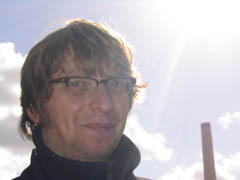

He does not completely look like Alan Rickman in Die Hard, but there is a definite resemblance, reinforced strongly by the fact that, like "Hans Gruber" if not Alan Rickman, he is also German. We tease him about this. He doesn't seem to mind. For in personality he is the opposite of Hans Gruber, very kind and very patient, and is willing to repeat himself, as often as we ask for it.
This is a particularly important quality for the kind of teaching he is doing, I think. Learning something of the fundamentals of photography from scratch, as most of us are doing, means becoming acquainted with a number of alien and interlocking concepts. Shutter speed. Aperture. Depth of field. And the point is that such things are not mere "facts". These are concepts, concepts that he wants us to internalise until they are part of our inner natures as photographers, and that takes time. Which is why they need to be repeated. On the other hand, lots of facts are also involved, and because there are so many of them, they too need to be repeated.
On its own, each fact – each concept even – is reasonably easy to learn, but there are too many of them for us to grasp everything first time around. When we might have been absorbing the next fact, we were still pondering the significance of – or simply trying not to be confused about – the previous one. So, we need reinforcement and confirmation at exactly the moment when we are attending to something. I do, anyway.
This, after all, is the problem with merely reading the documentation, or even reading helpful X-for-dummies type books. The answer to your particular question right now is usually there, but how to find it? And if you do, will it make sense to you, without you already knowing the answer to two other questions? A teacher, if he knows his stuff, can answer your exact question straight away, and if you don't understand his first answer, you can try again until you do, approximately speaking. And, when you forget it all and want to ask the same question again an hour later, you can, if your teacher is like André. In such circumstances the "But I've already told you that!!" style of instruction would be very demoralising.
One of the ways of remaining a good teacher, I think, is to subject yourself to teaching from time to time. That way, you are reminded of how it feels to be taught.
And since I am shovelling pictures onto my blog, I might as well shove up the best of the rest of the pictures taken that day.




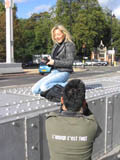
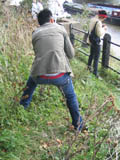

As you can see, I like to take pictures of digital photographers, and that includes taking pictures of myself from a reflecting surface when taking digital photos, as is the case in the photo of the guy in the blue glasses.
Next lesson tomorrow. I leave it to you to decide if they are having any effect.
I have been reading Jo-Anne Nadler's Too Nice to be a Tory, which is an autobiographical essay about the predicament of … well, it's obvious. Here is how she describes (pp. 91-92) that portentous moment when, fresh out of York University, she goes back to London and gets her first proper job.
 'How would you win back the audience we've lost to Capital Radio?'
It was the clincher question in my third and final round of interviews for a job as a trainee producer with Radio 1. Resting on my answer was the prospect of a fairly swanky opening straight out of college. I was shifting nervously, feeling rather sweaty, considering my response. My interrogator was one of three facing me in a deliberately intimidating configuration beloved of the BBC. He went on, 'You know the type, the skilled working class around the outskirts of the M25, out every Friday night at the Epping Forest Country Club, drives a Cortina, furry dice in the back of the car, but it's always independent radio tuned in at the front. What are we going to do about it?'
'Play more Luther Vandross!'
It seemed the obvious answer. It was certainly true that Essex Man liked soul music, of which London's independent station Capital Radio played a lot, while Radio 1 was wall-to-wall Phil Collins, Eric Clapton and the Travelling Wilburys. While I had been a temporarily displaced Londoner myself it had always been a blessed relief to hit Elstree at the bottom of the A1 on the drive home from York. Here was the chance to tune out of Radio 1 and the dirge of ageing hippy rockers and into loud, brash 'dancey' Capital. It was the sign that I was home, in radio terms back in the land of the living. Unsurprisingly I did not add that observation in my response just as I had not played up my YC past when outlining my suitability for the job. Whatever the reality it hardly spelt sex, drugs and rock'n'roll.
I had applied for the job during my final term at university almost as a joke but, without trying, I had apparently obtained the necessary qualifications; an encyclopaedic knowledge of pop music, I had run the campus radio station, I was articulate, ambitious and female – which had marked me out among the applicants. And so, to my great surprise, I was in.
Category: Examinations and qualifications • Relevance
 [0]
[0]
[0]
[0]