
Yes, like the man says, Norm Geras interviews Joanne Jacobs.
I didn't know this:
If you could effect one major policy change in the governing of your country, what would it be?I'd decriminalize drugs.
Because Joanne Jacobs favours schooling as usual (but improved by the market), I pretty much had her tagged as more conventionally right wing than that, i.e. perhaps worried about the War on Drugs, but not that worried.
Live, blog, read other blogs, and learn.

Depressing but inevitable, and presumably now being said by governments and by education departments the world over, more or less loudly:
WASHINGTON (AP) - The U.S. Department of Education has alerted school leaders nationwide to watch for people spying on their buildings as a possible sign of a higher terrorist threat.The warning is based on an analysis by the FBI and the Department of Homeland Security of the school siege that killed nearly 340 people, many of them students, in Beslan, Russia, last month.
The review was done to protect schools and not sent because of "any specific information indicating that there is a terrorist threat to any schools or universities in the United States," Deputy Secretary of Education Eugene Hickok said in a letter to school leaders.
The conventional Western view of war is that there are warriors, and there are innocent bystanding civilians - fighting men on the one hand, and the, old, the unfit, and women and children on the other. (Although during the great bombing campaigns of the Second World War that distinction was stretched way past its breaking point.)
War now is different. The stated ultimate aim of the Islamo-fascists is not to fight against the non-Muslim world and extract concessions from. It is to destroy the non-Muslim world, to wipe it out. And destroying the non-Muslim world absolutely includes destroying the non-Muslim world's children. Especially its children. There's no point in getting into a moral flap about this. Killing children is perfectly logical, given that their aim is to destroy the ability of non-Muslim societies to perpetuate themselves.
This means that all kinds of defensive measures for large assemblages of school-age children will now have to be thought about, just as the US Department of Education says.
And – a thought which has only just now occurred to me as I was typing in the above couple of paragraphs – what if the idea that schools are too big catches on, not just because big schools are (maybe, I think, others think) bad educationally, but also because large clumps of children all in one place are a nice juicey terrorist target. Disperse and defend. It's a thought.
The point is – just to make it clear in case it isn't – not that a small school is easier to defend, but that a big school gets the terrorists more bang for their bucks and their bodies, and is hence more enticing as a target and is hence more likely to be targetted.
Will the Pentagon and the FBI and the CIA and the rest of them start agitating for smaller schools, on the grounds that that way the casualties of terrorist attacks on schools are likely to be fewer? After all, one of the reasons why so many children were killed in that Beslan school is that so many children were at that Beslan school.
As I say, it's a thought and only a very slightly baked one at that. I wonder if others will join in with the baking of this notion.
While I'm on the subject of cumulative fractional baking, my thanks to the Instapundit of Education Bloggers for this posting, about this speculation here, and to her (on that posting) few but fascinating commenters there. Not such a "golden generation" after all, it seems.
UPDATE: Joanne Jacobs also posts today about school security against terrorist attack. Originally I put that this was schools in Iraq, that although the information came from Iraq the schools they're worrying about are in the USA. So I guess this might be the same story as the one I'm linking to.
Apologies for taking so long to link you all (?) to Sean Gabb's recent piece entitled Home Schooling: A British Perspective, but better late than never. Says Sean here: "This will be published in 2005 in an American book about home schooling across the world." And if you follow that link, you can also access other writings by Sean on the related matter of truancy (and also this!)
I have read through this piece, which is quite long by the standards of internet link destinations (28 pages in my print out), and my immediate reactions are very favourable.
Sean starts with what has always been his strong suit, some history. Home schooling has a long one. (Only very recently has our Royal Family not home schooled.) And so does the kind of schooling that now causes parents to want to rescue their children from it.
There then follows a description of the legal position with regard to home schooling, both in England, and in Scotland where things are different.
He makes the point that estimating the exact number of people involved in home schooling in Britain is difficult, because these are not people who volunteer details of their child rearing arrangements with the kind of people who do research into such things. They prefer to keep things to themselves.
He itemises and expands upon the various reasons why people choose to home school, under the three headings of: discipline and safety, curriculum and quality of instruction, and religious and ideological dissent.
He describes the extremely varied home schooling methods used, many of the people he refers to, of course, preferring not to use words like "school" or "schooling" at all. He speculates that the effects of home schooling can't be that bad, and seem pretty good, certainly compared with the available alternatives.
He describes the slow build-up among the meddling classes of the desire to meddle in and evntually to expunge home schooling, which is particularly strong in Scotland, and, given that there don't seem to be many harmful educational effects from home schooling, Sean speculates about other motives for this meddlesomeness, mainly, he suggests, ideological.
If I had started at the beginning of reading this piece with copying-and-pasting bits that were especially important and particularly felicitously expressed this post would have gone on for ever. I will confine myself to reproducing here the Concluding Remarks:
There can be no doubt that - whatever may be the numbers overall - the number of children educated at home has increased and is increasing. During the next few years, it is also at least reasonable to believe that there will be a debate over whether the numbers ought to be diminished. On the one side will be the supporters of an activist state, divided as to their motivation, but united in their belief that education should be supervised by the authorities. On the other will be the home schooling parents. Most of these may be hiding, and they will continue to see safety in concealment. Those who are visible can be expected to fight all efforts at regulation with a passion not seen in British politics within living memory.We may, then, be returning to something like the debates of the middle and late Victorian years, when education was considered more than just a matter of funding and standards.
Well, I reckon EUrope etc. rouses the odd spot of passion already. But otherwise, very good. Read it all, or at least dip in it more extensively than I have here.

That's Sean on the right, holding forth at my Last Friday of the Month Meeting in April of this year.
A new school in Afghanistan.

... from Instapundit, taken by his Afghanistan photo-correspondent and emailer, Major John Tammes.
I went from this at Samizdata to this at tBBC, to a comment on this, to this blog, and to this posting there.
Quote:
What is an educational blog?- An additional communication channel between teacher and learner
- A searchable archive of notes and handouts including downloadable worksheets and documents
- Signpost learners to additional resources
- Support questioning and discussion
- Provide a channel for comment, criticism and evaluation
- Open the teaching and learning process publicly to other interested parties
… which sounds, in a way, pretty old school to me. Which just might be the point.
My old Libertarian Alliance partner Chris Tame was fond of the word "hum", to describe a gradually spreading murmur in favour of some hitherto neglected notion.
Well, I think I detect the beginnings of a hum:
But the way the education system is going, it would be more honest simply to raise the school leaving age to 22. University is just something you do when you've finished your A-levels, no matter how badly you might have done or how bored you've been doing them.To suggest to those who are not cut out for even rudimentary academic life that university might not be the best place for them, is to consign them to non-person status.
It's not as if a degree even helps getting a job: all it means is that you've spent longer waiting to find yourself unemployed. If anything, I feel it might impede your prospects. You're just one among a pile of applicants, similarly qualified, none of whom has anything extra or interesting to offer.
I think it's the middle classes that have to start the move away from tertiary education. Concerned parents now insist, ever more anxiously, on finding a university place when they would be doing a lot more for their children by refusing to fund the whole enterprise.
"… the move away from tertiary education …" Well, well, well, fancy that.
 Remember that when people writing in the Daily Telegraph say "middle classes", they mean fairly well off people in the top 5 percent of wealth and income. Middle as in "not the Queen", so to speak.
The really interesting thing about this article is who it is by. Nigella Lawson. That's right, the Domestic Goddess herself, and not just a bit of posh totty on the telly either. This woman is the daughter of a former Chancellor of the Exchequer and now married to a Saatchi Brother. Talk about well connected.
When people like this start talking about "the move away from tertiary education", then you know that something is going on.
I noticed this when it was first published over the weekend, but it took me until now to pass this on. Sorry, but not really sorry, because this is not a notion that is going to go away.
Wonderful what a price increase does to demand, isn't it? For remember, the idea of this price increase is that it falls precisely on those middle (upper) classes. So, the middle-uppers will, in increasing numbers, turn their backs on the universities. Their kids will get started on Real Life earlier than the riff raff.
How long will it be before "university" starts to have the same social ring to it as "comprehensive"?
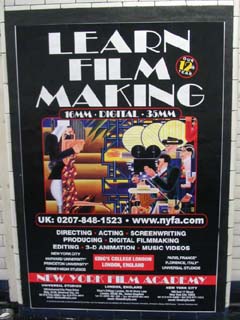 In accordance with my ongoing gratuitous picture policy, I featured a New York Film Academy poster, back in June. They have an offshoot in London, asking:
Are they as good as they claim to be at their website?
. . . i.e. as they claim here.
Someone called Linda Eden-Ellis has commented with an answer:
Yes, they are. The courses are intensive, students are kept very very busy every day and you have to keep up and stay awake - don't go for a rest! You get taught by people from the industry who have invariably done the job commercially – not just academics. The amount of advice, encouragement and motivation students receive on these courses is worth the financial outlay – plus the invaluable thing of networking – you make lots of contacts within the NYFA – people contracted in from industry to teach and mentor and other people on the courses already doing small film projects of their own who might invite you to work with them – if you are any good of course!
Comments, no matter how interesting, on postings from way back are unlikely to be noticed by anyone but me, unless I copy-and-paste them as new postings. Hence this new posting. With the gratuitous photo. Again. But smaller.
I have already linked to this article. Now I have read it.
Short quote:
"They want to make sure that it's good enough to be read by more than just their teacher," said Christopher S. Wright, a third grade teacher at Wyman Elementary School in Rolla, Mo.
That's a thought I have often had, here and there.
It always seemed to me that one of the stupidest things about my school essays was that on the whole only one person, the teacher, ever got to read them. I didn't blame anybody. It was inherent in the primitive technology we all then depended upon. Your stuff either got read by too few people, or was shoved in front of the faces of far, far too many people (i.e. "published" in some way or another), on a scarce and hotly contested piece of territory that involved a fight to get your bit of it. Learners need a happy medium (in both senses), where more than the tiny first few can browse, but no large readership is inconvenienced unless and until it wants to be. Blogging is that happy medium.
As Christopher S. Wright says, once learners blog, they have a built-in inducement to do it better, because the better they do it the more people will read and admire. There is a gradual success path there.
We all know that you typically teach in small increments of challenge, effort, result, reward.
Blogs teach.
I think this is interesting:
A teacher wrote me a letter, saying, "I found it very interesting that the Japanese teachers have students struggle with a problem before they teach them how to solve it. We never do that. We teach them how to solve it first, and then let them work on examples."She said, "I’m a very traditional teacher – I just get up and lecture – but I decided to try something after reading your book. I now start my lessons by letting students try to solve it on their own, and then give my lecture." She said this small change had worked brilliantly for her. She saw a huge change in motivation and engagement in her students.
First they do it. Then theorise about it for them, in a way that then makes sense. Load. Fire. Take aim.
It found this here.
Many adverts work like this. First confuse them with a confusing message. Then explain it.
And TV shows. And newspaper and magazine pieces. First you hit them with some enticing but rather confusing surface facts, perhaps facts which have already got around in a garbled form. Then you say: okay, what's really going on here?
Personally I favour pupils choosing what to be confused about, and on that basis choosing which lectures to attend, or to attend to, but that's beside this particular point. Close, but beside.
On Saturday evening I had supper with my friend and fellow Samizdatista Johnathan Pearce, and very agreeable it was too. We discussed many things, and one of the more interesting things we discussed was one of Johnathan's father's school teachers. Johnathan's father was at school just after World War II, and consequently found himself being taught by, among others, people who had just won the war.
He was apparently taught physics by a young guy, about twenty five years old then, who had, before taking up his post as a teacher, been a navigator in a Pathfinder Squadron. For those not versed in the details of how Britain's wartime bombers went about their grizzly business, the Pathfinders were the ones who went to the target first, and started a small fire on it, which all the bombers would then aim their bombs at. The combination of technical expertise and sheer guts needed to be someone like that is something at which most of us can only, luckily for us, guess.
And one of these young fellows was, as I say, Johnathan's dad's physics teacher. Young, obviously. But also, because young, very keen and energetic. In short, the very essence of Alpha Maleness.
Johnathan's dad goes further, and says it would be interesting to examine the impact upon education, not just of this one young man, but of all the other young men like him who, just after World War II, while still only in their twenties, entered the teaching profession.
Someone like this physics teacher (a) is going to know his physics pretty well, and (b) is hardly likely to be phased by a classroom full of exuberant and potentially rowdy and out-of-control schoolboys.
Now you may say that, now, things are very different, and even the most formidable of men sometimes have a problem keeping in control of classrooms, and I am sure that's true. But the exact chronology of this golden generation of schoolteachers, if that is what they were, is, I think, suggestive.
In particular, ask yourself when these guys stopped teaching. Assume that they were around 25 when they started teaching, fresh from their Avro Lancasters and their tanks and their ships and their Spitfires, and that they retired at around 65. So, add 40 years to 1945, and what year do you get? Well, you don't need much maths for that. The answer is 1985.
Now, 1985 is the approximate time when it is now claimed that education in Britain started to enter its most recent period of being very bad, and in need of much increased central control.
The usual explanation for educational decline, and most especially of decline in discipline and pupil behaviour, is … well, what? Nobody properly knows, other than to note that wider social forces, forces outside of schools, made a big impact upon schools and changed them for the worse. But just what did these "social forces" consist of? All sorts of things, of course, including television, the rights-before-responsibilities mentality encouraged by the welfare state, drugs, the immigration into Britain of some ethnic groups who behave very badly (although others behave extremely well of course), have been blamed for this decline. Other more immediate malign influences on schools have included: idiotic teacher training colleges, idiotic theories of literacy teaching, and, in general, all the stuff you read about here from time to time when I am in a complaining sort of mood. But how about this for at least a part of the explanation? - that during the 1980s a lot of extremely good and, so far as the wider life of the schools they taught in, hugely influential teachers retired, and were not replaced by teachers who were anything like as impressive, and especially not as impressive to young boys. How about that as part of the story of our nation's current educational woes?
Certainly, to judge by the TV adverts being shown by the government now, they would give anything for another generation of men of this calibre and experience of life to go into the teaching profession.
So, there's your answer, start another major war, and hope that a decent number of young men survive it and then, because of the depressed state of the post-war economy, become schoolteachers in huge numbers. Well, not really. But I still say that this is an interesting way of looking at the larger educational picture, usually scrutinised only through a microscope with a label on it saying something like "educational policy".
Here is a gratuitous picture of some Avro Lancasters and of some of the Alpha Males who flew in them and looked after them …

… which I found here.