
Another bit from the Bill Bryson book I've been reading. I've now nearly finished this book. Still excellent.
One of the more charming oddities of university life are those people who manoevre themselves into positions in the university which are not academic, but for an academic purpose. This is not done out of indifference to academic concerns. On the contrary, the people I am talking about take charge of the faculty air condition system, or (as is the case I am about to refer to) become janitors, out of an enthusiasm for the academic life, but accompanied by an unwillingness to bear the usual burdens of a conventional academic post, in the form of such annoyances as teaching unwelcome pupils, administrative duties, or tiresome instructions from academic superiors. Either that, or the university just wouldn't give them a proper job, so they got an improper one.
I remember people of this sort when I was at university. Their success rate is presumably not much different from that of regular academics. Most just live out their lives in obscurity, and by the end of it all they are janitors, or whatever. But occasionally they hit the big time. Bryson recounts one such success story.
In the 1860s, journals and other learned publications in Britain began to receive papers on hydrostatics, electricity and other scientific subjects from a James Croll of Andersen's University in Glasgow. One of the papers, on how variations in the Earth's orbit might have precipitated ice ages, was published in the Philosophical Magazine in 1864 and was recognized at once as a work of the highest standard. So there was some surprise, and perhaps just a touch of embarrassment, when it turned out that Croll was not an academic at the university, but a janitor.Born in 1821, Croll grew up poor and his formal education lasted only to the age of thirteen. He worked at a variety of jobs – as a carpenter, insurance salesman, keeper of a temperance hotel – before taking a position as a janitor at Anderson's (now the University of Strathclyde) in Glasgow. By somehow inducing his brother to do much of his work, he was able to pass many quiet evenings in the university library teaching himself physics, mechanics, astronomy, hydrostatics and the other fashionable sciences of the day, and gradually began to produce a string of papers, with a particular emphasis on the motions of the Earth and their effect on climate.
Croll was the first to suggest that cyclical changes in the shape of the Earth's orbit, from elliptical (which is to say, slightly oval) to nearly circular to elliptical again, might explain the onset and retreat of ice ages. No-one had ever thought before to consider an astronomical explanation for variations in the Earth's weather. Thanks almost entirely to Croll's persuasive theory, people in Britain began to become more responsive to the notion that at some former time parts of the Earth had been in the grip of ice. When his ingenuity and aptitude were recognized, Croll was given a job at the Geological Survey of Scotland and widely honoured: he was made a fellow of the Royal Society in London and of the New York Academy of Science, and given an honorary degree from the University of St Andrews, among much else.

People like this, when they make their first academic breakthroughs, are often celebrated as Holy Fools. Uneducated illuminati. They are nothing of the sort. They are very well educated, but by themselves.

Via Chrenkoff, I got to this about a lady who has been awarded a prize:
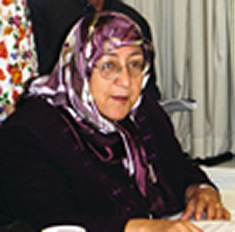
After more than a quarter century of war and instability, the literacy rate of Afghans, particularly women, was among the lowest in the world. When many schools closed in 1995 and the foundations of education throughout the country were in danger of collapse, Sakena Yacoobi and two other concerned Afghan women founded the Afghan Institute of Learning to help address the lack of access to education for women and girls, their subsequent inability to support their lives, and the resulting impact on society and culture. They committed AIL, a non-governmental organization (NGO), to bringing peace and dignity to the Afghan people as they struggle to overcome oppression, devastation, and injustice.During the Taliban years, AIL ran 80 underground schools as well as mobile libraries in four Afghan cities. By the end of 2003 the organization served more than 350,000 Afghan women and girls in Afghanistan and Pakistan's refugee camps through its girls schools and programs in teacher training, health education, human rights education, women's leadership training, and literacy. With its 470 employees, 83% of whom are women, it is a model and a leader in rebuilding Afghan civil society.
The official citations read: "The Women's Rights Prize of the Peter Gruber Foundation is hereby proudly presented to Sakena Yacoobi, President of the Afghan Institute of Learning, for her courageous vision and leadership in implementing quality education, human rights training, and safe healthcare for Afghan women and children. Despite significant personal risk during the time of the Taliban and in the aftermath of violence and war, she has worked tirelessly to improve the life, opportunities, and social infrastructure of Afghanistan's neediest residents and its refugees in Pakistan."
"The Women's Rights Prize of the Peter Gruber Foundation is hereby proudly presented to the Afghan Institute of Learning for expanding health and education opportunities for women and children in Afghanistan and Pakistan. The unwavering commitment of its dedicated teachers, doctors, and health care providers under the repressive Taliban regime and during post-war reconstruction has truly empowered hundreds of thousands of Afghan women and children, citizens and refugees alike."
This is all part of why Chrenkoff reckons things are now getting better in Afghanistan. Not, he says, that you'll get much about this from the mainstream media. But that's the way with good news. Not very interesting. Not dramatic enough.
Although, he does quote from this guy, the exception who expounds the rule.
Yesterday in the London Underground, I picked up a stray copy of the Camden New Journal, and found myself reading an article about a music teacher. Today I was able to find it in linkable form:
MR MUSIC at Camden School for Girls, John Catlow, is preparing to retire this month after 18 years explaining the mysteries of sharps and flats.
A distinguished former cellist, Mr Catlow, 63, played with the London Symphony Orchestra and was first principal cello with the Hallé Orchestra and English National Opera before becoming a teacher at the school in Sandall Road, Camden Town.
As well as his classroom work, he is currently preparing for a piano and cello recital the day after term ends.
And he is busy doing research before conducting Beethoven’s Eroica Symphony as part of the school’s third Reunion Orchestra Concert, performed by past pupils, on July 11.
Mr Catlow says of his mid-career move to the classroom: "I needed to get out of orchestras.
"I was experiencing stress in my bowing arm and the music profession is littered with former great players just serving out their time. I wanted to avoid that.
"And playing orchestral music isn’t at all demanding intellectually."
So, rather than simply becoming a peripatetic cello teacher, he decided to go the whole hog and teach music across the secondary age range up to A-level.
"Turning to teaching was a shot in the dark," he admits.
"A school isn’t a glamorous environment, and sometimes you don’t really feel like you’re winning. But it was definitely more fulfilling for me in the long run."
And so on. No criticism here. Here's how the piece ends:
… it was Rosemary Cumming, from the school office, who paid Mr Catlow his most significant compliment.A former temporary receptionist told her he was quite simply "the nicest, friendliest person at the school".
I suspect that there is a direct connection between extreme competence and extreme niceness. It doesn't always happen this way, of course. Many extremely competent people exploit their indispensability by being extremely nasty. But if you are extremely competent, and everyone knows it, you may not feel that you have to demand respect from people by chucking your weight around. You have respect already.
I further suspect that Catlow was a whole lot better at teaching for having done other things first, and at a high level of accomplishment. God save us from schools where the only thing the teachers have done is either teaching at school, or, before that, learning at school. Schools need variety on the staff, and people like Catlow provide it.
I bet he had some stories to tell. The LSO in particular is a famous storm centre of anecdotage.
 Okay so I was looking through Daryl Cobranchi's blog for something there recent to link to, and my favourite was this, which has a gratuitous picture of a dog. Gratuitous picture of the dog reproduced here. I know, you wait months for a picture of a dog, and suddenly two dogs in two postings.
But I followed the links in his piece of dog blogging, and I got to something more substantial, in the form of a piece about blogging. It includes this gem of brilliance, from a Sociology Professor:
"It's likely to be a fad," said Robert Wood, sociology professor at Rutgers University-Camden in New Jersey. "In a year or two we'll be on to something new."
What you mean "we", Sociology Professor? You ain't no blogger, that's obvious. If you were, you'd know that blogging is here to stay. Sure enough, he has a very individual looking website of the sort that people who want blogging to drop dead tend to have.
Being into websites he offers this page of websites for teachers, which includes a number of links that could be worth following up.
The Internet eh? You go looking for ways for sneering at someone, and before you know it you find something that might be interesting.
This, for example, took me to this which lead me to this and to this and this, athough I could have missed a few steps there. The pictures look really good.
I think I will now do a posting about this on this.
Alan Little kindly emails with a link to this posting, and singles out this paragraph as likely to be of particular interest to me:
If everyone in a poor neighborhood were educated to the standard of the average Harvard graduate all of the other problems would be solved. ... [but] ... Schools for poor people are government schools. Everyone who works there is either a bureaucrat or a union member. None of these people incurs any kind of pay loss or risk of firing if the kids remain totally ignorant.
Alan also supplies this entertaining potted biog of the writer of this, Philip Greenspun – gratuitous photo of Greenspun and friend to our right, obtained here – thus:
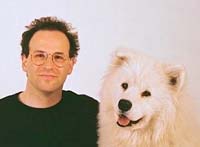
Philip Greenspun is a guy who made a pile of money by founding a dotcom software company and selling it out to a bunch of venture capitalists just before the crash. Smart move. Now he flies planes and writes a bitingly cynical but sometimes sharp weblog.
Smart move indeed.
I think that countries like the USA (and Britain) may now be entering a period of their history where the pressure to get educated (if not to Harvard graduate standard then at least well above barbarism) is reasserting itself, after a period of educational slackness that may now be ending.
In the first period, you did as well as you possibly could, including educationally, to get as far away from starvation as you could. (A lot of Indians and Chinese are in this phase now.)
In the phase of relative relaxation, if you were willing to work (without much in the way of education) then, wars and slumps willing, you could work, and have a reasonable life. This was the time of "Fordism".
But now, in countries like mine and like Greenspun's, there are just two classes: educated class, and underclass. There is now no "working" class in between, i.e. a class using physical effort, physical skills and little else.
That is of course an exaggeration and an over-simplification. But it's the way things are headed. And that's the sense in which Greenspun is right. He's probably overdoing it to say that we are already there.
By the way, the comments on Greenspun's posting are interesting, especially the ones defending public sector educators, quite eloquently as it happens.
Arts & Letters Daily links to this piece about how academics are now being pushed by their own faculties towards the media.
… As schools vie to attract top students, top faculty, and top-dollar gifts, they count on their bookish professors to leave the library and enter the studio, where their insights on the day's news might help put their institutions on the map."It lends a certain credibility when they see you on television," says Mr. Williams, an expert in military affairs. "It may boost student enrollment in my courses."
For schools aspiring to enhance their reputations, the task of positioning faculty for a "media hit" has become big business. To get their professors into reporters' Palm Pilots, 624 colleges and universities pay between $500 and $900 each per year to be listed with ProfNet, a private database. Some go further by paying thousands to private firms whose sole mission is to get professors quoted in the press.
Spokespeople in higher education tend to agree that the time, effort, and money they invest to get professors quoted in news stories are priceless.
You can imagine all manner of moans about what a bad thing this is. "Dumbing down", "soundbites", etc. etc. But I think that the intellectual dangers associated with universities becoming media backwaters are at least as great as the dangers of media involvement.
I am, of course, biased. My background is political think tanks in general and the Libertarian Alliance in particular, and about half the point of these enterprises is to get political ideas spread around - the other half being to think of and about them. And having been involved in both processes for the LA, I can tell you that far from interrupting or hurting the thinking bit, the media bit actually stimulates further thought.
Ask yourself this. When the history of Britain during the second half of the twentieth century is written, as it is starting to be, which institutions will loom large:a think tanks, or university faculties? And surely a big reason for this is that whereas universities during this period have been wary or even hostile of media engagement, think tanks have lived for it. Has this made think tanks any less inclined to think? I strongly think not.
What think tanks have actually supplied is a kind of media front-end for academics, of the sort their own universities have been unwilling or unable to supply. The think tanks have used universities rather than straightforwardly competed with them. But if you measure intellectual impact – young brain cells stirred up, old geezers made to rethink, worthwhile soundbites crafted and launched, etc. etc. – and compare it with money spent, I reckon the think tanks have done very well, compared to the universities.
 One obvious advantage of the media is that they face professors with something that they don't always get when tucked away safe in their faculties: disagreement. I still treasure the memory of a run-in I had with my old Essex Sociology Professor, Peter Townsend (partly because I wrote it up at the time for the LA), where we generally went for each other's throats on the subject of poverty – what causes it, how to end it, etc. etc. The abiding impression I got from this altercation was that Professor Townsend (gratuitous picture to the right) regarded it as something of a scandal that anyone should dare to disagree with him on his area of academic specialisation. Yet for this very reason, I am convinced that the experience can only have done him good, and maybe a lot of good. At the very least it will have acquainted him a little more forcefully with the ideas and attitudes of those whom he seeks to convert, persuade and convince.
More fundamentally, lots of people arriving at university for the first time are often shocked by how indifferent to ideas many people at universities actually are. I have many friends who have told me that they have had a better education at the hands of things like the LA than they got doing economics at university. Many universities exude the atmosphere not of intellectual hothouses bursting with fascinating ideas and arguments, but of rusty old machines idling along, shovelling a stagnating syllabus from A to B rather than causing anyone to get at all excited about it. A good old ruckus on the television between your crusty old Professor of Biology and the local Creationists, or between the Professor of Physics and some deep green anti-technologists or anti-nuclear peaceniks, might be just the thing to liven things up and get the students interested again, and generally to get people talking to each other again, in animated rather than tired voices.
As for that old "soundbite" canard, a soundbite is just a really well made point that you don't like, or just wish you were eloquent enough to have created but are actually not. The pressure from the media to answer dumb questions with short answers is often immensely stimulating to further thought. Professor Waffler, in one sentence because soon we have to go over to the newsroom: What do you do? Or: Why do you bother? Or: Why should we pay for it? Such questions are, I suggest, not so very dumb and are well worth thinking about until such time as you can answer them with a set of soundbites. And when you've got your soundbites, try sharing them with your students. They might finally get the point of you and of what you do.
As for media whore professors who are nothing but soundbites, well, they'll be found out sooner or later. Yes, there are dangers connected with media involvement. But universities can't be all light. They need a bit of heat. And in practice, I say, the two tend to go together.
This could be a Conservative vote winner.
Disruptive pupils will be sent to tough new day units and subjected to "no-nonsense discipline" under Tory education plans to be unveiled this week.
No doubt the actual details of the policy will involve the odd spot of nonsense, but I'm talking politics here, and politics is always nonsensical.
There are plenty of people in the upper reaches of the Government who understand that discipline is crucial to making state school function adequately, and that the key to discipline is being able to exclude unruly pupils. But lower down in the system are people who fatuously hope to achieve discipline without either violence or exclusion. "Society" must be "inclusive" blah blah. Can't be done. The Conservatives have a strong issue here.
Matthew d'Ancona, in today's Sunday Telegraph, made me smile with this:
A minister close to Mr Blair once asked me what would be a good objective for the Prime Minister to announce in a forthcoming conference speech. I said that he should commit his Government to reducing the percentage of parents who send their children to private schools - not by penalising those schools in any way, but by making the state sector so attractive that parents no longer felt the need to look elsewhere. The minister, normally garrulous and Tiggerish, went strangely quiet.
Much is made, by people in my corner the political opinion map, of the phrase "schoolsandhospitals". But d'Ancona ruminates on the differences between schools on the one hand, and hospitals on the other – between education and health. In particular, he speculates that the Conservatives, who still get nowhere on the health issue and just bleat that they will spend more money, might actually make some headway with their complaints about and policies for education.
Another reason why health is different from education is that the kind of clever, young, opinionated people who make the running in political policy creation are usually right in the middle of that time in their lives when they are least concerned, personally, about health. They are, in short, very healthy. They have no recent experience of serious healthcare, and they face no immediate prospect of it. They have hardly any sustained experience of - or, yet, much fear of - what it is actually like to spend a year in a hospital, or to have to combine staying alive with suffering from a chronic disease. They may learn from some survey or other that "people" care very much about the NHS, but this is a truth they most of them must accept at second hand.
By contrast, these clever young persons have just emerged from a couple of decades of the best that our nation's educational system can offer. They are good at this, and that is pretty much all they are good at. No wonder they take it so seriously, and want everyone else to, and are full of opinions about how to improve it, even if the teachers dread these plans.
However, voters are different, and so are many of the more senior politicians who seek their votes. Voters are old. Voters have young children. Voters have dispiriting jobs, which they seek medical excuses to avoid every now and again. So voters know about health and care about health even if policy wonks care less about it.
But second, and probably more important, is the fact that many millions of voters must surely feel, and with some justification, that they could teach their children, and other people's children, just as effectively as the actual teachers do. They could be wrong, but that is surely how they feel. They all have years of experience of the most important thing that goes on in schools, which is the teaching that goes on in classrooms, and the only reason they don't then teach for a living themselves is that they've more lucrative and interesting ways of spending their lives. If all state school teachers disappeared to the West Indies for permanent holidays, they would rapidly be replaced, by the electorate, and in a way that might very possibly be an improvement. This may not be true, but lots of people surely think this.
But your average voter would have no such confidence if he was suddenly asked to perform a hip replacement. Medicine involves real knowledge, real training. Teaching? Anyone can do that.
So, when people think about health, they think: could be far worse. Don't mess with it.
When they think about education, they think: could do far better. Give it a good kicking. What's the worst that could happen?