
Interesting stuff in the Guardian about history textbook battles in India. A change of government there means a change of syllabus:
India's new government is poised to rewrite the history taught to the nation's schoolchildren after a panel of eminent historians recommended scrapping textbooks written by scholars hand-picked by the previous Hindu nationalist administration.Hundreds of thousands of textbooks are likely to be scrapped by the National Council of Educational Research and Training, the central government body that sets the national curriculum for students up to 18.
The move, one of the first made by the new Congress led government, will strongly signal a departure from the programme of its predecessor.
The "saffronisation" of history, say critics of the last government, depicted India's Muslim rulers as barbarous invaders and the medieval period as a dark age of Islamic colonial rule which snuffed out the glories of the Hindu empire that preceded it.
Memorably, one textbook claimed that the Taj Mahal, the Qu'tb Minar and the Red Fort, three of India's outstanding examples of Islamic architecture, were designed and commissioned by Hindus.
Cue Gratuitous Picture of the Taj Mahal:

And a rather good one, I think.

Finally, a private sector in teacher training:
What business has the state controlling teacher training? Why do we need teacher training institutions? Shouldn't introducing teachers to their craft essentially be a matter for schools? Shouldn't the role of universities be confined to encouraging teachers to reflect on their practice and formulate their own vision of education?Such apparently subversive questions are prompted by an approach to teacher training being pioneered by Buckingham, Britain's only truly independent university. The programme is supported – up to a point – by HMC, the body that represents the heads of 240 leading independent schools.
This month, 13 teachers, all mature graduates working in HMC schools, will be the first to complete Buckingham's one-year post graduate certificate in education (PGCE).
Okay, it's a moot point just where in the private/public spectrum your average British university is to be found. But this is definitely a small step in the right direction along that spectrum.
By the way, this is the kind of big media story I am happy to link to, obviously (as Alice Bachini would say). This is because, although it may be big media, the story itself is small. Yes, it includes some numbers, but they are small numbers. 240 heads of independent schools, 13 teachers, and above all, just the one university. Thus, the story is likely to have some vague relationship to the truth.
When the big media recycle the claims of the big politicians to the effect that this or that big number (concerning national exam results for example) has done a small percentage shift in the right or for that matter the wrong direction, I find it all much harder to believe in or to be interested in.
I've already quoted here from the delightful A Short History of Nearly Everything, about the American scientist Michelson. Here is Bill Bryson describing that modest genius of chemistry, John Dalton (1766-1844). Dalton was a school-teacher from a very early age, until – despite his scientific eminence – a very late one.
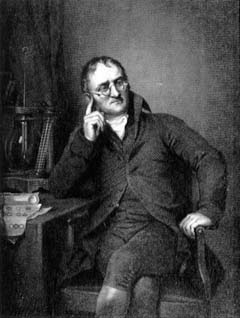 Dalton was born in 1766 on the edge of the Lake District, near Cockermouth, to a family of poor and devout Quaker weavers. (Four years later the poet William Wordsworth would also join the world at Cockermouth.) He was an exceptionally bright student – so very bright, indeed, that at the improbably youthful age of twelve he was put in charge of the local Quaker school. This perhaps says as much about the school as about Dalton's precocity, but perhaps not: we know from his diaries that at about this time he was reading Newton's Principia – in the original Latin – and other works of a similarly challenging nature. At fifteen, still school-mastering, he took a job in the nearby town of Kendal, and a decade after that he moved to Manchester, whence he scarcely stirred for the remaining fifty years of his life. In Manchester he became something of an intellectual whirlwind, producing books and papers on subjects ranging from meteorology to grammar. Colour blindness, a condition from which he suffered, was for a long time called Daltonism because of his studies. But it was a plump book called A New System of Chemical Philosophy, published in 1808, that established his reputation.
There, in a short chapter of just five pages (out of the book's more than nine hundred), people of learning first encountered atoms in something approaching their modem conception. Dalton's simple insight was that at the root of all matter are exceedingly tiny, irreducible particles. 'We might as well attempt to introduce a new planet into the solar system or annihilate one already in existence, as to create or destroy a particle of hydrogen,' he wrote.
Neither the idea of atoms nor the term itself was exactly new. Both had been developed by the ancient Greeks. Dalton's contribution was to consider the relative sizes and characters of these atoms and how they fit together. He knew, for instance, that hydrogen was the lightest element, so he gave it an atomic weight of 1. He believed also that water consisted of seven parts of oxygen to one of hydrogen, and so he gave oxygen an atomic weight of 7. By such means was he able to arrive at the relative weights of the known elements. He wasn't always terribly accurate – oxygen's atomic weight is actually 16, not 7 – but the principle was sound and formed the basis for all of modern chemistry and much of the rest of modem science.
The work made Dalton famous – albeit in a low-key, English Quaker sort of way. In 1826, the French chemist P. J. Pelletier travelled to Manchester to meet the atomic hero. Pelleder expected to find him attached to some grand institution, so he was astounded to discover him teaching elementary arithmetic to boys in a small school on a back street. According to the scientific historian E. J. Holmyard, a confused Pelletier, upon beholding the great man, stammered:
'Est-ce que j'ai I'honneur de m'addresser a Monsieur Dalton?' for he could hardly believe his eyes that this was the chemist of European fame, teaching a boy his first four rules. 'Yes,' said the matter-of-fact Quaker 'Wilt thou sit down whilst I put this lad right about his arithmetic?'
Although Dalton tried to avoid all honours, he was elected to the Royal Society against his wishes, showered with medals and given a handsome government pension. When he died in 1844, forty thousand people viewed the coffin and the funeral cortege stretched for two miles. His entry in the Dictionary of National Biography is one of the longest, rivalled in length among nineteenth-century men of science only by those of Darwin and Lyell.
A comment has recently been added to this posting about Muslim homeschooling, from way back in 2002. I said I was in favour of it. Corey writes as follows:
Hi Everyone,I think this is a good discussion. I like the freedoms involved in homeschooling my kids. I really support everyone's freedoms to do this. I happen to be a Muslim and even though I wear the headscarf, I am by no stretch an extremist. I have quite liberal views about human rights and social justice and as a Muslim I plan to give my kids more than just a religious education. In fact we'll focus on secular materials most of the time. (The nice thing about homeschooling is that we can still observe our 5 daily prayers together) and I'll be able to teach them some history that wouldn't be available as curriculum in public school. Our public schools over here are very overcrowded and riddled with gangs, drugs and the like. I think, as an educated woman I can find many resources to enrich my children more so than the public school. Even though I'll be homeschooling, I will especially teach my children respect for other people's belief systems and cultures. I feel very committed to that. I think that most people, no matter what religion they are or what culture they come from, try to teach cooperation and acceptance. Lately, there has been a lot of post September 11 backlash against the Muslim community. These hate-crimes and incidents have targetted many school children. Parents really appreciate the option to homeschool, especially if they feel that their child is in danger.
Corey might also be interested in this more recent posting on the same topic.
 A couple of months ago I reported on Mean Girls, basically because I had just introduced my Gratuitous Picture policy, and this was a fine excuse for pictures. (And of course mentioning this movie again is another picture opportunity. This time I've chosen a snap of one of the boys in the movie for my lady readers.)
However, quite aside from its pictorial possibilities, it seems that it is also quite a good movie.
It certainly, according to 14-year-old Ellie Veryard, serves up many lessons about the joys of all that socialisation that home schooled kids miss out on. The heroine of Mean Girls was home schooled before then being school schooled. And I'm guessing/hoping that if this movie does well in Britain, it will get more people thinking about home schooling, simply because home schooling is an important part of the story.
This looks really interesting. Note how public sector failure seems automatically to have attracted the interest of the private sector. The private sector had to solve the problem, and then it decided to go into the business in an even bigger way.
Clowes: How did you become involved in education reform?Brennan: When we began automating our manufacturing plants in the early 1980s, we discovered our employees were insufficiently educated to do the necessary transactions on the factory floor, so our company went into the education business. Every single employee, depending upon level of education and achievement, was in our classroom for one or two hours a week, using computer-aided instruction.
We had great success with that program – which still continues in our factories – and I recognized that technology has a major place in education reform. But when I tried to carry this message back to the public schools, they weren't interested. It didn't fit their pre-conception of how education should be carried out. Then I recognized that the problem we had in public education was a total inability to effect innovation. That only comes in a market economy, where there are choices.
Computer-aided instruction is the teaching of mathematics, reading skills, language arts, history, social sciences, and so on, by computer. All academic subjects are now deliverable by computer. It's a segment of our education world where a number of companies are aggressively pursuing the continued development of more sophisticated computer-delivered curriculum. Our education company now has a fully supported homeschooling network with high school curriculum delivered over the Internet. We have a very large center of master teachers serving a student population of about 2,500 here in Ohio and we're opening in Pennsylvania.
Sooner or later, computer aided basic education that really works is going to be available free to everyone on the Internet, and everyone is going to know that it is there. There is some way to go before this happens, but when it does, and it will, it will be a different world, my readers, a different world.
I've spent most of my blogging time today writing a ridiculously long piece about the complexities of qualifying out of the group matches at the European Soccer Championships, and a link from here to there is all I can offer today.
Here, gratuitously, is the picture I used to illustrate the kind of stuff I was writing about.

The educational relevance? Well, simply that sporting arithmetic is a great way to teach arithmetic to small boys. I still remember with pleasure the day I explained about fractions to a small boy, by talking about a soccer game.
And I dare say there's even the occasional girl who might be persuaded to take maths a bit more seriously with talk about sport.
In education, small is beautiful. That's what these people think anyway:
Next week is officially Small Schools Week, which means that for the next seven days, education pressure groups such as Human Scale Education and the National Small Schools Forum will join forces to harangue MPs and education administrators with their "small is beautiful" mantra.These organisations believe that, as schools have grown bigger over the years, they have become impersonal "academic sausage factories". Do they have a point? Can children really be taught more effectively in schools with fewer than 100 on the roll?
To find an answer, I went to Ashburton in Devon where, behind the facade of a Victorian merchant's house, is Sands School, a non-selective independent establishment for 11-17-year-olds. It has just 60 pupils. What are the advantages of such a small school?
"Having limited numbers means we can value all our children as individuals," says Sean Bellamy, the head teacher. "In a large school there is such uniformity. Children behave in a prescribed way and wear a uniform. Here the atmosphere is more relaxed - like that of an extended family."
Well, I can imagine some children not liking this particular school at all. An "extended family" of this particular sort might not suit everyone. But if there were a lot of small schools, children could chose a small school that they liked, and dodge the ones they didn't like. Choice would be more than a political slogan, it would be a reality.
At the Sands website, it says it has 75 pupils, rather than sixty. I don't know the explanation for this disagreement.
Last week, the oldest children at Sands were sitting GCSEs, their final exams before leaving. What did they make of their small school? "We have all absolutely loved being here," said Sophie Gibbs-Nicholls, 16, standing among a group of friends. "We have been crying our eyes out because we have to leave."It will be weird going to a big college next year, being taught by strangers. I'm not sure how we'll adapt to that."
Sounds like they might like a small college also. Yet, I somehow feel that the whole idea of a college is that it is big, or at least bigger than a small school. Colleges should, in this respect, resemble the world, the bigness of which we all have to face sooner or later, one way or another. But that's just me. If some people want to found a small college, and a small number of people want to attend it, why should I worry?