
Last night I hosted a talk by Sean Gabb, and ripped off a report of it for Samizdata. I fear I exaggerated the speed and extent of the collapse of the Eastern Roman Empire, following the plagues of the mid sixth century. But the impact of plague on events was most interesting.
Basically, when a political system is presided over by a tiny elite of literate conquerors who speak one language, but who rule people who speak other languages, plague spells deep trouble for that elite.
This elite doesn't perpetuate itself biologically. It perpetuates itself by teaching its alien language to a regular few of the upwardly mobile locals. So teachers are a key part of this process.
When plague strikes, half the elite die, including half the teachers. But the other half of the teachers then have to turn their hands to more important matters, filling in for their former dead superiors. Thus, the process of replenishment and perpetuation ceases. In large parts of the old Eastern Roman Empire, ruled by a Greek speaking elite, this elite melted away, throughout what we now call the Middle East.
And to me, even more of a revelation, the Black Death (mid fourteenth century) killed off French as the governing language of England. I never knew this.

Recruiting head teachers is getting harder, says David Hart of NAHT.
The turnover of senior management in schools has reached crisis levels, with headteachers suffering from "football manager syndrome" a conference heard today.
Which is daft. There is no shortage of people wanting to be football managers. Make that the political people talking about football in a desperate attempt to get media coverage syndrome.
Vacancies for headteachers has reached the highest level in seven years and is 20% up on this time last year, according to analysis from the National Association of Head Teachers, revealed at its annual conference in Cardiff.David Hart, NAHT general secretary, said: "Headteacher turnover is reaching critical proportions."
Read the whole thing, as they say.
My interpretation? If you sovietise the education system, but allow other parts of the economy to remain relatively unsovietised, people will flee the sovietised bit, just as they fled from old fashioned Communism. (The answer: A free market in education.)
There's an interesting article by David Hargreaves in the latest Spectator about how he didn't like the school he was at when he was fourteen. So he ran away from it, and, with the help of his parents, ended up attending a much nicer local school. Which would also have been cheaper, presumably.
It turned out better than any of us dared believe. Against the odds, I made friends quickly and easily, started to do some decent work and, three years down the line, won a place at Oxford.
And he went on to become a teacher. In which capacity, he recalls meeting another father who wasn't nearly as nice as his had been:
I've never forgotten bumping into the father of a very bright ex-pupil of mine at some dinner. 'I haven’t spoken to Henry for six months,' he told me. 'As far as I am concerned he has wasted his life.' Shocked and sorry, I asked what on earth had happened. 'He got a second,' came the reply, voice shaking with indignation. 'The third generation of our family at Trinity, and all of us with firsts. I can't even look at him.'
Sounds like Trinity has its limitations as an educational establishment.
Interesting plot to this movie, I think you may agree:
Plot Summary: Raised in African bush country by her zoologist parents, Cady Heron (Lohan) thinks she knows about "survival of the fittest." But the law of the jungle takes on a whole new meaning when the home-schooled 15-year-old enters public high school for the first time and falls prey to the psychological warfare and unwritten social rules that teenage girls face today.
It's the way that "home-schooled" is now a standard feature of American life, needing no explanation. I intend to check this out on video, if only to see how the whole home-schooled thing is treated.
It's Mean Girls. And as is all very proper for a Hollywood movie, not many of us can remember sharing a school with girls like :

Again, I've been wandering the Internet looking for pictures to decorate this. Although, perhaps …
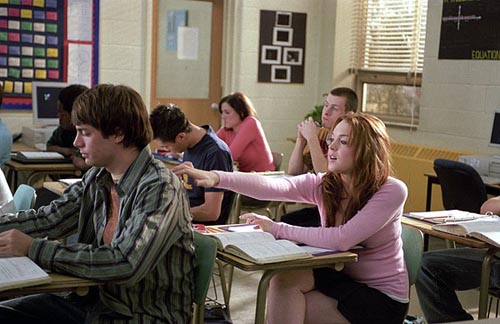
… would be more appropriate for here.
Cecile duBois describes the grief of group rather than individual assessment.
I have a lab report due tomorrow. I should be happy that its a group project, and we share equally the load of work to do. But no - not in this situation.
Her problem is that the three others aren't doing their fair share, but the marks will be dished out as if they are.
I don't mind doing work - but when its four people's shares of work on my back working for the sake of not only my grade, but our grade, I do mind.I recorded the data, typed everything out, printed everything out, stapled together as neatly as possible. But if science teacher is not pleased about a certain thing, if its not 'cute enough' or a number is missing in the data, your precious lab report will be torn in half in the trash.
Earlier, it was by sheer luck I wound up in groups with students who actually worked at least their share – and who actually knew what they were doing, math-wise.
I just hope I haven't lost my wits this time.
For the brutal truth is that …
… If I don't do the work, we all fail.The lesser of two evils: allowing three idiots to keep me as their one-night homework slave than having us all fail. Yeah, I've got to pick my battles. At least they don't read this blog.
Or this one. [P]oindexter comments somewhat pompously (but he has a point):
it's important to learn teamwork and how to engage in collaborative projects - it's a given that others will be slackers and/or ill-suited for the tasks ... welcome to the real world! ... that's how adults spend most of their waking hours: either dodging their share of the burden, or being forced to overcompensate for others' shortcomings ... here's an opportunity for you to exercise true team-leadership and management skills, and learn how to get the job done - without whining, complaining, fault-finding, finger-pointing, etc. ... that's how you'll get to be the one who picks your own team! ...
But I reckon the way to learn teamwork is to join a real team, rather than a fake one put together in a classroom. This is why employers – in Britain anyway, but I bet it's the same in the USA – look for evidence of out of school activities of one kind or another.
I'm not sure exactly why things work so much less well with classroom teams than with teams elsewhere. Partly it is that the results of school work are entirely concentrated in the individuals to whom education is done. The results are not actually collective. Another reason may be that since group work is the exception in school rather than the rule, there isn't very much of it, and the rewards of shirking are liable to outweigh the punishments. As so often in this world, repeat business is the key, and with group work at school, there is less of that than there is in non-school world.
I like Cecile. I like her because when we met in London … I liked her. And I like her because when I said something nice about her, she put it permanently up at the top right hand side of her blog, which means that I am famous throughout the right wing teenage-o-sphere. So, because I like her, and because this blog needs pictures, here is a another picture of her I took in London:

Technically this photo is all over the place, with red eye, and a blurry left side (as we look at it) of her face. But it gets her well, nevertheless.
The pictures on the wall? The owner of them is a good friend. He likes them.
UPDATE FRIDAY: And guess what. Without realising it, I posted all that on Cecile's fifteenth birthday. I must be psychic. Michael Jennings has another picture of Cecile at the same event.
Theodore Dalrymple, writing in the Spectator about the (impeccably legal) corruption of Britain's public services, has this to say about British education:
We cannot even organise a public examination system for schoolchildren in this country so that the results mean what they appear to mean. As for our universities, they blatantly steal the money of foreigners by virtually selling degrees that will soon start to devalue like the mark after the first world war. No longer scholarship and learning, but bums on seats and grade inflation to guarantee yet more bums on seats next year, these are the aim of our institutions of higher education.
I on the other hand like to think that since our universities will be operating in a genuinely competitive international market, all those foreign students will keep them up to the mark, and will thereby be doing us an even bigger favour than parting with their money to us.
Let's hope that I'm right about that, and that Dalrymple is being too pessimistic.
Arts & Letters Daily links to this article, which is about this blogger. First I'd heard of her.
If you are looking for academic angst, you have now found it.
Question: When does a blog turn into a book? Answer: When the blogger stops writing any more and just leaves it there, but when it's still worth reading. Here's another blog-book.
Blog-book. Blook. Have I just made up a new word?
No need to stop reading blooks just because the bloggers have stopped writing them. After all, books have to be finished before we are even allowed to start reading them, but we still read them.
I've just finished a posting at Samizdata which ends thus:
And now I will go and do a posting here …
I.e. here.
… about the educational vibes of combining home working with home educating.
And I reckon if I had to leave it at that, that would suffice.
Put it this way. Here are two big current trends on the up: home working and home educating. Between them they reunite children with the world of work, something educators have been wanting to do ever since an earlier generation of idealistic educators finally succeeded in wrenching these two things apart from each other.
In the present world, where work is work and school is school, all too many children emerge from their schools with their brains reasonably well exercised by year after year of school work, but with a basic ignorance about work work and about how work work is done. That was me, definitely. I remember it distinctly.
School work is all about individually getting ahead and showing promise. Cooperating at school verges on cheating, because the point is that you must do the school work. The point of work work is merely that the work gets done, and so long as you pull your weight in some capacity or another, you earn your pay. Work work is cooperating, and if you cooperate successfully no one expels you for cheating. No, they praise you for cooperating.
And the other thing that school work systematically separates you from is economic reality. The school spends money … the way it spends it. And you do your school work. The connection between work and wealth creation is severed, during a human being's most impressionable years.
(One of the points I make in this Libertarian Alliance piece, of which I am very proud and which people often link to still, even though it was written a decade ago, is that children who grow up in families where money is a constant worry and a constant battle grow up systematically more economically savvy than do those children whose parents are economically more comfortable and less burdened.)
It seems to me that all of these myopias are likely to be somewhat and perhaps even completely corrected if kids are educated in a home where real work work is also being done, even if the only regular message they get is that Dad is now busy and must not be disturbed, because if he is disturbed this will cost the family money.
The complaint about home education is that it isolates children from "reality", and from the wider world, and smothers them in a protective cocoon. What an irony if it was actually this exact trend that reunited education with reality.
Apologies to all home educators reading this who have known about this for years, but the thought has only just occurred to me. Home work work plus home school work anecdotes welcome.
Madsen Pirie writes about the belief that a bad school benefits from the presence in its midst of children from more motivated families.
The idea that academically gifted children, if they attended sub-standard state schools, would somehow inspire and motivate the others, is strange. It seems to belong to the fairy tales which social engineers tell each other round the camp-fires. In the real world such children are often bullied and demotivated, and scorned because study lacks any street-cred. Educated with others of their kind, however, they can become high achievers.
I'm not sure if I agree with that, in fact I'm pretty sure that I don't. Surely both sets of children are liable to influence each other, to the benefit of the bad ones and to the detriment of the better ones, assuming bad and good are what they are. It need not necessarily be an either/or thing. Madsen could be right about the damage done to the good pupils, but still ignoring the improving effect they nevertheless might have.
Not that this means that motivated families should be forbidden to educate their children as they see fit, just because said children radiate positive educational externalities, so to speak. Even assuming they do.
As it happens, there was a documentary on BBC4 TV (which I am watching a lot these days) last night, about a school in Stoke struggling to improve itself. The staff there certainly thought that having their best pupils enticed away by a neighbouring school, as had apparently been happening, was highly damaging to them. But was this because the remaining pupils then suffered, or merely because it lowered the overall exam success rate? They seemed to believe that the pupils left behind did suffer from the example of their betters being now denied to them, and it makes sense to me that this might be so.
My recollection of my own education is rather the opposite, though. I did best when I was near the top of the class. High status caused the juices to flow. As I proceeded to bigger and "better" educational establishments, I got demoralised at how much better than me the best of my numerous rivals were, and I got dispirited. Lower status lowered my energy rate. But did I actually do worse? Or was I merely not so happy? Maybe I would have been happier at less grand places, but have done worse.
As with so many educational questions: complicated.
The Independent on the apparent overproduction of graduates:
At no time during his four-year French degree or in the three subsequent years teaching English in Japan did Paul Escott, 26, see himself working as a full-time cashier in a bookies. Paul came back to the United Kingdom last August, with a view to getting his first UK graduate job - something to match his qualifications and experience. What he found, however, was not what he was expecting."I never thought I'd be taking 50p bets from stoned Jamaicans," he says with a smile. "In some ways I feel like a victim of my degree." Nowadays, he says, degrees are a dime a dozen.
Escott graduated in 2000 with a French degree from the University of East Anglia (UEA), where he spent his time "treating everything as a joke". He had a great time at UEA, and says that university life was the "mutt's nuts". He says he never gave a second thought to career development. "I did any old degree I knew I could pass, without any regard for where it would lead. If I ever made my mind up about anything at university, it was that I wouldn't make my mind up," he says.
Paul is one of an increasing number of graduates who are finding that their time in higher education was worth very little when it comes to getting a job. Although he says his priorities are not financial, and that he is reluctant to spend his life on the career ladder, Paul admits that he is not now where he wants to be.
In a book published last month, Anthony Hesketh of Lancaster University and Phil Brown of Cardiff University explain why cases like Paul's are increasingly common. Their study, The Mismanagement of Talent - Employability and Jobs in the Knowledge Economy, found that the number of graduates being turned out by universities is far greater than the number of graduate jobs available.
So forget about getting a degree then, even if you can?
The authors call into question the traditional notion of a degree being a key to guaranteed career success, saying that university credentials, "do no more than permit entry into the competition for tough-entry jobs rather than entry into the winner's enclosure."
So, you still need a degree to get a top job, even though it only gets you a chance of a top job?
The crucial question is not: Does a degree guarantee you a top job? It doesn't. Not now, probably not ever. The crucial question is: Are some people more likely to get top jobs if they skip degrees and start work at eighteen, or for that matter fifteen, or twelve, or eight? If a degree is insufficient, but still totally necessary for a top job, then it still makes sense for a would-be high fligher to get one. Even that bloke in the betting office may later find that his degree pushes him ahead in the queue.
It may well be that from the point of view of the economy as a whole, "Britain" cranks out too many graduates. But that doesn't mean that individual Britons who bust their guts and their banks accounts to get degrees are necessarily behaving irrationally.
In my opinion, the crucial question for a non-degree inclined eighteen-year-old to ask is: Where is the economy expanding fastest? You are much more likely to get a top job in an industry that is exploding with new opportunities, and is hence not organised and respectable and something that regular graduates yet want to get into.
Still study, in other words, but study different stuff.
One thing's for sure. Idling your way through university, getting a silly dime-a-dozen degree, and then expecting a great career, immediately, as of right, is no longer an option - if indeed it ever was. A top career means that sooner or later you have to start, you know, working. And sooner is better.
I don't think that those authors are right to regard the view that degrees guarantee you a great career as "traditional". I think that what they say, and what I've added, is much more traditional. Degrees get you in the door, but once in there, you have to work and to work intelligently, which is likely to mean that you have got into the habit of working, and of working intelligently, and that you can prove it. And I think most people know this.
Grade inflation. Is it really happening? Hard and fast facts are hard to come by. But here is a hard fact not to say a fast fact. Oxford University is to reintroduce its own entrance tests, for English and history.
I havn't been very fast myself with this fact. I first heard about this from this quite recent Daily Telegraph piece, but according to this Guardian report, the announcement was made over a month ago. But some announcements are noteworthy enough to be worth noting even if you do it very slowly.
The point is that a grade A in A level no longer makes enough of a distinction between the best and the rest. Only if getting an A became harder could Oxford use A levels pick the brightest and best.
This still doesn't prove beyond doubt that grade inflation has been happening. The other explanation is that ultra-clever would-be Oxford students are now a lot more numerous than they used to be. Which could well be, I suppose.
I've just got around to reading this from the BBC, about the rise in Britain of working at home. The key change has been the arrival of broadband connections for millions rather than for a few thousand.
One of the big breaks on the rise of home education in Britain has surely been the rise, at about the same time, of the two-wage/two-salary family, with both parents needing to be away from home during the day, and needing old fashioned schools simply to keep an eye on their kids – even if actual education there is something of a bonus.
The rise of working at home is surely, therefore, going to help home education. Anything which makes it easier for at least one parent (maybe by the two of them taking it in turns) to stay at home, as in this case, is bound to encourage it. And before commenters tell me that there are all kinds of problems with trying to combine working with child minding, I can fully appreciate that. I didn't say it necessarily makes child minding easy; I merely say that for some parents, it makes it easier. And it surely does.
l'm thinking in particular of children who are old enough to work undisturbed for quite long periods of time (something at which home educated children often excel), but who are nevertheless too young to be left at home entirely on their own. That way, Mum or Dad can also get some serious work done.