
And here's another educational titbit from this book (see also the previous posting).
This is the last of four entries for the year 1618:
VAGRANT CHILDREN FOR VIRGINIAA scheme was begun to send vagrant children off the streets of London to Virginia, there to be industriously employed. The Virginia Company agreed to take 100 boys and girls between the ages of 8 and 16, to educate them, and to give each of them 50 acres of land at 24 or on marriage.
So, become a vagrant, and end up with an education, and fifty acres. Well, it was actually pretty tough, I should imagine. But it couldn't happen now.

Again, no time for anything very profound today, but I did chance (and it really was pure chance) upon a bit in a book I bought today in a remainder shop, which is a date by date, year by year history of London. No analysis or grand theorising, or not by the look of it. Just history as one thing after another.
Here, as John Richardson tells it, is the entire story of London for the year 1565:
1565HiGHGATE SCHOOL FOUNDED
Sir Roger Cholmeley obtained permission to found a 'Free School' in Highgate village in April 1565, a few months before he died. Already the largest landowner in the area, to provide a site for a school and chapel he had acquired from the bishop of London a piece of land at the very top of Highgate Hill on which previously had stood a hermit's chapel. The school's rules were framed in 1571, which is probablv the year it opened, and a headmaster was appointed of 'good, sober and honest conversation, and no light person, who shall teach and instruct young children as well in their ABC and other English books, and to write, and also in their grammar as they shall grow ripe thereto'. Forty boys, paying fourpence each, from Highgate, Holloway, Kentish Town, Hornsey and Finchley, were to be admitted. At 7 a.m. the boys were at prayer; lessons followed until 11 a.m. and then from 1 p.m. until 6 p.m. This establishment developed into Highgate School, which is still on the same site, next to the remnants of the old chapel burial ground.

Look here for the story as of 2004.
You can also get married there.
There's comment from me over at Samizdata about how well Probus Primary School has been doing lately.
And that may be the lot for today, because I am busy this afternoon and occupied with St George's Day jollifications this evening. I seem to be managing with the at-least-once-a-day routine, and will keep up with it, I trust. But occasionally that means days like today.
Read books and talk quietly amongst yourselves.
I earlier alluded to Alan Little's intention to write about how yoga (his particular brand being ashtanga vinyasa yoga) is taught, and how the teachers of it qualify. He has now done this, and says that there will be more to come.
After describing the bare bones of the system, Alan says this:
Some people object to the system for various reasons. One is that it absolutely requires attendance in Mysore for substantial periods and so is too much commitment in time and/or money for some people. My view on that is: tough. I wouldn’t want to be taught yoga by somebody who wasn’t dedicated and serious; willingness to go to India for several spells of several months and pay substantial tuition fees is one pretty good way of demonstrating dedication and seriousness.
Quite so. Yet another case of education as peacock feathers. By which I do not mean frivolous and pointless rubbish, I mean clear evidence of seriousness as proved by willingness to sacrifice time, money and convenience. It's a principle which explains a great deal in the world of education, don't you think?
As for the actual yoga aspect of it all, my comments would be pretty much worthless. If that's what you want, read Alan himself.
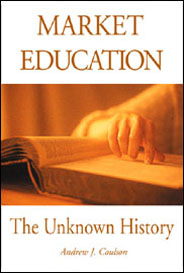
This looks like a useful site. And the book whose cover I here reproduce (the left of the two below) looks like a useful book. Useful, that is to say, if you wish to acquaint yourself at greater length with the opinions and prejudices of people like me.
Review:
Market Education is the culmination of five years of full-time research on a single question: What sort of school systems best fulfill the public's educational goals - at both the individual and the societal level? It is perhaps the most comprehensive investigation of school governance ever undertaken, comparing educational systems from all over the world and from ancient times to the present. To find out more about this book, click here.
Indeed.
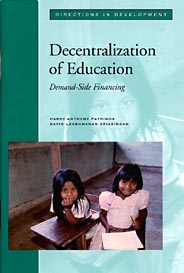
And the review of this little publication (the one on the right) is also interesting:
Despite its brevity (running to just 50 pages), Decentralization of Education is an important book. It describes the World Bank's foray into "demand-side financing," the practice of providing families with financial assistance so that they can purchase educational services in the private sector (rather than having governments own and operate schools). The various case studies discussed reach from the Dominican Republic to Pakistan, revealing just how widespread the practice has become, and how effectively it is reaching even the poorest families.The book's chief weakness is that it does not seize the opportunity to apply the lessons of its case studies to its review of the academic literature on school choice. The first section of the book is a digest of the (mostly theoretical) arguments that have been made for and against school choice. Since a large portion of this literature is badly reasoned and devoid of supporting evidence, it is frustrating that the authors did not apply what the World Bank is learning about demand-side financing to a critical assessment of the arguments pro and con.
It is also somewhat unfortunate that the book takes for granted a major funding role for the state in education, …
Double indeed.
And look, here's a a brand new blog (well it must have been once), by the editor of the School Choices site. It isn't only education stuff. But he does seem often to focus on the intersection between education and the main news agenda, as here:
Quote:
The Coalition Provisional Authority has officially handed control over Iraq's schools to the country's own Ministry of Education [free registration required]. No word when, if ever, control will be returned to families.Saddam, like virtually every totalitarian dictator in history, nationalized or shut down all private schools upon seizing power. The reason why is obvious: it's a lot easier to whip up support for your own regime and antipathy toward your enemies if you control the schools. Centralized government control over schooling is thus key.
What to do?
Iraq's internal religious divisions provide ample prospect for conflict if the nation sticks with an official government school system. Iraqis already realize that settling on a universally acceptable curriculum is a key sticking point.The solution: implement a market-based education system with need-based financial assistance, and let families pursue the kind of education they value for their children without obliging them to force their choices on their fellow citizens.
Question. Does copying and pasting other people's stuff instead of thinking of it all for myself mean I'm cheating? Why no. This is just one more way to learn.
And now, here come the Indians:
Indian students will be the third largest overseas students in the United Kingdom by 2020, outnumbering those from USA, Germany and France, a study indicated on Wednesday.As many as 29,800 Indians are expected to study in the UK by 2020 as against 8,600 in 2005, the study by the British Council and Universities said.
China, however, will have the largest number of overseas students in the UK – 130,900 – in 2020 as against 32,000 in 2005, the study said. It will be followed by Greece which will have 34,800 in 2020 as against 28,000 in 2005.
Britain could earn £13 billion a year from international students in higher education by 2020 in addition to the £3 billion they currently contributed to the economy, the study stated.
A separate government-funded study calculated that education has become one of Britain's most important export industries.
The report by Geraint Johnes, Professor of Economics at Lancaster University, said the economy earned £11 billion annually from 'exports' of tuition for foreign students, training, examinations, publishing and educational programming.
That places education in the same league as exports of oil and financial services, which earned Britain £14.3 billion and £13.6 billion in 2002, according to figures from the Office for National Statistics.
It is also slightly ahead of the British car industry, food beverages and tobacco, which earned £10 billion in exports. Education also dwarfs exports of ships and aircraft, at £6.5 billion, while computer services earned the country only £2.6 billion.
Britain at present has a quarter of the market in foreign students, with 270,000 enrolled in its universities and contributing an average of £16,000 a year each in fees and living expenses to the economy.
The British Council study, entitled 'Vision 2020: Forecasting International Student Mobility', concluded that the total could rise to 511,000 by 2020 if Britain maintained its present track record for recruitment.
However, student numbers would rise to 400,000 by 2010 and 870,000 in 2020 if both the country and its universities were promoted more aggressively in fast-growing new markets.
Demand was rising quickest in Asia, with annual growth in student numbers forecast at 15 per cent in China, 13 per cent in India, and 12.6 per cent in Pakistan.
Chinese students alone would outnumber those from the whole of the enlarged European Union of 25 states by 2020.
Some 145,000 students could be studying in Britain by then, compared with 43,000 now, making China by far the biggest and most lucrative single market for British education.
India would become the third-largest market with 30,000 students, as many as France and Germany combined. Asia would overtake Europe as Britain's main source of foreign students, accounting for more than half of student places.
Fascinating. I kept trying to find a place to stop copying, but kept wanting the next paragraph, and the next, and the next.
I speculated yesterday (see the immediately previous posting) about what impact all those Chinese students will make, upon China and upon the world. What the above report makes me ask now is: what effect will all this have on Britain, and on British education?
I'm interested that education is only "slightly" ahead of the car industry here. I thought the car industry here to be very tiny, but apparently not. I guess it's merely that our car industry isn't owned by us any more. There's still plenty of it.
The Chinese continue to develop their connections with the educational Anglosphere. Says People's Daily:
The Chinese Ministry of Education has signed an agreement with the IDP Education Australia to collaborate on a number of programs.The programs include holding university preparatory courses in China approved by 38 Australian universities, and establishing joint courses between the two countries. The plan will help Chinese college students transfer to Australian universities for further study.
Meanwhile, both sides are cooperating to develop training courses and projects for Chinese government employees and company managers.
I know, I know, it's all very clumsy and government-to-government. And the link to Australia is somewhat comical. But I think this stuff is interesting. What the enormous numbers of Chinese students now studying abroad or being educated in China by foreigners get up to in their lives is going to be one of the world's great stories, however it plays out, of the next fifty years.
Yes, an interesting posting over at Samizdata about a row in Japan about the compulsory respects that must now be paid to some (very controversial) symbols of Japanese nationhood, in Japan's schools. So far, over 200 teachers have rebelled.
Scott quotes at length from this article.
I think that giving prizes to great teachers is a great idea.
Who was the best maths teacher in Britain, last year? Who was the best science teacher in Britain, last year? Is there any award ceremony which tries to find out? I seem to recall some kind of televised (in Britain) event at which teachers were given prizes and celebs took it in turns to recall their favourite teachers, but alas I missed it for some reason. Can anyone fill us (me) in on that?
We'll know when this process has worked. The great teachers will be celebs.
Oddly enough it was this prize, which has had an amazing effect (on space flight), which got me googling for teaching prizes.
A recent Glenn Reynolds TCS article about this X-Prize, and about prizes generally, ends thus:
NASA wonders too, and is establishing its own prize system called Centennial Challenges. At the moment the program is new and relatively small, but I hope that we'll see other government agencies – and private philanthropists – consider the prize approach. It's not a panacea, of course, but it's a way of bringing many minds to bear on a problem, and trying out many different approaches in parallel. I suspect that many of the 21st Century's problems will benefit from this sort of approach, and I hope that the X-Prize example will break new ground, not only in terms of spaceflight, but in terms of all sorts of other problems.
Why shouldn't that sort of thinking apply to teaching?
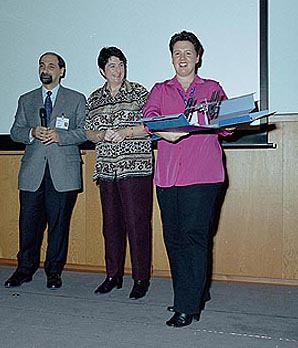 This picture here is captioned as follows:
20 November 2001
Mrs Susan Burr from the Kyle Academy in Scotland wins the 'Most Inspiring TEACH SPACE 2001 Award'.
Well done TeachSPACE. I picked this picture simply because it looked nice, and illustrated the principle, of turning little known good teachers into slightly better known good teachers. It was pure coincidence that once again the space exploration angle asserted itself.
If you want a window into the world of yoga - and more to the point here: yoga teaching – this posting, full of links, over at Alan Little's Weblog could be just the thing for you.
Interesting bit right at the bottom:
Coming soon: further thoughts on how yoga teachers are trained and certified, and why I would sooner trust a system based on the gut feel of a nearly 90 year old guy in India, than any kind of formal examination and certification scheme.
As so often in education nowadays, India leads the world.
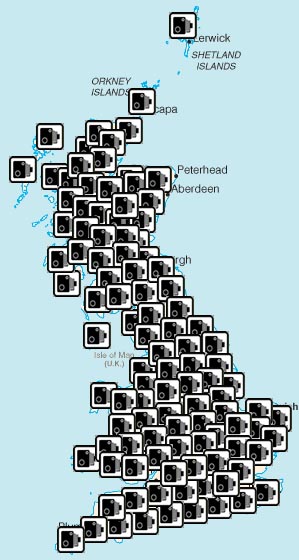 I can stick up pictures here (and here), but do not have such privileges at White Rose. Probably just as well. So this picture – with its obvious civil liberties vibes – goes here, and then I go there and link back to it. It's from b3ta.com, but stuff there tends to disappear rapidly (or such is my fear), so I need to nail it down somewhere else.
The reason this is educational is that I am now feeling the need to learn more about how to do things like attach bubbles of text to people in pictures, to attach captions to pictures, and generally to manipulate graphics as the graphics here have been manipulated, all of which takes a bit of sussing out. I know that once I have learned such things, I will realise that they are all ridiculously easy. Everything to do with computers is ridiculously easy. The difficult bit is finding out which ridiculously easy things you need to learn.
So despite the ridiculous ease of it, and as with so many learning processes, I feel that for things like this I now need some personal face-to-face guidance not to say tuition. Relax, I'm not going to ask you people. I already know who to ring and who to ask.
I think the general pattern here is approximately as follows.
First, you acquire the desire to do something. And then – and this is the important bit – you start doing it. Not load – aim. Load – fire. You learn the abject minimum you need to get going. You then either get fed up and forget about it, or you master your abject minimum and start thinking: You know, I'd actually quite like to really know how to do this. Load – fire – take aim. Fire a few times. Then you see the point of aiming, and you decide you need to learn about it.
Take digital photography. Until digital cameras came along, I couldn't be doing with photography. I had a camera, but it was too much bother and I gave up. The fit with my life wasn't there, enough. Too much bother, too little pay-off. But now I have a digital camera and the fit is very good, what with blogging. So I got started, and learned the bare minimum to get regular results. But now, I am starting to think: Maybe I should really find out about this photography stuff. Maybe I should take a course, or something. And maybe I will at that. The point is, I now have a pile of questions which I know I would like to answer, about how lenses work, how to control light, and what the hell all the settings on my camera mean. Having done lots of firing, I am now in the right frame of mind – slightly informed, respectful of the experts because aware of some of the problems they can solve but which I can't – to start taking serious aim at this thing, and at the things I am photoing. At present, as I never tire of telling my readers and lookersat my Culture Blog, I just click away and pick the best ones. I pick from what I happen to have got. My aim would be to learn how to get what I want, which is a very different matter. In my opinion this is the key conceptual distinction between an amateur photographer and a pro.
But with graphic design I don't yet feel the need for any systematic or prolonged study, yet. What I need is the bare minimum to start getting results. For that, a little personal guidance is in order – a little teaching. But a great big course would be superfluous.
The following article, by Joanna Pitman, under the headline "Lessons in hope", which I am taking the liberty of reproducing in its entirety, appeared in the (paper only I think – I couldn't find anything linkable to other than this Citizen's Foundation website) Times Magazine of yesterday, Saturday 17th of April. I hope no copyright toes are being trodden on, but it so impressed me that I am taking that chance.
I have done a posting at Samizdata about this article.
Samreen is a ten-year-old Pakistani girl who lives in Machar Colony, one of the biggest and most desperately poor of the 553 slum communities that are multiplying and choking the port city of Karachi to death. Her living conditions are medieval. On reclaimed harbour land, just a mile and a half from the impossibly remote, high-rise financial centre of the city, she shares a small, dark, dirt-floored room, no more than a box, with her mother and four brothers and sisters, hidden away down a narrow, stinking alleyway swarming with people and vermin. All around, as far as the eye can absorb, is a sea of filth, shimmering beneath a hot brown fog. In open sewers, rats,
playful as baby rabbits, mingle with malnourished children struggling to get through the day, labouring for miniscule wages, listlessly scrounging for food scraps and minding the babies, often their own. Generation follows generation quickly here, men and women as easily replaceable as the hovels in which they live. It is a special kind of human waste that comes with this sort of established destitution. And for the hundreds of thousands marooned in Machar Colony and other slums like it, cruelty no longer has a meaning. It is life itself.
Samreen's father has abandoned the family and disappeared, but she works alongside her mother and siblings, earning one penny for an hour's work peeling tiny, slimy shrimps. Every day they share some tea for breakfast. At lunchtime they have a piece of roti bread, made from flour and water, and in the evenings they usually manage to put together a meal of sorts - more roti and a few lentils, perhaps some vegetables if they've earned enough during the day.
Samreen is one of the lucky ones. On weekday mornings, after she's done her first two hours peeling shrimps, she puts on her school uniform and walks proudly to school. Built and run by the Pakistani educational charity. The Citizens Foundation (TCF), her school is an astonishing oasis in the middle of this desert of utter degradation. Entering the school gates she crosses a neatly swept playground planted with ornamental trees, and goes into the purpose-built primary school building equipped with six light and spacious classrooms, a library, an art room, a computer room, clean washrooms and staff quarters. She shares her classroom with 19 other children, roughly equal numbers of boys and girls, each of whom has his or her own desk and chair, exercise books and pencils. On the walls are colourful tissue paper pictures of rabbits, horses and cows made by Samreen and her classmates, the letters of the alphabet and a range of educational posters about volcanoes, dinosaurs and the solar system. Oxford University Press textbooks are piled neatly on the shelves and a string of numbers, cut out and coloured by the children, is pegged to a washing line strung jauntily across the sparkling window. The classroom would not look out of place in one of London's top private primary schools.
At school, Samreen has learnt not only Urdu and English, but also how to use a loo, wash her hands properly, brush her teeth and plait her hair. She can read and write, recite her times tables, work out complex percentages and compose poems that make her teachers laugh. She studies science and uses the school's computers every week. Each term she has three sets of assessment tests, and her mother - who had never seen a school before - attends three parents' evenings to discuss the results. Samreen's grades are excellent.
Samreen is, understandably, thrilled with her school. She adores her teachers, all of whom are women specially trained by TCF, and she enjoys all her subjects, particularly English. One day, she says, her eyes bright with excitement, she wants to become a teacher. To her mother, this is a concept as ungraspable as owning her own home. but instinctively she is proud of Samreen, and endures the beatings she gets from her brother-in-law who is opposed to the idea of education for girls. Although they miss the income Samreen would bring in during the mornings when she's at school, her mother is happy that her daughter is being given a chance in life. "When she grows up," she says shyly from behind her veil, "she won't have to do shrimp-peeling like me. Something better will come along and I can feel I've done my best for her."

Samreen's is just one of thousands of such heartbreaking stories that pour out of the hellish slums housing the dispossessed of Pakistan. Her school, Machar Primary School 1, was among the first of the 180 schools that have been built by TCF since 1995 in 17 cities around Pakistan, each one of them a small drop of hope in the middle of these parched and blighted communities.
Continue reading "The Citizen's Foundation schools of Pakistan"