
My thanks to Chris Cooper (he's the one holding the knife), who emailed me about this article.
A new brain-imaging study indicates that a specially designed program for second and third graders deficient in reading boosts their reading skills while prodding their brains to respond to written material in the same way that the brains of good readers do. The same investigation found that the remedial instruction typically offered to poor readers in the nation's schools doesn't improve their skills and fails to ignite activity in brain areas that have been linked to effective reading."Good teaching can change the brain in a way that has the potential to benefit struggling readers," says pediatrician Sally Shaywitz of Yale University School of Medicine.
At least one in five U.S. grade-schoolers with average or above-average intelligence encounters severe difficulties in learning to read, researchers estimate. In 2000, a panel of educators and scientists convened by Congress concluded that reading disability stems primarily from difficulties in recognizing the correspondence between speech sounds and letters.
And towards the end of the article the difference made and not made by different kinds of supposedly remedial teaching are spelled out:
At the end of the school year, only poor readers in the experimental program showed marked gains in reading accuracy, speed, and comprehension, the researchers report in the May 1 Biological Psychiatry. Good readers still exhibited the strongest literacy, but the poor readers who received phonetically based instruction had closed the gap considerably.After poor readers completed the experimental program, their brains displayed pronounced activity in several of the same left-brain areas that are active when good readers do reading-related tasks. In an earlier study of poor readers, Sally Shaywitz and Bennett Shaywitz found that one of those neural regions remains inactive as these kids grow up. Preliminary evidence from other researchers indicates that this structure, located near the back of the brain, fosters immediate recognition of familiar written words and is thus crucial for fluent reading, Sally Shaywitz says.
Students who had completed the experimental tutoring program still displayed improved reading scores and associated left-brain activation when measured 1 year later.
Bruce D. McCandliss, a neuroscientist at Weill Medical College of Cornell University in New York City, calls the new report a "landmark study." It builds upon similar findings by other research teams that tracked much smaller numbers of poor readers given phonological instruction, he notes.
Said Chris in his email: "More support for teaching reading by phonics?" It would certainly seem so.

Natalie Solent links to this story:
Zimbabwe renewed its offensive against "racist" private schools yesterday by arresting headmasters and members of governing bodies, who are accused of raising fees without permission.Teachers and others in the private sector went into hiding as the government warned a delegation of concerned parents: "We will do to you what we did to the white farmers, and we will take over your schools."
Says Natalie:
The dragon is eating its own tail: 90% of the children in these schools are black, and include the children of members of the cabinet, including Mugabe himself.
I wrote about the cricket manifestation of this process for Samizdata yesterday.
Not good.
I have no time for anything much today, but this has got to be today's most striking British education news story:
A history teacher was at the head of a network of football hooligans jailed today after conducting a violent pre-planned brawl along the platform of a busy railway station.Dave Walker, head of year at Turves Green boys' technology college in Birmingham, was jailed for two years and three months for his "vital role" in orchestrating fighting at Maze Hill, south east London, in April 2002.
Walker, 37, who called himself "Three Lions", posted messages on internet forums setting up the confrontation between 30 Charlton supporters and 15 Southampton fans before a match in London, Kingston crown court heard.
Like quite a few of the most dramatic criminals (expect a TV play about this guy any month now) he seems to have lead a double life.
In a statement, headteacher, Ken Nimmo, described Walker as an "outstanding teacher" with an "exemplary record" and said he was saddened by events.He said: "David Walker was an outstanding teacher who contributed a huge amount to the many successes of the boys here."
I bet he was especially good at explaining military history. (See below!)
Napoleon & Wellington by Andrew Roberts is what you might call a comparative double biography. What did the two have in common? How did they differ?
Here is the bit that deals with Wellington's schooling, at Eton. Note the mention of the Wall Game.
I found the picture of Wellington here.
Since Wellington's refusal to be overawed by Napoleon primarily stems from his invincible self-assurance, which in turn came largely from the nature of his schooling, it is worth while examining his psychology up to the time, in the summer of 1793, when he, in an action pregnant with symbolism, burned his violin and embarked on a serious professional military career.
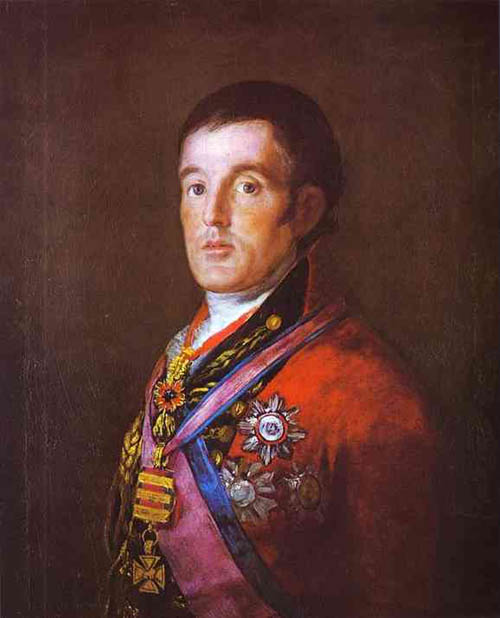
Wellington's remark about the battle of Waterloo having been won on the playing fields of Eton might well not have been a reference to the cricket pitches. An Eton historian, Lionel Cust, believes he was more probably alluding to 'the mills at Sixpenny Comer', which was where the boys went to fight one another. It was there, where the Wall Game is now played, that Wellington had a fight with Robert Percy 'Bobus' Smith, although sources differ on the outcome.' In the three years that he was at Eton before being withdrawn, probably but not certainly for financial reasons, Wellington entirely failed to distinguish himself in any capacity. 'A good-humoured, insignificant youth' was all a contemporary, the 3rd Lord Holland (admittedly later a political opponent), could remember about him there. Although it might be too hard to call him 'the fool of the family', as the Eton beak George Lyttelton did in one of his letters to the author Rupert Hart-Davis, he was intellectually far behind his eldest brother Richard, who had so shone at the school that he chose to be buried there.
A glance at the Eton College register for the three years that Wellington was a pupil there, from 1781 to 1784, shows how many of his contemporaries were drawn from the aristocracy. Although Winchester and Westminster had rivalled her socially in the past, by the late eighteenth century Eton was pulling away to become, as she unquestionably was by the early nineteenth century, the grandest school in the country. Wellington was educated with the offspring of three dukes, a marquess, thirteen earls, five viscounts, seven barons and a countess whose title was so ancient that it also went through the female line.
His Etonian contemporaries were a colourful lot, and provided a number of his senior officers later on. Robert Meade, son of the ist Earl Clanwilliam, was a lieutenant-general by 1814, as was William Lumley, son of the 4th Earl of Scarborough. Hugh Craven, son of the 6th Lord Craven, was a colonel in 1814, a major-general in 1825, and shot himself in his house in Connaught Place in 1856 owing to his losses on the racecourse at Epsom. At least his exit was intentional; Lord Barrymore, son of the 6th Earl of Barrymore, died in an accidental explosion of his musket while conveying French prisoners from Folkestone to Dover in 1795. George Evans, son of the 3rd Baron Carbery, died at Reddish's Hotel in London from a burst blood vessel on New Year's Eve 1804, and George de Grey, son of the 2nd Baron Walsingham, was burned to death in bed at his home in Upper Hariey Street. Robert King, son of the 6th Baron Kingston, was tried at Cork assizes in 1798 for the murder of Henry Fitzgerald, who had eloped with his sister. It was a pretty dear-cut case but, astonishingly even for eighteenth-century justice, he was unanimously acquitted by the House of Lords.
One of Wellington's school contemporaries. Henry Fitzroy, son of Lord Southampton, married Anne, Wellington's sister, but he was less fortunate in two others. Lord Holland, son of the 2nd Baron Holland, and Charles Grey, son of Earl Grey, became leading Whigs and political opponents of his. Holland was later a bitter personal critic, describing Wellington in his memoirs as 'destitute of taste, wit, grace or imagination', and a man whose vanity even 'exceeds his ambition' and who little care[s] what troops he leads or what cause be serves, so that he, richly caparisoned in the front, be the chief pageant of the show and reap the benefit of the victory and the grace of the triumph'. (The Whig hostess Lady Holland, an heiress of forceful personality, great beauty and ten thousand pounds a year, had heard Robespierre speak to the National Assembly during her five-year Grand Tour and had been most impressed.) The exaggerated loathing of the Whigs for the man who threatened and finally defeated their idol Napoleon was to be a constant feature throughout Wellington's career. They emerge from this story not as witty, brilliant, big-hearted Olympians of politico-social mythology, but as quotidian, nit-picking, mean-minded quasi-traitors.
Napoleon went to Brienne Military Academy speaking a Corsican patois and returned speaking French, but there is no suggestion that Wellington had even a smattering of an Irish brogue before attending Eton. Indeed throughout his life Wellington felt himself to be markedly superior to the Irish, once saying, albeit perhaps apocryphally, that they required 'only one thing to make them the world's best soldiers. White officers.' He is also believed to have quipped that his own Irish birth no more made him an Irishman than being born in a barn made one a horse.
Eton gave Wellington a belief in himself and his capabilities that his ten subsequent years of doing very little indeed entirely failed to dent. There are suggestions that he was taken away from school not because the Wellesleys were too poor after the death of his father the ist Earl of Mornington in 1781, but because his academic prospects were so unpromising. This is somewhat discounted by the fact that Lady Mornington took him to Brussels, where the cost of living was noticeably lower, and where Wellington was taught by a local lawyer.
Further evidence that British universities are at least semi-trading in semi-markets:

It's an advert in the tube, meaning (for non-Londoners) the London Underground railway. A bit blurry I'm afraid. Taken on the move. But you can just about make out that it's London South Bank University, and that this is their website.
More news, this time from timesonline (David Carr – thanks for the email), about British educational institutions doing business in Asia:
ELITE British schools are setting up in China to feed a growing appetite for public school education as expectations grow that a ban on foreigners and Chinese studying together will be lifted.Making the running is Dulwich College International School in Shanghai, which will be the first of four schools that the 400-year-old institution is setting up in China.
The South London school, which already has an international school at Phuket in Thailand, is not alone in looking eastwards for future growth. Harrow and Shrewsbury have schools in Bangkok.
At Dulwich in Shanghai, students will wear a formal uniform of shirt, tie and jacket, with grey slacks, raising the prospect of blazers and school ties on Shanghai’s promenade, the Bund, for the first time since the Second World War.
More Dulwich stuff, from me, here, here.
Commenting today on this posting here, Satya, who writes this blog says:
It is indeed interesting to follow the way trade in education is evolving. Some time back, I had looked at India's education imports and the possibility of India exporting education by leveraging the (Indian Institutes of Technology) IIT brand - India's strongest educational brand. See my posts here and here.But there is another interesting exports opportunity quietly growing in education - developing countries are exporting teachers to the developed countries. Indian teachers have been going to the US, the UK and many other countries to teach.
This kind of thing has undoubtedly emerged as one of the Big Stories while I've been writing this blog.
We all know why it is happening. Cheap international phone calls and even cheaper email make it far easier to arrange and maintain the quality of international relationships and faraway ventures and events than it ever was. It would have been crazy if the world – truly now the world – of education had not been deeply affected by this global trend. And especially so when you consider that a lot of educational material of great value can now be transmitted and distributed instantaneously, over thousands of miles and on a bewilderingly huge scale, simply by someone no more computer-literate than I am pressing a few buttons on keyboard.
My deepest thanks to Satya for the comment, with all its useful links. His education blog supplies a mass of detailed information about educational developments in India, and as I keep saying here, educational developments in India are also one of the Big Stories in the education world now.
More international business for Britain's universities:
A record number of university applications this year includes a threefold increase in students from some of the former communist countries joining the European Union on Saturday.Official figures from UCAS, the universities and colleges admissions service, published today, show a surge of interest from the 10 accession countries.
But now here's the tricky bit, for the universities:
These young people will be treated as home students, paying £1,150 a year in fees instead of the overseas charges of £8,000 to £19,000.
Ah.
Nevertheless, an interesting development. Do you get the feeling that it is perhaps going to get rather harder to get into a British university from now on?
And, perchance, more expensive. After all, it sounds like the only way they are going to be able to charge more to all these Eastern Europeans is going to be to charge more to the locals also.
As Dave Barry's judi says, do as I say, not as I do:
ORLANDO, Fla. – A federal drug agent shot himself in the leg during a gun safety presentation to children and his bosses are investigating.The Drug Enforcement Administration agent, whose name was not released, was giving a gun safety presentation to about 50 adults and students organized by the Orlando Minority Youth Golf Association, witnesses and police said.
He drew his .40-caliber duty weapon and removed the magazine, according to the police report. Then he pulled back the slide and asked someone in the audience to look inside the gun and confirm it wasn't loaded, the report said.
Witnesses said the gun was pointed at the floor and when he released the slide, one shot fired into the top of his left thigh.
That'll teach 'em.