
I like the idea of daily postings, and I even like them at the weekend. There is something satisfying about an uninterrupted posting record. But what to put today?
Well, this morning I encountered yet another policy initiative here, but this one is different. It is from the Conservatives, and it just might do some good, if only by making the people who ought to be suffering to suffer.
But I thought about it a bit and decided that the political implications were at least as interesting as the educational implications, so I said what I had to say about this at Samizdata rather than here.
But then I wanted to say here that I'd said all this there, as is my wont here, and that ought to involve me saying in more detail why I liked the sound of this policy. Basically what it is is education vouchers, dressed up as something else. Funding follows parental choice. Popular schools get more money and expand. Unpopular schools get less and wither away. That kind of thing. Good idea, I think. For why: see all my previous posts here since this blog began.
Luckily a commenter called Tim Worstall has commented in more detail, and says the kind of thing I had in mind better than I could. Quote:
You leave out some other implications of the policy: vouchers will quite obviously not pass through the LEA's : at one bound the system will be free of a bureaucracy that swallows 30% of all input. This has the interesting side effect of making state education equally funded with private at £5,000 or so a year per pupil (at the level of the school), without higher central government spending. And even more: removing education spending from local council budgets (where it currently rests along with the LEA's ) goes a long way to making local taxation more reasonable and responsive to local spending.There will of course be an outcry from the LEA staff as the implications sink in, that they're all going to be out of a job soon, and yet there is even a solution to that inherent in the cunning plan. The number of LEA employees with teaching credentials is within a fag paper of those teaching posts unfilled by a shortage of trained graduates.
So, real choice in schooling, abolition of a bureaucracy, solve the teacher shortage, end the "resources" crisis in state education and go at least halfway to getting a handle on council tax.
Maybe my old flatmate will actually get re-elected, into Govt this time, and I can look forward to some falconeration? Maybe just the odd quango post to start with? Usual rules, all meetings held standing up, pay of those attending publicly calculated minute by minute, any decision costing more by that meter to take than is at stake immediately made by the Chairman and, most important, a sunset clause.
For the benefit of Zanzibarian (and such like) readers of this, "LEA" stands for "Local Education Authorities". But what does that bit about his old flatmate mean? Maybe he will explain in a further Samizdata comment.
Anyway, as the American blog-commenters say: what he said.
I did some googling, and I rather think that Tim Worstall must be this guy.

Wilbur Wright was born in 1867, and younger brother Orville in 1871. The Wright brothers were the first people in the world to build and fly an airplane. They first did this on December 17th 1903, when they got their contraption to fly, under the control (and it was control – he wasn't just perched on board) of Orville, watched closely from the ground by Wilbur. On flight number four, they got their airplane to stay airborne for almost a minute and to cover a distance of getting on for a thousand feet.
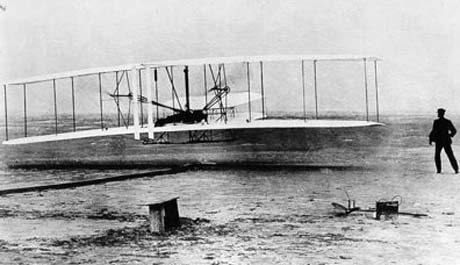
But how did they get their start as aviation's ultimate pioneers?
The Wright Brothers by Fred C. Kelly was first published in Britain in 1944, and presumably before that in the USA, although I don't know when. My edition is a Panther paperbeck published in 1958. The quotes that follow are the first few paragraphs of this book.
From earliest years both Wilbur and Orville Wright were motivated by what Thorstein Veblen called the instinct of workmanship. Their father, the Reverend Milton Wright, used to encourage them in this and never chided them for spending on their hobbies what little money they might have. But he did urge them to try to earn enough to meet the costs of whatever projects they were carrying on. "All the money anyone needs," he used to say, "is just enough to prevent one from being a burden on others."
The economic theme is an interesting one. I believe that this is now under-emphasised. This posting is about the Wright brothers and their education, not about my opinions, but modern education strikes me as not only educationally quite easy to criticise but also an economic absurdity. I can quite understand that looking after the elderly and the very young is sometimes necessarily expensive, but it ought not to cost as much as it does to look after the young and the vigorous. And teaching them to fend for themselves economically should be all part of teaching them generally, as it was for the Wright brothers.
Anyway, on with the mechanical stuff:
Both brothers were fascinated by mechanics almost from the time they were conscious of interest in anything. The childhood events most vivid in the recollections of Orville Wright have had to do with mechanical devices of one kind or another. One of the high spots was the day he attained the age of five, because he received for a birthday gift a gyroscopic top that would maintain its balance and spin while resting on the edge of a knife-blade.Shortly after that fifth birthday, and partly because of his inborn enthusiasm over mechanics, Orville began an association with another boy that had an important influence on his life. His mother started him to kindergarten. The school was within a short walking distance of the Wright home and Orville set out after breakfast each morning with just enough time to reach the classroom if he didn’t loiter. His mother bade him return home promptly after he was dismissed and he always arrived punctually at the time expected. When asked how he was getting along, he cheerfully said all was going well, but did not go into details. At the end of a month his mother went to visit the kindergarten to learn just how Orvie was doing. "I hope the child has been behaving himself," said the mother to the teacher.
The teacher stared at her in astonishment. "Why," said she, "you know, since the first few days I haven’t seen him. I supposed you had decided to keep him at home."
It turned out that Orville had almost immediately lost interest in kindergarten and instead had regularly gone to a house two doors from his own, on Hawthorne Street, to join a playmate, Edwin Henry Sines. With an eye on the clock to adjust himself to kindergarten hours, he had stayed there and played with young Sines until about a minute before he was due at home.
Orville’s father and mother were not too severe when this little irregularity was discovered, because the boys had not been engaged in any mischief. On the contrary, their play had been of a sort that might properly be called "constructive." The thing that had occupied them most was an old sewing machine belonging to Sines' mother. They "oiled" it by dropping water from a feather into the oil-holes!
Both Orville and Wilbur followed their father's advice and earned whatever money they spent. One source of income was from wiping dishes in the evening, for which their mother paid a flat rate of one cent. Sometimes she employed them to make minor household repairs. Orville seemed to find more outlets for money than did Wilbur, who was more saving, and from time to time borrowed from Wilbur – but he kept his credit good by sticking to an arrangement they always made that the next money earned should be applied to the debt.
One of Orville's early money-making ventures was the collecting of old bones in near-by alleys, vacant lots, or neighbors' yards, and selling them to a fertilizer factory. He and another boy first did this as a means for raising funds with which to buy candy for use while fishing. They accumulated a weight of bones that seemed to them must represent a small fortune – and were somewhat shocked when the buyer paid them only three cents.
At first, Orville's associates in his projects were boys of his own age rather than Wilbur, who was more than four years older and moved in a different group; but a day came when the brothers began to share curiosity over a mechanical phenomenon. In June, 1878, when Orville was seven years old and Wilbur eleven, the Wright family left Dayton, because the work of the father, who had been made a Bishop of the United Brethren church, was shifted to Cedar Rapids, Iowa. And it was in a house on Adams Street, in Cedar Rapids, not long after their arrival there, that an event occurred which was to have much influence on the lives of Wilbur and Orville – as well as to have its effect on the whole human race.
Bishop Wright had returned from a short trip on church business bringing with him a little present for his two younger sons.
"Look here, boys," he said to Wilbur and Orville, holding out his hands with something hidden between them. Then he tossed the gift toward them. But instead of falling at once to the floor or into their hands, as they expected, it went to the ceiling where it fluttered briefly before it fell. It was a flying-machine, a helicopter, the invention of a Frenchman. Alphonse Pénaud. Made of cork, bamboo, and thin paper, the device weighed so little that twisted rubber bands provided all the power needed to send it aloft for a few seconds. As the brothers were to learn later, Pénaud, an invalid during most of his short life, had not only invented, as early as 1871, various kinds of toy flying-machines – both the helicopter type and others that flew horizontally – but was the originator of the use of rubber bands for motive power. Simple as was this helicopter – they called it the "bat" – Wilbur and Orville felt great admiration for its ingenuity. Though it soon went the way of all fragile toys, the impression it left on their minds never faded.
Not long afterward Wilbur tried to build an improvement on that toy helicopter. If so small a device could fly, why not make a bigger one that could fly longer and higher? Orville was still too young to contribute much to the actual building of larger models, but he was keenly interested as Wilbur made several, each larger than the one preceding. To the brothers' astonishment, they discovered that the bigger the machine the less it would fly; and if it was much bigger than the original toy, it wouldn't fly at all. They did not yet understand that a machine of only twice the linear dimensions of another would require eight times the power.
Orville, meanwhile, had distinguished himself in another way, by organizing an army. …
But that's another story.
What fascinates me is how very "progressive" this all is. There is the skipping of the kindergarten, but the parents not minding. There is the economic stuff, which, translated into progressive-speak, would now be called "involvement in the local community". And there is the direct connection between play and subsequent achievement, with the very age of aviation itself first coming to the attention of the brothers in the form of a toy, powered by a rubber band. (I used to play with airplanes just like that myself, although they were not helicopters.)
In general, if you want technological innovators, the lesson seems to be (at not just from the story of the Wright brothers): let them mess about with technology. Let them have experience of technology, "hands on" experience. Book learning, if you want inventors, is necessary in a rudimentary form, but it is absolutely not sufficient.
Ms Dynamite is to launch her own school of urban music.
She wants to find budding young street talent and give them a chance to get behind the mic in a studio.
She'll take some of the classes herself, passing on songwriting and performing skills that have helped her win a Mercury Music Prize and a number of Brit Awards.
So Solid Crew and Big Brovaz will also give lessons. Ms Dynamite's school of cool will be named Diddymite and source youngsters from seven years of age to 19.
No venue has yet been found, but the school will be based in Lambeth, South London.
The Sun says she has put an amount of her own money into the project, while also receiving local authority and youth initiative grants.
The academy will run classes during weekends and holidays, and Diddymite gurus will also visit schools.
The school will be run by Marisha Skyers, a cousin of Ms Dynamite's boyfriend, Dwayne Seaforth.

Interesting. My guess would be that the key person here is this Marisha Skyers. If she is good at this, then it might just work.
A common attitude to this kind of thing is that the world needs more "qualified" and "trained" pop musicians like it needs a thousand more holes it its head. But I reckon that children who get excited about something – anything, that is mind expanding and works better if you work at it and which requires being organised and determined and cooperative, are much more likely to make a success of their lives than children who sit in classrooms being bored by more "useful" or "relevant" kinds of life preparation.
Besides which, my understanding of music these days is that the most important instruments involved are electrical and IT based, rather than things made of metal and wood that you scrape or blow down or pluck at. And learning about electrical kit has got to be good, educationally.
I've categorised this posting as "The private sector", and I hope that's right. Anything which spreads educational power away from the State Education Monolith run from London is good news, I think.
I wish them and all who learn with them every success.
Main reservation: "Diddymite" sounds like something you spread on toast and eat, with Ked Dodd doing the advertising. Not cool at all, in other words. But that's me showing my age.
Or aphorisms as they used to be called, culled from the Oxford Book of Aphorisms. A rather scary one to start with:
Education does not consist merely in adorning the memory and enlightening the understanding. Its main business should be to direct the will.
- Joubert, Pensées, 1842
Hm. I say: inform it, and inspire it, yes, but … direct it?
This is better:
Books we want to have young people read should not be recommended to them but praised in their presence. Afterwards they will find them themselves.
- Lichtenberg, Aphorisms, 1764-99
Actually I don't see the harm in a recommendation, so long as you don't slide into directing the will, and keep going on about it. Make your recommendation, but then give it a rest.
The self-educated are marked by stubborn peculiarities.
- Isaac d'Israeli, The Literary Character, 1795
And I like this:
Those who are slow to know suppose that slowness is the essence of knowledge.
- Nietzsche, The Gay Science, 1882-7
This I like, too:
You can't expect a boy to be vicious till he's been to a good school.
- Saki, 'The Baker's Dozen', Reginald in Russia, 1910
Here is one that makes a lot of sense of universities these days:
The University brings out all abilities, including stupidity.
- Checkhov, Notebooks, 1892-1904
This is very true:
To teach is to learn twice.
- Joubert, Pensées, 1842 (again)
And this, finally, nicely summarises the case against the discovery method of learning:
Experience is a good teacher, but she sends in terrific bills.
- Minna Antrim, Naked Truth and Veiled Allusions, 1902
Got to rush. Out to dinner. Probably too much yesterday, not much at all today, but that's blogging for you.
A friend of mine is trying to decide whether or not to take a post-graduate course offered by the London School of Journalism. Key question: will she be more likely to get a job in either print journalism or broadcasting after doing such a course than she would be right now, as a mere law graduate? Anyone able to comment?
Peter Drucker is undoubtedly the most famous ever writer about "management". Here is a description of his childhood from chapter 1, "A Singular Education", of The World According to Drucker by Jack Beatty.
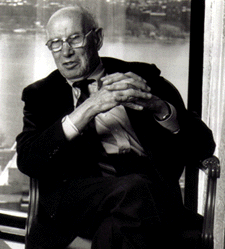
The war haunted Peter Drucker's childhood, though, as we will see, it also expedited his career as a writer. He and his friends taught themselves to read "by scanning the casualty lists and the obituaries with the big black borders, looking for names we knew, names of people we loved and missed." To them war was a permanent condition of the world. "None of us could imagine that the war would ever end," Drucker recalls. "Indeed every boy my age knew that 'When I grow up' meant 'When I get drafted and sent to the front.' "
A few years later, when Drucker was a senior in high school, his class was assigned to review the first crop of books to appear on the war. "When we then discussed these ... in class, one of my fellow students said, 'Every one of these books says that the Great War was a war of total military incompetence. Why was it?' Our teacher did not hesitate a second but shot right back, 'Because not enough generals were killed; they stayed way behind the lines and let others do the fighting and dying.'" In this the members of Drucker's generation shared something in common with the generals. They were spared. Drucker is conscious of his luck in being too young to be used as cannon fodder by those murderously incompetent generals. "Those of us who have been spared the horrors in which our age specializes," he wrote in Landmarks of Tomorrow (1959), "who have never suffered total war, slave-labor camp or police terror, not only owe thanks; we owe charity and compassion."
If the war brought fear, the peace brought hunger. The winter of 1919-1920 was grim. "Like practically every child in Vienna," Drucker writes in his sparkling autobiography, Adventures of a Bystander (1979), "I was saved by Herbert Hoover whose feeding organization provided school lunches. They left me with a lasting aversion to porridge and cocoa – but definitely saved my life and that of millions of children throughout ontinental Europe." An "organization" did all that good. One sees the biographical roots of Drucker's concept of organization as an instrument of human creativity.
This government does love a good shake-up, doesn't it?
This time they want a six-term school year, so students can do their exams a bit sooner and apply to universities a bit sooner, which will apparently help.
There has to be an easier way to arrange that.
This sounds quite well organised. Quote:
Topics will include state-of the-art CALL (computer-assisted language learning) technology, Communicative Language Teaching, vocabulary acquisition, grammar testing and oral skills assessment. In addition, there will be a session focusing on the highly anticipated new generation TOEFL that is expected to come out next year. "The workshop's dynamic approach is to present innovative and practical teaching methods and techniques, as well as assessment strategies, that Taiwan's teachers can readily adapt to their own classrooms," notes Smith. "At the same time, an active exchange of ideas between the presenters and the audience will be encouraged."
On the other hand – for as we all know "dynamic approach" could just mean doing bad things with other people's money, a lot - if the Taiwanese state sector is the sole customer and Mr Smith is an apparatchik working for the sole supplier, then may all of them be drowned by an enormous tidal wave.
The American International Education Foundation describes itself as a "non-profit foundation". Non-profit is obviously not good, but foundation at least suggests that there may be other foundations prowling around touting for the same business. I dare say plenty of people are actually profiting from all this.
Anyone know more about this? Is this a basically Chinese-American operation? Or is it bigger than that?
I'm in two minds about this report. Is this good teaching, or not? I'm inclined to think that maybe it is rather good teaching. What do you reckon?
A 17-year-old boy jumped out of a second-floor window at Miami Beach High last week after betting his teacher he was strong enough to do it and not get hurt.He won the bet, landing unharmed. No immediate word on whether he got any money out of it.
The teacher has been reassigned to a non-teaching job at a regional ACCESS Center while police and school officials investigate the incident.
The science class was in the middle of a lecture on evolution on Wednesday when the student -- whose name was not released -- began talking about jumping out the window to prove his point, according to the police report.
The teacher, Yrvan Tassy Jr., bet him $20 that he would hurt himself if he jumped, police said.
Yes, I suppose this is not really how teachers should conduct themselves. But I can't help thinking that (a) since the boy won his bet and was indeed undamaged, there was no harm done, but that if (b) he had been damaged, that would have been a valuable lesson for the lad which would have stood him in good stead in the future.
My thanks to the newly located Dave Barry for the link. And for this comment, from someone called Ivoirienne:
I fail to see why the teacher is being investigated for encouraging the scientific testing of his hypothesis. This is purely in line with the education principals of critical thinking and experimentation.Besides, I've had several students I would love to make this sort of bet with. I've simply been prevented from doing so by the fact that I teach in a windowless grey box.
Probably just as well. And a certain Sean explains it all thus:
Can't you just see how this really happened though?The teacher is doing the class teaching thing and the kid interrupts with some inane comment about jumping out the window. Teacher, being frustrated by the interruption, figures the kid is full of sh&t and says , 'whatever, an exploding $20 says you hurt yourself if you do it.
Kid jumps and teacher stands there dumbfounded watching his career go out the window.
Yes that's probably how it all happened.
I don't understand the relevance of the "exploding" bit, but the link will make a nice posting on White Rose, where RFID is a four letter word that is intensely disapproved of.
I wonder if this is a great as Eryl Crump of the Daily Post (whoever he/she is and whatever that is) thinks it is:
A NEW and unique Welsh qualification is exciting educationalists and business leaders, Education Minister Jane Davidson claimed yesterday.The Assembly's education supremo said the new Welsh Baccalaureate had been approved by university authorities and gained the support of the CBI.
She told the Daily Post: "The Welsh Bac is innovative. It's a new qualification developed by the Welsh Joint Education Committee and the Welsh Assembly Government. The Welsh Bac is distinctive, modern and proudly Welsh."
It feels like someone believes in it. On the other hand, Jane Davidson is a politician and it could all be hype and nonsense.
Read on, and the central idea simply seems to be that children need to be eased into productive work and prepared for prodiuctive work, rather than just taught nothing about productive work for a decade and then chucked into the dole queues, where they have to work it all out for themselves. Reading between the lines, as you generally have to do with newspaper education stories, it would appear that the children pick up marks for things like getting to work on time and being polite instead of neanderthal, having had a wash beforehand, and for being able to cooperate.
That last point is interesting. The traditional school doesn't really teach cooperation. It teachers individual intellectual skill. It trains individual minds.
But, on the other hand, maybe what employers want is precisely that: trained minds. They can teach all that stuff about punctuality, politeness, washing, etc., but only if it's worth it – if the person they are teaching the basic boring stuff to is worth bothering with. After all, if someone is smart, and can read, write and add up, it isn't hard for him to realise the importance of such stuff. All he has to do is something he may not have been doing at his school, which is look at the world through the eyes of those around him, rather than just through his own eyes.
Even so, I found the report interesting. Is devolution starting to work, I wonder? Even if it only unleashes a little healthy competition with English education, it might do some real good.
The independent schools are getting grief from the "Office of Fair Trading". Perry de Havilland comments here.
This brings to mind that old chestnut of a complaint about government interference in markets. If you have lower prices than your competitors, you are "undercutting" them and indulging in unfair competition. If you charge more than your competitors, you are indulging in predatory pricing. If you charge the same as your competitors, you are indulging in collusion.
The complaint this time is that independent schools are colluding.
The Office of Fair Trading is nothing of the kind. Independent schools should stay independent, and should be allowed to charge whatever they like for their services. If they all get together and agree to the same price, that should be their right. If you think they are all overcharging, then set up a school and undercut them yourself. The only morally decent way to interfere in a market is to participate in it. Otherwise, butt out.
This article by libertarian Wendy McElroy, entitled The Separation of School and State, contains much wisdom and many links of interest.
Sample quote from near the end:
My purpose is not to dispute with parents who send their children to public schools. I believe the system is a brutal failure, but parents must decide for themselves. I advocate extending alternatives far beyond the typical private versus public school debate, and even beyond homeschooling.
In particular, McElroy links to this article by Michelle Malkin which I missed when it first came out. Here's how that starts:
New Jersey's child welfare system, like most state child welfare systems, is a corrupt and deadly mess. Children are lost in the shuffle, shipped to abusive foster homes, returned to rapists and child molesters, and left to die in closets while paperwork piles up. So whom does the government decide to punish for the bureaucracy's abysmal failure to protect these innocents?Homeschoolers.
And what does the government think will solve its ills?
More power and paperwork.
My kind of quote. The piece ends equally well:
A crackdown on innocent homeschooling families to cure the incompetence of government child welfare agencies is like a smoker lopping off his ear to treat metastatic lung cancer. It's a bloody wrong cure conceived by a fool who caused his own disease.
Amen.
This is fascinating:
For pupils of Southlands School in Kent, the term "French exchange" no longer means three nerve-wracking summer weeks with a family of strangers.Instead, the school has bought and renovated its own property in France and - unique among schools in Britain - uses it all the year round, not just during the holidays. All 1,200 pupils have the chance to use it for language lessons, outdoor activity trips and class projects. Southlands isn't a rarefied public school with a big budget, but a community comprehensive in New Romney.
"What we wanted was a little bit of France, in France," says the head teacher, Eamonn Cahill, who worked with the assistant head, Siobhan Stevens, to find the right property. "In fact," adds Stevens, "it took seven years and we saw an awful lot of not quite right places."
Then she heard of a possibility in the commune of Azincourt in the Pas de Calais, the place the English have always called Agincourt. This, as all schoolchildren should know, is the site where, on October 25, 1415, Henry V, leading his "Band of Brothers" of some 6,000 men weakened by illness and hunger, defeated a French army of 25,000.
The mayor, Bernard Boulet, suggested that a derelict former cafe on the edge of the village might be suitable for the Southlands project. "He was right," says Stevens. "It needed a lot of work, but it clearly had potential and was only an hour's drive from Calais."
It sounds like a really good operation. Like all good operations, it is succeeding (assuming that this Telegraph report of its success is to be believed) because the people who have to make it work are the ones deciding about it. Yes, there is lots of government money – British, French and EUropean – swilling about, but nobody in London, Paris or Brussels commanded Southlands School to do this. They are doing it themselves. Governments everywhere please note. And if it works out so well it becomes seriously famous, please refrain from commanding - or even "encouraging" - any other schools to do something similar. Let them decide for themselves.
Last Friday the late lamented (blogwise) Jackie D gave a talk chez moi, about fame and all that.
This is the sort of thing she was referring to:
Celebrities such as Jordan, Kylie and David Beckham are becoming more influential to young people than their parents, teachers and even school friends, a study suggested yesterday.Star-struck youngsters are treating their famous role models as "pseudo friends", the research found. However, when hero worship turned into obsession, young fans could be left feeling isolated and lacking in social skills, the psychologists concluded.
Academics from Leicester and Coventry universities studied how celebrities influence young people and their social networks. Previously parents, teachers and friends had always been the key influence on children. However, more recently young people were being exposed to other influences such as pop stars, actors and sporting heroes.
To me what is extraordinary about this "research" is that they have finally noticed. This kind of thing has been going on at least since the 1960s.
The difference, if there is one, is that so many children are, I fear, being prepared for life only by television, which is no preparation at all.
Happy Feb 29. I wanted to put something up here today, however slight.