
Michael Jennings emails with the link to this, and comments that outing her was a bit unfair. Indeed, unless she outed herself, which seems unlikely. Anyway, too late now, so …
Quote from the BBC story:
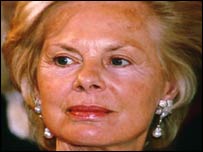
Pupils at a Hull primary school have just learned that "Mrs Kent" the music teacher is in fact the Duchess of Kent.The Duchess has secretly been giving music lessons at Wansbeck Primary School, Longhill, east Hull, for the past eight years.
After a visit in 1996, she offered to help boost the school's arts teaching.
Head teacher Ann Davies said: "Her enthusiasm with the children brings out the best in them and thanks to Mrs Kent music is now a strength at the school. …"
Interesting, and impressive. I hope that the BBC reporting of this doesn't somehow derange it and make it impossible to continue with.
It sounds as if Aussie Prime Minister John Howard favours a free market in education, and is doing something about it. The pips - the Philips anyway - are starting to squeak:
PROPHECIES of doom for public education are becoming self-fulfilling. One of our nation’s greatest achievements, a universal education system open to one and all, irrespective of class or religious belief, is being demolished by ideologues intent on destroying anything prefixed "public": public health, public broadcasting, the traditions of the public service and, of course, any vestiges of public ownership.The young John Howard was educated in the public system. It must have played some part in his brilliant career yet, as prime minister, he lashes out at public schools, slandering them as places of subversion and moral squalor. Little wonder that parents, confused and concerned, remove their kids from the system and send them to independent schools. Just as I started to write this column, I got a phone call from a senior educator with the latest figures. The market share for public high schools? Down to 52 per cent.
In the past 12 months, I’ve travelled all over Australia talking to school principals – hundreds of them, heads of primary, secondary and private schools. And let the record show that even the heads of major independent schools are deeply concerned by the trends. They know that if the public school system is effectively trashed by a combination of "impropaganda" and a turning of financial screws, Australia’s entire education system is imperilled. And that what looks like "choice" will become chaos.
Any Australians with opinions about that?
Here are two stories involving Muslims being urged to embrace "modern" education. Here's an Indian BJP man urging Muslims to get educated (and join the BJP):
Seeking to diospel the general perception that BJP was "anti-minority", Joshi said "the mere fact that the Muslims are less in number than the Hindus in the country does not make them a minority. The community can contribute as much as anybody in economic development if they take up modern education in a big way."
Funny. I thought that is what a minority is. Perhaps Mr Joshi could use a little more education himself.
And here's a Pakistani politician pushing women's education:
"Sindh government is anxiously working for promotion of cause of education, raise the academic standard and universalisation of education in the province." He was talking to a delegation of edducational experts, teachers, intellectuals and journalists of Sindh who met him at Chief Minister House here Wednesday.
Presumably "universalisation" means educating females as well.
Politics is only politics. But these kinds of pronouncements are bound to have consequences, if not immediately among educators and bureaucrats, then in the minds of the next generation of Muslims and women.
No time for prolonged thought about it, but this is interesting:
Academics at Birmingham University have condemned moves by the university authorities to ban 300 of their personal websites.The university's decision to stop hosting staff websites on university computers follows a series of controversies over links to allegedly anti-semitic content.
As at many other universities, staff have been able to set up sites on a university server on any subject they like. Under new guidelines, from March 31 they will have to demonstrate that content is "relevant and legitimate to their academic or administrative work".
Instant, off top of head reaction: the University is quite within its rights. Here’s how the story ends:
A spokeswoman for the university said: "It is important that our website accurately reflects the business of the university. Personal websites that are relevant and legitimate to academic or administrative work are being re-registered through a process of peer review."She added that staff were free to create websites using external internet service providers.
That seems to me the key line. A "ban" sounds more like they aren't free to do this. But, as always, I'd be interested to read any comments.
Further thought: although the University may be entitled to do this, maybe it is not wise. Universities ought to be havens of free speech etc. (Not that they ever are.)
Today I received this very pleasing email, of the sort that makes doing this feel very worthwhile:
Hello Brian,I came across your education blog yesterday and spent a good few hours trawling through it. Your posts are thought provoking, intelligent and highly relevant to anybody interested in education issues and libertarian principles. I have a 3 year old daughter, and my wife and I will be (and we are now) home educating her. I am glad to see that your posts and your contributors comments retain a balanced level of intelligent debate and do not resort to personal abuse and poorly reasoned waffle, seen on other forums. I look forward to reading your blog (and commenting) in future!
Simon Bone - Reading, UK
Many thanks, Simon. I especially like the bit about trawling through the archives. I don't suppose much of that goes on.
I agree about the nature of the comments here, and look forward to reading any which you may honour us with. Longer reports of progress with your daughter would also be welcome, unless of course you prefer to keep that private. Maybe generalised advice based on the experience, rather than particular dramas – that kind of thing.
Whether that appeals or not, the best of luck with your daughter and her education.
I did ask Simon Bone's permission (I now address everybody) before reproducing this particular email, since it included a reference to a child. But be warned that I regard all incoming emails in connection with this blog as fair publishing game, unless it is stated otherwise.
Especially ones as nice as Simon's.
I enjoyed reading this article very much (linked to by the wonderful this.
This man is the living embodiment of Peter's Parry.
A Peter's Parry is something practised by people who have a very nice job which they do very well, but who wish to avoid being promoted to a nasty job which they will do badly. The Peter's Parry, in other words, is the answer to the problem faced by so many of us, of the Peter Principle, which states that we all rise to our level of incompetence and then stay there for ever until we retire or die.
A Peter's Parry consists of doing something inessential very badly. I recall Professor Peter himself mentioning the case of a man who was highly competent at what he did, but who would, every so often, park his car in the space reserved for the Managing Director.
David Lester understands this sort of thing perfectly, as he vividly explains:
I went to the first graduation ceremony at the college in 1973, but I have never attended one since. I have not attended a faculty meeting since 1972. I found that I liked my colleagues much better if I did not listen to their silly comments in such meetings. I rarely go to division meetings (I belong to the college's division of social and behavioral sciences), but I do try to make most meetings of the psychology program.I used to lunch with colleagues, but I found that their continual complaints about the administration and the students soured my attitude toward the college. I switched to lunching with students for a while (faculty members and students share the same cafeteria at my college), and some became good friends of my wife's and mine. (Our annual Super Bowl party rotates between our house and that of one of my students and her husband.)
These days, I eat in my office and check the sports news online. For many years, I had my name removed from the faculty e-mail list so that I had no awareness of what activities were taking place at the college – I missed the president's Christmas party on several occasions because of that – nor what issues were making the faculty and staff members angry. Now I have had myself placed back on the e-mail list, but I direct all collegewide messages to a folder that I rarely peruse.
I do not pick up the telephone in my office, and my voice-mail message informs callers that I do not check for telephone messages. Callers are told to e-mail me.
None of this makes the man unsackable, but it does make him unpromotable. He has thus been free to get on with his life at a lesser college greatly to his liking, of scholarship, travel, matrimony, and above all, to judge by what he says about his students, teaching – and free of the distraction of being made to run any aspects of his college that do not interest him.
The teaching profession contains many such, I think.
A good example is perhaps the history teacher in Lindsay Anderson's movie if ..., who rides into his classroom on a bicycle. No danger of anyone wanting to make him a headmaster.
I remember an old gent who taught at Marlborough when I was there, of whom the following is a typical report, of a snatch of conversation. Boy: "I've been doing gym sir." Old Gent: "How nice for Jim." Not very witty. Not "inappropriate" enough (as we now say) to get him the sack. But, definitely inappropriate enough (when added to all the other similar reports) to rule him out for further promotion, which in his case would have meant the tedious burdens of being made a House Master.
I went looking (i.e. googling) for "Blaise Pascal" and "Phonetics", in order to sort out the connundrum here (see comments), but without success so far. I have as yet found nothing except a string of links to writings about information technology which mentioned phonetic alphabets in connection with the rise of printing, and then later the fact that Pascal invented a primitive adding machine.
But I did chance upon this (where there is apparently some kind of phonetics/Pascal nugget that I have yet to find), a compendium of quotations. From there to another compendium of quotations about education was an easy step. Of these, this, from Benjamin Franklin, on the economics of education, was new to me:
"If a man empties his purse into his head, no one can take it from him."
How true. That would go a long way to accounting for the way that the graphs measuring education mania and measuring crime have both gone upwards together. The latter trend would intensify the former, as a method of protecting wealth.
For "crime", don't just read the private sector version. Although some of the means of acquiring education can be taxed, in a very crude and approximate way, the final state itself, of actually being educated, is far harder to tax educational attainment than it is to tax physical wealth.
This process makes itself felt most strongly in the relationship between parents and children. Handing physical wealth on to children is hard, in most parts of the world. So, handing on education replaces the handing on of physical wealth as the means by which our selfish genes assert themselves in the modern (i.e. heavily taxed) world.
British state schools are now being graded according to how successful they are, and there are now a lot of stories flying around about children who are discouraged from attempting courses the exams at the end of which their teachers think they are liable to fail, even if those same teachers think that the course itself would be good for the child's education.
Teacher Francis Gilbert writes to this effect in today's Times T2 Magazine, now available to read at timesonline (but not for long if you are not British – if I understand things correctly).
Times have changed a great deal since I went to school in the early 1980s. Teachers are under pressure to get results, and results are usually put first in most institutions. I know this from bitter experience as an English teacher. When I started teaching in the early 1990s, league tables were unheard of and most teachers did not think much about their classes' results. This changed when the first league tables were published in 1992. I remember the day I learnt that I was teaching in a school which was officially the worst in England – only 3 per cent of students achieved five or more GCSEs at A-C grades.Most of the staff, as they sat amid exercise books in the dog-eared staffroom, hunched over chipped mugs of coffee, were unutterably glum. No one said much. Only one jokey teacher alleviated the gloom by pronouncing proudly: "We are like Millwall. We’re bottom of the league but we’re hard."
It was tough teaching in that school at that time because it felt as though all the staff's efforts to educate the underprivileged, difficult children who filled its classrooms counted for nothing and were not recognised. Even worse, we were pilloried in the press because of our low ranking. The way that society viewed schools like these made me revise my views about wanting to be a parent to troubled children, which was my initial reason for joining the school. I saw that I would get no thanks for this, and would become unhappy if I persisted with this altruistic attitude.
So I changed. Toughened up, one might say. I left the inner-city school and taught at a succession of schools where results were pretty good. Now I keep a vigilant eye on my results, because I have to. As a result, I find that sometimes my head is in conflict with my heart. I know that most students who want to study English at A level benefit from the experience, but I am also aware that some will find A level difficult and will fail to get a good grade. The idealistic teacher in me would like to sign such students on to the A-level course, but the hardened realist with a beady eye on his results exclaims: "No, no! They are bound to land up with a rotten grade. Don’t let them on the course."
This sort of conflict occurs a lot today. What is best for the student is not necessarily best for the institution that wants to be top of the league tables. The obsession with results makes teachers forget why they are teaching.
There are probably some at the DfET who think that if they improve the current measuring system enough it could end up perfect, yet the truth is that educational excellence, like economic excellence, will always elude the measuring systems of bureaucrats. Gilbert is adamant that some of his best teaching has been of the sort which would never show up in government statistics.
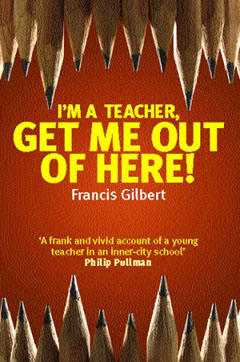 It is my understanding that this is not an actual excerpt from Gilbert's recently published book, I'm A Teacher, Get Me Out Of Here.
This, on the other hand, is lifted straight from that book.
Coincidentally, just as I thought I had finished this posting, this email arrives:
Hello BrianI heard this and thought of you.
Teacher Francis Gilbert was on Radio2's Drive Time programme this evening (wednesday 11th March), promoting his book "I'm a Teacher Get Me Out of Here!"
Though he described himself as being of the left and wanting equality, he delivered a tirade against a crushing bureaucracy he likened to something out of 1984, and said that he was disillusioned by "what the left had done." Notably, as questioned why schools weren't free to devise their own curriculums, something utterly uncontroversial as far as I'm concerned but seemingly unthinkable in today's political climate.
Host Johnnie Walker even chipped in agreeably, pontificating that anything the government tried to run it messed up!
All this on primetime national radio. Cause for optimism?
Regrds, Kit Taylor
Thanks. Very interesting, and of course smack on the nail I also was banging away at.
Although I rather think that Kit has allowed the recent occurrence of February 29th to pollute his dating system. I know the feeling.
Also, although "regrds" is an acceptable abbreviation , I can't be so happy with "curriculums". "Curricula", I think. The way I see it, if emailers are not corrected, how can they learn?
Follow up email from Kit!
Actually, now I think on Francis Gilbert something even more interesting in the interview.It was along the lines of -
"I can go to the corner shop, and I can buy a good quality jam or a cheaper one. I have that option. But if I want my daughter [aged three] to learn french or classics, the choices aren't available."
If advanced by the Tories, I'd be unsurprised if such a notion were attacked as Thatcherite extremism. What's interesting is that Gilbert's comments were not apparently derived from ideological dogma, but the product of a "man in the street" intuitively questioning why a system that was working well in one aspect of his life wasn't being applied in another that wasn't.
Thanks again!!
This comment materialised just now, on this:
hello... i'm from Poland, and I am preparing myself to the math championship... This championship is in English. could someone please send me a www page, on which I could find same excericises? THaks! maciekkowalski@yahoo.co.uk
Any offers? We'll overlook that he can't spell "maths".
Where would I be without helpful emailers? (See also: immediately below.)
One of my many unpaid research assistants, Tim Haas, emails me with update news from the BBC about the recent threat to regulate Home Schooling.
Here is the original scare story that this all refers to.
Says Tim:
Of course the headline and subhead ignore the real story - that the welfare manager who called for more stringent regulation because of a case of home educator abuse was completely wrong - but the rest of it isn't so bad.
Indeed. Sample quote from the new BBC story:
A leading education welfare manager has apologised for stating wrongly that a child, who died from natural causes, had been subjected to abuse.Jenny Price, general secretary of the Association of Education Welfare Managers, said she regretted that the information, published in good faith, had been incorrect.
And, having had complaints from home educators, Mrs Price says it is clear some education authorities "do not fully understand the home education ethos".
You can almost hear the angry phone calls, can't you? Phrases involving "fingers" and "burnt" suggest themselves, or even other phrases involving "stick" and "hornet's nest".
I can't remember when I said it, but I definitely did say, here, some time or other ago (yes – I said it here), that the Home Education "commmunity" (which really is something of a community) is too dangerous a beast to be simply steamrollered by the state education machine. If Home Education was at all severely messed with, the politics of this would be horrendous for the messer, I think.
Here's what I put here on May 12 2003, apropos of whether Home Ed might ever spread to France. I apparently talked with someone about how …
… any government which took on the home-schoolers of Britain would have got itself the Political Enemies from Hell. Think of all those terrifyingly bright children who'd overrun morning television. Consider the fact that many home-schoolers have considerable demonstrating experience. I may not hold with their political views about war, peace, etc., but these people do know how to lay on a good demo and to mobilise the media. And they must be, almost by definition, among the most intellectually self-confident people around.
Of course I hope that isn't just wishful thinking, but I really do think that.
My warmest thanks to Alan Little for emailing me about a posting on the Alien Landscape Weblog called On the evils of easy grading.
It's about the economics of education. Education as currently organised is a gigantic waste of juvenile energy. Teenagers - I would say: by definition (this is what a "teenager" is) – sit around doing extraordinarily little, and the truly scandalous bit is that the cleverer they are, the truer this often is. Result, they behave like "teenagers".
Key paragraphs:
But, you say, we're talking about teenagers here. Teenagers lack judgement and maturity, and if you let them out without a keeper, who knows what they'll do?Teenagers behave that way today, of course. But that's not because that's all they're capable of. Remember the old Soviet saying "As long as they pretend to pay us, we'll pretend to work"? Teenagers, like their older counterparts, rarely put forth their best effort unless they have a reason. Since diligence and maturity don't shorten their sentences, and immaturity and laziness don't get them into real trouble or lower their standard of living, it's not surprising that they're not really trying. There's no biological reason that they're incapable of being productive, useful adult citizens, it's just that there's no payoff for them. If they've got marketable skills and their own place, property, and liberty that they can improve through hard work, common sense, and ingenuity or lose through laziness, impulsiveness, or viciousness, they'll be just as inclined as anyone else to straighten up and fly right. It's clear that they're not pushing themselves to their limits, so I don't see any reason to believe anyone's assertions about just what their limits are based on observations of today's teenagers.
I have the feeling that the claim that smart kids do less work may be false, in lots of cases if clearly not in all. Smart kids generally have smart parents, and smart parents often "clean up" those confused signals by attaching rewards to each item of educational progress, and punishments to educational torpor or general "teenager"-ness. (Remember the girl who got a Cadillac, just for doing well at school?)
Nevertheless, the point about the non-biological-ness of teenager-ness is surely right. I did a sociology degree, and I actually learned quite a lot from doing it. The main thing I learned is that what my sociology teachers called "society" or "social structure" - and what I, under the influence of libertarian writers and pamphleteers and economists was starting to think of more as an "incentive structure" (although not yet with those sort of exact words) - matters.
One moment in 1945, all Germans adult males are fighting you and must be treated with extreme suspicion. Then something big happens in the big wide world out there ("Germany" surrenders in the war) and immediately all German adult males start to behave entirely differently. All of them. Society. (And in this case "history".) Explanations of previous, hostile German behaviour based on the immutability of the German version of human nature simply must be wrong. They are certainly woefully insufficient. Biology, that is to say, is not a satisfactory explanation of what is happening, even if it does have some bearing.
So yes, teenagers must have the energy to be a nuisance and the psychological energy to defy what passes for authority in their lives. But whether they behave like "teenagers" or not is a function of the society they find themselves in. Hormone theories of teenager-ness are excuses used by people who are presiding over unsatisfactory social arrangements, blaming the victims of these arrangements instead of changing the arrangements. It's the same with the theory that slaves (i.e. black people) are inherently slavelike. Or, many home-edders and home-ed supporters like me would add, the theory that children are inherently childlike.
I realise that I have a problem with biological and sociological/economic theories. I believe strongly in both. (Does this make me rather rare, apart from the general public I mean?) Young humans do have a definite nature, which is different from puppy nature or kitten nature or junior crab nature. But how that nature asserts itself is radically different depending on the social/economic influences that impinge upon it. Nature and nurture.
I could elaborate, but that's more than enough profundity for one post.
FINAL final point: I have just been wrestling with how to categorise this posting. I picked three from my list that seemed particularly pertinent, but could have picked at least half a dozen more. This shows, I think, how much the Alien Landscape man and I are thinking along similar lines, not neccesarily answering all questions the same way, but wrestling with lots of the same questions. So thank you again Alan.
Category: Economics of education • Examinations and qualifications • Parents and children • Sovietisation
 [1]
[0]
[1]
[0]
Incoming email from Susan Godsland, who runs this. Did I see this? Not until you emailed me, Ms G. Thank you.
Quote from this Telegraph story:
Over seven decades of communism, education played an important part in preparing children for their place in society. Young people left school with a good grasp of the basics, drilled into them by traditional teaching methods. Since the Soviet flag was lowered over the Kremlin, Russia has taken part in international comparisons in which its secondary pupils have performed well above the international average for maths and science – and better than their peers in Britain.Vladimir Putin's government, however, is not happy with the system and is looking to countries such as Britain to provide models for teaching methods that they believe will improve young people's creativity and entrepreneurial instincts.
Presumably Susan fears that something like this is about to happen in Russia, this being an essay about how the phonetics-based teaching of reading and writing got replaced by new and inferior methods.
The English language contains approximately half a million words. Of these words, about 300 compose about three-quarters of the words we use regularly. In schools where the "whole language" is taught, children are constantly memorizing "sight" words during the first three or four grades of school, but are never taught how to unlock the meaning of the other 499,700 or more words. Reading failure usually shows up after the fourth grade, when the volume of words needed for reading more difficult material, in science, literature, history, or math cannot be memorized quickly enough. The damage to children who have not been taught phonics usually lies hidden until they leave the controlled vocabulary of the basal readers, for more difficult books where guessing, or memorizing new words just does not work. The result is that textbooks in the middle and upper grades are "dumbed" down to a fourth or fifth grade reading level.This is the real reason why the SAT scores have dropped to such low levels during the last three decades.
It is a little bit off at a tangent, but I include also this next bit, which I knew nothing about until now.
From the time the alphabet was invented until the time of French scientist and mathematician Blaise Pascal, reading was taught by memorizing the sounds of syllables, and then stringing them together to make words. But Pascal found that by separating the syllables into their letter parts, one could learn to read more effectively and efficiently. His method was intended only to assist in the very beginning stages of reading, when a child is learning the printed syllables of his own language.

Former teacher and researcher Geraldine Rodgers puts it this way: "It was only for this purpose that Pascal invented it [phonics], to make the previously almost unending memorization of regularly formed syllables ... unnecessary. But phonics works, and has since 1655. So it is not surprising that it was invented by one of the most towering mathematical and scientific geniuses in history, Blaise Pascal ..."
With luck those Russians will stick to Pascal's methods when it comes to teaching reading and writing, and only introduce that "creativity" stuff later on. But thoughts of babies and bathwater inevitably present themselves to the mind of the anxious Telegraph reader.
It's a different world over there:
When I was 13, I started to think about what kind of car I wanted when I started to drive. I saw an EXT in a music video and thought, "Hey, having a pickup truck is way cuter than having a car." I started babysitting every week to save money for one. Then I went on the Cadillac Web site and saw how much it cost, and I thought that's a lot of babysitting. …
And here is why this is all here:
… Finally, my parents told me if I got a 3.0 G.P.A. or higher on my report card, they'd buy me any car I wanted, within reason.
Education, education, education.

I started working on my dad. I kept telling him, "Have you seen the new Cadillac pickup trucks, Dad? They're really cool." After school I'd drag him down to the dealership in Fullerton to look at them. About three months ago, my dad bought a ranch in Park City, Utah, and I made him go to Jerry Seiner Cadillac, the dealership in Salt Lake City, to check out their EXT's. Dad kept asking me, "Do you really like this car?" I told him I loved it.
Once a parent makes a promise, I guess you have to bully him to make sure he keeps it. So did he?
My birthday was Jan. 3. I wanted to spend it with my friends in Orange County, but my dad urged me to come to Park City. He said he was throwing me a party and inviting my favorite snowboarder, J. P. Walker, so I agreed. The party was at a restaurant called Easy Street, which has a big picture window that looks out on the street. I was waiting at the table thinking, where is this guy? So my parents suggested I open my presents. The last one looked like a watch box, but when I opened it, there were car keys inside. I looked out the window and saw a brand new EXT parked in front of the restaurant. It was the color I wanted: "Out of the Blue." I couldn't believe it. I was like, "Oh my God, are you serious?" I ran outside in the falling snow, climbed into the truck and sat there for a bit. Then I called my friends back in California on my cell. The whole thing was like a car commercial.Driving my EXT makes me feel powerful, safe and very high. I feel as if everybody is looking at it, maybe because the color is so vibrant. You can make the cargo bed longer by folding down the rear seat, lowering a panel and removing the window. My dad said, "Now you can carry hay to the horses," and I was like, "I don't think so."
No. You said: "I don't think so." People are not like words; they say words. Are you learning anything at your school?
Some people may think my dad spoils me, but he knows how happy it makes me to drive. Cars are my thing. I'm never ungrateful for anything my parents give me. I feel totally blessed.
Indeed.
My dad drove my Escalade out to California last week. The first time I drove up to the school, about 25 girls came running out to look at it. "That is so cool," they cried. "We hate you!" It was like a dream come true. I felt like, "Wow, I'm a princess."
The joy of peer group hatred.
And the trouble parents in the USA go to, to make their children study for their exams.
Thanks to this blog for the link.